200
CONSIDERATION AND EXPERIMENTAL RESEARCHES REGARDING
THE INTENSIVE SEPARATOR FOR CLEANING OF CEREAL SEEDS
BRĂCĂCESCU C.1), GĂGEANU P.1), SORICĂ E.1)
, BUNDUCHI G.1), CULEŢU A.2)
1)
National Institute of Research-Development for Machines and Installations Designed to Agriculture and Food Industry, INMA Bucharest, Romania; 2)IBA Bucharest / Romania E-mail: [email protected]
Keywords: vibrating sieves, cleaning, electric motovibrator
ABSTRACT
The cleaning of cereal seeds represent an essential operation of the conditioning chain. Taking into account all considerations, the experts׳ attention has been drawn by the study of phenomena which influence upon the impurities separation process, aiming at a maximum reduction impurities. The paper presents the constructive-functional scheme of an
intensive cleaner separator SAI 800 driven by means of electrical motovibrators, design, manufactured and testing at INMA Bucharest. The results of the experimental researches are highlighted, after which the optimal operating parameters were established.
INTRODUCTION
The continous progress related to improving the primary processing methods as conditioning operations and technical and material base periodically determines the enhancement of requirements in terms of foreign bodies removal and other quality aspects such as those related to seeds uniformity, sanitary state, plots homogeneity (Miskelly D., 2010, Uthayakumaran S., 2010 ).Therefore, profoundly knowing the technology to be used, the operating method of technical equipment appropriate to relevant technology and technical-functional parameters adjusting represent an important preriquisite to obtain the maximum quality with reduced power and man labour consumption.
To reduce the number of technical equipment and implicitly of technological spaces, the modern cleaning technologies use complex installations carrying out the separation by combined principles, the most used following the
specific mass difference being the ones and aerodynamic properties of various components of seed mixtures (Costin I., 1999, Didyh V.F., 2002, Geankoplis Chr., 2003, Rus Fl., 2001). Elimination of the impurities being in the grain mass carries out by more technological procedures depending on their physico-mechanical characteristics.
201
MATERIAL AND METHOD
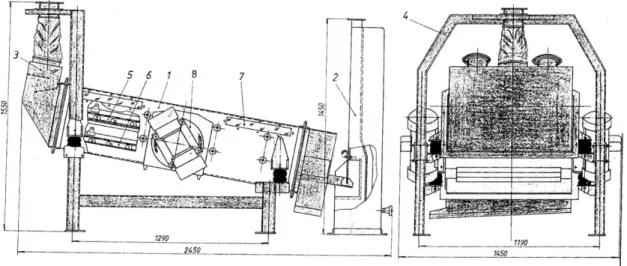
The Intensive Cleaner Separator SAI 800 (fig.2) is a technical equipment used at removing the impurities out of cereal matter combining the principle of separation based on size difference
(using surfaces put in vibrating movement) with the separation based on aerodynamical characteristics (by using a suction aspiration).
.
Figure 1. – Constructive Scheme of Intensive Cleaner Separator SAI 800
Cleaning processing capacity, 810 t/h
1 - sieve body; 2 -suction channel; 3 - flow box; 4 - frame; 5 - upper sieve stage; 6 - low sieve stage; 7 -sight glass; 8 – electric motovibrator.
The upper sieve and lower sieve (position 5, 6) are made of a metallic frame with several compartments each, having at their upper part perforated sheet for sifting, endowed with holes depending on the processed product and at lower part wire netting or perforated sheet, which support the shaking rods of sieving plate. The shaking balls used for sieves cleaning are made of rubber and can be found in sieve compartments. The damping system consists in elastic elements (rubber springs with double cavity) enabling the body’s support on the frame (pos. 4). The suction channel (pos. 2) is an independent sub-assembly placed in the area of evacuation of processed product and light impurities, being equipped with: a mobile wall,
allowing the adjustment of suction section by swinging and a hinged valve, which regulates the air flow by rotating movement.The electric motovibrators (pos.8) have monted on theirs axles two non-balanced eccentric masses m= m0/2, which are continously rotated, in opposite directions and which develop the centrifugal forces F(t)/2.
The location of driving system (the two electric motovibrators) is chosen in equation with the disturbance force trajectory that should cross the mass centre (c.g) of the whole system, eliminating this way the additional oscillations of the worked surface which could determine the disturbance, of normal harmonical movement law.
202
Figure 2. – Variation of centrifugal forces of unbalance masses depending on the angle of overlap of the non-balanced eccentric masses [1]
1, 2 - control plates; 3 - drive shaft of the non-balanced masses
Whithin the postresonating operating regime the rotation frequency of the two masses m0 is far smaller than the
own frequency of oscillating system.
The reduced (equivalent) mass m of vibrating system elements which perform the oscillating movement is calculated with the equation:
in in
s
k
m
m
m
. (1)where: ms is equivalent mass of vibrating
frame and other components connected to it; kîn = 0.1…0.25 – reducing factor of
loading mass for frame mass [6];
mîn – mass of loading material on the
vibrating frame (chute, sieve)
For the connecting elastic elements with viscous damping, the damping hypothesis through viscous friction are generally used, the external resistance force F (c, μ) being given by the Eq. 2 [6]:
.
) ,
(c cS c S
F . (2)
where: c is the elastic elements rigidity with viscous damping and μ – damping factor by internal friction (for rubber, μ = 0.001 s).
The amplitude A of oscillations of vibrating sieve body depends on the
rotation frequency ω of non-balanced masses, having the maximum value of Amax for a frequency p1 c/(mm0),
when the angle of phase difference φS =
π/2, namely:
) /(
0
max m r c
A (3)
The transport process and stages of matter particles displacement on vibrating surface is made by the micro-cast principle (Krampe H., 1990) and being presented in scheme of figure 3.
203
Figure 3. - Vibration transport by the micro-cast principle
The technological effectidex Ecs
represents the percentage of foreign bodies (impurities) eliminated from the
mass of processed product and is determined with the relation (Costin I.,1999):
Ecs
CcsiCcse/Ccsi
x100 (%) (4)where: Ccsi is content foreign bodies
(impurities) at the entrance in equipment, %; Ccse - content foreign
bodies (impurities) at evacuation of material, %
The methodology used in the experimental research was the one described in the test procedure of Testing Departament of INMA Bucharest, PGI-01.20 – Pre-cleaning and cleaning
installations for cereals and technical plants.
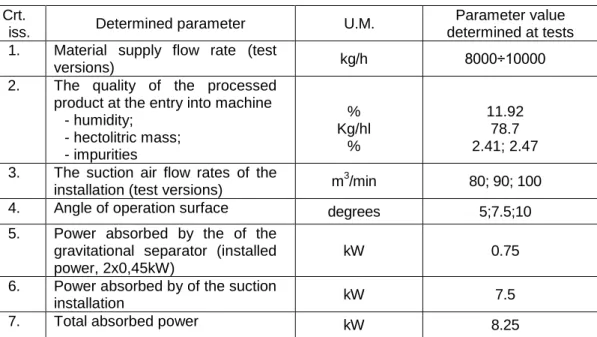
The material used at the experimental researches was the wheat (as seeds) obtained on experimental plots of INMA Bucharest. The values resulting from processing determined parameters are mentioned in Table 1.
RESULTS AND DISCUSSIONS
Table 1 Functional operating parameters of SAI 800
Crt.
iss. Determined parameter U.M.
Parameter value determined at tests 1. Material supply flow rate (test
versions) kg/h 8000÷10000
2. The quality of the processed product at the entry into machine - - humidity;
- - hectolitric mass; - - impurities
% Kg/hl
%
11.92 78.7 2.41; 2.47
3. The suction air flow rates of the
installation (test versions) m 3
/min 80; 90; 100
4. Angle of operation surface degrees 5;7.5;10
5. Power absorbed by the of the gravitational separator (installed power, 2x0,45kW)
kW 0.75
6. Power absorbed by of the suction
installation kW 7.5
204
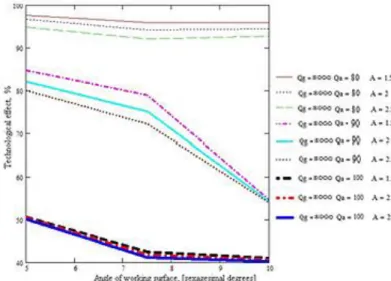
For an intuitive analysis of the influence of various constructive and functional parameters of the SAI 800 on
the global technological effect index values ECS were drawn graphics of which
we exemplify.
Figure 2. Variationof the valuesof technologicaleffectindex ECS depending on thesupplying flow ratewithmaterial(wheat) Qg atsuctioninstallationflow rate of Qa=100 m3/minand the
following adjustment parameters: inclination angle of theworking surface αk and working surface
amplitude Ak
Figure 3.Variationof the valuesof technologicaleffectindex ECS depending on the angle of the
working surface α at the supplying flow rate with material Qg=8000 kg/h, for the following
adjustment parameters: air flow rate Qa and working surfaceamplitude A
205
It finds the following aspects after analyse of the experimental results:
- By the increasing of the inclination angle of the operation surface, it diminishes the wheat quantity eliminated through impurities pipes. We have to mention that if it increases inclination angle more then 100, the
performance of separator becomes worst.
- The oscillations amplitude influences the operation regime, in such way that for values of 2 and 2.5 mm the separator performance increases.
CONCLUSIONS
The utilization of electric motovibrators as acting systems for Intensive Cleaner Separator SAI 800 has a series of advantages: simplifies the kinematic chain, allows modifying the amplitude of oscillating movement by adjusting the eccentric masses intensifies the separating process with reduced specific consumption of energy and reduces the stress transmitted to the foundation. At the same time, by adjusting the electric motovibrators eccentric masses, the acting force of motovibrators is regulate, and the
direction of oscillations can be adjusted by rotating the electric motovibrator fixing support. The results obtained during the experimental researches reveal that the SAI 800 for grains cleaning comply with the requirements in terms of destination, of the purpose and functioning mode, of the possibilities for adjustment and servicing, having a working capacity suitable to deposits from agricultural farms, cereal seeds conditioning stations as well as technological flows from milling units.
BIBLIOGRAPHY
1. Brăcăcescu C., Sorică, C., Manea, D., Yao, Guanxin, Constantin, G.A., 2014 - Theoretical contributions to the drive of cereal cleaning technical equipment endowed with non-balanced vibration generating systems, INMATEH – Agricultural Engineering, Vol. 42;
2. Costin, I., 1999 - Miller’s Book, Technical Publishing House, Bucharest, Romania;
3. Didyh, V.F., 2002 - Improving the efficiency of drying agricultural plant materials, monograph, Lutsk;
4. Geankoplis, Chr., 2003 - Transport processes and separation process principles, Prentice Hall PTR,Fourth Edition;
5. Rus, Fl., 2001 - Separation operations in the food industry, Publishing Transylvania University of Braşov;
6. Krampe, H., 1990 - Transport,
Umschlag, Lagerung, VEB
Fachbuchverlag, Lepizig;
7. Miskelly, D., Batey, I.L., Suter, D.A.I., 2010 - Processing wheat to optimise product quality, Cereal Grains;
8. Uthayakumaran, S., Wrigley, C.W., 2010 - Wheat: characteristics and quality requirements, Cereal Grains;
![Figure 2. – Variation of centrifugal forces of unbalance masses depending on the angle of overlap of the non-balanced eccentric masses [1]](https://thumb-us.123doks.com/thumbv2/123dok_us/8067092.2136545/3.892.284.659.93.367/figure-variation-centrifugal-unbalance-depending-overlap-balanced-eccentric.webp)