Oviedo University Press
1
ISSN: 2254-43807(1), 1-8, 2018
Editorial Note
Francisco J. Delgado
*1• Eduardo Gonzalez*
2Editors-in-Chief
1 Department of Economics, University of Oviedo, Spain
2 Department of Business Administration, University of Oviedo, Spain
Since the last Editorial Note, published in the Volume 4, Issue 1, March 2015, several
outstanding facts have influenced the evolution of
Economics and Business Letters (EBL), a
journal launched in 2012. We review here the most important ones with regard to indexing,
journal statistics, citations, most cited articles, and acknowledgements, especially to the
referees.
1. Indexing
Economics and Business Letters (EBL)
has been evaluated and accepted in ESCI - Emerging
Sources Citation Index (Web of Science) from 2015 and also in Scopus from 2017. In addition,
EBL has been included in the Academic Journal Guide 2018 among the 336 journals selected
for the category "Economics, Econometrics and Statistics". Finally, EBL has been evaluated
and accepted in Econlit in 2017. Our next goal is to get included in the SSCI - Social Sciences
Citation Index (Web of Science).
2. Journal statistics
The activity report, summarized in Table 1, reflects the evolution of submissions between 2012
and 2017. In this period, we have handled a total of 339 manuscripts, with a rejection rate of
61.36 per cent (with increasing desk rejections to favor both the authors and the referees).
Table 1. Activity report 2012-2017
2012 2013 2014 2015 2016 2017
N. % N. % N. % N. % N. % N. %
Received 81 100 45 100 50 100 65 100 55 100 43 100
Accepted 25 30.86 21 46.67 30 60.00 20 30.77 24 43.64 11 25.58
Rejected 56 69.14 24 53.33 20 40.00 45 69.23 31 56.36 32 74.42
* E-mails: [email protected], [email protected].
7(1), 1-8, 2018 2
3. Citations
Due to the acceptance in Scopus, but without SJR indicator until next year, we have (self)
computed the citations received by Economics and Business Letters (EBL) in this database for
information purposes only. This information is updated as of April 2018. Note that accepted /
online first articles are not included here (nor self-citations), only those articles actually
published in an issue each year. Next, we provide an overview of the citations in journal articles
included in SCOPUS:
3-years
2017
Cites in 2017 to articles published in 2014-2016: 21
Number of articles published in 2014-2016: 67
Cites/articles 2017 (3years): 0.313
2016
Cites in 2016 to articles published in 2013-2015: 17
Number of articles published in 2013-2015: 69
Cites/articles 2016 (3years): 0.246
2015
Cites in 2015 to articles published in 2012-2014: 24
Number of articles published in 2012-2014: 72
Cites/articles 2015 (3years): 0.333
5-years
2017
Cites in 2017 to articles published in 2012-2016: 31
Number of articles published in 2012-2016: 110
Cites/articles 2017 (5years): 0.282
Finally, we note that Economics and Business Letters (EBL) has a Google Scholar profile. This
can be accessed via
https://scholar.google.com/citations?user=syBPq1AAAAAJ&hl=en
. As of
April 2018:
Citations: 338
h-index: 10
i10-index: 11
Most cited papers
7(1), 1-8, 2018 3
Table 2. Most cited articles (as of April 2018).
Paper Citations
A.Y. Javid, M. Javid and Z.A. Awan (2013) Electricity consumption and economic
growth: evidence from Pakistan, Economics and Business Letters, 2(1), 21-32.
9
Patuelli, R., M. Mussoni and G. Candela (2014) Cultural offer and distance in a spatial
interaction model for tourism, Economics and Business Letters, 3(2), 96-108.
6
Lansink, A.O. and A. Wall (2014) Frontier models for evaluating environmental
efficiency: an overview, Economics and Business Letters 3(1), 43-50.
6
Ntim, C.G. (2012) Does the South African stock market value independent dual board
leadership structure?, Economics and Business Letters, 1(1), 35-45.
6
Alvarez, A. and C. Arias (2014) Some important issues in applied stochastic frontier
analysis, Economics and Business Letters, 3(1), 3-11.
5
Grosskopf, S., Hayes, K., Taylor, L.L (2014) Applied efficiency analysis in education, Economics and Business Letters, 3(1), 19-26.
5
Aiello, F. and Bonanno, G. (2013) Profit and cost efficiency in the Italian banking
industry (2006-2011), Economics and Business Letters, 2(4), 190-205.
5
Filippini, M. and L. Orea (2014) Applications of the stochastic frontier approach in
Energy Economics, Economics and Business Letters, 3(1), 35-42.
4
Zhao, J. and P.J. Barry (2013) Implications of different income diversification indexes:
the case of rural China, Economics and Business Letters, 2(1), 13-20.
4
4. Acknowledgements
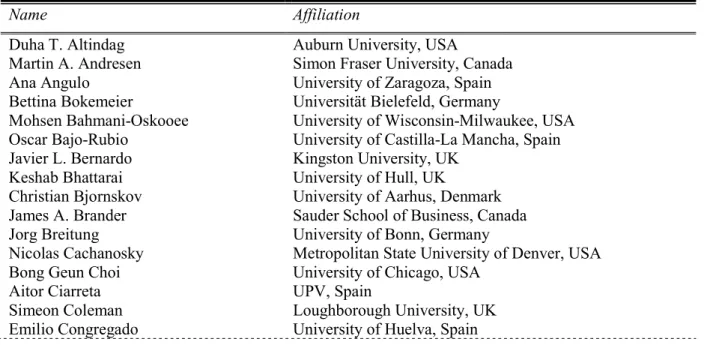
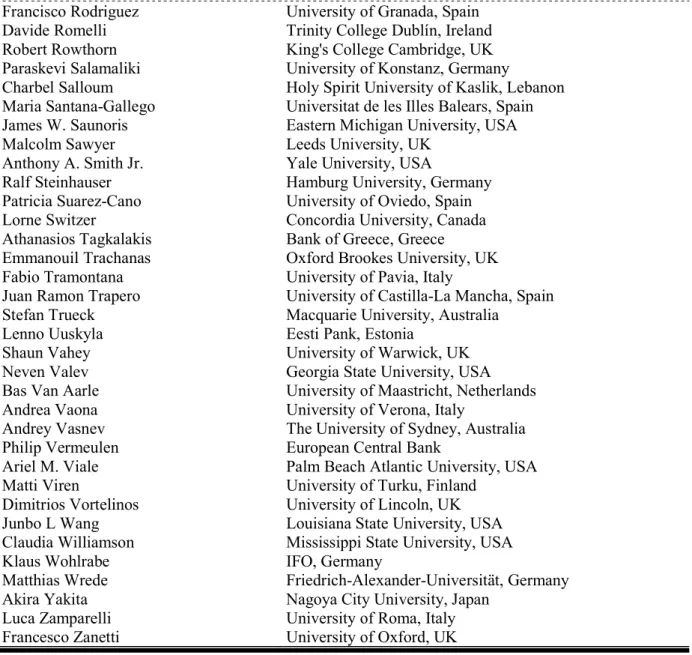
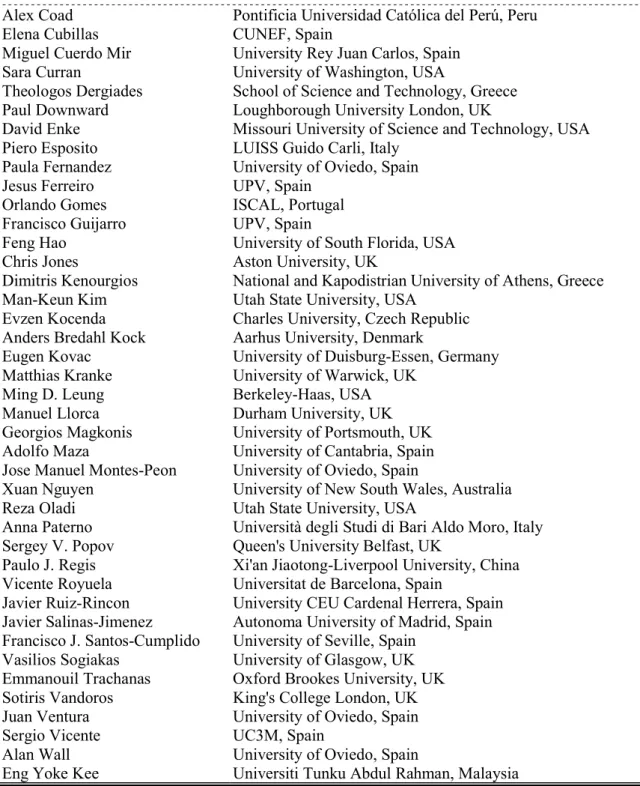
We greatly appreciate the effort of authors, referees (see Tables 3, 4, and 5 for the List of
Referees in 2015, 2016, and 2017 respectively), and Associate Editors for their valuable
contribution to the journal.
Table 3. List of referees in 2015.
Name Affiliation
Duha T. Altindag Auburn University, USA
Martin A. Andresen Simon Fraser University, Canada Ana Angulo University of Zaragoza, Spain Bettina Bokemeier Universität Bielefeld, Germany
Mohsen Bahmani-Oskooee University of Wisconsin-Milwaukee, USA Oscar Bajo-Rubio University of Castilla-La Mancha, Spain Javier L. Bernardo Kingston University, UK
Keshab Bhattarai University of Hull, UK
Christian Bjornskov University of Aarhus, Denmark James A. Brander Sauder School of Business, Canada Jorg Breitung University of Bonn, Germany
Nicolas Cachanosky Metropolitan State University of Denver, USA Bong Geun Choi University of Chicago, USA
Aitor Ciarreta UPV, Spain
7(1), 1-8, 2018 4
Bradford Cornell California Institute of Technology, USA David Cuberes Clark University, USA
John Paul Deane UCC, Ireland
Oscar Dejuan University of Castilla-La Mancha, Spain Claudio Detotto CNRS, France
Carmen Diaz Roldan University of Castilla-La Mancha, Spain Michael Donadelli Goethe University Frankfurt, Germany Sheldon (Xiaodong) Du University of Wisconsin, USA
Takeshi Ebina Tokyo University of Science, Japan Grigorios Emvalomatis University of Dundee, UK
Lucio Esposito Universty of East Anglia, UK Zied Ftiti EDC Paris, France
Luis A. Gil-Alana University of Navarra, Spain Paskalis Glabadanidis University of Adelaide, Australia Eduardo Gonzalez University of Oviedo, Spain
Yannig Goude EDF, France
Jang-Ting Guo University of California, USA
Ferda Halicioglu Istanbul Medeniyet University, Turkey Joshua C. Hall West Virginia University, USA Fausto Hernandez-Trillos CIDE, Mexico
Mark J. Holmes Waikato University, New Zealand
Tao Hong University of North Carolina at Charlotte,USA Florence Huart Université de Lille, France
Robert S. Hudson University of Hull, UK Peter N. Ireland Boston College, USA Keiichiro Kanemoto Kyushu University, Japan Natalia Kolesnikova University of Mississippi, USA Aviral Kumar Tiwari IBS/IFHE Hyderabad, India
Lukasz Lach AGH University of Science and Technology, Poland Michael Lamla University of Essex, UK
Vivien Lewis Catholic University Leuven, Belgium Simonetta Longhi University of Essex, UK
Sonia Longo Università degli Studi di Palermo, Italy Katarzyna Maciejowska Wroclaw University of Technology, Poland Serguei Maliar Stanford University, USA
Jaan Masso University of Tartu, Estonia Nicola Meccheri University of Pisa, Italy
Amilcar Menichini Naval Postgraduate School, USA
Valerie Mignon University of Paris Ouest - Nanterre La Défense, France Victor Montuenga University of Zaragoza, Spain
Salvatore Morelli CSEF, Italy
Yasutomo Murasawa Konan University, Japan
Rafael Myro University Complutense of Madrid, Spain Yasunori Okumura Tokyo University, Japan
Rupayan Pal Indira Gandhi Institute of Development Research, India Theodore Panagiotidis University of Macedonia, Greece
Theologos Pantelidis University of Piraeus , Greece Yaimara Peñate University of Oviedo, Spain
7(1), 1-8, 2018 5
Francisco Rodriguez University of Granada, Spain Davide Romelli Trinity College Dublín, Ireland Robert Rowthorn King's College Cambridge, UK Paraskevi Salamaliki University of Konstanz, Germany
Charbel Salloum Holy Spirit University of Kaslik, Lebanon Maria Santana-Gallego Universitat de les Illes Balears, Spain James W. Saunoris Eastern Michigan University, USA Malcolm Sawyer Leeds University, UK
Anthony A. Smith Jr. Yale University, USA
Ralf Steinhauser Hamburg University, Germany Patricia Suarez-Cano University of Oviedo, Spain Lorne Switzer Concordia University, Canada Athanasios Tagkalakis Bank of Greece, Greece
Emmanouil Trachanas Oxford Brookes University, UK Fabio Tramontana University of Pavia, Italy
Juan Ramon Trapero University of Castilla-La Mancha, Spain Stefan Trueck Macquarie University, Australia
Lenno Uuskyla Eesti Pank, Estonia
Shaun Vahey University of Warwick, UK Neven Valev Georgia State University, USA Bas Van Aarle University of Maastricht, Netherlands Andrea Vaona University of Verona, Italy
Andrey Vasnev The University of Sydney, Australia Philip Vermeulen European Central Bank
Ariel M. Viale Palm Beach Atlantic University, USA Matti Viren University of Turku, Finland
Dimitrios Vortelinos University of Lincoln, UK Junbo L Wang Louisiana State University, USA Claudia Williamson Mississippi State University, USA Klaus Wohlrabe IFO, Germany
Matthias Wrede Friedrich-Alexander-Universität, Germany Akira Yakita Nagoya City University, Japan
Luca Zamparelli University of Roma, Italy Francesco Zanetti University of Oxford, UK
Table 4. List of referees in 2016.
Name Affiliation
Paul Alagidede Wits University, South Africa Constantinos Alexiou Cranfield University, UK
Davide Antonioli University 'G d'Annunzio' of Chieti-Pescara, Italy Nicholas Apergis University of Piraeus, Greece
Muhammad Asali Tbilisi State University, Georgia Vidya Atal Montclair State University, USA Vasileios Babalos University of Piraeus, Greece Georgios Bampinas University of Macedonia, Greece Alessio E. Biondo Università degli Studi di Catania, Italy Luisa Blanco Pepperdine University, USA
Joern Block Universität Trier, Germany
Alex Bryson National Institute of Economic and Social Research, UK Nicolas Cachanosky Metropolitan State University of Denver, USA
7(1), 1-8, 2018 6
Alex Coad Pontificia Universidad Católica del Perú, Peru Elena Cubillas CUNEF, Spain
Miguel Cuerdo Mir University Rey Juan Carlos, Spain Sara Curran University of Washington, USA
Theologos Dergiades School of Science and Technology, Greece Paul Downward Loughborough University London, UK
David Enke Missouri University of Science and Technology, USA Piero Esposito LUISS Guido Carli, Italy
Paula Fernandez University of Oviedo, Spain Jesus Ferreiro UPV, Spain
Orlando Gomes ISCAL, Portugal Francisco Guijarro UPV, Spain
Feng Hao University of South Florida, USA Chris Jones Aston University, UK
Dimitris Kenourgios National and Kapodistrian University of Athens, Greece Man-Keun Kim Utah State University, USA
Evzen Kocenda Charles University, Czech Republic Anders Bredahl Kock Aarhus University, Denmark
Eugen Kovac University of Duisburg-Essen, Germany Matthias Kranke University of Warwick, UK
Ming D. Leung Berkeley-Haas, USA Manuel Llorca Durham University, UK Georgios Magkonis University of Portsmouth, UK Adolfo Maza University of Cantabria, Spain Jose Manuel Montes-Peon University of Oviedo, Spain
Xuan Nguyen University of New South Wales, Australia Reza Oladi Utah State University, USA
Anna Paterno Università degli Studi di Bari Aldo Moro, Italy Sergey V. Popov Queen's University Belfast, UK
Paulo J. Regis Xi'an Jiaotong-Liverpool University, China Vicente Royuela Universitat de Barcelona, Spain
Javier Ruiz-Rincon University CEU Cardenal Herrera, Spain Javier Salinas-Jimenez Autonoma University of Madrid, Spain Francisco J. Santos-Cumplido University of Seville, Spain
Vasilios Sogiakas University of Glasgow, UK Emmanouil Trachanas Oxford Brookes University, UK Sotiris Vandoros King's College London, UK Juan Ventura University of Oviedo, Spain Sergio Vicente UC3M, Spain
Alan Wall University of Oviedo, Spain
Eng Yoke Kee Universiti Tunku Abdul Rahman, Malaysia
Table 5. List of referees 2017.
Name Affiliation
Alexis Anagnostopoulos Stony Brook University, USA Mercedes Ayuso Universitat de Barcelona, Spain Scott Baker Northwestern University, USA Margarita Billon UAM, Spain
7(1), 1-8, 2018 7
Mardi Dungey University of Tasmania, Australia Gonzalo Fernandez de Cordoba University of Malaga, Spain Masood Gheasi VU Amsterdam, Netherlands Stephan Gohmann University of Louisville, USA Thomas L. Hogan Troy University, USA
Juan Luis Jimenez University of Las Palmas ULPGC, Spain Salih Katircioglu Eastern Mediterranean University, Cyprus Bernd Kempa University of Muenster, Germany
Jae H. Kim La Trobe University, Australia Ignacio Lago-Peñas Universitat Pompeu Fabra, Spain
Julie Le Gallo CESAER, INRA, AgroSup Dijon, France Nuno Carlos Leitao ESGT, Portugal
Claire Liang Southern Illinois University, USA Luke Lindsay University of Exeter, UK
Manuel Llorca Durham University, UK Hari Luitel Algoma University, Canada Janelle Mann University of Manitoba, Canada
Timo Mitze University of Southern Denmark, Denmark James Morley University of Sydney, Australia
Roberto Mura Manchester Business School, UK Thomas Niebel ZEW, Germany
Seemantani Pathak University of Missouri - St. Louis, USA Carmelo Petraglia Università degli Studi della Basilicata, Italy Tommaso Reggiani Masaryk University, Czech Republic Hans-Eggert Rimers Hochschule Wismar, Germany David Roibas University of Oviedo, Spain Agnese Sacchi Sapienza Università di Roma, Italy Sascha Sardadvar WPZ Research, Austria
Greg Shaffer University of Rochester, USA Andrea Silvestrini Bank of Italy, Italy
Mijkal Skuterud University of Waterloo, Canada
Alessandro Tampieri University of Florence and CREA, Italy Robert Tamura Clemson University, USA
Hinrich Voss Leeds University Business School, UK Joshua White Terry College of Business, USA A. Yasemin Yalta Hacettepe University, Turkey
5. Active Call for Papers
We encourage authors with high-quality research letters to consider
Economics and Business
Letters (EBL) as an outlet for their original work.
At this moment, two Special Issues are programmed:
Volume 7, Issue 4, December 2018: “Gambling Economics and Management”
o
Editor-in-Charge: Levi Perez (University of Oviedo)
o
Paper submission deadline: June 30, 2018
Volume 8, Issue 1, March 2019: “Quality of public finance”
o
Guest Editors: Antonio Afonso (ISEG) and Javier Perez (Bank of Spain)
7(1), 1-8, 2018 8