Journal of Global Pharma Technology
www.jgpt.co.in
:
Available Online at
RESEARCH ARTICLE
The Effect of Special Visual Exercises in the Development of
Visual Tracking and the Accuracy of Spike in the Volleyball for
Young Players
Bassem Hassan Ghazi1, Zaman Turki Hashim
2University of Kufa/ College of Physical Education and Sports Sciences/Iraq.
Abstract
The Aims of Research to
Preparation of visual exercises, especially in the development of visual tracking and the accuracy of the spike of the volleyball young players.
To identify the impact of exercise visual especially in the development of visual tracking and the accuracy of the spike of the volleyball of young players.
The Hypothesis was
Special visual exercises have a positive effect on the development of visual tracking and the accuracy of the volleyball spiking of young players.
As for the research method, the researchers chose the experimental approach as the appropriate method to solve the research problem by designing the experimental and control groups with the tribal and remote tests as it fits the nature of the research problem.
The sample of the research was chosen from the research community represented by the young players in the volleyball of the middle region (3 clubs) in Iraq at the age of 17-19 years and the number of (36) player has been selected two clubs, including the number of (20) player after the expulsion of the player prepared randomly by lot to represent the two groups Experimental and control of the sample of the search and the reality of (10) player for each group.
The Researchers Concluded
An evolution in visual tracking and accuracy of the volleyball team's spikein volleyball skill.
There is a preference for the experimental group in the tests of the dimension of visual tracking and the accuracy of spiking in the volleyball.
The various special exercises developed by the researchers contributed to the development of visual tracking and the accuracy of the spiking skill.
The recommendations were
The need to use special visual exercises to develop the visual tracking of players, especially young people.
The need to use special visual exercises to increase the accuracy of the skill of spiking.
The need to use special visual exercises to increase the excitement and excitement of young people and increase their motivation for training.
Keywords:Visual exercises, Accuracy, Spike and volleyball.
Introduction
Most sports and individual events and sports require special exercises to suit their skillful and planning requirements. The optical
individual games for the purposes of defense and attack in the matches is more difficult because dealing here with a tool and a colleague and competitor, In order for the player to succeed in the task assigned to him [1]. The volleyball game is one of the games which requires a variety of exercises to include many aspects, including sensory as the visual side because the ball in the case of flying constantly and need continuous follow-up during the rotation between the two teams always in defense skills or offensive and not the player in tracking the flight of the ball but needs to distribute the sight to include fellow players As well as the rival movement,here we focus on the skill of spike because it is the skill to be explored [2].
Through watching the researchers for most of the youth league games noted that most young players in the performance of the skill of spike overwhelming volleyball do not have sufficient amount of maneuver on the network and guide the balls to the empty places of the stadium or spaces and the weakest side in the wall of the researchers believe that the reason for this The focus is on the players in the opponent's team or against the wall and the gaps that are available to make the attack successful, so the researchers wanted to develop visual exercises aimed at giving the players a sufficient amount of visual follow-up to the moves of the players Rivals empty and potentialities in their court, in addition to follow-up the ball that has been prepared for him.
In which the player needs to monitor the stomach and fly the ball during the hiatus, and when jumping to look at the movement of the opponent, which kills the skill of the wall and the number of players involved in the possibility of the movement of players defenders to hit the ball at the end of the movement to the right place to get a point and the wider view of the player The chance of success was greater.
Here lies the importance of research by training young players on exercises to develop visual tracking and distribute the vision correctly [3].
The Aims of Research
Preparation of visual exercises, especially in the development of visual tracking and the accuracy of the spike of the volleyball young players.
To identify the impact of exercise visual especially in the development of visual tracking and the accuracy of the spike of the volleyball of young players.
Hypothesis
Special visual exercises have a positive effect on the development of visual tracking and the accuracy of the volleyball spiking of young players.
Material and Methods
Research MethodologyThe researchers should choose the appropriate method to solve the problem. The approach is "the method used by the researchers to determine the steps of research which can solve the problem of research."[4]The researchers chose the experimental approach in designing the experimental and control groups with the pre and posttests as the nature of the research problem.
Society and the Research Sample
As for the research method, the researchers chose the experimental approach as the appropriate method to solve the research problem by designing the experimental and control groups with the tribal and remote tests as it fits the nature of the research problem.
The sample of the research was chosen from the research community represented by the young players in the volleyball of the middle region (3 clubs) in Iraq at the age of (17-19) years and the number of (36) player was chosen two clubs randomly at the number of (20) players after the exclusion of the players prepared (4) to be Divided into two experimental and control groups by lot and with (10) players for each group.
Homogeneity and Equivalence of the Sample
Sample Homogeneity
length, mass), the researchers used the skewness coefficient before applying the main
experiment on the two research groups as shown in Table (1).
Table 1: Shows the homogeneity of the research sample
Variables Unit measurements Mean STD.EV. Mean Skewness
Age Year 18.2 1.536 18 0.407
Tall Cm. 183 3.972 182 0.346
Mass Kg. 70.5 1.715 70 0.687
Table (1) shows that the values of the torsion coefficient for the variables (age, height and mass) were limited to (±1) indicating the homogeneity of the research sample in these variables
Equivalence of the two Sets of Research in the Technical Tests
In order for the researchers to attribute the difference in the results of the remote tests to
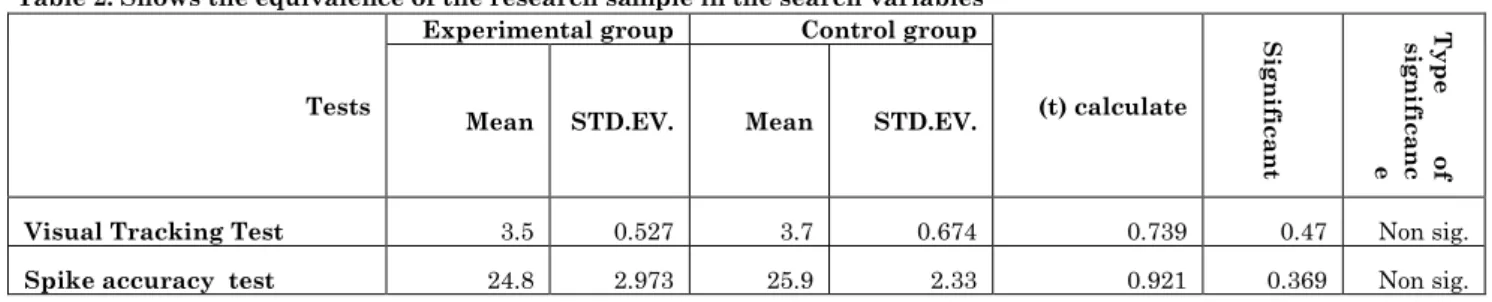
the effect of the experimental factor, the researchers sought to verify the equivalence of the two groups using the t-test of the independent samples. As shown in Table (2).
Table 2: Shows the equivalence of the research sample in the search variables
Tests
Experimental group Control group
(t) calculate
S
ign
ifica
nt
T
yp
e
of
si
g
ni
fica
nc
e
Mean STD.EV. Mean STD.EV.
Visual Tracking Test 3.5 0.527 3.7 0.674 0.739 0.47 Non sig.
Spike accuracy test 24.8 2.973 25.9 2.33 0.921 0.369 Non sig.
Instruments and Tools used in Research Arab and foreign sources.
Observation and experimentation.
Legal volleyball court.
Balls legal aircraft number (16).
A filming 5d origin Japanese – whistle.
Length measuring device (cm) and mass (kg) Chinese made.
Stopwatch number (2).
Colored tapes.
Various geometric shapes.
Fitness ball - Wooden board.
Field Research Procedures
Specify the Tests used in the Research The test of skill spike in the volleyball
[5]
Objective of the test
Measure the accuracy of spike skill in the volleyball.
Tools used
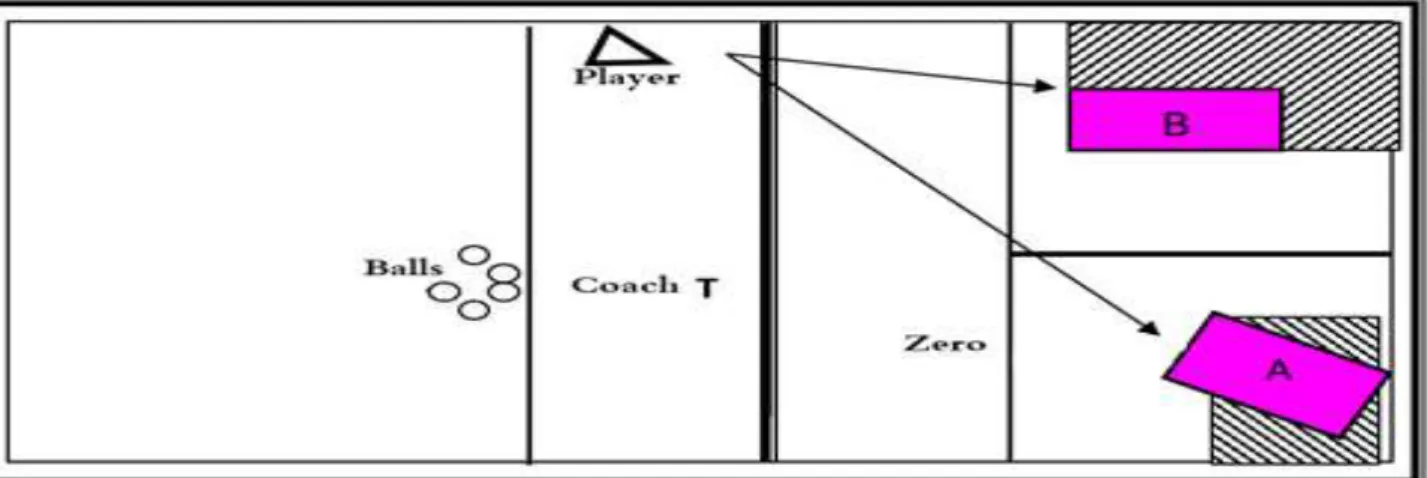
Legal volleyball court, plane legal balls number (5) and a colored strip to divide the corresponding pitch as in Figure (6).
Performance Specifications
The player plays the skill of spike from center (4) as the trainer prepares balls for him from center (3) and the player performs the skill.
Performance Requirements
Each laboratory player has (5) consecutive attempts on area (A).
Each laboratory player (5) consecutive attempts on the area (B).
The preparation must be good in each attempt and the laboratory is given the degree of the area where the ball is located.
Registration
(4) Points for each landslide where the ball falls on the area (A) or (B).
(3) Points for each strike where the ball falls on the planned area.
(2) Points for each landslide where the ball falls on the area (A) and (B).
For every strike that falls off the pitch.
Figure 1: Shows the accuracy test of spike skill in volleyball Pilot Study
The pilot study is a preliminary experimental study conducted by the two researchers on a small sample before starting research with a view to testing the methods of research and its tools [6]. Therefore, the researchers conducted a pilot experiment on Wednesday 1/2/2017 on a sample of the research community (4) And who did not participate in the basic experience The objectives of the pilot experiment as follows:
The extent to which tests are suitable for the research sample.
Know the time taken for the tests.
Know the readiness of the research sample to perform the tests.
To know the difficulties and obstacles facing the work.
Ensure the efficiency of the work team assistant.
Ensure the validity of the tools and devices used.
The adequacy of the inner room in the performance of the experience in terms of availability of the appropriate place and means and tools.
This experiment resulted in the validity of the tools used, the adequacy of the tests and the good performance of the supporting team.
The Scientific Foundations of the Tests
The researchers sought to adopt the scientific bases in the process of applying the tests, although they are standardized tests to determine the extent of the process of these tests.
Validity
Validity is (to gauge the test with a high degree of health what claims to be measured),[7] and the researchers using the method of content or content of sincerity and by displaying the tests on experts and specialists agreed those that these tests are valid to measure what put him.
Stability [8]
The consistency of the test means the accuracy of the test in the measurement and the consistency of its results when applied multiple times to the individuals themselves, that is, if we applied a specific test on a sample of individuals and then re-applied it again or consecutive times on the same sample, their grades do not change substantially, Stability by testing and return on a sample from outside the basic research sample on 1/2/2017 and re-test after seven days, ie, on 8/12/2017 as the result of correlation Pearson proved that the test has a high degree of stability as shown in Table (3) .
Subjectivity
One of the important things that should be available in the test subject to objectivity and which means freedom from prejudice and intolerance and the non-introduction of personal factors objectivity means to describe the capabilities of the individual as they are not as we want [9].
Table 3: Shows the stability and objectivity coefficients of the technical performance tests and the accuracy of the skill of spike the volleyball
Tests Stability coefficient Subjectivity coefficient
Visual Tracking Test 0.92 0.94
Spike accuracy test 0.85
-Main Research Procedures
The research procedures consisted of tribal tests and the application of the educational curriculum prepared by the two researchers on research sample and then performs the tests of the experimental and control.
Pretests
Pretests of the sample were conducted on 10/2/2017 for the technical performance of the skill of the spike. Each player was given (3) attempts to perform the technical performance of the overwhelming volleyball. As for the precision tests of the skill of the spike was conducted on the same day, each player was given (5) attempts to test the accuracy of the skill of spike and calculated the grades obtained by the player on the test depending on the specific test and according to the form prepared for this purpose.
Visual Exercises
The exercise period lasted 4 weeks
The total number of days of training (6) days per week, the number of days of visual exercises per week (4).
Total units (16) units.
Total module time (90) minutes, visual exercise time (25) minutes
The experimental group was subjected to special visual exercises, which were developed by the researchers. The control group was trained according to the usual method of the trainer with the time and the number of exercises and differences was only in visual exercises.
Posttests
After four weeks, the posttests were carried out on 11/3/2018.
Results and Discussions
View the Results of Pretests and Dimensionality of the two Groups
Control and Experimental Visual
Tracking and Accuracy Spike Skill in Volleyball
View the results of the pre and posttests of the control group for visual tracking and accuracy of the spike of the volleyball:
Table 4: Shows the computational circles, standard deviations, and the calculated value of (t) of the corresponding samples between the pre and posttests of visual tracking and the accuracy of the spike skill of the control group in volleyball
Tests
Un
it
m
eas
ur
e
m
ent
s
Pretests Posttests (t
)
cal
cul
at
e
S
ign
ifica
nt
T
yp
e of
si
g
ni
fica
nce
Mean STD.EV. Mean STD.EV.
Visual Tracking
Test Grade 3.7 0.674 4 0.316 1.964 0.08
Non sig.
Spike accuracy
test Grade 25.9 2.33 27 2.357 2.283 0.048 Sig.
Table 5: Shows the computational environment, standard deviations, and the calculated value of (t) of the corresponding samples between the pre and posttests of visual tracking and the accuracy of spike skill in volleyball
Tests
U
nit
m
ea
sur
em
e
nts
Pretests Posttests
(t)
ca
lcu
la
te
S
ignif
icant
T
yp
e o
f
signif
icanc
e
Mean STD.EV. Mean STD.EV.
Visual Tracking
Test Grade 3.5 0.527 4.6 0.516 3.973 0.003 Sig.
Discuss the Results of Tribal and Remote Tests
Table (5.4) shows the mathematical computations of the pre and posttests of the visual tracking and accuracy of the skill of spike in the volleyball of the control and experimental groups by looking at the results.
Note that the differences between the pre and posttests were significant except for the visual tracking of the control group. The researchers explained the cause of evolution
as a result of repetition in the performance of this skill and the practice of different exercises the cause of this development as the enhanced repetition of the exercise helps the player to increase accuracy by correcting the ball paths and increase control of the ball when the spikeis being accuracy it is contributed to a significant difference between the tribal and dimensionality tests.
View and discuss the results of the posttests of the experimental and control groups for visual tracking and accuracy of spike skill in volleyball:
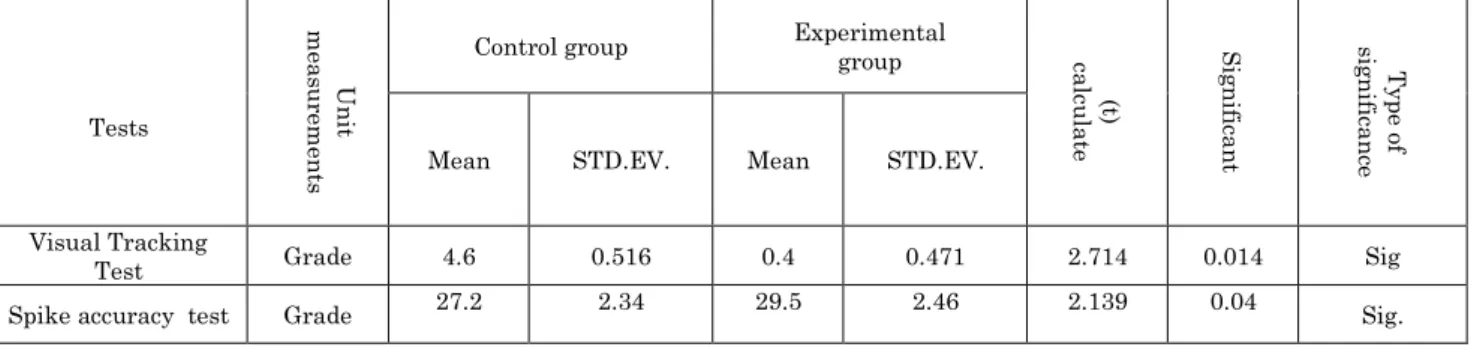
Table 6: Shows the computational circles, standard deviations, and the calculated value of (t) of the independent samples between the visual tests of the visual tracking and the absolute spike accuracy of the volleyball of the control and experimental groups
Tests
U
nit
m
ea
sur
em
ent
s
Control group Experimental
group
(t)
ca
lcu
la
te
S
ignif
icant
T
yp
e o
f
signif
icanc
e
Mean STD.EV. Mean STD.EV.
Visual Tracking
Test Grade 4.6 0.516 0.4 0.471 2.714 0.014 Sig
Spike accuracy test Grade 27.2 2.34 29.5 2.46 2.139 0.04 Sig.
Discussion of the Results of Table (6)
The researchers noted that there were significant differences between the experimental tests of the experimental and control groups and for the experimental group in the visual tracking tests and the accuracy of the spike of the volleyball.
The researchers attributed the reason to the fact that the various special exercises contributed to giving priority to the experimental group because it included exercises a variety of different forms contribute to the development of visual tracking and accuracy of the spike skill as it included exercises in which the player focuses on the color and place and try to direct the ball to the specific places and acclimation to expand the field of vision and focus on the field of the opposing team when the damage B - ball and also visual exercises with the tools increase the excitement and excitement in the players they increase the pleasure and joy among the players in addition to the challenge with themselves
when there are goals set requires accurate injury when spike. While the control group was only regular exercises so there was a difference between the two groups.
Conclusions
From results the findings of the researchers reached:
The development of visual tracking and accuracy of the spike skill of the volleyball of the experimental group.
There is an evolution in the accuracy of the spike skill while the development is small and insignificant for the visual follow - up of the control group.
There is a preference for the experimental group in the tests of the dimension of visual tracking and the accuracy of spike skill in volleyball.
References
1. Abernethy B (1987) Selective attention in fast ball sports II: Expert novice differences. The Australian Journal of Science and Medicine in Sport, 19: 4, 7-16. 2. Burroughs WA (1984) Visual simulation
training of baseball batters. International Journal of Sport Psychology, 15: 117-126. 3. Cohn EC, Chaplik DD (1991) Visual
training in soccer. Perceptual and Motor Skills, 72: 1238.
4. Wajih Mahjoub (2002) Scientific Research and its Methods, Baghdad: Directorate of Dar al-Kitb for Printing and Publishing, 81.
5. Ali MostafaTaha (1999) Volleyball - History - Education - Training - Analysis - Law, Cairo, Helwan University, Dar Al-Fikr Al Arabi, 178.
6. Wajih Mahjoub (1993) Practical Research Methods and Methods, Baghdad, Dar al-Hikma for Printing and Publishing, 178. 7. Mohamed SubhiHassanein (1995)
Measurement and Evaluation in Physical Education and Sports, I 3, C 1, Dar Al-Fikr Al-Arabi (Cairo) 168.
8. Mohammed Jasim Al-Yasiri (2010) The Foundations of the Theory of Physical Education Tests, 1, Dar Al-Diaa for Printing and Design, Najaf Al-Ashraf,87. 9. Marwan Abdel-Majid (1999) The Scientific
Foundations and Statistical Methods of Tests and Measurement in Physical Education, 1, Jordan, Dar Al-Fikr Al-Arabi for Printing and Publishing, 70.
Appendix (1) Exercise
The player prepares for the crushing spike and in front of him on the field opposite two players ready to defend each one wearing
a different color. We allow the player to hit the ball towards the player each time a particular color.
Two squares of two different colors shall be fixed on the wall, measuring 50 x 50 cm, 2.5 m above ground. The player stands 75
cm from the wall sideways facing the trainer who puts balls in the box every 10 balls of a certain color and 10 balls different from them. The exercise begins when the coach leaves a ball from the box and throws it to the player who grabs and then turns to jump against the wall and throw it with both hands for a box as agreed (Each color ball into a specific box).
Apply the spike straight once and diagonally again after the two areas with colored bars.
Hit the ball towards the corresponding field to squares of different colors.
placing a rope on the sticks, a half-meter height of the network with the placement of tapes hanging on that rope in different
colors requires the player to direct the ball in the direction of the color of the specified tape with the possibility of changing colors directed by the ball as requested by the coach.
The player is prepared to perform the crushing game by means of balls of different colors, a special color for the crushing blow in
a diagonal direction and the other color is a straight hit.
Stands the player to perform the crushing spike and standing in front of him from the other side of the stadium two players
ready to perform the wall of the block and the ball is prepared for the player, the batsman asks the coach to perform one of the wall of the block then requires the player to hit the ball to the player who did not throw the wall.
The trainer places geometric shapes on the field (triangle, square, and circle) and asks the player to direct the ball to a certain
geometry.
Wooden board installed on the lava of wood with a moving base (height in all 3 m and width 50 cm) placed by the coach in front
of the network wall of the bodice and when the player wins to perform the spike moves the trainer to close the plate straight or diagonal.
The player performs the skill of spike overwhelming and when starting to jump the trainer rolls the ball (fit ball) (used for