ISSN: 1311-1728 (printed version); ISSN: 1314-8060 (on-line version) doi:http://dx.doi.org/10.12732/ijam.v31i2.9
IMAGE ENCRYPTION USING THE INCIDENCE MATRIX Abdelghni Lakehal1§, Abdelkarim Boua2
1Abdelmalek Essaadi University Polydisciplinary Faculty MAE2D, Larache, MOROCCO 2Sidi Mohammed Ben Abdellah University
Polydisciplinary Faculty LSI, Taza – MOROCCO
Abstract: The purpose of this article is to indicate the importance of us-ing close planar rus-ings in the construction of high efficiency balanced incomplete block (BIBD) plans, and how these can be used to encrypting the image. There-fore, an algorithm of a program to compute the incidence matrix plays a very important role in encrypting and decrypting images.
AMS Subject Classification: 16N60, 16W25, 16U80 Key Words: planar near-ring, BIBD, image encrypting
1. Introduction and motivation
Near-rings are one of the generalized structures of rings. The study and research on near-rings is very systematic and continuous. Near-ring have been used since the development of calculus, but the key idea behind near-rings was formalized in 1905 by Dickson who defined the near-fields. Veblin and Wedderburn used Dickson’s near-field to give examples of Nondesarguesian planes. In late 1930s, Wieland studied near-rings, which were not near-fields. Extensive studies about the subject can be found in two famous books on near-rings (see [7]). Near-rings abound in all directions of mathematics and continuous research is being
conducted, which shows that their structure has power and beauty in all its own. Importantly, the study of the theory of planar near-rings has received momentum in the last decades. Various applications of planar near-rings have been applied in different fields (see [4], [7]).
The combinatorial design theory may seem like an area of math for solving puzzles or brainteasers. However, what if the theory itself had various appli-cations in encrypting and decrypting images.? The aim of this essay was to determine how could balanced incomplete block designs be applied in in en-crypting and deen-crypting images.
After the fundamentals theory had been established, a method for trans-forming (BIBD) into an incidence matrix was outlined. This transformation allowed the matrix to contain only binary digits while retaining the properties of (BIBD), allowing the rows or the columns of the matrix to be used as codes. These properties were later utilized to depict that error detection and correc-tion can be done at a faster and efficient rate when the codes were generated from (BIBD).
2. Definitions and terminology
Recall that a right (resp. left) near-ring is a set N together with two binary operations ” + ” and ”.” such that
(i) N is a group (not necessarily abelian). (ii) N is a semigroup.
(iii) For all x, y, z∈ N, (x+y)z=xw+yz (resp. z(x+y)z=zx+zy). Now we remind some definitions and properties of near-rings, for details see [4].
Definition 1. For a near-ring (N,+, .) anda, b∈ N, define an equivalence relation ℜon N by:
aℜb⇔xa=xb for all x∈ N.
Ifaℜb,we say that aand bare equivalent multipliers.
(ii) For constants a, b, c ∈ N where a is not equivalent to b, the equation
x.a+x.b=c has a unique solution for x∈ N.
The theory of codes and design has developed dramatically for the past few decades having vast amount of applications in current technology. Combinato-rial design theory lies in heart of coding theory. There exists various designs but this essay would only consider one of its fundamental design, balanced in-complete block designs, as the concepts of designs are new. Before the research question “How could balanced incomplete block designs be applied in error de-tection and correction” is answered, what are error dede-tection and correction and balanced incomplete block designs?
Definition 3. A balanced incomplete block design (BIBD) with parame-ters (v, b, r, k, λ) is a pair (P, B) with the following properties:
(i) P is a set with v elements.
(ii) B ={B1, B2, ..., Bb}is a subset ofP withbelements are called the blocks a (BIBD).
(iii) Each Bi has exactly k elements where k < v each unordered pair (p, q) withp, q∈P,p6=q occurs in exactly λelements in B.
Each a ∈ P occurs in exactly r sets of B. The term balance indicates that each pair of elements occurs in exactly the same number of block, the term incomplete means that each block contains less than v elements.
The main parameters of a (BIBD) are (v, b, r, k, λ) and the parameters sat-isfy the following necessary conditions for existence.
(1) vr=kb;
(2) λ(k−1) =v(k−1).
There are good construction methods for obtaining planar near-rings. We ex-hibit the following one, due to Clay (see [2], [3], [4], [5]), which is both easy and most useful.
Theorem 4. LetF be a field of order pn, wherep is a prime and lettbe a nontrivial divisor of pn−1, sost=pn−1 for somes. Choose a generator g of the multiplicative group of F. Define ga.
tgb =ga+b−[b]s, where [b]s denotes the residue class of a modulo s. Then (F,+, .t) is a planar near-ring with
3. Construction the incidence matrix from planar near-rings The planar near-rings theory is also used in the construction of balanced in-complete block designs (BIBD) of high efficiency where by high efficiency “E” we mean E = λv
rk, this E is a number between 0 and 1 and it estimates the quality of any statistical analysis ifE ≥0,75 the quality is good. According to [3], the construction of a (BIBD) from a planar near-ring can be obtained as follows:
Theorem 5. LetN be a finite planar near-ring andB ={aN∗+b |a, b∈
N, a6= 0}, then (N, B) is a (BIBD) with parameters(v,v(vk−1, v−1, k, k−1), wherev=|N|and kis the cardinality of each aN∗ witha6= 0.
It is often convenient to represent a (BIBD) by means of an incidence matrix. This is especially useful for computer programs. Here we recall the definition of an incidence matrix.
Definition 6. Let (P, B) be a (BIBD) where P = {p1, ..., pv} and B =
{B1, ..., Bb}. The incidence matrix of (P, B) is thev×bmatrixM =mij defined by the rule
mij =
1, if pi ∈Bj; 0, otherwise.
The incidence matrix M of a (v, b, r, k, λ)-BIBD satisfies the following proper-ties:
(i) every column ofM contains exactly k”1” s. (ii) every row if M contains exactly r”1” s.
(iii) two distinct rows ofM both contain ”1” s in exactly λcolumns.
Now using the planar near-rings one can construct error correcting codes from (BIBD). Indeed, by taking either the rows or columns of the incidence matrix of such a (BIBD) one can obtain binary codes called the row code
CrowB or (column codeCcolB, respectively) of B with several features.
Proposition 7. ([6]). Let the notation be as in Definition 3.
(ii) Chasbcodewords of lengthv, equal weightkand minimal distance(k−m), wherem=maxi6=j|Bi∩Bj|.
(iii) NeitherCrowB norCcolB can be linear. Algorithm [1]:
Input: m integer number Output: incidence matrix. Ifm=pn, then:
1. Define a field F of orderpn.
i)t : divisor ofpn−1 such thatst=pn−1. ii) g : multiplicative generator ofF.
2. Define law ”.t” Such that: ga.tgb =ga+b−[b]s, where [b]
s denotes the residue class of bmodulo s. ThenN = (F,+, .t) is a planar near-ring.
3. The construction of ”BIBD”.
• B ={αN∗+β |α, β ∈N, α6= 0}.
• v←−card(N);
• k←−card(αN∗);
• b←− v(vk−1);
• r←−v−1;
• λ←−k−1;
(v, b, r, k, λ) (BIBD) parameters of (N, B). 4. The construction of the incidence matrix. Fori= 1 :v
Forj = 1 :b mi,j =
1, if i∈Bj or i∈N and Bj ∈B ; 0, if not.
End for. End for.
Example: Using this algorithm wherep= 11, thent= 5,s= 2 andg= 2. The incidence matrix of order 11×22 is giving by:
0 0 0 1 0 1 1 0 1 1 0 1 0 0 1 0 0 0 1 0 1 0 0 1 1 0 1 0 1 1 0 0 0 1 0 0 0 0 1 1 0 1 0 1 1 0 0 0 1 1 0 0 0 1 1 0 1 0 1 1 0 0 0 0 1 0 0 0 1 1 0 0 1 1 0 0 1 0 1 0 0 0 1 0 0 1 0 1 1 0 1 1 0 1 0 0 0
.
From this matrix we extract 11 codewords and each codewords is row of the incidence matrix of length 22,weight 10 and minimum distance is 12. Similarly, we extract a column code with 22 codewords, and each codewords represents a column of the incidence matrix of length 11, and its weight 5 and minimum distance is 2.Hence the row code can detect 11 errors and correct 5 errors, and the column code can detect a single error but it doesn’t correct any error. On the other hand we found that the effectiveness of this (BIBD),E= 0.88≥0.75, thus indicating that its quality is good.
4. Encryption and decryption by line codes and column codes of the incidence matrix
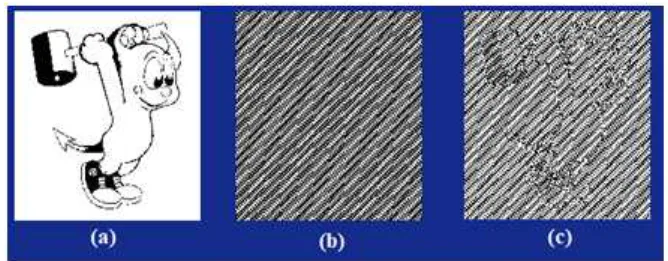
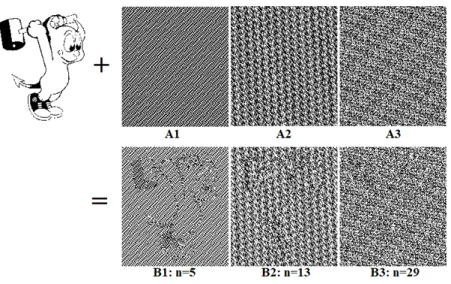
The idea of our method is to build a mask based on the incidence matrix presented in Section 3. Given an image I to be encrypted, from the incidence matrix we construct the mask M with the same size as the target image I, the encrypted imageR is obtained by the logical connector ”xor” between the imageI and the mask M as follow:
R=I xor M . (1)
Fig. 1: Encryption with the code lines of the incidence matrix.
Fig. 2: Encryption with the code column of the incidence matrix.
Fig. 3: Encryption according to different masks.
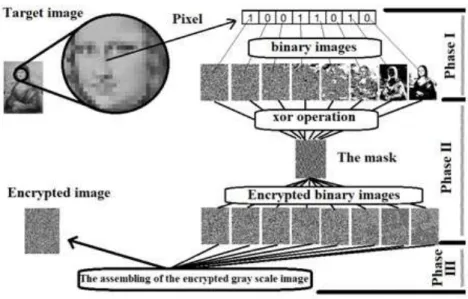
As we have mentioned, the encryption of a binary image is done in a sys-tematic way by the ”xor” logical connector between the mask and the target image, on the other hand in the case where the image is in gray level, the en-cryption process is done by the following steps:
(1) we decompose the grayscale images into 8 binary images where each pixel in the image breaks down into 8 bits and each bit corresponds to a binary image.
(2) The encryption of the 8 binary images is done by the same mask
(3) The encrypted image is constructed by assembling the eight encrypted images obtained using the inverse operation of the (phase I), the figure (Fig. 4) summarizes this procedure.
Fig. 4: Grayscale image encryption with group order n= 7.
In the case of a color image, the image is decomposed into three images, red, green, blue, then the method used in the case of grayscale image for each of these three images is used to obtain the encrypted image.
5. Conclusion
In these papers we presented a method to encrypt a binary image, gray level or color image, the method is based on the incidences matrix obtained by the (BIBD) of a planar nears-ring. Among the strong points of our method is the difficulty of decrypting the encrypted images without having the mask used in encryption or even impossible as well as the calculations in the encryption phase are very small which makes the complexity of the algorithm is polynomial all it gives our proposed method efficiency and robustness.
References
[1] A. Boua, L. Oukhtite, A. Raji & O. Ait Zemzami, An algorithm to con-struct error correcting codes from planar near-rings, Inter. J. of Math. Engineering& Sci.,3, No 1, (2014), 14-23.
[3] J.R. Clay, Geometric and combinatorial ideas related to circular planar nearrings,Bull. of the Institute of Math. Academia Sinica,16(1988), 275-283.
[4] J.R. Clay,Near-rings: Geneses and Applications, Oxford University Press, 1992.
[5] J.R. Clay, Geometry in fields, Algebra Colloq., 1, No 4 (1994), 289-306. [6] P. Fuchs, G. Hofer & G. Pilz, Codes from planar near-rings, IEEE Trans.
Inform. Theory, 36(1990), 647-651.