SEVERAL ISSUES REGARDING THE CONSERVATION AND
PROTECTION OF VULNERABLE PSAMMOPHYLOUS SPECIES
POLYGONUM MARITIMUM
L. AND
SILENE THYMIFOLIA
SIBTH. ET SM.
AT THE ROMANIAN BLACK SEA COAST
L.D.JIANU1, M. FĂGĂRAȘ2
1Company of BiodiversityResearch and Environmental Engineering AON,
I.C. Bratianu no 131, Constanţa, Romania
2OvidiusUniversity of Constanta, Faculty of Natural and Agricultural Sciences
E-mail:[email protected]
Key Words: Polygonum maritimum, Silene thymifolia, vulnerable species, Black Sea coast, conservation
ABSTRACT
The phenomenon of vegetation dynamics and the fragile balance of the coastal ecosystems and also the large number of endangered plant species from these areas represent a permanent challenge to which many specialists have to respond.
In this paper we present some issues regarding the ecology, chorology, current conservation status of the species populations within their specific habitats related to the main factors of anthropic and natural impact that affect the populations of the studied plant species and identification and description of measures that can betaken for their conservation and protection.
By means of the results obtain through out this study, we present the current status of Polygonum maritimum and Silene thymifolia, as well as their habitats, specific to the Romanian Black Sea coastal area.
INTRODUCTION
The main purpose of thisstudyis the in situ research of two vulnerable psammophylous species Polygonum maritimum and Silenet hymifolia at the Romanian Black Sea littoral in order to evaluate thei rcurrent conservation status and to identifyappropriate protection measures. Bothspecies are vulnerable (Dihoru, Negrean, 2009), faced a highrisk of extinction in the wild in a mean future, with decreasing populations due to habitat alteration or even destruction for anthropic as well as natural causes.
The two psammophylous plant speciesPolygonum maritimum and Silene thymifolia
are in danger of becoming extinct in the natural habitats of the sandy beaches from the Black Sea Coast area in Romania (Făgăraş, 2012) and Bulgaria too (Tzonev et al., 2005, Petrova, Vladimirov, 2009),astheirshabitats and/or populations have been reduced drastically due to the continuous pressure of the environmental threatening factors, especially anthropic ones (Făgăraş et al., 2008).
EXPERIMENTAL
Chituc, Grindul Lupilor, Grindul Saele, Corbu-Cap Midia, Navodari, Mamaia, Constanta, Agigea, Eforie Nord, EforieSud, Tuzla, Costinesti, Mangalia, 2 Mai-VamaVeche.
The method of fixed points was usedfor the collection of field data. This method involves covering certain tracks within the habitats characteristic to the littoral area, with at least ten stops in every assessed area(Joint Nature Conservation Committee, 2004). The total number of stops or sample squares was 177, irregularly distributed.
The coverage of species populations in the analysed areas are denoted in accordance with a scale which specify the coverage: no specimen, rare- non significant coverage, coverage ≤ 25%, coverage 26 - 50%, coverage 51 – 80%, coverage 81 -100%.
To analyse the data obtained was used a version of the DAFOR scale (acronym for: dominant, abundant, frequent, occasionally, rare), which was adapted to the particular characteristics of marine dune habitats:
- Dominant:the species appears at most (>60%) stops and it covers more than50% of each sampling unit;
- Abundant:species occurs regularly throughout a stand, at most (>60%) stopsand its cover is less than 50% of each sampling unit;
- Frequent:species recorded from 41-60% of stops; - Occasional:species recorded from 21-40% of stops; - Rare:species recorded from up to 1-20% of stops.
The DAFOR scale is used for semi-quantitative sampling, to provide a quick estimate of the relative abundance of species (generally plants species) in a given area (Kent, Coker, 1992).
In order to determine the sozological category were taken into account the main Romanian Red lists(Boşcaiu et al., 1994, Dihoru, Dihoru, 1994, Oltean et al., 1994, Oprea, 2005)especially the last published, The red book of vascular plants of Romania(Dihoru, Negrean, 2009).
For the determination of the two species chorology were indicated both the locations according to the bibliographical data(Ciocârlan, 2006, Sârbu et al., 2013) and the ones according to the own data picked on the field.
The evaluation of the conservation status was done by applying the method known as the ‘semaphore method’(Combroux, Schwoerer, 2007). This method is normally used for assessing the conservation status of habitats and species of Community interest, but we believe that it can be successfully used in case of rare/endangered species, too.
Methodology used for the identification of the studied species habitats was based on the typical plant associations from the Manual for the Interpretation of Natura 2000 Habitats of Romania (Gafta, Mountford, 2008).
The information regarding the names, characteristics and distribution of habitats and plant associations is mainly based on the bibliographical sources available (Doniţă et al., 2005, Făgăraş et al., 2008, Sanda et al., 2008, Niculescu, 2009, Trif et al., 2015, Trayanova et al., 2007), as well as own observations conducted on field.
RESULTS AND DISCUSSION
Coast. In the case of Silene thymifolia it ssozological status is also considered as a rare (R) species (Dihoru, Dihoru, 1994) and near threatened (NT) species (Oltean et al., 1994).
The importance of these psammophylousplant species in sozological terms is significant not only strictly refering on each taxon in part, but especially to their specific habitats. It is already proven that protecting isolated populations of threatened species without taking into account the relationship organisms-biotope is ineffective.
Polygonum maritimumL.- Fam. Polygonaceae
It is a perennial, with stout, woody stock (Fig. 1.). Stems are 10- 50 cm, procumbent, branched, stout. Leaves are narrowly elliptical, acute, glaucous, with revolutemargins. The ochreae are reddish- brown at the base, with 8-12 conspicuous, branched veins, silvery-hyaline distally, longer than most of internodes. Flowers are pedunculate, pink or whitish, often grouped in axillary clusters of 2-5; peduncles longer twice than the perianth; bracts leaf-like. The fruit is a brownish glossy nut, 3,5- 5 mm in length and 2,5-3 mm in diameter, equalling or slightly exceeding the perianth (Tutin et al., 1972, Săvulescu ed., 1952, 1953).
Fig. 1. Natural view ofPolygonummaritimumL. (original)
Silene thymifoliaSibth. et Sm.- Fam. Caryophyllaceae
It is a perennial plant with branched, woody stock. Stems are numerous, 15-20 cm, procumbent or ascending to erect, scabrid-puberulent (Fig. 2). Leaves are little, fleshy, 8-20 mm, ovate, rarely elliptic, conspicuously pubescent. The flowers are disposed in dichasial inflorescence, few-flowered. Flower has a glandular-villous calyx, narrowly clavate, 12-15 mm, and a corolla with white bifid petals, neck ligulate. Capsule (8- 9 mm) is slightly longer than carpophore (7 mm)(Tutin et al., 1972, Săvulescu ed., 1952, 1953).
Fig.2. Natural view ofSilene thymifoliaSibth. et Sm. (original)
neutral and oligohaline soils (Cicârlan, 2009, Sârbu et al., 2013). It grows on the maritime sand dunes in very small and strongly fragmented populations. It was identified in the associations: Cakilo euxinae- Salsoletum ruthenicae Vicherek 1971, Lactuco tataricae-Glaucietum flavae Dihoru et Negrean, Elymetum gigantei Morariu 1957, Artemisietum tschernievianae (arenariae) Popescu et Sanda 1977. These associations are part of two Natura 2000 natural habitat types- 2110 Embryonic shifting dunes and 1210 Annual vegetation of drift lines.
Distribution in Romania for Polygonum maritimum fragmented population is as follows:Sulina, Sf. Gheorghe, Portita-Periteasca, Portita-Periboina, Chituc maritime sandbank, Corbu beach, Midia Cape, Mamaia Nord- Navodari, Eforie Nord- Eforie Sud, Tuzla, 2 Mai, Vama Veche(Dihoru, Negrean, 2009, Cicârlan, 2009, Sârbu et al., 2013).
Silene thymifolia Sibth. et Sm. is a hemicryptophyte (H) characteristic on littoral dunes with spreading on North-West of Black Sea sandy seashore(Tutin et al., 1972).It is a heliophile species, spread in warm areas, with dryed to moderately moist soils, neutral soil(Cicârlan, 2009, Sârbu et al., 2013).It grows on marine sand dunes. It is extremely rare. Vegetal associations that has been cited are the following: Secali sylvestris-Alyssetum borzeani(Borza 1931),Secali sylvestris-Brometum tectorumHargitai 1940;Alysso borzaeani – Ephedretum distachyaeTzonev et al. 2005. These associations are part of two Natura 2000 natural habitat types:2110 Embryonic shifting dunes, 2130* Fixed coastal dunes with herbaceous vegetation (‘grey dunes’).
Distribution at the moment in Romania for Silene thymifolia population is only in Agigea Natural Reserve.
Distribution in Romania of Natura 2000 habitats referred to above is in the north of the Black Sea coast area (in the Danube Delta Biosphere Reserve area) and also in several isolated areas in the south of it.
In the field observations we noticed the presence of Polygonum maritimum L.
especially in Natura 2000 habitat 1210 Annual vegetation of drift lines. Rarely forming clusters as seen on Corbu Beach (next to the eroded cliff) and in the Port of Midia. The species was observed along the sandy beach of the Danube Delta Biosphere Reserve, Corbu beach, Midia Cape, Mamaia North beach - Navodari, Constanta (between 3PapuciBeach and Modern), between Eforie Nord and South Beach, Eforie South Beach, and Vama Veche Beach.
It must be mentioned that Polygonum maritimumpopulation are heavily exposed to strong winds and high waves during storms, but at the same time human activities (especially in the southern Romanian coast), where the trend of expanding recreational areas on the beaches it destroys typical vegetation of the Natura 2000 habitat 1210 Annual vegetation of drift lines.
the Romanian flora, despite the effort to preserve Silene thymifolia individuals in the natural protected area Agigea Reserve.
Currently the conservation status of the species in the Agigea Natural Reserve is satisfactorily maintained because the custodian of the protected area which has periodically cleaned up dunes by removing steppe, invasive species and Polytrichum piliferummoss23.
Data analysis obtained by using the method of fixed points shows that the presence of:
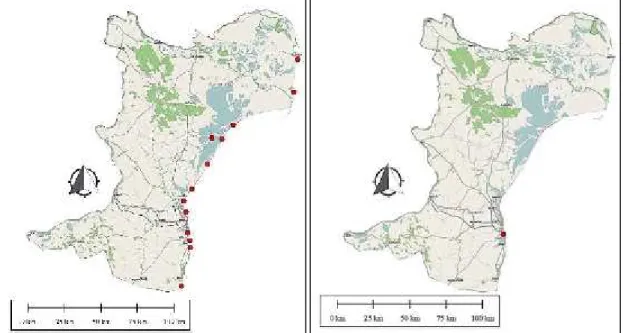
- Polygonum maritimumwas found in 12,4% of the sample squares or stops from total of 177 sample squaresinequal distributed in all observation points along the coastal area.It should be noted that Polygonum maritimumit was obsevedin 13 points from a total of 18 points along the coastal area (Fig. 3.).
- Silenethymifoliawas found in 1,12% of the sample squares or stops, which it means into a single point of observation (Fig.4.), only in two stops.
After assessing the presence and coverage of the soil both studied species can be qualified as Rare-with insignificant coverage which means that the species was registered in 1-20% of sample squares, according to the DAFOR scale (Kent, Coker, 1992), adapted to the particular characteristics of marine dune habitats.
Assessment of the conservation status of Polygonum maritimum and Silene thymifolia populations was achieved depending on the following parameters:species distribution, population status, species habitat status, perspectives and finally resulta global assessment of conservation status in the studied area. The conservation status is assessed based on 3-level scale as follows:
- Favorable conservation status; - Unfavorable conservation status;
- Totally inadequate unfavorable conservation status;
According Methodological Guide: Assessment of conservation status of habitats and species of Community interest in Romania(Combroux, Schwoerer, 2007).
Polygonummaritimumpopulationspopulationswere found during the studyperiod were found the during study period along the Romanian coastal area
As a result of the current conservation status of the Silene thymifolia, the conclusion is that species distribution, population status and perspectives have a totally inadequate unfavorable conservation status. The habitat of the Silene thymifolia populations have an unfavorable conservation status, the main causes being the intensified human activities in the Romanian coastal area over the past 50-60 years.
For the populations ofSilene thymifolia located in Romanian coastal area the global assessment of conservation status‘totally inadequate’ was identified.Due to this critical situation urgent measures being necessary for the reduction of the anthropic and natural factors impact.Management interventions absolutely necessary for the species conservation are: keeping in optimum state the maritime dune habitats by elimination of the risk factors represented by the humification of dunes, overgrowth of steppic and ruderal species and also the foreign bushes and/or trees intrusion.
For Polygonum maritimumthe assesing of the current conservation status it can be concluded that the species distribution is unfavorable. The populations of the Polygonum maritimumspecies display an unfavorable conservation status, the main causes being like in the previous species the limitation of the surfaces occupied as a result of the intensified human activities in the Romanian coastal area (e.g. coastal rehabilitation at that moment).Given the trends of development of new tourist capacities in the northern part of the Romanian coast (Golumbeanu et al, 2014) and in the absence of concrete measures for the protection and conservation it can be consider that the long term viability of the species is threatened.
By maintaining constant anthropogenic pressures as a result of economic activities in the coastal area (tourism, grazing, coastal facilities, construction, waste accumulation,mechanized works for beaches maintenance,beaches nourishment etc.) are created premises for profound changes in the structure and composition of arenicolousphytocoenosisbyruderalisedvegetation and installation of steppe species.
Thus,the main risk factors in Black Sea shore area for the Polygonum maritimum
populations can be considered: coastal urbanisation, development of mass tourism, reducing the area occupied by beaches and dunes, interventions with heavy equipment for beach nourishment and arranging beaches for tourism. For Silene thymifoliasmall population, distributed in two small patches, from Agigea Natural Reserve is the marine dune habitat alteration, by humification(marine dunes humification) and ruderalisation of the specific habitats.
In the case of the studied species, as a natural risk factors shall be mentioned coastal erosion(Golumbeanu, Nicolaev ed., 2015), extreme weather conditions (big storms), which also contributes to reducing psammophylous populations, including
Polygonum maritimumand far less in the case of Silene thymifolia population. In the case of the latter, are other natural risk factors involved (such as duneshumification, overgrowth of steppe and ruderalspecies and the invasive ones).
The critical state of the psammophylous species and their habitats of Romania, especially in the southern sector of the Romanian Black Sea littoral, requires the identification of viable strategies for the development of activities of protection, improvement or restoration of the conservation status and ecological recovery.
It is especially important at this stage that all the decision factors to be involved: at local, national trans-border and regional levelas well asthe civil society.
Thereby, the specific measures to protect and conserve the populations of studied plant species in the Romanian Black Sea costal area might be:
- for Polygonum maritimum population: habitat inventory and mapping for habitats 1210 Annual vegetation of drift lines and 2110 Embryonic shifting dunes: integrated coastal zone management;ex situconservation;
- for Silene thymifoliapopulation: regular monitoring of the remaining populations by any means ensuring a favorable conservation status; ex situ conservation; reintroduction of the species in habitats characteristic of which it disappeared.
For the population of Polygonum maritimum located in Danube Delta Biosphere Reserve and for these of Silene thymifolia located in Agigea Natural Reserve the main
exsituconservation measure applied is the protection compliance with the management plans protection and conservation measures.
For the populations located outside the protected area and distributed over the littoral area on sandy substrate the recommendation is to declare new protected areas of local or national interest (Făgăraş et al., 2006) or to institute a protection regime by declaring the population or the isolated individual monuments of nature and requesting approval from the central authorities for environmental protection.
Besides the creation of the protected area of IUCN categories I, II and IV, Biosphere Reserves and setting up biodiversity conservation networks at international, European and national level (such as Natura 2000 network in the European Union) is necessary to consider the protection of individual species by establishing special arrangements for declaring Natural Monument (IUCN category III), endangered or vulnerable species inclusion in national and international Red Lists (including annexes lists of national legislative acts) and not least the protection of species in areas without protection status.
However, it is important to stress that maintaining habitats and species of flora and fauna of national or European level in a favorable conservation status we cannot achieve without information, communication, education and involvement of all stakeholders in the effective management of these areas.
CONCLUSIONS
Our results on the current conservation status of the Silene thymifolia population reveal an ‘unfavorable- totally inadequate’ conservation statuswhile for the Polygonum maritimumthe current conservation status it can be assessed as ‘unfavorable’. Without the application of urgent protection and conservation measures it is possible sooner than expected the extinction ofSilene thymifoliaspecies from the Romanian flora.
It can be stated that the restoration of Polygonum maritimum and particularly
Silenethymifoliapopulation alongside the other components of the phytodiversityin the Romanian coastal area represents a difficult and lengthy process, with allotment of significant financial and human resources in order to conserve the natural habitats still present, simultaneous to the restoration of those affected.
REFERENCES
1. DIHORU, G.; NEGREAN, G.: 2009. Cartearoşie a plantelorvasculare din România, Edit. Acad. Rom., Bucureşti.
2. FĂGĂRAŞ, M.: 2012. Habitats of Conservative Interest and Plant Communities in the Sandy Black Sea Coast area of Romania and Bulgaria. J EnvironProtEcol,13 (3A), 1688.
3. TZONEV, R.; DIMITROV, M.; ROUSSAKOVA, V.: 2005. Dune Vegetation of the Bulgarian Black Sea Coast. Hacquetia(Warsaw),4(1), 7.
4. PETROVA, A.; VLADIMIROV, V.(ed.): 2009. Red List of Bulgarian vascular plants, Phytol.Balcan.,15(1), 63-94.
5. FĂGĂRAŞ, M. (coord.); GOMOIUM. T.; JIANUL.; SKOLKAM.; ANASTASIUP.; COGĂLNICEANUD.: 2008. Strategia privind conservarea biodiversității costiere a Dobrogei, Edit. Ex Ponto, Constanţa.
6. FĂGĂRAŞ, M.: 2008. Several Wetlands from the Romanian Black Sea Shore and Their Specific Plant Communities. J Environ ProtEcol,9(2), 344.
7. Joint Nature Conservation Committee: Common Standards Monitoring Guidance for Sand dune Habitats.on-line Version, August 2004 (updated from February 2004).
8. KENT, M.; COKER, P.: 1992. Vegetation Description and Analysis. A Practical Approach. John Wiley and Sons, Chichester, U.K.
9. BOŞCAIU, N.; COLDEA, G.; HOREANU, C.: 1994. Lista roşie a plantelor vasculare dispărute, periclitate, vulnerabile şi rare din Flora României, Ocrot. nat. med. înconj., 38, (1): 45-56.
10. DIHORU, G.; DIHORU, A.: 1994. Plante rare, periclitate şi endemice în Flora României – Lista roşie, Acta Botanica Horti Bucurestiensis. Lucrările Grădinii Botanice (1993-1994): 173-197.
11. OLTEAN, M.; NEGREAN, G.; POPESCU, A.; ROMAN, N.; DIHORU, G.; SANDA, V.; MIHĂILESCU, S.: 1994. Lista roşie aplantelor superioare din România, Studii, Sinteze, Documentaţii de Ecologie, Acad. Rom. Bucureşti I: 5-52.
12. OPREA, A.: 2005. Lista critică a plantelor vasculare din România, Edit. Univ. „Al. I. Cuza”, Iaşi.
13. CIOCÂRLAN, V.: 2009. Flora ilustrată a României, Edit. Ceres, București.
15. COMBROUX, I.; SCHWOERER, C.: 2007. Evaluarea statului de conservare al habitatelor şi speciilor de interes comunitar din România - ghid metodologic, Edit. Balcanic, Timişoara, România.
16. GAFTA, D.; MOUNTFORD, J. O. (ed.): 2008. Manual de interpretare a habitatelor Natura 2000 din România, Risoprint, Cluj-Napoca.
17. DONIŢĂ, N.; POPESCU, A.; PAUCĂ-COMĂNESCU, M.; MIHĂILESCU, S.; BIRIŞ,
A. I.: 2005. Habitatele din România, Ed. Tehnică Silvică, București.
18. FĂGĂRAŞ, M., SKOLKA, M., ANASTASIU, P., COGĂLNICEANU, D., NEGREAN,
G., BANICĂ, G., TUDOR, M., SAMOILĂ, C.: 2008.Biodiversitatea zonei costiere a Dobrogei dintre Capul Midia şi Capul Kaliakra, Edit. Ex Ponto, Constanţa.
19. SANDA, V.; OLLERER, K.; BURESCU, P.: 2008. Fitocenozele din România, Sintaxonomie, Structură, dinamicăși evoluție, Ars Docendi, Universitatea din București. 20. NICULESCU, M.:2009. METODE DE CERCETARE ŞI PREZENTARE A FLOREI,
Ed. Sitech, Craiova,119 p.
21. TRIF, C. R., FĂGĂRAȘ, M. M., HÎRJEU, N. C., NICULESCU, M.:2015. Ghid sintetic de monitorizare pentru habitate de interes comunitar (sărături, dune continentale, pajiști, apa dulce) din Romania, Ed. Bolda, Constanța
22. TRAYANOVA, T.; RAYANOV, V.; MARINOVA, V.; MICHNEVA, V.; ZAHARIA, T.; MAXIMOV, V.; YANKOVA, M.; GOLUMBEANU, M.: 2007. Marine Protected Areas in the Northern Part of the Bulgarian Black Sea Shelf. J Environ ProtEcol,8 (3), 574.
23. TUTIN, T. G.; HEYWOOD, V. H.; BURGESN, A.; MOORED, M.; VALENTINED, H.;
WALTERSS, M.; WEBB, D. A. (ed.): 1972. Flora Europaea. Vol. 3, Cambridge University Press, Cambridge.
24. SĂVULESCU, T. (Ed): 1952, 1953. Flora României, Vol. I, Vol.II.Ed. Acad. R.P.R.‐ R.S.R.
25. Plan de Management ROSCI 0073 Dunele Marine de la Agigea- Aprilie2011. http://www.bio.uaic.ro/agigea/doc/Management_plan_agigea.pdf (accessed in 20.10.2015).
26. GOLUMBEANU, M.; OROS, A.; NENCIU, M.; ZAVATARELLI, M.; DRAGOS,
A.:2014. Contribution of Environmental Indices in Meeting the Objectives and Principles of the Marine Strategy Framework Directive (MSFD). J Environ Prot Ecol,15(3), 1130.
27. GOLUMBEANU, M.;NICOLAEV, S.(ed.):2015. Study on Integrated Coastal Zone Management.Ex Ponto Publishing House, Constanta.