IOS Press
Querying Knowledge Graphs with Extended
Property Paths
Valeria Fionda
a, Giuseppe Pirrò
b,*and Mariano P. Consens
c aDeMaCS, University of Calabria, Rende (CS), ItalyE-mail: [email protected]
bICAR-CNR, Italian National Research Council, Rende (CS), Italy
E-mail: [email protected]
cMIE, University of Toronto, Toronto, Canada
E-mail: [email protected]
Abstract.The increasing number of Knowledge Graphs (KGs) available today calls for powerful query languages that can strike a balance between expressiveness and complexity of query evaluation, and that can be easily integrated into existing query processing infrastructures. We present Extended Property Paths (EPPs), a significant enhancement of Property Paths (PPs), the navigational core included in the SPARQL query language. We introduce the EPPs syntax, which allows to capture in a succinct way a larger class of navigational queries than PPs and other navigational extensions of SPARQL, and provide formal semantics. We describe a translation from non-recursive EPPs (nEPPs) into SPARQL queries and provide novel expressiveness results about the capability of SPARQL sub-languages to express navigational queries. We prove that the language of EPPs is more expressive than that of PPs; using EPPs within SPARQL allows to express things that cannot be expressed when only using PPs. We also study the expressiveness of SPARQL with EPPs in terms of reasoning capabilities. We show that SPARQL with EPPs is expressive enough to capture the main RDFS reasoning functionalities and describe how a query can be rewritten into another query enhanced with reasoning capabilities. We complement our contributions with an implementation of EPPs as the SPARQL-independent iEPPs language and an implementation of the translation of nEPPs into SPARQL queries. What sets our approach apart from previous research on querying KGs is the possibility to evaluate both nEPPs and SPARQL with nEPPs queries under the RDFS entailment regime on existing query processors. We report on an experimental evaluation on a variety of real KGs. Keywords: SPARQL, Property Paths, Navigational Languages, Query-based reasoning, Expressive Power, Translation
1. Introduction
Knowledge Graphs (KGs) are becoming crucial in many application scenarios [1]. The Google Knowl-edge Graph [2], Facebook Open Graph [3], DBpe-dia [4], Yago [5], and Wikidata [6] are just a few ex-amples. Devising powerful KG query languages that can strike a balance between expressiveness and com-plexity of query evaluation while at the same time having little impact on existing query processing in-frastructures is crucial [7]. There is a large number of KGs encoded in RDF [8], the W3C standard for the publishing of structured data on the Web [9]. To
*Corresponding author. E-mail: [email protected].
query RDF data, a standard query language, called SPARQL [10, 11], has been designed. While an early version of SPARQL did not provide explicit naviga-tional capabilities that are crucial for querying graph-like data, the most recent version (SPARQL 1.1) incor-poratesProperty Paths(PPs). The main goal of PPs is to allow the writing of navigational queries in a more succinct way and support basic transitive closure com-putations. However, it has been widely recognized that PPs offer very limited expressiveness [12–15]; notably, PPs lack any form of tests within a path, a feature that can be very useful when dealing with graph data. For example, a query like findmy Italian exclusive friends, that is, “my friends that are not friend of any of my friends, and are Italian" requires both path difference
and tests. Surprisingly, neither are these features avail-able in PPs nor in any previous navigational extension of SPARQL (e.g., NRE [16]). In this paper we intro-duceExtended Property Paths(EPPs), a comprehen-sive language including a set of navigational features to extend the current navigational core of SPARQL. In particular, EPPs integrate features like path conjunc-tion, difference, and repetitions, as well as powerful types of tests. A preliminary description of the lan-guage appeared in the proceedings of the AAAI’15 conference [17].
1.1. EPPs by Example
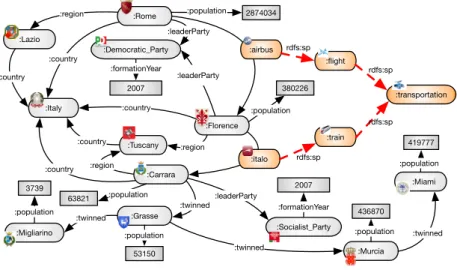
We introduce the main features of EPPs by describ-ing a few examples. An excerpt of a KG is given in Fig. 1. Intuitively, an EPP expression defines a binary relation on the nodes of the graph upon which it is eval-uated.
Example1. (Path Difference).Find pairs of cities lo-cated in the same country but not in the same region.
Navigational Languages such as Nested Expression (NRE) and PPs cannot express such requests due to the lack of path difference (the result has to exclude cities in the same region). With EPPs, the request can be ex-pressed as follows (the full syntax will be presented in Section 3.1):
?x ((:country/ˆ:country)∼(:region/ˆ:region)) ?y
The symbol ^ denotes backward navigation from the object to the subject of a triple. Path difference∼
enables to discard from the set of cities in the same country (i.e., :country/ˆ:country) those that are in the same region (i.e.,:region/ˆ:region). A SPARQL-independent evaluation pattern of the EPP expression1considers all the bindings of the variable
?x(representing one of the cities that are wanted) and then evaluates the expression from each binding. The result is the set of bindings for the variable?y, repre-senting the other city. From:Rome, the evaluation of the expression((:country/ˆ:country)∼(:region/ˆ:region))
reaches:Florenceand:Carrara. J
Example2. (Path Conjunction).Find pairs of cities located in the same country and in the same region.
?x ((:country/ˆ:country)&(:region/ˆ:region)) ?y
1We provide a detailed algorithm in Section 7.
In this case, path conjunction&enables to keep from the set of nodes satisfying the first subexpression those that also satisfy the second one. From:Florence, the evaluation of the expression((:country/ˆ:country)& (:region/ˆ:region)) reaches the cities :Florence
and:Carrara. J
Example3. (Tests).Find pairs of cities governed by the same political party founded before 2010.
?x (:leaderParty&&TP(_o,:formationYear&&
T(_o<2010))/ˆ:leaderParty) ?y
TP denotes a test for the existence of a path whose parameters specify the position in the triple from which the test starts (_o denotes the object of the last traversed triple), and a path (in this case :formationYear&&T(_o<2010)). The path is composed by logicalAND(&&) of two tests. The first checks the existence of an edge :formationYear and the second, which starts from the object of the last traversed triple (i.e., :formationYear), checks that the value is less than2010. PPs cannot express the query of Example 3 since do not have the possi-bility to check for path existence (i.e., nesting). NREs that have this type of construct cannot check for spe-cific conditions along the path; in particular, in this example we want only parties that have been founded before 2010. Starting from :Rome, the first logical AND (via &&) of two tests is performed; one checks for the existence of an edge :leaderParty, which leads to:Democratic_Party, while the other (i.e.,
TP) starts from the object of the previous navigational step, that is, the object of (:Rome, :leaderParty, :Democratic_Party). From:Democratic_Party, another logical AND (via &&) of two tests is eval-uated. The first one checks the existence of an edge :formationYear and enables to reach the node
2007; the second, which starts from the object of the previous step (i.e., 2007), checks that the value is < 2010; in this case the test succeeds and the eval-uation continues from :Democratic_Party by navigating the edge:leaderPartybackward and reaching the nodes:Florenceand:Romeincluded
in the results. J
Composing all the previous features together, we can express a more complex query.
2007 2007
:Rome
:Lazio
:Italy
:Florence
:Tuscany :Democratic_Party
:leaderParty
:leaderParty :leaderParty
:country
:country
:country :region
:region :formationYear
:formationYear :country
:country
rdfs:sp
:Grasse
:Murcia :twinned
:Migliarino
:twinned :twinned
:Miami
:twinned 3739
:population
53150 :population
436870
:population 419777
:population :transportation
:train :flight :airbus
:italo
rdfs:sp
rdfs:sp rdfs:sp
:region
:Carrara
:Socialist_Party 2874034
:population
63821 :population
380226
:population
Fig. 1. An excerpt of a Knowledge Graph taken from DBpedia.
?x ((:country/ˆ:country)∼(:region/ˆ:region))&
(:leaderParty&&TP(_o,:formationYear&&T(_o<2010))
/ˆ:leaderParty ?y
From:Rome, the evaluation of the first subexpres-sion, including:countryand :region, allows to reach the nodes:Florence and :Carrara. The evaluation of the second part of the path conjunction allows to reach the nodes:Romeand :Florence.
From:Romewe reach:Florence. J
Example 4 cannot be expressed by using NRE-based languages or PPs. These languages lack both path dif-ference (we want cities in the same country butnotin the same region) and conjunction (additionally, they must be governed by the same political party). We have discussed in the previous examples how a SPARQL-independent algorithm can evaluate EPP expressions. However, since our primary goal is to allow power-ful navigation queries on existing KGs query process-ing infrastructures, we devised a translation of non-recursive EPPs into SPARQL. Our approach follows the same reasoning as the translation of non-recursive PPs into SPARQL used by the current SPARQL stan-dard [18]. The advantage of using EPPs to write non-recursive navigational queries instead of writing them directly into SPARQL is that the same request can be expressed more succinctly and without the need to deal with intermediate variables.
Example5. The SPARQL query corresponding to the translation of the EPP expression in Example 4 is
shown in Fig. 2, where?v1, ?v2, ?v3and ?v4 are variables automatically generated by the transla-tion algorithm.
SELECT ?x ?y WHERE {
{?x :country ?v1.?y :country ?v1.} MINUS{?x :region ?v2.?y :region ?v2. } ?x :leaderParty ?v3. ?y :leaderParty ?v3. FILTER EXISTS{?v3 :formationYear ?v4. FILTER(?v4 < 2010)} }
Fig. 2. SPARQL translation of the EPP expression in Example 4. J
Example 6. (Arbitrary Path Length with Tests).
Find cities reachable from:Carraraconnected via a path of arbitrary length composed by edges la-bels :twinned and considering only those cities reachable by a chain of intermediate cities having :populationgreater than10000. The EPP expres-sion capturing this request is:
:Carrara(:twinned&&
TP(_o,:population&&T(_o>10000)))∗?y
The expression involves arbitrary length paths plus tests. The evaluation checks from the node:Carrara the existence of paths of arbitrary length (denoted by
∗) where each node reached in the path must satisfy
reaching:Murcia, which also passes theTPtest and :Migliarinothat does not pass the TPtest. The evaluation continues from:Murciaand stops when reaching the node:Miami, which passes theTPtest. Overall, we reach:Carrara,:Grasse,:Murcia,
and:Miami. J
The EPP expression in Example 6 cannot be trans-lated into a basic SPARQL query because it makes use of the closure operator ∗ (requiring the evalua-tion of (:twinned&&TP(_o,:population&&T(_o>10000))) an a-priori unknown number of times). To give seman-tics to this kind of EPP expression we introduce the evaluation functionEALP(Fig. 7), which extends the function ALP defined for PPs in the SPARQL stan-dard [10]. EPPs also supportpath repetitions(handled via EALP), that are a concise way of expressing the union of concatenations of an expression between a
minandmaxnumber of times.
Example 7. (Path Repetitions). If restricting the number of repetitions between 1 and 2, the expression in Example 6 can be written as follows:
:Carrara(:twinned&&
TP(_o,:population&&T(_o>10000))){{1,2}}?y
J
So far we have presented examples of isolated EPPs expressions. We now consider their usage in SPARQL.
Example8. (EPPs within SPARQL). Find pairs of cities (A,B) and their populations such that: (i) A and B are in the same country, but not in the same region; (ii) there exists some transportation from A to B.
SELECT ?cityA ?cityB ?popA ?popB WHERE { ?cityA :population ?popA.
?cityB :population ?popB. { /* BEGIN EPPs pattern */ ?cityA ((:country/^country) ~(:region/^:region))
&:transportation ?cityB. } /* END EPPs pattern */ }
Fig. 3. EPPs used inside SPARQL as for Example 8.
The query in Example 3 allows to obtain the popula-tion of the pairs of cities satisfying the EPP expression by introducing two additional patterns, where the vari-ables?popAand?popBare bound to population in-formation. When the query is evaluated on the graph reported in Fig. 1 it produces no results; for instance
the pair (:Rome, :Florence) is connected by an :airbusthat is a kind of:plane, which is a means of :transportation, but there is no edge whose
label is:transportation. J
The previous example does not take the KG RDFS schema into account. When considering transporta-tion services without specifying the exact type of ser-vice, one would be able to actually discover the con-nection between:Rome and:Florence. This can be achieved by performing sub-property inference ac-cording to the RDFS entailment regime. One crucial aspect of EPPs is that they can capture the main RDFS inference types by encoding each inference rule in a prototypical EPP expression (see Section 5.2), with the advantage that the resulting expressionscan be trans-lated into SPARQL and evaluated on existing proces-sors(viaALP).
Example9. (EPPs and Reasoning). The EPPs in Ex-ample 8 can be automatically rewritten into an EPP supporting RDFS reasoning as follows:
SELECT ?cityA ?cityB ?popA ?popB WHERE { ?cityA :population ?popA.
?cityB :population ?popB. { /* BEGIN EPPs pattern */ ?cityA
((:country/^country)~(:region/^:region))& (TP(_p,(rdfs:sp*/rdfs:sp)
&&T(_o=:transportation)) ||T(_p=:transportation)))))
?cityB.
}} /* END EPPs pattern */
The translation to SPARQL this query is reported in Fig. 4. When this query is evaluated on the graph in Fig. 1 it produces (?cityA→:Rome, ?cityB→
:Florence,?popA→2874034,?popB→380226). J
1.2. Contributions and Organization
The contribution of the paper are both theoretical and practical.
– We introduce two languages EPPs and iEPPs to query KGs. They have the same syntax but dif-ferent semantics; one based on multisets (Sec-tion 3.2) and complying with SPARQL, and the other based on sets (Section 7.1).
pro-SELECT ?cityA ?cityB ?popA ?popB WHERE
{ ?cityA: population ?popA. ?cityB : population ?popB. /* BEGIN EPPs-\rhoDF to SPARQL TRANSLATION */ { {?cityA ? pN_0_0_0 ? middleN_0_0.
FILTER(?pN_0_0_0 =:country)} UNION
{?cityA ?pN_0_0_0 ?middleN_0_0.
FILTER EXISTS {?pN_0_0_0 sp* ?middleN_0_0_0_0_1_0. ?middleN_0_0_0_0_1_0 sp ?endN_0_0_0_0_1_0. FILTER( ?endN_0_0_0_0_1_0 = :country)} {?cityB ?pN_0_0_1 ?middleN_0_0. FILTER(( ?pN_0_0_1 = :country)} UNION { ?cityB ?pN_0_0_1 ?middleN_0_0.
FILTER EXISTS {?pN_0_0_1 sp * ?middleN_0_0_1_0_1_0. ?middleN_0_0_1_0_1_0 sp ?endN_0_0_1_0_1_0. FILTER( ?endN_0_0_1_0_1_0 = :country)} }
MINUS
{?cityA ? pN_0_1_0 ? middleN_0_1. FILTER( ?pN_0_1_0 = :region)}} UNION {?cityA ?pN_0_1_0 ?middleN_0_1.
FILTER EXISTS {?pN_0_1_0 sp * ?middleN_0_1_0_0_1_0. ?middleN_0_1_0_0_1_0 sp ? endN_0_1_0_0_1_0. FILTER( ? endN_0_1_0_0_1_0 = : region)} { ?cityB ?pN_0_1_1 ?middleN_0_1. FILTER( ?pN_0_1_1 = :region)} UNION {?cityB ?pN_0_1_1 ?middleN_0_1.
FILTER EXISTS {?pN_0_1_1 sp * ?middleN_0_1_1_0_1_0. ?middleN_0_1_1_0_1_0 sp ? endN_0_1_1_0_1_0. FILTER( ? endN_0_1_1_0_1_0 = region)} }
{ ?cityA ?pN_1 ?cityB. FILTER( ? pN_1 = : transportation) } UNION {?cityA ? pN_1 ? cityB.
FILTER EXISTS { ?pN_1 sp * ?middleN_1_0_1_0. ?middleN_1_0_1_0 sp ?endN_1_0_1_0.
FILTER( ? endN_1_0_1_0 = : transportation)} }} /* END rhoDF-EPPs to SPARQL TRANSLATION */ }
Fig. 4. SPARQL translation of Example 9.
cessors; on the other hand, the usage of our trans-lation paves the way toward readily incorporating EPPs in the current SPARQL standard.
– Building upon our translation, we also show how a SPARQL query can be rewritten into another SPARQL query that incorporates reasoning capa-bilities and can be evaluated on existing SPARQL processors (Section 5).
– We implement the nEPPs to SPARQL translation as an extension of the Jena library and an iEPPs query processor. Both are available on-line2.
– We perform an extensive experimental evaluation on a variety of real data sets (Section 8).
From a theoretical point of view:
– We introduce iEPPs as a SPARQL-independent language and discuss its complexity (Section 7.2).
– We report novel expressiveness results about the capability of SPARQL in expressing navigational queries. We show that SPARQL is expressive enough to capture nEPPs (Section 4.2).
– We prove that the language of EPPs is more ex-pressive than that of PPs and, as a by-product, that the fragment of SPARQL including EPPs, AND and UNION is more expressive than the fragment
2https://extendedpps.wordpress.com
of SPARQL including PPs, AND and UNION (Section 6.1).
– We provide a novel study about the expressive-ness of SPARQL in terms of the main reason-ing capabilities of RDFS (defined as ρdf [19]) when considering different navigational cores (Section 6.2). We show that SPARQL is expres-sive enough to captureρdf.
The remainder of the paper is organized as follows. We provide some background definitions in Section 2. Section 3 presents the EPPs syntax and semantics. Sec-tion 4 formalizes the translaSec-tion of non-recursive EPPs into SPARQL queries. Section 5 shows how EPPs sup-port reasoning. The expressiveness of EPPs is analyzed in Section 6. The iEPPs language is described in Sec-tion 7. The implementaSec-tion and the evaluaSec-tion of EPPs and iEPPs are discussed in Section 8. Section 9 dis-cusses related literature. We conclude in Section 10.
2. Preliminaries
In this section we provide some background about RDF, SPARQL and SPARQL property paths. An RDF triple3is a tuple of the formhs,p,oi ∈I×I×I∪L, whereIandLare countably infinite sets of IRIs and literals respectively. An RDF graphGis a set of triples. The set of terms of an RDF graph (i.e., the set of IRIs and literals appearing in the graph) is denoted by terms(G)while nodes(G)denotes the set of terms used as a subject or object of a triple. In what follows we will focus on the fragment of SPARQL including theSELECTquery form and provide a formalization of its semantics along the lines of Angles and Gutier-rez [20] that is faithful to the semantics of the W3C standard.
2.1. Background on SPARQL
LetV be a countably infinite set of variables, such that V ∩(I∪L) = ∅. A (solution) mapping µis a
partial functionµ: V → I∪L. Theempty mapping, denotedµ0, is the mapping satisfyingdom(µ0) = ∅.
Two mappings, sayµ1andµ2, arecompatible (resp., not compatible), denoted byµ1∼µ2(resp.,µ16∼µ2), ifµ1(?X) =µ2(?X)for all variables?X∈ dom(µ1)∩ dom(µ2)
(resp., ifµ1(?X) 6=µ2(?X)for some?X ∈
3To simplify the discussion we do not consider blank nodes in
(dom(µ1)∩dom(µ2))). If µ1 ∼ µ2 then we write
µ1∪µ2for the mapping obtained by extendingµ1 ac-cording toµ2 on all variables in dom(µ2)\dom(µ1). Note that two mappings with disjoint domains are al-ways compatible, and that the empty mappingµ0 is compatible with any other mapping. Given a finite set of variables W ⊂ V, the restriction of a map-pingµtoW, denotedµ|W, is a mappingµ0 satisfying
dom(µ0) = dom(µ)∩Wandµ0(?X) =µ(?X)for ev-ery?X∈dom(µ)∩W.
A selection formula is defined recursively as fol-lows: (i) If?X,?Y ∈ V andc∈I∪Lthen(?X =c), (?X =?Y)andbound(?X) are atomic selection for-mulas; (ii) If F and F0 are selection formulas then (F∧F0),(F∨F0)and¬(F)are boolean selection for-mulas. The evaluation of a selection formulaF under
µ, denotedµ(F), is defined in a three-valued logic (i.e. with valuestrue,false, anderror) as follows:
– IfFis?X =cand?X ∈ dom(µ), thenµ(F) =
truewhenµ(?X) =candµ(F) =false oth-erwise. If?X∈/dom(µ)thenµ(F) =error.
– If F is ?X =?Y and ?X,?Y ∈ dom(µ), then
µ(F) =truewhenµ(?X) =µ(?Y)andµ(F) =
false otherwise. If either ?X ∈/ dom(µ) or ?Y∈/dom(µ)thenµ(F) =error.
– If F is bound(?X) and ?X ∈ dom(µ) then
µ(F) =trueelseµ(F) =false.
– IfFis a complex selection formula then it is eval-uated following the three-valued logic presented in Table 1.
Table 1
Three-valued logic for evaluating selection formulas.
p q p∧q p∨q
true true true true
true false false true
true error error true
false true false true
false false false false
false error false error
error true error true
error false false error
error error error error
p ¬p
true false
false true
error error
We use the symbol Ω to denote a multiset and card(µ,Ω) to denote the cardinality of the map-ping µ in the multiset Ω. Moreover, it applies that
card(µ,Ω) = 0 when µ /∈ Ω. We use Ω0 to
de-note the multiset containing only the mappingµ0, that iscard(µ0,Ω0) > 0 (Ω0 is called the join identity). The domain of a solution mapping Ω is defined as
dom(Ω) = S
µ∈Ωdom(µ). TheSPARQL algebra for multisets of mappingsis composed of the operations of projection, selection, join, difference, left-join, union and minus. LetΩ1,Ω2be multisets of mappings,Wbe a set of variables andFbe a selection formula.
Definition10. (Operations over multisets of map-pings).LetΩ1andΩ2be multiset of mappings, then:
Projection: πW(Ω1) = {µ0 | µ ∈ Ω1, µ0 = µ|W},
card(µ0, πW(Ω1)) =Pµ∈Ω1s.t.µ0=µ|Wcard(µ,Ω1) Selection: σF(Ω1) = {µ ∈ Ω1 | µ(F) = true}
wherecard(µ, σF(Ω1)) = card(µ,Ω1)
Union: Ω1∪Ω2 = {µ | µ ∈ Ω1∨µ ∈ Ω2} where
card(µ,Ω1∪Ω2) = card(µ,Ω1) + card(µ,Ω2)
Join: Ω1 on Ω2={µ = (µ1∪µ2) | µ1 ∈ Ω1, µ2 ∈
Ω2, µ1∼µ2},card(µ,Ω1onΩ2)= =P
µ1∈Ω1andµ2∈Ω2s.t.µ=(µ1∪µ2)card(µ1,Ω1)× card(µ2,Ω2).
Difference: Ω1\FΩ2={µ1∈Ω1| ∀µ2∈Ω2,(µ1
µ2)∨(µ1∼µ2∧(µ1∪µ2)(F) =false)}where
card(µ1,Ω1\FΩ2) = card(µ1,Ω1)
Minus: Ω1−Ω2={µ1∈Ω1| ∀µ2∈Ω2, µ1µ2∨
dom(µ1)∩dom(µ2) =∅}wherecard(µ1,Ω1−
Ω2) = card(µ1,Ω1).
Left Join: Ω1yqonFΩ2 =σF(Ω1 onΩ2)∪(Ω1\F Ω2) wherecard(µ,Ω1yqonFΩ2) = card(µ, σF(Ω1 on
Ω2)) + card(µ,Ω1\FΩ2).
2.2. SPARQL Patterns
We now introduce SPARQL graph patterns. Agraph patternis defined recursively as follows:
– A tuple from(I∪L∪ V)×(I∪ V)×(I∪L∪ V) is a graph pattern called atriple pattern4.
– If P1 and P2 are patterns then (P1ANDP2),
(P1UNIONP2), (P1OPTIONALP2), (P1MINUSP2)
and(P1NOT-EXISTSP2)are graph patterns.
– IfP1 is a pattern andC is a filter constraint (as defined below) then(P1FILTERC)is a pattern.
Afilter constraintis defined recursively as follows: (i) If?X,?Y ∈ Vandc∈I∪Lthen(?X=c),(?X = ?Y)andbound(?X)areatomic filter constraints; (ii) If
C1andC2are filter constraints then(!C1),(C1||C2) and(C1&&C2)arecomplex filter constraints. Given a filter constraintC, we denote by f(C)the selection formula obtained fromC. Note that there exists a sim-ple and direct translation from filter constraints to se-lection formulas and vice-versa.
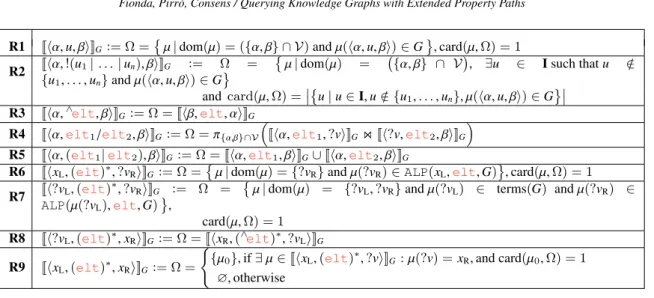
R1 [[hα,u, βi]]G := Ω =
µ|dom(µ) = ({α, β} ∩ V)andµ(hα,u, βi)∈G ,card(µ,Ω) = 1
R2 [[hα,!(u1|. . .|un), βi]]G := Ω =
µ|dom(µ) = {α, β} ∩ V
, ∃u ∈ Isuch thatu ∈/ {u1, . . . ,un}andµ(hα,u, βi)∈G
and card(µ,Ω) =
u|u∈I,u∈ {/ u1, . . . ,un}, µ(hα,u, βi)∈G
R3 [[hα,∧
elt, βi]]G:= Ω = [[hβ,elt, αi]]G
R4 [[hα,elt1/elt2, βi]]G := Ω =π{α,β}∩V
[[hα,elt1,?vi]]Gno[[h?v,elt2, βi]]G
R5 [[hα,(elt1|elt2), βi]]G := Ω = [[hα,elt1, βi]]G∪[[hα,elt2, βi]]G
R6 [[hxL,(elt)∗,?vRi]]G := Ω =µ
|dom(µ) ={?vR}andµ(?vR)∈ALP(xL,elt,G) ,card(µ,Ω) = 1
R7 [[h?vL,(elt)
∗,
?vRi]]G := Ω = µ
|dom(µ) = {?vL,?vR}andµ(?vL) ∈ terms(G) andµ(?vR) ∈
ALP(µ(?vL),elt,G) ,
card(µ,Ω) = 1
R8 [[h?vL,(elt)∗,xRi]]G := Ω = [[hxR,(∧elt)∗,?vLi]]G
R9 [[hxL,(elt)∗,xRi]]G := Ω = (
{µ0},if∃µ∈[[hxL,(elt)∗,?vi]]G:µ(?v) =xR,and card(µ0,Ω) = 1 ∅,otherwise
Fig. 5. Standard query semantics of SPARQL Property Paths, whereα, β∈(I∪L∪ V); u,u1, ...,un∈I; xL,xR∈(I∪L); ?vL,?vR∈ V;
?v∈ Vis a fresh variable.
FunctionALPγ,elt,G
Input:γ∈(I∪L),
eltis a PP expression,
Gis an RDF graph. 1: Visited:=∅
2: ALPγ,elt,Visited,G
3: returnVisited
FunctionALP γ,elt,Visited,G
Input:γ∈(I∪L), eltis a PP expression,
Visited⊆(I∪L), Gis an RDF graph. 4: ifγ /∈Visitedthen
5: addγtoVisited
6: for allµ∈[[h?x,elt,?yi]]Gsuch thatµ(?x) =γand?x,?y∈ Vdo 7: ALPµ(?y),elt,Visited,G
Fig. 6. Auxiliary functions used for defining the semantics of PP expressions of the formelt∗.
Given a triple patterntand a mappingµsuch that
var(t) ⊆ dom(µ), we denote by µ(t) the triple ob-tained by replacing the variables intaccording toµ. Overloading the above definition, we denote byµ(P) the graph pattern obtained by the recursive substitution of variables in every triple pattern and filter constraint occurring in the graph patternPaccording toµ.
2.3. Semantics of SPARQL graph patterns
The evaluation of a SPARQL graph patternP over an RDF graphGis defined as a functionJPKG which
returns a multiset of solution mappings. LetP1,P2,P3 be graph patterns andCbe a filter constraint. The eval-uation of a graph patternP over a graphGis defined recursively as follows:
– If P is a triple pattern tp then JtpKG={µ |
dom(µ)=var(tp)and µ(tp) ∈ G} wherevar(tp) is the set of variables intpand the cardinality of each mapping is 1.
– IfP=(P1AND P2), thenJPKG=JP1KGonJP2KG
– IfP=(P1UNION P2), thenJPKG=JP1KG∪JP2KG
– IfP=(P1OPTIONAL P2), then: then
(a) if P2 is (P3FILTERC) then JPKG = JP1KGyqonf(C)JP3KG
(b) elseJPKG=JP1KGyqon(true)JP2KG
– IfP=(P1MINUS P2), thenJPKG=JP1KG−JP2KG
– IfP=(P1NOT-EXISTSP2), then
J(P1NOT-EXISTSP2)KG ={µ|µ∈JP1KG∧ Jµ(P2)KG=∅}
– IfP=(P1FILTER C), thenJP1FILTERCKG=σf(C)(JP1KG)
2.4. SPARQL Property Paths
Property paths (PPs) have been incorporated into the SPARQL standard with two main motivations; first, to provide explicit graph navigational capabilities (thus allowing the writing of SPARQL navigational queries in a more succinct way); second, to introduce the tran-sitive closure operator ∗ previously not available in SPARQL. The design of PPs was influenced by earlier proposals (e.g., PSPARQL [21], nSPARQL [11]).
expres-sion) that is defined by the following grammar (where
u,u1, . . . ,un∈I):
elt :=u !(u1|. . .|un)
!(ˆu1|. . .|ˆun)!(u1|. . .|uj|. . .|ˆuq|. . .|ˆun)
elt/elt
(elt|elt) (elt)
∗
ˆelt
The SPARQL standard introduces additional types of PP expressions [18]; since these are merely syntac-tic sugar (they are defined in terms of expressions cov-ered by the grammar given above), we ignore them in this paper. As another slight deviation from the stan-dard, we do not permit blank nodes in PP patterns. PP patterns with blank nodes can be simulated using fresh variables. The SPARQL standard distinguishes between two types of property path expressions: con-nectivity patterns(or recursive PPs) that include clo-sure (*), and syntactic short forms or non-recursive PPs (nPPs) that do not include it. As for the evaluation of PPs, the W3C specificationinformallymentions the fact that nPPs can be evaluated via a translation into equivalent SPARQL basic expressions (see [10], Sec-tion 9.3). Property path patterns can be combined with graph patterns inside SPARQL patterns (using PP ex-pressions in the middle position of a pattern).
2.5. Property Path Semantics
The semantics of Property Paths (PPs) is shown in Fig. 5. The semantics uses the evaluation function
Jhα,elt, βiKG, which takes as input a PP pattern and
a graph and returns a multiset of solution mappings. In Fig. 5 we do not not report all the combinations of types of patterns as they can be derived in a similar way. For connectivity patterns the SPARQL standard introduces an auxiliary function calledALPthat stands forArbitraryLengthPaths (see Fig. 6); in this case the evaluation does not admit duplicates (thus solving a problem in an early version of the semantics that was based on counting [12, 22]).
3. Extended Property Paths
We now introduce our navigational extension of SPARQL called Extended Property Paths (EPPs). We present the syntax in Section 3.1 and the SPARQL-based formal semantics in Section 3.2.
3.1. Extended Property Paths Syntax
EPPs extend PPs and NRE-like languages with path conjunction/difference, repetitions and more types of tests. The importance of the new features considered by EPPs is witnessed by the fact that some of them (e.g., conjunction) are present in standards like XPath 2.0 [23]. Nevertheless, to the best of our knowledge no previous navigational extension of SPARQL has con-sidered these features. As our goal is to extend the current SPARQL standard we refer the reader to Sec-tion 7 for a treatment of EPPs as a language indepen-dent from SPARQL.
Definition 12. (Extended Property Path Pattern). Anextended property path pattern(orEPP patternfor short) is a tupleEP=hα,epp, βiwithα∈(I∪L∪V),
β∈(I∪L∪V), andeppanextended property path ex-pression(EPP expression) that is defined by the gram-mar reported in Table 2.
EPPs introduce the following features: path con-junction (epp1&epp2), path difference (epp1∼epp2), path repetitions between l and h times (denoted by epp{l,h}for set, andepp{{l,h}}for bag semantics). EPPs allow different types of tests (test) within a path by specifying thestarting/endingpositions (POS) of a test; it is possible to test from each of the sub-ject, predicate and object positions in triples, mapped in the EPPs syntax to the position symbols _s, _p
and_o, respectively. Positions do not need to be al-ways specified; by default a test starts from the sub-ject (_s) and ends on the object (_o) of the triple be-ing evaluated. A test (test) can be a simple check for the existence of an IRI in forward/reverse direc-tion. EPPs allow to express negated property sets by using the production test with the difference that the set of negated IRIs use the symbol ‘||’ as sepa-rator instead of ‘|’ used by PPs. A test can also be a nested EPP, i.e.,TP(POS,epp), which corresponds to the evaluation of the expressioneppstarting from a position POS (of the last triple evaluated) and re-turns true if, and only if, there exists at least one node that can be reached via epp. In a test of type T,EExp(not reported here for sake of space) extends the production [110] in the SPARQL grammar5where BuiltInCall6is substituted with a new production calledExtended-BuiltInCall, which enables to use in EPPs tests available in SPARQL as built-in
Table 2
Syntax of EPPs.1If omitted is_s;2If omitted is_o.
epp::= ‘ˆ’epp | epp‘+’|epp‘?’|epp‘∗’|epp‘/’epp |epp‘|’epp |
‘(’epp‘)’|[POS]1test[POS]2| epp‘&’epp |epp‘∼’epp|
epp‘{’l,h‘}’|epp‘{{’l,h‘}}’
test::= ‘!’test | test‘&&’test | test‘||’test |‘(’test‘)’| base base::= iri|‘TP(’POS‘,’epp‘)’|‘T(’EExp‘)’
POS::= ‘_s’|‘_p’|‘_o’
Table 3
EPPs SPARQL-based semantics. The functionEThandles tests.Π(POS,t)projects the element in positionPOSof a triplet ∈G. Moreover,
u∈I;?vL,?vR∈ Vand?vn∈ Vis a fresh variable.Evaluateis a function that checks if the tripletsatisfiesEExp.
R1 [[h?vL,ˆepp,?vRi]]G:= [[h?vR,epp,?vLi]]G
R2 [[h?vL,epp1/epp2,?vRi]]G:=π{?vL,?vR}
[[h?vL,epp1,?vni]]Gno[[h?vn,epp2,?vRi]]G
R3 [[h?vL,(epp)∗,?vRi]]G:=
µ
|dom(µ) ={?vL,?vR}, µ(?vL)∈terms(G)andµ(?vR)∈EALP(µ(?vL),epp,G,0,∗) ,card(µ,Ω) = 1 R4 [[h?vL,(epp)+,?vRi]]G:=µ|dom(µ) ={?vL,?vR}, µ(?vL)∈terms(G)andµ(?vR)∈EALP(µ(?vL),epp,G,1,∗) ,card(µ,Ω) = 1 R5 [[h?vL,(epp)?,?vRi]]G:=µ|dom(µ) ={?vL,?vR}, µ(?vL) =µ(?vR)orµ∈[[h?vL,(epp),?vRi]]G},card(µ,Ω) = 1
R6 [[h?vL,(epp1|epp2), βi]]G:= [[h?vL,epp1,?vRi]]G∪[[hα,epp2,?vRi]]G
R7 [[h?vL,epp1&epp2,?vRi]]G:= [[h?vL,epp1,?vRi]]Gon[[h?vL,epp2,?vRi]]G
R8 [[h?vL,epp1∼ epp2,?vRi]]G:= [[h?vL,epp1,?vRi]]G−[[h?vL,epp2,?vRi]]G
R9 [[h?vL,epp{{l,h}},?vRi]]G:=Shi=l[[h?vL,eppi,?vRi]]G
R9’ [[h?vL,epp{l,h},?vRi]]G:=
µ
|dom(µ) ={?vL,?vR}, µ(?vL)∈terms(G)andµ(?vR)∈EALP(µ(?vL),epp,G,l,h) ,card(µ,Ω)=1 R10 [[h?vL,POS1testPOS2,?vRi]]G:=ETJ?vLPOS1testPOS2?vRKG
R11 ETJ?vLPOS1uPOS2?vRKG:=
µ
|dom(µ) ={?vL,?vR}, µ(?vL) = Π(POS1,t), µ(?vR) = Π(POS2,t),t.p=u,t∈G ,
card(µ,Ω)=|{t|t∈G,t.p=u, µ(?vL) = Π(POS1,t), µ(?vR) = Π(POS2,t)}| R12 ETJ?vLPOS1TP(POSn,eppn)POS2?vRKG:=
µ
|dom(µ) ={?vL,?vR},∃µ0∈JΠ(POSn,t)eppn?vnK, dom(µ
0) ={?vn},
µ(?vL)=Π(POS1,t), µ(?vR)=Π(POS2,t),t∈G ,card(µ,Ω)=|{t|t∈G,∃µ0∈JΠ(POSn,t)eppn?vnK,
dom(µ0) ={?vn}, µ(?vL) = Π(POS1,t), µ(?vR) = Π(POS2,t)}| R13 ETJ?vLPOS1T(EExp)POS2?vRKG:=
µ
|dom(µ) ={?vL,?vR}, µ(?vL) = Π(POS1,t), µ(?vR) = Π(POS2,t),t∈G,
Evaluate(EExp,t) =true ,card(µ,Ω)=|{t|t∈G,Evaluate(EExp,t) =true,
µ(?vL) = Π(POS1,t), µ(?vR) = Π(POS2,t)}|
R14 ETJ?vL(POS1test1POS2) && (POS1test2POS2) ?vRKG:=ETJ?vL(POS1test1POS2)?vRKGonETJ?vL(POS1test2POS2)?vRKG
R15 ETJ?vL(POS1test1POS2)||(POS1test2POS2) ?vRKG:=ETJ?vL(POS1test1POS2)?vRKG∪ETJ?vL(POS1test2POS2)?vRKG
R16 ETJ?vLPOS1!testPOS2?vRKG:= µ
|dom(µ) ={?vL,?vR}, µ(?vL) = Π(POS1,t), µ(?vR) = Π(POS2,t),t∈G} − ETJ?vLPOS1testPOS2?vRKG
ditions also augmented with positions (POS). Built-in conditions are constructed usBuilt-ing elements of the set I∪ L and constants, logical connectives (¬, ∧, ∨), (in)equality symbol(s) (=,<,>,6,>), unary (e.g.,
isURI,) and binary (e.g., STRSTARTS) functions. Tests can also be combined by using the logical op-eratorsAND (&&), OR (||) and NOT (!). We refer to non-recursive EPPs (nEPPs) as those expressions that do not include closure operators (i.e., ∗ and+) and set-semantics repetitions ({l,h}). The reader can refer to the Website of the EPPs project7for further details
about the implementation.
7http://extendedpps.wordpress.com
3.1.1. Positions and Tests
To clarify the intuition behind tests and positions, we introduce the function Π(POS,t), which projects the element in position POS of a triplet. If we have
t=hu1,p1,u2i, the test T(_p=p1) is translated to
Π(_p,hu1,p1,u2i)=p1 that checks p1=p1, and, in this case, returns true; however, it returns false for T(_o=u3). Fig. 8 shows the expression from Exam-ple 4 including default positions and positions to traverse backward edges. Note that the subexpres-sion (_o :leaderParty _s) means that the edge
:leaderPartyis traversed from the object to the subject and, thus, backward.
3.2. Extended Property Paths Semantics
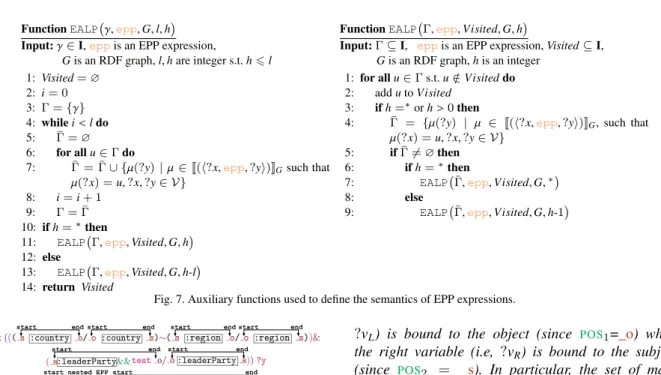
FunctionEALPγ,epp,G,l,h
Input:γ∈I,eppis an EPP expression,
Gis an RDF graph,l,hare integer s.t.h6l
1: Visited=∅
2: i= 0 3: Γ ={γ}
4: whilei<ldo 5: Γ =¯ ∅
6: for allu∈Γdo
7: Γ = ¯¯ Γ∪ {µ(?y)|µ∈[[(h?x,epp,?yi)]]Gsuch that
µ(?x) =u,?x,?y∈ V}
8: i=i+ 1 9: Γ = ¯Γ 10: ifh=∗then
11: EALP Γ,epp,Visited,G,h
12: else
13: EALP Γ,epp,Visited,G,h-l
14: return Visited
FunctionEALP Γ,epp,Visited,G,h
Input:Γ⊆I, eppis an EPP expression,Visited⊆I,
Gis an RDF graph,his an integer 1: for allu∈Γs.t.u∈/Visiteddo 2: addutoVisited
3: ifh=∗orh>0then
4: ¯Γ = {µ(?y) | µ ∈ [[(h?x,epp,?yi)]]G, such that
µ(?x) =u,?x,?y∈ V}
5: ifΓ¯6=∅then
6: ifh=∗then
7: EALPΓ¯,epp,Visited,G,∗
8: else
9: EALPΓ¯,epp,Visited,G,h-1
Fig. 7. Auxiliary functions used to define the semantics of EPP expressions.
start end start end start end start end
start end
start end
start nested EPP start end
Fig. 8. Expression in Example 4 with positions.
instead of a PP expressioneltnow appears an EPP expressionepp. This semantics lays the foundations for the translation algorithm (see Section 4) that given a (concise) nEPP expression produces a semantically equivalent (more verbose) SPARQL query. In the se-mantics shown in Table 3 we only report the case
α, β ∈ V (and use the symbols ?vL and ?vR to
de-note the left and right variable in the pattern); the other cases (e.g.,α∈I,β∈ V) are similar. We denote with
ta triple hs,p,oi ∈ G;t.xwithx ∈{s,p,o}is used to access an element of the triple. Finally, the notation eppiis a shorthand for the concatenation (i.e., via the operator ’/’) of eppi times. A peculiar construct of EPPs is the testPOS1testPOS2, which is handled at a high level by rule R10. In particular tests make usage of the semantic functionET, which handles the
differ-ent kinds of tests via rules R11-R16. Moreover,POS1 andPOS2 denote the positions (i.e., subject_s, pred-icate_por object_o) of the elements of a triple that have to be projected. We now provide some examples of R11-R13 by using the graph in Figure 1.
Example13. Consider the following EPP expression:
_o:leaderParty_s. This type of test is handled via rule R11 in Table ?? and considers all triples t∈G where :leaderParty appears in the predi-cate position. In the set of mappins obtained by ap-plying rule R11 on such triples, the left variable (i.e,
?vL) is bound to the object (since POS1=_o) while the right variable (i.e, ?vR) is bound to the subject (since POS2 = _s). In particular, the set of map-pings is:{(?vL → :Democratic_Party,?vR →
:Rome),(?vL → :Democratic_Party,?vR →
:Florence),(?vL→:Socialist_Party,?vR→
:Carrara)}.
Example14. Consider the following EPP expression:
_s TP(_o,:leaderParty) _o, which is handled via rule R12 in Table ??. In this case, the triples t ∈ G considered are those such that from their object, the EPP :leaderParty has a solution (∃ µ0∈
JΠ(POSn,t) eppn ?vnK). In more detail, these
triples have one among :Rome, :Florence or :Carrarain the object position (in particular, the two triples h:Rome,:airbus,:Florencei and
h:Florence,:italo,:Carrarai). To obtain the set of mappings from these triples, the left variable in rule R12 (i.e,?vL) will be bound to their subject (since
POS1=_s) and the right variable (i.e,?vR) to their ob-ject (sincePOS2 = _o). Overall, the set of mappings is:{(?vL → :Rome,?vR → :Florence),(?vL →
:Florence,?vR →:Carrara)}.
Example15. Consider the following EPP expression:
_s T(_o>400000) _p handled via rule R13 in Ta-ble ??. The set of triples t ∈ G that are of interest in this case are those in which the object has a value greater than400000(Evaluate(EExp,t) =true). These are:h:Rome,::population,2874034i,
h:Murcia,:population,436870iand
(since POS1=_s) and the right variable (i.e, ?vR) to the predicate (sincePOS2 =_p). The set of mappings is: {(?vL → :Rome,?vR → :population),(?vL →
:Murcia,?vR→:population), (?vL→:Miami,?vR→:population)}.
Closure and Repetitions. The closure operators ‘*’ and ‘+’ and set-semantics repetitions ({l,h}) use the function EALP (Extended Arbitrary Length Paths) shown in Fig. 7, which extends theALPfunction de-fined in the W3C specification (see Fig. 6). In partic-ular,EALPhandles the set-semantic repetitions of an EPP expressioneppbetween a minimumland a max-imum h of times. The closure operators ‘*’ and ‘+’ are handled by settingl = 0(respectively,l = 1) and
h=∗.EALPuses the global variableVisitedto keep track of the nodes already checked that belong to the results. The main task carried out byEALPis to skip the firstl−1navigational steps so that the results are stored inVisitedstarting from the steplviaEALP. We now further clarify the behavior ofEALPandEALP.
Example 16. Consider the expression :Carrara
(:twinned)∗ ?e evaluated according to EALP on the graph in Figure 1. As the expression involves the closure operator, EALP is called with the following parameters:EALP :Carrara,:twinned,G,0,∗. EALP initializes the global variable Visited to the empty set and the variableΓto the set{:Carrara}
(lines 1 and 3). Thewhilecycle is never executed as l = 0. Since h =∗ the function EALP is called as: EALP {:Carrara},:twinned,∅,G,∗. At this point, when the for cycle starts we have that Γ = {:Carrara}and Visited=∅(line1). Then,:Carrara is added to Visited (line 2) and the setΓ¯is computed, which includes all nodes reachable from:Carrara by traversing a :twinned edge (line 4), that is,
¯
Γ={:Grasse}; EALP is called again with the pa-rameters:EALP {:Grasse},:twinned,{:Carrara},G,∗
(line 6);Γcontains one IRI (i.e.,:Grasse) and the forcycle is executed only once::Grasseis added to Visited (line 2) andΓ =¯ {:Migliarino,:Murcia}
(line 4).EALP is called again with the parameters: EALP{:Migliarino,:Murcia},:twinned,{:Carrara,:Grasse},G,∗ (line 6). This timeΓcontains two IRIs (i.e.,:Migliarino and:Murcia) and theforcycle is executed twice one for each such IRIs. With:Migliarinowe have that
¯
Γ =∅andEALPis not called anymore.
With:Murciawe have thatΓ =¯ {:Miami}and EALPis called as:EALP {:Miami},:twinned, {:Carrara,:Grasse,:Migliarino,:Murcia},G,∗. SinceΓcontains one IRI only (i.e.,:Miami) thefor
cycle is executed only once: :Miami is added to Visited,Γ =¯ ∅andEALPis not called anymore. Since Visited is a global variable, the result of the execution is:{:Carrara,:Grasse,:Migliarino,
:Murcia,:Miami}. J
Example17. Consider the EPP expression:Carrara
(:twinned){1,2}?eevaluated on the graph in Fig-ure 1. This time EALP is called with the parame-ters: EALP :Carrara,:twinned,G,1,2
. EALP initializes the global variable Visited to the empty set and the variableΓ to the set {:Carrara} (lines 1 and 3). Thewhile cycle is executed for one iteration only since l = 1. The setΓ¯ is computed starting from :Carrara; in this case it isΓ¯={:Grasse}.EALP will be called on this set. In particular, since h = 2
the function EALP is called with the following pa-rameters: EALP {:Grasse},:twinned,∅,G,1).
The for cycle is executed only once, since Γ = {:Grasse} and Visited = ∅ (line1). After the execution Γ¯ = {:Migliarino,:Murcia} and EALP is called again as: EALP {:Migliarino,
:Murcia},:twinned,{:Grasse},G,0). As h = 0 :Migliarino and :Murcia are added to Vis-ited; however, theforcycle will not be executed. The result is{:Grasse,:Migliarino,:Murcia}. J
Usage of EPPs in Practice.The overall goal of our proposal is touse EPP expressions in the predicate po-sition of a property pattern (Definition 11) in lieu of PP expressions. This requires to “update" the SPARQL parser to support the nEPPs syntax. The aim of the Jena extension we implemented8 was to integrate nEPPs into an already existing (and popular) library. Clearly, while nEPPs expressions can be evaluated on current SPARQL processors, the evaluation of full EPPs expressions requires to also “update" query pro-cessors by replacing theALPprocedure withEALP.
3.3. Fragments of SPARQL Considered
In the remainder of the paper we will focus on the
SELECTquery form and consider the SPARQL
frag-ments shown in Table 4. These fragfrag-ments are built using combinations of: (i) the operatorson (AND),∪
(UNION),−(MINUS),FILTER; (ii) the functionsALP
andEALP(introduced in Section 3.2); (iii) PP and EPP languages.
Table 4
Fragments of SPARQL, using theSELECTquery form, considered in this paper.
Fragment on(AND) ∪(UNION) −(MINUS) FILTER PP EPP ALP EALP
S{./} x
S{./,∪,FILTER} x x x
S{./,∪,−,FILTER} x x x x
S{./,∪,FILTER,ALP} x x x x
S{./,∪,−,FILTER,EALP} x x x x x
S{./,∪,PP} x x x
S{./,∪,EPP} x x x
S{./,∪,FILTER,PP,ALP} x x x x x
S{./,∪,FILTER,EPP,EALP} x x x x x
4. Translation of nEPPs into SPARQL
The goal of this section is to formalize and describe a translation algorithm that given a non-recursive EPPs (nEPP) translates it into a SPARQL query. Our approach follows the same line of thought as the SPARQL standard for the translation of non-recursive property paths (nPPs) into SPARQL queries. As a by-product, our study formalizes the informal procedure mentioned in the W3C specification for non-recursive PPs (see [10], Section 9.3) and does it for a more ex-pressive language.
4.1. Translation Algorithm: an overview
We now provide an overview of the translation algo-rithmAt. The algorithm takes as input a nEPP pattern
P=hα,epp, βiand produces a semantically equivalent SPARQL queryQe. The algorithm involves three main steps:(i)building of the operational tree;(ii) propaga-tion of variables and termsalong the nodes of the op-erational tree;(iii)application of the translation rules. Each of the three steps is discussed in detail in the fol-lowing three subsections.
4.1.1. Operational Tree
LetP=hα,epp, βibe a nEPP pattern andτP be the
parse tree associated to the expressionepp. LetT = {root,ˆ,&,∼,|, /,iri,TP,T,test, ||,&&,!}9 be
the set of node types,Ω = {b,e,m,s,p,o}and∆ = {pos1,pos2,pos}be two sets of attributes. The op-erational treeπP = (V,E,type,id, ω, δ)associated to
the patternP is a binary, ordered, labeled, rooted tree, whereV is the set of nodes, E ⊂ V ×V the set of edges,type : V → T is a function that associates to each node a type,ida function that associates to each node a unique identifier,ω:V×Ω→ U ∪L∪Va
func-9Note that the?and{{·}}syntactic operators are omitted since
they are only syntactic sugar and can be rewritten by using|and/.
tion that associates to a pair(v,a), such thatv∈Vand
a ∈Ωa URI, a literal or a variable identifier. Finally,
δ:V×∆→ {_s,_p,_o}is a function that associates to a pair(v,a), such thatv∈Vanda∈∆, a position symbol. The nodes of the operational tree can be sub-divided in two categories: operational nodesthat are labeled with the syntactic symbolsˆ,&,∼,|, /, andtest nodesthat are labeled withu,TP,T(EExp),test,!,
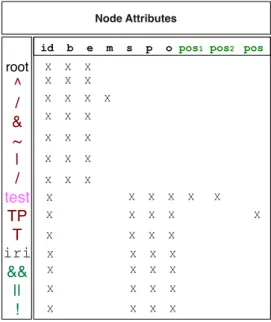
||,&&,!. Figure 9 reports, for each type of node, its set of attributes (i.e., the domain of the functionsωandδ). The attributesb(start) ande(end) denote the starting and ending points of the operation represented by each operational node. Concatenation nodes (/) have the ad-ditional attributemthat maintains the join variable.
Node Attributes
root
^ / & ~ | /
test
TP T iri
&& ||
!
id b e m s p o pos1 pos2 pos
X X X X X X X X X X X X X
X X X
X X X
X X X
X X X X X X X X X X X
X
X X X X X X X X X X X X X X X
X X X X
Fig. 9. Node attributes in the operational tree.
Test nodes have attributess,p,odenoting the sub-ject, predicate and object of the triple on which the test is to be checked. Additionally, since the test node
at-tributes start (POS1) and end (POS2) that can be val-ued with_s,_por_o, denoting the position of begin-ning and ending of the traversal. Finally, test nodesTP have the additional attributePOS(also valued with one among_s,_por_o) that indicates the beginning of the existential test with respect to the last triple.
The rootrofπPis a special node of typeroot
hav-ingid(r) = 0and attributesb(start) ande(end) val-ued with the pattern endpoints, that is,ω(r,b) =αand
ω(r,e) =β. To build the operational tree, the nodes of the parse treeτP are visited according to a pre-order
traversal, that is, the parent first, then left child and fi-nally the right child, if one exists. In what follows, the functionparentindicates the parent of a node. More-over, the functioncorrapplied to each node ofτP
re-turns exactly one node ofπP. For each nodevofτP
visited, we have:
(1) If vis the root of τP, then a node cis added as
the only child of r with id(c) = 0_0. If v is a left child of some node of τP, a nodecis added
as the left child of corr(parent(v)) andid(c) =
id(parent(c)) + “_0”. Ifvis a right child of some node ofτP, then a nodecis added as the right child
of corr(parent(v))withid(c) = id(parent(c)) + “_1”. Furthermore:
(1.1) If v is an operational node, then c has the same type as v and all its attributes are initialized with fresh variables. Moreover,
corr(v)=c.
(1.2) Ifvis a test node andcorr(parent(v))=c00is an operational node, then chas typetest, its attributess,p,oare initialized with fresh variables and pos1 andpos2 are set to be equal to the position used in the test (or to the default positions if they are omitted). More-over, a node c0 is added as the only child of cwith the same type of v and id(c0) =
id(c) + “_0”. Moreover, its attributes s, p
andoare initialized with fresh variables. If
type(c0) = TPthen the attributeposis ini-tialized with the value specified in the exis-tential test. Note thatcorr(v) =c0.
(1.3) Ifvis a test node, andc0=corr(parent(v))is a test node, thenchas the same type asvand all its attributes are initialized with fresh vari-ables. We have thatcorr(v)=c.
The operational tree for the nEPP pattern of Exam-ple 2 is shown in Fig. 11 (a). Fresh variables for the attributes of a nodenare generated using the template:
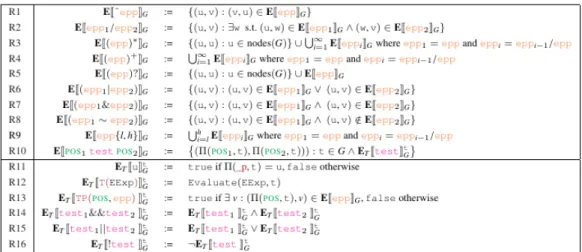
FunctionPropagate n) Input:n, a node of theoperational tree.
Result:updaten’s children attributes.
1: Letni=n.child(i) 2: ifnis atestnodethen 3: ifnisTPthen
4: ifn1is atestnodethen 5: n1.POS1=n.POS 6: elsen1.b=n.POS 7: else
8: ifn.POS1=_sandn.POS2=_othen 9: ni.X=n.X,i∈ {1,2},X∈ {s,p,o}
10: else ifn.POS1=_sandn.POS2=_pthen 11: ni.s=n.s,ni.p=n.o,ni.o=n.p i∈ {1,2}
12: else ifn.POS1=_pandn.POS2=_sthen 13: ni.s=n.p,ni.p=n.o,ni.o=n.s i∈ {1,2}
14: else ifn.POS1=_pandn.POS2=_othen 15: ni.s=n.p,ni.p=n.s,ni.o=n.o i∈ {1,2}
16: else ifn.POS1=_oandn.POS2=_sthen 17: ni.s=n.o,ni.p=n.p,ni.o=n.s i∈ {1,2}
18: else ifn.POS1=_oandn.POS2=_pthen 19: ni.s=n.o,ni.p=n.s,ni.o=n.p i∈ {1,2}
20:else ifnis^then
21: ifn1is atestnodethen 22: n1.POS1=n.e;n1.POS2=n.b 23: elsen1.b=n.e;n1.e=n.b 24:else ifnis/then
25: ifn1is atestnodethen 26: n1.POS1=n.b;n1.POS2=n.m 27: elsen1.b=n.b;n1.e=n.m 28: ifn2is atestnodethen 29: n2.POS1=n.m;n2.POS2=n.e 30: elsen2.b=n.m;n2.e=n.e; 31:else
32: ifniis atestnode, i∈ {1,2}then
33: ni.POS1=n.b;ni.POS2=n.e 34: elseni.X=n.X,X∈ {b,e}
35:∀iPropagate ni)
Fig. 10. Propagation of variables and terms.
?X+_+id(n), whereX∈ {b,e,m,s,p,o}, with+ de-noting string concatenation.
4.1.2. Propagation of Variables and Terms
Given an operational tree for a patternP, each of its nodes has attributes valued with variables or terms. The translation algorithm takes care of propagating these variables and terms during the generation of the SPARQL query associated toPvia the Procedure
Table 5
Translating nEPPs into SPARQL (code).EBCextends SPARQLBuiltInCallwith EPPs tests also augmented with positions (POS). nEPPs with double-brace path repetitions (epp{{l,h}}) are first translated into equivalent nEPPs via unions of concatenations.
Rm ΘP(root):=‘SELECT’root.broot.e‘WHERE{’ΘP(root.child(1))‘}’
R0 Γ(n) :=n.sn.pn.o‘.’ R1 ΘP(nˆ) :=ΘP(n.child(1))
R2 ΘP(n/) :=ΘP(n.child(1)) ΘP(n.child(2))
R3 ΘP(n|) :=‘{’ΘP(n.child(1))‘}UNION{’ΘP(n.child(2))‘}’ R4 ΘP(n&) :=ΘP(n.child(1)) ΘP(n.child(2))
R5 ΘP(n∼) :=‘{’ΘP(n.child(1))‘}MINUS{’ΘP(n.child(2))‘}’ R6 ΘP(ntest
):=Θt
(n.child(1))
R7 Θt
(nu) :=Γ(n) ‘FILTER(’n.p‘=’u‘)’
R8 Θt
(nEBC):=Γ(n) ‘FILTER’EBC R9 Θt
(nTP
) :=Γ(n) ‘FILTER EXISTS’{ΘP(n.child(1))‘}’ R10 Θt
(n!) :=Γ(n) ‘MINUS{’Θt
(n.child(1))‘}’ R11 Θt
(nˆ) :=Θt
(n.child(1))
R12 Θt
(n&&) :=Θt
(n.child(1)) Θt
(n.child(2))
R13 Θt
(n||) :=‘{’Θt
(n.child(1))‘}UNION{’Θt
(n.child(2))‘}’
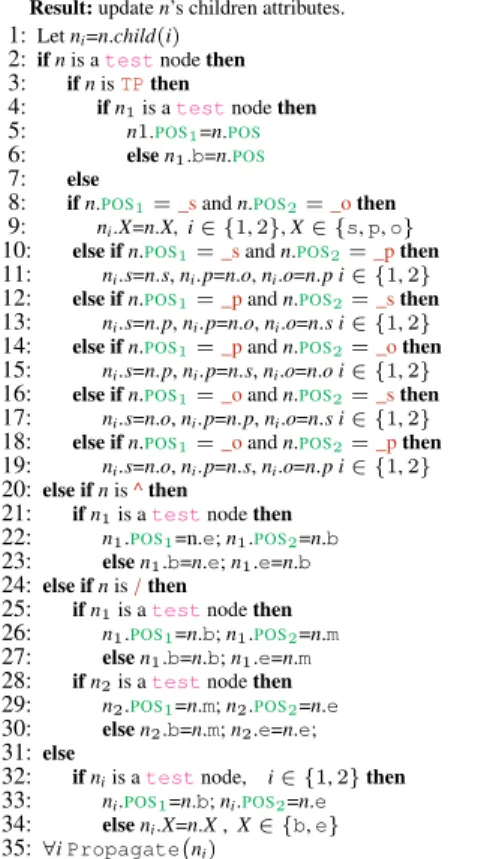
sof node0_0_0_0; the attribute eof node0_0_0 is propagated to the attributeeof node0_0_0_1; and the value of the attributem(that is a fresh variable) is prop-agated to the attributeoof node0_0_0_0and to the attributesof the node0_0_0_1.
Furthermore, the propagation phase also ensures that the tests are executed on the correct position of the triple and that the endpoints are correctly selected by applying the rules reported in Fig. 10 lines 8-19. By looking at Fig 11, the rule in lines 16-17 trans-lates to the fact that the attributesof node0_0_0_0 of Fig. 11 (b) is propagated to the attributeoof node 0_0_0_0_0; the attributepof node0_0_0_0 is prop-agated to the attributepof node0_0_0_0_0; and the value of the attributeois propagated to the attributes
of node0_0_0_0_0.
4.1.3. Generating SPARQL code
The last step of the translation algorithm takes as in-put the result of the previous phases, that is, an opera-tional tree where all attribute values are filled with the correct values (i.e., RDF terms, fresh variables and the variables or termsαandβderived from the nEPP pat-tern as input). At this point, to generate the SPARQL code for a given nEPP pattern, the translation algo-rithm leverages the translation rules shown in Table 5. The translation uses two functions:ΘP(·)that handles general nEPP expressions andΘt(·)that handles tests.
The translation algorithm applies the rules starting from therootand proceeding via a pre-order depth-first traversal of the operational tree. In a nutshell, the translation proceeds as follows: ruleRmgenerates
the outermost part of the final SPARQL query; more-over, it projects the variables stored in the attributes
root.bandroot.e; for sake of presentation we as-sume thatα, β∈ Vin the input patternP=hα,epp, βi. Path concatenation is handled via rule R2and is se-mantically dealt with via the join operator (R2in Ta-ble 3). Each of the two operands of the join is one of the children of the node labeled with /in the op-erational tree. The join operator is also used to han-dle path conjunction (R4). The difference with path concatenation resides in the usage of the variables; in-deed, by looking at Table 3 we note that concatenation makes usage of a (fresh) join variable stored in the at-tributemof the concatenation node of the operational tree, while path conjunction is evaluated from the same endpoints for both conjuncts. In the same spirit, we note that path difference (R5) is translated by using the −operator in the SPARQL algebra (see Table 3) that syntactically corresponds to theMINUSoperator. Path union (R3), which uses the union operator from the SPARQL algebra, is translated using its SPARQL syn-tactic counterpart, that is,UNION. Reverse path (R1) is handled by switching, in the propagation phase,n’s variables when propagated to its child noden.child(1). Tests are handled by a combination ofFILTER and
root b=?x e=?y id=0
~ id=0 0_
b=?x e=?y
/
:country :country b=?x
id=0 0 0_
e=?y
_
s=?x o=?m 0 0 0 p=?p 0 0 0 0_ _ _ _ id=0 0 0 0_ _
pos =1 _s pos 2=_o
_
_ _ _
s=?x id=0 0 0 0 0_ _ _ _
o=?m 0 0 0 p=?p 0 0 0 0_ _ _ _
_ _ _
/
:region :region b=?x id=0 0 1_
e=?y
_
s=?x o=?m 0 0 1 p=?p 0 0 1 0_ _ _ id=0 0 1 0_ _
pos =1_s pos 2=_o
_
_ _ _ _
s=?x id=0 0 1 0 0_ _ _ _
o=?m 0 0 1 p=?p 0 0 1 0_ _ ___ _ _ _
s=?y id=0 0 1 1 0_ _ _
p=?p 0 0 1 1_ _ _ _ o=?m 0 0 1_ _ _ o=?y
pos 2=_s pos =1_o id=0 0 0 1_ _
p=?p 0 0 0 1s=_ _ _ _?m 0 0 0 _ _ __
s=?y id=0 0 0 1 0_ _ _
p=?p 0 0 0 1_ _ _ _ o=?m 0 0 0___
_
o=?y pos 2=_s pos =1_o id=0 0 1 1_ _
p=?p 0 0 1 1s=?m 0 0 1_ _ _ __ _ _
_
_
root b=?x
e=?y id=0
~ id=0 0
b=?b 0 0 e=?e 0 0
/
:country :country b=?b 0 0 0id=0 0 0
e=?e 0 0 0
s=?s 0 0 0 0 o=?o 0 0 0 0 p=?p 0 0 0 0_ _ _ _ id=0 0 0 0_ _
pos =1_s pos 2=_o
_
_ _ _
s=?s 0 0 0 0 0id=0 0 0 0 0
_ _ _ _
o=?o 0 0 0 0 0 p=?p 0 0 0 0 0_ _ _ _ _
_ _ _
/
:region :region b=?b 0 0 1id=0 0 1 e=?e 0 0 1
s=?s 0 0 1 0 o=?o 0 0 1 0 p=?p 0 0 1 0_ _ _ id=0 0 1 0_ _
pos =1_s pos 2=_o
_
_ _ _ _
s=?s 0 0 1 0 0id=0 0 1 0 0
_ _ _ _
o=?o 0 0 1 0 0 p=?p 0 0 1 0 0_ _ _ _ _ _ _ _
s=?s 0 0 1 1 0id=0 0 1 1 0
_ _ _
p=?p 0 0 1 1 0_ _ _ _ o=?o 0 0 1 1 0_ _ _ o=?o 0 0 0 1
pos 2=_s pos =1_o id=0 0 0 1_ _
p=?p 0 0 0 1_ _ _ _ s=?s 0 0 0 1_ _ __
s=?s 0 0 0 1 0id=0 0 0 1 0_ _ _ p=?p 0 0 0 1 0_ _ _ _ o=?o 0 0 0 1 0___
_
o=?o 0 0 1 1 pos 2=_s pos =1_o id=0 0 1 1_ _
p=?p 0 0 1 1_ _ _ _ s=?s 0 0 1 1_ _ __
_ _ _ _ _ _ _ _ _ _ _ _ _ _ __ _ _ _ _ _ _ _ _ _ _ _ _ _ _ _ _ _ _ _ _ _ _ _ _ _ _ _ _ _ _ _ _ _ _ _ _ _ _ _ _ _ _ _ _ _ _ _ _ _ _ _ _ _ _ _ _ Before propagation After propagation (a) (b)
m=?m 0 0 0__ _
m=?m 0 0 1__ _
m=?m 0 0 0__ _
m=?m 0 0 1__ _
Fig. 11. Operational tree for Example 2 before (a) and after (b) the propagation phase.
disjunction of tests, join to deal with conjunction of tests andMINUSto deal with negated tests. To give a hint, a nEPP pattern containing a single triple pattern of the formh?b,u,?eiwhereu ∈ Iis translated via ruleR7asSELECT ?b ?e WHERE {?b ?p_0_0
?e.FILTER(?p_0_0=u)}where?p_0_0is a vari-able automatically generated. A nEPP pattern con-taining an EBC (Extended-BuiltInCall) is translated via rule R8 by using a FILTER expression applied to the specified EBC. For example, the nEPP pattern h?b,_sT(isLiteral(_o))_o,?eiis translated as
SELECT ?b ?e WHERE
{?b ?p_0_0 ?e.FILTER(isLiteral(?e))}
where the parameter of theisLiteralBuiltInCall is substituted during the translation with the variable
?e. Nested nEPPs are handled via ruleR9and are ba-sically existential tests; test whether the nested nEPP has a solution (see also ruleR12in Table 3).
Example 18. (Translating nEPPs into SPARQL). Consider the nEPP pattern in Example 2. The corre-sponding operational tree is reported in Fig. 11 (a). The operational tree obtained after the application of
the procedurePropagate is shown in Fig. 11 (b). As an example, by looking at the operational node
withid=0_0_0 and labeled with/in Fig. 11 (a) and (b) we can see thatPropagateupdated the values of the attributessandoof its children 0_0_0_0 and 0_0_0_1 with values in the attributesbandeof 0_0_0. Applying the translation rules to the operational tree in Fig. 11 (b) means starting from root (node 0) and triggering ruleRm(see Table 5), which generates
the outermost part of the final SPARQL translation: ΘP(0)=SELECT ?x ?yWHERE{ΘP(0_0∼)}. Then, the node withid=0_0 and labeled with∼is visited; this triggersR5:ΘP(0_0∼)=
‘{’ΘP(0_0_0/)‘}’MINUS‘{’ΘP(0_0_1/)‘}’. The trans-lation uses MINUS to reflect the semantics of EPPs dealing with path difference whiletest(e.g., 0_0_0_0) is reflected via theFILTERoperator. Visiting the node 0_0_0 triggersR2. The translation continues with:
ΘP(0_0_0/)=ΘP(0_0_0_0test)ΘP(0_0_0_1test); ΘP(0_0_0_0test)=Θt(0_0_0_0_0:country);
Θt(0_0_0_0_0:country)=?x ?p_0_0_0_0?m_0_0_0.
The translation continues until no more nodes of the operational tree have to be visited and gives:
SELECT ?x ?y WHERE { {?x ?p_0_0_0_0 ?m_0_0_0.
?y ?p_0_0_0_1 ?m_0_0_0. FILTER(?p_0_0_0_0=:country) FILTER(?p_0_0_0_1=:country)} MINUS
{?x ?p_0_0_1_0 ?m_0_0_1. ?y ?p_0_0_1_1 ?m_0_0_1. FILTER(?p_0_0_1_0=:region) FILTER(?p_0_0_1_1=:region)} }
Discussion about the Translation
Conciseness.EPPs enable to write navigational queries in a more succinct way as compared to SPARQL queries using triple patterns and/or union of graph pat-terns. Given a nEPPs expression containing a number of fragments (e.g., concatenation, union, predicates) it is interesting to note that its corresponding transla-tion in SPARQL is always more verbose. Consider for instance the nEPPs pattern ?x (p1&p2)/p3 ?y; here, conjunction avoids to use two triple patterns and concatenation avoids to explicitly deal with an inter-mediate variable besides the expression endpoints. Its translation in SPARQL, that is,?x p1 ?a. ?x p2 ?a. ?a p3 ?yincludes three triple patterns and 2 instances of the new variable?a. Generally, the num-ber of variables necessary to translate a nEPPs into an equivalent SPARQL query is a function of the size of its operational tree. Not only the elimination of inter-mediate variables increases the succinctness of the ex-pression, but it also eliminates causes of errors when writing queries as one has to check the consistency of variable names.
Benefits. EPPs coupled with the translation proce-dure bring a significant practical advantage as com-pared to other navigational extensions of SPARQL (e.g., nSPARQL, cpSPARQL). On one hand, nEPPs can be evaluated over existing SPARQL processors. On the other hand, the machinery presented in this pa-per could potentially extend the SPARQL standard in an elegant and non-intrusive way; one would need to use our translation algorithm instead of that currently used by the SPARQL standard.
4.2. SPARQL and Navigational Queries
By analyzing the translation algorithm presented in the previous section and the translation rules re-ported in Table 5, it is possible to identify the precise SPARQL fragment that can express nEPPs.
Lemma19. nEPPs can be expressed in the SPARQL fragment S{./,S,−,FILTER}, which uses AND,UNION,
MINUS,FILTERandSELECT.
In the remainder of this section we analyze for dif-ferent navigational cores, the SPARQL fragment nec-essary for its rewriting. The results of the analysis are reported in Table 6. The table shows in the first col-umn (Navigational Core) the navigational core, that is, the type of expression allowed in the predicate po-sition of triple patterns; it can be a predicatep, a non-recursive property path (nPP), a property path (PP), a non-recursive EPP (nEPP), and an EPP. The second column(Extended Processor) indicates whether the evaluation requires changes to SPARQL processors. The third and fourth column represents the SPARQL fragment needed for the rewriting. The simplest case (row 1) does not use regular-expression-like exten-sions and thus no rewriting is needed. The second and fourth rows consider non-recursive and recursive prop-erty paths, respectively. These cases are handled, as per W3C specification, via a rewriting into SPARQL and theALPprocedure, respectively. The third and last rows concern nEPPs and full EPPs, respectively. While the former can be translated into SPARQL queries (as shown in the previous section) and evaluated on ex-isting processors, the latter requires the usage of the
EALPprocedure shown in Fig. 7, currently not avail-able in existing processors.
The most interesting result that emerges from the ta-ble is that the fragmentS{./,S,FILTER} of the current SPARQL standard is already expressive enough to cap-ture nEPPs. Hence, the current W3C standard could readily benefit from the more expressive language of nEPPs without any impact on current SPARQL pro-cessors. In the following proposition we also mention an even stronger result that can be derived if we drop set-semantics path repetitions in EPPs (R9’ in Table 3).
Proposition20. The full EPPs language can be incor-porated in SPARQL using theALPprocedure with the only difference that for the evaluation of the patterns (see Fig.6) the translation discussed in Section 4 has to be used instead of the translation currently used by the standard.
Table 6
Languages and translations into SPARQL for plain RDF.
Navigational Core Extended Processor Fragment SPARQL Fragment
p∈I No R1 in Fig. 5 S{./}
nPP No R1-R5 in Fig. 5 S{./,S,FILTER}
nEPP No R1-R2, R5-R9, R11-R16 in Table 3 S{./,S,−,FILTER}
PP No Fig. 5 S{./,S,FILTER,ALP}
EPP Yes Table 3 S{./,S,−,FILTER,EALP}
5. Query-Based Reasoning on Existing SPARQL Processors
The aim of this section is to study the support that EPPs can give to querying under entailment regimes (Section 5.1) with particular emphasis on how to sup-port the entailment regime on existing SPARQL pro-cessors(Section 5.2).
5.1. Capturing the Entailment Regime
In this paper we focus our attention on the ρdf fragment [19, 25]. This fragment considers a subset of RDFS vocabulary consisting of the following ele-ments:rdfs:domain,rdfs:range,rdfs:type,
rdfs:subClassOf,rdfs:subPropertyOfthat we denote withdom,range,type,sc, andsp, re-spectively. The authors [19] showed that the ρdf se-mantics is equivalent to that of full RDFS when one focuses on this fragment. Note thatρdf does not con-sider datatypes that would allow to obtain inconsis-tent graphs. When considering SPARQL under theρdf entailment regime, not only the explicit triples in the RDF graphGhave to be taken into account but also triples that can be derived from G by the inference rules shown in Table 7. The application of each in-ference rule enables to obtain a sequence of graphs
G1,G2,G3, ...GkwithGi+1\Gi6=∅∀i∈[1, ...k−1].
WhenGk+1\Gk =∅, that is, when the graph is
un-changed, the application of the rules stops. The graph
Gkis called the closure ofGindicated bycl(G).
Definition21. (SPARQL and query-based reason-ing).Given a SPARQL pattern P and an RDF graph
G, the evaluation ofP overGunder theρdf seman-tics is denoted byJPK
ρdf
G , whileJPKcl(G) denotes the evaluation ofP over the closure ofG.
The intended meaning of two semantics differs with respect to the data graph on which the evaluation is performed. In particular,JPKρGdfmeans thatPis evalu-ated on the original data graphG, and the results
pro-vided should include those generated by considering theρdf rules. On the other hand,JPKcl(G) means that
P is evaluated on the materialization of the closure of
Gobtained by applying theρdf rules. Of course, we expectJPKρGdf=JPKcl(G)to hold.
Most of existing SPARQL processors handle (vari-ants of)ρdf reasoning in the following way: first, com-pute and materialize the finite polynomial closure of the graphGand then perform query answering on the closure via RDFsimple entailment regime [26]. It is interesting to point out that materializing all data by computing the closure cl(G) may cause a waste of space in case most of cl(G) is never really used for query answering, apart from the cost of computation and maintenance after updates. Having a mechanism to support entailment regimes while avoiding the com-putation ofcl(G)beforehand can bring a major advan-tage. Our goal is to studyquery-based reasoning, that is, the possibility torewritea query into another query that capturesρdf inferences.
Similarly to nSPARQL [11], cpSPARQL [21] and others approaches (e.g., [27, 28]), we identified for each inference rule in the fragment considered,ρdf in our case), an EPP expression encoding it. The transla-tion rules are shown in Table 8. Whenever one wants to adopt theρdf entailment regime, it is enough to rewrite the input pattern according to these translation rules. The result of the evaluation of the rewritten pattern on
Gis the same as the result that would be obtained by first computing the closurecl(G)and then evaluating the pattern before the rewriting.
Lemma22. (ρdf and SPARQL). Given a triple pat-tern(α,p, β)withα, β ∈ I∪ Vandp ∈ I, then for every graphGwe have thatJ(α,p, β)KρGdf=
J((α,Φ(p), β))KG=J(α,p, β)Kcl(G).
Table 7
Theρdf rule system. Capital lettersA,B,C,X, andY, stand for meta-variables to be replaced by actual terms inIL.
1. Subclass:
(a) (A,sc(,XB) (,typeX,,typeB) ,A) (b) (A,sc(A,B) (,sc,BC),sc,C) 2. Subproperty:
(a) (A,sp(,XB) (,B,YX),A,Y) (b) (A,sp(A,B) (,sp,BC),sp,C) 3. Domain:
(A,dom,B) (X,A,Y) (X,type,B)
4. Range:
(A,range,B) (X,A,Y) (Y,type,B)
Table 8
Encoding ofρdf inference rules via EPPs.
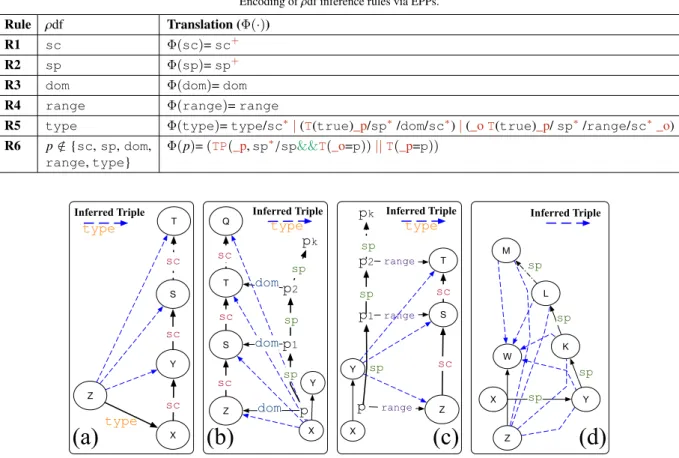
Rule ρdf Translation (Φ(·)) R1 sc Φ(sc)=sc+ R2 sp Φ(sp)=sp+ R3 dom Φ(dom)=dom R4 range Φ(range)=range
R5 type Φ(type)=type/sc∗|(T(true)_p/sp∗/dom/sc∗)|(_oT(true)_p/sp∗/range/sc∗_o) R6 p∈/{sc,sp,dom,
range,type}
Φ(p)=(TP(_p,sp∗/sp&&T(_o=p))||T(_p=p))
X Y
Z
X Y
Z p
X Y
Z
(a)
(b)
(c)
X
Z W
(d)
ST
S T Q
p1
p2
pk
Inferred Triple Inferred Triple Inferred Triple
p
dom dom
dom sp
sp
sp sc
sc
sc sc
sc
sc
p1
sp p2
sp pk
sp
S T
sc
range range
range type
type type type
Inferred Triple
sc
sp
sp sp sp M
L
K
Y
Fig. 12. RDFS inference rules. R5 in Table 8 captures rules (a)-(c) while R6 in Table 8 captures rule (d).
one of the three possible ways (shown in Fig. 12 (a)-(c)) to derive atypein RDFS and corresponding to rules Subclass (a), Domain and Range in Table 7. The first sub-expression in R5 captures the rule in Fig. 12 (a); a newtypecan be derived by finding triples of the form(z,type,x)and possibly (via *) traveling up (viasc) the super-classes ofx, which is thetypeofz. The second sub-expression captures the rule depicted
in Fig. 12 (b); a newtypecan be derived by navigat-ing from the subjectxto the predicatepand all its pos-sible super-properties (via∗) and then by finding the