1
ERROR ANALYSIS IN THE TRAVEL WRITING MADE BY THE STUDENTS OF ENGLISH STUDY PROGRAM
Vika Agustina
Brawijaya University of Malang, Indonesia
Esti Junining
Brawijaya University of Malang, Indonesia
Abstract: This study was conducted to identify the kinds of errors in surface strategy taxonomy and to know the dominant type of errors made by the fifth semester students of English Department of one State University in Malang-Indonesia in producing their travel writing. The type of research of this study is document analysis since it analyses written materials, in this case travel writing texts. The analysis finds that the grammatical errors made by the students based on surface strategy taxonomy theory consist of four types. They are (1) omission, (2) addition, (3) misformation and (4) misordering. The most frequent errors occuring in misformation are in the use of tense form. Secondly, the errors are in omission of noun/verb inflection. The next error, there are many clauses that contain unnecessary phrase added there.
Key Words: Error, Error Analysis, Surface Strategy Taxonomy, Travel Writing
INTRODUCTION
2
communication tool, English must be mastered by everyone around the world. One of the countries who pay attention highly to English is Indonesia. Bautista (2006, p.130) states that starting from the early age everyone could learn English with the main objective to provide reading skills to enable Indonesians to read science-related materials in English. Later Indonesian students should learn other skills of English, such as writing, listening and speaking.
Indonesian students find many difficulties in learning English. This happens because in the learners‟ environment, English is not used as a daily language. No wonder that nowadays students are required to master English because in the competitive job market it is necessary to speak English and it also helps in communicating with people from different countries as a lingua franca. Therefore, the students should learn English whether it is at school or outside the classroom. The process of language learning is the time when the language learners make mistakes or error, as pointed out by Dulay et al, (1982, p.138) “People cannot learn language without first systematically committing error.” Errors in communication can be inhibited towards effective communication and the decoding of messages. In second language learning, as Corder in Richards (1973, p.173) observes, the learner‟s errors indicate both the state of the learner‟s knowledge and the way in which a second language is learned. The error is natural, but errors made by the learners and native speakers are different. The structure differences between Indonesian and English could make learners produce some errors.
3
do not necessarily give evidence of the rules of the new language and the rules he has developed at given stages of his language development”. This can be done only by the errors he makes. And after knowing this only one can proceed in teaching. So, errors, and its analysis both are an inevitable part of teaching & learning. Whereas error can happen in the learner‟s learning process, they cannot give any correction of the error they have made.
Nzama (2010, p.11) states that error analysis is useful in second language learning because it reveals to the teachers, syllabus designers and textbook writers of what the problem areas are. The teacher could design remedial exercises and focus more attention on the „trouble shooting‟ areas, as it were. Corder (1967, as cited in Nzama, 2010, p.11) states that errors are visible proof that learning is taking place. He has emphasized that errors, if studied systematically, can provide significant insights into how a language is actually learned by a foreigner. He also agrees that studying students‟ errors of usage has immediate practical application for language teachers. In his view, errors provide feedback; they tell the teachers something about the effectiveness of his teaching. Sercombe, (2000, as cited in Nzama, 2010, p. 12) also explains that error analysis serves three purposes. Firstly, to find out the level of language proficiency the learner has reached. Secondly, to obtain information about common difficulties in language learning, and thirdly, to find out how people learn a language. From this statement it can be concluded that the study of errors should also be looked at as something positive both for learners and teachers.
4
ungrammatical sequences is one way of defining grammar. Language without grammar would be disorganized and would cause some communicative problems, like errors in writing. However, writing in different language is not always as easy as writing systems and these differences sometime make the learners produce errors. Therefore, it is interesting to observe the errors that appear in the travel writing texts made by the fifth semester students of English Study Program by using Surface Strategy Taxonomy theory by Dulay, Burt and Krashen (1982).
Travel writing is a mode of writing in which the purpose of the author is to tell the reader about his/her trip. Raban (1988, p.253) defines travel writing thus: As a literary form, travel writing is a notoriously raffish open house where different genres are likely to end up in the same bed. It accommodates the private diary, the essay, the short story, the prose poem, the rough note and polished table talk with indiscriminate hospitality. It freely mixes narrative and discursive writing. Those ideas of travel writing definition can be concluded that it is a mode of writing in which the writer produces literary work which records the people, events, sights, and feelings of an author who is touring a foreign place for the sake and pleasure of travel.
5
travel writing texts made by the students. Therefore, the researcher analyzed the ungrammatical words or sentences in those travel writing texts. This study is intended to find out the kinds of errors in surface strategy taxonomy as well as the dominant types of the errors made by the fifth semester students of English Study Program in producing their travel writing texts.
LITERATURE REVIEW Errors and Mistakes
It is considered important to distinguish errors from mistakes in linguistics. Distinction is always made between errors and mistakes where the former is seen as resulting from learner's lack of proper grammatical knowledge and the latter as being failed to utilize a known system correctly. In line with this, Brown (1994, p.205) defines error as “a noticeable deviation from the adult grammar of a native speaker, reflecting the interlanguage competence of the learner”. Then, “a mistake refers a performance error that is either a random guess or a „slip‟ in that is a failure to utilize a known system correctly” (Brown, 1994, p.205).
However, native speakers are generally able to correct themselves quickly. Such mistakes include slip of the tongue and random ungrammatical formations. On the other hand, errors are systematic in that they occur repeatedly and are not recognizable by the learner. They are a part of the learner's interlanguage, and the learner does not generally consider them as errors. They are errors
only from teachers' and others' perspectives who are aware of the possible grammatical deviations. In conclusion, mistakes can be self-corrected with or without being pointed out to the learners but errors cannot be self-corrected.
Error Analysis
6
incomplete rule application, and the hypothesizing of false concepts, reflected a learner's competence at a certain stage and thereby differed from learner to learner (Rustipa, 2011, p.21). Dulay et al, (1982, p.141) state that “Error analysis has made a significant contribution to the theoretical consciousness-raising of applied linguistics and language practitioners. It has brought the multiple origins of learners‟ errors to our attention. Finally, it has succeeded in elevating the status of errors from complete undesirability to the relatively special status of research object, curriculum guide, and indicator of learning stage.”
From the previous quotation, it can be concluded that error analysis is a theory developed by the researchers to dig and acknowledge the learners‟ problems in learning second language.
Error analysis was established in the 1960s by Stephen Pit Corder and colleagues. Error analysis was an alternative to contrastive analysis. It showed that contrastive analysis was unable to predict a great majority of errors although it has more valuable aspects that have been incorporated into the study of language transfer. A key finding of error analysis is that many errors are made by learners making faulty inferences about the rules of the new language.
Error Categories
7
Linguistic Category Taxonomy
Burt and Kiparsky developed another linguistic category taxonomy into which they classified several thousand English errors made by students learning English in foreign as well as host environments (1972, cited in Dulay et al, 1982, pp.147-148). The classifications are as follows.
1. The Skeleton of English Clauses 2. The Auxiliary System
3. Passive Sentences 4. Temporal Conjunctions 5. Sentential Complements 6. Psychological Predicates
Surface Strategy Taxonomy
This category highlights the way surface structures are altered. Analyzing errors from this taxonomy holds much promise for researchers as it is concerned with identifying cognitive processes that underlie the learners‟ reconstruction of the new language. This also gives us consideration that students‟ errors are not the result of laziness or sloppy thinking but are based on some logics, as the result of the learners‟ use of interim principles to produce a new language (Dulay, et al,1982, pp. 154-162). Those types of errors which belong to surface strategy taxonomy are (1) omission, (2) addition, (3) misformation, and (4) misordering.
1. Omission
This type of error is characterized by the absence of an item, which must appear in a well-formed utterance. Certain linguistic forms may be omitted by the learner because of their complexity in production. Generally, there are two main kinds of omission; they are omission of content morphemes and omission of grammatical
8 a. Omission of Content Morphemes
This type of omission is related to the major constituent of a sentence such as: nouns, verbs, adjectives, and adverbs. For example:
She ...him nothing. In this sentence, the learner omits a needed verb and the third singular marker –s. It should be „She gives him nothing’. b. Omission of Grammatical Morphemes
This type of omission does not carry the burden meaning. In other words, it plays a minor role in conveying the meaning of sentence. It includes noun and verb inflections (e.g. the –s in birds, the
–s in mother’s, the –ed in looked, the –ing in laughing, etc); preposition (in, on, at, under, etc); conjunction (and, or, but, because, if, although, etc); verb auxiliaries (is, will, can, etc); and article (a/an, the, those, these, etc). For example: Marry is beautiful girl. In this sentence, indefinite article before a singular countable noun is omitted. It should be „Marry is a beautiful girl’.
2. Addition
This type of error is characterized by the presence of an item, which must not appear in a well-formed utterance. It means that learners not only omit elements, which they regard as redundant, but they also add redundant elements.
This error type is divided into subcategories namely: double markings, regularization, and simple addition.
a. Double Markings
This error is described as the failure to delete certain items which are required in some linguistic construction but in others. For example, He doesn’t knows your name. This sentence shows the failure of deleting third singular person marker –s where the auxiliary does is required. This sentence should be He doesn’t know your name.
b. Regularization
9
regular ones to those that are irregular. This type of errors is called errors of regularization. For example, I putted my bag on the table.
The word putted is the example of regularization in which the regular past tense –ed has been added to the items. It should be „I put my bag on the table‟.
c. Simple Addition
This error is one of subcategories of addition that is neither a double marking nor regularization. For example: We stay in over there. The addition of preposition „in‟ is not appropriate used before over. It should be „we stay over there‟.
3. Misformation
This type of error is characterized by the use of the wrong form of the morpheme or structure. This error has three subcategorized, namely: regularization, archi-forms, and alternating forms.
a. Regularization
A regular marker is used in place of an irregular one. For example, She runned so fast. The correct form of this sentence is She ran so fast.
b. Archi-Forms
The selection of one member of a class of forms to represent others in class is often made by the learners. The form chosen by the learners is called as archi-forms. For example, a learner may temporarily select just one of the English demonstrative adjective this, that, these, and those. For example (Dulay, 1982, p.161):
That dog That dogs
c. Alternating Form
Having his vocabulary and grammar grow and by using archi-forms, the learner can choose various members of class as an
10 4. Misordering
This type of error is characterized by the incorrect placement of a morpheme in an utterance. For example: What daddy is doing? This question is incorrect. It should be „what is daddy doing?‟
Comparative Taxonomy
The classification of errors in a comparative taxonomy is based on comparison between the structure of second language acquisition errors and certain other types of constructions. These comparisons have yielded the two major error categories in this taxonomy: developmental errors and interlingual errors. Two other categories that have been used in comparative analysis taxonomies are derived from the first two: ambiguous errors and other errors (Dulay, 1982, p. 163).
1. Developmental Errors 2. Interlingual Errors 3. Ambiguous Errors 4. Other Errors
Communicative Effect Taxonomy
The communicative effect classification deals with errors from the perspective of the effect on the listener or reader. This taxonomy focuses on distinguishing between errors that seem to cause miscommunication (global error) and those that do not (local error) (Dulay, et. al. 1982, p.189), while Burt and Kiparsky (1974) also distinguish between global error and local error (cited in Dulay et al,1982, p.191).A global error is one which involves "the overall structure of a sentence" and a local error is one which affects "a particular constituent”.
1. Global Error
11 2. Local Error
Local errors are errors that affect single element (constituent) in a sentence which do not usually hinder communication significantly. These include errors in noun and verb inflections, articles, auxiliaries, and the formation of quantifiers.
METHOD Research Design
In this research of error analysis, qualitative approach is used since it tries to analyze the data qualitatively that use words rather than number or statistic formula in making conclusion. It is to describe the data obtained from English Study Program students‟ literary work in the form of written texts. The type of research of this study is document analysis since it analyzes written materials, in this case travel writing texts. Ary et al, (2002, p. 442) state “Content or document analysis is a research applied to written or visual materials for the purpose of identifying specified characteristic of the materials”. The researcher may take 10%-15% or 20%-25% or more if the population used as the sample.
Furthermore, Creswell (2003, p. 18) states that alternatively, a qualitative approach is one in which the inquirer often makes knowledge claims based primarily on constructivist perspectives (i.e., the multiple meanings of individual experiences, meanings socially and historically constructed, with an intent of developing a theory or pattern) or advocacy/participatory perspectives (i.e., political, issue-oriented, collaborative, or change oriented) or both. It also uses strategies of inquiry such as narratives, phenomenologies, ethnographies, grounded theory studies, or case studies. The researcher collects open-ended, emerging data with the primary intent of developing themes from the data.
12
literary form of writing, computer text analysis program, and experience in conducting open-ended interviews and observations.
Data Source
In this study, the researcher used twelve written texts produced by the fifth semester students of English Study Program of one State University in Malang-Indonesia which were applied as the data. The researcher chose travel writing text because it belonged to literature course and the researcher believed that the students were aware of the importance of grammar in their writing. Therefore, the researcher analyzed only the grammar, not the organization of the texts.
The sample of this study is the fifth semester students of English Study Program who took part in Creative Writing class. There are three classes of Creative Writing course. Each class consists of 40 students who come to 120 students in total and each of the students is required to write a travel text by their lecturers. The researcher asked the lecturers who teach creative writing and one of them allowed the students to be used as the research participant. Here the researcher selects the students who were available and likely to participate over semester five. The sample that the researcher took was 10% of the population. The total number of the samples were 12 out of 120 travel writing texts. Therefore twelve travel writing texts could represent the sample of the population.
Data Collection
In collecting the data, some steps were used by the researcher as follows:
1. Collecting students‟ work from creative writing class
The researcher collected the data by asking the participants to send the texts of the travel writing via email.
2. Reading the texts of travel writing texts
13 3. Taking the erroneous clauses
The researcher took the clauses containing erroneous phrases. 4. Underlining the erroneous phrases
The researcher underlined the erroneous phrases in the chosen clauses.
Data Analysis
The following were the steps in analyzing the data:
1. Classifying the erroneous clauses using surface strategy taxonomy by Dulay et al, (1982) by putting them in the following table in order to make the process of analysis easier.
Table 1 Example of Table of Type of Errors
No Code Erroneous
Clause
Corrected Clause
Type of Error
Om Ad Mf Mo
2. Providing the correct clauses that should be used in the texts as the correction of the erroneous clauses. The researcher used Understanding and Using English Grammar Third Edition by Betty Azar as the reference to make the corrections reliable.
3. Drawing conclusion. Once the errors were calculated and arranged, the writer made the result of the analysis in the form of percentage.
FINDING
14
From the identification, there were some errors found in the travel writing texts produced by the students. After analyzing and classifying the data, the researcher found 439 errors. The errors were classified based on the differences between the students‟ clauses and the reconstructed version.
Types of Errors
By using Surface Strategy Taxonomy theory by Dulay et al. (1982), the researcher found 439 errors in the travel writing texts made by the fifth semester students of this university. The researcher found 155 errors of Omission type (Om), 96 errors of Addition type (Ad), 172 errors of Misformation type (Mf), 16 errors of Misordering type (Mo). Thus, there were 439 errors in total.
In this section, the researcher analyzed the erroneous clauses and provided the corrections that should be used. Each type of errors was described in order to know why those were considered as errors. The following analysis concerns about omission, addition, misformation and misordering.
Omission
The researcher found 155 errors in terms of omission type. There are two main kinds of omission, they are omission of content morphemes and omission of grammatical morphemes. The researcher found four kinds omission of content morphemes, namely: verbs (v), nouns (n), adjectives (adj) and adverbs (adv). Mostly the errors occur in missing part of nouns. Secondly, the errors are in missing part of adverbs. Thirdly, the errors are in missing part of verb. Other error clauses are in adjectives missing type.
15
Fourthly, the errors occur in missing part of conjunction. Other error clauses are in pronoun missing part. Each of them is discussed as follows.
1. Omission of Content Morphemes
The researcher found fifty one (51) errors in missing part of content morphemes.
a. Omission of Noun
The researcher found twenty nine (29) errors in terms of noun missing part. Table 1 presents the example of the data.
Table 1 Omission of Noun
No Code Erroneous Clauses Correct Clauses
1. Student 2,
line 6
Yes, I cannot stand* again Yes, I cannot stand it again
2. Student
12, line 5
There was no interesting * that appealed to me
There was no interesting
channel that appealed to me
As attached in the example above, the errors occurred because noun was omitted in the students‟ clauses. For example, in datum number one, the sentence “Yes, I cannot stand again” shows that the student should put noun into the sentence to make it grammatically correct because the previous question in the writing is ”What? Pee? Now?”. In this case the noun it needs is an object „it‟. The correct sentence should be “Yes, I cannot stand it again”. Then, the sentence “There was no interesting that appealed to me” should be “There was no interesting channel that appealed to me”.
b. Omission of Adverb
16
for the example number two, the correct sentence should be “There were 17 people of us”, because an adverb should be used in place of a subject with „be‟ and a few other verbs, especially when referring to somebody or something for the first time.
Table 2 Omission of Adverb
No Code Erroneous Clauses Correct Clauses
1. Student 3,
line 14
*I almost arrived to Kuta, …
When I almost arrived to
Kuta, …
2. Student 6,
line 8
Me and my friends, all of us were 17 people
There were 17 people of us
3. Student
12, line 21
Saturday night was very crowded and* a little stuck
Saturday night was very
crowded and there was a
little traffic jam
Another corrected sentence is in the third example, “Saturday night was very crowded and there was a little traffic jam”. This sentence has similar pattern to that of the sentence number two.
c. Omission of Verb
The researcher found eight (8) errors in verb missing part. Table 3 presents the example of the data.
Table 3 Omission of Verb
No Code Erroneous Clauses Correct Clauses
1. Student 1, line 5
I woke up with really tired I woke up and felt really
tired 2. Student 1,
line 21
like many war that religion as ... who can not respect to other believe
like many wars which use
religion as ...who can not respect other beliefs
3. Student
11, line 9
We went to ... and welcome to that beach
We went to ... and arrived at
that beach
17
student uses conjunction „with‟ instead of „and‟. It also does not have any verb. Therefore the correct clause should use „felt‟, the same verb class with „woke‟. The next error is shown in datum number two. The clause “like many war that religion as…” does not have any verb. The correct sentence should be “like many wars which use religion as…”.
d. Omission of Adjective
The researcher found two (2) errors in terms of adjective. Table 4 presents the example of the data.
Table 4 Omission of Adjective
No Code Erroneous Clauses Correct Clauses
1. Student 8, line 6
to go to the nature place to go to the place close to
nature
It is considered as an error if the student composed writings ungrammatically. In the example above, adjective is needed. The sentence “to go to the nature place” is ungrammatical. Instead of wrote „natural place‟, the student wrote „nature place‟. Therefore, to make the sentence more grammatical, the student should put an adjective in the middle of the phrase. The correct sentence should be “to go to the place close to nature”.
2. Omission of Grammatical Morphemes
The researcher found one hundred sixty nine (169) errors in missing part of content morphemes. Each kind of them is discussed in the following explanation.
a. Omission of Inflection
The researcher found fifty six (56) errors in omission of inflection. Table 5 presents the example of the data.
18
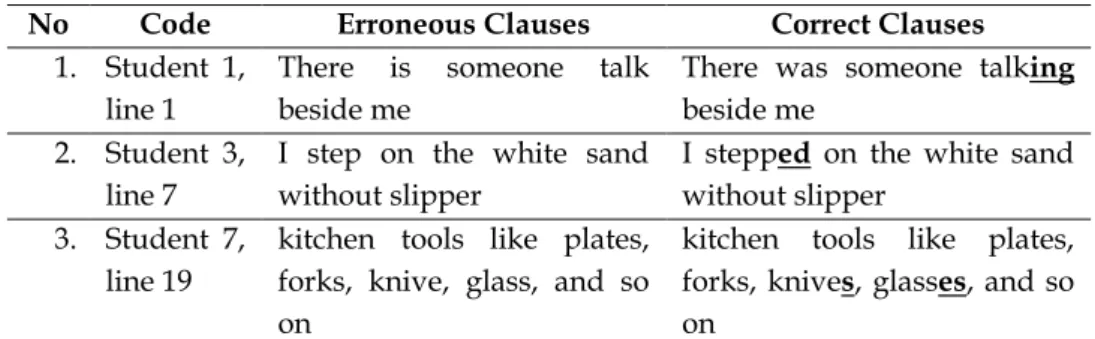
progressive form is omitted. The correct sentence of “There was someone talk beside me” is “There was someone talking beside me”.
Table 5 Omission of Inflection
No Code Erroneous Clauses Correct Clauses
1. Student 1, line 1
There is someone talk beside me
There was someone talking
beside me 2. Student 3,
line 7
I step on the white sand without slipper
I stepped on the white sand without slipper
3. Student 7, line 19
kitchen tools like plates, forks, knive, glass, and so on
kitchen tools like plates, forks, knives, glasses, and so on
b. Omission of Verb Auxiliaries
The researcher found forty (40) errors in omission of verb auxiliaries. Table 6 presents the example of the data.
Table 6 Omission of Verb Auxiliaries
No Code Erroneous Clauses Correct Clauses
1. Student 1, line 3
I *still confused I was still confused
2. Student 1, line 16
we *ready we were ready
3. Student
12, line 20
The weather at night
thankfully *not too cold
The weather at night
thankfully was not too cold
The errors occurred because auxiliary verb in omitted in the sentences. As shown in the example number one, the clause “I still confused” does not have any auxiliaries. Auxiliary verb „be‟ (was) should be added in this clause to make it more grammatical. Therefore the correct sentence should be “I was still confused”. The second and the third examples are the same. The auxiliary verb should be put after subject.
c. Omission of Article
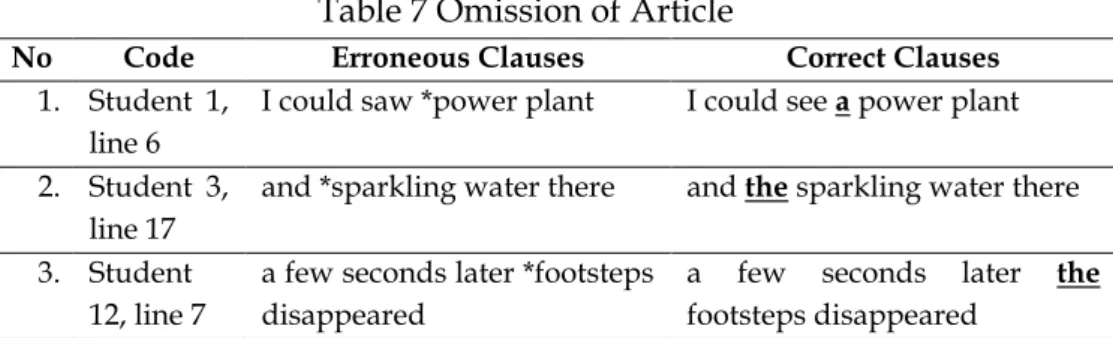
19
Table 7 Omission of Article
No Code Erroneous Clauses Correct Clauses
1. Student 1, line 6
I could saw *power plant I could see a power plant
2. Student 3, line 17
and *sparkling water there and the sparkling water there
3. Student
12, line 7
a few seconds later *footsteps disappeared
a few seconds later the
footsteps disappeared
There are two articles in English language. The first one is indefinite article „a/an‟. The form „a‟ is used before consonant sounds and the form „an‟ is used before vowel sounds. Here is the example of missing part in article „a‟, “I could see power plant”. The correct sentence should be “I could see a power plant”.
The second one is definite article „the‟. It is used for referring to somebody or something that has already been mentioned or can be understood. For example in datum number two, the clause “and sparkling water there” is ungrammatical. The correct clause should be “and the sparkling water there”. In this case, the object is already understood. The next example is in the clause “a few seconds later footsteps disappeared”. The correct clause should be “a few seconds later the footsteps disappeared”.
d. Omission of Preposition
The researcher found twenty eight (28) errors in omission of preposition. Table 8 presents the example of the data.
Table 8 Omission of Preposition
No Code Erroneous Clauses Correct Clauses
1. Student 2, line 2
the castle gate *Vredeburg the castle gate of Vredeburg
2. Student
10, line 11
the security hold me up in the first and *the middle gate
the security held me up in the first and in the middle gate
3. Student
11, line 11
I could see what happened with them
I could see what happened to
20
A preposition is usually used before a noun or pronoun to show places, positions or times. The first example is the phrase “the castle gate Vredeburg”. This phrase omitted preposition „of‟, because it is originating from a specific background in a place. Therefore the correct clause should be “the castle gate of Vredeburg”. The next example is in the sentence “the security held me up in the first and the middle gate”. In this case, the student composed the sentence in parallel form.
e. Omission of Pronoun
The researcher found six (6) errors in missing part of conjunction. Table 9 presents the example of the data.
Table 9 Omission of Pronoun
No Code Erroneous Clauses Correct Clauses
1. Student 2, line 8
I also do not know* I do not know either
2. Student 5, line 21
1 kilogram of rice, eggs, mineral waters, some biscuits
1 kilogram of rice, eggs,
several bottles of mineral water, some biscuits
3. Student 3, line 12
one of *popular beach in the world
one of many popular beaches
in the world
21 f. Omission of Conjunction
The researcher found five (5) errors in omission of preposition. Table 10 presents the example of the data.
As shown in the example, the error occurs because the phrases are not properly connected. As for the first example, the phrase “shock unsteadiness” should be connected by conjunction „and‟. Therefore the phrase should be “shock and unsteadiness”. The error in the second example occurs in the last two nouns. There should be an „and‟ connecting the last two nouns. The correct sentence should be “I also rented tent, sleeping bag and mattress”. The last example is similar to the first one. The correct sentence should be “Three boys and three girls with only two vehicles were perfect”.
Table 10 Omission of Conjunction
No Code Erroneous Clauses Correct Clauses
1. Student 6, line 16
cause of shocks unsteadiness truck and engine
because of truck and engine
shock and unsteadiness
2. Student 8, line 20
I also rent tent, sleeping bag, *mattress
I also rentedtent, sleeping bag
and mattress
3. Student
11, line 5
Three boys, *three girls with only two vehicles are perfect
Three boys and three girls
with only two vehicles were perfect
Addition
The second type of the error is addition. The researcher found 96 error of addition type. There are 2 kinds of error found in the writings instead of 3 kinds of errors. It is because the researcher did not find any erroneous phrase in terms of regularization. Therefore the researcher shows only the two kinds of addition. They are double markings and simple addition. Here is the explanation of each error.
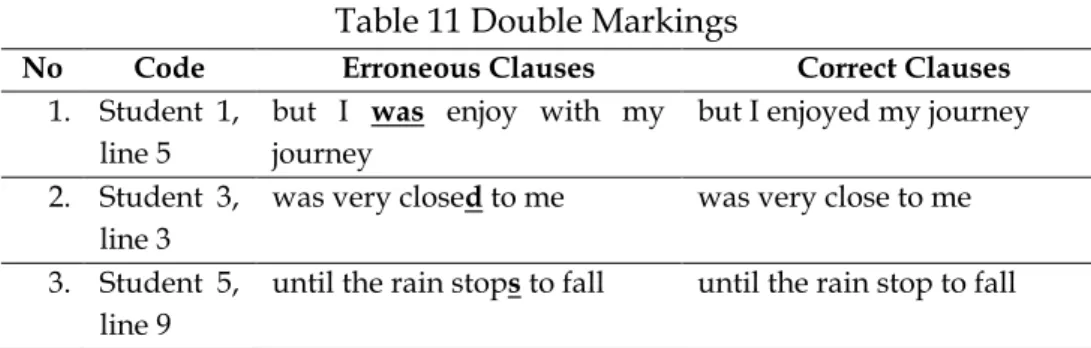
a. Double Markings
22
Table 11 Double Markings
No Code Erroneous Clauses Correct Clauses
1. Student 1, line 5
but I was enjoy with my
journey
but I enjoyed my journey
2. Student 3, line 3
was very closed to me was very close to me
3. Student 5, line 9
until the rain stops to fall until the rain stop to fall
The example number one is not correct. The clause “but I was enjoy my journey” is marked by present of verb auxiliary „was‟. If the student used simple past tense, the clause should use verb-ed instead of verb auxiliary. Therefore the correct clause should be “but I enjoyed my journey”. The datum number two “was very closed to me” is also not correct. The student failed to delete the passive marker v-ed where the construct meaning is different from the student means. The correct clause should be “was very close to me‟.
b. Simple Addition
The researcher found seventy nine (79) errors in missing part of content morphemes. Table 12 presents the example of the data.
Table 12 Simple Addition
No Code Erroneous Clauses Correct Clauses
1. Student 1, line12
like from, Malaysia, ..., and many more
like, Malaysia, ..., and many more
2. Student 7, line 10
In the former times, people
saw many peacocks were
finding brackish water for drink
In the former times, people saw many peacocks finding brackish water to drink
3. Student 9, line 13
But it was different with this
field
it was different from that field
4. Student
11, line 19
..., so we have to find a parking place ...
..., we had to find a parking place ...
5. Student
12, line 6
23
The first example is inappropriate. If the student wanted to mention something already understandable, the unnecessary word should be omitted. The clause “like from, Malaysia,…, and many more” is not correct. It should be “like Malaysia,…, and many more”. The second example is the usage of verb auxiliary verb „were‟, because it is not a past progressive sentence. Here the real form is „which find‟ and the phrases are connected became „finding‟. Therefore the correct sentence should “In the former times, people saw many peacocks finding brackish water to drink”.
Misformation
The researcher found one hundred seventy two (172) errors in the terms of misformation. Most of the student have done such error, therefore it can be concluded that, it happened because of their limited vocabulary. They just put the words they knew without any caution of inappropriate words or meaning. Mostly the errors occurred in terms of alternating form. Table 13 presents the example of the data.
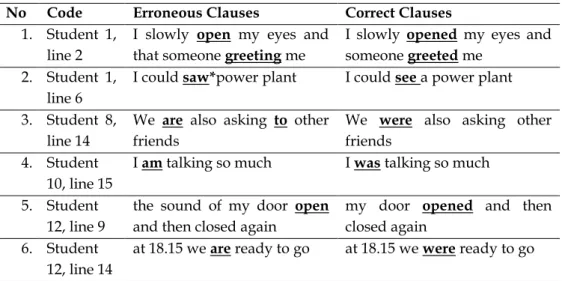
Misformation usually occurred because the lack of learners' information or knowledge in the changing of past participle or in constructing sentences according to its tense form. As shown in the first example, the student was not consistent in writing the right verb form. Here, the student used past tense in composing the writing. Therefore the right clause should be “I slowly opened my eyes and someone greeted me”. The next example is the clause “I could saw a power plant”. This clause already used past modal auxiliary. Because of that, the student should use simple present verb instead of simple past verb. Therefore the correct clause should be “I could see a power plant”.
The next example is the usage of past participle. The student used present verb instead of the past one. Therefore the correct sentence should be “we were also asking other friends”. The fourth example has the similar kind of error to the third example.
24
No Code Erroneous Clauses Correct Clauses
1. Student 1, line 2
I slowly open my eyes and
that someone greeting me
I slowly opened my eyes and
someone greeted me
2. Student 1, line 6
I could saw*power plant I could see a power plant
3. Student 8, line 14
We are also asking to other friends
We were also asking other
friends
4. Student
10, line 15
I am talking so much I was talking so much
5. Student
12, line 9
the sound of my door open
and then closed again
my door opened and then
closed again
6. Student
12, line 14
at 18.15 we are ready to go at 18.15 we were ready to go
The correct clause should be “I was talking so much”. As for the last two examples, they have the same kind of error with the previous examples. The correct clause should be “my door opened and then closed again” and “at 18.15 we were ready to go”.
Misordering
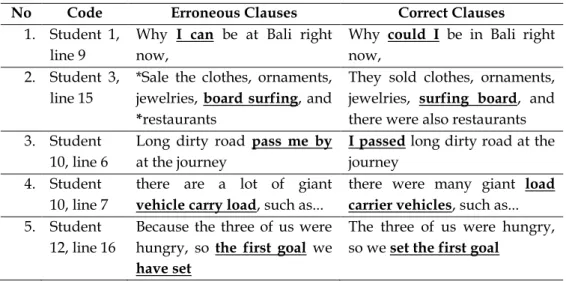
The researcher found sixteen (16) errors in terms of misordering from the text. In this type of error, the student did not write the clause in an appropriate order. Table 14 presents the example of the data.
This kind of error is characterized by the incorrect placement of a morpheme in a sentence. For example, the sentence in datum number one “Why I could be in Bali right now.” is not correct. It is a positive sentence, but its order is in an interrogative one. In the text, the next sentence is the answer. Therefore the sentence is not in appropriate order. The correct one should be “Why could I be in Bali right now”.
As for the last example, the clause “…so the first goal we have set” is not in right order.
25
No Code Erroneous Clauses Correct Clauses
1. Student 1, line 9
Why I can be at Bali right now,
Why could I be in Bali right now,
2. Student 3, line 15
*Sale the clothes, ornaments,
jewelries, board surfing, and
*restaurants
They sold clothes, ornaments, jewelries, surfing board, and there were also restaurants
3. Student
10, line 6
Long dirty road pass me by
at the journey
I passed long dirty road at the journey
4. Student
10, line 7
there are a lot of giant
vehicle carry load, such as...
there were many giant load
carrier vehicles, such as...
5. Student
12, line 16
Because the three of us were hungry, so the first goal we
have set
The three of us were hungry, so we set the first goal
„we have set‟ here is as the subject and „the first goal‟ is as the object. The right pattern is, subject (noun) + verb + object (noun). Therefore „the first goal‟ should be put after the „we set‟. The right sentence should be “so we set the first goal”.
Tabulation of Error
Here the researcher presents the percentage of the result of the errors after discussing the finding and identifying the errors in the travel writing texts made by the students. The following table is the percentage of the error occurred.
Table 15 Percentage of Each Type of Error
Type of Error Quantity Percentage
Misformation 172 39.18 %
Omission 155 35.31 %
Addition 96 21.87 %
Misordering 16 3.64 %
Total 439 100 %
26
omission type, 96 errors (21.87 %) in addition type, 172 errors (39.18 %) in misformation type and 16 errors (3.64 %) in misordering type.
CONCLUSION
Based on the findings, this analysis finds the grammatical errors which are used in the travel writing texts produced by the students by using Dulay‟s theory (1982). The theory used by the researcher is Surface Strategy Taxonomy which consists of four categories of error, namely omission, addition, misformation and misordering.
From those four types, the most dominant type found in the travel writing texts is misformation. There are 172 errors out of 439 error clauses. Mostly the errors occur in the changing of past participle or in constructing sentences according to its form. 155 errors are those in omission type. Most of the noun phrases in clause construction produced by the students were omitted its noun phrase. The next error is in addition type for 96 errors. In this case, the students mostly wrote unnecessary words in most of the sentences. The last error type is misordering that occurred in 16 clauses. In this type of error, the student did not write the words in appropriate order.
It shows that in producing their travel writing, the students focused on the story of their journeys without concerning the right structure. Misformation errors occurs most frequently because the students did not use correct tenses in their writing. Therefore, the students should know the tense form used in many kinds of writing.
REFERENCES
Ary, D. Jacobs, L. C. & Razavieh, A. (2002). Introduction to research sixth edition. Stamford: Wordsworth Group.
Azar, B. S. (1999). Understanding and using English grammar 3rd edition.
27
Bautista, M. L. S. & Gonzalez, A. B. (Eds). (2006). The handbook of world englishes. Oxford: Blackwell Publishing Ltd.
Brown, H. D. (1987). Principles of language learning and teaching. Eagle Cliff, New Jersey: Prentice Hall.
Creswell, J. W. (2003). Research design: Qualitative, quantitative, and mixed method approaches. Lincoln: University of Nebraska.
Dulay, H., Burt M. & Krashern, S. (1982). Language two. New York: Oxford University.
Ellis, R. (1997). Second language acquisition. New York: Oxford University Press.
Gass, S. & Selingker, L. (2008). SLA: an introductory course third edition.
New York: Routledge Taylor and Francis Group.
Joshi, N. (2011). Significance of Error Analysis in Language Teaching and Learning. Retrieved January 19, 2014, from
www.eslbasics.com/blog/teacher posts/significance-of-error-analysis/
Nzama, M. V. (2010). Error Analysis: A Study of Errors Committed by Isizulu Speaking Learners of English in Selected School. Retrieved
April 30, 2014, from
http://uzspace.uzulu.ac.za/bitstream/handle/10530/615/err or%20analysis.pdf?sequence=1
Richards, J. C. (1973). Error analysis. London: Longman.
28 Retrieved February 23, 2014, from
http://www.polines.ac.id/ragam/index_files/jurnalragam/p aper_3%20apr_2011.pdf
Saville, M. & Troike, M. (2006). Introducing to second language acquisition. New York: Cambridge University Press.
Suryadi, S. B. (2012). Error Analysis in the Writing Test by Four Semester Students of STAI Mahad Aly Al Hikam Malang, Unpublished Thesis. Malang. Universitas Brawijaya.
Yule, G. (2010). The study of language fourth edition. New York: Cambridge University Press.
Yuwanti, M. C. (2014). Error Analysis on the Argumentative Essays Written by Fourth Semester Students of Study Program of English.