Abstract
The paper evaluates the principle of addi-tionality in public support programs at local level. In the evaluation of public support policies a key question is whether the policy has made a differ-ence over what would have otherwise occurred. This could be measured by different ways as out-put, behavioral or input additionality. In this paper we analyze the impact of public support programs on input additionality as the extent to which the subsidy is reflected in increased expenditures by supported subjects through the measurement of substitution effect. We studied public investment subsidies in the case of education support in Slo-vakia. We identified the substitution effect in 10% of the analyzed municipalities. There are several differences in outcomes.
An important factor is the size of the city as larger municipalities reduce their other activities when obtaining the support. We also showed that less developed regions have a lower tendency to misuse the support programs. The more de-veloped regions and cities reduce their own spending on a given priority when obtaining the support.
Keywords: support programs, additionality, substitution effect, structural funds, municipali-ties.
SUBSTITUTION EFFECT OF
PUBLIC SUPPORT PROGRAMS
AT LOCAL LEVEL
*1Valéria SZITÁSIOVÁ
Monika MARTIŠKOVÁ
Miroslav ŠIPIKAL
Valéria SZITÁSIOVÁ (corresponding author) Research Assistant, Department of Public Administration and Regional Development, Faculty of National Economy, University of Economics, Bratislava, Slovak Republic Tel.: 00421-267-291.350
E-mail: [email protected]
Monika MARTIŠKOVÁ
PhD Student, Institute of Economic Studies, Faculty of Social Sciences, Charles University, Prague, Czech Republic
Miroslav ŠIPIKAL
Associate Professor, Department of Public Administration and Regional Development, Faculty of National Economy, University of Economics, Bratislava, Slovak Republic E-mail: [email protected]
* Acknowledgment: This research was supported by VEGA (Scientifi c Grant Agency of the Ministry of Education, Sci-ence, Research and Sport of the Slovak Republic) under the contract No. 1/0093/12 titled Effi ciency of EU Regional Policy in the Slovak Republic.
1. Introduction
European Union member states which accessed in 2004 and 2007 have been grant-ed large amounts of financial support through EU structural funds. They were con-sidered as lagging behind regions of the EU. This has allowed them to obtain a strong support for regional and local development. This new international level of regional support greatly exceeded existing public expenditures at the local level. Even though EU structural funds are intended to enhance the growth of the least developed regions within the EU, high amounts of additional resources can create wrong incentives for public finance allocations.
Local communities, including local governments, should adapt and plan their expenditures in line with EU structural funds priorities. Therefore we focus our re-search on the interaction between local municipalities and structural funds priorities. We specifically focus on the negative incentives EU support creates at the local level, namely the substitution effect. We measure the inefficiency level of the EU funds allo-cation in the public sector in Slovakia. We try to quantify the level of the substitution inefficiency based on the example of the Regional Operational Program targeted on support of school infrastructure in primary education.
Slovak municipalities are responsible for primary education in their districts. The costs for education are paid from the state transfers based on the number of pupils in a particular school. These transfers are supposed to cover both the personnel costs as well as the investments into the infrastructure. In most of the cases the schools are deprived, paying low wages and having only little money for investments.
The aim of this study is to focus mainly on the substitution effect in relation to the financing of the selected priorities by local municipalities. We identify the extent of the substitution effect and then characteristics of the municipalities which most likely replace their own resources by the EU funds.
Previous research on the efficiency of this assistance focused mainly on the anal-ysis of aid to the private sector. Considerably less attention has been paid to the rela-tion of the public support especially at lower levels of the public sector. This article is therefore focused on exploring the substitution effect, pointing to the problems of inefficiencies that may occur in supporting the public sector at the local level.
In the next section we offer literature review that emphasizes the theoretical foun-dations of the substitution effect. Then we elaborate on the data description as well as on methodology. The suggested type of methodology was until now used mainly to analyze the public support of the private sector. However, it will also help us to iden-tify whether the funding priorities of the EU actually translate into higher volumes of support for the development priorities at the local level. Finally, we formulate some policy recommendations to EU funds design for the public sector.
2. Theoretical framework of the research
There-fore, the distribution of EU funds is bind by several principles (Reg. 1083/2006) which should ensure the proper allocation of money. Two of them are important in our re-search. The first principle is concentratio,n meaning that EU funds should be allocated to the areas which need it. The second of them is additionality, which should ensure that EU funds are complementary to national and local resources rather than supple-mentary.
The additionality principle is defined from both macro and micro level perspec-tives. The macro level is defined by the European Commission that sets limits to EU expenditures which are related to the public expenditures of the government (Reg. 1260/1999, Reg. 1083/2006). At the micro (local) level, additionality principle means that the recipient should use the additional funds as the extra resources and should not substitute it with its own resources. Both, macro and micro levels are difficult to control and measure. According to Georghiou (1994) the additionality principle can be defined according to three dimensions: input additionality, output additional-ity and behavioral additionaladditional-ity. The first analyzes whether the additional funds/aid received by targeted subjects increases their expenditure on the target activity. The second aims at gauging the output which would not have been achieved without the policy intervention. Finally, behavioral additionality deals with the changes in terms of the internal allocation of funds and operative decisions of the targeted institution after the policy inception. The principle of additionality can be measured in many ways; the most common are measuring deadweight, displacement, substitution effect and leakage (BIS, 2009).
Output additionality is very often measured by the deadweight effect. This effect represents the proportion of total outputs/outcomes that would have been secured anyway without the intervention in question (BIS, 2009). In the case of projects under the Structural Funds, these are projects that would not be implemented in whole or in part without the support from the EU. The results of studies by different authors (Wren, 2005; Lenihan and Hart, 2006; Tokila and Haapanen, 2010; Sipikal, 2010; Sip-ikal, Pisar and Labudova, 2013) vary considerably. The obtained values range from 20% (Wren, 2005) to 73.5% (Lenihan and Hart, 2006). This indicates a large potential for the inefficiency of support. All studies are methodically based on interviews with businesses that received support, which can significantly distort the measured value.
will be ceased. Another reason is that with the substitution in public sector the EU in-vestments schemes lose their importance and therefore end up as useless inin-vestments with no multiplicative effect in the lagging behind regions.
As stated in Barca report:
‘The task of place-based development policies is not to compensate for the failure of some places to raise enough revenue from their own sources to finance their development. If this were the purpose, an EU-level regional equalization fund could be set up, as is com-mon practice in many countries. Instead, the task of such policies is to trigger a change in the behavior of private actors in regions where either an efficiency or a social exclusion trap exists. The simple transfer of funds cannot get close to doing this and might even worsen problems by creating a dependency culture’ (Barca, 2009, p. 39).
The problem is that there is no standard methodology on how to evaluate the ef-fective implementation of the principles which ensure the correct implementation of EU funds. In the case of additionality, this is also reported by Del Bo et al. (2011) - it is concluded that even though additionality as a criterion is controlled by the national authorities and the European Commission, ‘there is no standard methodology and the information provided is very heterogeneous in terms of quality and usefulness’ (p. 6).
The Cohesion policy of the EU is one of the most developed systems of internation-al support to the less developed regions. Mutuinternation-al interaction between locinternation-al, nationinternation-al and transnational forms of support should be guided by several fundamental prin-ciples (Council Regulation no. 1083/2006), including the principle of additionality. In order to ensure a genuine economic impact, contributions from Structural Funds should not replace public expenditure by Member States under the terms of this Reg-ulation. As a general rule, the level of the expenditure of recipient shall be at least equal to the amount of average annual expenditure in real terms attained during the previous programming period (Council Regulation no. 1083/2006, p. 24).
sub-stitution is removing funds from areas funded by the EU and to infer from this that concerns about additionality are appropriate. Despite of the need for the additionality principle at the local level, there is no obligation for this additionality in the support system.
2.1. Substitution effect
The measurement of the substitution effect was the subject of several studies. The ways how the authors approached this research vary from qualitative, with estima-tion and descripestima-tion of mechanisms how it is created, to quantitative approach with real data gathering, the approach we are trying to implement in this paper as well. In the study of BIS (2009), for instance, the authors summarized different evaluation studies in Great Britain and identified that the substitution effect arose from diff er-ent supporting schemes to the business sector. Even though data on the substitution effect did not allow the authors to provide a detailed inspection of the extent of the substitution according to the areas, it was identified as one of the smallest ineffi cien-cies. They conclude that from the three examined areas - Business development & competitiveness, Regeneration through physical infrastructure and People and skills - the last one reported the highest substitution effect, 4.4 %. The study of Potluka et al. (2010) about the substitution effect in public programs in Slovakia concludes that the business sector tends to replace its own resources with the public ones if available. Authors demonstrate it based on the example of Slovak beneficiaries from the busi-ness sector (e.g. tourism) and claim, although without exact data available, that there are many examples of purposely weak indicators of profitability concerning a certain project in order to receive EU support. The reason is that EU support seeks projects that are unprofitable in the financial sense but profitable for the society as such. This criterion therefore creates an incentive to provide data about financial unprofitability of the intended project even though it is possible that the project would be profitable even without the support.
In terms of regional concentration of assistance, studies also came to different re-sults. Bergström (2000) identified no statistically significant difference between sup-porting the companies of the lagging behind regions and supsup-porting the companies outside these regions. Tokila and Haapanen (2010), on the contrary, came to the op-posite conclusion.
For example, Luukkonen (2000), Czarnitzki and Licht (2006), Hewitt-Dundas and Roper (2010) focused specifically on the substitution effect in the area of R&D support. They have noted the positive impact of the support that stimulates additional private investment in R&D. This might be because of the specificity of the R&D sector which provides very costly research projects feasible only with additional support. There-fore the substitution effect is not much observed in the R&D sector.
ficient control mechanisms of quality of the implemented project and also the insuf-ficient control of the efficiency and adequacy of money spent. The problem is that there is no explicit mechanism to ensure that the local level recipients spend money efficiently. Also, there is no control mechanism to ensure that they contribute to the financing of the projects themselves instead of substituting own resources by the EU funds. There is an extensive debate about whether and how the international support has influenced the domestic policy priorities of municipalities. In some cases, struc-tural funds influence the spending priorities; in other, they just add finance volume to existing ones (Mairate, 2006).
Several research studies show that the local government is not completely benev-olent and welfare-maximizing, but is instead influenced by special interest groups or other political factors, the additional public funds may be diverted, irrespective of their growth potential. The political aspect dominates the presence of interest groups in the allocation of additional public funds, since municipalities ruled by the same party that is in charge of the higher level of government are more successful in att ract-ing grants and funds. In this setting, the role of institutional quality and the set of lim-its and controls on the use of additional public funds gains relevance and importance (Kemmerling and Bodenstein, 2006; Kemmerling and Stephan, 2002). This article is currently focused on exploring the principle of additionality in this type of settings, pointing to the problems and inefficiencies that may occur in supporting the public sector at the local level.
3. Research methodology 3.1. Data collection
3.2. Regression analysis
In respect of the external aid, various studies (Beugelsdijk and Eijfinger, 2005; Wren, 1996) indicate that support resources lead to substitution of own resources which indicates the existence of a substitution effect of the assistance. It can be as-sumed that the magnitude of the substitution effect is influenced by the various fac-tors as reflected in the scientific literature (Gillespie et al., 2001; Lenihan, 2004; Beu-gelsdijk and Eijfinger, 2005). These factors are tested in the analyses of the principle of additionality. International experiences suggest that this amount is affected mainly by the size of the supported entity (Atzeni and Carboni, 2006; Lenihan and Hart, 2006), territorial level (Atzeni and Carboni, 2006; Tokila and Haapanen, 2010) as well as the level of development of the investigated territory (Tokila and Haapanen, 2010). In or-der to obtain information about the behavior of the supported municipalities, we used a regression analysis where we pursue the modification of own capital expenditures on education (dependent variable) depending on the implementation (independent variable). Other independent variables are municipality size (population in 2009), the level of unemployment (in 2009) and the territory in which the municipality is located.
The unemployment rate was used as a proxy for the maturity of the city. The lit-erature assumes that richer regions are more likely to substitute own resources. In poor cities insufficient own resources are expected to support the development and therefore the substitution effect does not occur.
However, there are no available data at the regional level (i.e. GDP), which would better reflect the status of developed region. The unemployment rate was used, since there is a strong relationship between the rate of unemployment and the maturity of a city (Tokila and Haapanen, 2010; Gillespie et al. 2001).
We will also consider whether the regional dimension also plays a role in this ef-fect, we do not expect however that there should be a difference in the level of sub-stitution effect between regions. Regarding the size of the city, we assume that larger cities have greater budgetary resources that allow greater transfers between different development priorities and therefore there is a greater potential risk of substitution.
Table 1:Description of variables
Variable categoriesResponse Description
Treatment in year Binary 1= there was a support from the EU in the given year; 0 = there was no support from the EU in the given year;
Inhabitants Ordinal
Size categories according to the number of inhabitants of the given municipality in year 2009; 1 = 0 – 1000 inh., 2 = 1000 - 2000 inh., 3 = 2000 - 3000 inh., 4 = 3000 - 5000 inh., 5 = 5000 - 10 000 inh., 6 = 10 000 - 20 000 inh., 7 = 20 000 - 50 000 inh., 8 = over 50 000 inh.,
Unemployment Ordinal Unemployment categories according to the level of unemployment in LAU 2 level (districts in Slovakia) in 2009; 1 = 0 - 10%; 2 = 10 - 15 %; 3 = 15 - 20 %; 4 =over 20 %.
3.3. Substitution effect identification
As it was suggested in the previous section, the substitution effect is not easy to measure. We have seen that many researches tried to identify it through respondents’ estimations (BIS, 2009) or through meta-analysis of the projects and studies. In this paper we try to identify the substitution effect through quantitative analysis of data obtained in our own survey. In the survey we investigated whether EU funds recip-ients decreased their own resources once receiving EU funds. We propose a method how to identify this effect. Assume that amount of own resources on the given priority in the year, when EU support was received is αt. In the ordinary year, when support is not received, own resources are at-1. So we conclude that if at-1>αt we may expect that the substitution effect occurred. If i is the number of the observation based on the condition that at-1 - αt > 0, the quantification of the effect is as follows:
We do not concentrate on the quantification of the impact independent variables have on the substitution effect, we rather search for the evidence and importance of those variables on it.
Therefore, for the purpose of the regression analysis we operate with a dummy variable defined as:
If αt-1 > αt then SE=1 and if αt-1 < αt then SE=0.
This enables us to identify the factors which have an impact on the dependent variable but we do not have to deal with its quantification.
In our research, we aimed to investigate whether the substitution effect can be observed in school infrastructure projects in Slovakia. In addition, we focused on the factors that could influence the occurrence of the effect. In particular, we analyzed the potential impact of the size of the city and of the unemployment level.
4. Research results
Implementation of the Regional Operational Program started in January 2008 when the first call for grant applications for ROP municipalities was announced. In this call 1,009 applications were submitted representing more than double the amount of funds allocated to the whole measure 1.1. The high number of submitted applica-tions points to the fact that the schools accepted the challenge with high expectaapplica-tions and were well prepared for it.
782 applications were approved representing total eligible costs of approx. EUR 626 million of which a total of EUR 596 million represent non-returnable funds.
As suggested before, the current research focuses on the education support through the ROP measure 1.1 Education infrastructure approved until 2010 for pri-mary schools in 466 municipalities, of which 206 are investigated in detail.
4.1. Analysis of own capital expenditures on education
Information obtained through a questionnaire survey was related to the capital ex-penditures on education during the years 2006 to 2010. The following figure presents the evolution of total capital expenditures on education, own capital expenditures and EU supporting resources from the Measure 1.1 Education infrastructure in the surveyed 206 municipalities.
Figure 1: Capital expenditures on education in years 2006 - 2010 (EUR) Source: Own calculations
Overall capital expenditures in the surveyed municipalities grew steadily with the support of ROP. Overall, an impact of the EU funds can be seen as there is a signifi-cant increase in spending since 2009 and also a large disparity between own and EU resources. The aid is not only complementary, but crucial for the development of the analyzed priority. As it regards own resources, we can observe only a slight increase between the years 2007 and 2010. It may not be applied to all the municipalities ana-lyzed.
On the one hand, a general analysis of the expenditures does not point to ineffi -cient behavior, as the own resources increased over time. On the other hand, detailed analysis identified inefficiencies through categorization of expenses according to size categories of municipalities (Figure 2). This behavior indicates the occurrence of sub-stitution effect.
expenditures on education were EUR 2,596 when no EU support was implemented. In the years when the aid was realized it was already EUR 31,313. The average resources per capita have risen from 3 Euros per 1 inhabitant in years when there was no sup-port, to 41 Euros when a municipality was granted the EU fund.
Figure 2: Average own capital expenditures on education by municipality size (inhabitants) in period 2006 - 2010 (EUR)
Source: Own calculations
If we look at the largest towns in our sample, we can observe an opposite trend in the behavior of the average expenditures in the village as well as per capita. In this category, the average expenditures on education in the city were almost 790,000 Euros in the years when no support was implemented. In the years when the aid was real-ized it was only 700,000 Euros. The average resources per capita were 8 Euros per 1 inhabitant in years when there was no support, and 7 Euros in years when the support was implemented. These facts suggest that on the one hand the amount per capita in small villages increased in the years of support and on the other hand, decreased in large cities. This may suggest that large cities incline to decrease their own expendi-tures when external resources occur. This fact may indicate inefficient spending and a failure of the additionality principle fulfillment in the cities above 50 000 inhabitants.
4.2. Regression analysis
significance of the results. The effect of the particular independent variables on the substitution effect would be only country specific and will not allow us to apply it generally.
In the linear regression model (Table 2), the dependent variable is represented by the binary variable of the substitution effect. The positive change of own capital spending on education before and after the years of the support is denoted 1, other-wise it is zero. For independent variables we chose the existence of support, size of municipality (population), unemployment in the district in which the municipality is located, and we have also examined whether the change in expenditures depends on the NUTS 2 regions where the municipality is located1.
Table 2: Regression analysis
Model Unstandardized Coeffi cients Standardized Coeffi cients t Sig.
B Std. Error Beta
(Constant) 5726,294 27316,316 ,210 ,834
Treatment in year 65962,373 11894,107 ,146 5,546 ,000
Inhabitants 5,220 ,278 ,508 18,746 ,000
Unemployment -870,376 1202,809 -,025 -,724 ,469
ZS_NUTS3 31176,437 17983,606 ,075 1,734 ,083
SS_NUTS3 -3394,139 15980,177 -,007 -,212 ,832
Source: Own calculations, SPSS
The results highlight two factors that are statistically significant - the existence of support in a given year and the population of the surveyed village. This means that the change of own capital expenditure on education is dependent on the funds from the EU as well as on the size of the surveyed municipalities.
The results of the regression showed the positive impact of the aid from the EU, which means that the support generally led to an increase in own capital expenditures on education in the sample of 206 municipalities. In the years when EU support was received, municipalities have increased their own spending on education with more than EUR 65,000. The results also apply positive dependence in the size of the mu-nicipality, which means that the larger the municipality is, the more its own capital expenditure on education increases. The independent variables in the model, such as unemployment and location, are statistically insignificant.
4.3. The substitution effect
An individual analysis of the surveyed municipalities was conducted by calcu-lating the substitution effect. Based on the analysis of a comparison between own expenditures in years with and without the EU support, undesired substitution of own resources was identified. From all the 206 municipalities the substitution effect occurred in 21 cases. This means that more than 10% of local governments tend to replace their own resources by EU funds. The cumulative amount of the substitution effect in 21 municipalities was EUR 2,250.428 thousands. For expressing this number as a percentage, it represents 1.3% of the total amount of aid from the EU. Foreign experience exerts a relatively higher result, for example BIS study indicates the substi-tution effect of 4.4% (BIS, 2009).
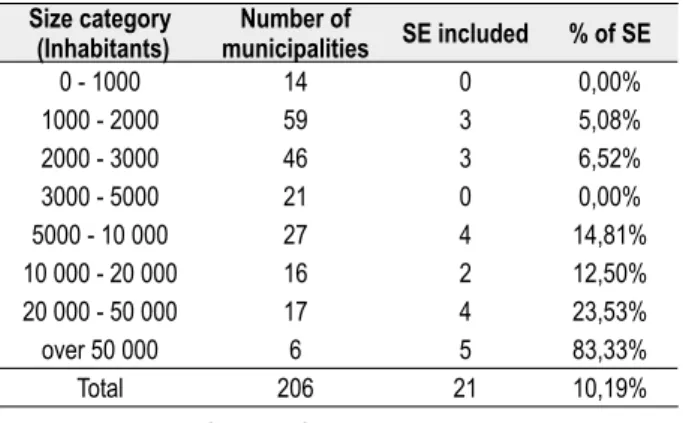
In the next section the surveyed municipalities are divided into eight categories by their population. According to the analysis it can be said that the substitution effect occurs in large cities.
Table 3: Substitution effect by size category Size category
(Inhabitants) municipalitiesNumber of SE included % of SE
0 - 1000 14 0 0,00%
1000 - 2000 59 3 5,08%
2000 - 3000 46 3 6,52%
3000 - 5000 21 0 0,00%
5000 - 10 000 27 4 14,81%
10 000 - 20 000 16 2 12,50%
20 000 - 50 000 17 4 23,53%
over 50 000 6 5 83,33%
Total 206 21 10,19%
Source: Own calculations
Out of the 21 municipalities where the substitution effect occurred, more than half (11) have more than 10,000 inhabitants (Table 3). It means that 86% of the sub-stitution effect (EUR 1,935.883 thousands) occurred in the largest cities within the sample. Another important finding is that the analyzed sample contained 6 cities with population of more than 50,000 and in 5 of them the substitution effect was identified. On this basis, it can be stated that the substitution occurs more likely in larger cities.
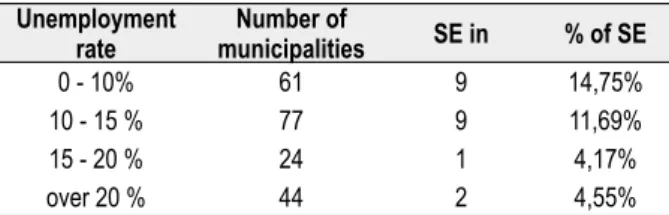
Table 4: Substitution effect by unemployment rate Unemployment
rate municipalitiesNumber of SE in % of SE
0 - 10% 61 9 14,75%
10 - 15 % 77 9 11,69%
15 - 20 % 24 1 4,17%
over 20 % 44 2 4,55%
Source: Own calculations
5. Conclusions
We have tried to point out the principle of additionality and its real scope in terms of the substitution effect of school infrastructure support in Slovakia. The result is a confirmation that the additionality principle also applies at the local level, even if it is not regulated by legal regulations.
The investigation showed that there are differences in the substitution effect’s oc-currence, especially in terms of the size of the municipalities. The breach of the addi-tionality principle is shown especially in the larger cities, which tend to replace funds previously invested in school infrastructure with funds gained from EU support programs. It was also shown that despite the large volume of the financial support from EU funds, the increase of their own financial resources by municipalities was relatively small compared to level of support. Part of this increase is made up by the investments that the cities were forced to pay for ineligible costs and thus are kept as own funds invested.
This analysis also showed that in underdeveloped regions the EU support be-comes crucial and not complementary for development. This increased emphasis on the need for proper selection of priorities as well as an effort to avoid waste of resourc-es. Therefore, it is always a continuous evaluation of financial resources importantce that needs to be provided in the widest range of implemented priorities. As the results showed, the substitution effect occurs frequently when investing in more developed regions. For confirmation of these trends in other areas or countries should accede to even greater concentration of aid to underdeveloped regions than ever before. It would be appropriate to compare the results in within each priority in different coun-tries of the European Union.
It was also confirmed that the substitution effect is a less problematic effect in the application of the principle of additionality than other effects. For example, dead-weight effect achieves more than 10-fold higher levels of inefficiency (Sipikal, Pisar and Labudova, 2013).
infrastructure in small cities is much more costly than achieving comparable effects in large cities. Here, it shows that 95% support from the EU and the state for co-financing of projects may lead to high interest for support, which could result in a commitment to getting it without a real need. In the future, policymakers should reconsider to reduce the present level of 95% of project’s cost co-financing to some lower level to demand higher participation of the recipients. It could lead to lower demand/supply ratio for support programs and also increase the amount of funds spent by local mu-nicipalities on education.
References:
1. Atzeni, G.E. and Carboni, O.A., ‘The Effects of Subsidies on Investment: An Empirical Evaluation on ICT in Italy’, 2006, Revue OFCE, vol. 97, no. 5, pp. 279-302.
2. Barca, F., ‘An Agenda for a Reformed Cohesion Policy: A Place-based Approach to Meeting European Union Challenges and Expectations, Independent Report prepared at the request of Danuta Hübner, Commissioner for Regional Policy’, 2009, [Online] available at http://www.europarl.europa.eu/meetdocs/2009_2014/documents/regi/dv/ barca_report_/barca_report_en.pdf, accessed on December 29, 2014.
3. Becker, S.O., Egger, P. and Von Ehrlich, M., ‘Absorptive Capacity and the Growth Ef-fects of Regional Transfers: A Regression Discontinuity Design with Heterogeneous Treatment Effects’, 2011, American Economic Journal: Economic Policy, vol. 5, no. 4, pp. 29-77.
4. Bergström, F., ‘Capital Subsidies and the Performance of Firms’, 2000, Small Business Economics, vol. 14, no. 3, pp. 183-193.
5. Beugelsdijk, M. and Eijffinger, S.C.W., ‘The Effectiveness of Structural Policy in the European Union: An Empirical Analysis for the EU-15 in 1995-2001’, 2005, Journal of Common Market Studies, vol. 43, no. 1, pp. 37-51.
6. BIS (Department of Business, Innovation and Skills), ‘Research to Improve the As-sessment of Additionality’, 2009, BIS Occasional Paper No. 1, [Online] available at http://web.bis.gov.uk/assets/biscore/economics-and-statistics/docs/09-1302-bis-occasio nal-paper-01.pdf, accessed on May 21st, 2014.
7. Council Regulation (EC) No. 1260/1999 laying down general provisions on the Struc-tural Funds, published in OJEUC no. L161/41 from 26.6.1999, [Online] available at www.google.sk/url?sa=t&rct=j&q=&esrc=s&source=web&cd=3&ved=0CDYQFjA C&url=http%3A%2F%2Feustructuralfunds.gov.ie%2Ffiles%2FDocuments %2F1260%2520of%25201999.pdf&ei=LNWnVM2eMIj7UMumhPgL&usg=AFQjCN EgSYyRAx0R1xKqVy7WVxAcpkkniw&sig2=nk8BBnmrWinYV2RvnwUCJg& bvm=bv.82001339,d.d24, accessed on May 21, 2014.
8. Council Regulation (EC) No. 1083/2006 laying down general provisions on the Eu-ropean Regional Development Fund, the EuEu-ropean Social Fund and the Cohesion Fund, published in OJEUC no. L210/25 from 31.07.2006, [Online] available at http:// ec.europa.eu/regional_policy/sources/docoffic/official/regulation/pdf/2007/general/ ce_1083%282006%29_en.pdf, accessed on May 21, 2014.
10. Czarnitzki, D. and Licht, G., ‘Additionality of Public R&D Grants in a Transition Econ-omy - The Case of Eastern Germany’, 2006, Economics of Transition, vol. 14, no. 1, pp. 101-131.
11. David, P.A., Geuna, A. and Steinmueller, W.E., ‘Additionality as a Principle of Euro-pean R&D Funding’, MERIT Research Memorandum, 2/95-012, MERIT, University of Mastricht, 1995.
12. Del Bo, C.F., Florio, M., Vignetti, S. and Sirtori, E., ‘Additionality and Regional De-velopment: Are EU Structural Funds Complements or Substitutes of National Public Finance?’, Working Paper no. 1/2011, Centre for Industrial Studies, [Online] available at http://www.csilmilano.com/docs/WP2011_01.pdf, accessed on December 29, 2014.
13. Devarajan, S. and Shetty, S., ‘Africa: Leveraging the Crisis into a Development Take-off’, 2010, World Bank, Economic Premise, [Online] available at http://siteresources. worldbank.org/INTPREMNET/Resources/EP30.pdf, accessed on December 29, 2014.
14. Devarajan, S. and Swaroop, V., ‘The Implications of Foreign Aid Fungibility for Devel-opment Assistance’, 1998, World Bank Policy Research Working Paper No. 2022.
15. European Commission, ‘Verification of Additionality in the Objective 1 regions for 2000-2006’, [Online] available at http://ec.europa.eu/regional_policy/sources/docgener/ evaluation/pdf/report_verif_add_obj1_2000_2006_en.pdf, accessed on June 6, 2014.
16. Georghiou, L., Impact of the Framework Programme on European Industry, Office for Offi -cial Publications of the European Communities, 1994.
17. Gillespie, G., McGregor, P.G., Swales, J.K. and Yin, Y.P., ‘The Displacement and Mul-tiplier Effects of Regional Selective Assistance: A Computable General Equilibrium Analysis’, 2001, Regional Studies, vol. 35, no. 2, pp. 125-139.
18. Hewitt-Dundas, N. and Roper, S., ‘Output Additionality of Public Support for Innova-tion: Evidence for Irish Manufacturing Plants’, 2010, European Planning Studies, vol. 18, no. 1, pp. 107-122.
19. Kemmerling, A. and Bodenstein, T., ‘Partisan Politics in Regional Redistribution’, 2006,
European Union Politics, vol. 3, no. 7, pp. 373-392.
20. Kemmerling, A. and Stephan, A., ‘The Contribution of Local Public Infrastructure to Private Productivity and Its Political Economy: Evidence from a Panel of Large Ger-man Cities’, 2002, Public Choice, vol. 113, no. 3/4, pp. 403-24.
21. Lenihan, H., ‘Evaluating Irish Industrial Policy in Terms of Deadweight and Displace-ment: A Quantitative Methodological Approach’, 2004, Applied Economics, vol. 36, no. 3, pp. 229 -252.
22. Lenihan, H. and Hart, M., ‘Evaluating the Additionality of Public Sector Assistance to Irish Firms: A Question of Ownership?’, 2006, Policy Studies, vol. 27, no. 2, pp. 115-133.
23. Luukkonen, T., ‘Additionality of EU Framework Programs’, 2000, Research Policy, vol. 29, no. 6, pp. 711-724.
24. Maraite, A., ‘The „Added Value” of European Union Cohesion Policy’, 2006, Regional Studies, vol. 40, no. 2, pp. 167-177.
25. Ministry of Finance of Slovak Republic, ‘Systém finančného riadenia štrukturálnych fondov a Kohézneho fondu na programové obdobie 2007–2013’, [Online] available at http://www.finance.gov.sk/Default.aspx?CatID=7540.pdf, accessed on October 11, 2011.
27. Potluka, O. et al., ‘Impact of EU Cohesion Policy in Central Europe’, 2010, Leipzig: Leipziger Universitätsverlag, [Online] available at htt p://km.vse.cz/wp-content/up-loads/2011/06/Impact-of-EU-Cohesion-Policy-in-Central-Europe-print-WWW.pdf, ac-cessed on May 21, 2014.
28. Šipikal, M., ‘Deadweight Effect’ (in Slovakian), 2010, Region Direct, vol. 2, pp. 71-79.
29. Šipikal, M., ‘Stratégia projektovo orientovanej podpory regionálneho rozvoja Sloven-skej republiky (kritická analýza)’, 2011, Ekonomický časopis (Journal of Economics), vol. 59, no. 9, pp. 954-968.
30. Šipikal, M. and Szitásiová, V., ‘The Additionality Effect in the Public Support Programs at Local Level’, 2012, Good Governance in Local Self-Government: European and Na-tional Trends: Proceedings of the InternaNa-tional Scientific Conference, 12-13 October 2012, Šiauliai University, Lithuania (published with ISBN).
31. Šipikal, M., Pisár, P. and Labudová, V., ‘Are Subsidies Really Needed? the Case of EU Regional Policy in the Czech and Slovak Republics’, 2013, E&M Ekonomie a Manage-ment, vol. 16, no. 4, pp. 30-41.
32. Tokila, A. and Haapanen, M., ‘Evaluation of Deadweight Spending in Regional Enter-prise Financing’, 2010, Regional Studies, vol. 46, no. 2, pp. 185-201.
33. Wren, C., ‘Regional Grants: Are They Worth It?’, 2005, Fiscal Studies, vol. 26, no. 2, pp. 245-275.
34. Wren, C., ‘Fund Substitution and the Incentive Effect of Public Investment Subsidies’, 1996, Scottish Journal of Political Economy, vol. 43, no. 5, pp. 534-548.
35. Wren, C., ‘Reply to Subsidies, Additionality and Financial Constraints’, 1996, Journal of Regional Science, vol. 36, no. 3, pp. 501-508.
Annex 1: Chi-Square Test - Frequencies
Size Category
Observed N Expected N Residual
1 12 17,7 -5,7
2 61 64,9 -3,9
3 46 47,8 -1,8
4 21 28,2 -7,2
5 27 20,0 7,0
6 16 11,5 4,5
7 17 12,4 4,6
8 6 3,5 2,5
Total 206
Test Statistics Size Chi-Square 11,709a
df 7