327
QUALITY AND ANTIOXIDANT PROPERTIES OF PINOT NOIR GRAPEVINE
VARIETY UNDER AGROECOLOGICAL CONDITIONS OF VRŠAC IN
SERBIA
ZORICA RANKOVIĆ-VASIĆ1, VESNA PAJIĆ1, BRANISLAVA SIVČEV1
, BLAGA
RADOVANOVIĆ2, ZORAN ATANACKOVIĆ1, NIKOLA LEKIĆ3, MILOVAN DŽOPALIĆ3
1University of Belgrade, Faculty of Agriculture, Belgrade, Serbia 2Faculty of Science and Mathematics, Department of Chemistry Niš, Serbia 3Vršački vinogradi” AD Vršac, Serbia
Key words: antioxidant properties, Pinot Noir, Vršac, agroecological conditions
ABSTRACT
This research was focused on the antioxidant properties of grape variety Pinot Noir in the period from 2009-2011 in Vojvodina (location Vršac - 45o 8' 40,80" N; 21º 24' 7,97" E, 199 m a. s. l.). Pinot Noir variety was grown on Berlandieri x Riparia Kober 5BB rootstock, at a distance of 3 x 0.8 m. Mechanical properties of bunch and berry, quality and chemical properties of grapes were analyzed. The contents of monomeric and polymeric anthocyanins in grape berry skin were 11.68 and 94.67 mg of malvidin-3-glucoside/g. Correlative relationship between phenolic content and antioxidant activity of berry skin was r = 0.754, n = 18, p <0.0005. Quality and antioxidant activity of Pinot Noir grape variety was determined to be high under the agroecological conditions of Vršac in Serbia.
INTRODUCTION
Production of high quality grape and wine depends on the relationship of different factors such as: locality, climate, soil, grapevine variety and applied agrotechnical and ampelotechnical measures. Contribution of each of these factors is not equal considering their complex relationship (Vaudour, 2002; Jones et al., 2004). Grape yield and quality are affected during the production process by agroecological conditions of locality. Grape chemical composition is especially affected by the applied viticulture practices and ecological conditions of the locality where grape variety is grown (Jackson and Lombard, 1993). When vegetation and reproductive development of grapevine are adapted to ecological conditions, mature grape has adequate ratio and content of sugar, acids, aromatic and phenolic compounds, or other quality parameters desired for the production of high quality wine (Jones and Davis, 2000; Jones, 2006; Van Leeuwen et al., 2008).
Evaluation of grape quality is based on different parameters. Sugar content and acid are very important indicators of grape quality and produced wine. Apart from sugar content, total acids and their ratios, quality of grapes grown for wine production is considerably influenced by the content of antioxidant compounds. Phenolic compounds as antioxidants can be found in different parts of grape bunch and berries and at different concentrations (Prieur et al., 1994). Besides optimal content of sugar and acids, high content of some phenolic compounds in berries is especially desired when grapes are grown for the production of red wines (Mattivi et al., 2002).
This paper presents the investigation of quality parameters of Pinot Noir grapevine variety which was grown under the agroecological conditions of Vojvodina, at the locality of Vršac.
MATERIAL AND METHODS
328
Vršac, at 45o 8´ 40.80´´ of northern latitude and 21o 24´ 7.97´´ of eastern longitude. In the study period from 2009-2011 Pinot Noir variety was grown on Berlandieri x Riparia Kober 5BB rootstock with modified asymmetric cordon training system. The following were investigated: elements of mechanical composition of a bunch and berry, quality of grapes and phenolic content in the berry skin. The tested elements of mechanical composition of a bunch and berry were: length, width, bunch mass, stem mass, berry mass and seed mass. The quality of grapes was determined on the basis of sugar content and total acids in the must. Sugar content was examined by refractometer (Pocket Atago Pal 1). Total acids were determined using a broader titration with n/4 NaOH. Total phenol content was determined by spectrophotometric method (AOAC, 1984) and total anthocyanin content by pH differential method (Shahidi and Marian, 2003). Antioxidant activity was determined with DPPH radicals. The measured data were statistically analyzed using the software package SPSS version 17.0. Correlation between phenolic content and antioxidant activity was determined by Pearsons´s test (Tabachnick and Fidell, 2007).
RESULTS AND DISCUSSION
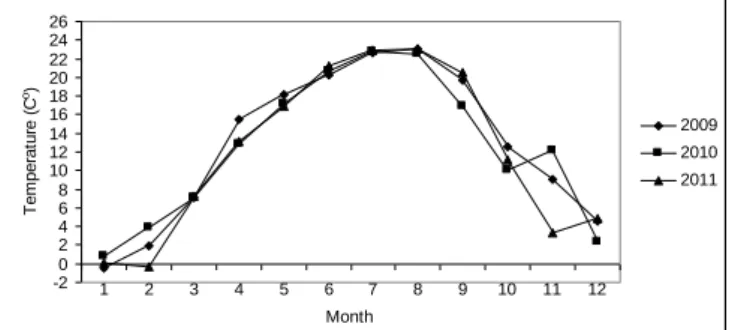
Mean monthly temperatures in Vršac during the investigation years are given in Figure 1, and mean monthly sums of precipitation are given in Figure 2.
-2 0 2 4 6 8 10 12 14 16 18 20 22 24 26
1 2 3 4 5 6 7 8 9 10 11 12 Month Te m p e ra tu re ( C o) 2009 2010 2011
Figure 1. Mean monthly temperatures (2009 - 2011)
0 20 40 60 80 100 120 140 160 180
0 1 2 3 4 5 6 7 8 9 10 11 12 Month P re c ip it a ti o n ( m m ) 2009 2010 2011
Figure 2. Mean monthly sums of precipitation (2009 - 2011)
Meteorological parameters (temperature and precipitation) varied with respect to the year of investigation. The hottest month in 2009 was August, when mean monthly temperature was 23oC, and in 2010 the hottest month was July with mean temperature of 22.8oC. In 2011, the hottest month was August again when mean temperature was 23.1oC. In the years of investigation, the coldest month was January (Figure 1). As for precipitation, in 2009, 2010 and 2011 there was 854.6 mm, 779.0 mm and 472.6 mm of precipitation, respectively (Figure 2).
329
were investigated for particular year. Table 2 shows that the ecological conditions in the investigated years did not affect bunch mass.
Table 1 Descriptive Statistics of bunch and berry properties
N Minimum Maximum Mean Std. Deviation Variance
Bunch length 30 7 13 9.64 1.461 2.134
Bunch width 30 3 7 4.93 1.007 1.013
Bunch mass 30 75 130 103.80 14.787 218.648
Stem mass 30 3.25 5.12 4.28 0.52 0.27
Single berry mass 30 0.39 1.47 1.05 0.21 0.45
Single seed mass 30 0.14 0.65 0.04 0.01 0.00
Table 2
Results of ANOVA test of statistical analysis of bunch mechanical properties at Vršac locality (2009 - 2011)
Property Variation F Significance
Bunch length (cm)
Among groups 3.319 0.051
Within a group Total
Bunch width (cm)
Among groups 7.689 0.002
Within a group Total
Bunch mass (g)
Among groups 1.509 0.239
Within a group Total
Stem mass
Among groups 2.842 0.076
Within a group Total
Single berry mass
Among groups 4.703 0.018
Within a group Total
Single seed mass
Among groups 4.781 0.017
Within a group Total
LSD test determined the years when differences were observed in bunch length and width, as well as the stem mass, single berry and seed mass (Tables 3a and 3b).
Table 3a Differences in grape mechanical properties determined by LSD
test during the investigated years
Property (I) Year (J) Year Difference
(I-J)
Standard
deviation Significance
Bunch length (cm)
2009 2010 -1.230 0.607 0.053
2011 -1.450* 0.607 0.024
2010 2009 1.230 0.607 0.053
330
Grapevine varieties grown for the production of wine have different composition of bunch and berry. Skin is considered to be an important element of berry composition because it contains phenolic compounds which are extracted into wine and which give wine its color and aroma. According to numerous authors (Spayd et al., 1994; De la Hera et al., 2005; Downey et al., 2006) structure of one variety depends on the berry size and water availability in soil. Structural indicators for bunch and berry are given in Figures 3 and 4. Structure of a bunch consisted of 95.79% of berries, and 4.21% of stem. Fazinić et
2011 2009 1.450
*
0.607 0.024
2010 0.220 0.607 0.720
Bunch width
(cm)
2009 2010 1.460
*
0.372 0.001
2011 0.710 0.372 0.067
2010 2009 -1.460
*
0.372 0.001
2011 -0.750 0.372 0.054
2011 2009 -0.710 0.372 0.067
2010 0.750 0.372 0.054
Bunch mass
(g)
2009 2010 8.000 6.500 0.229
2011 -2.900 6.500 0.659
2010 2009 -8.000 6.500 0.229
2011 -10.900 6.500 0.105
2011 2009 2.900 6.500 0.659
2010 10.900 6.500 0.105
Table 3b Differences in grape mechanical properties determined by LSD
test during the investigated years
Property (I)Year (J) Year Difference
(I-J)
Standard deviation
Significan ce
Stem mass (g) 2009 2010 0.05 0.221 0.819
2011 0.479* 0.221 0.039
2010 2009 -0.051 0.221 0.819
2011 0.428 0.221 0.063
2011 2009 -0.479* 0.221 0.039
2010 -0.428 0.221 0.063
Single berry
mass (g)
2009 2010 0.241* 0.085 0.008
2011 0.205* 0.085 0.023
2010 2009 -0.241* 0.085 0.008
2011 -0.036 0.085 0.676
2011 2009 -0.205* 0.085 0.023
2010 0.036 0.085 0.676
Single seed
mass (g)
2009 2010 0.013* 0.004 0.005
2011 0.007 0.004 0.111
2010 2009 -0.013* 0.004 0.005
2011 -0.006 0.004 0.161
2011 2009 -0.007 0.004 0.111
331
al. (1989) determined that 2.74% of stem made one bunch and 97.93% were berries (5.82% - skin, 84.56% - mesocarp and 6.58% - seeds).
95.79%
4.21% Berries in the bunch
Stem in the bunch
Figure 3. Elements of mechanical composition of a bunch (average 2010 - 2011)
Figure 4. Elements of mechanical composition of berry (average 2010 - 2011)
a b
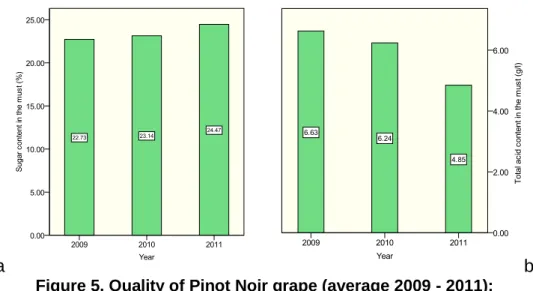
Figure 5. Quality of Pinot Noir grape (average 2009 - 2011); a- Sugar content; b – Total acid content
As grape quality parameters, sugar and total acid contents varied with respect to the production years (Figure 5).
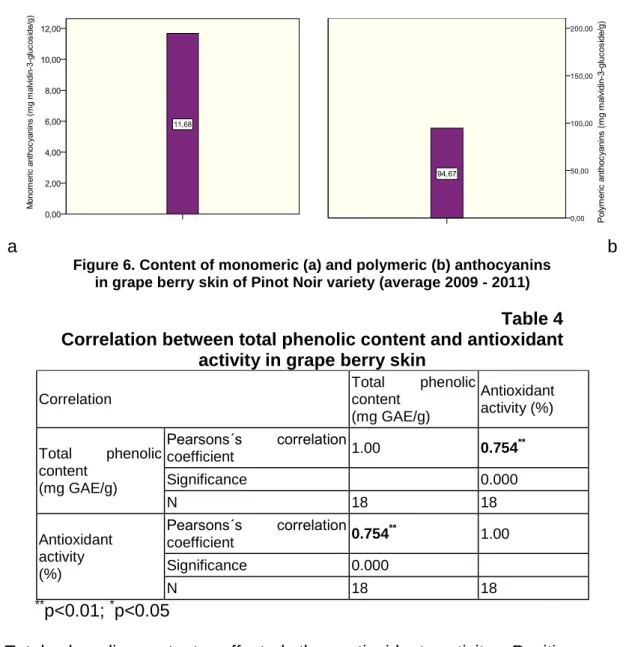
Quality of grape grown for wine production is also affected by phenolic compounds which composition depends on the grape variety, locality, climate, maturity stage of grapes. Quantity and chemical composition of phenolic compounds can be different with respect to the part of the bunch they are extracted from (Jordao et al., 2001). Pinot Noir grape grown in Vršac had different composition and concentration of phenolic compounds. The content of monomeric and polymeric anthocyanins in the berry skin is given in Figure 6.
59.75%
33.16%
7.11%
332
a b
Figure 6. Content of monomeric (a) and polymeric (b) anthocyanins in grape berry skin of Pinot Noir variety (average 2009 - 2011)
Table 4 Correlation between total phenolic content and antioxidant
activity in grape berry skin
Correlation
Total phenolic
content (mg GAE/g)
Antioxidant activity (%)
Total phenolic
content (mg GAE/g)
Pearsons´s correlation
coefficient 1.00 0.754
**
Significance 0.000
N 18 18
Antioxidant activity (%)
Pearsons´s correlation
coefficient 0.754
**
1.00
Significance 0.000
N 18 18
**
p<0.01; *p<0.05
Total phenolic contents affected the antioxidant activity. Positive correlation between total phenolic content in berry skin and antioxidant activity was determined (Table 4).
CONCLUSION
The year of investigation influenced almost all investigated elements of mechanical composition of bunch and berry of Pinot Noir variety:
- bunch length F (2.27) = 3.319, p = 0.051 (2009 differed from 2011); - bunch width F(2.27) = 7.689, p = 0.002 (2009 differed from 2010); - stem mass F(2.27) = 2,.842, p = 0.076 (2009 differed from 2011);
- single berry mass F(2.27) = 4.703, p = 0.018 (2009 differed from 2010 and 2011); - single seed mass F(2.27) = 4.781, p = 0.017 (2009 differed from 2010).
Grape samples taken in the investigated years had similar sugar content in must and it ranged from 22.73% (2009), 23.14 (2010) to 24.47% (2011).
Average values of total acid content were almost equal in the investigated years (around 6 g/l), except in 2011 when the content of total acids was 4.85 g/l which was the lowest.
The content of monomeric and polymeric anthocyanins in berry skin was average, with concentrations of 11.68 and 94.67 mg of malvidin-3-glucoside/g.
333
High quality of grapes was determined for grapevine variety Pinot Noir which was grown under agroecological conditions of Vršac.
Acknowledgments
This paper was realized as a part of project: "Studying climate change and its influence on the environment: impacts, adaptation and mitigation" (43007) financed by the Ministry of Education and Science of the Republic of Serbia.
BIBLIOGRAPHY
1. A.O.A.C., 1984 - Officiales methods of analysis, Association of Official Analytical Chemicts. Washington, D.C., USA.
2. De La Hera-Ortis, M.L., Martínez-Cutillas, A., López-Roca J.M., Gómez-Plaza, E., 2005 - Effect of moderate irrigation on grape composition during ripening, Spanish Journal of Agricultural Research, 3(3):352-361.
3. Downey, M.O., Dokoozlian, N.K., Krstic, M.P., 2006 - Cultural practice and environmental impacts on the flavonoid composition of grapes and wine: A review of recent research, American Journal of Enology and Viticulture, 57:257-268.
4. Fazinić, M., Purković, B., Albert, I., Troha, V., Vuković, T., 1989 - Burgundac (ʽPinotʼ) crni - elitna sorta među visoko kvalitetnim vinskim sortama, Jugoslovensko vinogradarstvo i vinarstvo, 5:2-6.
5. Jackson, D.I., Lombard, P.B., 1993 - Environmental and management practices affecting grape composition and wine quality: a review, American Journal of Enology and Viticulture, 44:409-430.
6. Jones, G., Davis, R., 2000 - Climate influences on grapevine phenology, grape composition, and wine production and quality for Bordeaux, France, American Journal of Enology and Viticulture, 51(3):249-261.
7. Jones, G., 2006 - Climate change and wine: observations, impacts and future implications, Wine Industry Journal 21:21-26.
8. Jordăo, A.M., Da Silva, J.M., Laureano, O., 2001 - Evolution of proanthocyanidins in bunch stems during berry development (Vitis vinifera L.), Vitis, 40:17-22.
9. Jones, G.V., White, M.A., Cooper, O.R., Storchmann, K.H., 2004 - Climate and Wine: Quality Issues in a Warmer World, Proceedings of the Vineyard Data Quantification Society’s 10th
OEonometrics Meeting. Dijon, France,
http://www.sou.edu/envirostudies/gjones_docs/VDQS%20Climate%20Change.pdf.
10. Mattivi, F., Zulian, C., Nicolini G., Valeti L., 2002 - Wine, biodiversity, technolgy and antioxidants, Annals of the New York Academy of Sciences, 957:37-56.
11. Prieur, C., Rigaud, J., Cheynier, V., Moutounet, M., 1994 - Oligomeric and polyumeric procyanidins from grape seeds. Phytochemistry, 36:781-784.
12. Shahidi, F., Marian, N., 2003 - Phenolics in Food and Nutraceuticals, CRC PRES. 13. Spayd, S.E., Wample, R.L., Evans, R.G., Stevens, R.G., Seymour, B.J., Nagel, C.W., 1994 - Nitrogen fertilization of white ʽRieslingʼ grapes in Washington. Must and wine composition, American Journal of Enology and Viticulture, 45:34-42.
14. Tabachnick, B., Fidell, L., 2007 - Experimental designs using ANOVA, Belmont, CA: Duxbury.