http://www.jscdss.com Vol.6 No.4 August 2019: 10-14 Article history:
Accepted 16 May 2019 Published online 16 May 2019
Journal of Soft Computing and Decision
Support Systems
A Driver Assistant System Using Behavior Patterns and Fuzzy Logic to Enhance
Safety
Arman Kavoosi Ghafi a,*, Behnam Mirzaeian b, Mohammad Hossein Shafiabadi c, Adnan Samerian Hosseini d, Adel Hojatkhah e, Elham Salehi f, Helena Kojooyan Jafari c
a
Department of Computer Engineering, Borujerd Branch, Islamic Azad University, Borujerd, Iran
b
Department of Electrical, Electronic and Information Engineering, University of Bologna, Italy
c
Department of Computer Engineering, Islamic Azad University of IslamShahr, Iran
d
Department of Computer Software, Islamic Azad University of Abadan, Iran
e
Shahrood University of Technology - Engineering Campus, Iran
f
Department of Computer Engineering, Islamic Azad University of Kish International, Iran
* Corresponding author email address: [email protected]
Abstract
In this article, the purpose of using learning algorithms is to create an advanced system of the driver's assistant in order to provide the driver with the driving safety by considering general and personal driving features.We used the decision tree algorithm to represent such a system. At as the first step, appropriate data are collected. The aim is to select the factors influencing the design of the warning system. In the next step, we prepared the data. Then outlier data is differentiated using categorical algorithms. In the next step, input data is prepared using a fuzzy device. The system is a Mamdani fuzzy system. In the last step, we determined the root, branch, and leaves of the decision tree model using the entropy method. In this paper, the rules are extracted from 5 attributes along with a target variable which has four modes. The rules of the fuzzy system are implemented on a local database and the results are provided. Finally, the results of the designed model are compared with the results of the previous.
Keywords: Decision tree, Fuzzy logic, Driving learning algorithms, Mamdani fuzzy system,Entropy method
1. Introduction
Nowadays, with the ever-increasing development of traffic engineering science in the world, many methods and tools have been developed for traffic management. Intelligent Transportation Systems (ITS) (El Faouzi, Leung, & Kurian, 2011; Zhang et al., 2011) are one of these tools. Intelligent transportation systems are a new concept in the field of traffic engineering, which plays a very important role in the security and dynamism of transportation. These systems have increased the efficiency of the transportation and traffic network, which its expansion can solve many transportation problems. In fact, in the intelligent transportation system, the assessment and monitoring of driving behavior, especially for public transportation drivers, including speed, driving experience and
atmospheric conditions, have a significant impact on identifying and employing safe drivers in passenger fleet management. On the other hand, monitoring and assessing through encouragement and punishment can reduce risky behaviors, and increase the inclination to drive safely (Rahbari D., 2014; Placzek B., 2014).
2. Procedure
2.1 The selected features
The selected features for developing the methods are as follows:
Age: which has three categorizations, young, middle-aged, and old.
Experience: a driver experience that has two modes: low (less than 10 years old), and high (more than 20 years of experience).
Weather: atmospheric conditions that are divided into two bad and good moods.
Speed: there are three modes of traveling: low (less than 50 km/h), moderate (50 to 70 km/h), and high (over 70 km/h). Traffic: the road traffic situation, which has two modes, low and high.
Safety: driver safety, which has four modes as the target variable: very dangerous, dangerous, moderate, and safe.
The above data is divided into two groups of training and test data, and by using training data that includes 70% of the data, the models are constructed, and then evaluated for the prediction accuracy using the test set.
2.2. Data analysis
The data analysis process is performed using the Matlab software. The main part of the data analysis in this research is the design of a fuzzy decision tree modeland the results are compared with the Adaptive Neuro-Fuzzy Inference System (ANFIS) which is widely used in the design of prediction systems (Nilashi et al., 2018a; Nilashi et al.,
2019b; Kheirandish et al., 2019; Nilashi et al., 2019b; Nilashi et al., 2017; Yadegaridehkordi et al., 2018; Nilashi et al., 2018b). The fuzzy Mamdani method is used to construct the fuzzy system through Triangular membership functions.
2.3. Rule extraction
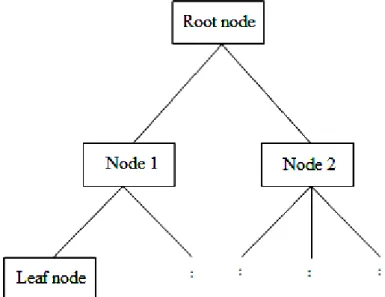
The decision tree consists of nodes and vectors connecting the nodes. The decision is made from the root node, and the person begins to ask questions to determine which branch tree extension continues until it reaches the leaf node and makes the decision. This structure is presented in Fig. 1. In this figure, non-leaf nodes show benchmarks (tests) and leaf nodes are decision values. The simplest tree may have only one leaf node.
The decision tree is created by selecting the attribute that obtains the maximum value of the two-way information. In order to construct a decision tree, it should be started from the root node. In this regard, among the all attributes, the one attribute should be selected that has the lowest entropy value, or the one that the most information can be obtained from it. Then, it should be placed in the root node (Chen et al., 2014; Manley et al., 2014).
Fig. 1. Root, node, and leaf in the decision tree .
2.4 Entropy
In information theory, entropy is an uncertainty about the source of the message. The entropy was first introduced by Shannon in 1948, and the following shows the relation formula:
( ( )| ( )) ∑ ( ) ( )
(1)
where ( ) ( ) is the probability distribution of limited set. Accordingly, the Shannon entropy is a function in the following form.
) (2)
where represents the set of all probability distributions on finite sets.
{( ) ∑
}
(3)
Table 1
attribute entropy
Attribute Entropy value
Rank from the root
Atmospheric conditions 0.309
2
Speed 0.095
0
Age 0.644
3
Experience 0.816
4
Traffic 0.175
1
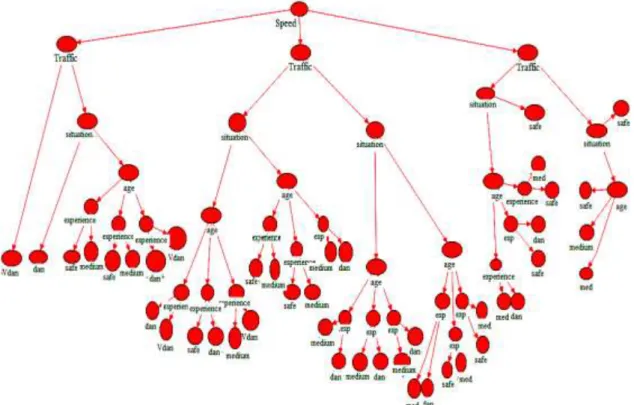
As it can be seen, the velocity or speed attribute is placed in the root with three values, after which the traffic attribute is placed in the next node and from each node of this attribute, the attribute of atmospheric condition is emanated. Finally, the following attributes including of age and driving experience comprise next nodes.
2.5 Design of decision tree
The entropy of each of the attributes is calculated according to Eq. (1) to determine the root node, so the attribute with the least entropy is placed at the root node. This process continues until it reaches the leaf node in each of the verbal variables such as (low, medium, and high) for each attribute. During this process, by selecting any of the attributes as a node, and by removing that node in its corresponding branch, the remaining entropy of the remaining traces is calculated based on the new database (which is formed by removing the previous node), and the smallest value is placed in the new node. This flow continues until it reaches the zero entropy, or the end of the attributes.
2.6 Implementation of Fuzzy Inference System
This section consists of three steps that are as follows.
2.6.1 Fuzzy inputs (attributes) and outputs
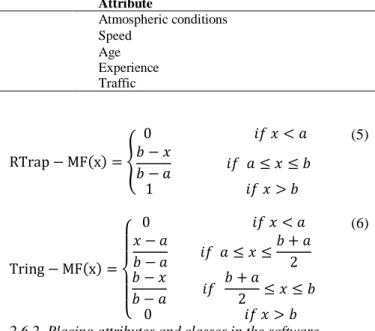
In this stage, the attributes are determined based on the linguistic variables, and by using the Trapezoidal and Triangular membership functions the fuzzing process is performed. At this stage, the outputs or the degree of driving safety as the classes in the decision tree is also fuzzy. The reason for the use of Triangular and Trapezoidal membership functions is the use of the fuzzy Mamdani method, in which this form of membership functions has more compatibility with the fuzzy Mamdani (Panchev et al., 2014; Cheng et al., 2014).
The membership function criterion is also given in two general terms which are left and right trapezoidal membership functions.
( ) {
(4)
( ) {
(5)
( )
{
(6)
2.6.2 Placing attributes and classes in the software
This step involves placing each specific attribute as inputs, and security levels as outputs, and the rule base is based on MATLAB software.
2.6.3 Implementation of the fuzzy inference system
After constructing the fuzzy system and incorporating the attributes, and classes in the fuzzy module of Matlab software, for each of the attributes in the fuzzy inference system, driving safety levels are given according to their priority. The fuzzy inference engine calculates the outputs or the strategies, using the rules in the database. It should be noted that, outputs are fuzzy numbers, which are becoming non-fuzzy according to the center of gravity or other methods. Finally, the degrees of membership are expressed in quantitative terms, and are ranked by the obtained score.
2.6.4 Designed system and rules
With the implementation of the above-mentioned algorithm and the design of the fuzzy system, the decision tree is presented in Fig. 2.
Fig. 2. Designed decision tree diagram.
Table 2
Extracted rules with high coverage
Safety Level Rules
Coverage percentage
Very dangerous High speed - high traffic
%99
Dangerous
High speed- high traffic - Bad weather conditions
%95
Safe High speed - high traffic - good weather conditions - old-Experienced
%88
Medium High speed - high traffic - good weather conditions - old - naive
%81
Very dangerous High speed - high traffic - good weather conditions - young - naive
%84
Dangerous High speed - high traffic - good weather conditions - old - experienced
%91
Medium Average speed high traffic -– Bad weather conditions young -- experienced
%88
Very dangerous Average speed high traffic -– Bad weather conditions old -- naive
%87
Medium Average speed high traffic -– good weather conditions old - naive
-%90
Medium Average speed - low traffic - bad weather conditions - middle-aged - experienced
%96
Dangerous Average speed - low traffic - bad weather conditions - middle-aged - naive
%92
Safe
Average speed - low traffic - good weather conditions - middle-aged - experienced
%89
Safe Low speed - high traffic - good weather condition
%93
Safe
Low speed - high traffic - experienced-young -bad weather
%93
Medium Low speed - low traffic - bad weather conditions - young
%95
Safe Low speed - low traffic - good weather conditions
%97
It is clear from the diagrams and rules that the speed attribute is located at the root, and at other levels, there are variables with less entropy. For example, if the speed of the driver is high and traffic is high, then with 99% coverage, driving will be very dangerous in terms of the situation in
the class. In order to show the effectiveness of the proposed method, we use several evaluation metrics to evaluate the methods. Specifically, we use MAE, RMSE, MSE and R2 and compare the results with the ANFIS technique. The results are presented in Table 3.
Table 3
Error criteria for the designed Decision Trees and Fuzzy Neural Network techniques
Model MAE RMSE MSE R2
Decision tree 8.419 19.628 385.258 91.084
3. Conclusion
The driver assistant system was proposed using data mining techniques. The collected data were analyzed using two different fuzzy decision tree. To determine the variables of the branch, we used the entropy method. Accordingly, the attribute with less entropy was placed in the root, and the attributes with high entropy were placed in the nodes near the leaves. In other words, in the estimation of entropies, speed attribute was placed at the root of the tree and then other attributes including traffic, atmospheric conditions, age, and experience were located in the next nodes. We compared our method with ANFIS technique. The results showed that the Decion Trees (R2=91.084;
MAE=8.419; RMSE=19.628; MSE=385.258) technique
outperforms ANFIS (R2=0.88; MAE=9.362; RMSE=21.22;
MSE=401.648). Therefore, by reviewing the results of the
three examined models, it can be concluded that using the decision tree in the design of the driver assistant system will be more efficient.
References
Chen, F., & Wang, L., & Jiang, B., & Wen, CH. (2014). A novel hybrid petri net model for urban intersection and its application in signal control strategy: Elsevier Journal of the Franklin institute, 4357-4380.
Cheng, S., & Mu, Q., & Zhang, H., & Zhang, Y. (2014). A Fuzzy Decision Tree Model for Airport Terminal, Departure Passenger Traffic Forecasting. In CICTP safe, Smart, and Sustainable Multimodal Transportation Systems, 11-17.
El Faouzi, N.-E., Leung, H., & Kurian, A. (2011). Data fusion in intelligent transportation systems: Progress and challenges–A survey. Information Fusion, 12(1), 4-10.
Kheirandish, A., Akbari, E., Nilashi, M., & Dahari, M. (2019). Using ANFIS technique for PEM fuel cell electric bicycle prediction model. International Journal of Environmental Science and Technology, 1-8.
Manley, E., & Cheng, T., & Penn, A., & Emmonds, A. (2014). A framework for simulating large-scale complex urban traffic dynamics through hybrid agent-based modelling: Elsevier,Computers, Environment and urban systems, 27-36.
Nilashi, M., Ahani, A., Esfahani, M. D., Yadegaridehkordi, E., Samad, S., Ibrahim, O., ... & Akbari, E. (2019). Preference learning for eco-friendly hotels recommendation: A multi-criteria collaborative filtering approach. Journal of Cleaner Production, 215, 767-783. Nilashi, M., Ahmadi, H., Shahmoradi, L., Ibrahim, O., &
Akbari, E. (2019). A predictive method for hepatitis disease diagnosis using ensembles of neuro-fuzzy technique. Journal of infection and public health, 12(1), 13-20.
Nilashi, M., Ibrahim, O., Ahmadi, H., & Shahmoradi, L. (2017). A knowledge-based system for breast cancer classification using fuzzy logic method. Telematics and Informatics, 34(4), 133-144.
Nilashi, M., Ibrahim, O., Ahmadi, H., Shahmoradi, L., & Farahmand, M. (2018a). A hybrid intelligent system for the prediction of Parkinson's Disease progression using machine learning techniques. Biocybernetics and Biomedical Engineering, 38(1), 1-15.
Nilashi, M., Ibrahim, O., Yadegaridehkordi, E., Samad, S., Akbari, E., & Alizadeh, A. (2018b). Travelers decision making using online review in social network sites: A case on TripAdvisor. Journal of computational science, 28, 168-179.
Panchev, C., & Dobrev, P., & Nicholson, J. (2014). Detecting Port Scans against Mobile Devices with Neural Networks and Decision Trees: On Engineering Applications of Neural Networks, 175-182.
Placzek, B. (2014). A self-organizing system for urban traffic control based on the predictive interval microscopic model: Engineering applications of artificial intelligence, 75-84.
Rafore, M. (2014). simulating the driving risk in North highway depends on the environment and traffic factors: a data mining approach. Anales de Pediatría (English Edition), 81-109.
Rahbari, D. (2014). Help the genetic algorithm to minimize the urban traffic on intersections: International journal of research in computer science, 4(4) 9-19.
Xu, Y., & Song, X., & Weng, Zh., & Gray, T. (2014). An entry time-based supply framework (ETSF) for microscopic traffic simulations: Elsevier, simulation modeling practice and theory, 185-195.
Yadegaridehkordi, E., Hourmand, M., Nilashi, M., Shuib, L., Ahani, A., & Ibrahim, O. (2018). Influence of big data adoption on manufacturing companies' performance: An integrated DEMATEL-ANFIS approach. Technological Forecasting and Social Change, 137, 199-210.