Description Logics Approach to
Semantic Matching of Web Services
S. Colucci
1, T. Di Noia
1, E. Di Sciascio
1, F. M. Donini
2and M. Mongiello
11Politecnico di Bari, Italy
2Universit´a della Tuscia, Viterbo, Italy
As more resources and services become available on the Web, there is a growing need for infrastructures that, based on advertised descriptions, semantically match in a peer-to-peer way providers with requesters of web ser-vices. We address the problem of matchmaking of web services from a knowledge representation perspective. Based on our approach we propose match categorization in terms of exact match, potential match – when request and offer though not identical are compatible – and partial match – when one or more inconsistency is present – and rank of matches within categories. Then we report on our implementation of the proposed matchmaking framework in a prototype system.
Keywords: knowledge representation, semantic web, fa-cilitator, services.
1. Introduction
The advent of the Internet and of its most no-ticeable offspring, the World Wide Web, has initially led to an explosion of information avail-able on-line. The lack of infrastructures to help in accurately locate and keep up to date the huge amount of information and resources at hand, has resulted, over a few years, in an informa-tion overload, basically because of the inherent unstructured nature of web data.
The Semantic Web 1] initiative has begun, slowly yet steadily, to revolutionize the way information is provided on the Internet. The basic idea is to structure information with the aid of markup languages, based on the XML language, such as RDF 21] and DAML+OIL 18]. These languages have been conceived to allow for representation of machine understand-able, unambiguous, description of web content
through the creation of arbitrary domain ontolo-gies, and aim at increasing openness and inter-operability in the web environment. Building on the Semantic Web foundations, also a flour-ishing of languages for the description of web services has been recently witnessed, struggling to become accepted de-facto standards, such as WSDL 8]and DAML-S 24].
Widespread availability of resources and ser-vices enables — among other advantages — the interaction with a number of potential counter-parts. The bottleneck is that it is difficult to find matches, possibly the best ones, between par-ties. Matchmakingis the process of searching the space of possible matches between demands and supplies, finding the best available ones 12, 20, 13, 23, 25, 24, 26, 14, 19, 27, 16, 7, 9]. De-mands and supplies are here meant to represent web services, information, tangible or intangi-ble goods, practically finding for any request an appropriate offer, or vice versa. Matchmaking is quite different from simply finding, given a demand a perfectly matching supply (or vice versa). Instead, it includes finding all those supplies that can to some extent fulfill a de-mand, and eventually propose the best ones. So the scenario, which is basically envisaged by the Semantic Web initiative, is one where peer entities may propose their goods and services and dynamically deal with counteroffers or fur-ther specifications, through the mediation of a matchmaking infrastructure.
Fig. 1.The architecture of the engine.
The infrastructure has to treat in a uniform way suppliers and demanders, and base the matches on common, extensible ontologies for describ-ing both supplies and demands 11].
Knowledge representation — in particular De-scription Logics(DL) — can deal with a uni-form treatment of knowledge from suppliers and demanders, by modelling both as generic con-cepts to be matched.
In fact, the logical approach — which DLS are based upon — allows for an open-world as-sumption. Incomplete information is allowed
(and can be filled after a selection of possi-ble matches), and absence of information can be distinguished from negative information, al-lowing to discard offers/requests without the necessary properties, and to ask for missing in-formation in the potential matches. The impor-tance of ranking cannot be underestimated, as it is of extreme importance for practical use of the approach. The key questions that have to be an-swered in a dynamic framework are how far is a given demand(supply)from a potential coun-terpart? And which are the requirements that would eventually fulfill it? Such questions have to be answered relying on publicly available al-gorithms, to enforce trust and prevent rising of doubts on fairness of the proposals returned by the matchmaking facilitator.
In this paper we will concentrate on descrip-tions, regardless of the good or service consid-ered. Although the logical framework is basi-cally independent from the application adopted, we strictly relate our description to CLASSIC 3, 4]. CLASSICis a knowledge representation system that, although not endowed of a lan-guage expressive as more recent reasoners,e.g.,
Fig. 2.The architecture of the matchmaking infrastructure.
FaCT 17]and Racer 15], has polynomial-time inferences and, most important, is a real sys-tem, endowed of concrete datatypes and can be simply wrapped into a host system.
2. Description Logics basics
DLs 2, 10] are a family of logic formalisms whose basic syntax elements areconceptnames,
e.g.,person, degree, androlenames, such as workingIn, requiredAS. Intuitively, concepts stand for sets of objects, and roles link objects in different concepts. Formally, concepts are interpreted as subsets of a domain of interpre-tation ∆, and roles as binary relations ( sub-sets of ∆ ∆). Basic elements can be com-bined using constructors to form concept and role expressions, and each DL has its distin-guished set of constructors. Every DL allows one to form a conjunction of concepts, usu-ally denoted asu; some DL include also dis-junctiontand complement:to close concept expressions under boolean operations. Roles can be combined with concepts using existen-tial role quantification,e.g.,Graduate u 9has Degree.Engineering, which describes the set of graduates with an engineering degree, and
universal role quantification, e.g., Person u
may involve counting, as number restrictions: Personu(1Degree)expresses persons with at most one degree, andPersonu( 3Specializa-tion) describes persons endowed of at least three specializations. Many other constructs can be defined, increasing the expressive power of the DL, up to n-ary relations 6]. Con-cept expressions can be used in inclusion as-sertions, anddefinitions, which impose restric-tions on possible interpretarestric-tions according to the knowledge elicited for a given domain. For example, we could impose that faculties can be divided into scientific and art ones, using the two inclusions Faculty v Scientifict SocialSciences and Scientific v :Social Sciences. Or that graduates have at least one degree as Graduate v ( 1hasDegree). His-torically, sets of such inclusions are called TBox
(Terminological Box). The basic reasoning problems for concepts in a DL are satisfiabil-ity, which accounts for the internal coherency of the description of a concept (no contradic-tory properties are present), and subsumption, which accounts for the more general/more spe-cific relation among concepts, that forms the basis of a taxonomy. More formally, a con-cept C is satisfiable if there exists an interpre-tation in which C is mapped into a nonempty set, unsatisfiable otherwise. If a TBox T is present, satisfiability is relative to the models of T, that is, the interpretation assigning C to a nonempty set must be a model of the inclu-sions in T. For instance, the conceptAFacultyv ScientificuSocialSciencesis clearly unsat-isfiable w.r.t. the TBox containing the inclu-sion scientific and social sciences. A concept C subsumes a concept D if every interpretation assigns to C a subset of the set assigned to D. Also subsumption is usually established relative to a TBox, a relation that we denoteT j= CD. Also, a TBox can be considered satisfiable if there exists at least one model(i.e., an interpre-tation fulfilling all its inclusions in a nontrivial way). It is important to note that in the CLASSIC system we use, each C concept has an equiva-lent normal form asCnamesuC
]
uCall, in which
Cnamesis a conjunction of names,C]of number restrictions, andCall of universal role
quantifi-cations. In the normal form, also all inclusions, definitions and disjoint groups have been made explicit 4]. CLASSICprovides the two basic rea-soning services of DL-based systems, namely
Concept Satisfiability (given a TBox T and a
conceptC, does there exist at least one model of T assigning a non-empty extension to C?), andSubsumption(given a TBoxTand two con-ceptsCandD, isCmore general thanDin any model of T?). Being a complete KR system, CLASSIC provides also data types as numbers and strings, and other services which are useful in a deployed prototype.
3. Principles for matchmaking
We highlight here common sense principles that a semantics-based approach should yield. First of all, a matchmaking facilitator of practical use has to be liberal enough about details, without preventing a proposer to fill in forms with(say) 30 or more different characteristics to be set. This implies that the absence of a characteristic in the description of a requested or offered pro-file should not be interpreted as a constraint of absence. Instead, it should be considered as a characteristic that could be either refined later, or left open if it is irrelevant for a user — which is called open-world assumption in KR. Ob-viously, the algorithm employed for matching should also take this issue into account. Sec-ondly, a matchmaking system may give differ-ent evaluations, depending on whether it is try-ing to match a request S with an offer D, or
D with S — i.e. depending on who is going to use this evaluation. This requirement is al-ready evident when characteristics are modelled as sets of words. Of course, using sets of words to model supplies and demands would be too sensible to the choice of words employed — it misses meanings related by words. It is now a common opinion that, it terms have a logical meaning, such fixed-terminology problems are overcome through an ontology 11]. Hence, we assume that supplies and demands are expressed in a DL. Obviously, this approach includes the sets-of-keywords, since a set of keywords can be considered also as a conjunction of concept names. We assume also that the common on-tology is established as a TBox in DL. Now a match between a supplyS and a demand D
Implication. IfT j=(D vS), then every con-straint imposed by D is fulfilled (implied) by
S, and vice versa if T j= (S v D). This rela-tion extends the previous set-based inclusion to general concepts. If both T j= (D v S) and
T j= (S v D), thenDandS should be consid-ered equivalent inT. This relation extends exact matching by ruling out irrelevant syntactic dif-ferences. Consistency. IfDuSis satisfiable in
T, then there is a potentialmatch, in the sense that the constraints of neither proposal exclude each other. This relation has also been high-lighted by other researchers 26]. However, that proposal lacks arankingbetween different po-tential matches, which we believe is fundamen-tal in order to support e.g., a project manager in the choice of the most interesting curricula, among all potential ones. Inconsistency. Oth-erwise, ifDuSis unsatisfiable inT, some con-straints of one proposal are in contrast with the properties of the other one. However, also(say) supplies which are inconsistent withDmay be reconsidered if the demander accepts to revise
some of D’s constraints. We call this situation a near miss or partial match. The point, of course, is in not revising too much. Hence, also in this case a ranking — different from the one of potential matches — is fundamental.
We now state some properties that — we believe — every ranking function should have in logical matchmaking. First of all, a ranking for seman-tic matchmaking should besyntax-independent. That is, for every pair of suppliesS1andS2, de-mand D and ontology T, when S1 is logically equivalent toS2thenS1andS2should have the same ranking for D — and the same should hold also for every pair of logically equivalent demandsD1,D2with respect to every supplyS. Secondly, a ranking for semantic matchmaking should bemonotonic over subsumption. That is, for every demandD, for every pair of supplies
S1andS2, and ontologyT, ifS1andS2are both potential matches for D, and T j= (S2 v S1), thenS2should be ranked either the same, or bet-ter thanS1. The same should hold also for every pair of demandsD1D2with respect to a supply
S. Intuitively, this property could be read as “A ranking of potential matches is monotonic over subsumption if the more specific, the better.” When turning to partial matches, adding another characteristic to an unsatisfactory proposal may either worsen its ranking (when another char-acteristic is violated)or keep it the same(when
the new characteristic is not in contrast). Note that this ranking should be kept different from the ranking for potential matches. Obviously, the properties pointed out here are independent of the particular DL employed, or even the par-ticular logic chosen. For instance, the same properties could be stated if propositional logic was used or also logics, such as DAML, for which reasoning systems are still unavailable.
4. Finding best matches
Here we present algorithms for matchmaking, which satisfy previously stated properties and have been devised adapting the original CLAS -SIC structural algorithm for subsumption 4]. Only the algorithm for potential match is com-pletely outlined; the partial match is similar, and is only briefly described here due to a lack of space. Recall that a CLASSICconceptCcan be put in normal form asCnamesuC
]
uCall. Without ambiguity, we use the three components also as sets of the conjoined concepts. Moreover, recall that the TBox in CLASSICcan be embedded into the concepts, hence we do not consider explic-itly the TBox, although it is present.
AlgorithmrankPotential(CD);
input CLASSICconceptsC,D, in normal form, such that
CuDis satisfiable
output rankn 0 ofCw.r.t.D, where 0 means that
CvD(best ranking)
begin algorithm letn:=0in
/* add tonthe number of concept names inD*/
/* which are not among the concept names ofC*/ 1.n:=n+jDnames
+
;Cnames+j; /* add tonnumber restrictions ofD*/
/* which are not implied by those ofC*/ 2.for eachconcept( xR)2D
]
such thatthere is no concept( yR)2C
]withy x n:=n+1;
3.for eachconcept(xR)2D ]
such thatthere is no concept(yR)2C ]withy
x n:=n+1;
/* for each universal role quantification inD*/
/* add the result of a recursive call */ 4.for eachconcept8R:E2Dall
ifthere does not exist8R:F2Call
thenn:=n+rankPotential(>E);
elsen:=n+rankPotential(FE);
returnn;
Obviously, total match is a particular case of po-tential match, obtained whenrankPotential(C,
D) = 0. With reference to the complexity, which is extremely important for practical use of the system, the expansion of the TBox in the construction of the normal form can lead to an exponential blow-up, as demonstrated by Nebel in 22]. Anyway, a polynomial algorithm cannot be expected since subsumption inAL with an acyclic TBoxT is co-NP-hard 5]. However, in the cited paper Nebel argues that the expansion is exponential in the depth of the hierarchyT; if the depth ofT isO(logjTj), then the expansion is polynomial, and so is the above algorithm. Notice that the algorithm penalizes generic pro-file descriptions, which in simple subsumption matching would be unfairly advantaged. The algorithm for ranking partial matches fol-lows again the partition of CLASSIC concepts into names, number restrictions, and universal role quantifications. However, this time we are looking for inconsistencies. Hence, when a uni-versal role quantification is missing in either concept, the recursive call is unnecessary. For both algorithms it can be proved they respect the properties highlighted in the previous section.
5. A protoype system
The matchmaking framework presented in the previous sections has been deployed in a pro-totype facilitator. The system embeds a Neo-Classic engine(a C++ implementation of the original CLASSIC system, whose sources have been adapted for our purposes).
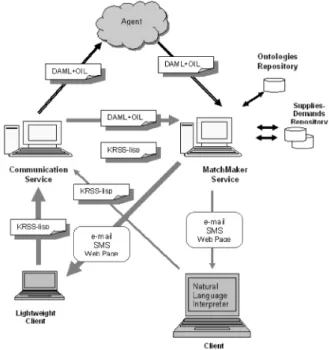
The general architecture of the system is shown in Figure 2. The system can accept requests by both a dedicated client and by generic user agents as DAML+OIL descriptions.
The client is a Java applet(an extremely light client, in view of application on devices such as PDAs)that sends, via SOAP(http://www.w3. org/TR/SOAP/), an advertisementi.e., a descrip-tion of the request to be matched, as a string in KRSS (Knowledge Representation System Specification) (http://www.bell-labs.com/ user/pfps/papers/krss-spec.ps) syntax,Fig-ure 3 shows the content for an example adver-tisement in KRSS.
Example Demand: (and APARTMENT (all
HAS-ROOMS BEDROOM)(at-most 0 HASPETS)) POST /soap/servlet/rpcrouter HTTP/1.0 Host: localhost:8070 Content-Type: text/xml Content-Length: 597 SOAPAction: ""
<SOAP-ENV:Envelope
xmlns:SOAP-ENV="http://schemas.xmlsoap.org/soap/envelope/" xmlns:xsi="http://www.w3.org/1999/XMLSchema-instance" xmlns:xsd="http://www.w3.org/1999/XMLSchema"> <SOAP-ENV:Body> <ns1:translate xmlns:ns1="urn:demo1:Translator"
SOAP-ENV:encodingStyle="http://schemas.xmlsoap.org/soap/encoding/"> <text xsi:type="xsd:string">(and APARTMENT (all HASROOMS BEDROOM) (at-most 0 HASPETS))</text> <uri
xsi:type="xsd:string">http://www.example.org/rent-toy-ontology#</uri> <requestType xsi:type="xsd:string">demand</requestType>
</ns1:translate> </SOAP-ENV:Body> </SOAP-ENV:Envelope>
Fig. 3. An example KRSS SOAP packet.
POST /soap/servlet/rpcrouter HTTP/1.0 Host: localhost:8070 Content-Type: text/xml Content-Length: 1979 SOAPAction: ""
<SOAP-ENV:Envelope
xmlns:SOAP-ENV="http://schemas.xmlsoap.org/soap/envelope/" xmlns:xsi="http://www.w3.org/1999/XMLSchema-instance" xmlns:xsd="http://www.w3.org/1999/XMLSchema"> <SOAP-ENV:Body> <ns1:matchMake xmlns:ns1="urn:demo1:Matchmaker"
SOAP-ENV:encodingStyle="http://schemas.xmlsoap.org/soap/encoding/"> <text xsi:type="xsd:string"> <rdf:RDF
xmlns:rdf='http://www.w3.org/1999/02/22-rdf-syntax-ns#' xmlns:daml='http://www.daml.org/2001/03/daml+oil#'
xmlns:rdfs='http://www.w3.org/2000/01/rdf-schema#'> <daml:Datatype rdf:about='http://www.example.org/rent-toy-ontology#HASROOMS'/> <daml:Datatype
rdf:about='http://www.example.org/rent-toy-ontology#BEDROOM'/> <daml:Datatype
rdf:about='http://www.example.org/rent-toy-ontology#HASPETS'/> <rdfs:Class
rdf:about='http://www.example.org/rent-toy-ontology#APARTMENT'/> <daml:Property
rdf:about='http://www.daml.org/2001/03/daml+oil#maxCardinality'/> <daml:Property
rdf:about='http://www.daml.org/2001/03/daml+oil#onProperty'/> <daml:Property
rdf:about='http://www.daml.org/2001/03/daml+oil#toClass'/> <daml:Restriction> <daml:onProperty
rdf:resource='http://www.example.org/rent-toy-ontology#HASROOMS'/> <daml:toClass
rdf:resource='http://www.example.org/rent-toy-ontology#BEDROOM'/> </daml:Restriction> <daml:Restriction daml:maxCardinality='0'> <daml:onProperty
rdf:resource='http://www.example.org/rent-toy-ontology#HASPETS'/> </daml:Restriction> </rdf:RDF> </text>
<uri
xsi:type="xsd:string">http://www.example.org/rent-toy-ontology#</uri> <requestType xsi:type="xsd:string">demand</requestType>
</ns1:matchMake> </SOAP-ENV:Body> </SOAP-ENV:Envelope>
Fig. 4.The DAML translation of the previous KRSS description.
The SOAP packet contains the string and the URI of the reference ontology. The communi-cation module is a web service whose main pur-pose is the translation of KRSS descriptions into portable DAML+OIL ones. The module, upon receipt of the packet, transforms the string in a DAML+OIL formatted description, using Jena APIs(http://www.hpl.hp.com/semweb/). Fi-gure 4 shows the corresponding packet.
the ontology requested. The matchmaking en-gine preliminarily checks for satisfiability w.r.t. the referenced ontology. If the check succeeds it carries out the matchmaking process with all descriptions in the repository corresponding to the given ontology, as will be described in detail in the next subsection.
The system accepts two types of requests, ad-vertisement and query. For the first one, the system will store the request. In this way, satis-fiable queries/demands that remain unmatched will be automatically reexamined when new supplies are provided, and notification will be provided for successful match. The same ser-vice is available for unmatched supplies. The query service does not permanently store de-mand/supply descriptions.
The matchmaker output is forwarded according to specifications included int the SOAP packet and can be formatted as an e-mail, a SMS(Small Message System)or a JSP(Java Servlet Page), if the request has been submitted by the client. If the request has been submitted by an agent, the response will be sent to the communication ser-vice for translation from KRSS to DAML+OIL.
Potential and partial matches can also trigger further communication services. For partial matches, on the basis of the matchmaker re-sponse, a demand can be revised,e.g., relaxing some constraint. For potential matches the sys-tem can ask the supplier of the advertisement whether some features, although not advertised, are available anyway.
It should be noticed that the architecture can simply be modified to host other reasoners, such as FaCT or Racer. The rationale of the choice of the CLASSIC system, apart from the obviously useful availability of concrete datatypes and the possibility to extend its functionalities through test functions, is that its polynomial time infer-ence allows practically synchronous operations, even with large ontologies. Recently, DAML-S 24]has been proposed as a standard for the au-tomation of web services and processes. It is a set of markup constructs based on DAML+OIL and we plan to implement support for it in the version of the system, where we will introduce also a negotiation service, which is currently not supported.
5.1. The matching engine
Our matching engine, whose architecture is shown in Figure 1, is based on Java servlets; it embeds the NeoClassic reasoner and communi-cates with the reasoner running as a background daemon. At this stage of the work, the system is not fully transactional, so requests have to be serialized by the engine.
The system receives the KRSS string describing the demand/supply and the URI referencing the proper ontology. The reasoner checks the de-scription for consistency; if it fails, based on the reasoner output, the system provides an error message stating the error has occurred. Other-wise, the proper matchmaking process takes place. The NeoClassic standard 4] subsump-tion algorithm has been adapted in accordance with the matchmaking algorithms presented in section 4]. Each match can return a 0, which means exact match or a value> 0. Recall that returned values for partial matches and poten-tial matches have logically different meaning and matching descriptions are sorted in differ-ent sets. The matching engine may then return up to three separate result sets.
The matchmaker can also use weights to in-crease the relevance of concepts. The weight is a positive integer that takes into account the oc-currence of a role or a concept w.r.t. all Demands and Supplies available for a reference ontology. For each concept or role present in an advertise-ment, in normal form, that isA 2 Dnames
+ or a concept ( xR) 2 D
] or
( xR) 2 D ], the corresponding weight is increased after each matching process. Obviously, the matchmak-ing algorithm is modified in that increments are no more unitary but correspond to the assigned weights.
6. Conclusion
We have addressed the problem of matchmak-ing of web services from a knowledge represen-tation perspective. We proposed match catego-rization in terms of exact match, potential match and partial match and rank of matches within categories. In accordance with the above prop-erties we have devised algorithms for match-making. The approach has been implemented in a matchmaking facilitator. The core engine has been implemented adapting the NeoClas-sic reasoner, and we have shown that, although with a reduced expressiveness w.r.t. more recent reasoners, CLASSICcan be effectively used for this class of problems.
References
1] T. BERNERS-LEE ANDJ. HENDLER ANDO. LASSILA,
The Semantic Web,Scientific American, may, 2001, available at:http://www.w3.org/2001/sw/
2] A. BORGIDA, Description Logics in Data
Manage-ment,IEEE Transactions on Knowledge and Data Engineering, vol. 7, no. 5, pp. 671–682, 1995.
3] A. BORGIDA AND R. J. BRACHMAN AND D. L.
MCGUINNESS ANDA. RESNICK, LORI, CLASSIC:
A Structural Data Model for Objects,Proceedings of the ACM SIGMOD International Conference on Management of Data, pp. 59–67, 1989.
4] ALEXANDER BORGIDA AND PETER F. PATEL
-SCHNEIDER, A Semantics and Complete
Algo-rithm for Subsumption in the CLASSIC Description Logic,Journal of Artificial Intelligence Research, vol. 1, pp. 277–308, Morgan Kaufmann, Los Altos, 1994.
5] D. CALVANESE, Reasoning with Inclusion Axioms
in Description Logics: Algorithms and Complexity,
Proceedings of the Twelfth European Conference on Artificial Intelligence (ECAI’96), pp. 303–307, John Wiley & Sons, 1996.
6] D. CALVANESE, G. DEGIACOMO ANDM. LENZERINI,
On the Decidability of Query Containment under Constraints, Proceedings of the Seventeenth ACM SIGACT SIGMOD SIGART Symposium on Princi-ples of Database Systems (PODS’98), pp. 149–158, 1998.
7] F. CASATI ANDM. C. SHAN, Dynamic and Adaptive
Composition of E-Services, Information Systems, vol. 26, pp. 143–163, 2001.
8] E. CHRISTENSEN, F. CURBERA, G. MEREDITH AND
S. WEERAWARANA, Web Services Description
Lan-guage, 2001, available at:http://www.w3.org/
TR/wsdl,
9] E. DISCIASCIO, F.M. DONINI, M. MONGIELLO AND
G. PISCITELLI, A Knowledge-Based System for
Person-to-Person E-Commerce,Proc. Workshop on Applications of Description Logics (KI 2001), 2001.
10] F. M. DONINI, M. LENZERINI, D. NARDI AND A.
SCHAERF, Reasoning in Description Logics,
Princi-ples of Knowledge Representation, Gerhard Brewka, pp. 93–238, CSLI Publications, Studies in Logic, Language and Information, 1996.
11] D. FENSEL, F. VAN HARMELEN, I. HORROCKS,
D. MCGUINNESS AND P. F. PATEL-SCHNEIDER,
OIL: An Ontology Infrastructure for the Se-mantic Web, IEEE Intelligent Systems, vol. 16, no. 2, pp. 38–45, 2001, available at:
http://www.computer.org/intelligent/ ex2001/x2toc.htm
12] T. FININ ANDR. FRITZSON ANDD. MCKAY ANDR.
MCENTIRE, KQML as an Agent Communication Language, Proceedings of the Third International Conference on Information and Knowledge Man-agement (CIKM’94), Gaitherburg, pp. 456–463, ACM, New York, 1994.
13] Y. GIL ANDS. RAMACHANDRAN, PHOSPHORUS: a
Task based Agent Matchmaker,Proc. AGENTS ’01, Montreal, pp. 110–111, ACM, New York, 2001.
14] J. GONZALES-CASTILLO ANDD. TRASTOUR ANDC.
BARTOLINI, Description Logics for Matchmaking of Services, Proc. Workshop on Applications of Description Logics (KI 2001), September, 2001.
15] V. HAARSLEV AND R. MOLLER, RACER System
Description,International Joint Conference on Au-tomated Reasoning, IJCAR’2001, pp. 701–705, Springer-Verlag, Berlin, 2001.
16] Y. HOFFNER, C. FACCIORUSSO, S. FIELD AND A.
SCHADE, Distribution Issues in the Design and
Im-plementation of a Virtual Market Place, Computer Networks, vol. 32, pp. 717–730, 2000.
17] I. HORROCKS, The FaCT System, Automated Rea-soning with Analytic Tableaux and Related Meth-ods: International Conference Tableaux’98, may, Lecture Notes in Artificial Intelligence, 1397, pp. 307–312, Springer-Verlag, Berlin, 1998.
18] I. HORROCKS AND ET AL., DAML+OIL language
specification, 2001, available at:http://www. daml.org/2001/03/daml+oil-index
19] N. KARACAPILIDIS ANDP. MORAITIS, Building an
Agent-Mediated Electronic Commerce System with Decision Analysis Features,Decision Support Sys-tems, vol. 32, pp. 53–69, 2001.
20] D. KUOKKA AND L. HARADA, Integrating
Infor-mation Via Matchmaking, Journal of Intelligent Information Systems, vol. 6, pp. 261–279, 1996.
21] O. LASSILA ANDR. R. SWICK, Resource Description
Framework, 1999, available at:http://www. w3.org/TR/REC-rdf-syntaxl
22] B. NEBEL, Terminological Reasoning is Inherently
23] T. DINOIA, E. DISCIASCIO, F.M. DONINI ANDM.
MONGIELLO, Semantic Matchmaking in a P-2-P
Electronic Marketplace,ACM SAC-03, Melbourne, Florida, USA, pp. 582–586, 2003.
24] M. PAOLUCCI, T. KAWAMURA, T.R. PAYNE ANDK.
SYCARA, Semantic Matching of Web Services
Ca-pabilities,The Semantic Web - ISWC 2002, Lecture Notes in Computer Science, 2342, pp. 333–347, Springer-Verlag, 2002.
25] K. SYCARA, S. WIDOFF, M. KLUSCH AND J. LU,
LARKS: Dynamic Matchmaking Among Het-erogeneus Ssoftware Agents in Cyberspace, Au-tonomous agents and multi-agent systems, vol. 5, pp. 173–203, 2002.
26] D. TRASTOUR AND C. BARTOLINI AND C. PRIEST, Proc. WWW ’02, Semantic Web Support for the Business-to-Business E-Commerce Lifecycle, Hon-olulu, pp. 89–98, ACM, New York, 2002.
27] H. WANG, S. LIAO AND L. LIAO, Modeling
Constraint-Based Negotiating Agents, Decision Support Systems, vol. 33, pp. 201–217, 2002.
Received:June, 2003 Accepted:September, 2003
Contact address: S. Colucci, T. Di Noia, E. Di Sciascio, M. Mongiello Politecnico di Bari Via Re David, 200 70125 Bari, Italy e-mail:
fs.colucci,t.dinoia,disciascio,[email protected]
F. M. Donini Universit´a della Tuscia Via S. Carlo 32 01100 Viterbo, Italy e-mail:[email protected]
SIMONACOLUCCIreceived the laurea degree “cum laude” in manage-ment engineering from the Technical University of Bari in 2002. Cur-rently she is a Ph.D. student in information technology engineering at the Technical University of Bari. Her research interests include descrip-tion logics and their applicadescrip-tion to e-commerce and skills management. On these topics she has published papers in journals and proceedings of international conferences.
TOMMASODINOIAreceived the laurea degree in electronic engineer-ing from the Technical University of Bari in 2002. Currently he is a Ph.D. student in information technology engineering at the Technical University of Bari. His research interests include description logics and their application to e-commerce issues and knowledge management. On these topics he has published papers in journals and proceedings of international conferences.
EUGENIODISCIASCIOreceived the laurea “cum laude” degree in
elec-tronic engineering from the University of Bari in 1989 and the Ph.D. degree in 1994 from the Technical University of Bari. In 1992 he joined the University of Lecce as an assistant professor. He is currently an associate professor of information technology engineering at the Tech-nical University of Bari, where he is responsible for various research projects. His research interests include knowledge-based systems for e-commerce, image and video processing and multimedia information retrieval. On these topics he has authored or co-authored over eighty paper in international journals and proceedings of international confer-ences.
FRANCESCOM. DONINIreceived the Master’s degree in electronics en-gineering from the University of Rome “La Sapienza” in 1988. He received the Ph.D. in computer science from the same university in 1992. From 1991 to 1998 he was researcher/assistant professor at
the Department of Computer and System Science of the University of Rome “La Sapienza”. Since 1998 he is an associate professor, first at the Technical University of Bari, and currently at the University of Tuscia in Viterbo. He is the coauthor of many papers in international journals, as well as in the proceedings of international conferences. The paper “Tractable concept languages”, presented at the conference IJCAI-91
(1991), received the best paper award. He is responsible for local
uni-versity research projects since 1996, and for CNR research projects. He is the editor of the area “Concept-Based Knowledge Representation” for the journal ETAI – electronic transactions on artificial intelligence – published by the Royal Swedish Academy.