Solving Sparse Symmetric Path
Problems on a Network of Computers
Robert Manger and Goranka Nogo
Department of Mathematics, University of Zagreb, CroatiaWe present an optimized version of a previously stud-ied distributed algorithm for solving path problems in graphs. The new version is designed for sparse symmet-ric path problems, i.e. for graphs that are both sparse and undirected. We report on experiments where the new version has been implemented and evaluated with the PVM package.
Keywords: graph theory, path problems, distributed com-puting, parallel virtual machine (PVM), experiments, symmetric path problems, sparse graphs.
1. Introduction
Path problems 10] are a family of
optimiza-tion and enumeraoptimiza-tion problems, which reduce to generation or comparison of paths in directed or undirected graphs. Some examples are: check-ing path existence, findcheck-ing shortest or most re-liable paths, listing all paths, etc.
Path problems can be solved in many ways, by sequential, parallel, general or specialized al-gorithms 2, 4, 6]. In 8] we have proposed a
fairly general distributed algorithm which can be implemented on a network of computers and can be applied to all types of path problems. In 7]we have also studied optimized versions
of the same algorithm that are faster but appli-cable only to certain classes of problems, e.g. symmetric or acyclic or sparse.
The aim of this paper is to present and eva-luate yet another optimized version, which is faster but even more restricted in its applica-bility. Namely, the new version is designed for sparse symmetric path problems, i.e. those whose graphs are both sparse and undirected.
The paper is organized in the following way. Sections 2 and 3 give preliminaries about path problems and the general distributed algorithm. Section 4 introduces our new optimized ver-sion. Section 5 reports on experiments, where the new version has been implemented using the PVM package and tested on appropriate ran-domly generated problem instances. The final Section 6 gives conclusions.
2. Path problems
We use the algebraic approach to path problems developed in 1]. According to this approach,
each particular problem in a (directed) graph
withnnodes is represented by a suitablen n adjacency matrix A. The entries of A are not necessarily numbers, but elements of a special setP, which is called apath algebra. The ele-ments ofPare manipulated by two binary opera-tions,_(join)and(multiplication), which are
analogous to conventional addition and multi-plication, respectively. The two operations sat-isfy the following properties: _is idempotent,
commutative, and associative; is associative,
left-distributive, and right-distributive over _;
there exist a zero elementφ and a unit element such that(for anya)φ_a=a,φa=φ =aφ,
a=a=a .
The solution of the path problem given by A
is obtained by computing the so-calledclosure
matrix:
A =E_A_A
2
_A
3
_:::: (1)
Here,Edenotes the unit matrix( on the
are derived from the corresponding scalar
op-erations, similarly as in ordinary linear algebra. In all meaningful path problems the matrixAis
stable, i.e. the closureA can be computed in a finite number of algebraic operations.
t t t
t t
t
H H H H H H H H H H
node 3 node 4 node 6
node 5 node 2
node 1
3.0
-1.0 4.0 7.0 5.0
2.0
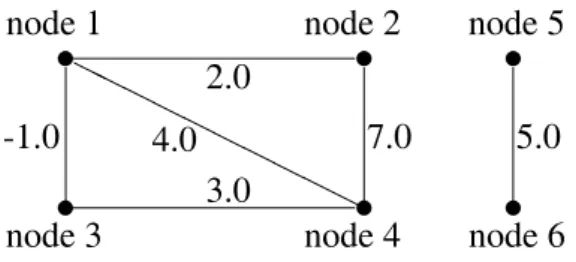
Fig. 1.A sample graph.
As an illustration, let us consider the graph in Figure 1 whose arcs are given “lengths”. Sup-pose that we want to solve theshortest distance
problem, i.e. we want to determine the length of a shortest path between any pair of nodes. Then the matrixAand its closureA are:
A =
2
6 6 6 6 4
1 2:0 ;1:0 4:0 1 1
2:0 1 1 7:0 1 1
;1:0 1 1 3:0 1 1
4:0 7:0 3:0 1 1 1
1 1 1 1 1 5:0
1 1 1 1 5:0 1
3
7 7 7 7 5
A =
2
6 6 6 6 4
0:0 2:0 ;1:0 2:0 1 1
2:0 0:0 1:0 4:0 1 1
;1:0 1:0 0:0 3:0 1 1
2:0 4:0 3:0 0:0 1 1
1 1 1 1 0:0 5:0 1 1 1 1 5:0 0:0
3
7 7 7 7 5 :
Pis here the set of real numbers including1,
with the standard min as _, and the standard
+ as . The zero element in P is 1, and the
unit element is 0. The(ij)-th entry ofAis the
length of the arc from nodeito nodej, while the
(ij)-th entry ofA is the length of the shortest
path from nodeito nodej.
As the second example, let us consider once again the same graph in Figure 1, but suppose now that we want to solve the path existence
problem, i.e. we only want to determine which pairs of nodes are connected by a path and which are not. Then we can use a much sim-pler Boolean path algebraP, which consists of the values 0 and 1, with the operations max and min as_and, respectively. The corresponding
matricesAandA have the same zero/non-zero
structure as before: any1is now replaced with
0 and any other value with 1. The(ij)-th entry
ofAspecifies the existence of an arc from nodei
to nodej, while the(ij)-th entry ofA indicates
the existence of a path from nodeito nodej. As shown in 1, 10], many other types of path
problems can be formulated and solved in a similar fashion. The general structure of the problem always stays the same. However, the setP changes, and the operations_and can
have different meanings.
Note that the two examples shown above are quite specific, namely their matricesA,A2,
:::,
A happen to be symmetric(which is generally
not the case). We deal here withsymmetricpath
problems. It is easy to prove that symmetric problems are exactly those where the involved graph is undirected and the operationis
com-mutative.
3. Distributed algorithm
Our algorithm for solving path problems is in fact an algorithm that computes the closureA
of a given stablen n matrix A over an arbi-trary path algebraP. The expression of the form
(1)is evaluated relatively quickly, byiterative
squaring and updatingof a suitable matrix B. The algorithm starts withB=E_A, and stops
whenBstabilizes.
Our algorithm is distributed in the sense that it consists of a ring ofm concurrent processes, where 1 m n=2. Each process
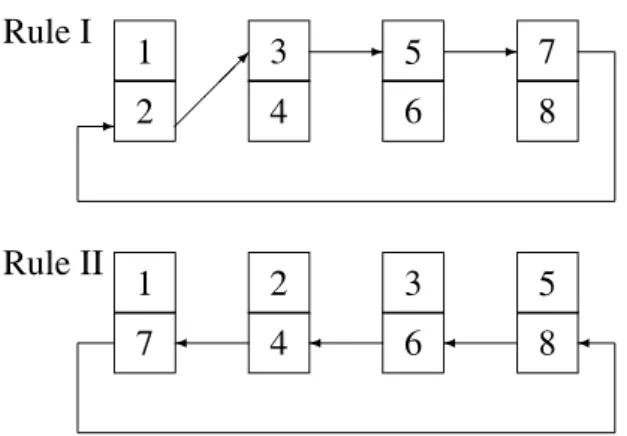
commu-nicates with its predecessor and its successor along the ring. There is no shared memory, but each process has its own private memory. Figure 2 refers to a ring ofm=4 processes.
To enable distributed computing, the algorithm maintains two copies of the matrixB, denoted by
R= rij]andC= cij]. The matrixRis divided
into 2mblocks, so that every block consists of a roughly equal number of adjacent rows. Sim-ilarly,C is divided into 2mblocks of columns. The range of column indices assigned to one particular block of C is the same as the range of row indices assigned to the corresponding
keeps exactly two blocks of R and the corre-sponding two blocks ofC.
Rule I 1
2
3 4
5 6
7 8
- ;
; ;
-
-Rule II 1
7
2 4
3 6
5 8
Fig. 2.Block exchange rules form=4.
As previously explained, the algorithm consists of iterations. However, due to distributed com-puting, each iteration is further divided into 2m;1 smaller parts calledphases. In one phase
a process generates row-column pairs from its locally available blocks. In each phase all pos-sible pairs from non-corresponding blocks are generated. In the first phase within an iteration, additionally, all possible pairs from the corre-sponding blocks are also generated. For each generated pair, consisting of, say, the i-th row ofRand thej-th column ofC, the process com-putes the “inner product”. The obtained value is used to update both thej-th element of thei-th row ofRand thei-th element of thej-th column ofC; thus:
rij:=cij:=
n
_
l=1
rilclj: (2)
After any phase the processes exchange blocks in order to form new combinations of blocks for the next phase. Any block of C moves to-gether with the corresponding block ofR. The exact block exchange procedure is shown in Fig-ure 2, for the case where m = 4. Rules I and
II are alternately applied. Each index in Fig-ure 2 denotes one block ofRtogether with the corresponding block of C. Arrows in Figure 2 indicate block moves. As proved in 3], the
chosen procedure assures that through a single iteration each block ofRmeets each of the non-corresponding blocks ofCexactly once.
It has been proved in 8]that for a stable matrix
Athe algorithm terminates after a finite number of iterations, with the final matrices R and C
equal toA .
4. Optimized version
Optimization of the described distributed algo-rithm is based on the idea that the used inter-nal data structures should be made more com-pact. Since instances of those data structures are exchanged among processes, their smaller size implies smaller communication costs. An-other positive side effect of data compaction is that some unnecessary algebraic operations are automatically skipped. The price we pay for this improvement of performance is a loss of generality.
In 7] we have already designed a version for
dense symmetric path problems. That version simply stores only one copy of the matrixB, for instanceC, and skipsR. Thanks to symmetry, each row of R, whenever needed, can be re-placed by the corresponding column ofC. The blocks ofCare represented as ordinary arrays. In 7]we have also designed a version suitable
for sparse unsymmetric problems. The version uses again two matricesRandCas described in the original algorithm. However, the blocks of
RandCare represented by a special data struc-ture that exploits sparsity and explicitly stores only non-zero entries.
In this paper we are proposing a new optimized version, which combines the features of the two versions mentioned above. Thus the new ver-sion stores only one copy of B, for instance
C, and represents the blocks of C by the spe-cial data structure. Obviously, the new version works correctly only for a symmetric problem, and becomes really efficient if that problem is at the same time sparse.
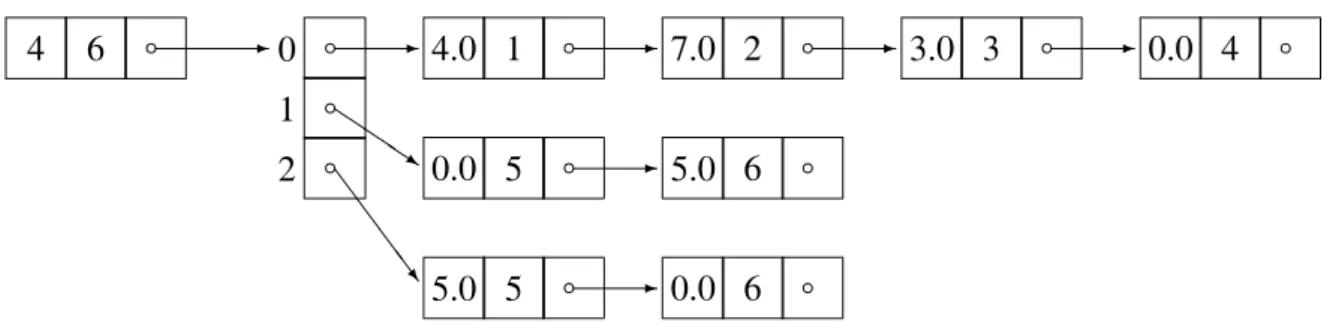
The data structure used in the new version is based onlinked lists 6, 9]. One linked list
cor-responds to one column of the block ofC. Each record within a list contains the value and the row index of a non-zero entry from that column. The pointer within a record points to the next non-zero entry from the same column.
4 6 b - b
b
b
0 1 2
-Q Q
Q s S
S S
S w
4.0 1 b - 7.0 2 b - 3.0 3 b - 0.0 4 b
-0.0 5 b 5.0 6 b
-5.0 5 b 0.0 6 b
Fig. 3.Linked lists representation of a block ofC.
of C consists of the 4-th to 6-th column of B, and B corresponds to the graph in Figure 1. The starting record also includes the original range of column indices for columns within the block. Note that φ in our example is 1, not
0.0. In order to assure portability of data struc-tures among processes, an actual implementa-ton could use a tabular variant of linked lists, i.e. record components could be put into arrays, and pointers replaced by array indices.
Computation in the new optimized version is done essentially in the same way as in the orig-inal algorithm, provided that rows of(
nonexis-tent)Rare replaced by corresponding columns
of C. More precisely, an inner product (2) is
now computed according to the following for-mula:
cji:=cij:=
n
_
l=1
cliclj: (3)
The formula (3) is evaluated only for i j
and not for all (ij)pairs. Note also that, due
to the used data structure, (3) implies a more
complicated algorithm than for ordinary arrays. Namely, computing an inner product means traversing two linked lists simultaneously, and updating an entry means finding the appropri-ate record within a linked list or inserting a new record. Since zero elements are not explicitly stored, trivial algebraic operations are automat-ically avoided thus additionally reducing com-putational effort.
5. Experiments
The original algorithm, its two previously men-tioned older optimized versions, and the
consid-ered new optimized version have all been imple-mented as separate C programs. The program code has been designed so that it can easily be adjusted to solve various types of path problems
(path existence, shortest distances, etc). In
or-der to monitor performance, the programs have been extended so that they count their own iter-ations and record their own execution time. By execution time we mean the real physical time, which comprises computation, communication, and possible network delays.
Each program has been built by using thePVM package 5] as a set of concurrent processes,
which can be allocated to different computers, and which exchange data through the network in a ring-like fashion. The programs have been tested on the same virtual parallel machine, as-sembled of four UNIX computers, as already described in 7, 8]. We have been able to run
any program with up to eight truly concurrent processes.
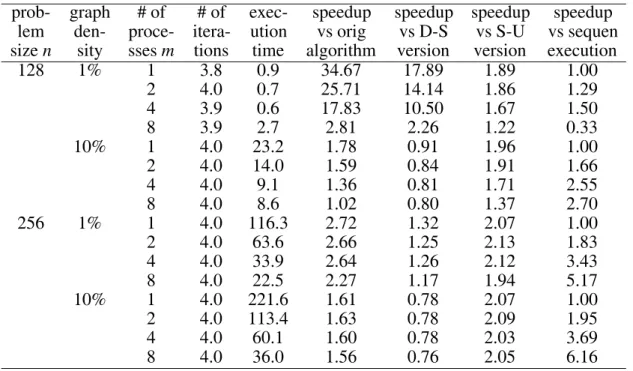
The performance of the new version has been measured on 40 randomly generated path ex-istence problems and 40 randomly generated shortest distance problems, all with undirected and more or less sparse graphs. In order to get relative measures of performance, all 80 prob-lems have also been solved by the original al-gorithm and by the two older versions. The ob-tained results are summarized in Tables 1 and 2.
Each of the Tables 1 and 2 shows the results for the corresponding 40 problems of a cer-tain type(path existence or shortest distances).
The problems within the same table have fur-ther been divided into groups of 10 according to their size(n = 128 or 256) and their graph
prob- graph # of # of exec- speedup speedup speedup speedup
lem den- proce- itera- ution vs orig vs D-S vs S-U vs sequen
sizen sity ssesm tions time algorithm version version execution
128 1% 1 3.8 0.7 15.00 6.86 1.71 1.00
2 4.0 0.6 11.17 6.83 1.50 1.17
4 3.8 0.5 7.60 5.60 1.40 1.40
8 3.8 2.0 2.75 1.95 1.35 0.35
10% 1 3.0 5.7 1.44 0.68 2.09 1.00
2 3.0 4.3 1.12 0.70 1.58 1.33
4 3.0 2.6 1.08 0.81 1.42 2.19
8 3.0 3.1 1.39 0.97 1.42 1.84
256 1% 1 3.4 31.4 2.56 1.17 2.19 1.00
2 3.1 18.7 2.02 1.08 1.86 1.68
4 3.2 11.8 1.78 1.11 1.60 2.66
8 3.1 8.3 1.39 1.13 1.23 3.78
10% 1 2.9 52.5 1.29 0.60 2.16 1.00
2 3.0 33.4 1.08 0.59 1.85 1.57
4 3.0 20.8 0.94 0.59 1.60 2.52
8 3.0 18.7 0.59 0.49 1.21 2.81
Table 1.Experimental evaluation of the new version, path existence problems.
prob- graph # of # of exec- speedup speedup speedup speedup
lem den- proce- itera- ution vs orig vs D-S vs S-U vs sequen
sizen sity ssesm tions time algorithm version version execution
128 1% 1 3.8 0.9 34.67 17.89 1.89 1.00
2 4.0 0.7 25.71 14.14 1.86 1.29
4 3.9 0.6 17.83 10.50 1.67 1.50
8 3.9 2.7 2.81 2.26 1.22 0.33
10% 1 4.0 23.2 1.78 0.91 1.96 1.00
2 4.0 14.0 1.59 0.84 1.91 1.66
4 4.0 9.1 1.36 0.81 1.71 2.55
8 4.0 8.6 1.02 0.80 1.37 2.70
256 1% 1 4.0 116.3 2.72 1.32 2.07 1.00
2 4.0 63.6 2.66 1.25 2.13 1.83
4 4.0 33.9 2.64 1.26 2.12 3.43
8 4.0 22.5 2.27 1.17 1.94 5.17
10% 1 4.0 221.6 1.61 0.78 2.07 1.00
2 4.0 113.4 1.63 0.78 2.09 1.95
4 4.0 60.1 1.60 0.78 2.03 3.69
8 4.0 36.0 1.56 0.76 2.05 6.16
Table 2.Experimental evaluation of the new version, shortest distance problems.
10%). Each particular problem has been solved
with different numbers of processes(m=1, 2,
4 or 8). Entries in Tables 1 and 2 are, in fact,
average values computed over a whole group of 10 similar problems. A table row comprises the number of iterations and the total execution time for a given group and a given number of
processes. The time is expressed as an abso-lute value(seconds), and as four relative values
(speedups).
same number of processes. The “speedup vs D-S version” compares in a similar way the new version and the older “dense-symmetric” version, while the “speedup vs S-U version” does an analogous comparison with respect to the “sparse-unsymmetric” version. Finally the “speedup vs sequential execution” compares the new version configured with more processes and the same version configured with only one process. Through different speedups we see dif-ferent effects of optimization(data compaction)
and of distributed computing.
6. Conclusions
The considered general distributed algorithm can be optimized for certain smaller classes of path problems. In a previous paper we stud-ied versions designed for dense symmetric and sparse unsymmetric problems, respectively. In this paper we have introduced a version for sparse symmetric problems.
The experiments have shown that for a sym-metric problem the best performance is always achieved by either of the two “symmetric” ver-sions. If the involved graph isvery sparse, the new “sparse-symmetric” version runs consid-erably faster than the older “dense-symmetric” version. On the other hand, if the graph is only
moderatelysparse, then the performance of the new version becomes similar, or even worse, compared to the older version. This is in fact not surprising since the solution of a moderately sparse problem can be dense.
References
1] CARRE´ B.,Graphs and Networks, Oxford: Oxford University Press; 1979.
2] CRICHLOW J.M., An Introduction to Distributed
and Parallel Programming, Englewood Cliffs NJ: Prentice-Hall; 1997.
3] EBERLEINP.J., PARKH., Efficient implementation of Jacobi algorithms and Jacobi sets on distributed memory architectures,Journal of Parallel and Dis-tributed Computing1990; 8: 358–366.
4] GAYRAUDT., AUTHIEG., A parallel algorithm for the all pairs shortest path problem, in: Evans D.J., Joubert G.R., Liddell H., editors, Parallel Computing ’91. Advances in Parallel Computing 4. Amsterdam: North-Holland 1992. pp. 107–114.
5] GEISTA., BEGUELINA., DONGARRAJ., JIANGW., MANCHEKR., SUNDERAMV.,PVM: Parallel Virtual
Machine – A Users’ Guide and Tutorial for Net-worked Parallel Computing, Cambridge MA: The MIT Press; 1994.
6] HOROWITZ E., SAHNI S., RAJASEKARAN S.,
Com-puter Algorithms / C++, New York: Computer Science Press; 1997.
7] MANGER R., NOGO G., Optimized versions of a
distributed algorithm for solving path problems,
Central European Journal of Operations Research – CEJOR2000; 8: 109–123.
8] MANGERR., Solving path problems on a network of computers,Informatica2002; 26: 91–100.
9] PREISSB.R.,Data Structures and Algorithms with
Object-Oriented Design Patterns in C++, New York: John Wiley and Sons; 1999.
10] ROTEG., Path problems in graphs,Computing
Sup-plement1990; 7: 155–189.
Received:June, 2003
Accepted:September, 2003
Contact address:
Robert Manger, Goranka Nogo Department of Mathematics, University of Zagreb Bijenicka cesta 30, 10000 Zagreb, Croatiaˇ
e-mail:[email protected], [email protected]
ROBERT MANGER received the BSc(1979), MSc (1982), and PhD
(1990)degrees in mathematics, all from the University of Zagreb. For
more than ten years he worked in industry, where he obtained practical experience in programming, computing, and designing information sys-tems. Dr Manger is presently an associate professor in the Department of Mathematics at the University of Zagreb. He has published over 30 scientific and 10 professional papers. His current research interests include: parallel and distributed algorithms, combinatorial optimiza-tion, soft computing and database systems. Dr Manger is a member of the Croatian Mathematical Society, Croatian Society for Operations Research and IEEE Computer Society.
GORANKA NOGOreceived the BSc (1981), MSc(1985), and PhD
(1998)degrees in mathematics, all from the University of Zagreb. She