Bio-IR-M: A Paradigm Modelling for Bio-Inspired
Multi-Agent Systems
Djamel Zeghida
LISCO Laboratory, Department of Computer Science, 20 Août 1955, Skikda University, P.O. Box 26 Route El Hadaeik, Skikda, 21000, Algeria
Djamel Meslati and Nora Bounour
LISCO Laboratory, Department of Computer Science, Badji Mokhtar, Annaba University, P.O. Box 12, Annaba, 23000, Algeria
[email protected], [email protected]
Keywords: bio-inspired system, agent-oriented software engineering, influence/reaction principle, biomorphic system Received: January 31, 2017
Nowadays bio-inspired approaches are widely used. Some of them became paradigms in many domains, such as Ant Colony Optimization (ACO) and Genetic Algorithms (GA). Despite the inherent challenges of surviving, in the natural world, biological organisms evolve, self-organize and self-repair with only local knowledge and without any centralized control. The analogy between biological systems and Multi-Agent Systems (MAS) is more than evident. In fact, every entity in real and natural systems is easily identified as an agent. Therefore, it will be more efficient to model them with agents. In a simulation context, MAS has been used to mimic behavioural, functional or structural features of biological systems. In a general context, bio-inspired systems are carried out with ad hoc design models or with a one target feature MAS model. Consequently, these works suffer from two weaknesses. The first is the use of dedicated models for restrictive purposes (such as academic projects). The second one is the lack of a design model.
In this paper, our contribution aims to propose a generic multi-paradigms model for bio-inspired systems. This model is agent-based and will integrate different bio-inspired paradigms with respect of their concepts. We investigate to which extent is it possible to preserve the main characteristics of both natural and artificial systems. Therefore, we introduce the influence/reaction principle to deal with these bio-inspired multi-agent systems.
Povzetek: Avtorji prispevka analizirajo podobnosti med biološkimi in multiagentnimi sistemi in predlagajo Bio-IR-M, integrirano shemo, ki zajema tako genetske algoritme kot npr. modele, temelječe na mravljah.
1
Introduction
In computer science, bio-inspired approaches are getting a particular interest. Their mechanisms and their behavioural, functional or structural features remain favourable fields of study and inspiration for multidisciplinary researches. Therefore, most researchers agree that both natural and bio-inspired systems are complex. In each system distribution and decentralization are inherent features.
We see now a large emergence of bio-inspired systems. These systems, inspired from nature and living organisms, extract metaphors for solving complex problems, getting new dimensions for systems we design. Some of these bio-inspired approaches became paradigms in many domains such as in hard optimization as heuristics [16], highlighting by the way the ACO meta-heuristic of Dorigo [15].
We can find early examples as use cases for instance in optimization with an evolutionary approach [23] or with a swarm intelligence (SI) using Ant Colony (AC)
[10]. Other examples are presented for the use of Artificial Neural Network (ANN) in control and decision systems [35] or for object-class detection (specifically face detection) [53]. While [58, 59] present respectively the use of Artificial Immune Systems (AIS) and AC in the security domain. Although, [63] presents the use of AC intelligence with agent for scheduling and [4] illustrates routing with GA.
evolutionary algorithm in [49]. In vision, Artificial Neural Networks (ANN) are used for place recognition [11].
This proliferation is mostly due to technological and methodological advances in application areas and a better understanding of biological natural mechanisms.
Historically, the evolution of any approach or paradigm must be accompanied by a methodological evolution to carry the design side. Therefore, the need for an associated and specific bio-inspired modelling is becoming increasingly urgent. Such unified abstract representation will, at least, help overcome the lack of reuse in this domain.
A straight analogy can be easily identified between natural and multi-agent systems. Formally, we clearly distinguish two levels as follows:
- Micro level: held by the Agent concept in MAS and by an individual in natural system. An agent and an individual are both: autonomous, reactive, proactive and social.
- Macro level: referring to the MAS concept (an aggregate of interacting agents) and to a sub-system or to the entire natural sub-system. In both systems we can find a set of features such as: diversity and distribution of knowledge, decentralization of data, distributed control, asynchronous calculations and processing, efficiency of parallel treatments, robustness, fault tolerance and dependability, flexibility, sophisticated plans of interaction (cooperation, coordination and negotiation), asynchronous local communication and emergent functionalities. In this paper we focus on the modelling issue. We show the interest of a dedicated multi-paradigm model for bio-inspired multi-agent systems.
In fact, by exploiting the evident analogy between biological and multi-agent systems and highlighting the fact that these agent/multi-agent concepts are a common denominator for bio-inspired paradigms; it is quite natural to model these systems using autonomous agents. With regard to this perspective we suggest a unifying and generic influence/reaction agent model for several bio-inspired paradigms.
In Section 2, we give the background used in this paper that presents natural/multi-agent systems and the influence/reaction principle. Section 3 gives some reflections and analysis on Agent/Actor/Object concepts and the micro/macro levels in both MAS and bio-inspired paradigms, and then we show the convenience of using the agent concept as a generic model. All this help to position our contribution. Section 4 presents the concept of bio-inspired design. Throughout Section 5, we focus on the details of our proposed generic influence/reaction agent model, which is based on an explicit environment model and a separate interaction module. Section 6 presents some case studies. We discuss related works in Section 7, and Section 8 concludes the paper.
2
Background
This section provides the basic concepts and features of natural and multi-agent systems, highlighting the influence/reaction principle.
2.1
Specificities of natural systems
If we consider any ecosystem or biotope we can see that several autonomous species cohabit together with various complex interactions and interdependencies.
Biologists define the biotope as a small box with a separate set of environmental conditions (climatic and geological) that supports an ecological community composed of plants and animals. In a biotope, interdependence is complex and species survival depends on it. It is important to notice that all the biotope forms a coherent system and that various species cohabit while they differ greatly in terms of mechanisms and behaviours. These species require continuous changes of organization: decomposition/aggregation to face these very constraining and changing environments (Figure 1).
Figure 1: Canonical view of a complex natural system [30].
Note that distribution and complexity are innate features of these systems rather than casual. These systems are Auto organized Group of individuals. These last are Autonomous, Simple and Cooperative, put together in local communication to perform Complex operations in a Distributed and Parallel manner. Where the behaviour shown by the group is not explicitly programmed in the members but emerges from their
interactions. These members join and leave freely the group in continual change. All this is performed without
any central control [36]. With all this chaos and
anarchic interactions, the organization continues to
grow, to live, to adapt and repairitself.
2.2
Multi-agent systems
According to J. Ferber [19],”an agent is an autonomous entity, real or abstract, which can act on itself and its environment, which, in a multi-agent universe can communicate with other agents, and whose behaviour is a consequence of its observations, knowledge and interactions with other agents”.
An agent is mainly [29, 62]:
- Autonomous: its behaviour is guided by objectives; it has an internal state on which it holds total control. This internal state is particularly inaccessible to other agents. Furthermore, the agent makes decisions that are based on this internal state without external intervention (human or other agent).
- Reactive: an agent is situated in an environment. It is able to perceive this environment and respond to events in it by its actions.
- Social: An agent is a social entity in the sense that it is able to interact and communicate with other agents through its environment.
- Proactive: an agent does not just react to its environment, but it is also able to produce self-actions motivated by its own goals (agent takes initiative).
An agent may be: reactive, cognitive or hybrid. MAS based on reactive agents are characterized by a large number of simple agents, by emergence and eco-resolution. MAS based on cognitive agents are characterized by a small number of intelligent agents, by coordination, negotiation and cooperation. In this case, the system depends on the agents’ intelligence.
When multi-agent systems are based on reactive agents (not intelligent), they depend on the agents’ interactions to get intelligent collective behaviour. It defines a particular kind of Distributed Artificial Intelligence called Swarm Intelligence (SI). In such systems, intelligent functionalities (which haven’t been explicitly coded in the system) can emerge throughout the agents' interactions.
MAS are usually characterized by:
- Diversity and distribution of knowledge: each agent has information and limited problem solving abilities (incomplete information and limited scope of action), and each agent has a partial view of the system,
- Decentralization of data,
- Asynchronous calculations and processing,
- Distributedcontrol: there is no overall control of the system,
- Efficiency of treatments: the agents work in parallel and communicate asynchronously,
- Robustness, fault tolerance and dependability: the disconnections of some agents do not substantially affect the overall behaviour of the system,
- Flexibility: we can always increase (or decrease) the number of agents to treat larger and larger systems, without disturbing the work of existing agents who can adapt themselves,
- Sophisticated plans of interaction: they include cooperation, coordination and negotiation,
- Ideal for representing problems with multiple solution methods, multiple perspectives and/or multiple solvers. They have the traditional advantages of distributed and concurrent resolution of problems such as modularity, speed (with parallelism) and reliability (due to
redundancy).
2.3
The influence/reaction principle
Besides being solution for simultaneity, the Influence/Reaction principle provides bases of good agent modelling/programming [41, 42] to accomplish more formally some aspects of the agent paradigm.
As a modelling principle, the Influence/Reaction principle has been defined for its ability to model concurrency behaviour but its interest goes beyond this objective. First, it gives a true semantic to the interactions management during the reaction phase (through influence). It, also, avoids the representation of action as a direct change in the global states of a system. This model can provide truly autonomous agents, requiring a clear distinction between the state variables of the agent decisional system (its mind) and variables relating to its physical appearance that are part of the environment (its body). The mind’s variables are accessed/modified only by the agent and only during the Influence phase when the body’s variables can be changed only during the Reaction phase by this environment [41, 42].
2.3.1
The influence/reaction principle for
modelling simultaneous actions
Focusing on the autonomous nature of these entities, the simultaneity of action is an inherent characteristic of the agent paradigm which is, in addition, difficult to implement adequately. Constrained, agents must not have the control over the consequences of their actions, only the environment has the ability to compute them and for which the internal structure of an agent will stay unreachable. The influence/reaction principle is a solution for modelling simultaneous actions [17, 41, 42].
In two points, this principle is summarized in the fact that:
1. Agents do not have direct control over the result of their actions;
2. All the influences produced at a moment must be known to compute the new state of the world. Every application of this principle will provide a
model for its implementation.
2.3.2
The influence/reaction principle for
modelling interactions
In Figure 2, let us denote δ(t) the dynamic state of a system at time t and γ1, γ2 two influences produced at this time.
The new state δ(t+dt) is given by the reaction function (equation1):
The parallel character of actions can be mandatory or optional depending on situations (see more details in [41, 42]).
In a mandatory parallel case, we have parallel reactions, requiring an explicit behaviour composition. To preserve the coherence of the system and to ensure the decisional autonomy of all involved agents, we calculate the reaction of the environment by treating all their influences simultaneously as a unit (equation 2):
+ = , 2
Figure 2: Illustration of the Influence/Reaction principle [41].
In the second case, the parallel character is no longer an obligation (it is just a modelling choice). Now we have serial (non-parallel) reactions. Both coherence of the system and the agent autonomy will not be compromised by the process used; we can use the equation 2 or we decompose the overall computing in elementary and independent reactions. We execute them in sequence one after another (equation 3 then equation 4). So we calculate first:
= , 3
And then:
+ = , 4
(or γ2 then γ1)
We have to conclude here that the use of an Influence/Reaction model in the treatment of interactions calls for a separate interactions module.
3
Analysis and reflections
We notice that the use of the term approach refers to a vision or process to face or to deal with an issue, we can call it paradigm when it is well defined and widely used (for instance, agent/object are both paradigms in many domains, when we qualify them as approach, we mean the global vision and the way they proceed).
3.1
The challenge
Knowing the multitude and variety of bio-inspired paradigms available today (Table 1), it would be interesting to seek a unified approach for their design.
In Artificial intelligence, think bio is sometimes like to think multi-agent system, and think MAS is to think modelling and simulation. This transitivity of MAS is a natural bridge between the real world and the simulation
and modelling in data processing. That is a generalisation of what was attested for immunology by Bakhouya [3]. So, for biology and MAS, the support is mutual.
Biology supports MAS in particular and the field of computer science in general, by providing artificial systems with principles, processes and mechanisms available in biological systems. This is achieved through biological metaphors as analogies established between the biological world and the artificial world, in order to propose approaches mimicking some aspects of the natural world while ignoring others. An historical overview of bio-inspired approaches can be found in [36]. Basically, the metaphors do not try to reproduce what is biological, but rather to interpret it in terms of what it is possible and reasonable to do. Thus, we can conclude that biological metaphors are evolving and depend on our understanding of reality and on our ability to extract beneficial and practical elements.
Paradigms Metaphor Inspiration’s Nature Artificial
Neural Network (ANN )
Brain structure & functioning
Structural & Functional.
Genetic Algorithm (GA)
Genetic mechanisms
Functional.
Fuzzy System (FS)
Human reasoning
Functional.
Artificial Immune System (AIS)
Operating & organisational mechanisms of immune cells
Structural & Functional.
Ant Colony Optimization (ACO)
Ant colony behaviour
Behavioural.
Particle Swarm Optimization (PSO)
Swarm of bird in flight behaviour
Behavioural.
Table 1: Description of some bio-inspired paradigms. On the other side, MAS allow the construction and design of complex systems highly distributed and adaptable to environmental changes. MAS offer to the biologists the ability to model and simulate, as simple as possible, complex natural systems (cells/molecules in interaction, insects, birds, fish or other living organisms) providing a reproduction of a natural phenomena through computers to:
- Understand their processes/mechanisms.
- Identify new metaphors: computation / memorisation models or resolution / optimization tools.
Beside their innate characteristics (Section 2.1), an
Open System must have the three flowing characteristics: 1. The number of the system’s components can
change; the system accepts new components and
allows departure of existing ones.
2. The system’s organizational structure can change; there is no predefined and fixed organization to respect, components can form and dissolve
aggregations and groups freely.
3. The two previous characteristics must be performed within “running” (in action) system. The two first characteristics are enough in nature to define an Open System. The third characteristic can be ignored in living organisms and “organizations”, because it is naturally verified: The ecosystem will not be constrained to stop or even wait the changes of its structure and the number of its components.
In artificial world (such in computer science), the third characteristic is very important. We can change the structure and the number of a system’s components by modifying its code when it is stopped; in this case the system is not Open. To be Open, the two previous changes must be observed within a running system
(system in execution).
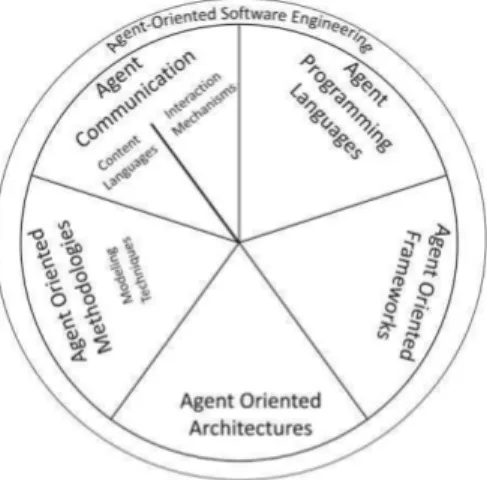
Agent-Oriented Software Engineering (AOSE) has evolved to include the following high-level themes:
methodologies, architectures, framework implementations, programming languages, and communication (Figure 3). Our contribution aims to address the modelling issue in the Agent Oriented Methodologies theme.
Figure 3: Agent-Oriented Software Engineering thematic map [55].
Mainly, a design methodology will include:
1. Models: Abstract representations of the real world or a part of it;
2. Tools: Means to represent, to manipulate and to implement the models;
3. Process: Coordinated set of steps, phases and tasks showing the path to achieve the system design.
For a precise positioning of our contribution, we summarize in Figure 4 and Figure 5, what has been
already done in particular computer science fields and what remains to be done.
Figure 4 depicts the combined/separated use of bio-inspired approaches and Agent/multi-agent concepts in the field of Distributed Artificial Intelligence (DAI) or traditional Artificial Intelligence (AI).
The case (a1), illustrates the use of bio-inspired resolution/optimization tools (Algorithms: computation / memorisation models or resolution / optimization tools) to solve problems. All examples and applications cited in Section 1 belong to this case (except where it has been mentioned the use of agent).
The case (b1), illustrates the use of bio-inspired Agent/multi-agent modelling/simulation tools (Platforms) to model/simulate bio-inspired multi-agent systems. For instance, the use of Turtlekit tool in Madkit
platform [26] for simulating artificial life/reactive systems and the use of Repast platform for simulating social science applications [22]. It can illustrate, too, the use of bio-inspired Agent/multi-agent tools and models (Algorithms) such in [7, 21, 46, 59, 63].
The case (c1), illustrates the use of Agent/multi-agent modelling/simulation tools (Platforms) to model and simulate multi-agent systems. Gama, NetLogo and
PRESAGE2 are examples of still used agent simulation platforms [22].
Figure 4: Bio-inspired approaches’ use in AI/DAI field combined or not with MAS.
Figure 5 depicts the combined/separated use of bio-inspired approaches and Agent/multi-agent concepts in the field of Software Engineering (SE).
Figure 5: Bio-inspired approaches’ use in SE field combined or not with MAS.
The case (b2), illustrates the use of bio-inspired agent/multi-agent methodology (models/process/tools) to develop bio-inspired multi-agent systems. There is no model nor methodology to deal with this case [24, 25, 34, 44, 50, 51]. Otherwise, we can find, only, methodology supporting a one target feature (for example Adelfe agent methodology supports emergent functionalities) [6].
It is the case that needs improvement, and where we aim to contribute in this paper.
The case (c2), illustrates the use of Agent/multi-agent methodology (models/process/tools) to develop multi-agent systems. For instance, we can cite the AGR
and AGRE organisational models [18, 20].
For the methodologies we have, for instance: Gaia,
MaSE, O-MaSE, Passi, Prometheus, INGENIAS, Tropos
[22, 47, 56]. Some examples of their application can be found in [38, 40, 54], when others don’t mention, at all, any methodologies [33, 52, 63].
3.2
Agent versus Object and Actor
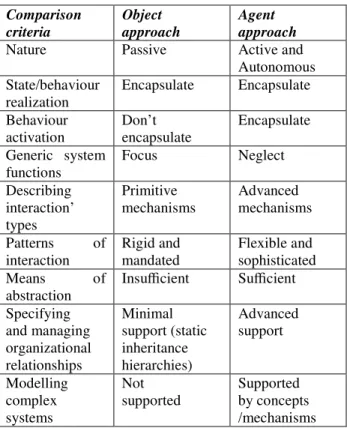
As a modelling concept, to overcome the passive nature of Object, the less known concept of Actor was launched. In Table 2, we situate the Agent with regard to the well-known and widely used concept of Object.
The Actor concept is a mathematical model of concurrent computation used for several practical implementations of distributed systems. It was built with a main added value; its asynchronous behaviour (Figure 6). The Actor concept initiated by 1973 was left out and ignored for decades. It has been relaunched first by Gul
[1] and after that by Karmani and Gul [31, 32]. The
Agent concept overtakes the Actor by its skills in interactivity (Figure 6). The three concepts became paradigms in computer science domain.
Comparison criteria
Object approach
Agent approach
Nature Passive Active and
Autonomous State/behaviour
realization
Encapsulate Encapsulate Behaviour
activation
Don’t encapsulate
Encapsulate Generic system
functions
Focus Neglect
Describing interaction’ types
Primitive mechanisms
Advanced mechanisms Patterns of
interaction
Rigid and mandated
Flexible and sophisticated
Means of
abstraction
Insufficient Sufficient Specifying
and managing organizational relationships
Minimal support (static inheritance hierarchies)
Advanced support
Modelling complex systems
Not supported
Supported by concepts /mechanisms Table 2: Comparing Object & Agent approaches. If we take the most important and illustrative features; Intelligence and intermediation, Figure 6 depicts the places of the three paradigms Agent, Actor
and Object together. This figure was inspired from a graphic description of Agent type and functionalities. It has been later refined in [66] and extended here to Actor
and Object.
Figure 6: Positioning Agent, Actor and Object concepts according to the intelligence and intermediation features.
On the intelligence axis, both three paradigms can deal with this feature more or less easier. On the other axis, we distinguish an inclusion relationship (Figure 7). Indeed, Objects cannot even deal with the first step:
Asynchronism, which is well-handled by Actors. Agent
reaches farther steps, with its sophisticated means of
colonies) and a direct mode. The latest is widely used ranging from: agent language (KQML for Knowledge Query and Manipulation Language, ACL-FIPA for Agent Communication Language, proposed by the Foundation for Intelligent Physical Agents), ontologies and a communication support (present in agent platforms such as JADE [5] or MadKit [26]). The direct mode is structured using; protocols, dialogue games or argumentation systems [28].
Figure 7: Object, Actor and Agent inclusion.
3.3
The analogy between biological
systems and MAS
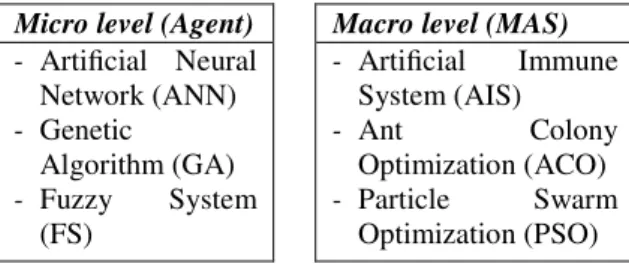
The first observation is the analogy between biological systems and MAS, and the mutual support of each. For instance, some bio-inspired approaches are easily identified to an aggregate of agents and have, so, a straight analogy with the MAS concept (the macro level). Others can be used in agent (the micro level) as a computational model held by the agent concept, as shown in Table 3.
Micro level (Agent) Macro level (MAS)
- Artificial Neural Network (ANN)
- Genetic
Algorithm (GA)
- Fuzzy System (FS)
- Artificial Immune System (AIS)
- Ant Colony
Optimization (ACO)
- Particle Swarm Optimization (PSO) Table 3: Classification of bio-inspired paradigms. Note that for a particular use and specific abstraction need, we can use a micro level as a macro according to Table 4. For instance, with a functional metaphor (Table 4), GA was classed in the micro level (Table 3), but with deeper abstraction level it can be used in a macro level, where every genotype, for instance, will be hold by an agent.
Nature of the metaphor
Micro level (Agent)
Macro level (MAS)
Functional Ok
Structural Ok
Behavioural Ok
Table 4: Classification of bio-inspired paradigms according to their metaphor’s nature.
3.4
The unifying formalism
The idea of using a unifying formalism to deal with the diversity of specific concepts to the considered paradigms became more obvious. Rather than proposing an approach that is the sum of the various concepts, or try to merge similar concepts, our vision of a unifying formalism is to wrap the various concepts by basic concepts and to operate, thereafter, a successive refinements that can be conducted in the specific contexts to each bio-inspired paradigm.
3.4.1
Adequacy of the agent approach for the
development of natural systems
The multi-agent systems benefit from the effort of a wide scientific community relying on the fact that their approach adapts to various levels of abstraction. Indeed, from cognitive complex agents to very simple reactive agents, it is possible to model very different realities.
In [48], criteria that characterize bio-inspired MAS approach were proposed (Table 5). Some of these characteristics refer to the micro level, which is the individual component (agent level) and others to their aggregate (multi-agent level).
Criteria Nature
Agents must correspond to entities and not to abstract functions.
Micro level: Agent Agents should be small in size
(system’s parts), in time (able to forget) and in scope (avoid global knowledge/actions).
Micro level: Agent
Agents’ community should be decentralized, with no single point of control or failure.
Macro level: MAS Agents must be diverse. Randomness and repulsion are important tools for the maintenance and stabilization of this diversity.
Micro level: Agent
Agents’ community should include mechanisms for disseminating information to increase its agents’ reactivity.
Macro level: MAS
Agents must have means to capture and share what they know/learn.
Micro level: Agent Agents plan and run in concurrent
and parallel way.
Micro level: Agent Table 5: Characteristics of bio-inspired multi-agent
approach.
1. Advantage of agent-oriented decompositions:
Limiting the scope and extent of the designer, the decomposition is the basic technique that helps to counter big problems and their complexity, by dividing them into smaller parts, manageable and treatable in a relatively separated way. It is apparent that the natural way to model a complex system is based on several independent components that can act and interact in a flexible way to achieve their objectives. The agent-oriented approach seems to be the best choice.
2. The convenience of agent-oriented abstractions: Limiting, at a given time, interest and visual field of the designer, the process of defining a simplified model of the system, helps to overcome its complexity, by focusing on some details and ignoring others. In the case of complex systems composed of subsystems, components of subsystems and organizational relationships, it is natural to match the sub-systems to agent organizations, the components of subsystems to agents and interaction between subsystems and between their components will be viewed in terms of high-level social interactions.
3. The need for flexible management of changing organizational relationships: Offering the ability to specify and adopt organizational relation-ships, the process of defining and managing interactions between different components of problem solving (sub-systems and interaction links), helps designers to deal with complexity by allowing the grouping of components, to treat them as a unit of high-level analysis and to provide means for describing high-level relationships between various units. Agent-oriented systems have mechanisms for concurrent computing to form, maintain and dissolve organizations flexibly. The multi-agent systems became a new technology
for the design and control of complex, flexible and scalable systems.
3.4.2
The environment in bio-inspired
multi-agent systems
In AEIO Vowels model [12]; Da Silva distinguishes four dimensions for MAS: Agent, Environment,
Interaction and Organization. We notice that the
environment component has been identified as a key element for MAS [61]. For bio-inspired systems, this component is of vital importance. This is the place where agents must co-exist and interact with the ability to form, maintain and dissolve organizations. All this changes can take place only through the environment [61].
Parunak [48] emphasizes a real consideration of the environment for ”natural” MAS. In this context, he establishes that such system can be defined as three components:
MAS = {Agents, Environment, Coupling}
Where an Agentiis a set of four elements as follows:
Agenti = {A.statei, A.inputi, A.outputi, A.processi }
The Environmenti (as a scoop of Agenti) is composed by two elements:
Environmenti =< E.statei, E.processi >
The exact nature of the Coupling depends on how we model agents and environment states and process. This
coupling can be very complex. When agents and environment are discrete events, the Coupling of the
A.inputi and A.outputi to E.statei is simply a mapping of agent and environment states. This kind of representations, dominating in the artificial intelligence area, is criticized because it generates unrealistic situations. A solution proposed for this is: the influence/reaction principle [17, 41, 42].
Obviously the autonomous of entities and simultaneity of their actions is crucial for natural MAS. So a direct validation of actions is to be avoided in such approaches. In respect of these requirements, we propose the use of the influence/reaction principle to deal with bio-inspired multi-agent systems.
4
Biomorphic systems
Nowadays we often speak about bio-inspired or biomorphic systems. Let us see their appropriate significations.
4.1
Origins
The biomorphic (biology-morphology) term was coined by the British zoologist Desmond Morris to describe the bio-inspired software approach [36].
Let us recall that a biological metaphor is an analogy sought to be determined between artificial and biological worlds, in order to provide tools which mimic some aspects of real world. The result of such process is a bio-inspired system.
A biomorphic system is simply designed based on algorithmic concepts inspired from biological systems and processes:
(Biomorphic = Bio-inspiration + Design).
Consequently when we speak about development, design or modelling, we precisely use the term bio-inspired instead of biomorphic which include implicitly a process and structure.
4.2
Premises of a bio-inspired design
The premises of any development process of biomorphic systems fall into two points:4.2.1
Characterization of bio-inspired design
We had to identify the core processes and to formally describe their computational model. Since there are many paradigms, it is important to distinguish the basic paradigms and hybrid/composed ones.
To address this issue, several criteria have been identified to characterize the behaviour of biomorphic systems [36]. These criteria emphasize that a biomorphic system is materialized by a multitude of autonomous entities that collaborate. Table 6 depicts them and suggests their nature.
Criteria Nature
The system behaviour results from the collective interaction of several independent and similar entities.
Macro level: MAS The system behaviour emerges
from the interaction of entities without being explicitly described in them.
Micro level: Agent
Entities actautonomously. Macro level: MAS The entities are operating based on
local information and interactions
and their spatial scope is rather local.
Micro level: Agent
The entities appear and disappear freely according to the system changes (free evolution of the group).
Micro level: Agent
The entities are able of self-adapt
and adjust to changing objectives, knowledge and conditions.
Micro level: Agent The entities have the ability to
evolve over time.
Micro level: Agent Table 6: Characteristics of a bio-inspired design. As said for the Parunak’s characteristics (Table 5) these characteristics can be classified in two categories; atomic characteristics; referring to individuals and composed one, referring to a group of individuals (their aggregate).
4.2.2
Characterization of the context of
applicability
The context of applicability, of each basic bio-inspired paradigm, help to reach a state where knowing specific criteria on a given problem, it will be possible to choose the bio-inspired paradigm to apply or indicate possible combinations (that suggests a multi-paradigm approach).
4.3
Consequences of a bio-inspired design
Based on the previous two premises, when we are interested in some way by a bio-inspired multi-paradigm development approach, it should be noticed that biomorphic aspect concerns the whole life cycle of a software system.On requirements phase which is supposed to deliver the system functional and non-functional requirements, a preliminary determination of bio-inspired paradigm to use for each requirement or group of requirements is necessary. At this level we can, for example, determine that a particular requirement has characteristics that
suggest the use of ant colony optimization or using a neural network classification. Determining the appropriate bio-inspired paradigm for a given requirement is closely linked to the premises previously introduced.
The design phase is a key phase. In architectural design, this phase allows to decompose the system into subsystems and to determine the role played by each one and interactions that must exist between the subsystems. For this, we must first determine the main bio-inspired paradigm to use according to the main system requirements.
Based on these requirements, it is possible that none of the basic bio-inspired paradigm matches and, at that time, it would be advisable to consider combinations (hybridization). The second step in design is the detailed design. If a subsystem must comply with a bio-inspired paradigm given its detailed design should specify inputs and outputs and the necessary adjustments to implement this paradigm.
4.4
The need for a multi-paradigm
approach
Natural systems are by definition typically complex. This complexity is not only due to the multitude of entities that form their operational system, but also to the diverse nature of these entities and the varied interactions they may have.
It is sufficient for realizing it to consider an operating system and the various devices it manages, an Intranet and nested protocols which keep it operational, or an air or rail traffic management system.
4.4.1
Analogy with artificial systems
From an organizational point of view and having in mind the image of a biotope, an artificial system may be composed of interdependent subsystems where each is governed by a biological metaphor, provided by a given paradigm.
The underlying interest in this approach is to take advantage of the best paradigms for each problem. So, it is a synergy of the various paradigms that we want to achieve.
In turn, the subsystems can be decomposed and everyone will operate within a given paradigm. The relationship itself between the various sub-systems may be governed by a different paradigm from those governing the subsystems.
By analogy with the biotope where the objective is to maintain equilibrium between individuals, species and environment, the objective which we assign to a multi-paradigm approach is to provide a system with performance relatively best and good quality (reliability, development facility, maintainability, portability, etc.).
4.4.2
Rules of application of a multi-paradigm
approach
1. The multi-paradigm approach is simply a further bio-inspiration that makes the analogy between an artificial system and a biotope. It is not limited by a single metaphor but by many.
2. The multi-paradigm approach is a systemic approach that aims to integrate or hybridize the paradigms to take advantage of their synergy. For example, a system can be modelled as an ant’s colony that uses genetic algorithms as a computational model.
3. In absolute, no paradigm dominates the other, but, a paradigm may be at the forefront in a context and second plane in another. For example, a system can be modelled as an evolving species (applying an evolutionary approach) where individuals are neural networks for which we try to improve the configuration or the synaptic weights. The opposite is also possible; for example a neural network where each node computes its combination function by a genetic algorithm.
4. Paradigms can be used in re-entrant order. For example, a neural network whose outputs are used to select another one among several neural networks.
Note to finish this section, that the persistence of various programming languages and their coexistence is a fact that illustrates the practical relevance of a multi-paradigm approach (Case of the .NET ’dotnet’ platform of Microsoft, which is independent of any programming language and natively supports a large number).
The next section focuses on the modelling issue as part of a multi-paradigm bio-inspired approach.
5
The Bio-IR Modelling
In the context of a bio-inspired design, our goal is to use a generic model to unify the diversity of concepts specific to the considered bio-inspired paradigms.
A recapitulative reflection and analysis can be performed on what was presented in the previous sections. Indeed, besides the fact that MAS, like natural systems, consider that the systems are composed of interacting entities, there is a great similarity in the criteria for characterizing bio-inspired and MAS approaches (Table 5 and Table 6). It is possible to classify these characteristics into two categories: the intra-entity and inter-entities characteristics. In other words, we characterize the entities taken separately (atomic; referring to individuals) as we characterize their interactions (composed; referring to an aggregate of individuals). We notice that the same fact has been established for the classification of bio-inspired paradigms (Table 3).
For these reasons, we believe that the multi-agent systems approach is naturally placed as a prime candidate to act as a unifying modelling for biomorphic systems.
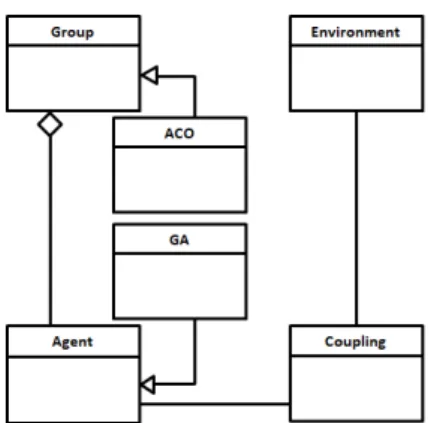
Figure 8 describes the meta-model of a general case of multi-paradigm bio-inspired multi-agent system with biomorphic agent and biomorphic group. We notice that
it includes the six bio-inspired paradigms cited in this paper. For a new bio-inspired paradigm we have to classify it in micro/macro level. We must follow the Table 4’ recommendations, according to the bio-inspired metaphor’s nature, its particular use and the needed abstraction level. If it belongs to a macro level, we add it as a specialisation of the group (inheritance). Otherwise it will be added as a specialisation of the agent (being in the micro level).
Figure 8: Meta-model for a multi-paradigm bio-inspired multi-agent system.
The complex nature of biomorphic systems is exhibited by different aspects ranging from simple computation, optimization, through complex coordination and symbolic resolutions. Using MAS to address these issues in a multi-paradigm context, we identify three possible scenarios:
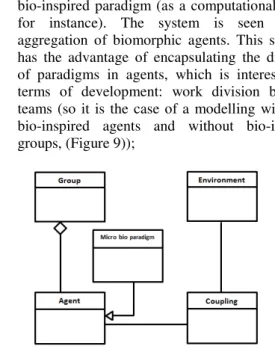
1. Intra-agent approach: Where the agent encapsulates a processing according to a given bio-inspired paradigm (as a computational model for instance). The system is seen as an aggregation of biomorphic agents. This scenario has the advantage of encapsulating the diversity of paradigms in agents, which is interesting in terms of development: work division between teams (so it is the case of a modelling with only bio-inspired agents and without bio-inspired groups, (Figure 9));
Figure 9: Meta-model for a bio-inspired agent.
behaviour with non-bio-inspired agents (Figure 10);
Figure 10: Meta-model for a bio-inspired group.
3. Hybrid approach: Where the previous two scenarios are combined. The system is then seen as a biomorphic group of biomorphic agents (the case of a modelling with bio-inspired groups and bio-inspired agents, (Figure 11)).
Figure 11: Meta-model for a bio-inspired agent and a bio-inspired group.
We notice that, in our model, there are no constraints on the type/architecture of the agent. In the micro level,
the agent will be cognitive according to the bio-inspired approach that it holds. In this case, its Computation module must be, consequently, sophisticated. In a macro level the agent is generallyreactive.
Formally and at a higher level of abstraction, in biomorphic MAS the three previous cases will be reflected in two levels as follows:
- Agent level
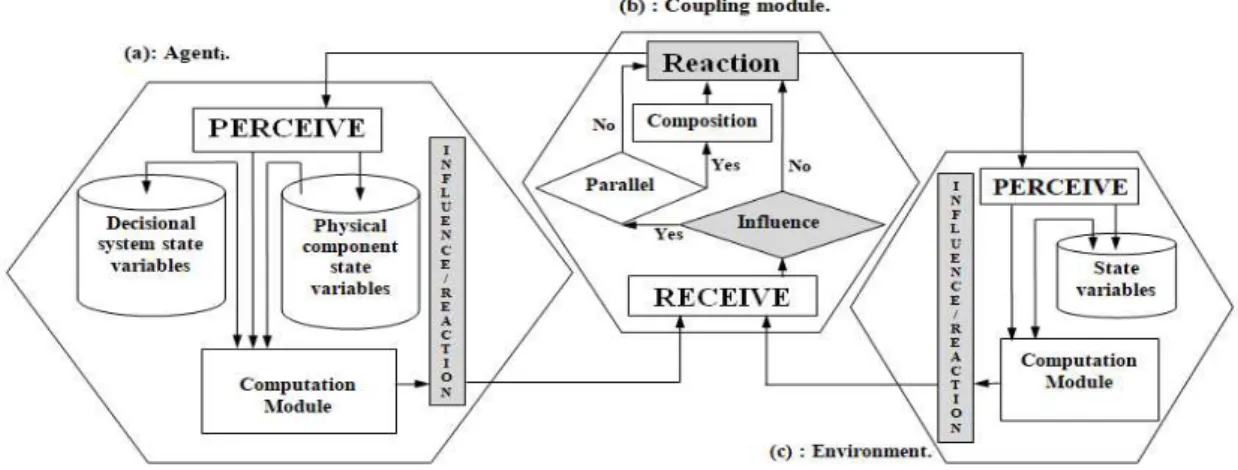
We use an agent model which must support the biological dimension; it will be designed by ensuring real autonomy with the separation between the state variables of the decisional system (the mind) and the physical component (the body). These interacting agents can be structured in groups (Figure 12.a).
- Group level
The resulting system is an aggregate of interacting agents. These interactions will be managed by a separate interaction module. We emphasize the active character of the environment to be modelled explicitly. This feature is because it has its own process that can change its state, regardless of the actions of its agents. The states of various agents are coupled to the state of the environment. This coupling will be performed using the influence/reaction principle.
We model a bio-inspired influence/reaction multi-agent system as follows (Figure 12):
Bio.IR.M = {{Bio.IR.A}, Bio.IR.E, Bio.IR.C}, Where:
1. Bio-IR-A; the Agent component: An agent does not have a direct control over the result of its influences on the environment, including on its physical component state variables. The agent has to emit influences to the interaction module. But in the opposite, the agent can use and modify its decisional system state variables, its physical component state variables can be changed by an external component (as a reaction to the environment component for instance) (Figure 12.a).
2. Bio-IR-C; the Coupling component: The coupling module manages interactions by composing the agent/environment influences which are simultaneous and then forward the result to the environment/agent component (Figure 12.b). 3. Bio-IR-E; the Environment component: as an
active component, the environment re-acts (by its own influence) to the agents’ influences based on its own process and state. The environment can not only use and modify its state variables but also change the agent physicapl component state variables through the coupling module (Figure 12.c). However, the environment cannot reach the agent decisional system variables.
The outgoing arrows from a database are read access, the incoming ones are updates.
This model can preserve the integrity of our agents by separating their state variables. Decisional system variables are accessed / modified only by the agent during the influence phase. The physical component variables are part of the environment and are modified only by the environment during the reaction phase.
The reaction of agent/environment is in our case an influence wished to be performed on the environment/agent and it is not, any more, a traditional action, in the artificial intelligence sense.
Even if the influence/reaction principle does not affect the simultaneous action and the interaction modelling, this principle improves the information dissemination mechanisms to increase the system’s reactivity.
To this end, we summarize the main characteristics of our proposal in:
1. The application of influence/reaction principle.
o Able to model concurrent and joined
behaviours.
o Abandon the representation of the action as a
modification of the system’ global state.
o Improve mechanisms for disseminating
information to increase agent reactivity. 2. Isolating an interaction module (the coupling
module). Use all the influences produced at a moment to compute the new state of the world. 3. The guarantee of the agent integrity (autonomy)
by the distinction between the decisional system state variables of an agent and variables concerning his physical aspect.
4. The explicit modelling of the environment.
6
Application case studies
We take, as a first case study, the use of Ant Algorithm
(Ant Colony Optimization meta-heuristic) applied to the famous Travelling Salesman Problem (TSP).
Figure 13 illustrates the modelling of a TSP Ant System, according to our model and using an adapted AGRE organizational model [20]: a special consideration for the environment and a double circle for the inspired aspect. In this case we have a macro level bio-inspiration represented with a biomorphic group
”Validation”, implementing the ACO approach to find the shortest circuit of towns.
Figure 13: Bio-inspired influence/reaction TSP modelling with ACO bio group.
The agents ant in this implementation use the probability depending on distance and the pheromone density on every path between towns to choose the next town to move to (the corresponding Meta-model is given in Figure 14).
Figure 14: Meta-model for an ACO bio group.
Figure 15: Bio-inspired influence/reaction TSP modelling with GA bio agent and ACO bio group.
Algorithm to choose the next town to move to (its Meta-model is presented in figure 16).
Figure 16: Meta-model for a GA bio agent and an ACO bio group.
In both cases the coupling is performed with the influence/reaction principle. The environment can be seen as a graph, where nodes are towns and arcs/weights are paths/distances between towns. An implementation on the JADE platform for the first case can be found in [67] comparing the three basic Ant System Variants: Ant-Cycle, Ant-Density and Ant-Quantity [13, 14]. The obtained results are promising in both SE and DAI fields (Figure 4 and Figure 5 in Section 3.1). That encourages us to look after improved variants of ant algorithms, such as the max-min ant system [57] and to explore other aspect using JADE and Madkit platforms to propose our improved Ant Algorithm.
A second case study concerns the Time Tabling Problem (TTP) solved with an Ant Algorithm too. Figure 13 and Figure 14 can illustrate, respectively the modelling of TTP Ant System and its meta-model. In this case the environment is a graph, where nodes are sessions’ extremities (begins/ends); arcs and their weights are duration and classes/classrooms. Consequently, ants (teachers) perform following an adapted process.
Another case is to deal with TTP, using a Grey Wolf Optimization (GWO) [43]. In this case, we have, just, to replace Ant with Wolf (teacher) in Figure 13 and ACO with GWO in Figure 14 to illustrate, respectively the modelling of TTP Grey Wolf Optimization System and its meta-model.
7
Related Works
We can find various examples of bio-inspired multi-agent systems. Most works have a specific purpose and are suffering from the fact to be designed using an Ad hoc process and ”methodology” or targeting one bio-inspired feature.
A first example and as a dedicated agent-based methodology, [6] presents the ADELFE methodology.
ADELFE is devoted to the design of adaptive and cooperative multi-agent systems and relies on the AMAS theory ”Adaptive Multi-Agent Systems”. It seems to be a
candidate for the handling of a class of biomorphic systems characterized by swarm intelligence.
A second example is taken from the engineering of self-organization in multi-agent systems. Inspired from multi-cellular organisms, Nagpal in [45] gives a set of bio-inspired primitives engineering in robotics.
In [8], author gives another example to build bio-inspired self-adapting systems; it deals with particular software systems, and presents the use of architectural styles in a software architectural perspective applied to problems with shared characteristics. It consists mainly to create a model for a given biological system. This model has to be studied until being completely understood. After that, in an iterative cycle, designers build on this initial model the target biological system. A concrete case was given for a discreet distribution problem: distributing a computation on a large network, where any small group of nodes ignore the problem they are helping to solve.
We can conclude that all existing works remain specific for particular domains and classes of problems and don’t support and encourage reuse.
At variance, and with more general vision, useful guidelines to a better definition and characteristics of biomorphic MAS were given in [48, 61] encouraging an advanced bio-inspiration which can lead to a generic process according to our topic.
Another work suggests the extension of the AGR
organizational model (Agent, Role and Group) [18], which gives rise to AGRE model [20]. AGRE includes the environmental dimension and crosses with our vision of the development issue of biomorphic multi-agent system.
In [64, 65] authors present a general multi-agent framework called SAPERE (Self-aware Pervasive Service Ecosystems). SAPERE deals with pervasive systems seen as an ecosystem where the pervasive computing services are carried with multi-agent systems. Their contribution aims to perform the interactions between these services (MASs) with respect of bio-inspired laws summed in: Bound, Aggregate, Decay and
Spread.
services were all bio-inspired with an
influence/reaction’s interaction model.
In [39], authors allow agents, in MAS technologies, to adopt dynamically an interaction’s mean among different possible ones. Concretely, they used the
TuCSoN (Tuple Center Spread over the Network) dedicated agent platform within the JADE and Jason
platforms. TuCSoN use a logic-based coordination language (ReSpecT), it is a Java library to model coordination in distributed processes (such as autonomous, intelligent and mobile agents).
The idea is interesting and can be used with our multi-paradigm vision to integrate different bio-inspired paradigms. When the bio-inspired paradigm is hold at a micro level by agents (they must be intelligent) or in a macro level by MAS based on small number of intelligent agents, the idea is worthwhile. But, when the bio-inspired paradigm is hold at a macro level by MAS based on big number of simple (not intelligent) agent (as indicated with MAS presentation in Section 2.2 and noticed in Section 5) the idea will be less useful.
8
Conclusion
To deal with the proliferation of biomorphic systems it has become necessary to focus attention and research efforts on their modelling. Such modelling must encompass all the different bio-inspired concepts.
In this paper, we have advocated for a generic influence/reaction agent-based model which integrates various bio-inspired paradigms. We consider this work as a step towards a development methodology for biomorphic MAS. Based on the fact that MAS represent a potentially unifying paradigm, a first perspective is to establish a synthesis of agent-based methodologies and identify a kernel to adapt, in order to incorporate a meta-model based on our generic bio-inspired meta-model. The degree of adaptation of a development approach, to this objective, depends not only on the diversity of the considered bio-inspired approaches but also their possible combinations, enriching their existing scope of applicability.
In such multi-paradigm context, a second perspective would be to reconsider this kernel to exploit the power of bio-inspired approaches. Where for a given problem and knowing all its specific criteria, we will be able to reach the state for a real guidance of the user to choose the bio-inspired paradigm to apply or indicate possible combinations.
References
[1] Agha, G. A., (1985). Actors: A model of concurrent computation in distributed systems, technical report, DTIC Document.
[2] Amine, L. M. and Nadjet, K., (2015). A Multi-objective Binary Bat Algorithm, Proceedings of the International Conference on Intelligent Information Processing, Security and Advanced Communication, ACM, 75.
[3] Bakhouya, M., Gaber, J. and Koukam, A., (2003). Bio-inspired model for behavior emergence: Modelling and case study, Procs. Of Knowledge Grid and Grid Intelligence workshop (KGGI’03) at IEEE WI/IAT’03.
[4] Bari, A., Wazed, S., Jaekel, A. and Bandyopad- hyay, S., (2009). A genetic algorithm based approach for energy efficient routing in two- tiered sensor networks, Ad Hoc Networks Journal, Elsevier, (7), (4), 665–676.
[5] Bellifemine, F., Poggi, A. and Rimassa, G., (1999). JADE–A FIPA- compliant agent framework,
Proceedings of PAAM, London, (99), 97–108. [6] Bernon, C., Gleizes, M-P., Peyruqueou, S. and
Picard, G., (2002). ADELFE: a methodology for adaptive multi-agent systems engineering,
International Workshop on Engineering Societies in the Agents World, Springer, 156–169.
[7] Broecker, B., Caliskanelli, I., Tuyls, K., Sklar, E. and Hennes, D., (2015). Social insect-inspired multi-robot coverage, Proceedings of the International Conference on Autonomous Agents and Multiagent Systems, International Foundation for Autonomous Agents and Multiagent Systems, 1775–1776. [8] Brun, Y., (2008). Building Biologically- Inspired
Self-Adapting Systems, Dagstuhl Seminar Proceedings, Schloss Dagstuhl- Leibniz-Zentrum fr Informatik.
[9] Capera, D., George, J.P., Gleizes, M.P. and Glize, P., (2003). The AMAS theory for complex problem solving based on self-organizing cooperative agents,
Enabling Technologies: Infrastructure for Collaborative Enterprises, WET ICE 2003. Proceedings. Twelfth IEEE International Workshops on, IEEE, 383–388.
[10]Colorni, A., Dorigo, M., Maniezzo, V. and others, (1991). Distributed optimization by ant colonies,
Proceedings of the first European conference on artificial life, (142), 134–142.
[11]Cuperlier, N., Guedjou, H., de Melo, F., and Miramond, B., (2016). Attention-based smart-camera for spatial cognition, Proceedings of the 10th International Conference on Distributed Smart Camera, ACM, 121–127.
https://doi.org/10.1145/2967413.2967440
[12]Da Silva, J.L.T. and Demazeau, Y., (2002). Vowels co-ordination model, Proceedings of the first international joint conference on Autonomous agents and multiagent systems: part 3, ACM, 1129-1136.
[13]Dorigo, M., Maniezzo, V. and Colorni, A., (1991). The ant system: An autocatalytic optimizing process.
Tech. rep., Italy: Dipartimento di Elettronica, Politecnico di Milano.
PMid:1810600 PMCid:PMC1908841
[14]Dorigo, M. and Gambardella, L., (1997). Ant colonies for the travelling salesman problem.
BioSystems, Elsevier, (43), (2), 73–81.
https://doi.org/10.1016/S0303-2647(97)01708-5 [15]Dorigo, M. and Di Caro, G., (1999). Ant colony
Computation, CEC 99. Proceedings of the 1999 Congress on, IEEE, (2), 1470–1477.
[16]Dréo, J., Pétrowski, A., Siarry, P. and Taillard, E., (2006). Metaheuristics for hard optimization: methods and case studies, Springer Science & Business Media.
PMCid:PMC1569826
[17]Ferber, J., and Müller, J-P., (1996). Influences and reaction: a model of situated multiagent systems,
Proceedings of Second International Conference on Multi-Agent Systems (ICMAS-96), 72–79.
[18]Ferber, J. and Gutknecht, O., (1998). A meta-model for the analysis and design of organizations in multi-agent systems, MultiAgent Systems, Proceedings. International Conference on, IEEE, 128–135. [19]Ferber, Jacques, (1999) Multi-agent systems: an
introduction to distributed artificial intelligence, Addison-Wesley Reading.
PMCid:PMC1736616
[20]Ferber, J., Michel, F. and Báez, J., (2004). AGRE: Integrating environments with organizations,
International Workshop on Environments for Multi-Agent Systems, Springer, 48–56.
[21]Fink, G.A., Haack, J.N., McKinnon, A.D. and Fulp, E.W., (2014). Defense on the move: ant-based cyber defense, IEEE Security & Privacy, IEEE, (12), (2), 36–43.
[22]Florin Leon, Marcin Paprzycki, and Maria Ganzha. (2015). A Review of Agent Platforms, Multi-Paradigm Modelling for Cyber-Physical Systems (MPM4CPS), ICT COST Action IC1404, 1–15. [23]Fogel, D.B., (1988). An evolutionary approach to the
traveling salesman problem, Biological Cybernetics Journal, Springer, (60), (2), 139–144.
[24]Gengan, D., Schoeman, M.A. and Van Der Poll, J.A., (2014). An Ant-based Mobile Agent Approach to Resource Discovery in Grid Computing,
Proceedings of the Southern African Institute for Computer Scientist and Information Technologists Annual Conference 2014 on SAICSIT 2014 Empowered by Technology, ACM, 1.
PMid:25528196
[25]Gonçalves, F. A.C.A., Guimarães, F.G. and Souza, Marcone J.F., (2013). An evolutionary multi-agent system for database query optimization, Proceedings of the 15th annual conference on Genetic and evolutionary computation, ACM, 535–542.
PMid:23278174
[26]Gutknecht, O. and Ferber, J., (2000). The madkit agent platform architecture, Workshop on Infrastructure for Scalable Multi-Agent Systems at the International Conference on Autonomous Agents, Springer, 48–55.
[27]Hong, T-P., Huang, L-I. and Lin, W-Y., (2014). A Different Perspective on Parallel Sub-Ant-Colonies,
Proceedings of the 12th International Conference on Advances in Mobile Computing and Multimedia, ACM, 322–325.
PMCid:PMC4346605
[28]Huget, M-P., (2014). Agent Communication, Agent-Oriented Software Engineering, Springer, 101–133.
[29]Jennings, N.R., Sycara, K. and Wooldridge, M., (1998). A roadmap of agent research and development, Autonomous agents and multi-agent systems, Kluwer Academic Publishers, (1), (1), 7– 38.
[30]Jennings, N.R., (2001). An agent-based approach for building complex software systems,
Communications ACM Journal, ACM, (44), (4), 35– 41.
[31]Karmani, R.K., and Shali, A. and Agha, G., (2009). Actor frameworks for the JVM platform: a comparative analysis, Proceedings of the 7th International Conference on Principles and Practice of Programming in Java, ACM, 11–20.
[32]Karmani, R.K. and Agha, G., (2011). Actors,
Encyclopedia of Parallel Computing, Springer, 1– 11.
[33]Kosakaya, J., (2016). Multi-agent-based SCADA system, Event-based Control, Communication, and Signal Processing (EBCCSP), 2016 Second International Conference on, IEEE, 1–5.
[34]Lee, U., Magistretti, E., Gerla, M., Bellavista, P., Li´o, P. and Lee, K.W., (2009). Bio-inspired multi-agent data harvesting in a proactive urban monitoring environment, Ad Hoc Networks Journal, Elsevier, (7), (4), 725–741.
[35]Lin, C-T. and Lee, C.S.G., (1991). Neural-network-based fuzzy logic control and decision system, IEEE Transactions on computers, IEEE, (40), (12), 1320– 1336.
[36]Lodding, K.N., (2004). The Hitchhiker’s Guide to Biomorphic Software, ACM Queue Journal, ACM, (2), (4), 66–75.
[37]Ma, J., Man, K.L., Ting, T. Zhang, N., Guan, S-U. and Wong, P.WH., (2014). Accelerating Parameter Estimation for Photovoltaic Models via Parallel Particle Swarm Optimization, Computer, Consumer and Control (IS3C), International Symposium on, IEEE, 175–178.
[38]Manate, B., Fortis, F. and Moore, P., (2014). Applying the Prometheus methodology for an Internet of Things architecture, Proceedings of the 2014 IEEE/ACM 7th International Conference on Utility and Cloud Computing, IEEE Computer Society, 435–442.
[39]Mariani, S. and Omicini, A., (2016). Multi-paradigm Coordination for MAS: Integrating Heterogeneous Coordination Approaches in MAS Technologies,
WOA, 91–99.
[40]Massawe, L.V., Aghdasi, F. and Kinyua, J., (2009). The development of a multi-agent based middleware for RFID asset management system using the PASSI methodology, Information Technology: New Generations, ITNG’09. Sixth International Conference on, IEEE, 1042–1048.
[41]Michel, F., (2004). Formalism, tools and methodological elements for the modeling and simulation of multi-agents systems, PhD thesis, LIRMM, Montpellier, France.
![Figure 1: Canonical view of a complex natural system [30].](https://thumb-us.123doks.com/thumbv2/123dok_us/8037898.2128380/2.892.478.801.505.722/figure-canonical-view-complex-natural.webp)
![Figure 2: Illustration of the Influence/Reaction principle [41].](https://thumb-us.123doks.com/thumbv2/123dok_us/8037898.2128380/4.892.105.436.280.510/figure-illustration-influence-reaction-principle.webp)
![Figure 13 illustrates the modelling of a TSP Ant System, according to our model and using an adapted AGRE organizational model [20]: a special consideration for the environment and a double circle for the inspired aspect](https://thumb-us.123doks.com/thumbv2/123dok_us/8037898.2128380/12.892.485.781.194.392/figure-illustrates-modelling-according-organizational-consideration-environment-inspired.webp)