C
Abstract.
GDP Indo SMEs is v themselves. wisely. They the phenom construct th impact imp modified th The result s
Keyword
1. Intr
1.1.Back
Small m role for made Indones The am % from that dat market i the follo SMEs w 1. S t a *Correspon Received: 2 Accepted:6 DOI: http: Print ISSN Copyright@ School of Th
Cloud Co
1Schoot.Small medium e onesia. The amo
very big market The limitation o ey have to think menon why SME
he variables. Aft plementation of i he variables in th shows that cloud
ds : Cloud compu
roduction
kground medium ente
r GDP in I contribution sia [Kement mount of SM
m total com ta, we know
in Indonesi owing years we can define SMEs creat to reduce th and poverty
nding author. E
27th October 20 6thDecember 20
://dx.doi.org/1 N: 1978-6956; O @2014. Publish Business and M
he Asian Journ
omputin
A S
ol of Business
enterprises (SME ount of SMEs i t in Indonesia. H of capital is one
very carefully how Es are hard to ter that, we use t information techn he model and sim d computing is sui
uting, SME, Sys
erprises (SM ndonesia. In n 59,08 % trian Kopera MEs in Indo mpany in Ind w that SME a. And it w s. In genera
e as the follo te many job he level of u y in Indonesi
Email: arief.abdil
14;Revised:18th 014
0.12695/ajtm.2 nline ISSN: 208 ed by Unit Rese Management-Inst
nal of Technol
ng as an A
System D
Mocham s and Manage
Es) play a big ro in Indonesia is 9 However, despite
of challenges th w to expand thei implement inform the variables to b nology to flow bus mulated it. We co itable to be imple
stem Dynamic, I
MEs) play a n 2012, SM % for GD asi dan UKM onesia is 99
donesia. Fro Es is very will be raised al the role owing : b opportunit unemploym ia [email protected] November 201 014.7.2.2 89-791X. earch and Know
titutTeknologi B
logy Managem
Alternati
Dynamic
mad Arief A ement, Institu
ole for GDP in 99,99 % from t e many big contr at SMEs have t ir business. Is it rmation and syst build the model u siness of SMEs ompared the resu emented in SME
Information Tech big MEs DP M]. 9,99 om big d in of ties ent Ho SM the of lim cap car pro c.id 4; wledge Bandung.
ment Vol. 7 No
ive IT So
c Approa
Abdillah1* ut Teknologi
Indonesia. In 20 total company in tributions that S to face. The limi profitable or not tem technology. W using system dyna s. To propose new ult between own Es.
hnology, Model
2. Have c
GDP Indon 3. Have of exp
owever, desp MEs gave, S emselves. T f challenges mit of cap
pital wisely refully how ofitable or n
o. 2 (2014):
65-olution f
ach
Bandung, In
012, SMEs ma n Indonesia. Fro SMEs gave, SM it of capital mak t. In this paper w We used observa
amics. And then w alternative tech information tech
contribution and growt esia
contribution port from In
pite many bi SMEs also The limitatio that SMEs ital make y. They ha
to expand not.
-74
for SMEs
ndonesia
de contribution 5 om that data, we MEs also have ch ke SMEs spend we want to under ation and second n we simulate it hnology (cloud com hnology and cloud
n for the inc th of econ
n for the in ndonesia
ig contribut have challe on of capita
s have to fa SMEs spen ave to thi
their busin
s:
59,08 % for e know that hallenges for their capital rstand about dary data to to know the mputing), we d computing. crease of nomy in ncreasing tions that nges for al is one face. The nd their
own IT infrastructure.
In some organizations, the investments of IT may exceed 50 % of annual capital investment and it has been suggested that, by 2010, the average IT expenditure will be 5 % of revenue [Graeser, Willcocks, Pisanias, 2010]. That is why few SMEs implement IT infrastructure. So we want to propose alternative information technology that can implement by SMEs but can answer the limitation of capital that SMEs face.
Most of papers discussed about cloud computing side more than SMEs side. Several researchers that discussed about cloud computing and SMEs are from information technology background like Kourik, 2011; Briscoe and Marinos, 2009; Weindhardt, 2009. Kourik, 2011 discussed about implementation cloud computing in SMEs from risk assessment and security side. Briscoe and Marinos, 2009 discussed about cloud computing in community. How cloud computing used in community service. Although some of researchers have discussed about cloud computing and SMEs like Sharma, et al. 2010.
The originality of this paper is the author wants to propose cloud computing as an alternative IT solution for SMEs especially in Indonesia. Sharma, et al. 2010 already discussed about implementation cloud computing for SMEs in India. They used qualitative and quantitative as their research methodology. In Indonesia, there is no paper that discuss about propose implementation of cloud computing in SMEs. The author used different research methodology and
SMEs’s capital.
1.2. Research objectives
The research objectives of this paper are :
1. To understand why information
technology is needed especially for SMEs
2. To propose alternative technology
that suitable for SMEs condition
3. Compare between own information
technology and alternative technology (cloud computing) based on affect for SMEs’s capital
2. Literature Review
2.1.Cloud Computing
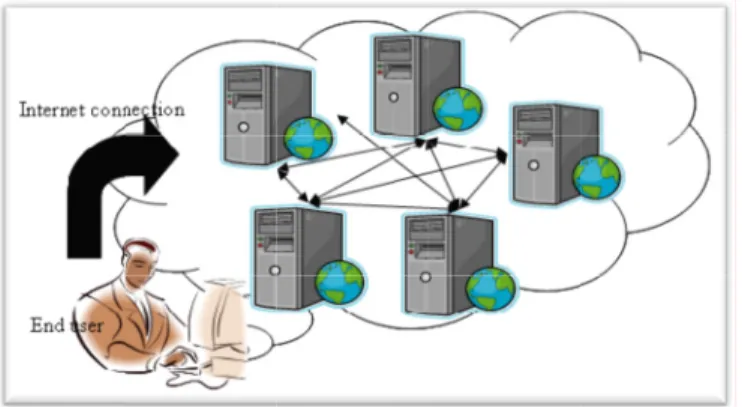
Figure 1 In figure connect or custo anywher consider server. B based on The be [Saugatu • S c a m o • L b e p • L i S b e • C o w a • I o S S e • R r r o
1. Cloud Com
e 1, we see t tion to use c omer can a re and anyti r about th Because clo n the needs
enefits of uck Technol
Short impl computing e as a servic minimal tim of a button Low entry based prici entirely line planned Low risk of interest of t SaaS offer benefit fro extended fu Customizati offer a wide well adapte and medium Integration, offers web Service-orie SaaS solutio existing soft Reduced d resources, c reduce the organization
mputing Co
that user jus cloud compu access their ime. They d he spesifica oud comput
of custome
the clou logy, 2008], i ementation especially a ce) can be me, often ju
costs, due ing approa ear to usag
f obsolescen the provider rings up-to om new unctionality e
ion, usually e range of d the requi m enterprises
if the S b service ented Archit ons can be i tware enviro demand f cloud servi requiremen n of an
oncept Map
t need inter uting. The u sources fro do not have
ation of ting will ad er. ud comput include : cycles, clo SaaS (softw employed st with a cl
to the usa ch, costs ge and can
nce, it is in r to keep th o-date. Us releases w easily cloud servi configuratio irements sm s SaaS provi –APIs a tectures (So integrated in onments for own
ices drastica nt on the
enterprise net user om e to the dapt ting oud ware in lick age-are be the heir sers with ices ons mall der and oA), nto IT ally IT in Cl org res op [V 20 20 20 foc ch op ma cap pro Th co Wa terms base • Focus small from related • Collab service enterp anytim interne especi and/o oud compu ganizations; sources and pportunities Vouk, 2008; B
009; Schub 010; Chang 010;Chang,
cus of clo hange from c perational ex any SMEs p pital expen oposed to ch
here are thr mputing pro alters, 2011] • Infrast divided Resou provid resour
of required
on the core and medium the reductio d overhead boration an
es offer ins prise applic me and from
et access i ally benef or distributed
uting provid ; saving c d staff-as w for servic Briscoe, Ma ert, Jeffere g, Bacigalu Wills, De oud compu capital expen xpenditure (
perceive tha nditure). Cl
hange that p
ree kind of opose [Chan
:
tructure as d into Com rce Clouds de users acce
rces such as
d personnel
e business, e m enterprise on of “tedi
nd mobility stant access cation envi m anywher s available. ficial for d workforce
des added v osts in op well as new
ce-oriented arinos, 2009; ey, Neideck upo, Wills,
Roure, 201 ting is in nditure (CA (OPEX). No
at IT resou loud comp problem.
services th ng, De Rou
a Service mpute Clou s. Compute
ess to comp s CPUs, hyp
and skill
especially e benefit ious” IT
execution according to user requests (e.g. access rate).
• Software as a Service (SaaS), referred to as Service or Application Clouds, offer implementations of specific business functions and business process that are provided with cloud capabilities. Therefore, they provide applications and/or services using a cloud infrastructure or platform, rather than providing cloud feature themselves.
Cloud computing also have some characterization. Necessity, reliability, usability, and scalability are the characters of cloud computing. Necessty related to utility to satisfy everyday needs of the users. Reliability related to expectation about the utility when the user requiree it. Usability related to the convenient and easy to use, despite cloud computing is quite complex architecture. Scalability related to capacity that fit with the needs of users and can be expand according to the needs of the customer.
2.2.System Dynamic
The fundamental idea of System Dynamics is that socioeconomic and business systems can be regarded as continous feedback control systems that have self-regulating properties by virtue of the technological and accounting relationships between system variables and the policies that are used to manage system [Sharp, 1977]. System dynamic is used to change or modify the structure of a problem. It is different with statistical approach. Statistical approach just focus to adapt the
• Defining problems dynamically, in
terms of graphs overtime
• Striving for an endogenous,
behavioral view of the significant dynamics of a system, a focus inward on the characteristics of a system that themselves generate or exacerbate the perceived problem
• Thinking of all concepts in the real system as continous quantities interconnected in loops of information feedback and circular causality
• Identifying independent stocks or
accumulations (levels) in the system and their inflows and outflows (rates)
• Formulating a behavioral model
capable of reproducing, by itself, the dynamic problem of concern. The model is usually a computer simulation model expressed in nonlinear equations, but is occasionally left unquantified as a diagram capturing the stock-and-flow/causal feedback structure of the system
• Deriving understanding and
applicable policy insights from resulting model.
• Implementing changes resulting from model-based understandings and insights
3. Model Building
3.1. Scope of the model
Figure
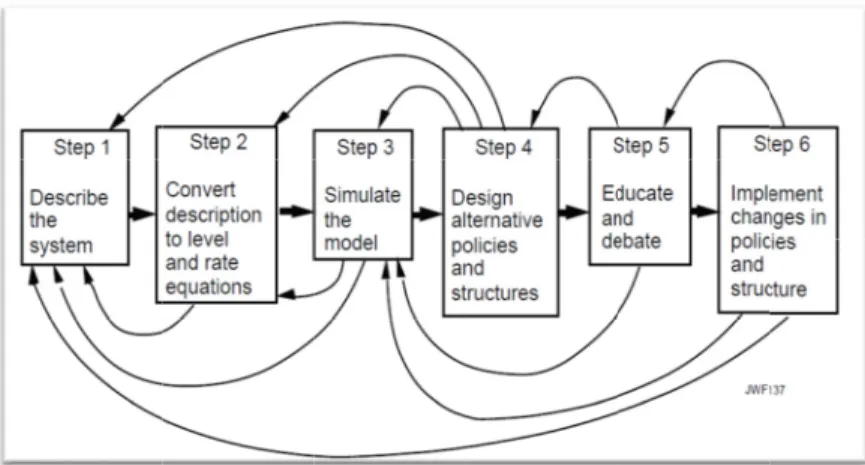
In step business capital i informa informa amount analyzed capital o is affect Because the level we defin some as variable. that has analyzed step 4,
Figure 3
2. System D
1, we desc s on SMEs.
is influence ation techno ation techno
of server d how the of SMEs. Th ted by level e the functio l of materia ned the leve ssumptions t . In step 3 s been buil d the structu
we design
3. Causal Lo
Dynamic Ste
ribed the sy We focus o ed by imple
ology infras ology that w r that SME
amount of he amount o
of inventor on of server al for produc el in each v to define th 3, we simula
lt. After sim ure of the m
alternative p
op Diagram
eps From Pr
ystem of fl on how SM ementation structure. T we observed Es need. W f server aff
of server its ry of mater r is to moni ction. In ste variable. We
e level of ea ate the mo mluated it, model. And policies in
m for Own IT
roblem Sym
low MEs of The d is We fect self rial. itor p2, do ach odel we d in the
mo ne an co the po foc ad cap exp
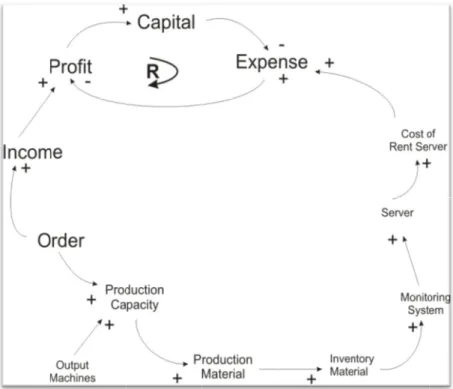
3.2 In tha exp tha hav
T Infrastruc
ptomps to I
odel. We m ew model a nalyzed the b mpared it w en in step olicies. As w cus on capit vantages of pital exp penditure.
2. Causal Loo this paper, at explain plained the at build the ave to buy se
cture
Improvemen
modified som and simulate behavioral o
with the pr p 6, we im we stated ear
tal and expe f cloud com penditure
ops/ Causal R we built 2 c of each c causal loop eir own IT erver by them
nt [Forrester
me variable ed it.In ste of new struc revious mod mplement t rlier, that th ense. Becaus puting is ch to op
Relationship causal loop d condition. F p diagram o
infrastructu mselves.
r, 1994]
es in the ep 5, we cture and
del. And the new his model
e one of hange the perational
Figure 4
Because change expendi affect th need co manpow cost. An is the decrease example so the a But wh data so decrease provider amount
4. Causal Lo
e the basic IT infras ture (OPEX he expense ost of ma wer because nother advan amount of e depend e, if monitor
amount of en the mon o the amo ed. SMEs ju r to decrea of server.
op Diagram
of cloud structure a X), the cost of SMEs. aintenance
all costs in ntage of clo f server ca on SME ring system
server will nitoring jus ount of se
ust have to ase the spe
m of Cloud C
computing as operatio of server o SMEs do n
and cost ncluded in r
oud comput an inrease s need. F needs big d l be increas t needs a f erver will ask the clo esification a
Computing
g is onal only not of rent ting or For data sed. few be oud and
3.. In bu of is the the exp inf ma Fig if
Th inc an dif im clo exp
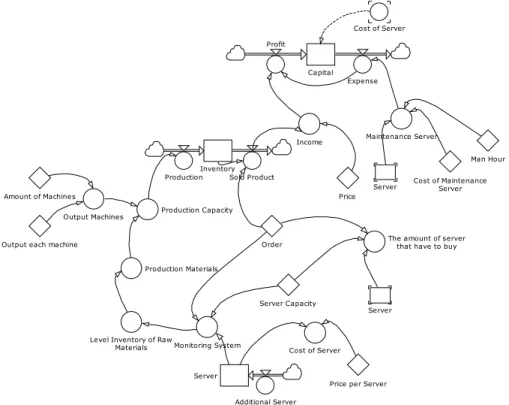
3 SFD/ Ma SFD sectio uild SFD. W f SMEs. The fix. And the e value of o e effect to pense als frastructure. aintenance, gure 5 descr
SMEs build
he amount crease. It wi nd increase
fferent mplementatio
oud comput pense of SM
ain Formulatio on, we do We set that s e price of th e amount of order manua the capital so just . So the ex manpower o ribe the stoc d their own I
of server i ill affect the
the expen with cl on. We can ting affect MEs.
on
some limita sales is only he product o f order is fix ally in order l and expen
affected xpense just
of IT infras ck and flow IT infrastruc
n figure 5 e amount o se of SME loud co
see in figur the capital
ations to y income of SMEs x. We set
to know nse. The
by IT cost of structure.
diagram cture.
is fix or of capital
Es. It is omputing
Capital Profit
Expense
Income
Price
Order Inventory
Production Sold Product
Production Capacity
Output each machine Amount of Machines
Production Materials
Level Inventory of Raw
Materials Monitoring System
Server Capacity
Cost of Server
Price per Server Output Machines
Server
The amount of server that have to buy
Server
Additional Server
Maintenance Server
Cost of Maintenance Server Server
Cost of Server
Man Hour
Capital Profit
Expense
Income
Price
Order Inventory Production Sold Product
Production Capacity
Output each machine Amount of Machines
Production Materials
Level Inventory of Raw
Materials Monitoring System
Server Capacity Output Machines
Server
The amount of server that have to buy
Server
Additional Server
Cost of Server
The Price Rent Server per month Server
The amount of server that have to
buy Reduction of Server
Figure 5. Stock and Flow Diagram for Own IT Infrastructure
Capital is our parameter to differentiate between owning IT infrastructure and implementation of cloud computing for SMEs.
The equation will be :
Capital = Profit – Expense, where Profit = income * price
Expense (maintenance server) = cost of maintenance server * man hour * amount of servers
Jan Feb Mar Apr Mei Jun Jul Agust Sep Okt Nop Des Rp60.000.000
Rp70.000.000 Rp80.000.000 Rp90.000.000
Ca
p
it
a
l
Jan Feb Mar Apr Mei Jun JulAgustSep OktNopDes (Rp3.000.000)
(Rp2.000.000) (Rp1.000.000) Rp0 Rp1.000.000 Rp2.000.000 Rp3.000.000 m o^-1
Profit (m o^-1) Expense (m o^-1) Incom e (m o^-1)
Jan Feb Mar Apr Mei Jun Jul Agust Sep Okt Nop Des
(Rp50.000.000) Rp0 Rp50.000.000
Ca
p
it
a
l
(Rp4.000.000) (Rp2.000.000) Rp0 Rp2.000.000 Rp4.000.000 Rp6.000.000 m o^-1
Profit (m o^-1) Expense (m o^-1) Income (m o^-1)
will impact to the cost of IT infrastructure (server). The cost of maintenance server and manpower of IT in figure 5 is fix and could be increased. In figure 6 the cost could be increased and decreased depend on the amount of server. It wil save the expense of SMEs.
4. Experiments
b. Scenario 2, the amount of order is higher than server capacity 2. Condition 2 (SMEs implement cloud
computing)
a. Scenatio 3, the amount of order is lower than server capacity
b. Scenario 4, the amount of order is higher than server capacity
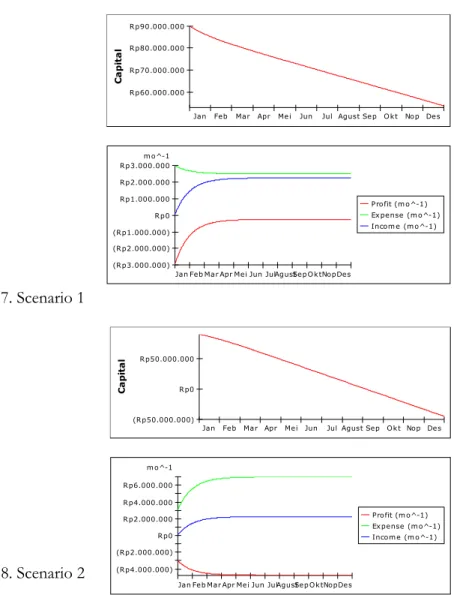
Figure 7. Scenario 1
Jan Feb Mar Apr Mei Jun Jul Agust Sep Okt Nop Des Rp100.000.000
Rp105.000.000 Rp110.000.000 Rp115.000.000 Rp120.000.000
Ca
p
it
a
l
Jan Feb Mar Apr Mei Jun Jul AgustSep O kt Nop Des Rp0
Rp500.000 Rp1.000.000 Rp1.500.000 Rp2.000.000 m o^-1
Incom e Expense Profit
Jan Feb Mar Apr Me i Jun Jul Agust Se p O kt Nop De s
R p93.000.000 R p96.000.000 R p99.000.000
Ca
p
it
a
l
Jan Fe b Ma r Apr Mei Jun Jul AgustSep O k t Nop Des R p0
R p500.000 R p1.000.000 R p1.500.000 R p2.000.000 m o^-1
Incom e Expense Profit
Figure 9. Scenario 3
Figure 10. Scenario 4
In scenario 1 and 2 the modal will increase because the amount of cost by server (maintenance, manpower, and server) is fix. It is different with scenario 3 and 4.
5. Conclusions
From the experiment, we can conclude that : 1. Information technology is very useful
for SMEs to increase their income and
make their business effective and efficient.
2. Cloud computing is one of promising alternative IT solution for SMEs and is useful to be implemented
al., 2010 a).
Chang, V, Wills, G, and De Roure D .(2010). A Review of Cloud Business Models and Sustainability. IEEE Cloud, the third International Conference on Cloud
Computing, 5-10 July, Miami, Florida,
USA (Chang, Wills and De Roure, 2010 b).
Chang, V, De Roure D, Wills G, Walters R J. (2011). Case Studies and Organizational Sustainability Modelling Presented by Cloud Computing Business Framework. International Journal of Web Servies Research, 8 (3). Haynie, M. (2009). Enterprise cloud services:
Deriving business value from Cloud
Computing. Micro Focus, Tech. Rep.
Kourik, J.L. (2011). For Small and Medium Size Enterprises (SME) Deliberating Cloud Computing: A Proposed Approach”. ECC’11 Proceedings of The 5th European Conference on European Computing Conference, 216-221. 2011. L. M. Vaquero,L. Rodero-Merino,J. Caceres,
and M. Lindner. (2009). A break in the clouds: towards a cloud definition,”
ACM SIGCOMM Computer
Communication Review, 39(1): 50-55,
January.
Lusch, R. F., and S. L. Vargo. (2006). Conceptual Foundations for a Science of
Service. Presentation for the Conference
on the Art and Science of Services, May 24, Madrid, Spain.
Marinos, A, G . Biscoe . (2009). Community Cloud Computing. First International
Conference on Cloud Computing, 1-4
December, Beijing, China.
Kementrian Koperasi dan Usaha Kecil dan
Anand Kumar, Madhvendra Misra, and Vijayshri Tiwari. (2010). Scope of Cloud Computing for SMEs in India”. Journal of Computing, 2, May 2010.
Sharp, J .(1977). System Dynamics Applications to Industrial and Other Systems”, Opl. Res Q., Pergamon Press, 28 (3-i): 489 to 504, Great Britain. Schubert L, Jeffery K and Neidecker-Lutz B .
(2010). The Future for Cloud Computing: Opportunities for European
Cloud Computing Beyond 2010. Expert
Group report, public version 1.0, January.
V. Graeser, L. Willcocks, and N. Pisanias .(1998). Developing the IT Scorecard: A Study of Evaluation Practice and Integrated
Performance Measurement, Business
Intelligence, London.
Vargo, L. S .(2009). Alternative Logics for Service
Science and Service Systems. Service
Systems Workshop University of Cambridge, March 20.
Vouk M A .(2008). Cloud Computing – Issues, Research and Implementations. Journal of Computing and Information
Technology-CIT 16 (4): 235–246.
Forrester J. W. (1994). System Dynamics, Systems Thinking, and Soft OR. System Dynamic Review, 10 (2).
Weinhardt, C., Anandasivam, D. I. W. A., Blau, B., Borissov, D. I. N., Meinl, D. M. T., Michalk, D. I. W. W., and Stößer, J. (2009). Cloud computing–a classification, business models, and
research directions. Business &