In
Abstra innovat have be house R which f know-hKeywo
1. In
Innova used b global innova it’s mo concep propert on sha Leinter and Te effectiv among accumu platfor *Corresp B.S. San correspo Point, Lu
DOI: http
Print ISS Copyrigh School of The
ndustry Su
SM
act. The presen tion culture in een introduced R&D to SMEs. further facilita ow by these ins
rds: Industry S
ntroduction
ation has bee by global org markets. In t ation has chan ore open and c pts around tig
ty are giving aring intellect r, 2011). It is echnology ins ve distributio g different ulation in rm for excha ponding author: ngha is a Ph.D S onding address i
udhiana-141 010
p://dx.doi.org/10.1
SN: 1978-6956; O
ht@2013. Publishe f Business and Ma
e Asian Journal
upport Ins
ME’s of P
B.S.
13
T
2
Sym
nt paper attemp manufacturing d by the Institu
Knowledge a ate the process stitutes have b
Support Institu
en a major ganizations fo
the 21st centu nged; it’s hap
collaborative ghtly controll g way to a m
tual capital ( s a known fac stitutions play on of innova sectors and such institu ange of idea
Scholar with Sc is General Man 0. India. Email: b
12695/ajtm.2013.6
Online ISSN: 2089 ed by Unit Researc anagement-Institut
l of Technology
stitutions F
unjab, Ind
Sangha1*, T.
Thapar Univers mbiosis Internat
pts to investiga g sector of Punj utions. These h ccumulations s of open innov
rought creativi
utions, Open In
strategic too or dominatin ury, the face o
ppening faster . The outdate ed intellectua more emphasi (Bontis, 2001 ct that Scienc y a key role i ation product d knowledg utes offer as, facilitatin
hool of Behavio nager, Institute f
balwinder_sangh
6.1.3 -791X. ch and Knowledge t Teknologi Bandu
y Management
Fostering
dia: A Str
P. Singh2 and
sity, Patiala. Pu tional Universi
ate the role of njab in India. S highly interac in the institute vation. The sp ity and innovat
novation, Sma ol ng of r, d al is 1; ce n ts ge a ng open states SMEs peopl indus SME qualit propo institu tool region discu and substa strate
oral Sciences & for Autoparts an [email protected]
e ung.
t Vol. 6 No. 1
Innovatio
rategic Per
d Ajay Batish
unjab, India. ity, Pune, India
f six Industry S Some path brea tive, self-relian es also offer a peedy and effic tiveness among
all and Medium
innovation. P s of India ha s employing le. (DI&C, stry support in
’s to become ty and pric osition that se utions may b for fostering n. This pro ussed first in
later illustra antiate the ra egic perspectiv
Business Studi nd Hand Tools
(2013): 37-48
ons Cultur
rspective
h3 a. Support Institu aking technolo nt institutes arplatform for e cient dissemina
g SMEs of the
m Enterprises.
Punjab is one aving presen g approxim Pb; 2009). nstitutions in e competitive ce. This pa etting up of i be recognized
g innovation ospective is
the backgrou ations are s ationale behin
ve.
es, Thapar Univ Technology, A
re among
utions in foster ogical innovatio
re the virtual exchange of ide ation of techni
region.
e of the northe nce of 1,62,0
ately 9,44,0 There are Punjab helpi e by improvi aper makes industry supp
d as a strateg n culture in
analyzed a und of literatu
summarized nd the propos
versity, Patiala. A-9, Phase-V, Fo
The Asian Journal of Technology Management Vol 6. No.1 (2013):37-48
2. Background Literature
The concept of Industrial District or cluster has been mooted by a number of researchers who observed the productivity raising benefits to small industrial units positioned in an Industrial network or cluster (Sforzi, 1990; Pyke et al 1990, 1992; Brass et al 2004). According to Porter (1998), clusters are geographic concentrations of interconnected companies or institutions in a particular field. There is now enormous evidence on the contributions of universities, public research organizations, the military, other public actors and financial organizations (such as venture capital) in the generation and diffusion of technological advance in industries. Their roles, however, have been shown to be quite different in different industries (Levin et al. 1987; Cohen et al. 2002).
SMEs provide a strong base for innovation in manufacturing sectors. Empirical studies have shown that SMEs contributed to the main innovations of the twentieth century (Rothwell and Zegveld, 1982; Oakey, et al., 1988; Rothwell, 1994). Small firms usually have good internal communications and many have a dynamic and entrepreneurial management style (Rothwell, 1994). The average capability of technical people is higher in small firms and that innovations in these firms can be less expensive. SMEs absorb technologies and improve their productivity more effectively and efficiently (Cooper, 1964; Vossen, 1998). Incremental innovations involve “improving and exploiting an existing technological trajectory,” whereas radical innovations “disrupt an existing technological trajectory.” Gatignon, et. al. (2004). Similarly, Abernathy and Clark (1985) noted that incremental innovations “build on and reinforce the applicability of existing knowledge,” while radical innovations “destroy the value of an existing knowledge base”.
The phenomenon by which large firms discover, develop and commercialize technologies internally is identified as closed
innovation model (Chesbrough, 2003). On the other hand open innovation is defined as ‘the use of purposive inflows and outflows of knowledge to accelerate internal innovation, and to expand the markets for external use of innovation, respectively.’ (Chesbrough et al., 2006, p.1). It thus comprises both outside-in and inside-out movements of technologies and ideas, also referred to as ‘technology acquisition’ and ‘technology exploitation’ (Lichtenthaler, 2008). Companies can no longer keep their own innovations secret unto themselves; the key to success is creating, in effect, an open platform around your innovations so your customers, your employees and even your competitors can build upon it, because only by that building will create an ongoing, evolving community of users, doers and creators." (Rothenberg, 2003).
External networking is an important aspect associated with open innovation (Chesbrough et al., 2006) and includes all activities required to acquire and maintain connections with external sources of individuals and organizations. Networks in the shape of formal or informal allow firms to fill in specific knowledge needs quickly without any major investments. The crux of open innovation is in the background that organizations cannot conduct all R&D activities in-house, but have to depend on external knowledge sources which can be licensed or bought (Gassmann, 2006).
3. The Study
Sangha, Singh and Batish, Industry support Institutions Fostering Innovations Culture among SME’s of Punjab, India: A Strategic Perspective
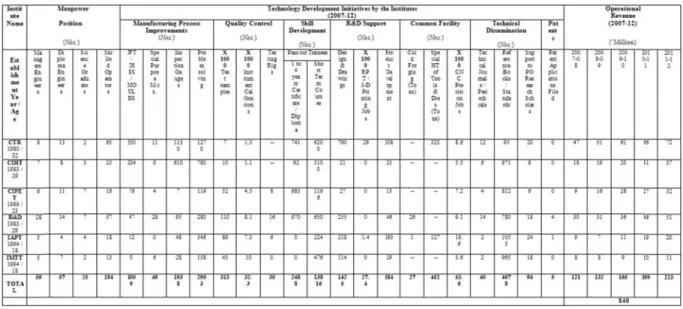
targeted to know period of operational existence of an individual institution. The column of ‘Manpower’ was designed to know levels and education of staff deployed in these institutions. The column of ‘Technology Development Initiative’ was designed to collect information about technical intensive services being rendered by institutions under sub-headings of ‘Manufacturing Process improvements’, ‘Quality Control’, ‘Skill Development’, ‘R&D Support’, ‘Common Facility’, ‘Technical Dissemination’ and ‘Patents’ filed.
To know the operational sustainability of individual institution, their revenue earning during period 2007-2012 was aimed for recording under the column of ‘Operational Revenue. The questionnaire was designed to study six industry support institutions operating in the state of Punjab, India. The data was collected on a pre-tested and well-structured questionnaire using interview method. The interviews were held with General Managers / Senior Managers of the Institutes. The main source of primary data provided by the institutions during the interview was based on records available in their accounting, finance, administration, consultancy, and marketing departments. The illustrations of six industry support institutions covered under the study are as follow.
4. Illustrations of Industry Support Institutions
4.1. Research and Development Center, Ludhiana.
The Research & Development Center, (R&D Center), Ludhiana was set up in year. This center has well equipped Design and Testing labs, Precision Tool Room, CNC Machining and HRD Training Sections and has a cliental pool of about 2400 SMEs. This centre has introduced about 72 nos. of testing equipment, 28 nos. of Special Purpose Production Machines, 47 nos. of Cold Forging Forming Tools, handled about 1,10,000 test samples, undertaken 56 Technical Assistance Turn-Key
Projects aiming low cost automation and energy efficient technologies.
There has been huge material saving by introduction of Cold forging technology in manufacturing of various bicycle parts. The path breaking manufacturing technique of cold tube swaging and tube butting has eliminated cumbersome process of sheet cutting and welding to make bicycle frame and forks earning millions of carbon credits to the state. This centre has also filed 04 patents under Design Act, 2000 with controller general of patent design and trade mark India the Registrar, Govt. of India.
The accumulated knowledge has also raised absorption capacity of this Center and networking with user industry led to formation of a well knitted cohesive community of creators, doers and operators around the Centre; where incremental improvements and process innovations are a routine.
4.2. Institute for Autoparts & Hand Tools Technology, Ludhiana.
The Asian Journal of Technology Management Vol 6. No.1 (2013):37-48
depend for development and treatment of tools, dies and moulds to long destinations in south or western India. Rapid Prototype is State of the Art equipment for speedy “Reverse Engineering” applications.
This institute is a co-inventor for the filed Patent title “Cryogenic treatment of brass wire for improved machining characteristics”; which has been published (U/S 11A; year 2011) by controller general of patent design and trade mark India.
4.3. Institute for Machine Tools Technology, Batala.
Institute for Machine Tools Technology (IMTT) is one of the two UNIDO assisted Projects set up by the Punjab Government in year 1994 in a small township of Batala. A comprehensive skill up-gradation programme was taken up to impart training in scientifically advanced technical areas to local youth and entrepreneurs. Institute also impart trainings for TQM system and solve technical problems of small foundries and extends its facilities for testing of sand, moulds, tensile strength and metallographic evaluation of castings. The institute facilitated improvement in quality, energy efficiency and reduction of input costs for the machine tools builders. This institute also developed six special purpose machines for single / double head boring operations and regularly takes up alignment and leveling of machine tools beds using electronic leveler. This small industrial town of Batala has a strong technical infrastructure support of the institute which is as good as having a dedicated in house R&Ds in an enterprise perusing innovations.
4.4. Central Tool Room, Ludhiana.
Central Tool Room (CTR), was established by Govt. of India at Ludhiana in year 1980. The core competency of CTR is skill training, making precise press tools, injection moulds, jig, fixtures and dies for regional SMEs. It is an institution par excellence in providing solutions for design, development,
manufacturing, skill development and project consultancy. The Central Tool Room has established its brand image as one of the top skill certification institute in Northern India and is running a four years diploma course in the tool & die making. The pass out students of CTR is always in demand and is readily absorbed in regional SMEs. This tool room was instrumental in dissemination of heat treatment technology is also a pioneer in introducing RPT 3-D printing since year 2000. Central Tool Room is the leader among all industry support institutions operating in the state of Punjab. All the services provided by CTR have played important role in enhancing creativity and innovativeness among young engineers and entrepreneurs of the region.
4.5. Central Institute for Plastics and Engineering Technology (CIPET), Amritsar.
Sangha
quality innova
4.6. J
Centra establi role in SME’s fabrica entrepr innova
The m manag institut
a, Singh and Bat
y systems ations.
Central Ins Jalandhar.
l Institute for shed in year
technical and s. Their st ation of forgi reneurs starte ation activiti
manpower ind ers, engineer tion. Put toge
tish, Industry sup
leading to
stitute for
r Hand Tools 1983 and is p d economic d
trength is ing Dies and ed undertakin ies targeted Table 1. Pe
dicates the d rs and scien ther; there are
pport Institution
incrementa
Hand Tools
s (CIHT), wa playing a vita evelopment o design an d Moulds. Th ng incrementa d at qualit
erformance of In
deployment o ntists in eac e 59 manager
ns Fostering Inno
al
s,
as al of nd he al ty
impro produ institu
5. R
The suppo show indica indivi institu succe ndustry Support
of h rs
/ eng gradu for S the de
ovations Culture
ovement, w uctivity impro
ute.
Result and D
performance ort institution wn in Table-1. ates the op idual institute utions are ser essfully for
Institutions of P
ineers, 57 dip uates and 194 SMEs of Punj
etails of the m
e among SME’s St
waste mini ovement with
Discussion
e of all the ns during the l
. The age sho perational ex e since incept rving SMEs
more than Punjab
ploma engine 4 technical op njab. Figure-1 manpower.
of Punjab, India trategic Perspec
mization a h support of th
e six indus last five years own in this tab
xistence of tion. All the of Punjab St two decad
eers, 25 scien erators worki 1 below depi
a: A tive
and his
stry s is ble an six ate des.
The Asia
The sh asset profess respon and k institut assistin improv problem
The re quality have g 16949 These by thr calibra
an Journal of Te
hown manpo as a team sionals with
sible for a co knowledge tions. The te ng SME’s fo vement, pro m solving.
egion has w y culture as a
gone for IS and quality institutions h rough 3,13,0 ations and sup
echnology Manag
ower forms of highly multiple set ontinuous cap accumulatio eam is quite or bringing a oduct devel
Combined t
witnessed a s a large numb SO-9000, TQ y systems in have assisted 000 test sam pplying 30 te
gement Vol 6. N
an invaluabl experience t of skills i pacity buildin n in thes e effective i about proces lopment an together, thi
sea change i ber of SME’ QM, ISO TC n recent pas
entrepreneur mples, 32,30 est rigs in las
No.1 (2013):37-4
le d is ng se n ss nd is
manp 1009 mach last fi result autom amon manu show
n ’s C t. rs 0 st
05 ye have small institu testin indivi contro
48
power has so JFT / Dies / hines and 193 five years. Ma ted in bri mation’ and ng SMEs. Th ufacturing p wn in the Figur
ears. The qua also brough l innovation utions are jus ng facility of
idual instituti ol programm
olved 2953 p Moulds; 49 38 inspection any process in
inging abou higher prod he contributio
process imp re-2.
ality improve ht along wit ns. The te st like an ext SME’s. The ions in streng e is shown in
problems, ma special purpo n gauges duri
nnovations ha ut ‘low c ductivity lev on in supporti provements
ement initiativ th a culture sting lab. tended in-hou performance gthening qual n Figure-3.
ade ose ing ave ost vels ing is
Sangha
The tr skillful learnin vision resourc turnov sparing activiti institut engine machin run by skill or
The ru institut in a s knowle
a, Singh and Bat
raining not o l but also ig ng. In the 2
revolves ce. Irrespect
er, organizati g time & mo ies. In this tes have chu ers having e nery. The m y all these ins
riented one. T
unning of c tes is a mode speedy and e
edge. The co
tish, Industry sup
only makes gnites an att 21st century around qu tive of the ions are now oney for Trai changed sc urned out 2 exposure to most effective stitutes are s Training mod
common faci el in itself as effective diss ommon facili
pport Institution
an individua titude toward organizationa uality huma
eir size an quite open i ining & HRD cenario; thes 2488 diplom latest plant e programme hort term an dules are eve
ility in thes it has resulte semination o ity covers th
ns Fostering Inno
al ds al an nd n D se ma / es nd n
tailor worki years been Precis TQM Maki Treat Figur grada traine last fi
se d of he
area and C small and I
ovations Culture
r made with ing hours of s, a total num trained in sion CNC Ma M, Quality
ing, Testing tment and Ma re-4 below sh ation program ees trained by
ive years.
of special h CNC precisio l batch produ IAHT are eff
e among SME’s St
h flexible ti f SMEs. Duri mber of 1381 the fields o achines, Plast Control, To Calibration, aintenance. hows the num
mmes and t y individual
heat treatmen on machining uction lots. Th fectively runn
of Punjab, India trategic Perspec
imings to s ng the last fi 6 trainees ha of CAD/CA tic Engineerin ools and D
, Special H
mber of skill u the number institutes in t
nt, cold forgi g jobs done he R&D Cen ning the facil
a: A tive
suit five ave AM, ng, Dies eat
up-of the
The Asia
of cold Similar CIHT, handlin Machin
The R& is inva infrastr The re scanne SMEs. confide develo
The ro of tech to thei technic is a sto
an Journal of Te
d forging and rly, the IMTT
Jalandhar, R ng a numb ning lots. In
&D Support aluable when
ructure and d everse engine er, CAD/CAM
These fac ent to ha pments per
ole of these in hnical knowle
r Library ref cal journals h ock of 4678 r
echnology Manag
d heat treatme T, Batala, CIE R&D Centre a ber of CN total they hav
given by the viewed from deployment o eering tools o M and RPT a cilities have andle comp
requiremen
nstitutions in edge by provid ference standa has been very
reference boo
gement Vol 6. N
ent processing EPT, Amritsar and IAHT ar NC Precisio ve undertake
ese institution m the angle o of manpower of white ligh are a boon fo made them plex produc nts of globa
disseminatio ding an acces ard books an y useful. Ther oks / standard
No.1 (2013):37-4
g. r, re n n
about forge tons indivi is sho
ns of r. ht or m ct al
marke creati Durin provi and c SMEs the in
n ss nd re ds
and 4 are m techn with t
48
t 53,600 prec ed 27 tons of
of alloys ste idual institut own in Figure
ets. These ivity and inn ng the last fiv ided 1425 des carried out 58 s. The facts nstitutes to SM
40 technical j made availabl nical dissem
the institution
cision machi f steel and H eels. The sup tes through c e-5.
initiatives novativeness ve years, these
signs, 27400 84 product de
about the R ME’s are show
journals / pe le to SME’s ination facil ns is depicted
ning jobs, co Heat treated 4
pport given common facil
have fuel among SME e institutes ha
RPT 3-D prin evelopments
&D support wn in
Figure-eriodicals whi . The status lities availab d in Figure-7.
old 452 by lity
led Es. ave nts for by -6.
Sangha
The S visit lib knowle problem These 94 PG to rese The f institut
a, Singh and Bat
MEs and re braries of the edge and ms or peruse institutions h
research sch arch work on filing of pat
tes is an ind
tish, Industry sup
esearch schol ese institutes t for referenc e academic r
ave given a v holars by offe n latest techno tents by so dicator that
pport Institution
lar frequentl to update thei ce to solv esearch work vital support t ering guidanc ologies. ome of thes
patent drive
ns Fostering Inno
ly ir ve k. to ce
se n
resear has f Autop filed perfo gener financ Figur
ovations Culture
rch work is b filed four pa parts and H
one patent du rmance of ration of ope
cial year 20 re-8.
e among SME’s St
being done. T atents and th
and Tools T uring the last all these erational reve 008 to 2012
of Punjab, India trategic Perspec
he R&D Cen he Institute Technology h
five years. T institutes enues from t 2 is shown
a: A tive
The Asia The O Figure The up revenu finding for m relevan and c genera Name of Institute CTR CIHT CIPET R&D IAPT IMTT ** Signi * Signifi The fa deman shorter externa with d market opportu strong
an Journal of Te
verall growth -9.
pward trend in ue by all the
g. The sustain more than tw nce to the SM cumulative g tion of institu
e F.Y. 07-08
F. 08 47 5 18 1
9 1
30 3
9 7
8
ificant at 1% Lev ficant at 5% Leve
ast changing d ‘high mix l r life cycles al resources a deadlines of t. This offer
unities for th R&D set up
echnology Manag
h and trends
n generation e institutes is nability of the wo decades MEs. The tren growth rates utions are sho
Table-2. Tren Operation Rev .Y. -09 F.Y. 09-10 51 61 19 2 16 28 31 36 7 11
8 9
vel. el.
technologica low volume’ . The entrep and networkin bringing new r distinct ch e entrepreneu with deploy
gement Vol 6. N
in generation
of operationa s a promisin ese institution reflects thei nd coefficient s in revenu own in Table ds in Revenue o
venue During the (` Million
F.Y. 10-11
F.
11-66 7
31 3
27 3
46 5
19 2
10 1
l environmen products wit preneurs nee ng to catch-u w products i hallenges an urs requiring yment of mult
No.1 (2013):37-4
n of operation
al ng ns ir ts ue e-2. All signif increa 11.07 and regist
of Different Indu
e Financial Year n)
Y. -12
Average
72 59.40 37 25.00 32 22.40 51 38.80 20 13.20 1 9.20
nt th d up n nd a ti skill m met b Punja house stay Intern devel helpe 48
nal revenue o
l the six instit ficantly. It is ase in the C 7 (p<0.01) in the remain tering a signif
ustry Support Ins
rs (F.Y.)
e C.V. C
17.44 1 34.06 2 42.66 3 24.00 1 44.95 2 14.17
manpower. T by these indu ab as these a e R&D for SM
competitive national M lopment initia ed to promote
of the institu
tutions are gr s also found Compound G case of Cent ning instituti ficant growth
stitutions.
t-valu
C.G.R.
11.75 11.07* 21.30 4.27* 35.80 3.47* 15.67 6.97 * 29.64 2.96
8.98 7.00 *
This requirem ustry support are the virtua ME’s. It has h in both Markets. Th atives by the e creativity a
utes is shown
rowing overtim that there is Growth Rate tral Tool Roo ions are a h (p<0.05%).
ue Trend Coeffici
a
** 39.90 * 10.00 * 5.30 ** 21.70
* 3.00 ** 6.80
Sangha, Singh and Batish, Industry support Institutions Fostering Innovations Culture among SME’s of Punjab, India: A Strategic Perspective
among regional entrepreneurs. These industry support institutions also offer a platform for exchange of ideas among entrepreneurs. The accumulated acknowledge of these institutes is also facilitating the process of open innovation. The study reveals that Government has been very active for timely and vital support to these institutes. The mandate for both Central and State Governments institutes is to run on self-sufficient basis has worked very well and has proved strategically a right decision.
This has helped in ensuring utilization of Public funds spent on new facilities and a sustainable growth in operational revenue of these institutes. These highly interactive, self-reliant institutes are found to be the virtual In-house R&D for SMEs. The technical professionals of these institutes are imparting skill upgradation training and also act as a source to fuel creativity and innovation among young entrepreneurs, engineers and research scholars. In view of the excellent role played by six industry support institutions of Punjab; this strategy can be adopted for fostering technological innovations in other parts of the country. There is a big challenge to improve interaction between industry and educational institutes in India. A study can further be undertaken to explore the role of such industry support institutions in bridging the gaps between Industry and Academia. There is also an opportunity to develop a support mechanism to convert such Institutions into ‘Business Incubators’ for grooming of first generation entrepreneurs in the country.
References
Acs, Z., and Audretsch, D. B., (1987). Innovation, Market Structure, and Firm Size.
Review of Economic and Statistics 69 (4): 567-574.
Bontis N., (2001). Assessing Knowledge Assets: A Review of The Models Used to Measure Intellectual Capital. International Journal of Management Reviews 3 (1): 41-60.
Brass, D., Galaskiewicz, J., Greve, H. and Tsai, W. (2004). Taking Stock of Networks and Organizations: A Multilevel Perspective.
Academy of Management Journal 47(6): 795– 817.
Chesbrough, H., (2003). Open Innovation: The New Imperative for Creating and Profiting from Technology. Harvard Business School Press, Boston, MA.
Chesbrough, H., Crowther, A.K., (2006). Beyond High Tech: Early Adopters of Open Innovation in Other Industries. R&D Management 36 (3): 229–236.
Chesbrough, H., Vanhaverbeke, W., West, J., (2006). Open Innovation: Researching a New Paradigm. Oxford University Press, London. Cohen, W.M., Nelson, R.R. and Walsh, J. (2002). Links and Impacts: The Influence of Public Research on Industrial R&D.
Management Science 48 (1): 1-23.
Cooper, A.C., (1964). R&D is more efficient in small companies?. Harvard Business Review 42 (3): 75-83.
D.i.and c, Pb., (2009). Website of Director of Industries & Commerce (Punjab).
Chandigarh, India.
Gassmann, O., (2006). ‘Opening up the innovation process: towards an agenda’. R&D Management 36 (3): 223–228.
Kharbanda, V.P., (2001). Facilitating Innovation in Indian Small and Medium Enterprises – The Role of Clusters’, Current Science 80 (3): 343-8.
Leitner, K-H., (2011). The effect of intellectual capital on product innovativeness in SMEs. Int. J. Technology Management 53 (1): 1–18.
The Asian Journal of Technology Management Vol 6. No.1 (2013):37-48
Development. Brookings Pap Econ Act 3: 783–820.
Lichtenthaler, U., (2008). Open Innovation in Practice: An Analysis of Strategic Approaches to Technology Transactions. IEEE Transactions on Engineering Management 55 (1):148–157.
Msme, Goi. Report (2012). Website of Development Commissioner, Ministry of Micro, Small, Medium Enterprises, Government of India, New Delhi, India.
Oakey, R., Rothwell, R. and Cooper, S., (1988). The Management of Innovation in High Technology Small Firms’: Innovation and Regional Development in Britain and the United States. Quorum Books, Westport, CT. Porter, M.E., (1998). Clusters and the New Economics of Cooperation. Harvard Business Review (November–December): 77–90.
Pyke, F.; Becattini, and G. Y. Sengenberger, W. (1990). Industrial districts and inter-firm cooperation in Italy. Génova, ILLS.
Rothenberg R., (2003). Open Innovation Editor. Strategy + Business Published by Booz Allen Hamilton.
Rothwell, R. and Zegveld, W., (1982).
Innovation and the Small and Medium-sized Firm. Kluwer Nijhoff Publishing, Boston, MA.
Sforzi, F., (1990). The Quantitative Importance of Marshallian Industrial Districts in the Italian Economy; en Pyke, F.; Becattini, G. Y. Sengenberger, W., eds.: Industrial Districts and Inter-firm Cooperation in Italy. Génova, IILO; 75-107.
Vossen, R.W., (1998). Relative Strengths and Weaknesses of Small Firms in Innovation.