Differential Evolution to Optimize
Hidden Markov Models Training:
Application to Facial Expression
Recognition
Khadoudja Ghanem, Amer Draa, Elvis Vyumvuhore and
Ars`ene Simbabawe
MISC Laboratory, Constantine 2 University, Constantine, Algeria
The base system in this paper uses Hidden Markov Models(HMMs)to model dynamic relationships among facial features in facial behavior interpretation and un-derstanding field. The input of HMMs is a new set of derived features from geometrical distances obtained from detected and automatically tracked facial points. Numerical data representation which is in the form of multi-time series is transformed to a symbolic repre-sentation in order to reduce dimensionality, extract the most pertinent information and give a meaningful repre-sentation to humans. The main problem of the use of HMMs is that the training is generally trapped in local minima, so we used the Differential Evolution (DE) algorithm to offer more diversity and so limit as much as possible the occurrence of stagnation. For this reason, this paper proposes to enhance HMM learning abilities by the use of DE as an optimization tool, instead of the classical Baum and Welch algorithm. Obtained results are compared against the traditional learning approach and significant improvements have been obtained.
Keywords: facial expressions, occurrence order, Hidden Markov Model, Baum-Welch, optimization, differential evolution
1. Introduction
Analyzing the dynamics of facial features and (or)the changes in the appearance of facial fea-tures(eyes, eyebrows and mouth)is a very im-portant step in facial expression understanding and interpretation. Many researchers attempt to study the dynamic facial behavior. Timing, du-ration, speed and occurrence order of face/body actions are crucial parameters related to dy-namic behavior(Ekman, & Rosenberg, 2005).
For instance, facial expression temporal dynam-ics are essential for recognition of either full ex-pressions (Kotsia & Pitas, 2007; Littlewort & al, 2006), or components of expressions such as facial Action Units(AUs) (Pantic & Patras, 2006; Valstar & Pantic, 2007). They are essen-tial for categorization of complex psychologi-cal states like various types of pain and mood (Williams, 2002)and are highly important cues for distinguishing posed from spontaneous fa-cial expressions(Cohn & Schmidt, 2004; Val-star & al, 2006). Timing, duration and speed have been analyzed in several studies(Cohn & Schmidt, 2004; Valstar & al, 2006; Valstar & al 2007). However, little attention has been given to occurrence order(Valstar & al, 2006; Valstar & al 2007).
Several efforts have been recently reported on automatic analysis of facial expression data (Zeng & al, 2009; Sandbach & al, 2012; Gunes & al, 2011). We note from all cited methods that most recent methods employ probabilistic (Hidden Markov Models, Dynamic Bayesian Network), statistical(Support Vector Machine), and ensemble learning techniques ( Gentle--Boost), which seem to be particularly suitable for automatic facial expression recognition from face image sequences. Because we want to ex-plicitly study the dynamic behavior, both the HMM(Koelstra & al, 2010; Cohen & al, 2003) and DBN(Tong & al, 2007; Tong & al, 2010) can be used.
Emotional System”, optimal in terms of speed, precise, full, and its performances reaching the 100%. The aim of this part is to reach the 100% of the facial expressions recognition rate. This paper is an extended version of the work described in(Ghanem(1), 2013), where the au-thors propose to explicitly analyze facial mo-tion in terms of the order of occurrence of fa-cial features by modeling semantic dependen-cies among facial features. For example, Joy expression configuration is as follows: Eyes are slightly closed and mouth is opened, its corners are pulled backward to ears. The fact is that it is not known in which order these facial defor-mations occur when displaying this expression. This is why we aim to discover temporal rules to give a new temporal description of each facial expression.
The evaluated method was Hidden Markov Mod-els (HMM)and four facial expressions which are Joy, Disgust, Anger and Sadness were stud-ied.
In the proposed approach, characteristic facial points were localized on the first frame, then, they were automatically tracked for the rest of the sequence. Five facial distances were calcu-lated for each frame from each video leading to a multivariate facial time series. These time series were cleaned from noise, segmented and annotated to get sequence observations. These sequences were used as input to the HMM to allow it to learn the best structure of each facial expression studied.
The main contributions of this paper are sum-marized as follows:
− As HMM learning is generally trapped in a local optimal solution, we evaluate the use of the Differential Evolution(DE) optimiza-tion algorithm, in order to get a global opti-mal solution in the learning step of HMMs, instead of the classical Baum and Welch al-gorithm.
− To improve DE performances, we evaluate three(03)DE variants-based mutation crite-rion.
The remainder of this paper is structured as fol-lows. We present a brief review of related work in the next section. Section 3 discusses the use of HMM in modeling occurrence order of facial dynamics. In Section 4, we investigate the pro-posed DE-based training of the HMM, we also evaluate different Schemes of DE. Experimental
results and discussions are presented in Section 5. Finally, Section 6 concludes the paper.
2. Related Work
Performance of classification methods is very dependent on the characteristic features used as input to classifiers, or, to local classifiers pa-rameters. Many researchers in facial expression analysis were interested in enhancing classifi-cation performance by using statistic methods such as the Adaboost algorithm (Littlewort & al, 2006; Bartlett a al, 2005)and the Principal Component Analysis(PCA) (Lajevardi & Hus-sain, 2009; Dubuisson & al, 2002)to select the most pertinent features to be used to classify expressions.
To optimize local classifiers parameters, a very few researchers were interested in using meta-heuristics. The authors in(Ye & al, 2008) pro-pose a best-step operator (to refine the prey behavior) with the artificial fish-swarm algo-rithm(AFSA)for RBF neural network training. They applied the proposed algorithm to solve the problem of expression recognition. Their reported results demonstrate that the BAFSA has better global astringency and stability. That research indicates that the new algorithm has some advantages in terms of convergence per-formance and recognition rate, compared with BP and RBF neural network training. In( Mpipe-ris & al, 2008)anatomical correspondence be-tween faces is first established using a generic 3D face model which is deformed elastically to match the facial surfaces. Surface points are then used as a basis for classification according to a set of classification rules, which are discov-ered by the ant colony algorithm and particle swarm optimization ACO/PSO-based rule dis-covery algorithm. The performance of that al-gorithm has been evaluated on the BU-3DFEDB facial expression database, where a total recog-nition rate of 92.3% has been achieved, but the expressions ‘angry’ and ‘sad’ are not com-pletely discriminated.
preci-sion rate of 93.96% for emotion recognition of six basic emotions from RaFD dataset.
To optimize feature selection for input classi-fiers, the authors in(Bhanu & al, 2004)propose a genetic programming-based technique, which learns to discover composite operators and fea-tures that evolve from combinations of primitive image processing operations. In the mentioned approach, the output of the learned composite operator is a feature vector that is used for fa-cial expression recognition. The experimental results show that the proposed approach can find good composite operators to effectively extract useful features. Obtained results are about 72% with genetic programming and 63,3% without genetic programming on the Japanese Dataset. In (Yu & Bhanu; 2006), a learning method can discover the features automatically in a genetic programming-based approach that uses Gabor wavelet representation for primitive fea-tures and linear/nonlinear operators to synthe-size new features. These new features are used to train a support vector machine classifier which is itself used for recognizing facial ex-pressions. The obtained results are reported to be about 80,95% on the Japanese Dataset with a feature vector dimension equal to 35. In( Laje-vardi & Hussain, 2009), a wrapper approach to feature selection from image sequences applied to the facial expression classification problem is introduced. The pre-processing phase au-tomatically scans image sequences and detects frames with maximum intensity of facial ex-pression. The features are generated using the log-Gabor filters. A global optimization genetic algorithm(GA)is adopted to select a sub-set of features based on minimization of the classi-fication error. The wrapper approach is com-pared with two previously known filter-based feature selection methods: MID-mRMR and MIQ-mRMR. The features are classified using the naive Bayesian(NB)classifier. The average classification rates are: 79% (MIQ-mRMR), 78%(wrapper)and 64%(MID-mRMR)on CK dataset. The results from the filter methods did not appear to be significantly affected by the size of the feature subset.
In (Ruihu & Bin, 2011), to build a surveil-lance system, facial expression and body ges-ture feages-tures are extracted. Particle Swarm Op-timization algorithm is used to select feature subset and parameters optimization. The se-lected features are trained or tested for the cas-caded Support Vector Machine to obtain a
high-accuracy classifier. The high-accuracy of anxiety recognition is found to be about 91,46% with PSO/SVM, about 85,54% with PCA-SVM and about 83,27% with PCA-RBF on real video se-quence captured by cameras control.
In(Anisha & al, 2011), a lip-contour model was developed to represent the boundary of the lip, and the parameters of the model were adapted using an artificial bee colony(ABC)algorithm to match it with the boundary contour of the lip. An SVM classifier was then employed to classify the emotion of the subject from the pa-rameter set of the subject’s lip-contour. The experiment was performed on 50 subjects, and the average case accuracy in emotion classifica-tion was found to be 86%.
In (Amir & MdJan, 2012), a hybrid model which combines a special genetic algorithm called Queen Bee Algorithm (QBA) with a fuzzy rule-based system is used to make better performance and parameter optimization to im-prove the accuracy of facial expression recogni-tion. Therefore, the QBA as a training technique sets the fuzzy membership functions under the adverse conditions.
3. The HMM for Modeling Occurrence Order of Facial Temporal Dynamics
A specific contribution in the field of facial ex-pression analysis is to introduce the occurrence order of facial feature deformations in the de-scription of each facial expression. The aim is to study this parameter by using Hidden Markov Models as a dynamic descriptor tool as well as a classifier. The main three steps of a classifi-cation process are as follows:
3.1. Facial Features Extraction
Figure 1.Characteristic distances.
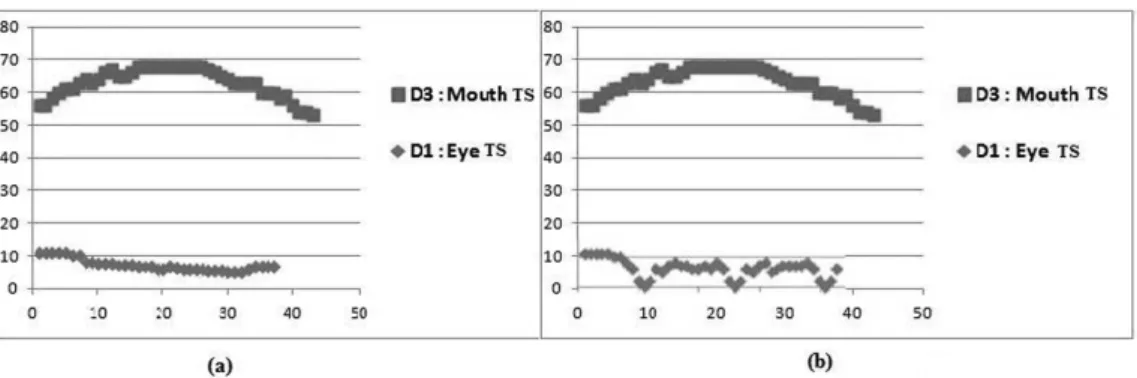
interested in the first frames, where a facial dis-tance transits from the neutral state to the onset one, the errors were negligible. After tracking, each frame of the video data is represented as a vector of the 18 facial points’ 2Dcoordinates. For each frame, geometric features D1−D5 (Figure 1)are calculated on the basis of the po-sitions of facial points. Therefore, each frame of the captured video was represented as a 5-dimensional vector, so each video segment containing n frames is represented as a 5Xn-dimensional vector. This leads to multivariate (5)time series.
Eye blinking is a natural reaction; it occurs each 300 to 400 milliseconds. Generally, the eyelid automatically closes 10 to 30 times per minute. The adjusted seasonality for time series associ-ated to eyelids movement reflects real eyelids movement without blinking. The Moving Av-erages(Makridakis & al, 1998), one of the first mathematical methods developed for seasonal factor estimates, is used to adjust seasonality of D1 time series.
Another problem with the obtained time series concerns mouth time series which can be dis-turbed by speaking. Blinking and speaking are
usually manipulators and can disturb time se-ries values. The solution to this problem is not discussed in this paper. However, to test the proposed method we have chosen to remove manually the speech sections from the studied sequences.
Interesting information is not directly accessi-ble from the raw data. So, a common prereq-uisite task is changing data representation, for both information extraction and dimensionality reduction.
3.2. Data Representation
What characterizes a temporal nature is the ex-istence of an order(temporal)in the data. This criterion would greatly benefit our analysis of facial expression dynamics. Indeed, in order to have a meaningful representation, we pro-posed to build symbolic representations of time series by incorporating “the occurrence order parameter”. The new constructed information elements which are in a higher level are more comprehensible for humans.
Each video is characterized by 5-Time series and each time series counts more than 200 (time) samples (each value is for a particular frame of the video). To reduce time series di-mensionality, time series segmentation is per-formed. Time series segmentation can be seen as the task of detecting transition points. Transi-tion points correspond to the frames where the distance increases or decreases with regard to the first frame.
Many time series segmentation methods have been developed in the literature(Arlot, Celisse, 2010; Gu’edon, 2008; Lavielle, 2009). Most of these methods are based on dynamic program-ming; they aim at reducing the number of the obtained segments. However, in our context, we were only interested in the detection of the first and second segments(just to know if the time series increases or decreases). For this purpose, the first transition point from each time series is detected. A transition point which corresponds to the start of a given emotion indicates the tran-sition from neutral state to an onset one.
To detect transition points, a very simple al-gorithm based on a mobile means was used (Ghanem, 2013). A label determining whether the time series increases or decreases is assigned to each time series and the rank of these points is saved.
After segmentation, all time series associated with each video are sorted to detect the or-der of the changed time series, according to the saved ranks. It leads to a set of 2X5 features to describe each video. (2=the la-bel assigned to each time series and its rank, 5=facial distance time series). Then, the an-notation process takes place; each time series (distance) has two discrete states which repre-sent the “decrease/increase” states of the dis-tance. If distances from D1 to D5 decrease, the values 1,2,3,4,5 are associated to each distance consecutively, and, if the distances from D1 to D5 increase, the values 6,7,8,9,10 are associ-ated to each distance consecutively. The num-ber of observations is 10(1..5:D1..D5 decrease; 6..10:D1..D5 increase) . These new features represent all possible observations which can be emitted from each HMM state.
3.3. Classification Using HMM
In order to classify a studied facial expression, we choose to explore the HMM classifier.
3.3.1. Formal Definition of an HMM
Formally, an HMM is characterized by the fol-lowing:
N: the number of hidden states in the model M: the number of distinct observation symbols A: The state transition probability distribution B: The observation symbol probability
distri-bution
: The initial state distribution
Given appropriate values of N, M, A, B and, the HMM can be used as a generator to give an observation sequence: O=O1O2. . ..OT.
The compact notation: =(A,B,) is used to indicate the complete parameter set of the model.
3.3.2. HMM Structure
A Hidden Markov Model HMM is a stochas-tic process for sequential data. Its performance depends heavily on the availability of an ade-quate amount of representative training data to estimate its parameters, and in some cases its topology.
In our work, we are interested in video se-quences which begin by a neutral state. From each state the possible observations correspond to any of the 5 changed distances (which can increase or decrease). As we only consider the beginning of each facial expression and not the entire expression, we aim at investigating the order of changed facial distances when the state changes from neutral state to the onset one. We have chosen to study the three first changed distances for each facial expression. These dis-tances form the basis for three possible states of the hidden variables.
raiser)is activated in an average of 0.4 second after the activation of AU12 (Schmidt, Cohn, 2001). This means that if the expression in-tensity is low, the number of activated units is less than when the intensity is high(HMMs are well suited when the used examples are of dif-ferent length). Consequently, the type of our constructed HMM must have a Left-to-Right topology; the three states are sequentially con-nected such that the model is only allowed to stay in its current state or change to the next state.
The parameters used in the proposed HMM can be summarized as follows: The number of states is 3 (N=3, consequently the dimen-sions of A are A(3,3)) (neutral, first changed distance, second changed distance), the num-ber of observations is 10(M=10, consequently, the dimensions of Bare B(3,10)), (1..5:D1..D5 decrease; 6..10:D1..D5 increase), and the initial state probabilities are set to 1 for the neutral state and 0 for the others. Besides, initial transition probabilities are generated randomly.
To study the four facial expressions which are Joy, Sadness, Anger and Disgust, we associate one HMM to each facial expression.
HMM profiles are usually trained with a set of sequences that are known to belong to a single category. Consequently, this set of sequences is often redundant in the sense that many se-quences would have the same values taken by the different features describing the category in question. Due to the variability among indi-viduals, many facial expressions(e.g. Disgust or Anger) can be displayed in different ways. So, many sets of sequences can be associated to each category.
In order to reduce the run-time of HMM train-ing, while providing accurate discovery and dis-crimination of different category behaviors, an unsupervised clustering process was performed (Ghanem(2), 2013). To preserve training data from any information loss, we have associated a weight factor to each cluster. This weight fac-tor is the frequency of observing instances with similar behavior(characteristics).
In many studies, clusters with small weight are considered as noisy instances, so they are re-moved. In this work, each cluster describes a specific behavior associated to the considered
category, it cannot be considered as noisy se-quences. In this case, only a human expert can remove these clusters to improve classification accuracy.
When clustering sequences, both Euclidean dis-tance and Dynamic Time warping(DTW)were used. Euclidean distance has been used be-cause it is not time consuming. However, it cannot be used when produced sequences are not of the same length. In this case, we used DTW because it offers better accuracy than Eu-clidean distance in such situation, since it pro-duces meaningful clusters. As a result, each cluster of each category represents a specific configuration(description)of the studied cate-gory(facial expression)leading to a set of dif-ferent descriptions which can be formulated in the form of temporal rules to describe each fa-cial expression.
Finally, we can deduce the following HMM parameters: N=3 states, M=10 observations, “A” dimensions are A(3,3), “B” dimensions are B(3,10)anddimensions are(3,1).
3.3.3. Classification
After the representation process, each video is represented by a simple sequence of three val-ues instead of 5D time series. As instance “8 51” is a new constructed sequence which repre-sents Joy expression. According to this config-uration, three distances have changed, they are ordered from the first changed distance to the third one. The first changed distance is D3 and it increases(8), the second changed distance is D5 and it decreases (5) and the third changed distance is D1 and it decreases (1). All these new sequences are presented to each HMM as inputs to classify.
4. HMM Learning With Differential Evolution (DE)
In order to improve HMM classification rates, we explore in this paper the use of an opti-mization method to train HMMs instead of the classical Baum and Welch algorithm.
4.1. Problem Formulation
Training HMMs is a crucial problem for most applications using them since it is supposed to allow optimal adaptation of the model param-eters to the observed training data, in order to create best models for real phenomena. The fact is that in literature there is no optimal way of estimating the model parameters. An iterative procedure called Baum and Welch method(or, equivalently, Expectation Maximization(EM)) is widely used to estimate HMM parameters, but learning is generally trapped in local opti-mal solutions. Instead of using the Baum and Welch approach that suffers from stagnation, we use in this paper a DE approach to train the system for setting the A, B andparameters.
4.2. Representation of Solution
In this type of algorithms, a solution is repre-sented by an “Individual”, and the population is the whole set of individuals. To choose the better individual between two individuals, an objective function, calledfitness, is computed. Each individual represents an instance of the HMM parameters which are A: the transition matrix andBthe observation matrix. The initial matrixis not optimized here because we sup-pose that each expression starts from the neu-tral state, so the initial probabilities are always (1,0,0). A constraint which is the sum of each row of each vector is equal to “1” and is associ-ated to both vectorsAandB,
4.3. Differential Evolution
Differential Evolution is an evolutionary algo-rithm introduced by Price and Storn (Storn, Price, 1997), it is designed for global optimiza-tion problems over continuous domains. It fol-lows the general procedure of an evolutionary
algorithm: an initial population of individuals is created by random selection and evaluated; then the algorithm enters a loop of generating off-spring, evaluating offoff-spring, and selecting so-lutions to create the next generation, till a stop condition is met. Generating offspring consists of two operations: differential mutation and dif-ferential crossover.
The mutation operation creates a new individual
vicalled themutantby adding the weighted dif-ference between two individuals(vectors) cho-sen randomly from the population to a third one, also chosen randomly, as shown in equa-tion (1) below. In the equation, i, i1, i2 and
i3 ∈ {1, . . . ,NP} are mutually different
in-dices, NP is the size of the population, andF
is a real positive scaling factor of the difference
di=xi2−xi3.
vi=xi1+F∗(xi2−xi3) (1)
The crossover operator implements a discrete recombination of the mutant,vi, and the parent vector,xi, to produce the offspringui. This op-erator is formulated as shown in equation (2) below, where: Uj(0,1)is a random number in the interval [0,1], CR ∈ [0,1]is the crossover rate, andk∈ {1,2, . . . ,d}is a random parame-ter index, chosen once for each individuali to make sure that at least one parameter is always selected from the mutant. The most popular values forCRare in the range[0.4,1].
ui(j) =
vi(j), if Uj(0,1)≤CR or j=k, xi(j) otherwise
(2) After applying differential crossover, the ob-tained individual, called trial vector, is com-pared to the parent individual, also calledtarget vector. A greedy selection takes place at this point, i.e. the fittest of them will become the target vector.
In the case of our work, the mutation and cros-sover operators are applied on matrices instead of vectors, but the principle of each remains the same. Indeed, the mutant individual is defined as:
Mutant individual={A mutant,B mutant}
A mutant=A1+F∗(A2−A3)
B mutant=B1+F∗(B2−B3)
In equation(3), A1, A2, A3 are randomly
cho-sen individuals reprecho-senting potential state tran-sition probability distribution matrices, and B1,
B2, B3 are randomly chosen observation
sym-bol probability distribution matrices which rep-resent candidate solutions.
The trial individual is obtained after the appli-cation of a crossover operator on the mutant individual and the parent (target)individual, it is defined as:
Trial individual={A trial, B trial}where:
A trial(i,:) =
A mutant(i,:), if rand<CR A target(i,:), otherwise
(4)
B trial(i,:) =
B mutant(i,:), if rand<CR B target(i,:), otherwise
(5) Finally the selection operator is defined as the individual which has the best fitness when com-paring between target and trial individuals. In our work, the objective function(fitness) rep-resents the maximum likelihood and is defined
as:
F =MAX[P(O|)] (6)
O is an observed sequence, and represents all numeric parameters defining a considered HMM( =(A,B,)).
4.4. The Proposed Hybrid EM-DE Algorithm
In this work, we propose a new sequential hy-brid EM-DE learning algorithm where DE ini-tial individuals are locally optimized with the classical EM Algorithm. This hybrid can be formulated as in Algorithm 1 below.
In Algorithm 1, target is the current individual of the population to be evolved and the trial individual is that generated after mutation and crossover operations to be a candidate substitute of the target one using a greedy selection. When speaking about the algorithm complex-ity, we have to note that the complexity of DE is linear, when associated to Baum & Welch al-gorithm, we get the same complexity of BW, it means O(2m2n)where m is the number of states and n is the number of observations.
Algorithm 1: hybrid EM-DE learning algorithm. G=1//Initialize number of iterations;
1- Choose the DE parameters:NP,FandCR; 2- PopG<-Initialize population randomly;
3- PopG=EM(PopG)//estimate the HMM parameters with Baum and Welch
algorithm;
4- While(G<Number of iterations)do For every individual:
a. Choose auxiliary parents:Xr1,G;Xr2,G;Xr3,G;
b. Create mutant individualsmuti,Gusing mutation
operator(Equation3);
c. Add a new individual called trial by applying differential crossover operator to mutant individualmuti,G(Equations 4,5);
d. greedy selection between trial and target individuals(Equation 6); End for
4.5. Different Variants of DE
In this work we evaluate other variants of DE. Each scheme concerns the mutation operator. The different evaluated schemes are:
a- DE/best/1: The perturbed parent is the cur-rent best member added with a weighted dif-ference vector:
Mutant individual={A mutant,B mutant}
A mutant=Abest+F∗(A2−A3)
B mutant=Bbest+F∗(B2−B3)
(7) b- DE/current-to-best/1: The perturbed parent is the target member added with a weighted difference vector:
Mutant individual={A mutant,B mutant}
⎧ ⎪ ⎨ ⎪ ⎩
A mutant=A1+F∗(Abest−A1)
+F∗(A2−A3)
B mutant=B1+F∗(Bbest−B1)
+F∗(B2−B3)
(8) c- DE/self-mutation: The perturbed parent is a random member added with a weighted difference vector, but with only two parents where the mutant individual participates in the difference vector:
Mutant individual={A mutant,B mutant}
A mutant=A1+F∗(A2−A1)
B mutant=B1+F∗(B2−B1)
(9)
5. Experimental Results and Discussion
In order to evaluate performances of the pro-posed method, we conducted a series of exper-iments following different scenarios on three universal Datasets.
5.1. Facial Expression Datasets
To validate our approach, we conducted our ex-periments using the Cohn-Kanade(2000), MMI (2005) and Semaine (2012) databases. The Cohn-Kanade database consists of 100 univer-sity students aged between 18 and 30, of whom 65% are females, 15% are African-American and 3% are Asian or Latino.
For our experiments, we used 231 image se-quences from the database. The sese-quences come from 96 subjects, with 1−4 posed ex-pressions per subject(Joy, Anger, Sadness and Disgust). The MMI posed database is a re-source for Action unit(AU)and basic emotion recognition from face video. It consists of five parts; each part is recorded in a different con-dition. The second set of the recorded data is posed displays of the six basic facial expres-sions: Joy, Sadness, Anger, Disgust, Fear and Surprise. In total, 238 videos of 28 subjects are recorded. All expressions are recorded twice. For our experiments, we have used 100 image sequences from the database. Each video con-tains more than 100 frames. In our experiments we are interested in all frames displaying the expressions from the neutral state, the begin-ning of the expression (onset) until the apex. We have used 20 frames from each video, so about 2000 images. The two datasets contain recordings of subjects displaying posed facial expressions in frontal or near-frontal head poses and under controlled lighting conditions. The Semaine spontaneous dataset contains dis-plays of spontaneous expressions recorded in a natural environment. For our experiments, we have used 80 image sequences. The sequences come from 10 subjects. After removing the speech sections from each image sequence, we extract at least three sub-sequences from each image sequence leading to more than 240 image sequences. Most of these sequences display joy expression(smile displaying).
5.2. Our Experiments
in the training step and one third of the two datasets in the test step.
All our experiments are Subject-Independent. The obtained results are presented in Table 1 below.
Many important conclusions were drawn from Table 1 and are discussed in detail in(Ghanem, 2013). The most important one is that HMM are well suited in situations where it is important to model occurrence order of facial features de-formations, and many description rules can be extracted from Transition and Observation (A, B)Matrices learned by EM algorithm. We have shown that it is possible to describe the dynamic of a produced facial expression using one, two or three temporal rules. Also, it has been shown that only ‘first order’(one rule)is not sufficient to recognize expressions because many facial expressions can start in the same way when speaking about the order of facial features de-formations. This is why the second and third orders(when present)are considered to recog-nize facial expressions. This is exactly what was concluded in(Ghanem, Caplier, 2011).
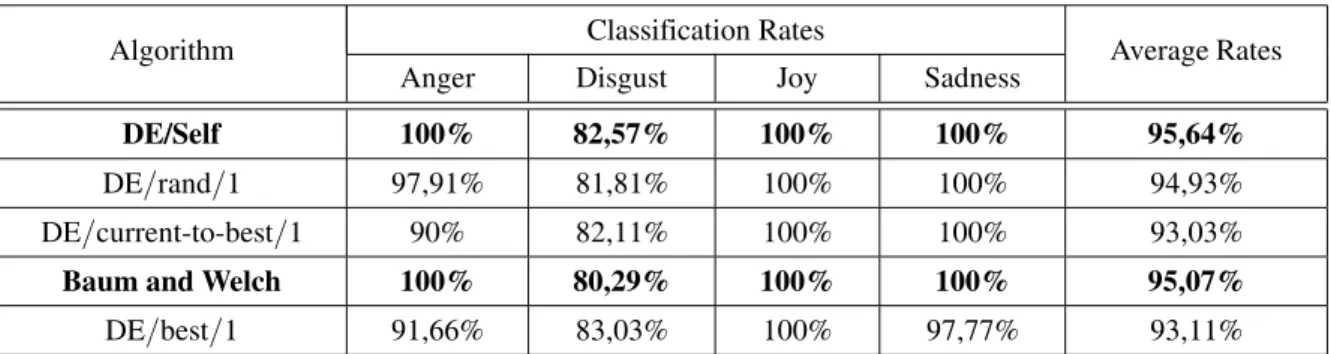
In the second step, we aimed at evaluating the performance of the proposed approach after the optimization using different DE schemes. In order to fix DE parameters (F, CR, NP), we have studied the influence of these parameters on the classification rates. We have found that the value of CR has no significant influence on the process in the contrast to F, where we noted that the variation of this parameter has signif-icant influence on the results. As a result, we have found that the best values for these pa-rameters are NP=20, F=0.4, CR=0.6 and the number of iterations It=1000. The obtained re-sults are given as the mean of 30 runs for each scheme and are summarized in Tables 2 and 3. It is possible to draw many conclusions from Ta-bles 2 and 3 with both MMI and CK databases after optimization. HMM training with the DE algorithm (DE/rand/1) gives better rates than training with Baum and Welch (EM) al-gorithm for all studied expressions. The differ-ent schemes of DE algorithm give better rates too, except with DE/best/1 scheme(with MMI database). The scheme DE/best/1 is the worst one for both databases, it gives the lowest rates
Training Dataset Test Dataset Joy Anger Sadness Disgust Average Rates
CK CK 100% 100% 100% 81,81% 95.45%
CK MMI 76.47% 47.06% 30.43% 58.62% 53.15%
CK SEMAINE 91.89% 33.33% 90% 100% 78.81%
MMI MMI 100% 80% 81.82% 70.59% 83.10%
MMI CK 100% 56.58% 92.59% 91.35% 85.13%
MMI SEMAINE 94.60% 75% 80% 100% 87.4%
CK+MMI SEMAINE 94.60% 91.67% 100% 100% 96.57%
Table 1.Cross database testing.
Algorithm Classification Rates Average Rates
Anger Disgust Joy Sadness
DE/Self 100% 82,57% 100% 100% 95,64%
DE/rand/1 97,91% 81,81% 100% 100% 94,93%
DE/current-to-best/1 90% 82,11% 100% 100% 93,03% Baum and Welch 100% 80,29% 100% 100% 95,07% DE/best/1 91,66% 83,03% 100% 97,77% 93,11%
Algorithm Classification Rates Average Rates Anger Disgust Joy Sadness
DE/Self 100% 75,29% 100% 90,29% 91,40% DE/rand/1 100% 72,15% 100% 86,96% 89,78% DE/current-to-best/1 100% 70,98% 99,33% 88,48% 89,69% Baum and Welch 95,55% 71,36% 100% 86,05% 88%
DE/best/1 97,77% 68,23% 98% 85,14% 87,29%
Table 3.Classification rates of the different DE schemes+EM for MMI database.
when compared to EM and the other variants of DE. The scheme DE/Self is the algorithm which gives the best model structure, i. e. the highest rates for all studied expressions.
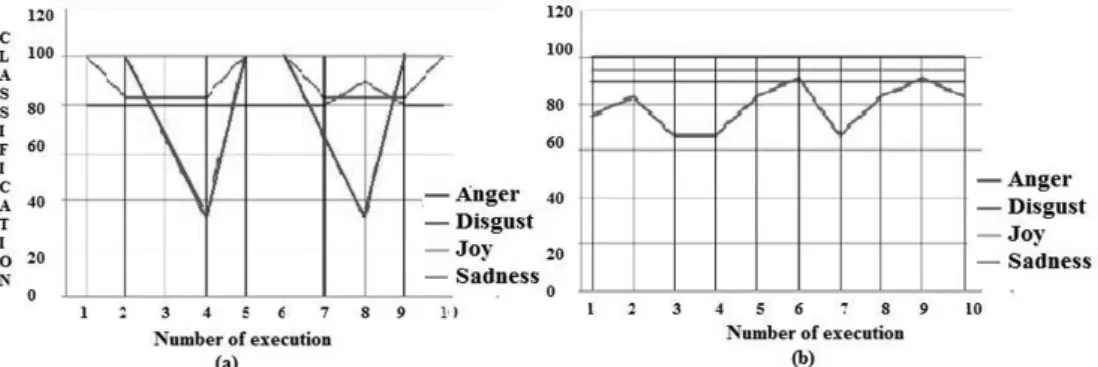
For all DE schemes, in addition to the Basic HMM (EM), Disgust is the most difficult ex-pression to recognize, it has the lowest rates. This can be explained by the fact that there are several configurations of displaying this facial expression which leads to a confusion with other facial expressions(e.g Anger or Sadness). In the last experiment, in the second step, we tested the Semaine database. As seen in Fig-ure 3, there is a stability of the obtained re-sults for the classification of each facial expres-sion across different runs when HMM training is done by the ‘DE/self’ scheme (Figure 3.b) in contrast to the case where the HMM training is done by the EM algorithm(Figure 3.a). A comparison of the recognition rates achieved for each facial expression with the state of the art(Fanelli & al, 2010; Khan & al, 2012; Zhao, Pietik ¨ Ainen, 2007; Shan & al, 2009; Aleksi, Katsaggelos, 2005; Yeasin & al, 2004; Kotsia
& al, 2008), is not really possible. The fact is that the lack of a standardized training and testing database do not allow us to compare any proposed method with others (in term of our results being higher or lower than others). Besides rules and protocols on how to use im-ages or videos in training and testing, a certified benchmark that contains images and video se-quences(at different resolutions)of people dis-playing expressions under different conditions (lighting, occlusions, head rotations, etc)is re-quired. Moreover, each method in the literature has its own constraints, it proposes a full auto-matic system or a semi autoauto-matic system, also it can study three, four, five, six or seven classes. Indeed, when training on a higher number of classes, obtained accuracy rates in testing step, are reduced.
However, our goal in this work is to prove the effectiveness of optimization methods to im-prove classification process. According to this context, and when considering obtained results before and after optimization, we can see that obtained results after optimization are very in-teresting.
6. Conclusion and Future Work
In this paper, a new HMM approach based on differential evolution for facial expression recognition has been proposed. It consists of improving the performance of basic HMM through applying the DE algorithm for its train-ing. The proposed approach has been validated by using it for two datasets, namely: Cohn & Kanade and the MMI datasets with different configurations. Four basic expressions were considered: anger, disgust, joy and sadness. Different mutation strategies for the proposed DE-based HMM were compared against each other and against the state-of-the-art Baum and Welch training algorithm. The obtained results proved superiority of the proposed DE-HMM hybrid, where we found that, on the whole, the DE/Self training algorithm gave 95,64% as an average success rate, then comes the Baum and Welch training algorithm with a success rate of 95,07% for the Cohn & Kanade database. For the MMI database, more superiority of the DE/Self was observed; it gave a success rate of 91,40% compared to the Baum and Welch algorithm with a rate of 88%.
As our future work, we plan to train and test the model on spontaneous datasets to deduce new temporal rules, in order to distinguish between posed and spontaneous expressions. Also, a comparison between the DE and other meta-heuristics for HMM training would be a good path of research.
References
[1] S. P. ALEKSIC, K. A. KATSAGGELOS, Automatic
Fa-cial Expression Recognition Using FaFa-cial Anima-tion Parameters And Multi-Stream Hmms. IEEE Trans. Signal Processing, Supplement on Secure Media, 2005.
[2] J. AMIR, N. MDJAN, A Modified Genetic Model
Based on the Queen Bee Algorithm for Facial Ex-pression Classification. Journal of Computational and Theoretical Nanoscience,9(8), pp. 1109–1114, 2012.
[3] H. ANISHA, R. PRATYUSHA, C. ARUNA, Emotion
Recognition from the Lip-contour of a Subject Us-ing Artificial Bee Colony Optimization Algorithm. 2nd Swarm, Evolutionary and Memetic Computing Conference, Part I,7076, pp. 610–617, 2011.
[4] S. ARLOT, A. CELISSE, Segmentation of the Mean of
Heteroscedastic Data via Cross-Validation. Statis-tics and Computing, pp. 1–20, 2010.
[5] M. BARTLETT, G. LITTLEWORT, M. FRANK, C. LAIN
-SCSEK, I. FASEL, J. MOVELLAN, Recognizing Facial
Expression: Machine Learning and Application to Spontaneous Behavior, Computer Vision and Pattern Recognition.IEEE Computer Society Con-ference,2, pp. 568–573, 2005.
[6] B. BHANU, J. YU, X. TAN, Y. LIN, Feature Synthesis
Using Genetic Programming for Face Expression Recognition.Genetic and Evolutionary Computa-tion, pp. 896–907, 2004.
[7] L. H. BURSTYN, B. BALLOT, C. H. DIEDERIK,
Dic-tionary of Scientific Biography,1, pp. 628, 1973. [8] C. SHAN, S. GONG, P. W. MCOWAN, Facial
Expres-sion Recognition Based on Local Binary Patterns: A Comprehensive Study, Image and Vision Com-puting,27, pp. 803–816, 2009.
[9] I. COHEN, N. SEBE, A. GARG, L. CHEN, T. S. HUANG,
Facial expression recognition from video sequences: temporal and static modeling.In Computer Vision and Image Understanding,91, pp. 160–187, 2003. [10] J. F. COHN, K. L. SCHMIDT, The timing of facial
mo-tion in posed and spontaneous smiles. J. WAVELETS,
Multi–resolution and Information Processing,2(2), pp. 121–132, 2004.
[11] S. DUBUISSON, F. DAVOINE, M. MASSON, A solution
for facial expression representation and recognition. Signal Processing: Image Communication,17(9), pp. 657–673, 2002.
[12] P. EKMAN, E. L. ROSENBERG, What the Face
Re-veals: Basic and Applied Studies of Spontaneous Expression Using the Facial Action Coding System, 2nd edition, Oxford University Press, 2005.
[13] G. FANELLI, A. YAO, P. L. NOEL, J. GALL, L.
VANGOOL, Hough Forest-based Facial Expression
Recognition from Video Sequences, Workshop on Sign, Gesture and Activity(SGA’10), 2010, LNCS 6553, pp. 195–206. cSpringer
[14] K. GHANEM, A. CAPLIER, Occurrence order
detec-tion of face features deformadetec-tions in posed ex-pressions, International Conference on Informat-ics Engineering & Information Science, PART 2, CCIS:252,(2011), pp. 56–66.
[15] K. GHANEM(1), Hidden Markov Models for
Model-ing Occurrence Order of Facial Temporal Dynamics. International Conference on Advanced Concepts for Intelligent Vision Systems (ACIVS), pp. 174–185, 2013.
[16] K. GHANEM(2), Towards more accurate clustering
method by using dynamic time warping. Inter-national Journal of Data Mining & Knowledge Management Process (IJDKP),3(2), 2013. [17] H. GUNES, B. SCHULLER, M. PANTIC, R. COWIE,
[18] Y. GU’EDON, Exploring the segmentation space for
the assessment of multiple change-point models. Institut National de Recherche en Informatique et en Automatique, Cahier de recherche 6619, 2008.
[19] M. ILBEYGI, H. SHAH-HOSSEINI, A novel fuzzy
fa-cial expression recognition system based on fafa-cial feature extraction from color face images. Engi-neering Applications of Artificial Intelligence, 25, pp. 130–146, 2012.
[20] KANADE, J. F. COHN, Y. TIAN, Comprehensive
database for facial expression analysis. IEEE In-ternational Conference on Automatic Face and Gesture Recognition, pp. 46–53, 2000.
[21] S. KOELSTRA, M. PANTIC, I. PATRAS, A Dynamic
Texture-Based Approach to Recognition of Facial Actions and Their Temporal Models.IEEE transac-tions on pattern analysis and machine intelligence, 32, 2010.
[22] R. A. KHAN, A. MEYER, H. KONIK, S. BOUAKAZ,
Human Vision Inspired Framework For Facial Ex-pressions Recognition. 19th IEEE International Conference on Image Processing, 2012.
[23] I. KOTSIA, I. PITAS, Facial expression recognition
in image sequences using geometric deformation features and support vector machines.IEEE Trans-actions on Image Processing,16(1), pp. 172–187, 2007.
[24] I. KOTSIA, S. ZAFEIRIOU, I. PITAS, Texture and Shape
Information Fusion for Facial Expression and Facial Action Unit Recognition.Pattern Recognition,41, pp. 833–851, 2008.
[25] S. M. LAJEVARDI, Z. M. HUSSAIN, Feature selection for facial expression recognition based on mutual in-formation.5th IEEE GCC Conference & Exhibition, pp. 1–5, 2009.
[26] S. M. LAJEVARDI, Z. M. HUSSAIN, Feature selection
for facial expression recognition based on opti-mization algorithm. 2nd International Workshop on Nonlinear Dynamics and Synchronization, pp. 182–185, 2009.
[27] M. LAVIELLE, Detection of Changes using
a Penalized Contrast (the DCPC algorithm), http:www.math.upsud.fr lavielleprogramm es lavielle.html, 2009.
[28] G. LITTLEWORT, M. BARTLETT, I. FASEL, J.
SUSSKIND, J. MOVELLAN, Dynamics of facial
ex-pression extracted automatically from video.Image and Vision Computing,24(6), pp. 615–625, 2006.
[29] B. D LUCAS, T. KANADE, An Iterative Image
Regis-tration Technique with an Application to Stereo Vi-sion.Proceedings of Imaging Understanding Work-shop, pp. 121–130, 1981.
[30] S. MAKRIDAKIS, S. C. WHEELWRIGHT, R. J. HYND
-MAN, Forecasting: methods and applications, 3rd
edn, John Wiley & Sons, New York, 1998.
[31] G. MCKEOWN, M. VALSTAR, R. COWIE, M. PANTIC,
ANDM. SCHRODER, The SEMAINE database:
An-notated multimodal records of emotionally colored conversations between a person and a limited agent. IEEE Transactions on Affective Computing,3, pp. 5–17, 2012.
[32] I. MPIPERIS, S. MALASSIOTIS, V. PETRIDIS, M. G.
STRINTZIS, 3d Facial Expression Recognition Using
Swarm Intelligence. IEEE International Confer-ence on Acoustics, Speech and Signal Processing, pp. 2133–2136, 2008.
[33] M. PANTIC, I. PATRAS, Dynamics of facial
expres-sion: Recognition of facial actions and their tem-poral segments from face profile image sequences. IEEE Transactions on Systems, Man, and Cyber-netics Part B: CyberCyber-netics,36(2), pp. 433, 2006.
[34] M. PANTIC, M. F. VALSTAR, R. RADEMAKER L.
MAAT, Web-based Database for Facial Expression Analysis. Proc. IEEE Int’l Conf. Multmedia and Expo, 2005.
[35] W. RUIHU, F. BIN, Emotion Fusion Recognition for
Intelligent Surveillance with PSO-CSVM. Interna-tional Conference on Automation, Communication, Architectonics and Materials, 225–226(1–2), pp. 51–56, 2011,
[36] G. SANDBACH, S. P. ZAFEIRIOU, M. PANTIC, L. J.
YIN, Static and dynamic 3D facial expression
recog-nition: A comprehensive survey, IVC,30(10), pp. 683–697, 2012.
[37] K. SCHMIDT J. COHN, Dynamics of Facial
Ex-pression: Normative Characteristics and Individual Differences.IEEE Int’l Conf. Multimedia and Expo, pp. 728–731, 2001.
[38] R. STORN, K. PRICE, Differential evolution – a
simple and efficient heuristic for global optimiza-tion over continuous spaces.Global Optimization, 11(4), pp. 341–359, 1997.
[39] Y. TONG, W. LIAO, Q. JI, Facial action unit
recog-nition by exploiting their dynamics and semantic relationships.IEEE Trans. Pattern Analysis and Ma-chine Intelligence,29(10), pp. 1683–1699, 2007. [40] Y. TONG, J. CHEN, Q. JI, A Unified Probabilistic
Framework for Spontaneous Facial Action Mod-eling and Understanding. IEEE transactions on pattern analysis and machine intelligence, 32(2), 2010.
[41] M. F. VALSTAR ANDM. PANTIC, Combined support
vector machines and hidden markov models for modeling facial action temporal dynamics. IEEE International Conference on Human-computer in-teraction, pp. 118–127, 2007.
[42] M. F. VALSTAR, M. PANTIC, Z. AMBADAR, & J. F.
COHN, Spontaneous versus Posed Facial Behavior:
Automatic Analysis of Brow Actions. ACM Int’l Conf Multimodal Interfaces, pp. 162–170, 2006. [43] M. F. VALSTAR, H. GUNES, & M. PANTIC, How to
[44] A. C. WILLIAMS, Facial expression of pain: An
evo-lutionary account, Behavioral and Brain Sciences, 25(4), pp. 439–488, 2002.
[45] W. YE, W. XIAOJUN, W. SHITONG, Y. JINGYU,
Fa-cial Expression Recognition Using RBF Neural Network Based on Improved Artificial Fish Swarm Algorithm, 27th Chinese Control Conference,4, pp. 416–420, 2008.
[46] M. YEASIN, B. BULLOT, R. SHARMA, From Facial
Expression to Level of Interest: A Spatio-Temporal Approach.Proceedings of the 2004 IEEE Computer Society Conference on Computer Vision and Pattern Recognition, 2004.
[47] J. YU, B. BHANU, Evolutionary feature synthesis for facial expression recognition, Pattern Recognition Letters, volume27, pp. 1289–1298, 2006.
[48] Z. ZENG, M. PANTIC, G. I. ROISMAN, T. S. HUANG,
A Survey of Affect Recognition Methods: Au-dio, Visual, and Spontaneous Expressions. IEEE transactions on pattern analysis and machine intel-ligence,31(1), 2009.
[49] G. ZHAO, M. PIETIKAINEN¨ , Dynamic Texture
Recog-nition Using Local Binary Patterns With an Appli-cation to Facial Expressions.IEEE Transaction on Pattern Analysis and Machine Intelligence,29, pp. 915–928, 2007.
Received:May, 2014
Revised:October, 2014
Accepted:November, 2014
Contact address:
Khadoudja Ghanem MISC Laboratory Constantine 2 University Constantine Algeria
e-mail:[email protected]
KHADOUDJAGHANEMis a lecturer at the Constantine 2 University in Algeria. She received her PhD degree in Computer Science from Men-touri University of Constantine in 2010. Her current research interests include, but are not limited to the areas of human machine interaction and specifically in facial expression recognition from still images and image sequences as well as in the area of clustering, classification, in-formation retrieval and organization techniques, then their application in different fields.
AMERDRAAis a lecturer at the Constantine 2 University, Algeria. He
received his BSc. Master and PhD degrees in Computer Science in 2002, 2004 and 2011 respectively, from Mentouri University, Algeria. His current research interests include complex adaptive systems, meta-heuristics, computer vision and nature-inspired computing.
ELVISVYUMVUHOREwas a Master student at the Constantine 2 Univer-sity, Algeria, he received his Master degree from Constantine 2, Algeria in 2013. His research interests include complex adaptive systems, meta-heuristics and nature-inspired computing.