Vol. 117 No. 2 (2016) 295–308
urn:nbn:de:hebis:34-2016101851052 ISSN: 2363-6033 (online); 1612-9830 (print) – website: www.jarts.info
Risks, resources and reason: understanding smallholder decisions
around farming system interventions in Eastern Indonesia
Clemens M. Grünbühel
a,∗, Liana J. Williams
baSchool of Environment, Resources and Development, Asian Institute of Technology (AIT), Pathumthani, Thailand
bCSIRO Ecosystem Services, Commonwealth Scientific and Industrial Research Organisation, Brisbane, Australia
Abstract
Adoption of new cattle management practices by Indonesian smallholders occurs less as a ‘technology transfer’ in the classical sense but rather as a series of conscious decisions by farming households weighing risks and resources as well as matching innovations to livelihood strategies. This paper uncovers the context of decisions and communication of innovations by way of social networks. The research looks at two geographically distinct cases where new cattle management practices have been introduced. We apply the lens of a common sense framework initially introduced by Clifford Geertz. Smallholder decisions are analysed within a socio-cultural context and a particular set of resources, risks and livelihood objectives. We show that the respective value placed on land, cattle and food security is central to adoption of new cattle management techniques. Far from accepting everything novel, smallholders are selective and willing to make changes to their farming system if they do not conflict with livelihood strategies. Innovations are communicated through a range of existing social networks and are either matched to existing livelihood strategies or perceived as stepping-stones out of agriculture.
Keywords: adoption, common sense, decision analysis, Indonesia, smallholders, social network analysis
1
Introduction
The research for this paper stems from the need to learn more about how decisions are made and mediated when farm management innovations are introduced to a subsistence-oriented agricultural society. The research centres on a qualitative analysis of household decisions and decision influences through social networks in re-sponse to introduced information about improved cattle management in South Sulawesi and Central Lombok— two geographically distinct areas of Indonesia.
Modern economics acknowledge the issues attached with the homo oeconomicus assumption of people act-ing as ‘selfish rational actors’ (Janssen & Anderies, 2011, p.1569). Instead, researchers face the challenge
∗Corresponding author Email: [email protected]
Phone:+66 2 524 5603; Fax:+66 2 299 5800
of uncovering the context of decision-making, which “requires the development of a framework that spe-cifically captures context. Furthermore, this requires the development and application of methods to meas-ure this context, such as social networks, mental mod-els and communication patterns” (ibid., see also Ander-ies et al., 2011). Understanding smallholding house-hold decisions is imperfect - neither do they accept everything novel because they are destitute; nor do they reject innovations because they are conservative or illit-erate. Rather, smallholders use culture to mediate social action, and institutions to filter their choices. Far from being ‘irrational’, they are rational in considering the social ramifications of change.
The research presented here subscribes to the call for a departure from the rational actor paradigm when designing development research or agricultural exten-sion interventions. The farming household’s deciexten-sions
and actions occur in a cultural and social environment, for which the household has developed skills, tech-niques and knowledge to navigate through. The ar-gument articulated here supports the notion that de-velopment interventions cannot assume to be designed on a white canvas, or within an economic balance sheet. Rather, household decisions are based on com-mon sense, or encultured knowledge, which is, in es-sence, an adaptation strategy to the historic and current socio-cultural context (Geertz, 1975, 1983).
1.1 Farming systems and decisions
Any farming activity occurs within a system con-strained by social, physical and economic resources (Giampietro, 2004). Changes to one part of the system will most likely have an impact on other parts, i.e., re-quire adjustments by several elements in the system. In largely subsistent smallholder systems any adoption of a new practice is most likely to have an effect on land and labour demands, division of labour, and input/output ra-tios. However, we cannot assume that farmer decisions are based solely on rational choice as other factors, such as social pressure, cultural norms, aspirations, and risk perception feed into the decision (Douglas, 1985).
The homo oeconomicus model of classical economic theory assumes an independent agent who acts ration-ally with the objective to maximise self-interest. It usually assumes full access to relevant information (cf. Reeson & Dunstall, 2009; Mzoughi, 2011). Newer the-ory building in behavioural economics, however, has identified several ‘anomalies’ under which rationality is discarded for the sake of other goals, such as avoid-ing risk, minimisavoid-ing losses and the unwillavoid-ingness to change between different activities within the poten-tial livelihood portfolio. In addition, the relevance of institutions, social preferences and norms has been acknowledged. For example, conditional cooperation and equity as guiding values when making decisions (ibid.).1
In fact, recent research relates adoption decisions mainly to social and moral concerns, rather than eco-nomic ones. Mzoughi (2011) differentiates between in-trinsic and exin-trinsic motivations; inin-trinsic being the sat-isfaction of personal standards and extrinsic being so-cial acceptance and reward. The field of economic an-thropology (e.g., Rössler, 1999) tends to focus on
non-1Conditional cooperation and equity are analogous terms to re-distribution and reciprocity in economic anthropology (Polanyi, 2001; Rössler, 1999).
economic rationality, i.e. benefits (material and social) outside of the monetary realm.
It seemed relevant for our study to look into the cul-tural system of decision making. Therefore, we took a heuristic approach following the seminal works of an-thropologist Clifford Geertz (1975, 1983). The inter-pretative – rather than functionalist – approach of his framework lies on understanding the emic or inside per-spective of the decision rather than focusing on its re-sults. It captures the different steps involved in the process of decision-making. The analysis of common sense, according to Geertz (1983, 75f) requires focus on perception – rather than objectified reality – assessment, judgement and conclusion when dealing with every-day problems within a given cultural setting2.
Natur-ally, such an approach is highly contextual and merits a number of case studies of decision-making processes: by looking at institutions, influences and resource con-straints of each case, decision patterns emerge.
Geertz’ notion of common sense emphasises the im-portance of understanding the knowledge commonly shared in the social system and how the system reacts to perturbations of new knowledge for which there are no indigenous (pre-existing) concepts. When exposed to everyday phenomena, people are able to perceive in-formation and process it in a sensible, intelligent, com-prehensive and reflexive manner and respond appro-priately and efficiently. Common sense responses af-firm the cultural system. They also provide guidance when making everyday decisions and evaluating risk. Common sense is based on knowledge of the immedi-ate environment that ensures household survival through everyday challenges. It is specific to culture and envir-onment and constantly (re-)negotiated among the cul-ture bearers. It is democratic (i.e., everyone can/should have it) and serves as a guide when specialised know-ledge is lacking (Geertz, 1975, 1983).
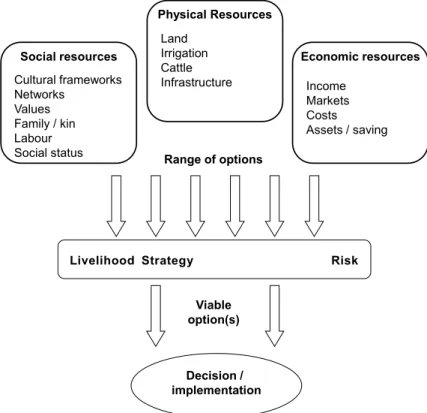
The fields of development studies (e.g., Ellis, 2000) and ecological anthropology (e.g., Ellen, 1982) simi-larly observe the systemic nature of farming and the multi-layered decision space under which the household operates. Within this framework, household decisions are influenced by the following factors (see also Fig-ure 1):
Fig. 1: Interaction of resources, risk and livelihood strategy in the household
decision-making process. (authors’ own).
• available resources which determine the viable op-tions for the household’s activity portfolio;
• household livelihood strategies;
• household perception and evaluation of risk. Resources are defined here as material and immater-ial assets enabling the household to select among dif-ferent options depending on how the resources are ap-plied or expended. Resources available to the household and expected economic effects determine the viability of options. When evaluating options, households se-lect within the relevant institutional and cultural context. This includes social networks and institutions, which mediate how information is spread through the com-munity and influence the interpretation of information (Preston, 1994; Wiersum, 1994).
Within the household, livelihood strategy as well as its evaluation of risks significantly influences the se-lection of new practices (Ellis, 2000; Sjah et al., 2006; see Figure 1). Both livelihood strategy and risk evalu-ation are based on the perceived availability of resources which the household is endowed with. This is where the common sense notion comes to play. Only those resources, which pass the social filter and are deemed appropriate for application, become part of the de-cision process. Perceived resources are those commonly shared within the system (cf. Pastore et al., 1999).
1.2 Supporting cattle management in Eastern Indone-sia
Holding large ruminants (buffalo and cattle) is a tra-ditional ancillary activity of rice farmers in South East Asia (Devendra & Thomas, 2002). While the priority lies on the production of the staple crop, cattle are often held if there is additional land and labour available on the farm, and are particularly important for smallholder farmers (ibid.). Most farming households show a strong preference towards securing food stocks with rice, ve-getables, and poultry (Pengelly et al., 2003). Cattle, while rarely consumed within the household, are tradi-tionally used as food source for larger festivities, such as weddings, and shared among relatives and neighbours. Additionally, cattle are bred, fattened and eventually sold offto traders or at local livestock markets where they mostly end up satisfying the growing beef demand in regional cities.
invest-ment needs (Devendra & Thomas, 2002; Paris, 2002; Mayrhofer-Grünbühel, 2004).
In eastern Indonesia, cattle are fed by either (a) tethered grazing on rice bunds, small patches of other-wise unused land and on the banks of waterways or (b) left to graze freely on harvested paddy fields or second-ary forest. Stables or pens are used to protect cattle from natural hazards and cattle theft during the night. Supple-mentary manual feeding may occur if naturally avail-able forage is insufficient. In this case, locally available forages, such as elephant grass (Pennistum purpureum) is used, which is either gathered from places where it grows wild or planted around the homestead.
The focus of our analysis is two livestock research projects in Lombok and South Sulawesi, Eastern In-donesia. The aim of these projects was to adapt tech-niques for improved cattle management and allow for a more rapid turnover and more secure income stream for smallholding famers (see Table 1; and, for more de-tail, van Wensveen et al., 2010, 2011). Interventions included introduction of new forage varieties, strategic forage production, feed budgeting to improve cattle nu-trition and health, as well as controlled mating and weaning to enable higher fertility rates. The newly introduced practices can be roughly separated into (1) practices requiring complementary resources and (2) practices requiring behaviour change only. Suggested practices support intensification by keeping the cattle in or near pens and planting forages. The emphasis, thus, shifts from predominantly free grazing to manual feed-ing.
The introduction of improved cattle management techniques in the two projects has been deemed widely successful (Martin, 2010) and a large number of house-holds adopted one or more of the introduced techniques (455 known households in South Sulawesi, and 1,030 group members – out of a total 1,144 – in Lombok; for details see: van Wensveen et al., 2010, 2011)3. The evaluation of uptake, however, revealed that the adop-tion of techniques by households was highly selective. Therefore, effort was put into understanding the social process of adoption, which is presented here.
We attempt to contribute to an understanding of household decisions under the conditions of constrained resource access. This is informed by the insight that culture and the social environment mediate the common understanding of how to manage the farming system. We seek to elucidate the smallholders’ rationale – their
3The projects have been completed and approved by the commis-sioning agency. The research presented here represents a comparat-ively small activity within the project.
common sense – of making changes to the farm sys-tem when exposed to new information and resources by providing a contextual description of the adoption pro-cess. This coincides with increased attention to the role of the smallholder in agricultural development (Wiggins et al., 2010) and contributes to an understanding of the rural economy and decisions made under the uncertainty of system effects caused by introducing new practices in resource constrained environments.
2
Method
To understand household decision processes, which determine whether or not adoption takes place, decision narratives were developed. These provide insights into the livelihood strategies of households as well as the various steps in decision-making. Narratives were de-veloped from in-depth interviews, which explored the various steps of deciding whether or not to accept new livestock management practices. To make them com-parable across locations and contexts, the interviews were structured according to Geertz’ (1975) categories of common sense4and, more specifically, along the
ana-lytical framework described above (cf. Figure 1). The categories enable outlining the perceptions, risks con-sidered, and persons involved in the decision making process and identify relevant institutions and drivers.
The decision to make changes to the farming sys-tem does not occur in isolation of social relationships. Rather, there is a process of (formal or informal) ex-change with other actors and institutions such as neigh-bours, village heads, religious leaders, government agencies – all of which feed into and possibly influence – the decision-making process. In fact, for development interventions to be successful, more attention needs to be paid to accessing and building links with existing net-works (Mahanty, 2002).
Social Network Analysis (SNA) was used to ana-lyse the spread of information and explore actors and institutions influencing household decisions. SNA al-lows for analysis of the structure and composition of social connections and subsequent implications on ac-cess to information or resources as well as the articula-tion of norms, and values and behaviour (Wasserman & Faust, 1994). The structure and context of social net-works can highlight access to (or lack of) information and resources as well as the factors supporting decision-making (Lai & Wong, 2002; Hoang et al., 2006).
Table 1: Table 1: Summary of introduced practices for each area. Slight differences in recommendations reflect adaptations to local conditions and priority of implementation in each region
Lombok: South Sulawesi:
1. Controlled mating
Bull service facilitated through the kandang group; aims at mating once yearly.
2. Preferential feeding for pregnant and lactating cows Requires additional forage for cows.
3. Early weaning and preferential feeding for calves Requires pen to separate cow and calf, and quality forage for calves.
4. Forage management*
Requires management of forage on communal land or on dedicated farmland.
1. Better use of existing forage†
Improved management of forage to ensure productivity.
2. Introduction of new forages‡
Planting and management of new varieties on farmland or backyard plots.
3. Controlled mating
Aims to time mating so that the calf is born during the wet season when more feed is available. No bull provided through project.
4. Early weaning and preferential feeding
Requires pen to separate cow and calf, and quality forage for calves
5. Feed budgeting
Meeting anticipated forage demand throughout the year
*Forages newly introduced to Lombok included Mulato (Brachiaria hybrid cv Mulato) and Panicum (Panicum maximum), pre-existing forages included Leucaena (Leucaena leucocephala), Gliricidia (Gliricidia sepium), Elephant Grass (Pennisetum pupureum) and Sesbania (Sesbania grandiflora). For both, the focus was on forage management.
†Existing forages in South Sulawesi included Gliricidia and Elephant Grass.
‡Introduced grasses in South Sulawesi included Paspalum (Paspalum artatum cv Higane), Mulato, Panicum and Setaria (Setaria sphacelata cv Narok). Introduced herbaceous legumes included Clitoria (Clitoria ternatea cv Milgarra), Centrosema (Centrosema pubescens cv Cardillo) and Stylo (Stylosanthes guianensis CIAT 184, Stylosanthes scabra cv Seca, Stylosanthes hamata cv Verano).
In this study, SNA was used to examine how know-ledge about new practices spread among households and communities as well as the type of households, rela-tionships or institutions critical for promoting adoption (Bandiera & Rasul, 2006; Crona & Bodin, 2006). The underlying assumption is that communication through cultural institutions would be more efficient than com-munication of knowledge introduced by external project staff. Data for SNA was collected as part of the decision narratives and focused on capturing:
• Interactions and influence between households and local institutions;
• The spread of information; and
• The spread of resources as concomitant to informa-tion.
Respondents were asked questions to determine if and where they heard about new cattle management prac-tices; who they had discussed the practices with, and if/how they were able to obtain resources to support ad-option, such as cuttings or seeds for forage. Different types of networks constitute inherently different ties or relationships between actors (Bodin & Crona, 2009).5
5For example, formal associations versus kinship ties.
Interviews sought to reveal the nature and effectiveness of different networks for the spread of information. Data collection included both volatile as well as institutional-ised relations, i.e., both the exchange of information as coincidental part of people’s every day interactions, and part of the regular flow of information by the project, with the aim of identifying patterns of information and resource flow in the target community6.
Key challenges in SNA relate to definition of ana-lytical boundaries (either geographic or relational) and sampling strategies. Scott (2000) highlights a range of strategies depending on the focus of analysis, each with its own limitations and requirements for justific-ation. In our case, working at a village level (and in multiple villages) meant it was not feasible to include all households within a village in the analysis. Instead, we used snowball sampling, starting with a sample of households, which the project had been communicating
with. We asked them whom they had provided inform-ation and resources to. A sub-set of these “scale-out” households would then be invited to participate in inter-views. An equivalent number of households were also selected randomly and invited for interview.
The method used creates inherent limitations. For ex-ample, in a network created from snowball sampling, it becomes irrelevant to analyse the connectedness of the network as it is, by virtue of the sampling technique, highly connected (Scott, 2000). At the same time, the networks in this study represent only a small fraction of the relations present in the village. Nevertheless, rather than representing minutiae, the objective of the method was to arrive at an orientation hypotheses, which would allow us to understand selected relations between actors and provide more insight in the structure of information dissemination throughout the community (Schweizer, 1988)7.
The two methods applied, decision narratives and net-work analysis, allow for observation of the structural-institutional as well as the cognitive-emotive aspects of processing information within the community. Hence, the results not only contain a formal analysis of relations among actors but also elucidate the process of evaluat-ing risks and adaptevaluat-ing livelihood strategies by house-holds as their environment changes through the project intervention.
The study observes two cases in Eastern Indonesia, which differ substantially in terms of their agricultural
7The »orientation hypothesis« does not make strictly valid state-ments of relations between network variables. Rather, it identifies im-portant phenomena within the network, which need to be considered when developing stringent hypotheses (Schweizer, 1988; Kelle, n.d.)
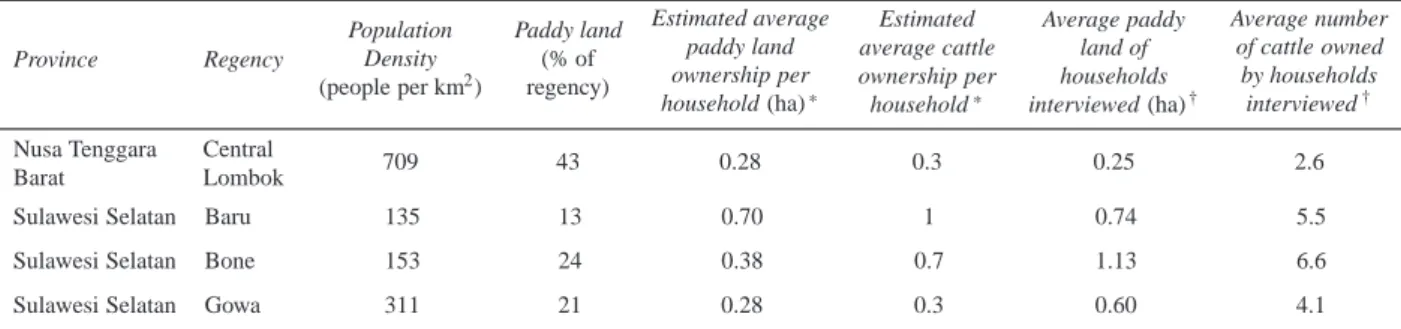
systems, socio-economic characteristics and cattle man-agement. One is characterised by single cropping, ex-tensive livestock husbandry and a relatively low human population density, while the other is a (relatively) in-tensive farming and husbandry system with high popu-lation density (more details in results section, below). A total of 216 interviews were conducted in South Sulawesi (Baru, Bone and Gowa Regencies), and 80 in Nusa Tenggara (Central Lombok Regency) between July and November 2009. For the main characteristics of each Regency see Table 2. Interviews included re-spondents directly involved with the project, as well as those with limited or no involvement.
3
Results
3.1 CASE STUDY 1: Central Lombok, West Nusa Tenggara
3.1.1 Resources
Central Lombok shows high population density of 709 people per square kilometre (see Table 2). Land-lessness is a common feature among rural households. On average, smallholders in Lombok who own or rent land have access to less than 0.3 ha (Table 2). As a result, spare land for grazing or forage production is limited.
Constraints on the available land area in Central Lom-bok limit the potential for adoption of practices that re-quire additional land, such as forage cultivation. Avail-able resources in the farming system do not allow for a significant increase in land used to grow forage without corresponding adjustments to other types of land use, such as replacement of other crops or land purchase.
Table 2: Comparison of population density and household resources, Nusa Tenggara Barat and Sulawesi
Province Regency
Population Density (people per km2)
Paddy land (% of regency)
Estimated average paddy land ownership per household (ha)*
Estimated average cattle ownership per household*
Average paddy land of households interviewed (ha)†
Average number of cattle owned
by households interviewed†
Nusa Tenggara Barat
Central
Lombok 709 43 0.28 0.3 0.25 2.6
Sulawesi Selatan Baru 135 13 0.70 1 0.74 5.5
Sulawesi Selatan Bone 153 24 0.38 0.7 1.13 6.6
Sulawesi Selatan Gowa 311 21 0.28 0.3 0.60 4.1
*Average calculated based on total number of households in regency – therefore includes non-farming households †Based on household interviews conducted in 2009-10, includes landless households
Cattle theft has been a significant problem in Central Lombok and a system of communal pens (kandang) was established in the 1980s to address this. Large sheds with multiple individual pens are used by a group of households from one or several communities. Cattle are taken out to graze during the day, and are returned to the pen each night, where group members take turns guard-ing to protect against theft. Each member is required to pay a fee (rice or cash) and participate in night watch duties. In return, they receive pen space for their cattle. Space constraints in communal kandang limit the num-ber of cattle a household can keep at any one time. Ac-cess to government support for inputs such as fertiliser is often tied to group membership.
A household in Lombok with access to land will typ-ically sow one crop of rice in the wet season, followed by a dry season crop, such as maize, soybean or tobacco. In addition, maize, cassava, chilli or forages are grown on bunds between rice fields. Grass for cattle is collec-ted from riverbanks, roadsides and unused land. Unless explicitly claimed by a farmer (through signs or sym-bols), forages and grass are considered common prop-erty resources and thus can be grazed or collected by anyone. This fact greatly inhibits adoption of forage plantations, as even claims on forages often lead to con-flicts among farmers.
Most households engage in some degree of off-farm activities for cash income (e.g., brick making, transport-ation). While this provides additional income security to the household, it also means less time available for on-farm activities. Income from off-farm activities is most often used for paying daily expenses, such as commod-ities, taxes and additional food.
Cattle provide the farming household with an op-portunity to pay for major items by selling animals whenever needed. This practice allows for cash liquid-ity when required. When questioned about the income function of cattle farming, respondents in Lombok dis-tinguished between:
• calf production: provides annual income for large expenses;
• fattening of bulls: provides 6-monthly regular in-come;
• poultry and goats: provides income for daily ex-penses.
At certain times in the year cattle prices tend to rise, e.g., during religious celebrations when demand is greater. Where possible, farmers try to plan the sale of their cattle according to the fluctuating market price. This is because households generally do not find it dif-ficult to sell cattle. Most prefer to sell to traders who
frequently visit villages. For farmers, this removes risk and costs required to transport animals to the market.
Respondents perceive the lack of available mating bulls as the key resource constraint to cattle production (cf. van Wensveen et al., 2011). Prior to the project in-tervention, farmers either left cows in communal areas in hope of serendipitous mating, moved cows to neigh-bouring villages for mating, or used commercial artifi-cial insemination services. Even where households kept bulls for fattening, they were not perceived as suitable for mating, since it was believed that this would make the bull lose weight and result in loss of income. Thus, farmers responded well to the project’s provision of bull mating services. It was by far the single most widely ad-opted practice out of the package of cattle management techniques offered by the project (cf. Table 1). Per-ceived requirement and options offered seemed to co-incide well in this case (less so in others).
Households estimate rearing cattle to be one of their most labour-intensive activities, due to time investments in the cut and carry of forage, relocation of cattle to grazing sites and watering spots during the day and re-turning them to the pen each night. The tasks of look-ing after cattle are shared between men, women and children within the same household. When feed re-sources are scarce, men generally travel longer distances to search for forage. Most households see these activ-ities to be a major burden on their time budgets and react cautiously to any new investments into cattle manage-ment if these are perceived to put further strain on time resources.
Other than keeping mating bulls, households were re-luctant to adopt practices relating to forage production and feed management. As productive land is limited, forage production would require redistribution of land to grow feed instead of food crops. Reduction of paddy land under land-scarce conditions is not considered a viable option among farming households in Lombok. Smaller forage plantations along bunds and in home gar-dens can be an alternative, but amounts are usually not sufficient to feed the herd. Thus, households are re-quired to devote significant amounts of labour to “cut and carry” (i.e. retrieving forage from areas distant to the homestead). Significantly, however, small forage plantations are seen as a safety net for times when farm-ers are unable to travel in search of fodder, (e.g., due to illness, or during peak labour times).
re-sources from being invested into expensive and often unreliable artificial insemination services. Satisfaction with other aspects of their cattle production, such as feed availability, meant little incentive to try new variet-ies of forage introduced by the project, even where there would have been nutrition benefits for cattle and produc-tion benefits for the household.
Respondents mentioned that, to be a successful farmer, a Sasak from Central Lombok must have both cattle and rice8. This is typified by the Sasak language
expression ‘ngaro ngarit’ which conveys the sentiment that cattle and cropping are complementary and together provide for a good income. Decisions on where to al-locate resources into the future depend on perceptions of security. Investment in land is seen as providing con-crete and tangible results as food and marketable crops. Cattle, on the other hand, cannot provide for a predict-able income due to price fluctuations and risk of animal theft. Rather, households tend to breed or fatten cattle to provide for additional income with little (physical or financial) investment9.
3.1.2 Networks
The project staffdeliberately focused their efforts on kandang groups for information provision and support. Key members within each group, often the kandang leader or the bull keeper, were used to demonstrate the results and impacts of adopting different practices.
Use of the mating service, was readily accepted within the group as well as non-member households10. This provided a pathway for information to reach house-holds outside the kandang groups and beyond usual fa-milial or neighbourly connections. When non-kandang group members obtained mating services they were provided with information regarding other cattle man-agement practices by group members who have been trained in these activities. However, actual uptake of these practices by non-kandang group members has been limited.
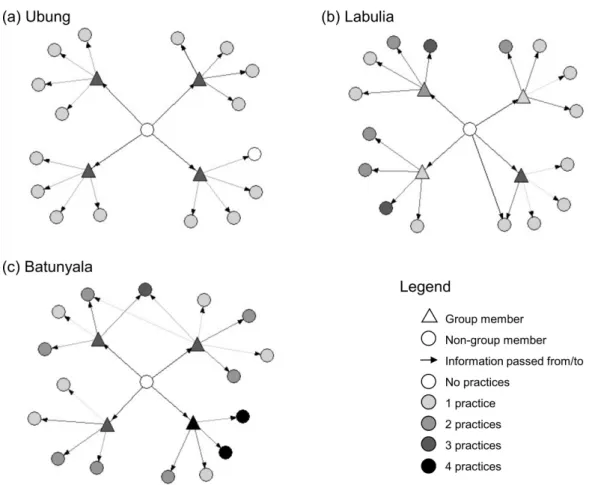
While non-member households were provided with information when they take their cows for mating, weak ties to the kandang group (i.e., relationship between members and non-members based on the provision of a service only) result in limited follow-up support and lack of consistency in the information provided. In Fig-ure 2(a) and 2(b) the majority of non-group members interviewed had only adopted one practice – controlled
8The Sasak are the majority ethnic group on the island of Lombok (http://www.ethnologue.com/language/sas).
9High labour costs do not seem to factor in these decisions. 10The kandang group subsequently began to commercialise the mating service to non-members within the community.
mating through the group’s bull service. These farmers felt unable to properly implement any of the other prac-tices suggested.
In cases where non-group members have been able to successfully adopt practices in addition to the bull service, they are part of the social network of kandang group members (through family, neighbour or friend-ship ties). Of the six non-member farmers in Figure 2(b) who have adopted more than one practice, all have close relationships to group members, either by family, friendships or as previous members of this group.
In Figure 2(c) more than half of non-members who used the bull mating service adopted more than one practice. These respondents refer to family and neigh-bourly relations or, more generally, to repeated discus-sions with group members and being able to observe the development of forage plots and quality calves.
3.2 CASE STUDY 2: Baru, Bone and Gowa Regencies, South Sulawesi
3.2.1 Resources
In comparison to Lombok, Sulawesi has a lower population density (between 135–311 people per square kilometre across three study Regencies; see Table 2). More land availability allows for diverse land use dis-tributed between paddy, other crops and grazing areas.
Due to the absence of kandang groups, the pro-ject worked with individual farmers in South Sulawesi. While the project staffwould work with any farmer will-ing to learn about the introduced practices, five farmers in each village (n=60) volunteered as ‘champions’ to promote new forages and practices among their fellow community members It was anticipated that direct rela-tionships with champion farmers would support demon-stration of benefits, and farmer-to-farmer communica-tion of practices.
Fig. 2: Information provision and adoption in a kandang farmer group, Lombok. Centre nodes represent project
field staff; the nodes closest to the centre are members the group; nodes further out are non-group members (grey shading based on number of practices).
Households typically produce a minimum of one rice crop, plus a secondary crop using residual soil moisture (maize or peanut). Most farmers leave their cattle to graze on harvested cropland, spare land, or dedicated grazing land. Forage production, largely elephant grass, was in common usage prior to the project, but used only to supplement grazing in the dry season. Farmers main-tain that this practice is well established and adapted to the farming system as cattle provide for additional in-come without large investment requirements of cash or labour.
Some households engage in off-farm activities (e.g., brick making, transportation) to supplement farm in-come, and this is particularly pronounced in areas close to urban centres (i.e., Gowa Regency). The trade-off between labour spent on- and off-farm further restricts the ability to adopt new practices.
In Sulawesi, cattle are not typically part of the regular income stream of the household. Rather, cattle are a form of wealth saving and tend to be sold for particular
events or purposes. Income from cattle production is used for three main purposes:
• major investments (agricultural inputs, vehicle, agricultural machinery);
• exceptional expenses (health costs, ceremonies, festivities);
• emergency expenses (in case of crop failure).
Most households rely on free grazing and homesteads rarely include cattle pens. Due to the distances between homes and grazing locations collection of forage is a task mainly carried out by men. Forage varieties in-troduced by the project proved popular as they were planted on spare land closer to the household, which re-duced travel time to collect grass.11 In addition, these
varieties have higher nutritional value than traditional grasses harvested on roadsides and river banks (Pengelly et al., 2003; Lisson et al., 2010). Where households adopted new forage varieties, a redistribution of labour within the household became possible. Men spent less
travel time to collect forage and were able to reinvest spare time into cropping, rest, or other activities. Due to shorter distances and lighter carrying loads, however, it also led women to take on more responsibility to feed cattle, thereby adding to their time burden of cutting and carrying forage to sheds. On balance, the adop-tion of forage banks was seen to significantly decrease time spent in cattle feeding, albeit proportionally less so for women. These labour savings were stated by inter-viewees and had been quantified in previous studies of the same areas by Lisson et al. (2010).
While many farmers in South Sulawesi aspire to increasing cattle production as a proportion of their farming system, meeting household food requirements through rice production remains a priority. For many farmers cattle are a good complement to rice production, but are unlikely to replace rice as the central pillar of their livelihood strategy. Interviews suggest households only consider allocating land for the purpose of grow-ing forage if they (1) have sufficient land for household rice production; and (2) already own enough paddy land to hand down to their children. Households with suffi -cient land area to fulfil these needs, or who had limited labour to manage additional paddy land would turn to cattle production. To the farmers interviewed, cattle are of secondary importance to acquiring sufficient land.
3.2.2 Networks
Households with ties to champion farmers received an increased amount of information, resources and sup-port. Thus, champion farmers were central to the spread of information, through relationships based around the mosque, neighbours and family ties.12
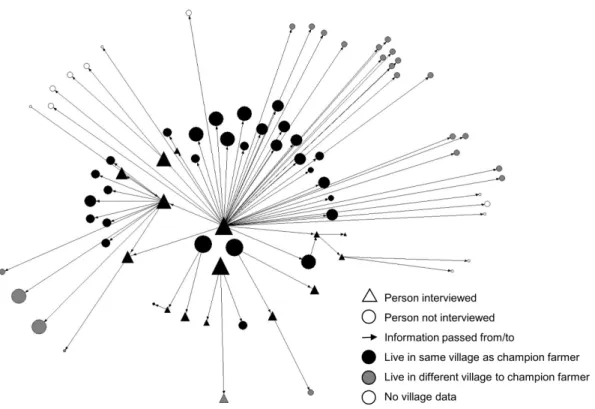
Champion farmers in Sulawesi were usually located close to main roads and their highly visible forage banks sparked interest both within and outside their exist-ing networks. In addition, formal promotional activ-ities were arranged by the project, such as farmer field days to demonstrate practices as well as cattle weigh-ing events at the mosque. While these events help to spread basic knowledge, only those households living in the same village as the champion farmers tended to successfully implement a number of practices. Figure 3 illustrates the importance of proximity for adoption in a village in Bone Regency, South Sulawesi. The node with the highest number of connections in the diagram represents a champion farmer who hosted a field day on his farm. While many farmers visited from outside the
12Staffemployed as extension officers by the project were clearly essential to the spread of information. However, since they were ar-tificial to the existing networks, we decided not to focus on their role here.
Fig. 3: Adoption of practices by proximity to champion farmer in Bone, South Sulawesi (central node represents
village, these farmers adopted only one, if any, prac-tices. In contrast, farmers residing in the same village as the champion farmer adopted more than one practice as they experienced higher exposure and access to inform-ation to support decisions on innovinform-ations.
Champion farmers in South Sulawesi were key to providing proof that the new practices (in particular, new forage varieties) yield positive results within the farm context. Their activities reassure potential adop-ters and provide feedback to those hesitant to take risks (see also Millar & Connell, 2009). Unsurprisingly, fam-ily and neighbours are often the first to receive informa-tion from the champion farmers, reflecting existing net-works. Family receives higher preference in the distri-bution of resources concomitant to information, such as seeds or seedlings to start forage banks.
4
Discussion
Resource requirements for adoption of new cattle management techniques include, at a minimum:
(1) land for forage banks;
(2) pens to separate cows and calves;
(3) a bull for mating; and
(4) time to manage forages and implement the other practices.
If resources are tied up in other uses (e.g., land for other crops, or labour for other activities) then the household needs to make a decision whether substi-tution is worthwhile. This decision will depend on whether a problem with current production systems is perceived, and whether increasing cattle production is desirable. Culturally specific common sense determines this perception, not what is feasible from a rationalist perspective.
South Sulawesi and Central Lombok offer two dis-tinctly different sets of resource conditions in which the household decisions are framed. In Central Lombok, with high population density, limited land, and high levels of landlessness, land is a key consideration. This impacts on inputs (e.g., land for forage production) as well as outputs (e.g., increased herd size) of cattle pro-duction. At the same time, limited land also encourages a diverse management strategy that places importance on cattle, as often the area of land owned by households is not sufficient to ensure subsistence.
In South Sulawesi, land is more abundant and sub-stitutions between land uses do not necessarily threaten household food security. As a result, lower importance was placed on cattle rearing as compared to rice and
dry-season crops. Instead, lack of bulls for mating and limited labour availability inhibited higher investments into cattle management.
Yet in both cases, even households with sufficient resources often decided not to change farming prac-tices despite strong evidence for increased cattle pro-duction. Geertz’ common sense understanding of house-hold strategies for wellbeing and perceptions of risk provides a rationale for such decisions. While there is a complementary relationship between rice and cattle production, East Indonesian households tend to favour household food security through rice production. Many of these households selectively adopted new practices rather than the full package. They preferred invest-ing into activities that added value to cattle production, while minimising risk in rice production. Many house-holds saved time through the adoption of forage banks. The saved time, however, was not re-invested into cattle production, but into rice or other livelihood activities (cf. Lisson & Corfield, 2010).
Champion farmers and kandang group members freely shared information about new practices. How-ever, multiple links in social networks (community, eco-nomic, family, proximate location) and/or redundant provision of information supported adoption. Farming households seem to rely on these redundant links to de-velop trust in new techniques and build evidence for their usefulness. Mating services and farmer field days provided an opportunity to introduce new practices, but do not necessarily lead to uptake if they do not resonate with shared cultural values.
Farming households tended to rely on a variety of sources and influences when considering new cattle management practices. Champion farmers in South Su-lawesi and kandang group heads were mentioned as the most influential sources for decision-making. How-ever, informal sources, such as conversations at Friday mosque meetings, with neighbours or consultation with family members can be vital when deciding for changes in farm management.
ers adopt integrated crop protection and organic farm-ing techniques for social and moral reasons (Mzoughi, 2011), current Indonesian smallholders make selective decisions based on (a) long-term resource availability, (b) form and source of communication, (c) risk and (d) livelihood strategies.
5
Conclusion
Subsistence-oriented smallholders are willing to ex-periment with changes to their farming systems where they do not conflict with existing livelihood strategies. It is easier for households in South Sulawesi to experiment with forage production, where land is relatively more abundant, than in Lombok, where land is scarce and pri-oritised for crop production. New practices are select-ively applied and adapted as perceived through cultural rationality. While one could assume that increased cattle production would mark a gradual transition of the farm-ing system it is more likely that subsidiary role of cattle to rice persists.
The continued focus on crop production and the low preference for expanding cattle has implications for In-donesia’s policy on beef production, specifically, the Government’s policy to establish Nusa Tenggara Barat as the ‘Land of One Million Cattle’ (cf. Jakarta Post, 2009). As long as smallholders conduct farming at a subsistence level and land is scarce they are reluctant to invest heavily in growth of herd size, increased calf turnover or fattening. Smallholders may see cattle as a supplementary income or even as a stepping-stone out of farming. Hence, the feasibility of current policy goals needs to be revisited.
While demonstration of the benefits and savings of new practices is important to inform a larger number of households about new practices, it is equally import-ant to rely on existing networks for continued commu-nication of ideas. This is paramount to providing le-gitimacy to the information and re-interpretation of the information along indigenous cultural categories. De-contextualised information is less valuable and useful than information, which can be accommodated by or in-tegrated into common sense knowledge systems.
As research and development projects continue to provide innovations for smallholders to reduce poverty and transition into sources of global supply chains, “best practice” demonstrations seemingly provide rational-istic solutions for transforming farming systems through technology and practice change. Understanding the cul-tural context of household decisions requires a depar-ture from economic decision-making models in both the
design of and expectations for agricultural intervention. At stake is the potential for development agencies and practitioners to achieve improved rates and – more im-portantly – socially adapted adoption of innovations to traditional farming systems.
Acknowledgements
Funding for this research was provided by the Aus-tralian Centre for International Agricultural Research of the Australian Government (ACIAR-SMAR/2006/061 and ACIAR-SMAR/2006/096). The authors wish to thank Dr. Dahlanuddin (University of Mataram); Ke-tut Puspadi and Rachmat Rachman (Assessment Insti-tute for Agricultural Technology, Indonesia); and Dr. Asmuddin Natsir (Hassanudin University); Monica van Wensveen, Bruce Pengelly, Cam McDonald and Jeff Corfield (CSIRO); Henky Widjaja; and Peter Horne (ACIAR) for sharing their knowledge and their support in this research. Data gathering was conducted with the enthusiastic effort of project field staffin Lombok and South Sulawesi. The authors wish to thank Zvi Hoch-man, James Butler (CSIRO) and two anonymous re-viewers for providing us with valuable input to the vari-ous drafts of this paper.
References
Anderies, J. M., Janssen, M. A., Bousquet, F., Carde-nas, J. C., Castillo, D., Lopez, M. C., Tobias, R., Vol-lan, B. & Wutich, A. (2011). The challenge of un-derstanding decisions in experimental studies of com-mon pool resource governance. Ecological Econom-ics, 70 (9), 1571–1579.
Bandiera, O. & Rasul, I. (2006). Social Networks and Technology Adoption in Northern Mozambique. The Economic Journal, 116 (514), 869–902.
Bodin, Ö. & Crona, B. I. (2009). The role of social networks in natural resource governance: What rela-tional patterns make a difference. Global Environ-mental Change, 19 (3), 366–374.
Crona, B. I. & Bodin, Ö. (2006). What you know is who you know? Communication patterns among resource users as a prerequisite for co-management. Ecology
&Society, 11 (2), Art. 7.
Devendra, C. & Thomas, D. (2002). Crop-animal sys-tems in Asia: importance of livestock and character-isation of agro-ecological zones. Agricultural Sys-tems, 71 (1–2), 5–15.
Ellen, R. (1982). Environment, Subsistence and System. The ecology of small-scale social formations. Cam-bridge University Press, CamCam-bridge.
Ellis, F. (2000). Rural livelihoods and diversity in devel-oping countries. Oxford University Press Inc., New York.
Geertz, C. (1975). Common sense as a cultural system. The Antioch Review, 33 (4), 5–26.
Geertz, C. (1983). Local knowledge: further essays in interpretative anthropology. Basic Books, New York.
Giampietro, M. (2004). Multi-scale integrated analysis of agroecosystems. CRC Press, Florida.
Hoang, L. A., Castella, J. C. & Novosad, P. (2006). Social networks and information access: Implica-tions for agricultural extension in a rice farming com-munity in northern Vietnam. Agriculture and Human Values, 23 (4), 513–527.
Jakarta Post (2009). West Nusa Tenggara strives to meet ‘One Million Cattle’ target. The Jakarta Post, July 6, 2009. PT. Bina Media Tenggara, Jakarta.
Janssen, M. A. & Anderies, J. M. (2011). Governing the commons: Learning from field and laboratory exper-iments. Ecological Economics, 70 (9), 1569—1570.
Lai, G. & Wong, O. (2002). The tie effect on informa-tion disseminainforma-tion: the spread of a commercial rumor in Hong Kong. Social Networks, 24 (1), 49—75.
Lisson, S. & Corfield, J. (2010). Impact assess-ment of project related activities from ACIAR project AS2/2004/005 Improving smallholder crop-livestock systems in Eastern Indonesia. CSIRO, Hobart.
Lisson, S., MacLeod, N., McDonald, C., Corfield, J., Pengelly, B., Wirajaswadi, L., Rahman, R., Bahar, S., Padjung, R., Razak, N., Puspadi, K., Dahlanud-din, Sutaryono, Y., Saenong, S., Panjaitan, T., Hadi-awati, L., Ash, A. & Brennan, L. (2010). A particip-atory, farming systems approach to improving Bali cattle production in the smallholder crop-livestock systems of Eastern Indonesia. Agricultural Systems, 103 (7), 486–497.
Mahanty, S. (2002). Conservation and development in-terventions as networks: The case of the India Eco-development Project, Karnataka. World Develop-ment, 30 (8), 1369–1386.
Martin, G. (2010). ACIAR investment in research on forages in Indonesia. ACIAR Impact Assessment Series Report No. 65. ACIAR, Canberra.
Mayrhofer-Grünbühel, C. (2004). Resource use systems and rural smallholders. An analysis of two Lao com-munities. Ph.D. thesis, University of Vienna, Vienna, Austria.
McGregor, A. (2008). Southeast Asian Development. Routledge, London.
Millar, J. & Connell, J. (2009). Strategies for scaling out impacts from agricultural systems change: the case of forages and livestock production in Laos. Agriculture and Human Values, 27 (2), 213–225.
Mzoughi, N. (2011). Farmer’s adoption of integrated crop protection and organic farming: Do moral and social concerns matter? Ecological Economics, 70 (8), 1536–1545.
Paris, T. R. (2002). Crop-animal systems in Asia: socio-economic benefits and impacts on rural livelihoods. Agricultural Systems, 71 (1–2), 147–168.
Pastore, G., Giampietro, M. & Ji, L. (1999). Con-ventional and land-time budget analysis of rural villages in Hubei Province, China. Critical Re-views in Plant Sciences, 18 (3), 331–357. doi: 10.1080/07352689991309252.
Pengelly, B., Whitbread, A., Mazaiwana, P. R. & Mukombe, N. (2003). Tropical forage research for the future—better use of research resources to deliver ad-option and benefits to farmers. Tropical Grasslands, 39, 198–209.
Polanyi, K. (2001). The Great Transformation. The political and Economic Origins of our time. Beacon Press, Boston. (orig. 1944)
Preston, D. (1994). Rapid household appraisal: a method for facilitating the analysis of household live-lihood strategies. Applied Geography, 14 (3), 203– 213.
Reeson, A. F. & Dunstall, S. (2009). Complex de-cision making. Implications for the Australian Tax and Transfer System. CSIRO Mathematical and In-formation Sciences Report 09/110. CSIRO, South Clayton.
Rössler, M. (1999). Wirtschaftsethnologie. Eine Ein-führung. Dietrich Reimer, Berlin.
Schweizer, T. (1988). Netzwerkanalyse als mod-erne Strukturanalyse. In: Schweizer, T. (ed.), Net-zwerkanalyse. Ethnologische Perspektiven. pp. 1–32, Dietrich Reimer, Berlin.
Sjah, T., Cameron, D. & Woodford, K. (2006). Ex-tension service and farmer decision making on new copping lands in East Lombok Indonesia. Journal of International Agricultural and Extension Education, 13 (2), 39–55.
Wasserman, S. & Faust, K. (1994). Social network ana-lysis: methods and applications. Cambridge Univer-sity Press, Cambridge.
van Wensveen, M., Dahlanuddin, Corfield, J., Grun-buhel, C. M., Hasanuddin, Lisson, S., McDonald, C. & Puspadi, K. (2010). Scaling up herd manage-ment strategies in crop-livestock systems in Lombok. ACIAR, Canberra.
van Wensveen, M., Rahman, R., Bahar, S., Corfield, J., Grunbuhel, C. M., Lisson, S. & Marsetyo (2011). Building capacity in the knowledge and adoption of Bali cattle improvement technology in South Su-lawesi. ACIAR, Canberra.
Wiersum, K. F. (1994). Farmer adoption of contour hedgerow intercropping, a case study from east In-donesia. Agroforestry Systems, 27 (2), 163–182.