A Practical Implementation of ISMS
A. Asosheh
Faculty of Engineering
Tarbiat Modares University, Tehran, Iran [email protected]
P. Hajinazari
Faculty of Engineering
Tarbiat Modares University, Tehran, Iran [email protected]
H. Khodkari
Faculty of Engineering University of Tehran, Iran
Abstract
Nowadays, access to reliable information has become an essential factor leading to success in business. In this regard, adequate security of information and systems that process it is critical to the operation of all organizations. Therefore organizations must understand and improve the current status of their information security in order to ensure business continuity and increase rate of return on investments. Since, information security has a very important role in supporting the activities of the organization and for this reason; it is needed to have a standard or benchmark which controls governance over information security. Hence, this paper discusses some of Information Security Management System (ISMS) standards in order to determine their strengths and challenges. Then, based on most appropriate standards in the field, a method is proposed to allow information technology-related or based enterprises to implement their ISMS. This method helps identifying critical assets and related threats and vulnerabilities, assessing assets risks and providing necessary risk treatment plans. The proposed method makes it possible and structured to establish information security management system in IT related large-scale enterprises.
Keywords: Information Security, ISMS, ISO/IEC 27000 Series, Risk Assessment.
Introduction
completeness of assets and Availability is the property of being accessible and usable by an authorized entity.
Information assets are especially important in the increasingly interconnected business environment. At this time, as a result of this increasing interconnectivity, information is exposed to a growing number and a wide variety of threats and vulnerabilities (ISO/IEC 27002, 27005). Information security is the protection of information from this wide range of threats in order to ensure business continuity, reducing losses of business and increase rate of return on investments. In order to achieve information security, it is needed to implement a suitable set of policies, processes, procedures, organizational structures and software and hardware functions that need to be established, implemented, monitored, reviewed and improved in order to ensure that the specific security and business objectives of the enterprise are met.
Basically, information security is a process intended to identify risks and reduce their effects to acceptable levels. This process should be iterative and requires an “Information Security Management System” called ISMS (Jacqueline, 2003). An ISMS takes the information security requirements and expectations of the enterprises as input and produces information security outcomes that address those requirements and expectations. It ensures that security continues to fulfil necessary processes and legal requirements. In this regard, the adoption of an ISMS should be a strategic decision for an enterprise because the design and implementation of ISMS is influenced by enterprise needs and objectives, security requirements, the processes employed and its size and structure (ISO/IEC 27001, 27005).
The information security has a very important role in supporting the organization activities and it is needed to have a standard which controls governance over information security. Hence, at first, this paper discusses some of ISMS standards such as ISO1 standards for information security, BS7799, PCIDSS2, ITIL3, COBIT4 and GASSP5 in order to determine their strengths and challenges. Then, the most appropriate standards in the field are selected and based on these standards; a method is proposed to implement an ISMS. This implementation method is executed in a large-scale enterprise that is presented as a case study in this paper.
The rest of the paper is organized as follows: Section 2 is a brief introduction to ISMS and information security standards. Section 3 introduces significant challenges large scale enterprises face in implementing ISMS as well as ISMS implementation steps according to ISO/IEC 27001, 27003 and 27005. A proposed solution is presented in section 4 in order to address the mentioned challenges and results are given in section 5. Finally, section 6 concludes the paper and presents some directions for the future work.
Information Security Management System
The ISMS focus on managing organization’s information security framework that is a growing concern of many organizations as they deal with the challenges presented in the information society including privacy legislation, published guidelines, and natural threats (fire, flood, earthquake) or human introduced (viruses, hacking, industrial espionage) (Fiona, 2007).
but includes paper-based information. An appropriate ISMS can be efficiently used by either small or large organizations, and can be appropriate for supporting information protection in various organizations including e-commerce, health care, software development, e-commerce, finance, manufacturing and service organizations.
The efficient implementation of the framework guarantees that a management team provides proper resources to support the processes that the organization needs in order to achieve appropriate information security (Standard B. S. I., 2005).
Information Security Standards
In the field of information security, different standards have been developed. The use of security standards in companies and enterprises will not only improve security, but make the development of it easier. In order to agree on what these standards protect, the security should be implemented in a form. The following overview presents the most important standards.
ISO standards (for information security): the ISO/IEC 27000-series include information security standards published in cooperation with the International Organization for Standardization (ISO) and the International Electrotechnical Commission (IEC). At present, eleven standards are published in the series and ready for use, while some are still under development. The most important standards in this series are:
o ISO 13335: ISO/IEC 13335 consists of two parts, under the general title Information technology —Security techniques — Management of information and communications technology security. Several sections of the original ISO 13335 are replaced with ISO 27005.
o ISO 17799: ISO17799 (BS7799) is comprehensive in its coverage of security issues. It contains significant control requirements, extremely complex.
o ISO 27001: Specifies the requirements for establishing, implementing, operating, monitoring, reviewing, maintaining and improving an Information Security Management System. This standard adopts a process approach.
o ISO 27002: Provides control objectives and best practice controls to be selected and implemented in order to mitigate risks and achieving information security. This standard contains 11 security control clauses including 39 main security categories and 133 controls.
o ISO 27003: provides practical implementation guidance for ISMS in accordance with ISO/IEC 27001.
o ISO 27004: provides guidance on the development and use of measures in order to assess the effectiveness of ISMS, control objectives, and controls as specified in ISO/IEC 27001.
o ISO 27005: provides guidelines for information security risk management.
o ISO 27006: specifies requirements and provides guidance for bodies providing audit.
o ISO 27007: provides guidance on conducting ISMS audits, as well as guidance on the competence of ISMS auditors.
controls.
o Other standards in the ISO27k series: The ISO27k series of standards will probably be made up of ISO standards 27000–27019 and 27030–27044 in the long term. All standards in this series handle different aspects of security management and are based on the requirements in ISO 27001.
BS7799 Security Standard: The first security standard is created by the British Standards Institution (BSI). The 1995 version is well-known and respected. Later versions were published in 1999 and 2000 but for clarity, we refer to these as BS Version 1, BS Version 2 and BS Version 3, respectively (Broderick, 2006).
PCIDSS: the Payment Card Industry Data Security Standard (PCIDSS) is a worldwide information security standard defined by the Payment Card Industry Security Standards Council. The standard was created to help industry organizations in processing card payments and preventing credit card fraud. The standard is applied to all organizations that hold process or exchange cardholder information from any card branded with the logo of one of the card brands (Susanto, Almunawar, & Tuan, 2011).
ITIL: The Information Technology Infrastructure Library (ITIL) concept emerged in the 1980s, when the British government determined that the level of IT service quality provided to them was not sufficient. ITIL is a set of practices for Information Technology Services Management (ITSM), IT development and operations, which has parts focus on security. ITIL concerns the management of IT services from the point of view of the IT service provider (Standard B. S. I., 2005).
COBIT: COBIT (Control Objectives for Information and related Technology) describes a method for controlling the risks arising from the use of IT to support business-related processes. The COBIT documents are issued by the IT Governance Institute (ITGI) of the Information domains Audit and Control Association (ISACA) (COBIT, 2000).
GASSP: The development of GASSP started in 1992, with support from the U.S. government, the International Information Security Foundation, and other world-wide organizations. In version 3.0, the name was changed to Generally Accepted Information Security Principles. The aim in the development of GAISP was to document common practice. GAISP version 3.0 included the“Detailed Principles Cookbook”for guiding GAISP developers in detailing the principles from authorities such as OECD and ISF (Siponen & Willison, 2009).
Best Standard in Field
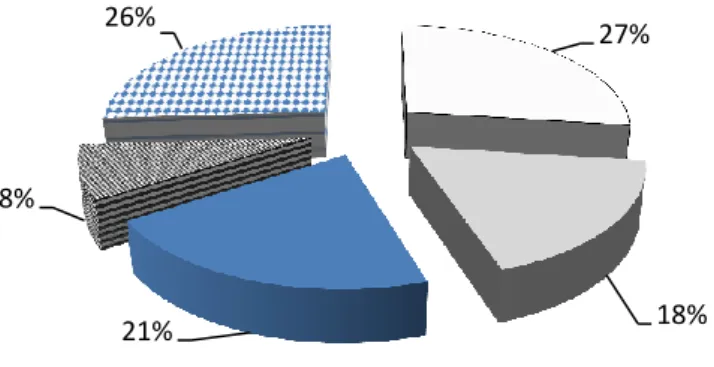
These utilization rates indicate that ISO (27001) is being applied more than four other standards especially on ISMS. In this regard, it can be concluded that ISO standards for information security are simpler to implement and well recognized by stakeholders (top management, staff, suppliers, customers/clients, regulators) and also their platforms are more appropriate for an organization deal with.
Figure 1. Utilization rates of standards
It should be mentioned that ISO27001 and BS7799 have similar characteristics, since ISO27001 adopted from BS7799. These two standards emphasize on the strength of ISMS from various aspects, while the other three focus on IT governance and Project Management. ISO 27000 series of standards set out the best practices for information security and security policies. These standards deal with the technological aspects of information systems. Therefore, ISO series security standards are one of the best standards in the information security field.
Real Problem
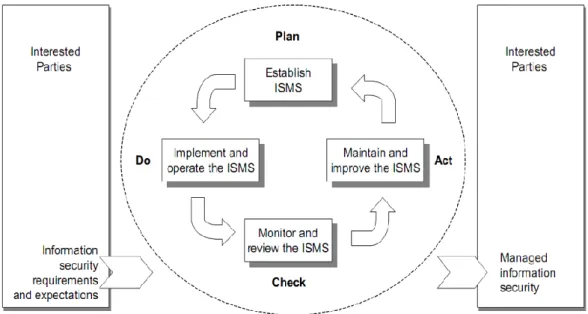
The security level is the main challenge for the executive manager of an enterprise, especially if it is developing, establishing and maintaining electronic banking systems. In this regard, according to the ISO/IEC 27000, it is going to identify risky assets of the enterprise and justify the proper treatment actions. In order to ensure the selection of adequate and proportionate security controls that protect enterprise assets and give confidence to interested parties, the ISMS is designed (ISO/IEC 27001, 2005). For this purpose, relevant security requirements of the enterprise should be defined in order to be supported by the ISMS. As shown in Figure 2, ISO/IEC 27001 adopts the ''Plan-Do-Check-Act" (PDCA) model, which is applied to structure all ISMS processes. Thus the required activities for an ISMS are structured into four phases:
Plan: establish the ISMS policy, objectives, processes and procedures relevant to managing risk and improving information security to deliver results in accordance with an organization’s overall policies and objectives
Do: implement and operate the ISMS policy, controls, processes and procedures. Check: assess and, where applicable measure process performance against ISMS policy, objectives and practical experience and report the result to management for review.
Act: take corrective and preventive actions, based on the results of the internal ISMS audit and management review or other relevant information, to achieve continual
27%
18% 21%
8%
26% ISO27001
BS7799
PCIDSS
ITIL
improvement of the ISMS.
These activities build a loop according to the PDCA model leading to a continuous improvement of the ISMS (Siponen & Willison, 2009).
Figure 2. Plan-Do-Check-Act Model (ISO/IEC 27001, 2005)
According to ISO/IEC 27003, the actual implementation of an ISMS is generally executed as a project. The main steps to implement an ISMS based on ISO/IEC 27003, are listed below:
1- Obtaining management approval for initiating an ISMS project 2- Defining ISMS Scope, boundaries and ISMS policy
3- Conducting information security requirements analysis 4- Conducting risk assessment and planning risk treatment 5- Designing the ISMS
Generally, In an ISMS, establishing the context, risk assessment, developing risk treatment plan and risk acceptance are all part of the “plan” phase. In the “do” phase of the ISMS, the actions and controls required to reduce the risk to an acceptable level, are implemented according to the risk treatment plan. In the “check”, managers will determine the need for revisions of the risk assessment and risk treatment in the light of incidents and changes in circumstances. In the “act” phase of the ISMS, any required action, including additional application of the information security risk management process, is performed (Hensel & Lemke-rust, 2010).
As mentioned before, according to ISO/IEC 27003, relevant security requirements of the enterprise should be defined in order to be supported by the ISMS. One of these requirements is to identify and assess the information assets and their risk levels in order to picture the information security status of organization. Then, it is needed to define and execute a plan for ISMS project implementation.
In this paper, the case is the implementation of an ISMS within an enterprise related to banking. In this case, the main business of the enterprise (including 16 departments) is developing, establishing and maintaining electronic banking systems and the main goal is to identify and improve current information security level of the enterprise. In order to address these challenges, a practical solution is proposed in the next section that presents a method for identifying the security level of the enterprise in a time and cost saving manner. This method helps identifying critical assets of the enterprise and related threats and vulnerabilities and assessing assets risks.
Proposed Solution
In this section, a proposed solution for implementing an ISMS within the above mentioned enterprise, is presented. The intent of this solution is to help enterprises recognize the activities related to establish an ISMS especially the asset identification and related threats and vulnerabilities and risk assessment activities. This solution presents a 5 steps process according to ISO/IEC 27003 implementation guidance.
Obtaining management approval for initiating the ISMS project
When starting an ISMS implementation project, the first step is obtaining management approval. In this regard, the organization’s priorities and the preliminary scope of the ISMS should be clarified and defined. Based on these definitions and clarification, the project plan and its business case are created and then approved by management.
Defining ISMS Scope, boundaries and ISMS policy
In this step, the ISMS policy is concluded and approved by management in order to establish the scope and boundaries of system. The Information and communication technology (ICT), organizational and physical scopes and boundaries are defined and integrated as a final outcome document of this step.
Conducting information security requirements analysis
In the third step, relevant requirements are defined in order to be supported by the ISMS. For this purpose, the enterprise assets should be identified so that the current information security status would be identified within scope. In the field of assets identification, first it is necessary to categorize the assets.
According to ISO/IEC 27003, asset is anything that has value to the organization and based on Annex B of ISO/IEC 27005, two kinds of assets can be distinguished. The primary assets consist of Information and Business processes and activities while hardware, software, network, personnel, site and organization’s structure are considered as supporting assets. In accordance with this definition, the following categorization is presented for the enterprise assets.
Organization: this category is related to the enterprise business and includes following two subcategories:
o Information: include each type of document, files, procedures, instructions, source programs, software licenses are associated with the organization business. In addition, any kind of information needed to achieve business goals and organization's mission are placed in this category.
Hardware: because of the wide variety of this category, it is necessary to divide that further into the following five subcategories:
o General hardware: they have general application such as servers, PCs and so on. o Portable hardware: they are small and lightweight enough to carry and also have general application such as laptops, external hard disks and so on.
o Network equipment: they are used in the field of network such as routers and switches.
o Infrastructure equipment: they provide the organization with the fundamental services such as generators and UPS.
o Special-purpose hardware: they do not fit in any of four subcategories listed above and have specific applications for the organization such as tokens and HSMs.
Software: this category includes software and applications used in the organization and based on their expected function, is divided into the following three subcategories:
o Applications: refers to the desktop applications have no access to networks (stand-alone applications).
o Network-based applications: the applications in which either the program or the data or both, reside on a network.
o Database software: refers to the applications designed to store, organize and manage information.
Communication: this category covers inter/intra organizational communication in terms of the nature of interactions and communication platforms. In this regard, this category include following two subcategories:
o Data transfer link: includes communication infrastructure such as radio antennas, MPLS, optic fibre, internet and so on.
o Commercial interactions: includes interactions with other companies, organizations and institutions based on contracts and agreements in addition any critical business relationship between inter-organizational groups.
Physical environment: include rooms, offices, warehouses and any physical environment involved in the organization's mission.
Personnel: refers to human resources employed in the organization and involved in information systems including managers, project leaders, users, system analysts, investigators, application developers and so on.
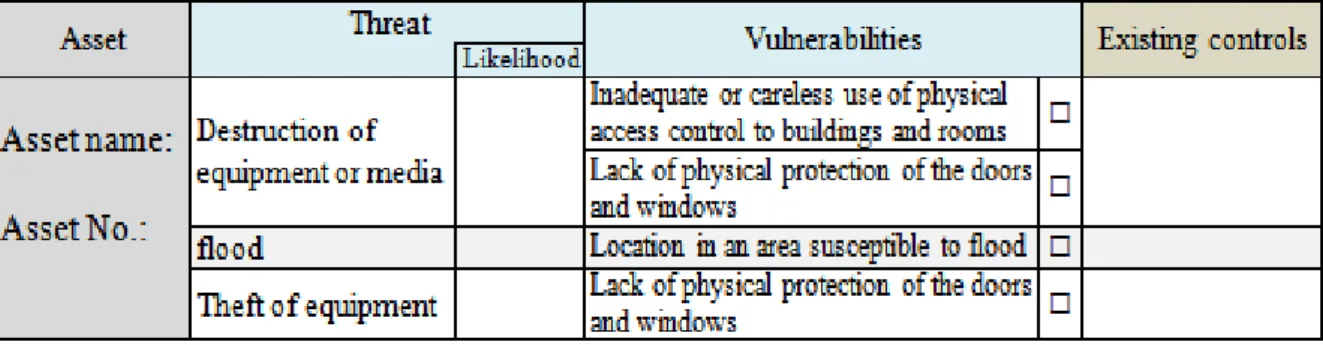
Then, in order to identify the enterprise assets and gather the required information, specific forms related to each asset category, would be designed. Figure 3 shows an instance of asset identification form for physical environment category.
Figure 3. Asset identification form for physical environment category
It should be mentioned that in this solution, it is planned to identify those assets that are critical for the company’s business and processes. In order to estimate assets values, some indicators are defined that affect the importance of assets. These indicators are shown in Table 1. Identified critical assets and associated threats and vulnerabilities are documented and integrated as an outcome of this step.
Table 1. Indicators affecting the importance of each category of assets Category Indicators affecting the importance of asset
Hardware
Hardware dysfunction leads to disruption of organization's mission Hardware dysfunction leads to disruption of services provided by them Hardware dysfunction leads to disruption of employee tasks
Inability to replace hardware quickly Hardware cost
Software
Software dysfunction leads to disruption of services provided by them Software dysfunction leads to disruption of organization's mission Software dysfunction leads to disruption of employee tasks Not available Source Software
The type of information stored in databases Volume of information stored in databases Frequency of referring to database
Structure & Organization
Associated with the organization mission Cannot easily be replaced
Confidentiality
Communication
Communication dysfunction lead to disruption of organization's mission Communication dysfunction lead to the disruption of services
Communication dysfunction lead to disruption of employee tasks
Physical environment
Problems of the physical environment lead to disruption of organization's mission
Problems of the physical environment lead to the disruption of services Problems of the physical environment lead to disruption of employee tasks Cannot easily be replaced
Personnel
Individual's problems lead to disruption of organization's mission Individual's problems lead to disruption of services provided by them Individual's problems lead to disruption of other individuals' tasks Volume and types of information available to the individual Individual knowledge, experience and skills
Conducting risk assessment and planning risk treatment
According to ISO/IEC 27003, the aim of this step is to define the risk assessment methodology, identify, analyze and evaluate the information security risks of identified assets in order to select risk treatment options, control objectives and controls for hardening assets.
In this regard, the first task is risk identification in which threats, vulnerabilities and existing controls are identified on each asset. As mentioned before, to identify the threats and vulnerabilities of important assets, assets' owners are the most knowledgeable persons in the field. Therefore, information can be found by referring to them and for this purpose, special forms would be designed in which the threats and vulnerabilities associated with each asset category (addressed in ISO/IEC 27005 annex C and D), is listed. In order to save time, the identification of threats, vulnerabilities and existing controls of each asset can be done in previous step (assets identification) in which meetings were held with the assets owners in order to identify their critical assets. Figure 4 shows a part of threats and vulnerabilities identification form of physical environment.
Figure 4. A part of threats and vulnerabilities identification form of physical environment
In general, a risk is combination of a threat and vulnerability, so in order to identify risks, likelihood and consequences of them must be realized. Consequence is outcome of an event affecting objectives and likelihood is chance of something happening (ISO/IEC 27005, 2011).
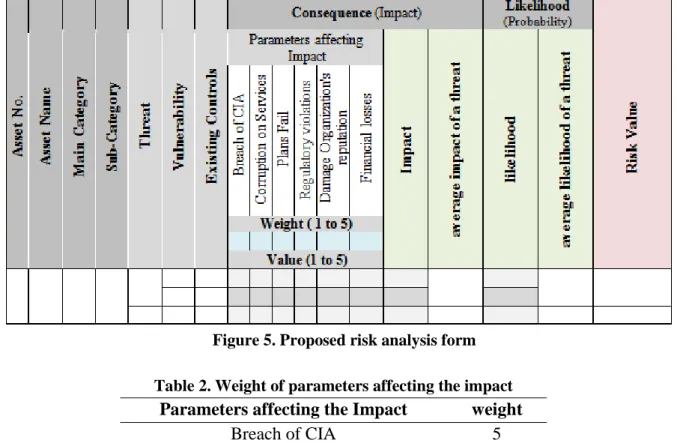
In the proposed solution, risk estimation takes advantage of a quantitative methodology and in order to estimate the value of risk, a specific risk analysis form would be designed. Figure 5 shows an instance of the form.
As shown in Figure 5, in order to estimate the value of consequence (impact), some parameters that affected the consequence, are defined and then based on managers' viewpoint, some weights are determined for each of them. The range of weights is between 1 and 5. An instance of these parameters and related weights is presented at Table 2. Then, security experts estimate each parameter value considering interview results. The domain of values is between 1 and 5, too. The value of impact is calculated according to Formula (1).
Formula 1: Impact = ∑
be mentioned that the range of impact will be between 0 and 100.
Also, the range of likelihood is between 0 and 1 and the value of that is estimated by security experts, considering factors like interview results, the number of vulnerabilities, the criticalness of vulnerabilities and so on.
Figure 5. Proposed risk analysis form
Table 2. Weight of parameters affecting the impact Parameters affecting the Impact weight
Breach of CIA 5
Corruption on Services 3
Plans Fail 2
Regulatory violations 1 Damage Organization's reputation 4
Financial losses 5
In order to manage the risks of identified important assets within scope and boundary of the system, the level of risk must be assessed by the combination of consequences and their likelihood. In this regard, the risk value will be estimated as the product of the impact and probability of each threat.
The range of Risk value will be between 0 and 100.
Then levels of identified risks should be compared with risk evaluation and risk acceptance criteria. In this solution, the risk level is divided into three levels based on the risk value:
1. Low; if 0<= Risk value <25 2. Medium; if 25<= Risk value <60 3. High; if 60<= Risk value <=100
1. Risk reduction: refers to reduce the level of risks by selecting controls and implementing them.
2. Risk retention: refers to retain the risk without further action.
3. Risk avoidance: is the action of avoiding activity or condition that raises the particular risk.
4. Risk transfer: risk could be transfer to another party that can manage the particular risk most effectively.
The risk treatment is a periodic process including: • assessing a risk treatment;
• deciding whether residual risk are acceptable;
• generating a new risk treatment if risk are not acceptable; • assessing the effectiveness of the treatment
Since it is possible that the risk treatment will not immediately lead to an acceptable level of residual risks, another iteration of the risk assessment might be required. Note that residual risks should be explicitly accepted by the managers of the organization. This is especially important when implementation of controls is omitted or postponed, e.g. due to cost. Then, the risk levels and the corresponding selected risk treatments should be approved by management.
Designing the ISMS
The final step of project is designing ISMS in which the organizational structure and documentation of the system would be designed. Also the final security policy should be published as an information security policy document of the organization. Based on chosen treatment options, ICT and physical security’s policies and procedures are developed.
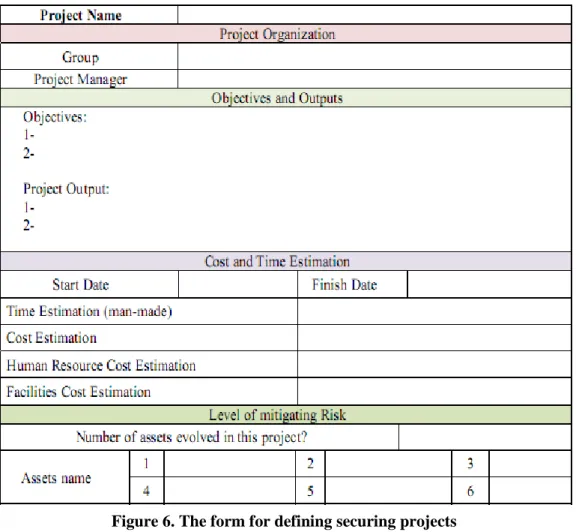
According to ISO 27003, the specific final ISMS project implementation plan is the output of this step. Based upon this plan, the ISMS project can be launched in the enterprise as part of the first “DO” phase of the PDCA cycle as described in (ISO/IEC 27005, 2011) For this purpose, in the proposed method, High-Risk and Medium-Risk Assets lists are sent to the owners. Also, the threats, related vulnerabilities, the values of impact and likelihood corresponding to each asset, are presented in lists. Along with the lists, some forms are sent to related groups of assets (asset owners) as forms of defining hardening projects (shown in Figure 6). These forms are used to define appropriate projects for securing of assets in order to reduce their risks to an acceptable level. The definition of these projects and implementing of their activities are done by assets owners. In this manner, the required actions and controls are defined and implemented by assets’ groups according to the risk treatment plan. The advantage of this method is avoiding the influence of security experts on activities of the groups of departments and their workflows.
In order to inform staff about information security, training and education programs must be planed (Humphreys, 2008). Finally, a procedure should be developed for management reviews of the system.
Figure 6. The form for defining securing projects
Results
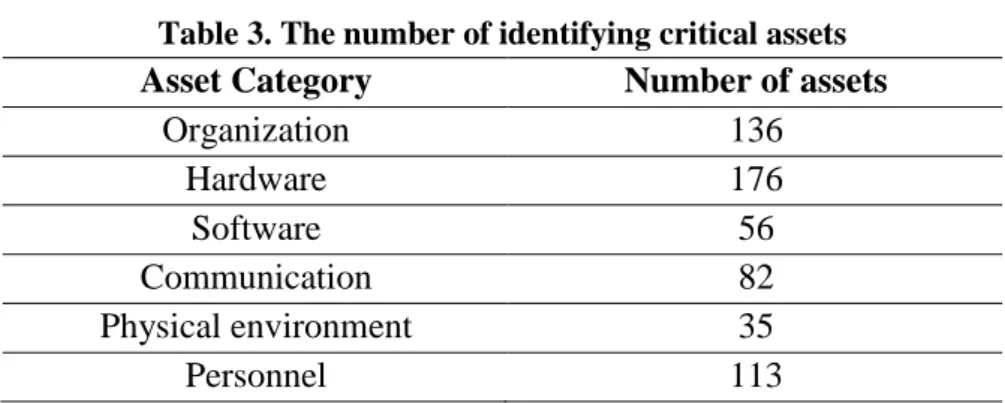
As a result of doing proposed steps in the case of mentioned enterprise, it took 50 hours effort and six people as security experts for interviewing activities. Also, analysis and assessment activities took 110 hours effort and three people as security experts. During this project, 598 critical assets were identified. Table 3 shows the number of these assets in each category.
Table 3. The number of identifying critical assets
Asset Category Number of assets
Organization 136
Hardware 176
Software 56
Communication 82
Physical environment 35
Personnel 113
Then, based on risk treatment options, appropriate actions and controls should be defined. For this purpose, high-risk and medium-risk lists of assets and associated threats, vulnerabilities and the values of impact and likelihood sent to the owners. Also, forms of defining hardening projects sent to asset owners. Based on these forms, assets owners defined appropriate projects for securing of assets in order to reduce their risks to an acceptable level. After approval of projects by security experts and managers, the required actions and controls were implemented by assets’ groups according to selected risk treatment option. The advantage of this method is avoiding the influence of security experts on activities of the groups of departments and their workflows. Then, required procedures developed for managing and monitoring of the projects.
Figure 7. The enterprise risky assets dispersal
It should be mentioned that because of the confidentiality of information in the case of this enterprise, it is not permitted to present the list of critical assets, related threats and vulnerabilities, identified risks and their values, hardening projects, implemented controls and related actions.
Conclusion
current status of information security to identify the enterprise security requirements. Hence, this paper presents a method to identify the current status of information security proportional to the scale and characteristic of the enterprise and based on implementation guidance of ISO/IEC 27000 series standards. The information security analysis provides senior managers a starting point for adequately decision making about ISMS implementation and also provides a clear understanding of facilities and situation of the organization in order to identify and document ISMS implementation conditions. In this regard, this solution helps enterprises recognize the activities related to the asset identification and related threats and vulnerabilities and risk assessment activities.
As a result of doing proposed method activities in the case of the enterprise (including 16 departments), 598 critical assets and associated 1001 threats and 1766 vulnerabilities identified. Each threat and related vulnerability may result in harm to a system or enterprise and security breaches, therefore it is considered as risk. In general, information about identified risks is very valuable to manage incidents and helps to reduce potential damage (Fung, Farn, & Lin, 2003). The result of the risk assessment helps to guide and determine the appropriate management actions and also priorities for managing information security risks and for implementing controls selected to protect assets against these risks.
Finally,the enterprise risky assets dispersal was presented for enterprise managers and then, based on security policies and decisions for the treatment of risks have been made by senior managers, appropriate actions is performed to ensure risks are reduced to an acceptable level.
Acknowledgements
The issues and views presented in this paper were explored in the ISMS implementation project at Behsazan Mellat Co.6 that develops and maintains electronic banking systems of “Mellat Bank” which has been ranked first in e-banking services providing in Iran. The authors would like to thank the executive manager of this project, and also the senior manager for encouragement related to the contents of this study and additional support.
Notes 1. International Organization for Standardization 2. Payment Card Industry Data Security Standard 3. Information Technology Infrastructure Library
4. Control Objectives for Information and related Technology 5. Generally Accepted Systems Security Principles
6. www.behsazan.com
References
Broderick, J. (2006). ISMS, security standards and security regulations. information security technical report 11(1).
Fiona, P. (2007). Certifying. Information Security. Management Systems. CISSP.
Fung, A., Farn, K. & Lin, A. (2003). A study on the certification of the information security management system. Computer Standards & Interfaces, 25(10), 447–61.
Hensel, V. & Lemke-rust, K. (2010). On an Integration of an Information Security Management System into an Enterprise Architecture. Dexa.
Hopkinson, J. (2001). Security standards overview. Proceedings of the Second Annual of International Systems Security Engineering Conference.
Humphreys, E. (2008). Information security management standards: Compliance, governance and risk management. information security technical report, 13, 255-74. ISO/IEC 27001:2005. (2005). Information technology- security techniques- information
security management systems- requirements. Geneva: International Organization for Standardization.
ISO/IEC 27002:2005. (2005). Information technology - Security techniques -Code of practice for information security management. Geneva: International Organization for Standardization.
ISO/IEC 27005:2011, (2011). Information technology - Security techniques - Information security- risk management.
Jacqueline, B. (2003). The BS 7799 / ISO 17799 Standard For a better approach to information security. White Paper CISSP, Callio Technologies.
Siponen, M. & Willison, R. (2009). Information security management standards: Problems and solutions. Information & Management, 46(5), 267-70.
Standard, B. S. I. (2005). 100-1: Information Security Management Systems (ISMS). Susanto, H., Almunawar, M. & Tuan, Y. (2011). Information security management system