VOLUME 18 ISSUE 1 (2020), Page 133 – 144
STUDIES ON THE CULTURAL ECOSYSTEM SERVICES IN MALACCA CITY
Nur Shazwanie Rosehan1, Azlan Abas2 & Kadaruddin Aiyub3
1,2,3Centre of Social, Development & Environmental Studies (SEEDS), Faculty of Social Sciences and Humanities
UNIVERSITI KEBANGSAAN MALAYSIA
Abstract
The benefits from ecosystem services have the prospective and potential to improve the Malay urban design and increase the quality of life. However, rapid development and urbanization activities are increasingly causing a conversion from the original functions and changes that can affect the urban environment. This paper aims to update current understanding of the concept of Malay cultural ecosystem services in Malacca City. Quantitative research through the survey method to 150 Malay respondents have been carried out in order to identify the parameters describing the types and value of the Malay cultural ecosystem services in the city context. The result revealed aesthetic value, recreational, tourism, social relations, spiritual and educational as the most significance parameters of the Malay cultural ecosystem services. The paper concluded that only through good practices from all parties can reduce the incredible development effects as political, economic and social systems is inevitable and constantly generates new demand.
INTRODUCTION
The Malay city possesses a unique urban design and concept, as well as a unique architectural identity. Moreover, Malay urban is one of the oldest civilizations in the world. The urban design deals with both the aesthetic and functional aspects of the City's built environment. Aesthetics, being the traditional concern of the urban design can only be more meaningful when they are combined with other considerations to generate an environment that is visually pleasant, convenient, comfortable, which conveys a sense of place, pride and belonging (Dewan Bandaraya Kuala Lumpur, 2020). The Millennium Ecosystem Assessment (MEA) (2005) defines the ecosystem services as the advantages people obtain from the ecosystem and its surroundings. Ecosystem services are the goods given to humans throughout the conversions of environments such as water and vegetation into a flow of necessary services and goods such as food and clean air (Constanza et al. 1997). Therefore, it becomes important to understand the role of nature in maintaining human well-being including the Malay cities and Malay urban design.
Zhang et al. (2016) has categorized these direct and indirect ecosystem services into four categories to sustain human well-being and survival throughout the world. These are including the regulation (e.g., disease control and flood regulation, support (e.g., primary production and nutrient cycling), provisioning (e.g., freshwater and fiber) and cultural (e.g., recreational and spiritual reflection). The ecosystem service concept can be adapted to urban ecosystems because the services for various inhabitants are important and needed (Tratalos et al. 2007; Ahern, 2007). In this case, urban planning plus urbanization activities are often associated with the development potential of ecosystem services including in the Malay urban design. Therefore, its ecosystem services will also decrease. This is because an urban ecosystem will be worthless if it is unable to provide any basic benefit and human need.
The rising request and demand for space for new users in the associated residential and industrial areas have generated massive uncontrolled built-up areas that occur in many developing countries and developed cities (Gonzalez & De Lazaro, 2011). Human activities can dominate the changes in land use and unnecessary synergies and trade-offs in the context of the ecosystem service's provision (Zhang et al. 2016). Sometimes, some of the old buildings carry a lot of traditional and unique identities in terms of history, architectural and heritage value which later reflected towards the urban form aspect (Abdullah et al. 2018). Hence, the contributions of the ecosystem services to the human well-being and world's economy have been recognized in policy and also in the basic science and policy (Egoh et al. 2012; Corbera, 2012; Van Oudenhoven et al. 2012; Muller and Burkhard, 2012).
agricultural land to residential or industrial areas planning. Generally, this changes the physical environment consisting of either atmosphere, biosphere, lithosphere and even hydrosphere (Md Jahi, 1993). Changes that occur as a result of human activities can affect the human environment such as the impact on the well-being of people. Besides, measuring the quality and well-being of the population who received the impact of rapid development is too difficult for a community or individual. In this context, although there are no indicators or effective methods for measuring cultural service satisfaction and the well-being of the population, the rapid development activities in one area will certainly have a social impact on the population in particular.
Malay urban cities, such as Malacca City with the highest percentage of Malay population, consist of designated built that can accommodate urban ecosystem services in cultural categories. In this study's point of view, its only focused on the cultural categories of the Malay urban ecosystem services in the Malay city as concerned in recognizing the social quality and level, despite the fact that the Malay urban ecosystem services provided more than the services. The cultural services, which include the direct uses of non-material (Sarukhan and Whyte, 2003) also cause bad qualifications and consolidation in management terms (de Groot et. 2005). The study of ecosystems that researchers often deal with is related to cultural aspects such as social relations, recreation, tranquillity, culture, tourism and a host of other ecosystem services. Cultural-based ecosystem services are often included under the direct use values (Sarukhan & Whyte, 2003) and undergo reduction and integration in management plans (de Groot et al., 2005). However, in Malaysia, little research has been done on contemporary history and culture as conducted by researchers in other ASEAN countries, namely Singapore.
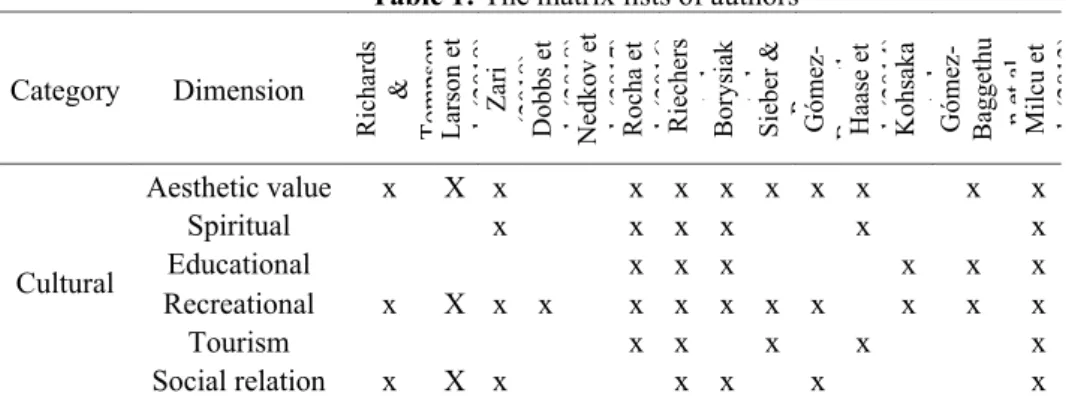
Table 1: The matrix lists of authors
Category Dimension
Ric har ds & Tom pson (2019) La rson et al. ( 2019 ) Za ri (2018 ) Dobbs et al . (2018) Nedkov et al
. (2017) Rocha
et al . ( 2016 ) Rieche rs et al. (2016)
Borysiak et
al. (2016) Siebe r & Pons (2015) Gómez -Bagge thu n et al. (2014 ) Haa se et al
. (2014) Kohs
aka et al. (2013) Gómez -Bagge thu n et al. (2013) Milc u et al . (2013) Cultural
Aesthetic value x X x x x x x x x x x
Spiritual x x x x x x
Educational x x x x x x
Recreational x X x x x x x x x x x x
Tourism x x x x x
Social relation x X x x x x x
Furthermore, it is also important to achieve the Sustainable Development Goals by 2030 for a better and more sustainable future for all, including environmental degradation, peace and justice in order to leave no one behind. In order to determine the Malay urban ecosystem services and cultural in Malacca City this study aims to measure the value of the urban ecosystem services that have been provided based on the perception of the Malay communities. In addition, the researcher hope that this study will complement existing policy and help to design better conservation plan for the Malay urban ecosystem services and cultural in the area. Then, the paper also discusses about the methodology and approach that been used and also the results based on the study, as well as the discussion and conclusions. Hence, the researcher concludes this study by a brief overview role to make sure that the Malay urban, especially in Malacca and other cities in Malaysia, to be sustainable and more liveable with the right guideline in the present and future.
METHODOLOGY
The study was conducted around the city of Malacca with an area of 114.7 square miles (303 km²). Malacca City is a famous tourism city and it is administered by the Malacca City Council (Majlis Bandaraya Melaka Bersejarah, MBMB). Furthermore, the Malaysian Census in 2010 reported that the population of Malacca City was 484,885, which Malays comprised the majority ethnics with 273,844. Therefore, the study was conducted in Malay residential areas around the city such as Taman Pahlawan, Kampung Padang Temu, Kampung Melayu, Taman Sungai Udang and Kampung Kubu. The selection of the study area also includes the placement of the special Malay urban design elements around the study area especially building design and historical heritage that have their aesthetic value with the highest percentage of Malay population.
purposive sampling method where the form was distributed only to 150 Malay respondents who live in and around Malacca City via door-to-door surveys. 150 respondents were sampled in the experimental group that focuses on the characteristics of the Malay respondents and it also withers away as a backup sample in these pilot studies. Furthermore, the survey forms were distributed to the respondents to measure their perception on the urban ecosystem services that are provided around them and also to measure the cultural level in their community's life. Besides, the secondary data are obtained from various sources including through the ministry's website and the Local Authority such as Majlis Bandaraya Melaka Bersejarah (MBMB).
RESULTS
Respondent’s Background
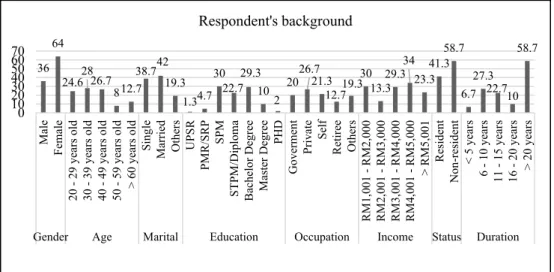
Figure 1 shows the respondent's background in the sampling area around Malacca City.
Figure 1:The respondent’s background
Then, based on the survey that is distributed to 150 Malay respondents, 64% were females and 36% were males. In terms of age, it was divided into 6 age categories. The first category was under 19 years, that has no respondents, then 20-29 (24.6%), 30-39 (28%), 40-49 (26.7%), 50-59 (8%) and >60 years old (12.7%). Besides, most of the respondents have a bachelor's degree (29.3%), followed by SPM (30%), PMR (4.7%), PHD (2%) and UPSR (1.3%). For occupation background, most of the respondents work in the private sectors (26.7%), followed by self-employed sectors, the government sectors (20%), and the remaining were retirees (12.7%). Next, in terms of residency status, where the
36 64
24.62826.7 812.7 38.742 19.3 1.34.7 30 22.7 29.3 10 2
2026.721.3 12.719.3
30 13.3
29.33423.341.3 58.7 6.7 27.3 22.710 58.7 0 10 20 30 40 50 60 70 M ale Fem ale 20 - 29 year s ol d 30 - 39 year s ol d 40 - 49 year s ol d 50 - 59 year s ol d > 60 year s o ld Sin gle M arried Oth er s UPS R PM R/SR P SPM ST PM/D ip lo m a Bach elo r Deg ree M aster Deg ree PHD Go vermen t Pr iv ate Self Retir ee Oth er s RM 1, 00 1 RM2 ,000 RM 2, 00 1 RM3 ,000 RM 3, 00 1 RM4 ,000 RM 4, 00 1 RM5 ,000 > R M 5,001 Res id en t No n-r esident < 5 yea rs 6 1 0 year s 11 - 15 year s 16 - 20 year s > 20 year s
Gender Age Marital Education Occupation Income Status Duration
original respondents from Malacca, or vice versa, most of them came from other areas or cities which were 58.7% and 41.3% were the original residence from Malacca. Most of the respondents have stayed in Malacca for more than 20 years and less than 5 years (6.7%). Overall, majority of the respondents have lived for a long time in the city and keep productive to enjoy the Malay cultural and urban ecosystem service cycle there.
Malay Urban Ecosystem Services Assessment
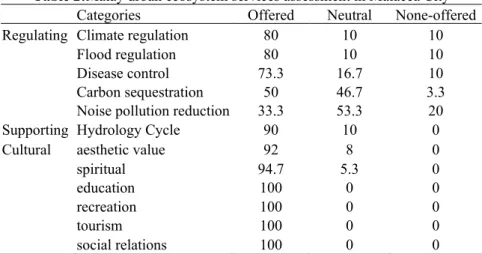
Table 2 shows the respondent's perception on the urban ecosystem services that are offered around them from the survey data in Malacca City. All the urban ecosystem services were measured based on a Likert scale with 3 scores: offered, neutral and none-offered. The classification of urban ecosystem services was referred to as Millennium of Ecosystem Assessment (2005) and The Economics of Ecosystems and Biodiversity (2011); five services belong to regulating services, single service from supporting services and six services from cultural services. However, there is no service from provisioning services because its services were rare and none was offered directly in the urban ecosystem services as shown in Table 2.
Table 2:Malay urban ecosystem services assessment in Malacca City
Categories Offered Neutral None-offered
Regulating Climate regulation 80 10 10
Flood regulation 80 10 10
Disease control 73.3 16.7 10
Carbon sequestration 50 46.7 3.3
Noise pollution reduction 33.3 53.3 20
Supporting Hydrology Cycle 90 10 0
Cultural aesthetic value 92 8 0
spiritual 94.7 5.3 0
education 100 0 0
recreation 100 0 0
tourism 100 0 0
social relations 100 0 0
remaining 10% disagreed. Besides, based on the table, it also shows that most of the respondents (50%) are neutral about the carbon sequestration that is offered at their areas and 46.7% of respondents agreed that the service is offered. In terms of noise pollution reduction, 53.3% of respondents are neutral that Malacca City has offered the services of noise pollution reduction, while the remaining 33.3% of them agreed and 20% disagreed. Overall, based on the result, the most significance of the urban ecosystem services provided by classified them, including cultural services (aesthetic value, recreational, tourism, social relations, spiritual and educational).
Assessment of Malay Urban Cultural in Malacca City
Based on Figure 2, the study found that the overall cultural components; educational, aesthetic value, recreational, tourism, spiritual and social relations were in a satisfactory condition, which means that these services were provided in the city.
Figure 2: Malay cultural assessment in Malacca City
The level of respondents' cultural satisfaction was measured and analyzed from the survey data. Then, the figure shows that the highest level of satisfaction among the cultural services is in the aesthetic value and tourism services with a value of 20 respectively, followed by educational services with 19.93, both recreational and social relation services have the value of 19.6 and spiritual services have the value of 18. The cultural ecosystem services are defined in the report of the Millennium Ecosystem Assessment (MEA) as "nonmaterial benefits the people obtain from ecosystems through spiritual enrichment, cognitive development, reflection, recreation, and aesthetic experiences" (MEA, 2005a:40).
19.934
20
19.6
20 18
19.6
17 18 19 20 Educational
Aethetic value
Recreation
Tourism Spiritual
Social relations
DISCUSSION
Overall, the paper gives a summary of all aspects that are related to this Malay urban studies including the concerns of current studies that are related to the Malay urban design and urban ecosystem services. There are several problems and challenges that need to be faced while carrying out this study. In the area of data collection in the field, namely the distribution of questionnaires, the problems and the main challenges are the difficulty to get the Malay respondents to complete the questionnaire. Besides, many respondents did not understand the term and key variables in this study of the urban ecosystem services and the Malay cultural services. Therefore, the researcher should take a considerable amount of time to inform the respondents before they complete the questionnaire form.
Based on the findings, Malacca City provided good Malay urban ecosystem services which were the regulating services i.e. climate regulation, flood regulation, disease control, carbon sequestration, noise pollution reduction, then supporting services i.e. hydrology cycle and cultural services i.e. spiritual, recreational, tourism, aesthetical value, educational and social relations. However, no service from provisioning services seems important because its services were rare, and none is offered directly in the urban ecosystem services. Based on this, the attempt to generate a liveable and sustainable city, including a Malay urban design that is complete with all the good infrastructures, social activities and interests, green landscapes, human security, social safety and protection, residents, public health, education and social work; shows the sustain process and usually needs enhancement (Khalid, 2016).
Based on the questionnaires that have been answered by the respondents, most of them were agreed that they got benefits in the educational services categories in Malacca City. For example, ‘’the residents are easy to access in education and a variety of facilities are available in channeling
knowledge’’ questions which mostly got the highest score (85%) among the
respondents. Education, that interest in the quality of living that connected to people living and allows people to make better decisions with their valued outcome (Ayoroa et al. 2010). Tourism's impact on the socio-cultural identity of the community such as introducing unique to foreign tourists also showed the highest score (90%) among the respondents. Based on this, Malacca City has ventured as an educational urban and tourism. It was supported by a studied that done by Samsir et al. (2016) and stated that tourism products in Malacca have valuable knowledge and experience for communities and tourists.
attraction design (Abdullah 2012). Furthermore, based on aesthetic value services in Malacca City, some landscapes have a high aesthetic value and quality in the vicinity (82% scores) and the historic building has a role in the cultural landscape also got the highest scores (79%) among the respondents. It connected with the studies that Malacca is a popular tourism terminus and destination that rich with cultural attraction and historical heritage which also offers knowledge and educational opportunities to various communities including Malays and visitors (Samsir et al. 2016).
As reported by Elmqvist et al. (2015), cities are a key nexus of the relationship between people and nature and are the huge centers of demand for ecosystem services and also generate extremely large environmental impacts. It can be seen based on the results that Malacca City was a convenient city and good in providing the urban ecosystem services, especially towards Malay's communities. While the city can provide many benefits and services to humans through the development and urban expansion activities, however, it remains an adverse impact on the environment. Thus, maintaining and increasing the providing of various ecosystem services, are relevant and significant in both perspectives of human living and the economic such as marketed and non-monetary services (Loinaz et al. 2015). This is important for the Malay urban dweller and communities who are surviving in the urban area in long duration and to make sure that their quality of life is in a good condition including in the cultural services. According to Ali et al. (2010), urban dweller's quality of life is very much depending on the livability of the city and people tend to leave the city when it has become less livable.
improved. Next, the SDG's goals as planned will be achieved as all the countries comply with the policies such as the Paris Agreements, and hence the standard of urban ecosystem services would be allowed to enhance in the future.
Studies on the urban ecosystem services and urban design have received increasing attention from researchers covering various aspects such as the study of culture and the benefits of its services, especially to humans and the environment. Therefore, there are several research proposals for future research. In this study, the researchers emphasize the cultural aspects of the Malay population in the city of Malacca. In the next study, the researcher intends to broaden the scope of the study area to include a broader range of aspects and scopes. In the context of data analysis, the researcher uses only a simple descriptive analysis, therefore in future research, the researcher intends to diversify the data analysis method so that various data inputs can be presented and discussed in detail. For example, a statistical analysis such as the Correlation Test and the Manova test can be utilized. So, the studies on aspects of urban ecosystem services and each category are relevant for implemented to ensure that urban areas with variety of ethnic groups including Malay communities will live safe, habitable and sustainable time by time.
CONCLUSION
The study has given an overview on Malay urban ecosystem services and Malay cultural in Malacca City that related to variety of benefits provided by the environment especially to the community and economy for maintaining human well-being. Overall, based on the result and the studies, the most significance of the urban ecosystem services provided by classified them, including cultural services (aesthetic value, recreational, tourism, social relations, spiritual and educational), regulating services (climate regulation, disease control, flood regulation, carbon sequestration and noise pollution reduction) then followed by supporting services (hydrological service). Finally, the paper concludes that the level of satisfaction among respondents toward the urban ecosystem services that have been offered in Malacca City is moderately good, but a few adjustments and improvements are in need immediately. So, all the parties should play an important role to make sure the cities especially Malacca City keep sustainable and more livable with the right policies and guidelines efficiently.
ACKNOWLEDGEMENTS
REFERENCES
Abdullah, N. F. (2012). Masjid Sebagai Pengendali Penginapan: Kajian Kes Di Masjid Al Ghufran, Selangor. Conference: Tourism and Hospitality International Conference (THIC 2012).
Ahern, J. (2007). Green infrastructure for cities: The spatial dimension. Conference Cities of the Future: Towards Integrated Sustainable Water and Landscape Management. IWA Publishing.
Abdullah, A. A. A., Mohd Noor, N. & Abdullah, A. (2018). Drone 3D mapping in identifying Malay urban form: case study of Kota Bharu. IOP Conference Series: Earth and Environmental Science, 169.
Ali, H., Rashid, N. H. A., Lukman, Z. M. & Awang, A. (2010). Socioeconomic well- being and the quality of life between regions: A case of Malaysia. International Business Management, 4(4), 250-254. https://doi.org/10.3923/ibm.2010.250.254 Ayoroa, P., Bailey, B., Crossen, A. & Geo-JaJa, M. A. (2010). Education in China: The
Urban/Rural Disparity Explained in Zajda. J. (ed.), Globalisation, Ideology and Education Policy Reforms, Globalisation, Comparative Education and Policy Research 11, Globalisation, Ideology and Education Policy Reforms, 89-113. Corbera, E. (2012). Problematizing REDD+as an experiment in payments for
ecosystem services. Current Opinion in Environmental Sustainability,4(6), 612-619.
Costanza, R., D’Arge, R., De Groot, R., Farber, S., Grasso, M., Hannon, B., Limburg, K., Naeem, S., O’Neill, RV., Paruelo, J., Raskin, RG., Sutton, P. & Vandenbelt, M. (1997). The value of the world’s ecosystem services and natural capital.
Nature International Journal of Science,387 (1997), 253-260.
De Groot, R., Ramakrishnan, P. S., Berg, A.V. D., Kulenthran, T., Muller, S., Pitt, D. & Wascher, D. (2005). Chapter 17: cultural and amenity services. Pages 455-476 in Hassan, R., Scholes, R., Ash, N., Ecosystems and human wellbeing: current state and trends, volume 1. Findings of the Condition and Trends Working Group of the Millennium Ecosystem Assessment.
Dewan Bandaraya Kuala Lumpur. 2020. Kuala Lumpur Structure Plan (2020) in Urban Design and Landscape.
http://www.dbkl.gov.my/pskl2020/english/urban_design_and_landscape/index. Egoh, B., O'Farrell, P., Charef, A., Gurney, L. J., Koellner, T., Abi, J. N., Egoh, M. & Willemen, L. (2012). An African account of ecosystem service provision: use, threats
and policy options for sustainable livelihoods. Ecosystem Services,2(2012), 71-81. https://doi.org/10.1016/j.ecoser.2012.09.004
Eliasson, I., Knez, I. & Fredholm, S. 2019. Heritage Planning in Practice and the Role of Cultural Ecosystem Services. Journal Heritage & Society, 11(1), 44-69. https://doi.org/10.1080/2159032X.2019.1576428
Elmqvist, T., Setala, H., Handel, S. N., van der Ploeg, S., Aronson, J., Blignaut, JN., Gomez-Baggethun, E., Nowak, DJ., Kronenberg, J. & de Groot, R. 2015. Benefits of
restoring ecosystem services in urban areas. Current Opinion in Environmental Sustainability,14,101-108. https://doi.org/10.1016/j.cosust.2015.05.001.
Khalid, K. A. T. (2016). Konsep, dasar dan perlaksanaan Bandar Sejahtera dengan rujukan khas kepada Malaysia. Malaysian Journal of Society and Space,12(7), 26 - 33.
Md Jahi. J. (1993). Issues of Environmental Management through Legislative Measures in Malaysia. Akademika, 42 (1), 181-204.
Milcu, A. I., J., Hanspach, J., Abson, D. & Fischer, J. 2013. Cultural ecosystem services: a literature review and prospects for future research. Ecology and Society, 18(3),
44. http://dx.doi.org/10.5751/ES-05790-180344
Millennium Ecosystem Assessment Series. Island Press: Washington, D.C., USA. Millennium Ecosystem Assessment (MEA). 2005. Ecosystems and Human Wellbeing:
Synthesis Report. Island Press: Washington, DC.
Müller, F. & Burkhard, B. (2012). The indicator side of ecosystem services. Ecosystem Services, 1(1), 26-30. https://doi.org/10.1016/j.ecoser.2012.06.001
Riechers, M., Barkmann, J. & Tscharntke, T. (2016). Perceptions of cultural ecosystem services from urban green. Ecosystem Services, 17(2016), 33–39. Rodríguez-Loinaz, G.,
Josu G., Alday, J. G. & Onaindia, M. (2015). Multiple ecosystem services landscape index: A tool for multifunctional landscapes conservation. Journal of
Environmental Management, 147(2015), 152-163.
https://doi.org/10.1016/j.jenvman.2014.09.001
Samsir, S. W., Ahmad, H., Choy, E. A., Jusoh, H. & Mat Jali. M. F. (2016). Meneroka Edupelancongan Di Melaka Bandaraya Warisan Dunia Berasaskan Pengalaman Pelancong Domestik. Malaysia Journal of Society and Space, 12(11), 156-167. Sarukhán, J. & Whyte, A. (2003). Ecosystems and human well-being: a framework for
assessment. Millennium Ecosystem Assessment Series. A report of the Conceptual Framework Working Group of the Millennium Ecosystem Working Group. Island Press: Washington: Island Press.
The Economics of Ecosystems and Biodiversity in National and International Policy Making. (2011). Edited by Patrick ten Brink. Earthscan, London and Washington. Tratalos, J., Fuller, R. A., Warren, P. H., Davies, R. G. & Gaston, K. J. (2007). Urban
form, biodiversity potential and ecosystem services. Landscape and Urban Planning, 83(4), 308-317. https://doi.org/10.1016/j.landurbplan.2007.05.003 Van Oudenhoven, A., Petz, K., Alkemade, R., Hein, L. & de Groot, R. (2012).
Framework for systematic indicator selection to assess effects of land management on ecosystem services. Ecology Indicator,21, 110-122.
Zhang, Z. M., Gao, J. F., Fan, X. Y. & Lan, Y. (2016). Assessing the variable ecosystem services relationships in polders over time: a case study in the eastern Chaohu Lake Basin, China. Environmental Earth Science, 75(856), 1-13. https://doi.org/10.1007/s12665-016-5683-5