(online) = ISSN 2285 – 3642 ISSN-L = 2285 – 3642
Journal of Economic Development, Environment and People Volume 5, Issue 2, 2016
URL: http://jedep.spiruharet.ro e-mail: [email protected]
Engaging Romanian teachers in a 3D feedback process
Mihaela Purcaru1, Natalia Manea2
1
Bucharest Academy of Economic Studies, [email protected] 2
University Politehnica of Bucharest, [email protected]
Abstract. This article presents a comparative overview regarding pupil’s perceptions about quality of the educational act. Some of the key topics that are taken into consideration are the culture of learning environment, the expectations, the confidence and the feelings about the school’s climate. The research is a specific practice within Teach for Romania organization that comes as an innovation method in the Romanian educational system and only applies to teachers of TFR.
Keywords: Teach for All, Teach for Romania, Panorama Teachers Survey, engaging, feedback process
JEL Codes: I21
1.
Introduction
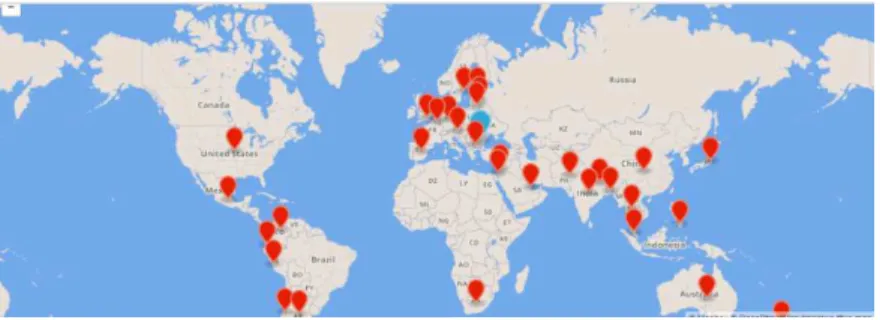
Teach for All supports its partner organizations in transforming the educational context of their countries from the inside, learning from each other, sharing solutions, and accelerating their overall impact. The teachers, alumni, and employees of the network adapt their solutions to the local context, generating innovations that can be shared to accelerate progress across the network. The mission of Teach for All is to extend access to education all over the world by increasing and accelerating the impact generated by organizations cultivating the necessary leadership for transformational change. Given the similarity in the nature of the problems faced by the countries participating in the network, solutions can be shared across frontiers. Teach for All is present in over 46 countries.
(online) = ISSN 2285 – 3642 ISSN-L = 2285 – 3642
Journal of Economic Development, Environment and People Volume 6, Issue 3, 2017
URL: http://jedep.spiruharet.ro e-mail: [email protected]
Teach for Romania is a Teach for All subsidiary, created for children in Romania today, in order to achieve their basic education. The knowledge they acquire in school and the environment in which they grow up are crucial for creating their future life options. The quality of education received before the age of 15 determines children’s life trajectory.
According to PISA’s 2012 international survey, Romanian students are the least motivated of all students of the 65 countries analyzed. Other recent international studies demonstrate that Romania’s education system ranks towards the bottom of both European and global rankings.
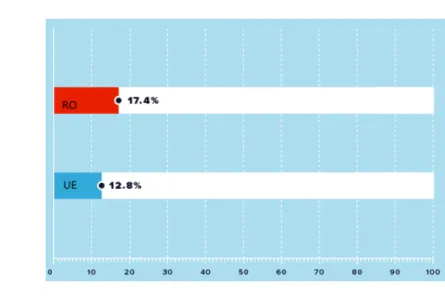
Fig. 2: School motivation and school drop-out rates Source: http://en.teachforromania.org
Lack of motivation is a real and alarming problem. Upwards of 40 percent of high school students are chronically disengaged with school, according to a 2003 National Research Council report on motivation.
The causes of the aforementioned results are complex and varied, but there are three underlying key factors:
− Parents’ limited education and involvement: The low level of parents’ education and their limited involvement in their children’s schooling generate a vicious circle: children from disadvantaged schools become parents with low education who cannot help their own children succeed and surpass the limits imposed upon them by their environment.
(online) = ISSN 2285 – 3642 ISSN-L = 2285 – 3642
Journal of Economic Development, Environment and People Volume 5, Issue 2, 2016
URL: http://jedep.spiruharet.ro e-mail: [email protected]
contribute to covering household and school costs. This reduces the time available for learning and individual preparation and can ultimately lead to parents taking their children out of school.
− Lack of motivation: the teaching profession has become a last option for top Romanian graduates. Teacher salaries in Romania are among the lowest (as a percentage of average income) of all countries participating in the 2012 PISA survey. This reality is confirmed by the fact that more than 50% of those who took the 2013 national teacher certification exam did not achieve a grade above seven, the minimum required for access to permanent teaching positions.
− Attitude towards students: Romanian teachers’ expectations of “problem” students are usually low, with a focus on keeping students in the classroom rather than on improving academic performance. Faced with such low expectations, students see no reason to make an effort to study or to even attend classes. They thus face an increased risk of dropping out before finishing their studies.
− Discrimination against disadvantaged students (e.g. Roma, rural students) often leads to de facto segregation caused by “white flight,” non-Roma parents taking their children out from Roma schools or explicit segregation by creating separate classes for Roma students or assigning them to special education classes. Ultimately, underperforming students come predominantly from families affected by poverty with limited experience of formal education. Rather than counter these problems, the Romanian education system tends to exacerbate them, reinforcing stereotypes and augmenting inequalities.
The Teach for Romania model was initially developed in 1990 by Teach for America in the United States. It aims to attract top graduates who would not have normally considered the teaching profession among their future professional options. The model works successfully in 34 countries across 5 continents, where it is implemented by the partner organizations of the Teach for All network.
Since the spring of 2015, every year, teachers are 3D evaluated by using Panorama Teacher Survey to give school and organization a tool to collect feedback from pupils. The survey is designed to spark and support productive conversations between teachers and pupils about professional learning, school communication, and school climate. The report is available only for the members (teachers and mentors) of TFR community.
2.
Research methodology
The research is split in all the countries that TFA has teachers, and my contribution is to compare the results obtained for TFR with the average of the network in order to see if there are some major differences.
This quantitative research was for the part of the year during which school is in session, typically lasting from September 2016 to June 2017. A classical questionnaire was distributed to the students of all the classes where the TFR’s teachers have courses and in the primary schools the questions where adapted to the level of comprehensions of the pupils.
(online) = ISSN 2285 – 3642 ISSN-L = 2285 – 3642
Journal of Economic Development, Environment and People Volume 6, Issue 3, 2017
URL: http://jedep.spiruharet.ro e-mail: [email protected]
• Encouraging and supportive relationships fostered
90% Romania
Global Network average: 82% Teach For All
Q.1: I like the way my teacher treats me when I need help.
Q.2: My teacher is nice to me when I ask questions.
Q.3: My teacher in this class makes me feel that s/he really cares about me.
Q.4: If I am sad or angry, my teacher helps me feel better.
Q.5: The teacher in this class encourages me to do my best.
Q.6: My teacher seems to know if something is bothering me.
Q.7: My teacher gives us time to explain our ideas.
• Engaging learning environment established
76% Romania
Global Network average: 72% Teach For All
Q.1: School work is interesting.
Q.2: We have interesting homework.
Q.3: Homework helps me learn.
Q.4: School work is not very enjoyable. Do you agree?
• Learning fully internalized
84% Romania
Global Network average: 78% Teach For All
Q.1: My teacher takes the time to summarize what we learn each day.
Q.2: When my teacher marks my work, s/he helps me understand.
• Positive culture and learning environment created
48% Romania
Global Network average: 56% Teach For All
Q.1: My classmates behave the way my teacher wants them to.
Q.2: Our class stays busy and does not waste time.
Q.3: Students behave so badly in this class that it slows down our learning.
(online) = ISSN 2285 – 3642 ISSN-L = 2285 – 3642
Journal of Economic Development, Environment and People Volume 5, Issue 2, 2016
URL: http://jedep.spiruharet.ro e-mail: [email protected]
• Rigorous expectations held
82% Romania
Global Network average: 84% Teach For All
Q.1: My teacher pushes us to think hard about things we read.
Q.2: My teacher pushes everybody to work hard.
Q.3: In this class, we have to think hard about the writing we do.
Q.4: In this class, my teacher accepts nothing less than our full effort.
• Student input and ideas valued
86% Romania
Global Network average: 82% Teach For All
Q.1: My teacher asks questions to be sure we are following along when s/he is teaching.
Q.2: My teacher checks to make sure we understand what s/he is teaching us.
Q.3: My teacher tells us what we are learning and why.
Q.4: My teacher wants us to share our thoughts.
Q.5: Students speak up and share their ideas about class work.
Q.6: My teacher wants me to explain my answers − why I think what I think.
• Understanding checked for and ensured
84% Romania
Global Network average: 83% Teach For All
Q.1: My teacher explains things in very orderly ways.
Q.2: In this class, we learn to correct our mistakes.
Q.3: My teacher explains difficult things clearly.
Q.4: My teacher has several ways to explain each topic that we cover in this class.
Q.5: I understand what I am supposed to be learning in this class.
Q.6: My teacher knows when the class understands, and when we do not.
Q.7: This class is neat − everything has a place and things are easy to find.
Q.8: If I don’t understand something, my teacher explains it another way.
Q.9: When s/he is teaching us, my teacher asks us whether we understand.
3.
Conclusions
(online) = ISSN 2285 – 3642 ISSN-L = 2285 – 3642
Journal of Economic Development, Environment and People Volume 6, Issue 3, 2017
URL: http://jedep.spiruharet.ro e-mail: [email protected]
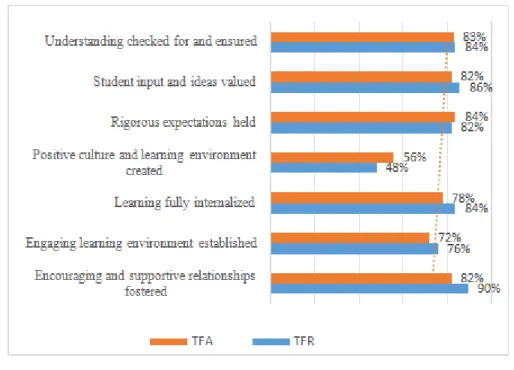
indicator score. Both TFR and TFA have the same issue and in our country things are even worst. The other indicators (Fig. 3) are almost similar in both areas and the results are very encouraging.
3D evaluation, using student’s perception of the quality of educational act, is very useful for the organization in order to have strategic interventions for increasing it.
Fig. 3: Survey summary
Source: date processed by the authors’ text.
4.
References
[1] Panorama Education 2017 evolution report (available only for members).
[2] Engaging Schools: Fostering High School Students’ Motivation to Learn (2003), The National academies press, 500 Fifth Street, NW, Washington, DC 20001, https://www.nap.edu/read/10421/chapter/1
[3] The Centre on Education Policy is a national, independent source for research and information about public education, https://www.cep-dc.org//
[4] Teach for Romania, http://en.teachforromania.org/