Juniper Networks, Inc.
1194 North Mathilda Avenue Sunnyvale, CA 94089 USA408-745-2000
www.juniper.net
Part Number: 530-015647-01, Revision 09
Security Products
2
without notice.
FCC Statement
The following information is for FCC compliance of Class A devices: This equipment has been tested and found to comply with the limits for a Class A digital device, pursuant to part 15 of the FCC rules. These limits are designed to provide reasonable protection against harmful interference when the equipment is operated in a commercial environment. The equipment generates, uses, and can radiate radio-frequency energy and, if not installed and used in accordance with the instruction manual, may cause harmful interference to radio communications. Operation of this equipment in a residential area is likely to cause harmful interference, in which case users will be required to correct the interference at their own expense.
The following information is for FCC compliance of Class B devices: The equipment described in this manual generates and may radiate radio-frequency energy. If it is not installed in accordance with Juniper Networks’ installation instructions, it may cause interference with radio and television reception. This equipment has been tested and found to comply with the limits for a Class B digital device in accordance with the specifications in part 15 of the FCC rules. These specifications are designed to provide reasonable protection against such interference in a residential installation. However, there is no guarantee that interference will not occur in a particular installation.
If this equipment does cause harmful interference to radio or television reception, which can be determined by turning the equipment off and on, the user is encouraged to try to correct the interference by one or more of the following measures:
Reorient or relocate the receiving antenna.
Increase the separation between the equipment and receiver. Consult the dealer or an experienced radio/TV technician for help.
Connect the equipment to an outlet on a circuit different from that to which the receiver is connected.
Caution: Changes or modifications to this product could void the user's warranty and authority to operate this device.
Disclaimer
THE SOFTWARE LICENSE AND LIMITED WARRANTY FOR THE ACCOMPANYING PRODUCT ARE SET FORTH IN THE INFORMATION PACKET THAT SHIPPED WITH THE PRODUCT AND ARE INCORPORATED HEREIN BY THIS REFERENCE. IF YOU ARE UNABLE TO LOCATE THE SOFTWARE LICENSE OR LIMITED WARRANTY, CONTACT YOUR JUNIPER NETWORKS REPRESENTATIVE FOR A COPY.
Table of Contents 3
Table of Contents
About This Guide 5
Organization ... 6
Conventions... 6
Web User Interface Conventions ... 6
Command Line Interface Conventions ... 7
Requesting Technical Support ... 7
Self-Help Online Tools and Resources... 8
Opening a Case with JTAC ... 8
Feedback ... 8
Chapter 1 Hardware Overview 9 Front Panel ... 9
Port Descriptions ... 9
Device Status LEDs ... 10
Ethernet Port LEDs ... 12
Back Panel ... 12 Power Connector... 13 Radio Transceivers ... 13 Grounding Lug ... 13 Antennae Types... 13 USB Port ... 14
Chapter 2 Installing and Connecting the Device 15 Before You Begin ... 16
Installing Equipment ... 16
Rack Mounting ... 16
Desk Mounting ... 17
Organizing Interface Cables ... 18
Connecting Power... 18
Connecting the Device to a Network ... 18
Chapter 3 Configuring the Device 21 Accessing the Device... 22
Using a Console Connection ... 22
Using the WebUI ... 24
Using Telnet ... 24
Default Device Settings ... 25
Basic Device Configuration ... 26
Admin Name and Password ... 27
Administrative Access ... 27
Interface IP Address ... 27
4 Table of Contents
Hostname and Domain Name ... 28
Date and Time... 28
Default Route... 29
Bridge Group Interfaces ... 29
Backup Untrust Interface Configuration ... 30
Basic Wireless Configuration... 31
WAN Configuration ... 35
ISDN Interface ... 35
V.92 Modem Interface ... 36
Basic Firewall Protections ... 37
Verifying External Connectivity... 37
Restarting the Device ... 38
Restarting the Device with the CLI Reset Command... 38
Restarting the Device with the WebUI ... 38
Resetting the Device to Factory Defaults ... 39
Device Serial Number ... 39
unset all... 40
Reset Pinhole Button ... 40
Chapter 4 Servicing the Device 43 Required Tools and Parts ... 43
Upgrading Memory ... 43 Appendix A Specifications 47 Physical... 47 Electrical ... 47 Environmental Tolerance ... 48 Certifications... 48
RoHS and WEEE ... 49
Connectors... 49
Appendix B Initial Configuration Wizard 51 Appendix C Country Code and Channel Information 65 Index... 67
5
About This Guide
The Juniper Networks Secure Services Gateway (SSG) 5 device is an integrated router and firewall platform. It provides Internet Protocol Security (IPSec) virtual private network (VPN) and firewall services for a branch office or a retail outlet. Juniper Networks offers six models of the SSG 5 device:
SSG 5 Serial SSG 5 Serial-WLAN SSG 5 V.92 SSG 5 V.92-WLAN SSG 5 ISDN SSG 5 ISDN-WLAN
The WLAN models support wireless local area networks (WLANs).
NOTE: The configuration instructions and examples in this document are based on the functionality of a device running ScreenOS 6.0.0. Your device might function differently depending on the ScreenOS version you are running. For the latest device documentation, refer to the Juniper Networks Technical Publications website at www.juniper.net/techpubs/hardware. To determine which ScreenOS versions are currently available for your device, refer to the Juniper Networks Support website at http://www.juniper.net/customers/support/.
6 Organization
Organization
This guide contains the following sections:
Chapter 1, “Hardware Overview,” describes the chassis and components for the SSG 5 device.
Chapter 2, “Installing and Connecting the Device,” describes how to mount the SSG 5 device and how to connect it to your network.
Chapter 3, “Configuring the Device,” describes how to configure and manage the SSG 5 device and how to perform some basic configuration tasks.
Chapter 4, “Servicing the Device,” describes service and maintenance procedures for the SSG 5 device.
Appendix A, “Specifications,” provides general system specifications for the SSG 5 device.
Appendix B, “Initial Configuration Wizard,” provides detailed information about using the Initial Configuration Wizard (ICW) for the SSG 5 device.
Appendix C, “Country Code and Channel Information,” provides information regarding wireless network deployment.
Conventions
This guide uses the conventions described in the following sections:
“Web User Interface Conventions” on page 6
“Command Line Interface Conventions” on page 7
Web User Interface Conventions
The Web user interface (WebUI) contains a navigational path and configuration settings. To enter configuration settings, begin by clicking a menu item in the navigation tree on the left side of the screen. As you proceed, your navigation path appears at the top of the screen, with each page separated by angle brackets. The following example shows the WebUI path and parameters for defining an address:
Policy > Policy Elements > Addresses > List > New: Enter the following, then click OK:
Address Name: addr_1 IP Address/Domain Name:
IP/Netmask: (select), 10.2.2.5/32 Zone: Untrust
To open online Help for configuration settings, click the question mark (?) in the upper left of the screen.
Requesting Technical Support 7 About This Guide
The navigation tree also provides a Help > Config Guide configuration page to help you configure security policies and Internet Protocol Security (IPSec). Select an option from the list and follow the instructions on the page. Click the? character in the upper left for Online Help on the Config Guide.
Command Line Interface Conventions
The following conventions are used to present the syntax of command line interface (CLI) commands in text and examples.
In text, commands are in boldface type and variables are in italic type. In examples:
Variables are in italic type.
Anything inside square brackets [ ] is optional.
Anything inside braces { } is required.
If there is more than one choice, each choice is separated by a pipe ( | ). For example, the following command means “set the management options for the ethernet1, the ethernet2, or the ethernet3 interface”:
set interface { ethernet1 | ethernet2 | ethernet3 } manage
Requesting Technical Support
Technical product support is available through the Juniper Networks Technical Assistance Center (JTAC). If you are a customer with an active J-Care or JNASC support contract, or are covered under warranty, and need postsales technical support, you can access our tools and resources online or open a case with JTAC.
JTAC policies—For a complete understanding of our JTAC procedures and policies, review the JTAC User Guide located at
http://www.juniper.net/customers/support/downloads/710059.pdf.
Product warranties—For product warranty information, visit http://www.juniper.net/support/warranty/.
JTAC hours of operation—The JTAC centers have resources available 24 hours a day, 7 days a week, 365 days a year.
NOTE: When entering a keyword, you only have to type enough letters to identify the word uniquely. For example, typing set adm u ang j12fmt54 is enough to enter the command set admin user angel j12fmt54. Although you can use this shortcut when entering commands, all the commands documented here are presented in their entirety.
8 Feedback
Self-Help Online Tools and Resources
For quick and easy problem resolution, Juniper Networks has designed an online self-service portal called the Customer Support Center (CSC) that provides you with the following features:
Find CSC offerings—http://www.juniper.net/customers/support/ Find product documentation—http://www.juniper.net/techpubs/ Find solutions and answer questions using our Knowledge Base—
http://kb.juniper.net/
Download the latest versions of software and review your release notes— http://www.juniper.net/customers/csc/software/
Search technical bulletins for relevant hardware and software notifications— http://www.juniper.net/alerts/
Join and participate in the Juniper Networks Community Forum— http://www.juniper.net/company/communities/
Open a case online in the CSC Case Manager— http://www.juniper.net/customers/cm/
To verify service entitlement by product serial number, use our Serial Number Entitlement (SNE) Tool—
https://tools.juniper.net/SerialNumberEntitlementSearch/
Opening a Case with JTAC
You can open a case with JTAC on the Web or by telephone.
Use the Case Manager tool in the CSC at http://www.juniper.net/customers/cm/.
Call 1-888-314-JTAC (1-888-314-5822—toll free in USA, Canada, and Mexico). For international or direct-dial options in countries without toll-free numbers, visit us at http://www.juniper.net/customers/support/requesting-support/.
Feedback
If you find any errors or omissions in this document, contact Juniper Networks at [email protected].
Front Panel 9
Chapter 1
Hardware Overview
This chapter provides detailed descriptions of the SSG 5 chassis and its components. It contains the following sections:
“Front Panel” on page 9
“Back Panel” on page 12
Front Panel
Figure 1 shows the front panel of an SSG 5 device. Figure 1: SSG 5 Front Panel
The following sections describes the elements on the front panel of an SSG 5 device:
“Port Descriptions” on page 9
“Device Status LEDs” on page 10
“Ethernet Port LEDs” on page 12
Port Descriptions
Table 1 describes the function, connector type, and speed/protocol of the ports on the front panel of the SSG 5 device.
SSG 5 V.9 2 STATUS POWER CONSOL E TX /RX CD 0 1 2 3 4 5 6
TX/RX LINKTX/RX LINK TX/RX LINK TX/RX LINK TX/RX LINK TX/RX LINK TX/RX LINK
10/100 10/100 10/100 10/100 10/100 10/100 10/100 B /G WLAN V.92 802.11A 0/6 0/5 0/4 0/3 0/2 0/1 0/0 Console Port AUX, ISDN, or V.92 Port Ethernet Ports Device Status LEDs
10 Front Panel
Device Status LEDs
The Device status LEDs display information about critical device functions. Figure 2 shows the position of each status LED on the front of the SSG 5 V.92-WLAN device. The device LEDs differ depending on the version of the SSG 5 device.
Table 1: SSG 5 Ports
Item Description Connector Speed/Protocol
Ethernet 0/0 to 0/6 Ports
Enables ethernet connections to workstations or a LAN connection through a switch or hub. These connections also allow you to manage the device through a Telnet session or the WebUI.
When configuring one of the ports, reference the interface name that corresponds to the location of the port. From left to right on the front panel, the interface names for the ports are ethernet0/0
through ethernet0/6. For the default zone bindings for each Ethernet port, see “Default Device Settings” on page 27.
RJ-45 10/100 Mbps Ethernet
Autosensing duplex and auto MDI/MDIX
USB Port Enables a 1.1 USB connection with the device. - 12M (full speed) or 1.5M (low speed) Console Port The console port is an RJ-45 serial data terminal
equipment (DTE) port that can be used for either local or remote administration. For local
administration, connect the port to a terminal with an RJ-45-to-DB-9 (female-to-male) straight-through serial cable. For remote administration, connect the port to a workstation with an RJ-45-to-DB-9 (female-to-male) serial cable with a null modem adapter.
See “Connectors” on page 49 for the RJ-45 connector pinouts.
RJ-45 9600 bps/RS-232C serial
AUX Port The auxiliary (AUX) port is an RJ-45 serial port wired as a DTE that you can connect to a modem to allow remote administration. We do not
recommend using this port for regular remote administration. The AUX port is typically assigned to be the backup serial interface. The baud rate is adjustable from 9600 bps to 115200 bps and requires hardware flow control.
See “Connectors” on page 49 for the RJ-45 connector pinouts.
RJ-45 9600 bps — 115 Kbps/RS-232C serial
V.92 Modem Enables a primary or backup Internet or untrusted network connection to a service provider.
RJ-11 9600 bps — 115 Kbps/RS-232 serial autosensing duplex and polarity ISDN Port Enables the ISDN line to be used as the untrust or
backup interface. (S/T)
RJ-45 B-channels at 64 Kbps Leased line at 128 Kbps
Front Panel 11 Chapter 1: Hardware Overview
Figure 2: Device Status LEDs (SSG 5 V.92-WLAN Shown, Others Similar)
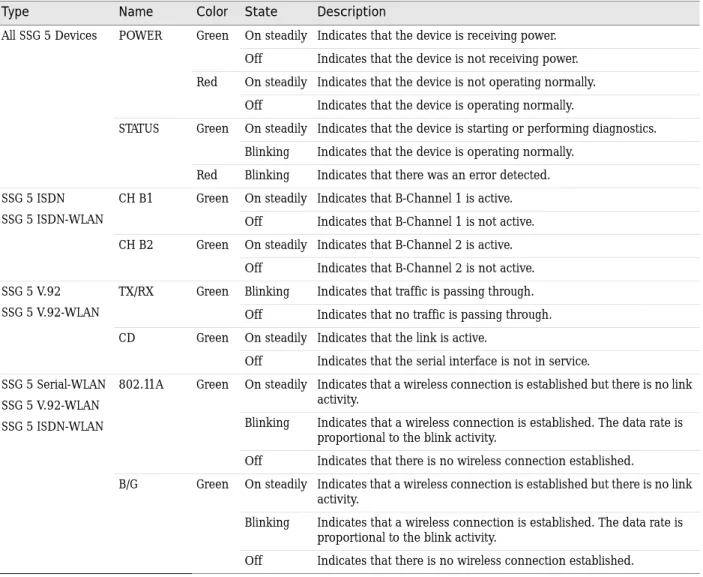
When the device powers up, the POWER LED changes from off to blinking green, and the STATUS LED changes in the following sequence: red, green, blinking green. Startup takes approximately two minutes to complete. If you want to turn the device off and on again, we recommend you wait a few seconds between shutting it down and powering it back up. Table 2 lists the type, name, color, status, and description of each device status LED.
Table 2: Device Status LED Descriptions
Type Name Color State Description
All SSG 5 Devices POWER Green On steadily Indicates that the device is receiving power. Off Indicates that the device is not receiving power. Red On steadily Indicates that the device is not operating normally.
Off Indicates that the device is operating normally.
STATUS Green On steadily Indicates that the device is starting or performing diagnostics. Blinking Indicates that the device is operating normally.
Red Blinking Indicates that there was an error detected. SSG 5 ISDN
SSG 5 ISDN-WLAN
CH B1 Green On steadily Indicates that B-Channel 1 is active. Off Indicates that B-Channel 1 is not active. CH B2 Green On steadily Indicates that B-Channel 2 is active.
Off Indicates that B-Channel 2 is not active. SSG 5 V.92
SSG 5 V.92-WLAN
TX/RX Green Blinking Indicates that traffic is passing through. Off Indicates that no traffic is passing through. CD Green On steadily Indicates that the link is active.
Off Indicates that the serial interface is not in service. SSG 5 Serial-WLAN
SSG 5 V.92-WLAN SSG 5 ISDN-WLAN
802.11A Green On steadily Indicates that a wireless connection is established but there is no link activity.
Blinking Indicates that a wireless connection is established. The data rate is proportional to the blink activity.
Off Indicates that there is no wireless connection established.
B/G Green On steadily Indicates that a wireless connection is established but there is no link activity.
Blinking Indicates that a wireless connection is established. The data rate is proportional to the blink activity.
12 Back Panel
Ethernet Port LEDs
The Ethernet port LEDs show the status of each Ethernet port. Figure 3 shows the location of the LEDs on each Ethernet port.
Figure 3: Ethernet Port LEDs
Table 3 describes the Ethernet port LEDs. Table 3: Ethernet Port LEDs
Back Panel
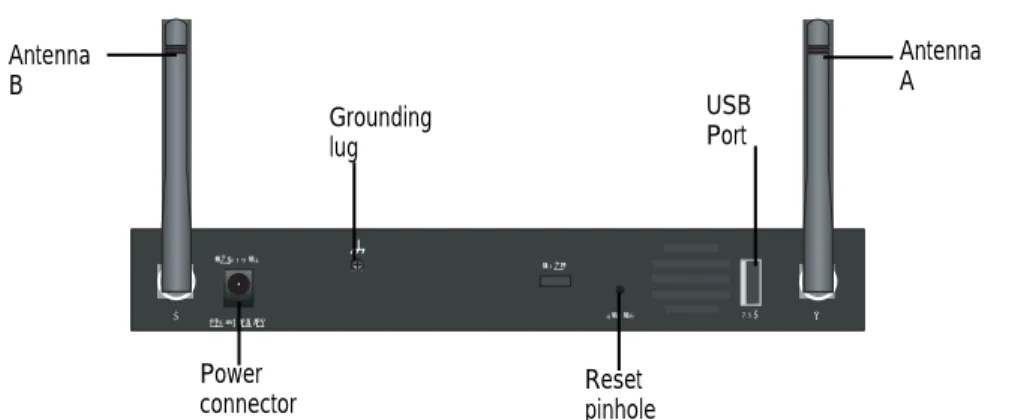
Figure 4 shows the back panel of the SSG 5 device. Figure 4: Back Panel of an SSG 5 Device
The following sections describe the elements on the back panel of the SSG 5 device:
“Power Connector” on page 13
“Radio Transceivers” on page 13
“Grounding Lug” on page 13
“Antennae Types” on page 13
“USB Port” on page 14
Name Function Color State Description
LINK Link Green On steadily Port is online. Off Port is offline. TX/RX Activity Green Blinking Port is receiving data.
Off Port might be on, but it is not receiving data.
LINK TX/RX RESET DC POWER L OCK USB B A 12V 3.0-4.2A Power connector USB Port Grounding lug Reset pinhole Antenna A Antenna B
Back Panel 13 Chapter 1: Hardware Overview
Power Connector
The power connector lets you connect the device to the AC power adapter supplied with the device. (We recommend using a surge protector.)
Radio Transceivers
The SSG 5 wireless transceivers enable a direct connection to workstations in the vicinity of a wireless radio connection. Table 4 shows information for the
transceivers.
For information on configuring the wireless radio band, see “Basic Wireless Configuration” on page 33.
Grounding Lug
Use the one-hole grounding lug on the back of the device to connect the device to earth ground (see Figure 4).
To ground the device before connecting power, you connect a grounding cable to earth ground and then attach the cable to the lug on the rear of the chassis.
Antennae Types
The SSG 5-WLAN devices support three types of custom-built radio antennae:
Diversity antennae — The diversity antennae provide 2dBi directional coverage and a fairly uniform level of signal strength within the area of coverage and are suitable for most installations. This type of antennae is shipped with the device.
External omnidirectional antenna — The external antenna provides 2dBi omnidirectional coverage. Unlike diversity antennae, which function as a pair, an external antenna operates to eliminate an echo effect that can sometimes occur from slightly delayed characteristics in signal reception when two are in use.
NOTE: Only SSG 5-WLAN devices have the antennae connectors.
NOTE: The POWER LED on the front panel of the device glows green when power is connected properly.
Table 4: Radio Transceiver Information
Transceivers Radio Band Standard Speed
WLAN 0 2.4 GHz 2.4 GHz 2.4 GHz and 5GHz 802.11b 802.11g 802.11 superG 11 Mbps 54 Mbps 108 Mbps WLAN 1 5GHz 802.11a 54 Mbps
14 Back Panel
External directional antenna — The external directional antenna provides 2dBi unidirectional coverage and is appropriate for locations like hallways and outer walls (with the antenna facing inward).
USB Port
The USBport on the back panel of an SSG 5 device accepts a universal serial bus (USB) storage device.
The USB port lets you transfer data such as device configurations, image keys, and ScreenOS software between a USB storage device and the internal flash storage of the security device. The USB port supports USB 1.1 and USB 2.0 specifications. You can also log messages to a USB storage device. For more information about logging, refer to the Administration volume of the Concepts and Examples ScreenOS Reference Guide.
To transfer data between the USB storage device and an SSG 20:
1. Connect the USB storage device to the USB port on the security device. 2. Save the files from the USB storage device to the internal flash storage on the
device with the save {software | config | image-key} from usbfilenameto flash command.
3. Stop the USB port with the exec usb-device stop command before removing the USB storage device.
4. Remove the USB storage device.
If you want to delete a file from the USB storage device, use the delete file
usb:/filename command.
If you want to view the saved file information on the USB storage device and internal flash storage, use the get file command.
CAUTION: Always execute the exec usb-device stop command before disconnecting a USB storage device. Disconnecting a USB device without executing the stop command may cause the device to restart.
15
Chapter 2
Installing and Connecting the Device
This chapter describes how to mount an SSG 5 device and connect cables and power to the device. This chapter contains the following sections: “Before You Begin” on page 16
“Installing Equipment” on page 16
“Organizing Interface Cables” on page 18
“Connecting Power” on page 18
“Connecting the Device to a Network” on page 18
NOTE: For safety warnings and instructions, refer to the Juniper Networks Security Products Safety Guide. When working on any equipment, be aware of the hazards involved with electrical circuitry, and follow standard practices for preventing accidents.
16 Before You Begin
Before You Begin
The location of the device, the layout of the mounting equipment, and the security of your wiring room are crucial for proper system operation.
Observing the following precautions can prevent shutdowns, equipment failures, and injuries:
Before installation, always check that the power supply is disconnected from any power source.
Ensure that the room in which you operate the device has adequate air circulation and that the room temperature does not exceed 104° F (40° C).
Do not place the device in an equipment-rack frame that blocks an intake or exhaust port. Ensure that enclosed racks have fans and louvered sides.
Correct these hazardous conditions before any installation: moist or wet floors, leaks, ungrounded or frayed power cables, or missing safety grounds.
Installing Equipment
The following sections describe how to rack-mount or desk-mount the SSG 5 device:
“Rack Mounting” on page 16
“Desk Mounting” on page 17
The mounting kits may be purchased separately.
To rack-mount the SSG 5 device, you must have a Number-2 phillips screwdriver (not provided) and screws that are compatible with the equipment rack (included in the kit).
Rack Mounting
To rack-mount an SSG 5 device:
1. Unscrew the mounting brackets on the tray with a phillips screwdriver.
2. Align the bottom of the device with the base holes on the tray.
CAUTION: To prevent abuse and intrusion by unauthorized personnel, install the SSG 5 device in a secure environment.
NOTE: When mounting the device, make sure that it is within reach of the power outlet.
NOTE: To install an SSG 5-WLAN with the optional antennae, you must remove the existing antennae and then connect the new antenna through the side hole.
Installing Equipment 17 Chapter 2: Installing and Connecting the Device
3. Pull the device forward to lock it in the base holes on the tray.
4. Using the screws, attach the mounting brackets to the device and the tray. 5. Place the power supply in the supply holder, then plug the power adapter into
the device.
6. To install a second SSG 5 device, repeat steps 1 through 5, then continue. Figure 5: SSG 5 Rack Mounting
7. Mount the tray on the rack with the screws provided. 8. Plug in the power supply to the power outlet.
Desk Mounting
To desk-mount an SSG 5 device:
1. Attach the desktop stand to the side of the device. We recommend using the side closest to the power adapter.
2. Place the mounted device on the desktop. Figure 6: SSG 5 Desk Mounting
3. Plug in the power adapter and connect the power supply to the power outlet.
18 Organizing Interface Cables
Organizing Interface Cables
Arrange network cables as follows to prevent them from dislodging or developing stress points:
Secure cables so that they are not supporting their own weight as they hang to the floor.
Place excess cable out of the way in neatly coiled loops.
Use fasteners to maintain the shape of cable loops.
Connecting Power
To connect the power to a device:
1. Plug the DC-connector end of the power cable into the power connector on the back of the device.
2. Plug the AC-adapter end of the power cable into an AC power outlet.
Connecting the Device to a Network
This section provides basic information on how to physically connect the SSG 5 device to a network.
To connect the necessary cables as shown in Figure 7:
1. Connect an RJ-45 cable from the port labeled 0/0 (ethernet0/0 interface) to the external switch or router. The ethernet0/0 interface is prebound to the Untrust security zone.
2. Connect an RJ-45 cable from the port labeled 0/1 (ethernet0/1 interface) to a switch or router in the DMZ security zone.
3. Connect an RJ-45 cable from the port labeled 0/2 (bgroup0 interface) to a switch or router in the Trust security zone.
4. Connect an RJ-45 cable from the Console port using the instructions provided in “Using a Console Connection” on page 22 for management access.
Connecting the Device to a Network 19 Chapter 2: Installing and Connecting the Device
Figure 7: Basic Cabling Example
5. If you want to connect to your device through wireless, you must first connect the provided antennae to the device. If you have the standard 2dB diversity antennae, use screws to attach them onto the RPSMA posts marked A and B at the back of the device. Bend each antenna at its elbows, making sure not to put pressure on the bulkhead connectors (see Figure 8).
Figure 8: SSG 5-WLAN Antennae Location
If you are using the optional external antenna, follow the connection instructions that came with that antenna.
SSG 5 V.9 2 STATUS POWER CONSOL E TX /RX CD 0 1 2 3 4 5 6
TX/RXLINKTX/RXLINKTX/RXLINKTX/RXLINKTX/RXLINKTX/RXLINKTX/RXLINK
10/100 10/100 10/100 10/100 10/100 10/100 10/100 B /G WLANV.92 802.11A Callouts Untrust Zone Console DMZ Trust Zone RESET DC POWER L OCK USB B A 12V 3.0-4.2A Bulkhead connector Bulkhead connector Antenna B Antenna A
WARNING: Make sure that you do not inadvertently connect the Console, AUX, or Ethernet ports on the device to the telephone outlet.
21
Chapter 3
Configuring the Device
ScreenOS software is preinstalled on SSG 5 devices. When the device is powered on, it is ready to be configured. While the device has a default factory configuration that lets you initially connect to the device, you need to perform further
configuration for your specific network requirements. This chapter contains the following sections:
“Accessing the Device” on page 22
“Default Device Settings” on page 25
“Basic Device Configuration” on page 26
“Basic Wireless Configuration” on page 31
“WAN Configuration” on page 35
“Basic Firewall Protections” on page 37
“Verifying External Connectivity” on page 37
“Restarting the Device” on page 38
“Resetting the Device to Factory Defaults” on page 39
NOTE: After you configure the device and verify connectivity through the remote network, you must register your product at the Juniper Networks Support website at http://www.juniper.net/customers/support/ so certain ScreenOS services, such as Deep Inspection Signature Service and Antivirus (purchased separately), can be activated on the device. After registering your product, use the WebUI to obtain the subscription for the service. For more information about registering your product and obtaining subscriptions for specific services, refer to the
Fundamentals volume of the Concepts & Examples ScreenOS Reference Guide for the version of ScreenOS running on your device. To determine which ScreenOS versions are currently available for your device, go to the Juniper Networks Support website.
22 Accessing the Device
Accessing the Device
You can configure and manage the SSG 5 device in several ways:
Console—The Console port on the device lets you access the device through a serial cable connected to your workstation or terminal. To configure the device, you enter ScreenOS command line interface (CLI) commands on your terminal or in a terminal-emulation program on your workstation. For more information, see “Using a Console Connection” on page 22.
Remote Console—You can remotely access the console interface on a security device by dialing into it. You can either dial into the v.92 modem port or into a modem connected to the AUX port. For more information, refer to the
Administration volume of the Concepts & Examples ScreenOS Reference Guide.
WebUI—The ScreenOS Web user interface (WebUI) is a graphical interface available through a browser. To initially use the WebUI, the workstation on which you run the browser must be on the same subnetwork as the device. You can also access the WebUI through a secure server using Secure Sockets Layer (SSL) with secure HTTP (HTTPS).
Telnet/SSH—Telnet and SSH are applications that allow you to access devices through an IP network. To configure the device, you enter ScreenOS CLI commands in a Telnet session from your workstation. For more information, refer to the Administration volume of the Concepts & Examples ScreenOS Reference Guide.
Network and Security Manager—Network and Security Manager is a Juniper Networks enterprise-level management application that enables you to control and manage Juniper Networks security devices. For instructions on how to manage your device with Network and Security Manager, refer to the Network and Security Manager Administrator’s Guide.
Using a Console Connection
To establish a console connection with the device:
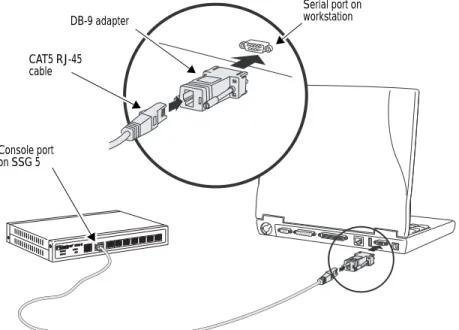
1. Plug the female end of an RJ-45-to-DB-9 adapter into the serial port of your workstation, making sure it is properly secured. (RJ-45-to-DB-9 adapters can be purchased from Juniper Networks. See “Connectors” on page 49 for pin numbering information.)
2. Plug one end of the RJ-45 CAT5 cable into the DB-9 adapter.
NOTE: Use a straight-through RJ-45 CAT5 cable with a male RJ-45 connector to plug into the Console port on the device.
Accessing the Device 23 Chapter 3: Configuring the Device
3. Plug the other end of the RJ-45 CAT5 cable into the Console port on the SSG 5 device. Figure 9 shows the arrangement of the cable and adapter.
Figure 9: Establishing a Console Connection
4. Launch a serial terminal-emulation program on your workstation. The required settings to launch a console session are as follows:
Baud rate: 9600
Parity: None
Data bits: 8
Stop bit: 1
Flow Control: None
5. If you have not yet changed the default login for the login name and password, enter netscreen at both the login and password prompts. (Use lowercase letters only. The login and password fields are both case-sensitive)
For information on how to configure the device with the CLI commands, refer to the Concepts & Examples ScreenOS Reference Guide.
6. (Optional) By default, the console times out and terminates automatically after 10 minutes of idle time. To remove the timeout, enter set console timeout 0.
Serial port on workstation DB-9 adapter Console port on SSG 5 CAT5 RJ-45 cable
24 Accessing the Device
Using the WebUI
To use the WebUI, the workstation from which you are managing the device must initially be on the same subnetwork as the device. To access the device with the WebUI:
1. Connect your workstation to the 0/2 — 0/6 port (bgroup0 interface in the Trust zone) on the device.
2. Ensure that your workstation is configured for DHCP or is configured with a static IP address in the 192.168.1.0/24 subnet.
3. Launch your browser, enter the IP address for the bgroup0 interface (the default IP address is 192.168.1.1/24), then press Enter.
The WebUI application displays the login prompt.
4. If you have not yet changed the default login for the admin name and password, enter netscreen at both the admin name and password prompts. (Use lowercase letters only. The admin name and password fields are both case-sensitive.)
5. Once the WebUI homepage opens, the device is ready to be configured. See “Basic Device Configuration” on page 26 to complete the initial device configuration.
Using Telnet
To use a Telnet connection, the workstation must be in the same subnetwork as the security device. To access the device with a Telnet connection:
1. Connect your workstation to any Ethernet port from 0/2 to 0/6 (bgroup0 interface in the Trust zone) on the device.
2. Ensure that your workstation is configured for DHCP or is configured with a static IP address in the 192.168.1.0/24 subnet.
3. Start a Telnet client application to the IP address for the bgroup0 interface (the default IP address is 192.168.1.1). For example, enter telnet 192.168.1.1.
The Telnet application displays the login prompt.
4. If you have not yet changed the default login for the login name and password, enter netscreen at both the login and password prompts. (Use lowercase letters only. The login and password fields are both case-sensitive)
5. (Optional) By default, the console times out and terminates automatically after 10 minutes of idle time. To remove the timeout, enter set console timeout 0.
NOTE: When the device is accessed through the WebUI the first time, the Initial Configuration Wizard (ICW) appears. If you decide to use the ICW to configure your device, see “Initial Configuration Wizard” on page 51.
Default Device Settings 25 Chapter 3: Configuring the Device
Default Device Settings
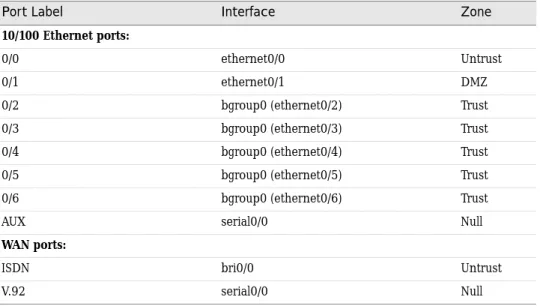
This section describes the default settings and operation of the SSG 5 device. Table 5 shows the default zone bindings for ports on the devices.
Table 5: Default Physical Interface to Zone Bindings
Bridge groups (bgroups) let network users switch between wired and wireless traffic without having to reconfigure or reboot their workstations. By default, the
ethernet0/2 — ethernet0/6 interfaces, labeled as ports 0/2 — 0/6 on the device, are grouped together as the bgroup0 interface, have the IP address 192.168.1.1/24, and are bound to the Trust security zone. You can configure up to four bgroups.
You can change the default IP address on the bgroup0 interface to match the addresses on your LAN and WLAN. For configuring a wireless interface to a bgroup, see “Basic Wireless Configuration” on page 31.
For additional bgroup information and examples, refer to the Concepts & Examples ScreenOS Reference Guide.
Port Label Interface Zone
10/100 Ethernet ports:
0/0 ethernet0/0 Untrust
0/1 ethernet0/1 DMZ
0/2 bgroup0 (ethernet0/2) Trust
0/3 bgroup0 (ethernet0/3) Trust
0/4 bgroup0 (ethernet0/4) Trust
0/5 bgroup0 (ethernet0/5) Trust
0/6 bgroup0 (ethernet0/6) Trust
AUX serial0/0 Null
WAN ports:
ISDN bri0/0 Untrust
V.92 serial0/0 Null
NOTE: The bgroup interface does not work in Transparent mode when it contains a wireless interface.
26 Basic Device Configuration
Table 6 shows the default zone bindings for wireless and logical interfaces.
There are no other default IP addresses configured on other Ethernet or wireless interfaces on a device; you must assign IP addresses to the other interfaces, including the WAN interfaces.
Basic Device Configuration
The following sections describe the basic configuration tasks required to place the SSG 5 device in operation:
“Admin Name and Password” on page 27
“Administrative Access” on page 27
“Interface IP Address” on page 27
“Management Services” on page 28
“Hostname and Domain Name” on page 28
“Date and Time” on page 28
“Default Route” on page 29
“Bridge Group Interfaces” on page 29
“Backup Untrust Interface Configuration” on page 30
The examples in this section demonstrate how to establish initial network connectivity. For advanced configuration information, refer to the Concepts & Examples ScreenOS Reference Guide.
Table 6: Wireless and Logical Interface Bindings
SSG 5-WLAN Interface Zone
Wireless Interface
Specifies a wireless interface, which is configurable to operate on 2.4G and/or 5G radio
wireless0/0 (default IP address is 192.168.2.1/24).
Trust
wireless0/1-0/3. Null
Logical Interfaces
Layer-2 interface vlan1 specifies the logical interfaces used for management and VPN traffic termination while the device is in Transparent mode.
-Tunnel interfaces tunnel.n specifies a logical tunnel interface. This interface is for VPN traffic.
-Basic Device Configuration 27 Chapter 3: Configuring the Device
Admin Name and Password
The administrative user has complete privileges to configure a device. We recommend that you change the default admin name (netscreen) and password (netscreen) immediately.
To change the admin name and password:
WebUI
Configuration > Admin > Administrators > Edit (for the NetScreen Administrator Name): Enter the following, then click OK:
Administrator Name: Old Password: netscreen New Password:
Confirm New Password: CLI
set admin name name set admin password pswd_str save
Administrative Access
By default, anyone in your network can manage the device if they know the admin name and password.
To configure a device to be managed only from a specific host on your network:
WebUI
Configuration > Admin > Permitted IPs: Enter the following, then click Add:
IP Address/Netmask: ip_addr/mask CLI
set admin manager-ip ip_addr/mask save
Interface IP Address
The bgroup0 interface has the default IP address 192.168.1.1/24 and is preconfigured for management services. You can configure the device using a management service such as Telnet by connecting a workstation to any of the bgroup0 ports on the device. The workstation must have an IP address in the 192.168.1.1/24 subnet.
To change the default interface IP address on the device:
WebUI
Network > Interfaces > Edit (for bgroup0): Enter the following, then click OK:
28 Basic Device Configuration CLI
set interface bgroup0 ip ip_addr/mask save
Management Services
ScreenOS provides services for configuring and managing a device, such as SNMP, SSL, and SSH, which you can enable on a per-interface basis.
To configure the management services for the ethernet0/0 interface:
WebUI
Network > Interfaces > Edit (for ethernet0/0): Under Management Services, select or clear the management services you want to use on the interface, then click Apply.
CLI
set interface eth0/0 manage web unset interface eth0/0 manage snmp save
Hostname and Domain Name
The domain name defines the network or subnetwork that the device belongs to, while the hostname refers to a specific device. The hostname and domain name together uniquely identify a device in the network.
To configure the hostname and domain name on the device:
WebUI
Network > DNS > Host: Enter the following, then click Apply:
Host Name: hostname Domain Name: domain-name CLI
set hostname hostname set domain domain-name save
Date and Time
The time settings on a device affect events such as the setup of virtual private network (VPN) tunnels. The easiest way to set the date and time on the device is to use the WebUI to synchronize the device clock with the clock on your workstation. To configure the date and time on the device:
WebUI
1. Configuration > Date/Time: Click the Sync Clock with Client button. A pop-up message prompts you to specify if you have enabled the daylight saving time option on your workstation clock.
Basic Device Configuration 29 Chapter 3: Configuring the Device
2. Click Yes to synchronize the device clock and adjust it according to daylight saving time, or click No to synchronize the device clock without adjusting for daylight saving time.
You can also use the set clock command in a Telnet or console session to manually enter the date and time for the device.
Default Route
The default route is a static route used to direct packets addressed to networks that are not explicitly listed in the routing table. If a packet arrives at the device with an address for which the device does not have routing information, the device sends the packet to the destination specified by the default route.
To configure the default route on the device:
WebUI
Network > Routing > Destination > New (trust-vr): Enter the following, then click OK:
IP Address/Netmask: 0.0.0.0/0.0.0.0 Next Hop
Gateway: (select)
Interface: ethernet0/2 (select) Gateway IP Address: ip_addr CLI
set route 0.0.0.0/0 interface ethernet0/2 gateway ip_addr save
Bridge Group Interfaces
The SSG 5 device is preconfigured with bridge group (bgroup) interfaces identified as bgroup0 through bgroup3. By default, the Ethernet interfaces
ethernet0/2—ethernet0/6 are grouped together in bgroup0, which is bound to the Trust security zone.
Bgroups let you group multiple Ethernet and wireless interfaces together. Each bgroup constitutes its own broadcast domain and provides high-speed Ethernet switching between interfaces within the group. You can assign a single IP address to each bgroup interface. You can bind a bgroup interface to any zone.
You can unbind interfaces from a bridge group and assign them to a different security zone. Interfaces must be in the Null security zone before they can be bound to a bridge group. To bind a grouped interface to the Null security zone, use the unset interfaceinterfaceportinterface command.
30 Basic Device Configuration
To configure a bridge group with Ethernet and wireless interfaces:
WebUI
Network > Interfaces > List > Edit (bgroup0) > Bind Port: Deselect ethernet0/3 and ethernet0/4, then click Apply.
Edit (bgroup1) > Bind Port: Select ethernet0/3, ethernet0/4, and wireless0/2, then click Apply.
>Basic: Enter the following, then click Apply:
Zone Name: DMZ (select)
IP Address/Netmask: 10.0.0.1/24 CLI
unset interface bgroup0 port ethernet0/3 unset interface bgroup0 port ethernet0/4 set interface bgroup1 port ethernet0/3 set interface bgroup1 port ethernet0/4 set interface bgroup1 port wireless0/2 set interface bgroup1 zone DMZ set interface bgroup1 ip 10.0.0.1/24 save
If you want to bind an Ethernet or a wireless interface to a bgroup, you must first make sure that the Ethernet or wireless interface is in the Null security zone. Unsetting the Ethernet or wireless interface that is in a bgroup places the interface in the Null security zone. Once assigned to the Null security zone, the Ethernet interface can be bound to a security zone and assigned a different IP address. To unbind ethernet0/3 from bgroup0 and assign it to the Trust zone with a static IP address of 192.168.3.1/24:
WebUI
Network > Interfaces > List > Edit (bgroup0) > Bind Port: Deselect ethernet0/3, then click Apply.
List > Edit (ethernet0/3): Enter the following, then click Apply:
Zone Name: Trust (select)
IP Address/Netmask: 192.168.3.1/24 CLI
unset interface bgroup0 port ethernet0/3 set interface ethernet0/3 zone trust
set interface ethernet0/3 ip 192.168.3.1/24 save
Backup Untrust Interface Configuration
The SSG 5 device lets you configure a backup interface for untrust failover. To set a backup interface for untrust failover:
1. Set the backup interface in the Null security zone with the unset interface
Basic Wireless Configuration 31 Chapter 3: Configuring the Device
2. Bind the backup interface to the same security zone as the primary interface with the set interfaceinterfacezonezone_name command.
To set the ethernet0/4 interface as the backup interface to the ethernet0/0 interface:
WebUI
Network > Interfaces > Backup > Enter the following, then click Apply.
Primary: ethernet0/0 Backup: ethernet0/4 Type: track-ip (select) CLI
unset interface bgroup0 port ethernet0/4 set interface ethernet0/4 zone untrust
set interface ethernet0/0 backup interface ethernet0/4 type track-ip save
Basic Wireless Configuration
This section describes how to configure the wireless interface on the SSG 5-WLAN device. Wireless networks consist of names referred to as Service Set Identifiers (SSIDs). Specifying SSIDs lets you have multiple wireless networks reside in the same location without interfering with each other. An SSID name can have a maximum of 32 characters. If a space is part of the SSID name string, then the string must be enclosed with quotation marks. Once the SSID name is set, more SSID attributes can be configured. To use the wireless local area network (WLAN) capabilities on the device, you must configure at least one SSID and bind it to a wireless interface.
The SSG 5-WLAN device lets you create up to sixteen SSIDs, but only four of them can be used simultaneously. You can configure the device to use the four SSIDs on either one of the transceivers or split the use on both (for example, three SSIDs assigned to WLAN 0 and one SSID assigned to WLAN 1). Use the set interface
wireless_interfacewlan {0 | 1 | both } command to set the radio transceivers on the SSG 5-WLAN device. Figure 10 shows the default configuration for the SSG 5-WLAN device.
Once you have set an SSID to the wireless0/0 interface, you can access the device using the default wireless0/0 interface IP address in the steps described in “Accessing the Device” on page 22. Figure 10 on page 32 shows the default configuration for the SSG 5-WLAN device.
NOTE: The primary and backup interfaces must be in the same security zone. One primary interface has only one backup interface, and one backup interface has only one primary interface.
32 Basic Wireless Configuration
Figure 10: Default SSG 5-WLAN Configuration
By default, the wireless0/0 interface is configured with the IP address
192.168.2.1/24. All wireless clients that connect to the Trust zone must have an IP address in the wireless subnetwork. You can also configure the device to use DHCP to automatically assign IP addresses in the 192.168.2.1/24 subnetwork to your devices.
By default, the wireless0/1 – wireless0/3 interfaces are bound to the Null zone and are not assigned IP addresses. If you want to use any other wireless interface, you must configure an IP address for it, assign an SSID to it, and bind it to a security zone. Table 7 shows the wireless authentication and encryption methods.
NOTE: If you are operating the SSG 5-WLAN device in a country other than the United States, Japan, Canada, China, Taiwan, Korea, Israel, or Singapore, you must set the country code with the set wlan country-code command or set it on the Wireless > General SettingsWebUI page before a WLAN connection can be established. This command sets the selectable channel range and the transmit power level. If your regional code is ETSI, you must set the correct country code that meets your local radio spectrum regulations.
Table 7: Wireless Authentication and Encryption Options
Authentication Encryption
Open Allows any wireless client to access the device Shared-key WEP shared-key
WPA-PSK AES/TKIP with pre-shared key
WPA AES/TKIP with key from RADIUS server WPA2-PSK 802.11i compliant with a pre-shared key WPA2 802.11i compliant with a RADIUS server WPA-Auto-PSK Allows WPA and WPA2 type with pre-shared key WPA-Auto Allows WPA and WPA2 type with RADIUS server 802.1x WEP with key from RADIUS server
SSG 5 V.9 2 STATUS POWER CONSOL E TX /RX CD 0 1 2 3 4 5 6
TX/RXLINKTX/RXLINKTX/RXLINKTX/RXLINKTX/RXLINKTX/RXLINKTX/RXLINK
10/100 10/100 10/100 10/100 10/100 10/100 10/100 B /G WLAN V.92 802.11A Callouts Callouts Untrust Zone Trust Zone wireless0/0 Console
Basic Wireless Configuration 33 Chapter 3: Configuring the Device
Refer to the Concepts & Examples ScreenOS Reference Guide for configuration examples, SSID attributes, and CLI commands relating to wireless security configurations.
To configure a wireless interface for basic connectivity:
WebUI
1. Set the WLAN country code and IP address.
Wireless > General Settings > Select the following, then click Apply:
Country code: Select your code IP Address/Netmask: ip_add/netmask
2. Set the SSID.
Wireless > SSID > New: Enter the following, then click OK:
SSID:
Authentication: Encryption:
Wireless Interface Binding:
3. (Optional) set the WEP key.
SSID > WEP Keys: Select the key ID, then click Apply. 4. Set the WLAN mode.
Network > Interfaces > List > Edit (wireless interface): Select Both for the WLAN mode, then click Apply.
5. Activate wireless changes.
Wireless > General Settings > Click Activate Changes.
CLI
1. Set the WLAN country code and IP address.
set wlan country-code { code_id }
set interface wireless_interface ip ip_addr/netmask
2. Set the SSID.
set ssid name name_str
set ssid name_str authentication auth_type encryption encryption_type set ssid name_str interface interface
(optional) set ssid name_str key-id number
3. Set the WLAN mode.
set interface wireless_interface wlan both
4. Activate wireless changes.
save
34 Basic Wireless Configuration
You can set an SSID to operate in the same subnet as the wired subnet. This action allows clients to work in either interface without having to reconnect in another subnet.
To set an Ethernet and a wireless interface to the same bridge-group interface:
WebUI
Network > Interfaces > List > Edit (bgroup_name) > Bind Port: Select the wireless and ethernet interfaces, then click Apply.
CLI
set interface bgroup_name port wireless_interface set interface bgroup_name port ethernet_interface
NOTE: Bgroup_name can be bgroup0—bgroup3.
Ethernet_interface can be ethernet0/0—ethernet0/6.
Wireless_interface can be wireless0/0—wireless0/3.
If a wireless interface is configured, then you need to reactivate the WLAN with the CLI exec wlan reactivate command or click Activate Changes on the Wireless > General Settings WebUI page.
WAN Configuration 35 Chapter 3: Configuring the Device
WAN Configuration
This section explains how to configure the following WAN interfaces:
“ISDN Interface” on page 35
“V.92 Modem Interface” on page 36
ISDN Interface
Integrated Services Digital Network (ISDN) is a set of standards for digital transmission over different media created by the Consultative Committee for International Telegraphy and Telephone (CCITT) and International
Telecommunications Union (ITU). As a dial-on-demand service, it has fast call setup and low latency as well as the ability to carry high-quality voice, data, and video transmissions. ISDN is also a circuit-switched service that can be used on both multipoint and point-to-point connections. ISDN provides a service router with a multilink Point-to-Point Protocol (PPP) connection for network interfaces. The ISDN interface is usually configured as the backup interface of the Ethernet interface to access external networks.
To configure the ISDN interface, use the WebUI or CLI:
WebUI
Network > Interfaces > List > Edit (bri0/0): Enter or select the following, then click OK:
BRI Mode: Dial Using BRI Primary Number: 123456 WAN Encapsulation: PPP PPP Profile: isdnprofile CLI
set interface bri0/0 dialer-enable
set interface bri0/0 primary-number "123456" set interface bri0/0 encap ppp
set interface bri0/0 ppp profile isdnprofile save
To configure the ISDN interface as the backup interface, see “Backup Untrust Interface Configuration” on page 30.
For more information on how to configure the ISDN interface, refer to the Concepts & Examples ScreenOS Reference Guide.
36 WAN Configuration
V.92 Modem Interface
The V.92 interface provides an internal analog modem to establish a PPP
connection to a service provider. You can configure the serial interface as a primary or backup interface, which is used in case of interface failover.
To configure the V.92 interface, use the WebUI or CLI:
WebUI
Network > Interfaces > List > Edit (for serial0/0): Enter the following, then click OK:
Zone Name: untrust (select) ISP: Enter the following, then click OK:
ISP Name: isp_juniper Primary Number: 1234567 Login Name: juniper Login Password: juniper
Modem: Enter the following, then click OK: Modem Name: mod1
Init String: AT&FS7=255S32=6 Active Modem setting
Inactivity Timeout: 20 CLI
set interface serial0/0 zone untrust
set interface serial0/0 modem isp isp_juniper account login juniper password juniper
set interface serial0/0 modem isp isp_juniper primary-number 1234567 set interface serial0/0 modem idle-time 20
set interface serial0/0 modem settings mod1 init-strings AT&FS7=255S32=6 set interface serial0/0 modem settings mod1 active
For information on how to configure the V.92 modem interface, refer to the
Concepts & Examples ScreenOS Reference Guide.
Basic Firewall Protections 37 Chapter 3: Configuring the Device
Basic Firewall Protections
The SSG 5 device is configured with a default policy that permits workstations in the Trust zone of your network to access any resource in the Untrust security zone, while outside computers are not allowed to access or start sessions with your workstations. You can configure policies that direct the device to permit outside computers to start specific kinds of sessions with your computers. For information about creating or modifying policies, refer to the Concepts & Examples ScreenOS Reference Guide.
The SSG 5 device provides various detection methods and defense mechanisms to combat probes and attacks aimed at compromising or harming a network or network resource:
ScreenOS SCREEN options secure a zone by inspecting, and then allowing or denying, all connection attempts that require crossing an interface to that zone. For example, you can apply port-scan protection on the Untrust zone to stop a source from a remote network from trying to identify services to target for further attacks.
The device applies firewall policies, which can contain content-filtering and Intrusion Detection and Prevention (IDP) components, to the traffic that passes the SCREEN filters from one zone to another. By default, no traffic is permitted to pass through the device from one zone to another. To permit traffic to cross the device from one zone to another, you must create a policy that overrides the default behavior.
To set ScreenOS SCREEN options for a zone:
WebUI
Screening > Screen: Select the zone to which the options apply. Select the SCREEN options that you want, then click Apply:
CLI
set zone zone screen option save
For more information about configuring the network-security options available in ScreenOS, refer to the Attack Detection and Defense Mechanisms volume of the
Concepts & Examples ScreenOS Reference Guide.
Verifying External Connectivity
To verify that workstations in your network can access resources on the Internet, start a browser from any workstation in the network and browse to
38 Restarting the Device
Restarting the Device
You may need to restart the device in order to implement new features, such as when you change between route and transparent mode or when you add new license keys.
The following sections describe two methods of restarting the device:
“Restarting the Device with the CLI Reset Command” on page 38
“Restarting the Device with the WebUI” on page 38
Restarting the Device with the CLI Reset Command
To restart the device with the CLI reset command:
1. Establish a console session with the device as described in “Using a Console Connection” on page 22 or “Using Telnet” on page 24.
At a Windows workstation, the easiset way of opening a console connection is to choose Start > Runand enter telnetip_address.
The device prompts you for your login and password.
2. If you have not yet changed the default username and password, enter
netscreen at both the login and password prompts. (Use lowercase letters only. The login and password fields are both case-sensitive.)
3. At the console prompt, enter:
reset
The device prompts you to confirm the reset:
System reset, are you sure? y/[n]
4. Enter Y.
The device restarts.
Restarting the Device with the WebUI
To restart the device with the WebUI:
1. Launch your browser and enter the IP address for the management interface (the default IP address is 192.168.1.1), then press Enter.
The WebUI application displays the login prompt.
2. If you have not yet changed the default username and password, enter
netscreen at both the login and password prompts. (Use lowercase letters only. The login and password fields are both case-sensitive.)
3. In the WebUI, choose:
Resetting the Device to Factory Defaults 39 Chapter 3: Configuring the Device
4. Click Reset.
An alert box prompts you to confirm that you want to reset the device. 5. Click OK.
The device resets. Also, an alert box prompts you to leave your browser open for a few minutes and then log back into the device.
Resetting the Device to Factory Defaults
If you lose the admin password, or you need to clear the configuration of your device, you can reset the device to its factory default settings. Resetting the device destroys any existing configurations and restores access to the device.
You can restore the device to its default settings using one of these methods:
Using the device serial number
Using the CLI unset all command
Using the Reset pinhole
The following sections describe how to use these methods to reset the device to its factory defaults.
Device Serial Number
To use the device serial number to reset the device to its factory defaults: 1. Start a Console session as described in “Using a Console Connection” on
page 22.
2. At the Login prompt, enter the device serial number.
3. At the Password prompt, enter the serial number again. The following message appears:
!!! Lost Password Reset !!! You have initiated a command to reset the device to factory defaults, clearing all current configuration and settings. Would you like to continue? y/[n]
CAUTION: Resetting the device deletes all existing configuration settings and disables all existing firewall and VPN services.
NOTE: By default, the device recovery feature is enabled. You can disable it by entering the CLI unset admin device-reset command. Also, if the security device is in FIPS mode, the recovery feature is automatically disabled.
40 Resetting the Device to Factory Defaults
4. Press the y key. The following message appears:
!! Reconfirm Lost Password Reset !! If you continue, the entire configuration of the device will be erased. In addition, a permanent counter will be incremented to signify that this device has been reset. This is your last chance to cancel this command. If you proceed, the device will return to factory default configuration, which is: device IP: 192.168.1.1; username: netscreen, password: netscreen. Would you like to continue? y/[n]
5. Press the y key to reset the device.
The system now resets and returns to the login prompt; the default login name and password are both reset to netscreen.
unset all
To use the CLI unset all command, you will need to know the login name and password. To reset the device to its factory defaults:
1. Start a Console session as described in “Using a Console Connection” on page 22, then log in.
2. At the command prompt, enter unset all. The following message is displayed:
Erase all system config, are you sure y/[n] ?
3. Press y
4. Enter reset. Press n for the first question and y for the second question:
Configuration modified, save? [y]/n System reset, are you sure? y/[n]
The system now resets and returns to the login prompt; the default login name and password are both reset to netscreen.
Reset Pinhole Button
To use the Reset pinhole button (labeled Reset Config on some devices) on the device, you must either view the device status LEDs on the front panel or start a Console session.
Using the device status LEDs:
1. Locate the Reset (or Reset Config) pinhole on the device. Using a thin wire (such as a straightened paperclip), push the pinhole button for four to six seconds.
The Status LED blinks red.
NOTE: If you do not follow the complete sequence, the reset process cancels without any configuration change and the console message states that the erasure of the configuration is aborted. The Status LED returns to blinking green. The device generates SNMP and SYSLOG alerts to configured SNMP or SYSLOG trap hosts.
Resetting the Device to Factory Defaults 41 Chapter 3: Configuring the Device
2. As soon as the Status LED blinks green, release the pinhole button and wait two seconds.
3. The device now waits for the second reset, which confirms the operation. Push the pinhole button again for four to six seconds until the device resets. The system now resets and returns to the login prompt; the default login name and password are both reset to netscreen.
Using the Console:
1. Start a Console session as described in “Using a Console Connection” on page 22.
2. Locate the Reset pinhole on the device. Using a thin wire (such as a straightened paperclip), push the pinhole button for four to six seconds. The message “Configuration Erasure Process has been initiated” appears in the console window. Continue to press the pinhole button until the
message “Waiting for 2nd confirmation” appears. 3. Release the pinhole button, and wait two seconds. 4. Push the pinhole button again for four to six seconds.
The message “2nd push has been confirmed” appears. 5. Continue to press the pinhole button until the device resets.
The system now resets and returns to the login prompt; the default login name and password are both reset to netscreen.
Required Tools and Parts 43
Chapter 4
Servicing the Device
This chapter describes service and maintenance procedures for an SSG 5 device. It contains the following sections:
“Required Tools and Parts” on page 43
“Upgrading Memory” on page 43
Required Tools and Parts
To replace a component on the SSG 5 device, you need the following tools and parts:
Electrostatic discharge (ESD) grounding wrist strap
Number-2 phillips screwdriver
Upgrading Memory
To upgrade the SSG 5 device from 128 MB to 256 MB of memory:
1. Attach an ESD grounding strap to your bare wrist and connect the strap to the ESD point on the chassis or to an outside ESD point if the device is
disconnected from earth ground.
2. Unplug the AC cord from the power outlet.
3. Turn over the device so that its top is lying on a flat surface.
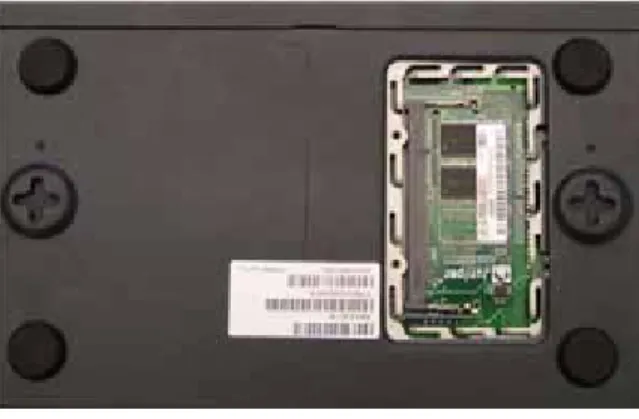
4. Use a phillips screwdriver to remove the screws from the memory-card cover. Keep the screws nearby for use when securing the cover later.
5. Remove the memory-card cover.
NOTE: For safety warnings and instructions, refer to the Juniper Networks Security Products Safety Guide. The instructions in the guide warn you about situations that could cause bodily injury. Before working on any equipment, you should be aware of the hazards involved with electrical circuitry and be familiar with standard practices for preventing accidents.
44 Upgrading Memory
Figure 11: Bottom of Device
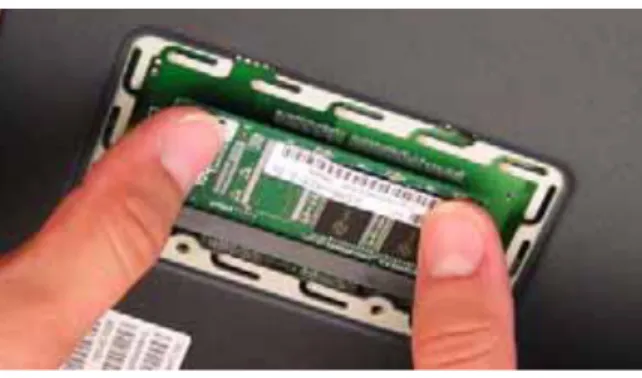
6. Release the 128 MB DIMM DRAM by pressing your thumbs outward on the locking tabs on each side of the module so that the tabs move away from the module.
Figure 12: Unlocking the Memory Module
7. Grip the long edge of the memory module and slide it out. Set it aside. Figure 13: Removing Module Slots
8. Insert the 256 MB DIMM DRAM into the slot. Exerting even pressure with both thumbs upon the upper edge of the module, press the module downward until the locking tabs click into position.
Upgrading Memory 45 Chapter 4: Servicing the Device
Figure 14: Inserting the Memory Module
9. Place the memory-card cover over the slot.
10. Use the phillips screwdriver to tighten the screws, securing the cover to the device.
Physical 47
Appendix A
Specifications
This appendix provides general system specifications for the SSG 5 device. It contains the following sections:
“Physical” on page 47
“Electrical” on page 47
“Environmental Tolerance” on page 48
“Certifications” on page 48
“RoHS and WEEE” on page 49
“Connectors” on page 49
Physical
Table 8 lists physical specifications for the SSG 5 device. Table 8: SSG 5 Physical Specifications
Electrical
Table 9 lists electrical specifications for the SSG 5 device. Table 9: SSG 5 Electrical Specifications
Description Value
Chassis dimensions 222.5 mm x 143.4 mm x 35 mm. With rubber feet, the system is 40 mm (1.6 inches) tall.
(8.8 inches X 5.6 inches X 1.4 inches). Device weight 960g (2.1 lbs).
Item Specification
DC input voltage 12V DC system current rating 4 Amps
48 Environmental Tolerance
Environmental Tolerance
Table 10 lists environmental tolerance specifications for the SSG 5 device. Table 10: SSG 5 Environmental Tolerance
Certifications
Table 11 lists certifications for the SSG 5 device.
Description Value
Altitude No performance degradation to 6,600 ft (2,000 m)
Relative humidity Normal operation ensured in relative humidity range of 5 to 90 percent, noncondensing
Temperature Normal operation ensured in temperature range of 32°F (0°C) to 104°F (40°C)
Nonoperating storage temperature in shipping carton: -40°F (-40°C) to 158°F (70°C)
Table 11: SSG 5 Device Certifications
Certification Type Certification Name
Safety CAN/CSA-C22.2 No. 60950-1-03/UL 60950-1 Third Edition, Safety of Information Technology Equipment
EN 60950-1:2001+A11, Safety of Information Technology Equipment IEC 60950-1:2001 First Edition, Safety of Information Technology Equipment
EMC Emissions FCC Part 15 Class B (USA) EN 55022 Class B (Europe) AS 3548 Class B (Australia) VCCI Class B (Japan) EMC Immunity EN 55024
EN-61000-3-2 Power Line Harmonics EN-61000-3-3 Voltage Fluctuations and Flicker EN-61000-4-2 ESD
EN-61000-4-3 Radiated Immunity EN-61000-4-4 EFT
EN-61000-4-5 Surge
EN-61000-4-6 Low Frequency Common Immunity EN-61000-4-11 Voltage Dips and Sags
ETSI European Telecommunications Standards Institute (ETSI) EN-300386-2: Telecommunication Network Equipment. Electromagnetic Compatibility Requirements (equipment category Other than telecommunication centers)