April 2006
The Vision
California has a safe, sustainable, world-class transportation system that provides for the mobility and accessibility of people, goods, services, and information through
an integrated, multimodal network that is developed through collaboration and achieves a Prosperous Economy, a Quality Environment, and Social Equity.
April 2006
ARNOLD SCHWARZENEGGER, GOVERNOR
State of California
SUNNE WRIGHT M
CPEAK, SECRETARY
Business, Transportation and Housing Agency
WILL KEMPTON, DIRECTOR
California Department of Transportation
JOAN C. SOLLENBERGER, CHIEF
Update to the
California Transportation
Plan 2025
Strategic Growth Plan
G
OC
ALIFORNIA– Mobility Action Plan
The California Transportation Plan 2025 (CTP) offers a blueprint for meeting the State’s future mobility needs. The CTP is a long-range transportation policy plan that explores the social, economic, and technological trends and demographic changes anticipated over the next 20 years and their potential influence on travel behavior. The CTP vision is one of a fully integrated, multimodal, sustainable transportation system that supports the three outcomes (3Es) that define quality of life — prosperous economy, quality environment, and social equity.
Connecting people, markets, and goods in a dynamic global economy will require bringing California’s transportation system into the 21st century. Transportation improvements are critical to the State’s future economic prosperity and improved quality of life. A prosperous economy is dependent upon a safe, efficient, and reliable transportation system. To fulfill the CTP’s vision of improved mobility and to reduce congestion, the Schwarzenegger Administration has launched the historic and comprehensive transportation mobility initiative — GoCalifornia.
GoCalifornia is a mobility action plan designed to decrease congestion, improve travel times, and increase safety, while accommodating future growth in the population and the economy. GoCalifornia, now part of the Governor’s Strategic Growth Plan, is an ambitious 10-year effort to invest the resources needed to significantly decrease congestion below today’s levels. This effort will require innovation in transportation planning, project development and management, design, construction, and system management; sustained coordination between regional transportation agencies and the State; and dedicated funding.
Represented graphically as a pyramid, GoCalifornia’s key premise is that investments in mobility throughout the pyramid’s elements (or strategies) yield significant improvements in congestion relief. The base of the
pyramid is as important as the apex. System monitoring and evaluation are the basic foundation upon which the other strategies are built. System expansion and completion will provide the desired mobility benefits to the extent that investments in and implementation of the strategies below it establish a solid platform. A synergistic improvement in mobility will occur when strategic investments in each of the elements are coordinated between the elements.
Built upon the CTP’s vision of improved mobility and quality of life, GoCalifornia is performance-based and outcome-driven, providing a roadmap to target our transportation dollars to those improvements and investments that yield the greatest benefit for all Californians now and in the future. It will deploy demand-management strategies, such as dedicated truck lanes and high occupancy toll lanes, and build new capacity. It will enable more traffic to move through existing roadways, rehabilitate thousands of lane miles of roads, add new lanes, and increase public transportation ridership.
By providing a common policy and a strategic framework for decision-makers at all levels of government, as well as the private sector, the CTP and GoCalifornia seek to influence transportation decisions and investments to create a world-class transportation system. A system that enhances our economy, supports our communities, safeguards our environment, and keeps California moving towards 2025 and beyond.
������ ���������� ���� ��������� ������������������������ ���������������������������������� ������������������������������������ ������������������� �������������� ������������������������������� ���������������������������� ��������������������������������
TABLE OF CONTENTS
Update to the California Transportation Plan 2025
Executive Summary ... i
Introduction ... 1
Purpose of the California Transportation Plan ... 1
Vision for California’s Transportation System ... 2
Trends and Challenges ... 5
Transportation Revenues and Expenditures ... 26
Guiding Principles for Reaching the Vision ... 32
Goals ... 34
Goal 1. Improve Mobility and Accessibility ... 34
Goal 2. Preserve the Transportation System ... 42
Goal 3. Support the Economy ... 46
Goal 4. Enhance Public Safety and Security ... 50
Goal 5. Reflect Community Values ... 54
Goal 6. Enhance the Environment ... 58
Rural Issues ... 66
Performance Measures ... 70
Acknowledgements ... 75
MAPS Map 1 - California Seaport Facilities ... 7
Map 2 - California Rail Facilities ... 9
Map 3 - California Public Use and Military Airports ... 24
Map 4 - California State Highways ... 43 Map 5 - Priority Regions and Corridors (Global Gateways) in California ... A-32 Map 6 - California Metropolitan Planning Organizations ... A-34
APPENDICES
I. Legal Requirements and Regulations ...A-1 II. California Transportation Plan Guidelines Team ...A-3 III. California Transportation Futures Symposiums and Conferences ...A-5 IV. Public Participation Program ... A-9 V. Planned Projects ... A-17 VI. Associated Efforts ... A-21 California Transportation Investment System ...A-21 California Transportation Plan Trends and Demographic Study ...A-23 The 2000-2001 Statewide Travel Survey ...A-25 VII. California Commission on Building for the 21st Century ... A-27 VIII. Global Gateways Development Program Summary ...A-29 IX. Regional Transportation Plans ...A-33 X. Birth of a Project ... A-37 XI. Glossary ...A-43
Funding for this plan was provided by the California Department of Transportation
State Planning and Research Program. Project Managers
Nathan Smith, Pam Korte, and
Roxanne Henriquez Office of State Planning
Graphic Designer Karen Brewster
EXECUTIVE SUMMARY
1 California Department of Finance, Population Projections by Race/Ethnicity, Gender and Age for California and Its Counties
2000-2050, May 2004.
We can choose to let the future take care of itself and address the changes and their consequences as they come or we can look to the future, embrace it and the opportunities it offers to build a better life for all. We can choose to make informed decisions about how our communities will grow into the future,
integrating decisions about how, where, and what types of housing we provide; where and what kind of businesses and jobs we promote; how we provide mobility and access; and how we enhance the environment in which we live.
The California Transportation Plan 2025 (CTP) offers a blueprint for just such a thoughtful and reasoned approach
for meeting California’s future mobility needs. This plan examines some of the future trends and challenges facing the State, and presents strategies for improving mobility while strongly supporting
a growing economy
and healthy environment, and providing equitable opportunities for all Californians.
Each and every day we make transportation choices about how to get from where we are to where we want to go — to work, school, daycare, shopping, medical services, recreation, to name a few. Often our only viable alternative is to drive alone just like millions of other Californians already on our roadways.
The lack of options for getting from here to there is the result of choices — individual choice, but also choices made by those responsible for building our communities and the supporting infrastructure. Is there affordable housing near my place of employment? Are my local streets safe? Can I easily and safely walk or ride my bicycle? Is there safe, affordable transit going where and when I want to go? The answer to these and other questions limit or expand the transportation choices we each have.
Over the next 30 years, California’s population is expected to increase by an average of 500,000 residents per year.1 This means by 2020, the State’s population will reach nearly 44 million, and by 2030, nearly 48 million. California’s policy and decision makers and service providers will be challenged to provide for the State’s growing population, while maintaining the quality of life, economic vitality, and diverse environment that has made the Golden State so attractive.
The CTP is a long-range transportation policy plan that explores the social, economic, and
technological trends and demographic changes anticipated over the next 20 years and their potential influence on travel behavior. The CTP provides a vision for California’s future transportation system and defines goals, policies, and strategies to achieve the vision. The CTP proposes a balanced approach to the projected increase in demand for mobility and accessibility. By providing a common framework for decision-makers at all levels of government and
“We… stand ready to work with you to address
the challenge, solve the problems, and ensure that California has an adequate
housing supply in the right places for its people and
workforce. California’s future economic prosperity
depends on us working together and succeeding.”
Sunne Wright McPeak Secretary
California Business, Transportation and
the private sector, the CTP seeks to guide transportation decisions and investments that will enhance our economy, support our communities, and safeguard our environment for the benefit of all.
The People’s Plan
The CTP was developed through considerable public outreach and consultation with transportation partners and stakeholders. The California Department of Transportation (Department), on behalf of the Business, Transportation and Housing Agency (BTH), asked Californians to share their transportation concerns and visions for a brighter future. The Department also sought guidance from public and private sector transportation experts, providers, and decision-makers, and a multi-disciplined policy advisory group. The public’s input and the experts’ guidance shaped the draft CTP. The draft CTP was then released for public review and comment. The Department conducted a public opinion survey, composed of a series of focus groups and a telephone survey, sponsored numerous workshops and meetings throughout the State, distributed a summary brochure and questionnaire, developed a website that included an on-line questionnaire, and accepted comments through numerous sources.
The results of early public participation revealed that we, as Californians, are committed to making this State the best place to live, work, play, and visit. We take pride in our State and communities and have many suggestions about improving our future. We want to enhance our ability to safely access the economic, educational, cultural, and social opportunities we desire and the services we need. We want to constructively address population growth, affordable housing, land
use practices, traffic congestion and resource consumption, and their impacts on mobility, the environment, our communities, public health, and our quality of life.
The following pages reflect the ideas and suggestions Californians expressed in the initial public participation effort and comments submitted during the public review and comment phase. The resulting product is a “people’s plan” for guiding development of our future transportation system. Details of the public participation and outreach efforts are contained in Appendix IV of the CTP.
The California
Transportation Plan
2025 Vision
THE VISION
California has a safe, sustainable, world-class transportation system that provides for the
mobility and accessibility of people, goods, services, and information through an integrated, multimodal network that is developed through collaboration and achieves
a Prosperous Economy, a Quality Environment, and Social Equity.
California faces many challenges and opportunities, including protecting our sensitive agricultural lands and natural environment while preserving our economic prosperity, and providing access to business and recreational opportunities and a desirable quality of life for all segments of our rapidly growing population. Decisions must be made today to responsibly meet the transportation demands of the future. The CTP provides a blueprint for making those decisions.
The public’s comments received during the development of the CTP are broadly expressed in the vision for California’s transportation system in 2025.
Vision of
a Balanced System
The CTP looks to the future by envisioning a balanced transportation system that promotes sustainability. To many, transportation means the roadway system, but it is much more. It is also transit, bicycle, pedestrian, maintenance and communication facilities, railways, airports, seaports, spaceports, pipelines, and the publicly and
privately owned vehicles that travel on them. We use the transportation system each day to access employment, education, shops, medical services, and to participate in social and recreational opportunities. Our transportation system is the network that connects our local, State, and national economies and allows us to efficiently move people, goods, services, and information.
The CTP emphasizes the concept and economic and social benefits of a fully integrated transportation “system.” Transportation must be planned and operated as a complete system with complementary modes, effectively connecting jurisdictions. Jurisdictional boundaries should be “seamless” or transparent to the system user.
Mobility is not mode-specific; rather it encompasses all modes. We need to choose transportation investments that will provide
the greatest mobility and efficient use of the entire system. Providing transportation choices will help balance the system, improve the economy, and reduce congestion and environmental impacts.
Vision of Sustainability
Sustainability is defined as meeting the needs of the present without compromising the ability of future generations to meet their own needs. When applied to transportation, it means ensuring that economic, environmental, and social considerations are factored into decisions affecting transportation activity. A sustainable transportation system is one that meets people’s needs equitably, fosters a healthy environment, provides a broad, balanced system in which the private vehicle, public transportation, bicycling, and walking are all viable options and can be maintained and operated efficiently and effectively over time.
Sustainability will result in “livable communities” that enhance our quality of life and our economy and are characterized by mixed land uses, compact development, a wide range of housing and transportation choices, walkable neighborhoods, a sense of place, preservation of open space and farmland, and rehabilitation and redevelopment in existing communities. The term “livable communities” is often used interchangeably with “smart growth.” Although “smart growth” is a term that is often debated, there is general agreement
“(Smart growth is)… development that serves the economy, the community, and the environment.
It changes the terms of the development debate away from the traditional growth/no growth
question to how and where should new development be
accommodated.”
United States Environmental Protection Agency
that using smart growth principles can lead to improvements within existing communities and preservation of the environment.
Polls across the country indicate that the widely held belief is that communities no longer can afford the patterns of low-density suburban development called “sprawl.” This is not a call to limit growth. It is a growing call for metropolitan development, “smart growth,” that serves the economic, environmental, and social needs of all communities by encouraging reinvestment in existing communities as an alternative to suburban sprawl. Investment in infrastructure through smart growth is one of the current complementary strategies for economic recovery in California.
While transportation influences the shape of our communities and is a vital part of the social and economic fabric of California, housing is the linchpin of sustainable development. Decisions about housing (for example, what types and where to locate it), coupled with compatible land use decisions, must be connected to transportation improvements to ensure sustainable communities and a more economically competitive California. Our ability to sustain and increase our economic competitiveness, leading to a strong and prosperous economy for California will enable us to reach our goals for social equity and a healthy environment.
Providing Mobility
and Accessibility
The transportation vision includes the concepts of mobility and accessibility. While these terms are closely related, there are distinctions that will become increasingly important in the future. To understand the goals, policies, and strategies outlined in the CTP, it is important to understand
mobility and accessibility, and their relationship to transportation.
MOBILITY is movement and the potential for movement. It is measured in person-miles, ton-miles, and travel speeds. Mobility is affected by the cost of transportation and the available transportation choices. It is also affected by personal limitations, both financial and physical. As the cost of transportation increases, mobility often decreases. Likewise, if one’s options are limited due to physical disability, mobility decreases.
ACCESSIBILITY refers to the ability to reach desired goods, services, activities and destinations or outcomes. Access is the ultimate goal of the transportation system, except for a small portion of travel in which movement is an end in itself (for example, jogging, horseback riding, and pleasure drives).
Accessibility is measured by the time and ease with which destinations can be reached. One may access a destination by actual movement or by “virtual” movement using communication systems such as the Internet, telephone, video, or teleconference systems. Accessibility is affected by distance, connectivity, congestion, transportation options, and physical capabilities. Thus, it includes the characteristics of mobility while incorporating the factors of time and ease. Accessibility may be influenced by many factors, including urban form and street design. For example, the traditional grid street pattern has numerous options for getting from one point to another. However, late 20th century residential developments often include circuitous street patterns with cul-de-sacs, a surrounding wall, and limited entry points. Thus, while movement or mobility is still possible, current development patterns
often reduce accessibility because they limit options, decrease ease, and likely increase travel time.
Accessibility is of utmost importance to California’s economy. Businesses, as well as consumers and the labor force, rely on quick access to airports, seaports, rail lines, and major highways. If access to transportation facilities, destinations, and markets is not reliable, firms may choose to locate elsewhere.
Transportation system performance can be measured by the mobility and accessibility it provides the user. The CTP proposes goals, policies, strategies, and the establishment of performance measures to enhance California’s mobility and accessibility over the next two decades. It builds on current activities and policies, and proposes new approaches to make the system safer and more efficient and to provide more transportation choices for its users.
Trends and Challenges
The first step in determining how to achieve the vision for California’s transportation system is an assessment and identification of the current and projected trends and challenges under which the CTP’s goals, policies, and strategies will be implemented. Transportation is an integral part of the social and economic fabric of California. It cannot be examined without considering population growth and demographics, changing travel behavior and increasing demand, safety, employment, housing, land use, the economy, technology, fuel and energy use, the environment, community values, individual opportunity, and resources. The CTP explores the impact of projected trends
and demographic changes on transportation. Among the trends examined are:
■ ECONOMY: California is the sixth largest
economy in the world. Our economic status is dependent upon the safe and efficient movement of people and goods within the State, as well as to other states and countries. In addition to ensuring mobility, investments in transportation facilities can both lower our transportation costs (such as reduced accident rates, travel times, and environmental impacts), as well as provide direct, immediate, and significant benefits to our economy. Transportation investments can facilitate economic development, job creation, income, and additional economic activities, in communities without an existing economic base and in those communities whose economies are already robust. Based on estimates developed by the U.S. Department of Commerce for California, a $1 billion investment in highway and transit improvements would directly and indirectly provide over 26,000 jobs, generating about $870 million in personal income, and almost a $1.5 billion net increase in the Gross State Product. The full realization of the economic impacts of transportation investments may take up to a decade, with the majority of impacts occurring in the first three to five years of the expenditure.
■ GOODS MOVEMENT: An estimated 45
percent of containerized cargo passes through California’s ports. An efficient and effective freight transportation system is essential to economic growth, productivity,
comparative advantage, national
security, and the overall quality of life in California and the United States. Efficient,
technologically advanced, well organized, and well managed freight transportation systems supported by improvements in transportation infrastructure reduce delivery costs of goods and enhance competitiveness for businesses. California’s Pacific Rim location and North America Free Trade Agreement status are an economic blessing; however, they are also a major security and traffic challenge.
■ EMPLOYMENT: By 2020, employment of
wage and salary workers in California is expected to grow by more than 30 percent. Employment will reach almost 20 million jobs by 2020. San Diego is projected to be the fastest growing region, at 51 percent, while the Sacramento region and San Joaquin Valley will grow by almost 40 percent. The Los Angeles region will have a 30 percent increase in employment growth. The service industry is projected to increase, while manufacturing jobs are expected to decrease from 13.2 percent to 8.4 percent by 2020.
■ TRANSPORTATION REVENUE AND
EXPENDITURES: Adequate and flexible funding is one of the greatest challenges in providing a transportation system that offers a high degree of accessibility to all Californians and supports and enhances the efficient movement of goods. The primary source of transportation revenue is the excise tax collected on each gallon of gas. The purchasing power of this tax is steadily diminishing, because it has not kept pace with inflation. Proposition 42, which dedicated the State’s portion of the sales tax on gasoline to transportation in 2002, will help reverse decades of under-investment in the transportation system. However, Proposition 42 will not entirely bridge the gap between future
transportation demand and revenue. There is also the need for expanded funding flexibility and resources to improve mobility and to provide funding for goods movement infrastructure.
■ ENVIRONMENT: Vehicle fuel combustion
and associated health and greenhouse gas emissions impact air quality. Transportation also affects water and
visual quality, vegetation, wildlife and wildlife habitat, open space, wetlands and prime agricultural land, quality of life, health, and community livability.
■ LAND USE IMPACTS ON TRANSPORTATION:
The way communities are planned and designed has a profound impact on our travel behavior. Uncoordinated decision-making, single-use zoning ordinances, and low-density growth planning have resulted in increased traffic congestion and commute times, air pollution, greater reliance on fossil fuels, loss of habitat and open spaces, inequitable distribution of economic resources, and loss of a sense of community. A policy environment in which land use decisions are made mostly based on fiscal considerations has resulted in rejection of affordable housing projects, increased cost of new housing, and competition between local jurisdictions for retail developments that generate sales-tax revenue.
■ HOUSING-EMPLOYMENT MISMATCH:
As employment centers moved from the central city to the suburbs and edge cities in the last half of the 20th century, jobs became less accessible to inner-city residents, especially the urban poor. Employment has continued to grow in suburban areas while housing affordable to the workforce has lagged, resulting in
long commutes and congestion on corridors linking affordable housing in outlying communities with employment centers in urban areas. Additionally, communities seeking additional sales taxes revenue are further exacerbating the problem by selecting large retail developments or auto malls that replace higher paying jobs with lower paying retail sector jobs. Workers cannot afford to buy housing near their employment and may find themselves priced out of home ownership. If the housing-employment mismatch continues, Californians will experience increasing transportation costs in the form of longer commutes, degradation of air quality, and increasing costs for mobility solutions.
■ POPULATION AND DEMOGRAPHICS:
California is the most populous and rapidly growing state in the nation, and its population is expected to increase by 29 percent in the first two decades of the 21st century. The State’s population is also the most ethnically diverse, having no ethnic majority. While the State’s growth and diversity adds to California’s economic strength and vibrancy, they also confront policy-makers with a multitude of social, economic, environmental, and transportation challenges.
■ TRAVEL BEHAVIOR: In recent years, the
number of non-work trips has overtaken the number of commute trips, leading to increased congestion during off-peak periods and more demand on local road networks. The increase in non-work trips can be partially attributed to the need to drive to most destinations, due to changes in urban and street design, and lack of safe, convenient travel choices.
Guiding Principles for
Reaching the Vision
To develop a seamless, integrated, sustainable transportation system that boosts our economy and offers a high degree of mobility and accessibility to California’s growing population, the CTP adopts the following four guiding principles:
■ Collaboration ■ Leadership ■ Innovation ■ Communication
COLLABORATION is part of the vision and a guiding principle. In the simplest terms, collaboration is everyone working together; but, in the context of transportation planning and programming in California, the process is a complex one shared among multiple public and private entities. It requires collaboration among transportation providers, stakeholders, and all levels of government.
Collaboration by governmental entities is multi-dimensional in scope. It must take place among geographic areas and between federal, regional, State, and city governments. It must also occur among many functions (for example, housing, transportation, and health) at each level of government.
Collaboration among policy-makers to ensure harmonization of policies is critical to successfully achieving common goals. For example, if a community or region adopts a policy to relieve roadway congestion by offering convenient and reliable transit, its land use policies should support transit service.
Collaboration is essential to selecting and implementing transportation strategies that best meet current and future local, regional, and State needs. The CTP supports meaningful communication and consensus early in the transportation planning process and their continued use throughout project development to minimize the possibility that projects could be delayed due to legal action. Reaching consensus early facilitates timely project completion.
Implementing the CTP will require a sustained commitment to share decision-making, effective system management, and the participation of federal, State, regional, local and Native American Tribal Governments, community-based organizations, the private sector, and residents. All of these voices must be heard and considered in order to achieve an integrated, connected transportation system that provides mobility and promotes economic vitality and community goals. LEADERSHIP means def ining the transportation vision, working toward the vision, taking risks to reach the vision, and inspiring and encouraging others to embrace actions and policies needed to achieve the vision.
INNOVATION is the ability and flexibility to develop, test, implement, and replicate new and creative ideas and solutions. California is a knowledge-based economy. Working closely with universities and other research institutions to develop innovative solutions to transportation problems becomes more critical as demand increases. Transportation planners and decision-makers cannot predict with certainty the technological innovations that will develop in the future. Therefore, they must continue to support advanced transportation technology research and be
willing to embrace new solutions as they are proven effective. In addition, the CTP recognizes the importance of and encourages technology transfer from research and development within the universities to deployment through the private sector. COMMUNICATION is the exchange of information and ideas. It involves both sending and receiving ideas and information, and striving to understand and relate to the concerns of others. Communication is the key to an informed public making wise transportation choices to complete their travel.
Goals
The following goals were developed based on consultation with numerous public and private transportation providers and system users during the two-phased public participation program. The goals, while identified and discussed as separate issues, are interdependent. (For example, if the system is not well maintained, the level of mobility will decline.)
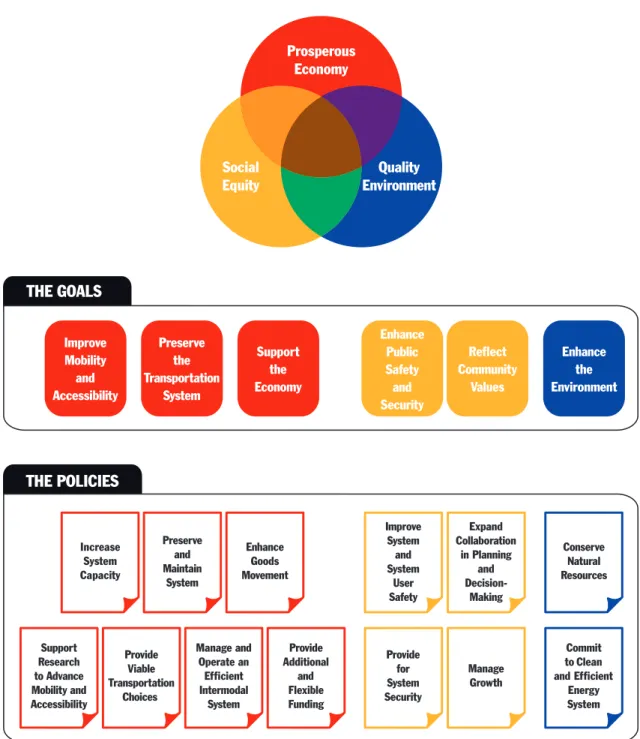
FIGURE ES-1
California Transportation Plan
Each of the following goals support one or more concepts contained in the vision for California’s transportation system:
PROSPEROUS ECONOMY:
Goal 1. Improve Mobility and Accessibility: Expanding the system and enhancing modal choices and connectivity to meet the State’s future transportation demands.
Goal 2. Preserve the Transportation System: Maintaining and rehabilitating California’s extensive transportation system to preserve it for future generations.
Goal 3. Support the Economy: Ensuring the State’s continued economic vitality by securing the resources needed to maintain, manage, and enhance the transportation system, while providing a well organized and managed goods movement system.
SOCIAL EQUITY:
Goal 4. Enhance Public Safety and Security: Ensuring the safety and security of people, goods, services, and information in all modes of transportation.
Goal 5. Reflect Community Values: Finding transportation solutions that balance and integrate community values with transportation safety and performance, and encourage public involvement in transportation decisions.
QUALITY ENVIRONMENT:
Goal 6. Enhance the Environment: Planning and providing transportation services while protecting our environment, wildlife, and historical and cultural assets.
Transportation Policies
The following policies were developed to support the goals and to respond to issues raised by the public and stakeholders, while being mindful of future trends and challenges. Although most policies support more than one goal, the CTP presents each policy under the goal it most closely supports.
■ Increase system capacity.
■ Preserve and maintain the system. ■ Enhance goods movement.
■ Support research to advance mobility and accessibility.
■ Manage and operate an efficient intermodal system.
■ Provide additional and flexible funding.
■ Improve system and system user safety. ■ Expand collaboration in planning and
decision-making.
■ Provide for system security. ■ Manage growth.
■ Conserve natural resources. ■ Commit to a clean and energy
efficient system.
The policies are designed to preserve the transportation system and provide mobility and accessibility for California’s growing population, while enhancing the State’s economy, environment, and social equity. For each policy, the CTP identifies key partners and offers a number of implementing strategies designed to achieve the transportation vision and goals.
Rural Issues
Rural issues, while as acute as those in urban areas, have very different characteristics. With only eight percent of California’s population, rural areas comprise 94 percent of the land area. Providing transportation services to a sparse and widely distributed population presents special transportation challenges that must be considered when planning for a balanced, interconnected system. California’s economy relies heavily on the rural and interregional road and rail system in order to move agricultural products, timber, and tourists.
Rural transportation issues vary depending on the area’s economic base, topography, and proximity to urban areas and tourist destinations. If located adjacent to an urban area, the rural jurisdiction might receive a “spillover” of big city problems, such as traffic and air pollution, but not receive sufficient resources to address these impacts. The CTP explores some of the issues facing rural transportation providers and offers strategies to address them.
Performance Measures
Developing performance measures and indicators to assess performance is a standard private sector business practice. Performance measures use statistical evidence to determine progress toward specific, defined objectives. This includes both evidence of fact, such as measurement of pavement surface smoothness (quantitative) and measurement of customer perception determined through customer surveys (qualitative). Performance measures provide information about how well services are being provided. Performance measures help set goals and outcomes, detect and correct problems, and document accomplishments. BTH Agency Secretary, Sunne Wright McPeak, initiated efforts to improve the effectiveness and efficiency of State government using input from the Transportation Expert Review Panel. The panel consisted of members from external, public, and private sector entities and produced 39 recommendations, including developing system and organizational performance measures. A team comprised of members from regional and metropolitan planning agencies, and other stakeholders developed performance measures and
indicators that support the vision, goals, and policies contained in the CTP.
Integration of performance measures into long-range planning is critical to the continued success of performance measures implementation. As we endeavor to develop a more balanced and sustainable system, the evaluation of transportation objectives and related performance measures will continue. Additional efforts are already being focused towards finding measures appropriate for rural areas. The next step will be to determine what types of performance measures can be developed and used that will accurately reflect system performance in rural areas of the State.
Introduction
Transportation benefits us all. We are dependent on the transportation system to access friends and family, goods and services, and information and activities. In California, transportation means much more than the roadway system. It is also transit, bicycle and pedestrian facilities, railways, airports, seaports and spaceports, pipelines, vehicles, and communication facilities. This complex network serves many purposes, from getting our kids to school to moving our goods to market.
Transportation influences the shape of our communities. When walking was the primary mode of transportation, our communities were very compact. As transportation evolved to horse, river, canal, and rail modes, communities expanded. The advent of automobiles and air travel allowed even greater freedom and independence and communities developed accordingly. The ongoing evolution of the transportation system will continue to influence California’s communities and activities in the future.
The system of the future must provide people with safe, reliable, and affordable transportation options. People should be able to commute easily and safely by foot, bicycle, or public transit, as well as by automobile. Transportation modes must provide access for people and goods to all areas of the State, nation, and the world. The system must be interconnected, allowing travelers and goods to transfer easily between transportation facilities and modes.
Just as business makes itself less vulnerable and more responsive to market demand by having a variety of suppliers, California’s mobility must rely on a variety of transportation options and strategies. This plan provides goals, policies, and strategies to achieve a balanced, safe transportation system that increases mobility and accessibility, while strongly supporting a growing economy and healthy environment, and providing equitable opportunities for all Californians.
Purpose of the California Transportation Plan
The California Transportation Plan 2025 (CTP) is a policy plan designed to guide transportation investments and decisions at all levels of government and by the private sector to enhance our economy, support our communities, and safeguard our environment for the benefit of all. It is consistent with and supports the findings of the California Commission on Building for the 21st Century’s report Invest for California, Strategic Planning for California’s Future Prosperity and Quality of Life, the Speaker of the Assembly’s Commission on Regionalism’s report New California Dream, Regional Solutions for 21st Century Challenges, the Global Gateways
by the Business, Transportation and Housing Agency (BTH) and the California Environmental Protection Agency, in partnership with transportation and goods movement industry representatives and stakeholders.
This document provides a vision for California’s transportation system and explores major trends that will likely influence travel behavior and transportation decisions over the next 20-plus years. In the context of these future trends and challenges, it then provides goals, policies, and strategies to reach the vision.
Developing a statewide long-term transportation plan is an ongoing effort. The last CTP was developed in 1993 and updated in 1998 by the Statewide Goods Movement Strategy, the Transportation System Performance Measures Report, and the Study of the Role of the State in Mass Transportation. While the CTP 2025 incorporates strategies contained in the 1993 CTP and the 1998 updates, as appropriate, it also reflects the changing transportation environment. Most notably, the CTP reflects the shift in transportation planning and project selection responsibilities resulting from Senate Bill 45 (Chapter 622, Statutes of 1997).
SB 45 had significant impacts on the regional transportation planning and programming process. The statute delegated major planning decisions to the regional transportation planning agencies (RTPAs) requiring them to take a more active role in selecting and programming transportation projects and encouraged more decision-making through partnerships among stakeholders. SB 45 changed the transportation funding structure; modified the transportation programming cycle, program components, and expenditure priorities; and required the development and implementation of transportation system performance measures.
State law and the California Transportation Commission (CTC) require metropolitan regional planning agencies to adopt a 20-year regional transportation plan (RTP) every three years, and rural agencies to adopt an RTP every four years (see Appendix IX). The CTP is developed in consultation with the State’s 44 RTPAs and will provide guidance for developing future regional transportation plans.
Additionally, the CTP considers the findings and recommendations of numerous other focused transportation plans such as the California Aviation System Plan, Interregional Transportation Strategic Plan, Intelligent Transportation System strategic deployment plans, California State Rail Plan, High-Speed Rail Plan, Amtrak’s California Passenger Rail System 20-Year Improvement Plan, California Blueprint for Bicycling and Walking, and the Ten-Year State Highway Operation and Protection Plan.
Vision for California’s Transportation System
California faces many challenges and opportunities, including protecting our sensitive agricultural lands and natural environment while preserving our economic prosperity, and providing access to opportunities and a desirable quality of life for our rapidly growing population. Decisions must be made today to responsibly meet the transportation demands of the future.
Developing a universally accepted vision for our transportation system in a state as large and diverse as California is difficult. To accomplish this task the California Department of Transportation (Department), on behalf of the Secretary of Business, Transportation and Housing Agency, initiated a multi-faceted, statewide public participation program to gain input from our customers, partners, and stakeholders regarding the State’s current and future transportation system. Included in this statewide outreach effort was a two-part customer survey, 54 focus groups, 3,200 completed telephone surveys, 24 workshops, comment cards, a brochure and questionnaire distributed in four languages, and a CTP website.
A draft CTP was developed based on the public’s response and guidance received from a Policy Advisory Committee comprised of representatives from academia, RTPAs, cities, counties, key State agencies, and advocacy groups. The public was presented the draft CTP and asked, “Did we get it right?” This document reflects the results of that two-part public input effort.
Appendix IV provides a detailed description of this effort and a summary of the comments and concerns received.
On a broad view, the public’s comments and concerns are incorporated in the following vision for California’s transportation system in 2025:
California has a safe, sustainable, world-class transportation system that provides for the mobility and accessibility of people, goods, services, and information through an integrated, multimodal network that is developed through collaboration and achieves a Prosperous Economy, a Quality Environment, and Social Equity.
Key concepts are defined to enable the vision to be fully understood.
SUSTAINABLE means meeting the needs of the present without compromising the ability of future generations to meet their own needs. When applied to transportation, it means ensuring that environmental, social, and economic considerations are factored into decisions affecting transportation activity. By simultaneously considering the economy, equity, and environment when making decisions about transportation, we will be leaving a sustainable legacy for future Californians.
A sustainable transportation system is one that meets people’s needs equitably, fosters a healthy environment, provides a broad, balanced system in which the private vehicle, and public transportation, bicycling, and walking are all viable options, and can be maintained and operated efficiently and effectively over time.
A sustainable transportation system is effectively inter-connected among jurisdictions and modes. It is comprised of many publicly and privately owned and operated transportation modes and supporting facilities designed to move people, goods, services, and information. Transportation facilities and modes include transit, bicycle, pedestrian, airports and seaports, ferries, pipelines, railways, roadways, and vehicles. The transportation system is integrally tied to the shape and vitality of California’s communities, reflects those communities’ values, and is supported by effective land use decisions.
MOBILITY is the ability to move people, goods, services, and information. Increasing capacity and improving system connectivity, management, and operation will result in increased mobility. Mobility can also be improved by effectively using all travel modes including privately and publicly owned vehicles; air, rail, transit and ferry services; and bicycling and walking. ACCESSIBILITY is the ability of people to reach other people, goods, services, activities, destinations, and information. Access can be achieved by expanding the capacity, efficiency, and convenience of the transportation system and removing barriers to persons with disabilities. It can also be achieved by alternate methods, such as telecommuting, electronic business and government transactions, and through land use changes that reduce the distances between residences, employment, services, and points of entry to the transportation system.
COLLABORATION is included in both the vision and the guiding principles to emphasize its level of importance. Transportation planning and programming in California is a complex process shared among multiple public and private entities. It requires collaboration among transportation providers and governmental entities as well as community-based organizations, urban planners, developers, social, community, and emergency service providers, the environmental and business communities, permitting agencies, system users, and others. All of these voices must be heard and considered in order to achieve an integrated transportation system that promotes economic vitality and community goals.
PROSPEROUS ECONOMY means transportation decisions support a globally competitive economy and promote prosperity. Transportation decisions are made based on an analysis of the total benefits and long-term costs of transportation, including life cycle, environmental, social, and economic costs, and their immediate and cumulative impacts and efficiencies. Benefits include the improvement of the State’s mobility and regional economic vitality, and coordination of development, land use, and environmental objectives. Additionally, the cost of maintaining, managing, and operating the existing system is considered before improving or expanding the system.
QUALITY ENVIRONMENT means that the transportation system is part of an enhanced, ecologically healthy environment, and is developed with appropriate safeguards to protect open space, agricultural and sensitive lands, critical habitats, wildlife, and water and air quality; to minimize noise and visual impacts; and to reduce emissions of greenhouse gases. SOCIAL EQUITY in transportation has two components. The first is to ensure that no group receives disproportionate burdens or benefits from transportation investment decisions. The second is that the transportation system allows everyone “…to participate fully in society whether or not they own a car and regardless of age, ability, ethnicity, or income.”2 A transportation system designed to provide social equity ensures that low-income individuals, the young and elderly, persons with disabilities, and disadvantaged individuals in rural and urban areas have access to safe and reliable transportation.
Trends and Challenges
The first step in determining how to achieve the vision for California’s transportation system is an assessment and identification of the current and projected future trends and challenges under which the CTP’s goals, policies, and strategies will be implemented.
Transportation is part of the social and economic fabric of California. It cannot be considered apart from population growth, changing demographics, travel behavior, safety, employment, housing, land use, the economy, technology, the environment, community values, individual opportunity, and funding. Many current trends, if continued, give rise to concerns regarding California’s future in terms of environmental quality, economic prosperity, equity of individual opportunity, and society’s ability to provide adequate services.
California is the most populous state in the nation, and its population and natural environment are the most diverse. While the State’s growth and diversity adds to California’s economic strength and vibrancy, they also confront policy-makers with a magnitude of social, economic, environmental, and transportation challenges. The following is an overview of trends expected to influence future transportation decisions and travel behavior:
ECONOMY Transportation investments have a direct and immediate impact on the economy. Transportation investments can facilitate economic development, job creation, income, and additional economic activities, from communities without an existing economic base to those communities whose economies are already robust. Based on estimates developed for California by the U.S. Department of Commerce, a $1 billion investment in highway and transit improvements would directly and indirectly provide over 26,000 jobs, generating about $870 million in personal income, and almost $1.5 billion net increase in the Gross State Product. The same amount of expenditure on highway repair, maintenance, and operational improvements would support 31,600 jobs in the State. This difference in job generation is due to the fact that maintenance and operational improvement projects are typically more labor-intensive and more of the jobs tend to originate and remain within the State. The full realization of the economic impacts of transportation investments, whether capacity increasing or rehabilitation, may take up to a decade, with the majority of impacts occurring in the first three to five years of the expenditure.
In addition to jobs, investments in transportation facilities generate benefits by lowering transportation costs. Lower transportation costs promote productivity growth, because more output can be produced with the same amount of input. Increased productivity generally implies greater net income and hence an improvement in society’s economic well being. When projects produce transportation “costs savings” (such as reduced travel times, accident rates, and environmental impacts) that exceed the cost of the project, our economy becomes more productive and, consequently, more competitive.
The travel industry is a major component of California’s economy and a primary industry in many local communities. Nearly 893,000 Californians were employed in tourism related industries
in 2004. During the same year, the tourism industry generated approximately $82.5 billion in spending as it hosted an estimated 314 million domestic and 8 million international travelers.3 To continue this level of popularity, California must provide safe, reliable, interconnected transportation choices. Failure to invest in the system could result in the State’s economic decline, rising unemployment, environmental degradation, and diminished quality of life.
3 California Travel and Tourism Commission, “California Fast Facts 2005,” August 2005.
GOODS MOVEMENT California’s status as the world’s sixth-largest economy is connected to our ability to transport people and goods within the State, as well as to other states and countries. California is the nation’s leading global gateway for Pacific Rim trade. It is estimated that 45 percent of all U.S. continental, containerized cargo passes through California’s ports (see Map 1). More than two million jobs nationwide are tied to these ports, including the loading and unloading of ocean vessels, rail and truck transport, warehousing and distribution, and administrative support functions. The goods movement industry supports one in seven California jobs (including many high-wage jobs); contributes more than $200 billion per year to the State’s economy and produces more than $16 billion a year in tax revenues to State and local government.4
4 California Business, Transportation and Housing Agency and California Environmental Protection Agency, Goods Movement Action
Plan - Phase I: Foundations, September 2005.
Further, the enormous market in California, and other western states served by California, provides profitable opportunities for carriers making this State their port of call. The Ports of Long Beach, Los Angeles, and Oakland are three of the four largest container ports in North America. The Ports of Long Beach and Los Angeles are planning to invest at least $6 billion and the Port of Oakland will invest $2 billion over the next 20 to 25 years on infrastructure development.5 Investments in transportation infrastructure that reduce the cost of moving freight are critical to California and the nation.
In reality, California’s freight infrastructure is interdependent — an event in one sector can have dramatic consequences in another for example, in October 2004, a “Perfect Storm” of events combined to create the most significant slowdown of activity at the ports of Los Angeles and Long Beach since the labor lockout of Fall 2002. Explosive increases in import demand, shortages of available port labor, and terminal congestion (resulting in part from shortages in freight rail capacity and drayage haulers) resulted in up to 90 ships per day docked at port facilities or anchored offshore waiting to unload. In addition, 124 ships were diverted to other west coast ports or through the Panama Canal.6
Since the passage of the North American Free Trade Agreement, Mexico has replaced Japan as California’s primary export market. The value of California’s trade with Mexico was $29.5 billion in 2003 (of which exports represented $12.5 billion), 98 percent of which travels by truck. Significant resources have been targeted to address the congestion resulting from increases in trade with Mexico. However, additional infrastructure will be needed
to accommodate an anticipated doubling of truck trips across the U.S.-Mexico border over the next 20 years.7
7 California Business, Transportation and Housing Agency and California Environmental Protection Agency, Goods Movement Action
Plan - Phase I: Foundations, September 2005.
Nationally, air cargo is the fastest growing segment of freight transportation. In California, Los Angeles International Airport (LAX) was the nation’s second busiest air freight gateway by value in 2003. Approximately 12 percent ($64 billion) of the value of all U.S. international air freight moved through LAX.8
8 U.S. Department of Transportation, Bureau of Transportation Statistics, America’s Transportation Gateways, 2004.
Railroads handle more than 40 percent (approximately 155 million tons during 2003) of the nation’s intercity freight traffic (see Map 2).9 Rail intermodal service (the movement of truck trailers or containers by rail and at least one other mode of transportation, usually trucks) is an increasingly important segment of the U.S. freight rail industry, rising from just over three million trailers and containers in 1980 to more than nine million in 2002. Half of rail intermodal traffic consists of imports or exports, a reflection of the vital role railroads play in our nation’s international trade. As manufacturing has become more global and as supply chains have become longer and more complex, rail intermodal traffic has come to play a critical role in making supply chains far more efficient for retailers and other firms and industries. As demand increases over the next two decades, railroads will face capacity, environmental, emergency access, safety, and other community-related problems.
9 Association of American Railroads, February 2005.
Transporting freight by rail can reduce highway congestion and may decrease the need for major new highway investments. A single intermodal train can take up to 280 trucks (equivalent to more than 1,100 automobiles) off our highways. However, for this to occur continued development of inland container yards and intermodal facilities will be needed.
The volume of truck transport is enormous and will continue to grow, but at a slower rate than air and rail transport. In California, approximately 86 percent of freight is moved by trucks as the principal mode of transportation.10 Accommodating increased trucking goes beyond highway congestion. Routes providing access to rural areas, such as California’s North Coast, older interchanges, local roadways, and truck parking facilities have not kept pace with the needs of the trucking industry.
10 Federal Highway Administration (FHWA), Office of Freight Management and Operations, Freight Analysis Framework, State Profile -
Efforts by various organizations demonstrate the increasing seriousness of these issues. The Southern California Association of Governments (SCAG) is proposing truck-only lanes along Interstate 710, State Route 60, and Interstate 15, approximately 143 miles. According to their studies, dedicated lanes (separate truck and/or bus facilities) could reduce safety and operational conflicts. The cost for such separate facilities will be very high, but the long-term benefits may be significant. As population and commercial vehicle traffic increase, separate facilities in some form could be one of the solutions that will need to be pursued.11
An understanding of the relationship between investments in transportation infrastructure and the performance of the freight system is critical to policy-makers, transportation users, and transportation providers. Transportation improvements result in lower transportation and inventory costs, and enhanced productivity, profits, growth, and competitiveness for businesses. To ensure California’s pre-eminence as an economic powerhouse, we will need improved access to railways, seaports, highways, and airports, while ensuring the safety and security of ports of entry and cargo moving through the State.
EMPLOYMENT In the late 20th century, employment centers moved from central cities to the suburbs and edge cities. This shift in employment centers has made job access for inner-city residents — especially the urban poor — an important concern. The problem is made more complex by the fact that relatively few suburban jobs are well served by public transit and many inner urban residents are without cars.
Without intervention, it is expected that employment centers will continue to be in suburban centers and office parks and that employment growth will continue to be heavily concentrated in Southern California and the San Francisco Bay Area. These areas are already experiencing considerable traffic congestion. Transportation providers and employers will need to explore new forms of transit or telecommuting to provide alternatives to the single-occupancy vehicle.
TECHNOLOGY Transportation services, vehicles, and infrastructure are rapidly being changed by new technologies. Technology applications include: electronic payment of transit fares, tolls and parking; on-board diagnostics, information, and control systems that can assist the driver in maneuvering the vehicle and avoiding collisions; personal and vehicle-based “mayday” systems that can automatically notify authorities and provide vehicle location in event of an accident; smart infrastructure that monitors real-time usage and conditions to increase system efficiency; monitoring systems to enhance public transit and airport security; and logistics systems that route, monitor, and track shipments.
Technological changes will also influence the transportation fuels we use. For example, electric, hydrogen, or hybrid electric-petroleum vehicles are being introduced, substantially reducing emissions of greenhouse gases and other pollutants, and changing fleet fuel characteristics. Advances in computer and communications technology will also influence how Californians work, educate, shop, and do business. Telecommuting, teleshopping, and video conferencing could reduce the need to travel, and have a profound impact on where Californians choose to live and work.
Technology presents unique challenges. Short lifecycles require flexibility and compressed timelines that are uncommon in transportation decision-making. Technologies must also be standardized and integrated statewide so that transportation services are consistent. Consumer devices, such as vehicle-based navigation systems, must work effectively everywhere to achieve market penetration levels needed for low-cost mass production.
The range of options and their impacts will continue to expand and may alter transportation systems in many ways as additional technologies are introduced. Whether and to what extent these technologies become a significant element of the transportation system will depend not only on the technological developments but also on public and private decisions about the technologies’ desirability and usefulness.
EQUITY Equity is a key component of sustainability and the transportation vision of the CTP. Equity applies to access to the transportation system and services for the young, the elderly, persons with disabilities, and low-income households.
Transportation costs comprise the second greatest expense in Californian’s household budget, second only to shelter, and greater than food and health care.12 The Consumer Expenditure Survey of major metropolitan statistical areas indicates that residents of the Los Angeles area spend an average of approximately $8,100 annually on transportation, while San Diegans spend just over $9,100 and San Franciscans spend nearly $9,500. This represents 18 percent, 21 percent and 17 percent, respectively, of the total household expenditures. The following example provides yearly transportation expenditures for the average San Diego household:
12 U.S. Department of Labor, Bureau of Labor Statistics, Consumer Expenditure Survey, www.bls.gov/cex/home.htm.
Vehicle purchase (net outlay) ... $4,800 Gasoline and motor oil ... 1,400 Insurance, maintenance, licensing, etc. .... 2,400 Transit ...500 ______________________________________ Household total ...$9,100
The national average annual household expenditure for the same period was about $7,600, or 19 percent. Only recently has transportation comprised such a large share of the family budget. In 1919, families spent only 3.1 percent of their total expenditures on transportation. By 1950, it had grown to 13.8 percent and in 1960 to 15.1 percent.
For lower income families, the expense of transportation poses a tremendous burden. Nationally, the poorest families (those earning less than $13,900 after taxes) spend 39 percent of their take-home pay on transportation. A recent Bureau of Transportation Statistics study found that the working poor spend nearly 10 percent of their income on getting to and from work. This compares to just over two percent for individuals earning $45,000 or more annually, and 3.9 percent for all Americans.13 For many low-income families, the high expense of owning a car may put home ownership out of reach.
A more extensive mix of flexible transportation choices and services would also improve accessibility for Californians with disabilities. However, people with disabilities are also vulnerable to “environmental barriers.” Barriers may include the physical design of buildings, streets, vehicles, and facilities. Often, something as simple as curbs or the lack of sidewalks can keep people with disabilities from interacting socially or being independent.
The transportation system will become more equitable to the extent that transportation planners promote traditional urban growth patterns that are more readily served by transit, provide more transportation choices, and offer incentives for Location Efficient Mortgages, like those now offered in Los Angeles and the San Francisco Bay Area.14
14 A Location Efficient Mortgage is a private sector mortgage product that provides extra home purchasing power by enhancing the
ability of prospective homebuyers to purchase a home within a transit oriented development or urban infill area.
LAND USE IMPACTS ON TRANSPORTATION The way communities are planned and designed has a profound impact on our travel behavior. Over the past several decades, three predominant land use practices have influenced urban design:
■ Lack of coordinated decision-making between cities and counties who make local land-
use decisions, and regional agencies and the State who make regional and interregional transportation decisions.
■ Single-use zoning ordinances isolating employment, shopping and services, and
housing locations.
■ Low-density growth planning resulting in considerable land consumption and sprawl-type
urban form, requiring higher infrastructure investments due to distances served.
These land use practices have often resulted in increased traffic congestion and commute times, air pollution, greater reliance on fossil fuels, loss of habitat and open spaces, inequitable distribution of economic resources, and loss of a sense of community. These land use practices have contributed to the increase in vehicle miles traveled and vehicular non-work trips. Existing community designs often do not include safe bicycle and pedestrian facilities, or destinations are too great in distance to be practicably accessed by walking or biking. Additionally, suburban street designs and low-density housing make communities difficult to effectively serve with transit.
Most older adults and baby boomers live in suburban areas, and are likely to retire in these surroundings. Frequently, the communities lack public transportation, have no sidewalks or poorly maintained sidewalks, and lack mixed-use development, meaning there are no stores or services nearby. Two of the major problems with walking as a form of transportation cited by older adults are poor sidewalks and destinations being located too far away.15
A major influence on community form over the past 20 years is a phenomenon often called “the fiscalization of land use.” This means a policy environment in which land use decisions