facebook.com/redhatinc @redhatnews linkedin.com/company/red-hat HP and Red Hat have designed a purpose-built scale-out storage solution to meet the datacenter challenges to save space, energy, and time when deploying large data workloads.
Red Hat Gluster Storage open software-defined storage platform and the HP ProLiant® SL4500 server line enable enterprises to efficiently and cost-effectively store and manage big data growth.
TABLE OF CONTENTS
2 INTRODUCTIONStorage, growth, innovation, and cost Scale-out storage with HP and Red Hat
3 RED HAT GLUSTER STORAGE ON THE HP PROLIANT SL4540 GEN8 SERVER
Large file and object store
Enterprise drop box or cloud storage for service providers Near-line archival
9 SOLUTION COMPONENTS
Red Hat Gluster Storage
Two-Node HP ProLiant SL4540 Gen8 Server
12 CAPACITY AND SIZING DISCUSSION
One-, two, and three-node HP ProLiant SL4540 Gen8 Servers Server sizing for use cases
Sizing and growing configurations
14 CONCLUSION 15 REFERENCES TECHNOLOGY DETAIL
RED HAT GLUSTER STORAGE ON THE
HP PROLIANT SL4540 GEN8 SERVER
Deploying open scalable software-defined storage
Scale-out early adopters have realized a number of benefits, including improved scalability, improved performance (from both I/O and a throughput perspective), improved data availability, improved hardware utilization, and lower costs. ESG - “Scale-out Storage Market Trends”, December 2010
INTRODUCTION
Organizations of all kinds are struggling with the need to manage growing amounts of data in a cost-effective fashion, even as they focus on extracting more value from that data. Unstructured data in particular continues to grow rapidly in the typical enterprise, outpacing the abilities of conventional storage solutions. Enterprises have seen enormous gains in scalability, flexibility, and affordability as they migrated from proprietary, monolithic server architectures, but storage has remained a bastion of inflexible technology. The advent of virtualization and growing adoption of cloud models are only adding to these challenges.
Driven by the need for improved scalability, performance, and faster provisioning at lower infra-structure and management costs, HP and Red Hat are collaborating to bring effective scale-out storage solutions to market. Scale-out storage solutions provide a compelling alternative for serving growing amounts of unstructured data in an approach that scales easily in multiple dimensions. Scale-out storage increases performance, capacity, or throughput by adding resources (processors, memory, network interfaces, or spindles) as a loosely coupled system of nodes that work side-by-side, in parallel.
Red Hat® Gluster Storage running on HP ProLiant® SL4540 Gen8 servers offers massive scalability, high performance, and volume economics for storage of all kinds of unstructured data. In particular, two-node HP ProLiant SL4540 Gen8 servers equipped with up to 25 disks per node can offer scal-able and cost-effective solutions for a variety of use cases, including:
• Creating a large file and object store
• Deploying an enterprise drop box or cloud storage for service providers
• Establishing a near-line archive
STORAGE GROWTH, INNOVATION, AND COST
In recent years, unstructured data has been growing at unprecedented rates. Enterprises of all kinds are facing an explosion of data from diverse applications and technology trends including virtualiza-tion, collaboravirtualiza-tion, business intelligence, data warehousing, and media. The proliferation of sensors and mobile devices along with the move to cloud computing models will only accelerate these growth trends. New regulation and data retention requirements further exacerbate the problem. In fact, according to IDC, from 2005 to 2020, the digital universe will grow by a factor of 300, from 130 exabytes to 40,000 exabytes1 with 30 billion connected devices by 20202. At the same time, manag-ing data and exploitmanag-ing it for new opportunities has become a top priority for IT organizations as the strategic and tactical importance of data and its analysis have become apparent.
Driven by this rampant growth, storage costs are having an outsized impact on enterprise IT budgets. While the volume and use of storage is expected to grow dramatically each year, the price for storage continues to remain high. Per-terabyte storage prices are not falling as fast as data volumes are growing, presenting a problematic diverging trend for organizations that must supply and manage large-scale storage infrastructure. For example, IDC estimates that the investment in spending on IT hardware, software, and services, telecommunications, and staff will grow by 40% between 2012 and 2020.1
1 Source: IDC, The Digital Universe in 2020: Big Data, Bigger Digital Shadows, and Biggest Growth in the Far East
As a result of these trends, organizations are frequently forced into buying expensive solutions to meet their storage requirements. Every time organizations wants to add more data, they have to purchase additional storage capacity. Every time they add more capacity, they have to sacrifice performance, as many storage solutions do not scale linearly. Making matters worse, many storage solutions often have rigid architectures with limited deployment options, and are not flexible enough to both scale up, by adding more capacity, and scale out, by adding more nodes. Furthermore, JBOD (just a bunch of disk) solutions frequently introduce complexity through considerable hardware variety, and lack of cohesive scalability and management model. Strategies are needed that enable both cost-effective growth and scalability of storage for unstructured data.
SCALE-OUT STORAGE WITH HP AND RED HAT
Once thought of as a niche approach, scale-out storage has emerged as a compelling solution. Just as scale-out server architectures have revolutionized cost-effective computing, scale-out storage offers many of the same benefits for storage. Virtualization and cloud computing benefit in particu-lar, with scale-out storage offering a more scalable storage infrastructure to support rapid virtual machine growth. The same aspects of scale-out storage that make it ideal for virtualization and cloud make it ideal for serving unstructured data of all kinds.
Red Hat Gluster Storage running on HP ProLiant SL4540 Gen8 servers represents a purpose-built solution that takes scale-out storage to a new level of density and volume economics—allowing orga-nizations to effectively store and manage petabyte-scale data growth. Together Red Hat Gluster Storage and the flexible and scalable HP ProLiant SL4540 Gen8 server offer cost-effective multi-dimensional storage scalability. In fact, Red Hat and HP estimate that a5 PB installation based on Red Hat Gluster Storage and HP ProLiant SL4540 Gen8 servers could offer a 30% savings in infra-structure, space, power, and cooling costs over a comparable JBOD configuration over a three-year period, including:
• 50% less space
• 61% less power
• 75% less administration time
• 63% fewer cables
RED HAT GLUSTER STORAGE ON THE HP PROLIANT SL4540 GEN8 SERVER
The combination of Red Hat Gluster Storage and HP ProLiant SL4540 Gen8 servers provides a next-generation scale-out storage solution. Red Hat Gluster Storage is a software-defined scale-out file and object storage software solution for private cloud or datacenter, public cloud, and hybrid cloud environments. Red Hat Gluster Storage is software-only, open source, and designed to meet unstruc-tured, semi-strucunstruc-tured, and big data storage requirements.Red Hat Gluster Storage enables organizations to combine large numbers of HP ProLiant SL4540 Gen8 servers into a high-performance, virtualized, and centrally-managed storage pool. Both capac-ity and performance can scale linearly and independently on demand, from a few terabytes to pet-abytes and beyond. By combining economical HP ProLiant SL4540 Gen8 servers with a scale-out approach, organizations can achieve radically better price and performance in an easily deployed and managed solution that can be configured for increasingly demanding workloads.
Benefits of the joint Red Hat and HP solution include:
• Flexible deployment. Flexible configurations of compute and storage can be tuned for diverse workloads.
• Drastically lower cost. Massive scalability and density provided by HP ProLiant SL4540 Gen8 servers consolidate power and cooling and save on space.
• Unstructured data scalability. Scale-out storage software offers a scalable foundation for unstructured data.
• Open and extensible. Extensible storage modules enable new business models without concern for inflexible infrastructure.
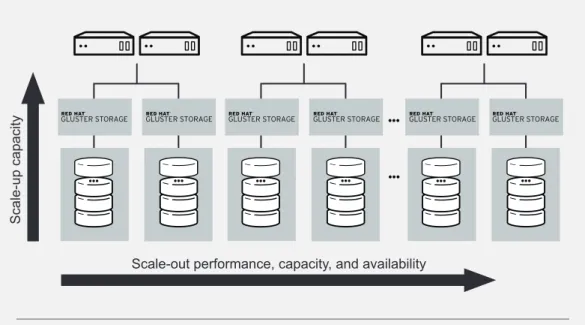
The HP and Red Hat solution provides multi-dimensional scale-out storage infrastructure in terms of both performance and capacity. By aggregating the disk, CPU, and I/O resources of large numbers of HP ProLiant SL4540 Gen8 servers, organizations can create large high-performance storage pools. More capacity can be added simply by adding additional disks. More performance can be added by adding additional server nodes (Figure 1). The unique architecture of Red Hat Gluster Storage deliv-ers the benefits of scale-out storage while avoiding the corresponding overhead and risk associated with keeping large numbers of storage nodes in sync. In practice, Red Hat Gluster Storage accom-plishes multi-dimensional scalability through:
• The elimination of the metadata server
• Effective distribution of data to achieve scalability and reliability
• The use of parallelism to maximize performance via a fully distributed architecture
Scale-up capacit
y
Scale-out performance, capacity, and availability RED HAT®
GLUSTER STORAGE RED HAT
®
GLUSTER STORAGE RED HAT
®
GLUSTER STORAGE RED HAT
®
GLUSTER STORAGE RED HAT
®
GLUSTER STORAGE RED HAT
®
GLUSTER STORAGE
Figure 1. Red Hat Gluster Storage running on the HP ProLiant SL4540 Gen8 server offers both performance and capacity scalability.
The joint HP and Red Hat solution delivers a number of benefits.
• Reduced costs. Deploying scale-out storage with Red Hat Gluster Storage on HP ProLiant SL4540 Gen8 servers allows organizations to dramatically reduce capital costs while maintaining high levels of performance and availability.
• Enhanced agility. Red Hat Gluster Storage can be deployed and scaled in minutes. Because Red Hat Gluster Storage automates the management of files and storage nodes, operational complex-ity is simplified and costs are reduced.
• Increased reliability and reduced downtime. Software ensures the availability of the storage system and its data. Red Hat Gluster Storage can replicate data to multiple HP ProLiant SL4540 Gen8 servers, helping to ensure that the system is protected from faults and that the failure of any individual server does not compromise data access, or the overall availability of the storage system.
• Lower complexity. Red Hat Gluster Storage running on HP ProLiant SL4540 Gen8 servers pro-vides vastly simplified homogeneous infrastructure over disparate JBOD systems, while a simpli-fied global namespace helps eliminate architectural complexity.
• Better user and customer satisfaction. By consistently delivering high levels of performance and helping to eliminate data silos, Red Hat Gluster Storage combined with HP ProLiant SL4540 Gen8 servers helps drive higher user satisfaction levels.
The sections that follow describe how the combination of Red Hat Gluster Storage with the HP ProLiant SL4540 Gen8 server can be deployed to serve a diverse range of use case scenarios. LARGE FILE AND OBJECT STORE
Many organizations use applications that generate a vast amount of unstructured data. Taking the form of either files or objects or both, these data need to be stored for analysis and synthesis at a later time. Industries as diverse as oil and gas-exploration (seismic data), telecommunications (data and application logs and billing records), healthcare (imaging and patient records), finance (risk anal-ysis, compliance, and security data), scientific (gene sequencing and simulations) and others (render-ing, geographical information systems and computer aided engineering) all generate vast amounts of data. Unfortunately, these unstructured data can accumulate at an exponential rate, causing orga-nizations to continue to react by adding additional file servers or expensive monolithic NAS devices. Over time, these sprawling configurations can become difficult to manage and control. In many cases, this file server sprawl can result alternately in under utilization of costly storage devices or lower performance because of over utilization of those same file servers and NAS devices. Large file and object store workloads can be characterized as write once (or write-seldom) with many reads. Average file sizes can vary from small to large, or from a few kilobytes to several mega-bytes. The total size of the data-store can start small (from a few terabytes) but will often grow to hundreds of terabytes and continue to grow steadily. The access pattern generally consists of several concurrent users reading and a only few writing at any given point in time.
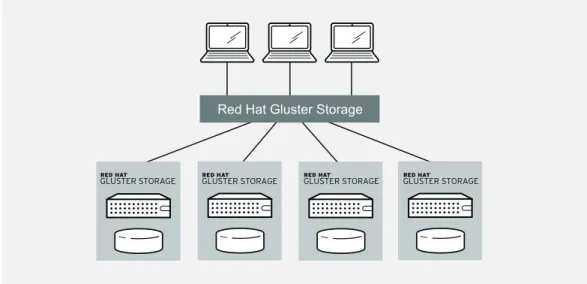
Figure 2 illustrates multiple HP Proliant SL4540 Gen8 servers combined via Red Hat Gluster Storage into a single volume that serves as a large file and object store. This approach provides a number of advantages when serving as a large file and object store, including:
• Elastic scalability
• Centralized and simplified management with global namespace technology
• Volume server and storage economics
• Multi-protocol client support for flexible file sharing
Red Hat Gluster Storage
RED HAT®
GLUSTER STORAGE RED HAT
®
GLUSTER STORAGE RED HAT
®
GLUSTER STORAGE RED HAT
®
GLUSTER STORAGE
Figure 2. Red Hat Gluster Storage and the HP ProLiant SL4540 Gen8 server can be deployed to serve as a large file and object store.
ENTERPRISE DROP BOX OR CLOUD STORAGE FOR SERVICE PROVIDERS
Telecommunication companies, cable operators, and other content providers are increasingly faced with competitive needs for providing differentiated services towards their end customers. As a consequence, many service providers offer their customers access to free and/or paid storage for storing photos, videos, and other media files that they access via the Web using a smart phone, tablet, or a personal computer. A similar use-case is seen in the enterprise context, where employ-ees need to reliably and securely store and retrieve files from a variety of devices. Many find that building a reliable back-end storage infrastructure to meet the agility, cost-point, and versatility of demanding cloud storage or enterprise drop box deployments is extremely challenging.
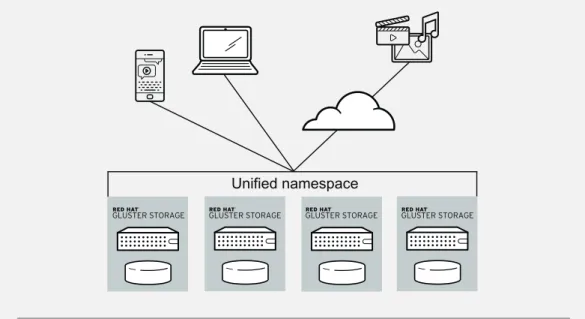
The enterprise drop box or cloud storage workload can be characterized as initially comprising only writes, as end-users upload media files. Over time reads and writes become roughly equivalent as users access, view, and play those media files. File sizes range from a few megabytes (smart phone photos) to dozens of megabytes (HD videos taken using high-end digital SLR cameras). The total size of the data store and its growth is directly proportional to the number of users of the service Deployments typically start at hundreds of terabytes and there is a need to pre-provision for poten-tially millions of subscribers or enterprise users. As new users sign up for content services, typical data stores can easily grow to several petabytes over time, and often span multiple datacenters. Data access patterns consist of hundreds of concurrent users reading and writing at the same time. Competitive storage solutions must be able to deliver very high sustained throughput. As shown in Figure 3, multiple HP ProLiant SL4540 Gen8 servers combine via Red Hat Gluster Storage to provide a unified namespace, allowing access from diverse devices in either an enterprise drop box or cloud storage setting.
Together Red Hat Gluster Storage running on the HP Proliant SL4540 Gen8 server provides a scale-out architecture with distinct advantages that include:
• Massive and linear scalability, with capacity and performance that can scale independently with no bottlenecks
• Object storage support via the OpenStack SWIFT API.
• Support for multiple drop box software implementations that can be co-resident on the storage servers
• Simultaneous storage and retrieval of files and objects interchangeably
• Consistent, sustained, and predictable throughput performance
Unified namespace
RED HAT®
GLUSTER STORAGE RED HAT
®
GLUSTER STORAGE RED HAT
®
GLUSTER STORAGE RED HAT
®
GLUSTER STORAGE
Figure 3. Red Hat Gluster Storage and HP ProLiant SL4540 Gen8 servers provide a unified namespace and can be deployed to serve as an enterprise drop box, or as cloud storage for service providers.
NEAR-LINE ARCHIVAL
A wide variety of organizations need to backup vast amounts of unstructured data, quickly accessing archived data when needed. Financial services firms, pharmaceutical companies, logistics opera-tions, telecommunicaopera-tions, oil and gas, healthcare, public safety, educational, and government organizations all share this common need. Complicating matters, new regulations now dictate that organizations must comply with multi-year data retention policies. Customers are also demanding stringent Recovery Point Objectives (RPO) and Recovery Time Objectives (RTO).
Near-line archival strategies often involve replacing tape archival with faster disk based access. Consistent access to data regardless of where it resides with consistent performance is another key requirement. Many storage solutions are simply unable to keep pace with the explosive growth of data and information.
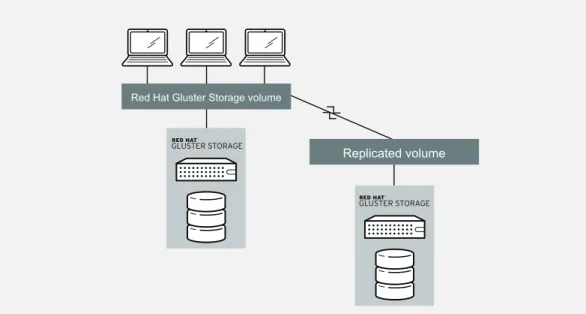
The near-line archival workload can be characterized as write once, read sparingly or never. The average file sizes depend on the kind of data that is being backed up by the organization. The total data store usually starts with dozens of terabytes and can easily grow to several petabytes. However, if tape replacement is involved, the data store may start at a petabyte scale. The data access pattern consists of concurrent writes as the archive is populated, and typically very few if any reads. As shown in Figure 4, multiple Red Hat Gluster Storage volumes can be deployed with one serving as near-line archival to the other. For example, a Red Hat Gluster Storage-based object store volume or a drop box volume could use another Red Hat Gluster Storage-based volume for near-line archival. The HP and Red Hat solution provides distinct advantages, including:
• Elastic scalability
• Rapid and random file access to ensure speedy access and recovery (faster retrieval and restora-tion of file data)
• Optional high availability via replication
• Optimized costs for archiving unprecedented amounts of data while minimizing complexities
• Compatibility with industry standards, including support for CIFS, NFS, and HTTP protocols as well as POSIX compatibility
• Reduced backup windows
Red Hat Gluster Storage volume
Replicated volume
RED HAT®
GLUSTER STORAGE
RED HAT®
GLUSTER STORAGE
Figure 4. Red Hat Gluster Storage running on HP ProLiant SL4540 Gen8 servers can function as an ideal near-line archival solution.
SOLUTION COMPONENTS
Red Hat Gluster Storage and the HP Proliant SL4540 Gen8 server represent an ideal technology combination for deploying scale-out storage.
RED HAT GLUSTER STORAGE
Red Hat Gluster Storage is software-only, open source, and designed to meet unstructured, semi-structured, and big data storage requirements. At the heart of Red Hat Gluster Storage is GlusterFS, an open source, massively scalable distributed file system that allows organizations to combine large numbers of storage and compute resources into a high-performance, virtualized, and centrally-managed storage pool. Red Hat Gluster Storage was designed to achieve several major goals as described in the sections that follow.
• Elasticity. With Red Hat Gluster Storage, storage volumes are abstracted from the hardware with each managed independently. Volumes can grow or shrink by adding or removing systems from the storage pool. Even as volumes change, data remains available with no application interruption.
• Petabyte scalability. Today’s organizations demand scalability from terabytes to multiple pet-abytes. Red Hat Gluster Storage lets organizations start small and grow to support multi-pet-abyte repositories as needed. Organizations that need very large amounts of storage can deploy massive scale-out storage from the outset.
• High performance. Red Hat Gluster Storage provides fast file access by eliminating the typical centralized metadata server. Files are spread evenly throughout the system, eliminating hot spots, I/O bottlenecks, and high latency. With the HP ProLiant SL4540 Gen8 server, organizations can use commodity disk drives and 10 Gigabit Ethernet to maximize performance.
• Reliability and high availability. Red Hat Gluster Storage provides automatic replication that helps ensure high levels of data protection and resiliency. In addition to protecting from hardware failures, self-healing capabilities restore data to the correct state following recovery.
• Industry standard compatibility. For any storage system to be useful, it must support a broad range of file formats. Red Hat Gluster Storage provides native POSIX compatibility as well as support for CIFS, NFS, and HTTP protocols. The software is readily supported by off-the-shelf storage management software.
• Unified global namespace. Red Hat Gluster Storage aggregates disk and memory resources into a single common pool. This flexible approach simplifies management of the storage environment and eliminates data silos. Global namespaces may be grown and shrunk dynamically, with no inter-ruption to client access.
• Rapid and random access. Unlike archival systems based on tape, Red Hat Gluster Storage offers fast random access and data can be both accessed and recovered rapidly.
From a technical perspective, Red Hat Gluster Storage provides distinct advantages over other technologies.
• Software-defined storage. Red Hat believes that storage is a software problem that cannot be solved by locking organizations into a particular storage hardware vendor or a particular hard-ware configuration. Instead, Red Hat Gluster Storage is designed to work with a wide variety of industry-standard storage, networking, and compute server solutions.
• Open source. Red Hat believes that the best way to deliver functionality is by embracing the open source model. As a result, Red Hat Gluster Storage users benefit from a worldwide community of thousands of developers who are constantly testing the product in a wide range of environments and workloads, providing continuous feedback, and providing unbiased feedback to other users.
• Complete storage operating system stack. Red Hat Gluster Storage delivers more than just a distributed file system. The complete storage solution adds distributed memory management, I/O scheduling, software RAID, self-healing, local N-way synchronous replication, and asynchronous long-distance replication via Red Hat Geo-Replication.
• User space. Unlike traditional file systems, Red Hat Gluster Storage operates in user space, rather than kernel space. This innovation makes installing and upgrading Red Hat Gluster Storage significantly easier, and greatly simplifies development efforts since specialized kernel experience is not required.
• Modular, stackable architecture. Red Hat Gluster Storage is designed using a modular and stack-able architecture approach. Configuring Red Hat Gluster Storage for highly-specialized environ-ments is a simple matter of including or excluding particular modules.
• Data stored in native formats. With Red Hat Gluster Storage, data is stored on disk using native formats (i.e. XFS) with various self-healing processes established for data. As a result, the system is extremely resilient and files are naturally readable without Red Hat Gluster Storage.
• No metadata with the elastic hash algorithm. Unlike other storage systems with a distributed file system, Red Hat Gluster Storage does not create, store, or use a separate index of metadata in any way. Instead, Red Hat Gluster Storage places and locates files algorithmically. The perfor-mance, availability, and stability advantages of not using metadata are significant, and in some cases, dramatic.
TWO-NODE HP PROLIANT SL4540 GEN8 SERVER
The HP ProLiant SL4500 Gen8 server is the industry’s first ever purpose-built server for big data. With support for up to 540 drives and over 2 PB per rack, these servers are ideal for building dense scale-out storage infrastructure. At the same time, the server features a converged and balanced architecture that is ideal for a range of workloads, with an efficient chassis that scales easily as data grows. The server is designed with workload optimization in mind, with different ratios of compute and storage capacity per server, and with scalable performance and throughput demanded by those workloads.
• The one-node chassis supports up to 60 disk drives.
• The two-node chassis supports up to 25 disk drives per node (up to 50 drives per chassis).
• The three-node chassis supports up to 15 disk drives per node (up to 45 drives per chassis). The HP and Red Hat scale-out storage solution and use cases described in this document are
based on the two-node HP ProLiant SL4540 Gen8 server. However, depending on application needs, Red Hat Gluster Storage can be run on one-, two-, and three-node HP ProLiant SL4540 Gen8 servers as described below in the section on capacity and sizing. Importantly, each node within the two-node and three-node chassis is electrically isolated. Power and cooling are shared, reducing both CAPEX and OPEX required for the entire system. HP ProLiant SL4540 Gen8 servers can be configured to order.
For all of the HP ProLiant SL4540 Gen8 servers, each compute node is further divided into three zones to provide serviceability and balanced performance:
• Compute node module. The compute module includes two processor sockets and 12 DIMM slots. One or two Intel E2400 series processors can be configured. Two 2.5-inch small form factor (SFF) hot pluggable SATA drive slots provide redundant boot and operating system space, allowing all of the large form factor (LFF) drives to be used for data storage.
• I/O module. The I/O module includes an HP Smart Array P420i controller with an optional low-profile PCI Express slot. Dual Gigabit Ethernet connections are provided and an optional dual-port 10 Gigabit Ethernet NIC is supported (upgradable to a single 40 Gb InfiniBand port).
• Capacity area. The capacity area for each server includes space for 15, 25, or 60 LFF hard disk drives, depending on the model chosen. SATA and SAS 7.2K rpm drives are supported as well as SAS 15K rpm drives. Up to 4 TB drives can be configured. Solid state devices (SSDs) also available in a LFF carrier3.
HP ProLiant SL4540 servers were designed to be a part of enterprise-class solutions. As such, these servers offer key enterprise features. Cluster management is supported using the HP Insight Cluster Management Utility. Sophisticated power management is provided including Dynamic Power Capping and Asset Management with SL Advanced Power Manager. 94% Platinum Plus efficient power supplies offer power discovery. A host of additional enterprise-class features make the HP ProLiant SL4540 ideal for large-scale deployments in both enterprise settings and cloud service provider environments.
• Serviceability. In complex datacenters, scale-out data deployments need each node to be service-able, and service times need to be quick. With HP ProLiant SL4540 Gen8 servers, compute nodes are serviceable from the front (hot aisle) side of the chassis. No cables need to be disconnected from the rear of the unit to service motherboard components. The I/O module is serviceable from the rear of the chassis and the I/O module and PCI cards can be swapped without having to walk to the front of the unit. No cables cross a service zone, and the HDD backplanes are cable-less (and can be rapidly swapped as well).
• Performance. Matching processor cores to spindles is one aspect of performance that is impor-tant for being able to configure workload-specific server infrastructure. Another imporimpor-tant aspect is the relationship of network performance to compute or storage performance. HP ProLiant SL4540 Gen8 servers provide a truly balanced architecture, with 40 Gbps of raw bandwidth on the network side and 48 Gbps of raw bandwidth on the SAS controller side. Network bandwidth requirements vary, so various I/O options are provided including Gigabit Ethernet, 10 Gigabit Ethernet, and InfiniBand compatibility.
• HP SmartCache technology. HP SmartCache technology accelerates access times to most frequently-accessed data (hot data). With support provided on the HP SmartArray P420i control-ler, HP SmartCache technology caches hot data on solid-state devices (SSDs). This approach com-bines low cost, high capacity spinning media with fast, low-latency SSD devices to dramatically accelerate performance over spinning media alone, at a fraction of the cost of an end-to-end solid-state solution4.
3 SSDs are not supported with Red Hat Gluster Storage as of this writing.
CAPACITY AND SIZING DISCUSSION
One of the principal virtues of scale-out storage is that it can be scaled easily in multiple dimensions. In this solution, the flexibility of the HP Proliant SL4540 Gen8 platform as well as that of Red Hat Gluster Storage make multi-dimensional scalability a reality. In general, sizing constraints will be dic-tated by both the initial size of the data to be stored, as well as expectations for anticipated growth. ONE-, TWO-, AND THREE-NODE HP PROLIANT SL4540 GEN8 SERVERS
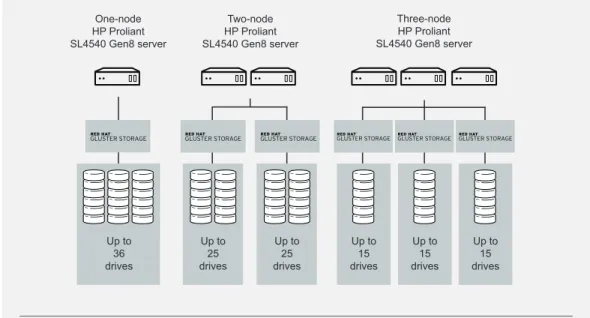
HP understands that different applications and storage-related deployments require differing core-to-spindle ratios. The HP ProLiant SL4540 Gen8 server line offers different numbers of compute nodes, with different numbers of disk spindles supported by each compute node. While the use cases described in this document are ideal for the two-node HP server, Red Hat Gluster Storage can be run on any of the configurations as shown in Figure 5.
• One-node HP ProLiant SL4540 Gen8 Server. The one-node chassis supports a single compute node and as many as 60 attached disk drives5. For the largest archival, object storage, or transient data applications with less need for compute performance scalability, the one-node HP ProLiant SL4540 Gen8 server enabling maximum capacity scalability.
• Two-node HP ProLiant SL4540 Gen8 server. The two-node chassis supports more symmetrical application use cases, where some amount of computational power is required along with scal-able data storage, density, and efficiency. Each of the two nodes in the chassis supports up to 25 drives. The large file and object store, enterprise drop box and cloud storage, and near-line archive use cases described herein are all ideal applications for the combination of the two-node HP ProLiant SL4540 Gen8 server and Red Hat Gluster Storage.
5 As of this writing, Red Hat Gluster Storage supports 36 drives per node.
Up to 36 drives Two-node HP Proliant SL4540 Gen8 server One-node HP Proliant SL4540 Gen8 server Three-node HP Proliant SL4540 Gen8 server Up to 15 drives Up to 15 drives Up to 15 drives Up to 25 drives Up to 25 drives RED HAT®
GLUSTER STORAGE RED HAT
®
GLUSTER STORAGE RED HAT
®
GLUSTER STORAGE RED HAT
®
GLUSTER STORAGE RED HAT
®
GLUSTER STORAGE RED HAT
®
GLUSTER STORAGE
Figure 5. One-node, two-node, and three-node HP ProLiant SL4540 Gen8 servers can all run Red Hat Gluster Storage to meet a range of application and capacity needs.
• Three-node HP Proliant SL4540 Gen8 server. The three-node chassis provides an ideal platform for big data analytics applications such as Hadoop. With three compute nodes, each supporting 16 cores and up to 15 disk drives, the server nears the ideal 1:1 spindle to core ratio needed for the fre-quent interaction between processors and data dictated by many big data analytics applications. SERVER SIZING FOR USE CASES
Individual HP ProLiant SL4540 Gen8 servers are widely configurable in terms of processors, memory, disks, and I/O to match specific workload requirements. While specific sizing recommenda-tions are beyond the scope of this document, general recommendarecommenda-tions can be made for configuring individual two-node HP ProLiant SL4540 Gen8 servers for use in scale-out storage configurations with Red Hat Gluster Storage. For all configurations, dual processors are recommended.
HP ProLiant SL4540 Gen8 servers support 4-, 6-, and 8-core Intel ES2400 Series processors, depending on workload requirements. For the workloads described herein, processor performance is not typically a bottleneck. As a result, most deployments can deploy two quad-core Intel ES-2407 processors per node. Scenarios requiring higher computing requirements may wish to deploy pro-cessors with larger core counts.
• Large file and object store. For a large file and object store, HP and Red Hat recommend 48 GB of DRAM for storage node system memory. Either 2 TB SAS 7.2 K rpm or 15 K rpm drives are well suited for this application.
• Enterprise drop box or cloud storage. For enterprise drop box or cloud storage, HP and Red Hat recommend 48 GB of DRAM for storage node system memory. Either 2 TB or 3 TB SAS 7.2 K rpm or 15 K rpm drives can be used for storage.
• Near-line archival. Near-line archival tends to be more focused on capacity than performance. For this reason, HP and Red Hat recommend 32 GB of DRAM for storage node system memory. To maximize capacity, 3 TB or 4 TB SATA 7.2 K rpm drives can be used for storage.
SIZING AND GROWING CONFIGURATIONS
Scale-out storage using Red Hat Gluster Storage and HP ProLiant SL4540 Gen8 servers yields useful multi-dimensional scalability. Servers can be configured to ideally serve specific workloads and appropriate numbers of servers can then be deployed to match capacity needs. This building-block approach is particularly useful and allows organizations to scale storage infrastructure without arbitrary architectural limitations found in many competing solutions.
In general, scale-out storage deployments can thought of as falling into small, medium, and large categories as described below. Its important to note that these are not fixed categories and any Red Hat Gluster Storage configuration can grow easily on demand.
• Small configurations typically comprise two-to-four HP ProLiant SL4540 Gen8 servers, for four-to-eight compute nodes and a total raw capacity of 200 to 800 TB.
• Medium configurations span 16 to 20 nodes (8-10 HP ProLiant SL4540 Gen8 servers). Depending on disks chosen, raw capacity can range from 800 TB to 2 PB.
• Large configurations can easily be built from 40+ nodes (20 or more two-node HP ProLiant SL4540 Gen8 servers), easily extending scale-out storage to multiple petabytes.
facebook.com/redhatinc @redhatnews linkedin.com/company/red-hat
NORTH AMERICA 1–888–REDHAT1
ABOUT RED HAT
Red Hat is the world’s leading provider of open source solutions, using a community-powered approach to provide reliable and high-performing cloud, virtualization, storage, Linux, and middleware technologies. Red Hat also offers award-winning support, training, and consulting services. Red Hat is an S&P company with more than 70 offices spanning the globe, empowering its customers’ businesses.
EUROPE, MIDDLE EAST AND AFRICA 00800 7334 2835 [email protected] ASIA PACIFIC +65 6490 4200 [email protected] LATIN AMERICA +54 11 4329 7300 [email protected] CONTACT YOUR HP OR RED HAT
SALES REPRESENTATIVE TO LEARN MORE ABOUT SCALE-OUT STORAGE WITH HP AND RED HAT. REQUEST A PROOF OF CONCEPT BY VISITING WWW.REDHAT.COM/PROMO/LIBERATE AND SELECTING THE “START YOUR TRIAL” BANNER.
For larger configurations, a fully-configured rack of nine dual-node HP ProLiant SL4540 Gen8 servers yields a particularly attractive hardware (and software) building block. With nine dual-node servers, a full rack provides a raw capacity of from 900 TB (when configured with 2 TB drives) to 1.4 PB (with 4 TB disk drives). This range is a particularly useful and manageable size for a Red Hat Gluster Storage volume. Multiple racks and multiple Red Hat Gluster Storage volumes can be added as needed to construct scale-out storage of any size required.
CONCLUSION
With the combination of Red Hat Gluster Storage and the HP ProLiant SL4540 Gen8 server, scale-out storage is now a viable solution for large amounts of structured and semi-structured data. As a software-defined and open source solution, Red Hat Gluster Storage brings significant advantages to a range of use cases, from large file and object stores, to enterprise drop boxes and cloud storage, to near-line archival. With a choice of processors, memory, disks, and I/O, HP ProLiant SL4540 Gen8 servers represent a modular and scalable high-capacity building block for deploying scale-out storage. Together, HP and Red Hat let organizations deploy software-defined scale-out storage that fits both the characteristics of their applications and their esca-lating data storage needs.