A Case Study of L1 Interference in Speech Acts among Chinese L2 Students
PRAMELA KRISH
Faculty of Social Sciences and Humanities, Universiti Kebangsaan Malaysia
OH CHEN MAY
Kolej Matrikulasi Negeri Sembilan, Malaysia
ABSTRACT
Improving linguistic and communicative competence will minimise challenges faced in Intercultural communication especially with globalisation and technology advancement. The study aimed at identifying potential areas of L1 interference in speech production relating to five speech acts: compliments, requests, refusals, apologies, and complaints. The L1 interference is examined based on four approaches which are Contrastive Analysis, Error Analysis, Interlanguage Analysis, and Contrastive Rhetoric. Data was collected through a discourse completion task comprising five speech acts: compliments, requests, refusals, apologies, and complaints, and an interview to find out students’ reasons for committing L1 interferences. The findings revealed lexical, discourse and syntactic interferences in the students’ speech where students faced difficulties in understanding the different semantic systems between Chinese and English, were influenced by cultural knowledge and transferred linguistic rules from their L1 to the L2. The main reasons for these interferences were lack of opportunities for practice and limited vocabulary repertoire. Therefore, it is important to develop ways to improve linguistic and communicative competence to minimise misunderstanding and awkward sentences in speech communication.
Keywords: L1 interference; Chinese students; L2 students; speech acts; communicative competence
INTRODUCTION
important to identify how the various L1 elements influence the production of L2 learners’ speech and the extent of its influence.
L1 interference in L2 speech is common among English language learners in China, causing communication strain for them. One contributing factor is because the English language that is taught in classrooms focuses on memorising grammatical rules and vocabulary, textbook exercises and reading skills (Ye 2013). More emphasis is placed on learning English language forms and functions, but there is a lack of practice in real life contexts where the memorised language rules may not surface in spontaneous communicative speech. Therefore, the students may seem to have mastered the English language in terms of obtaining high scores in their English language exams but are unable to speak English effectively (Dipolog-Ubanan 2016). Additionally, a number of Chinese students lack opportunities to explore English-speaking contexts in China leading to minimal exposure and practise. Hence, after completing their high school and furthering their studies in Malaysia, they carry over their cognitive processes and transfer the linguistic rules from their Chinese language into the English language during communication (Zou 2013). This results in incorrect grammatical structures, awkward vocabulary and even the loss of intended meaning in the speech produced because it is mainly translated from their native language. For example, when the Chinese send-off guests, they would say “再见,慢走” (zai jian, man zhou) but when produced in the English language, they may say “Goodbye, slowly walk”. Therefore, even students with adequate linguistic knowledge may still commit errors when communicating with foreigners in real-life situations (Ji 2008).
There are two types of errors normally committed by the second language learners, which are interlingual and intralingual errors, (Manan & Raslee 2017). Interlingual errors are caused by L1 interference, for example, using inappropriate vocabulary which has similar meaning in the L1 but have different connotations in the L2 (“My sickness was very heavy”). While intralingual errors are caused by the difficulty of acquiring the language being learned, for instance, being confused with subject-verb agreement (“She have a cat”) (Hourani 2008).
Researchers who have studied language learners’ ability to perform speech acts identify L2 proficiency as one of the factors which influence their ability, which may give information concerning pragmatic developmental patterns (Kim 2000; Li, Suleiman & Sazalie 2015). Therefore, if the speaker is able to get their intended message across with minimal L1 interference and without causing misunderstanding, this would mean successful communication.
In Malaysia, no studies have so far highlighted issues which combine both L1 interference with the speech acts of Chinese students. All studies on L1 interference in Malaysia focused either only on writing proficiencies (Siti Hamin Stapa & Mohd Mustafa Izahar 2010, Chen & Li 2016; Darus & Subramanian 2009, Dipolog-Ubanan 2016, Zou 2013) or solely on speech acts (Farnia & Wu 2012; Zhao & Mohd Nor 2016). Hence, this study is significant because it combined both of these elements. The objectives of the study aimed at identifying potential areas of L1 interference in speech production relating to five speech acts: compliments, requests, refusals, apologies, and complaints. Speech acts were chosen as a point of analysis for L1 interference because they also caused problems in communication. There has been great consensus among second language learner acquisition (SLA) scholars that lack of L2 pragmatic competence in speech acts can lead to communication breakdown for students besides writing (Al-Ghamdi, Almansoob & Alrefaee 2019).
the problem areas relating L1 interference in speech. These can cause miscommunication and misunderstanding between native and L2 speakers. If not addressed, communication problems may then lead to relationship strains. By identifying the potential problems that arise from L1 interference, it is hoped that specific problematic areas could be targeted and resolved. The findings of this study could also be used by ESL educators to seek effective methods and possible solutions to deal with the problem areas of L1 interference in speech.
REVIEW OF LITERATURE
Initially, studies on L1 interference in second language acquisition (SLA) was developed from Contrastive Analysis (CA). This was a traditional approach which was widely practiced in the 1950s and 1960s where it focuses on the comparison of the linguistic systems of the two languages, especially the sound and grammar systems of L1 and L2 and attempts to predict errors and areas of difficulty in L2 acquisition due to the native language (Richards & Schmidt 2002). From there CA seeks to find solutions to interference problems by improving on second language instruction. However, it was found that the error predictions from Contrastive Analysis were not often consistent with the L2 learners’ performance as not all differences between the L1 and L2 caused difficulties in L2 acquisition. At the same time, other difficulties in L2 acquisition were not only caused by the L1 and L2 differences (Ellis & Barkhuizen 2005). There were also other factors such as the complexity of L2 structures. Therefore, in the 1960s, Error Analysis (EA) was developed as an analytical approach in identifying L2 errors rather than predicting them. It was found that these errors were not random but systematic in nature, according to the various stages of L2 acquisition (Corder 1981). Richards and Schmidt (2002) classified the errors as overgeneralizations (errors caused by extension of target language rules to inappropriate contexts), simplifications (errors resulting from learners producing simpler linguistic rules than those found in the target language), developmental (errors from natural stages of development, communication-based (errors resulting from the use of communication strategies, induced (errors resulting from transfer of training), avoidance (caused by failure to use target language structures since they are thought to be too difficult), and overproduction (errors in structures being used too frequently).
Nevertheless, Error Analysis was limited only to errors and therefore was supplemented with Interlanguage Analysis (IA) which refers to the type of language produced by L2 learners in the process of learning the target language. Selinker (1972:214) described interlanguage as ‘a separate linguistic system based on the observable output which results from a learner’s attempted production of a TL (Target Language) norm’. This means that the analysis of the interlanguage system involves different processes such as i) borrowing patterns from the native language, ii) extending patterns from the target language, e.g. analogy, and iii) expressing meanings using the words and grammar which are already known (Richards and Schmidt, 2002).
The study of CR is related to many other theories such as theories of linguistic relativity, rhetoric, text linguistics, discourse types and genres, literacy, and translation (Connor 2002) but this study employs the theory of applied linguistics, which focuses on L1 patterns which are transferred into L2 speech. This study combines Contrastive Analysis, Error Analysis and Interlanguage Analysis to identify patterns of L1 interference at the lexical and sentential levels of the Chinese students’ L2 speech acts and the Contrastive Rhetoric approach is used to analyse rhetorical, stylistic and cultural patterns of the speech discourse. These theories were used as the foundation of this study and investigated according to five speech acts which were compliments, requests, refusals, apologies and complaints.
METHODOLOGY
The subjects involved in this study were 6 mainland Chinese students (labelled as S1 to S6) aged 21 to 25 years who were selected through snowball sampling. This sampling method was used because suitable participants with L1 interference problems in speech would be more easily identified through their contacts and similar circles. These participants came from six different private universities in Malaysia and were currently pursuing different disciplines including Masters in Business Administration, Bachelors in Logistic Management, Accounting Finance, Education and English language Communication, and Music. They had passed with minimal scores in various English language tests before commencing their post-graduate studies, and have resided in Malaysia for at least 3 years.
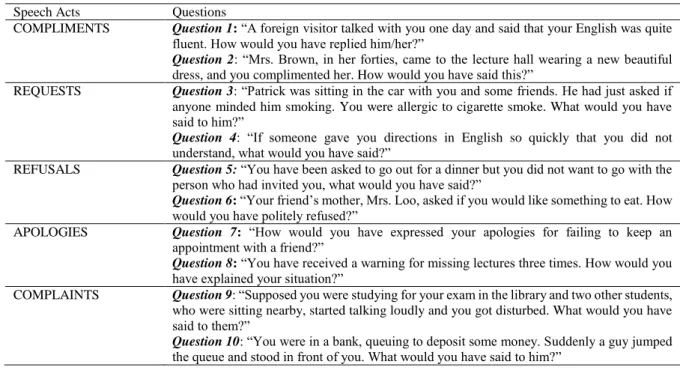
Data was collected in 2 phases. Phase 1 involved a verbal discourse completion task whereas Phase 2 involved a follow-up interview conducted with reference to Phase 1’s responses shown to the students for recall. The focus of Phase 1 was solely on collecting speech data based on the students’ responses to the questions asked. These questions were designed and adapted from Feng (2009) and they were based on five speech acts: compliments, requests, refusals, apologies and complaints. The students’ responses were used to determine the extent of L1 interference with regards to their communicative competence. Table 1 lists the questions that were designed.
TABLE 1. Phase 1 Questions Based on Speech Acts
Speech Acts Questions
COMPLIMENTS Question 1: “A foreign visitor talked with you one day and said that your English was quite
fluent. How would you have replied him/her?”
Question 2: “Mrs. Brown, in her forties, came to the lecture hall wearing a new beautiful dress, and you complimented her. How would you have said this?”
REQUESTS Question 3: “Patrick was sitting in the car with you and some friends. He had just asked if anyone minded him smoking. You were allergic to cigarette smoke. What would you have said to him?”
Question 4: “If someone gave you directions in English so quickly that you did not understand, what would you have said?”
REFUSALS Question 5: “You have been asked to go out for a dinner but you did not want to go with the person who had invited you, what would you have said?”
Question 6: “Your friend’s mother, Mrs. Loo, asked if you would like something to eat. How would you have politely refused?”
APOLOGIES Question 7: “How would you have expressed your apologies for failing to keep an appointment with a friend?”
Question 8: “You have received a warning for missing lectures three times. How would you have explained your situation?”
COMPLAINTS Question 9: “Supposed you were studying for your exam in the library and two other students, who were sitting nearby, started talking loudly and you got disturbed. What would you have said to them?”
Phase 2 on the other hand, focused on the students’ reasons for constructing such responses in the discourse completion task in Phase 1. Both these phases of data collection were conducted on one-to-one basis.
The complete data was then organised based on the speech acts and analysed based on L1 interference approaches which were Contrastive Analysis, Error Analysis, Interlanguage Analysis, and Contrastive Rhetoric in order to identify potential problems due to L1 interference and how cross-linguistic language transfers influence the students’ spoken English. These transcribed responses were left unedited in this paper in order to capture the students’ actual spoken discourse. The analysed data was also further verified by an expert in English and Mandarin.
FINDINGS AND DISCUSSION
Analysis from the students’ responses to the discourse completion tasks reveal three major types of L1 interference in their L2 which are at the lexical, syntactic and discourse level.
L1 LEXICAL INTERFERENCE (DIRECT TRANSLATION)
Lexical interference in this study refers to the direct translation of words or sentences from the Chinese language to English. In this study, it was found that this kind of interference occurred the most compared to syntactic and discourse interferences in the speech context. In contrast to writing tasks, most interferences in L2 writing were more syntactic in nature (Bennui 2008, Chen and Li 2016, Dipolog-Ubanan 2016). This was perhaps due to the fact that while speaking, L2 speakers were required to produce L2 speech promptly and spontaneously and hence needed to produce sentences in a short frame of time. Therefore, the available time to process correct forms of L2 words and sentences was more limited compared to the writing process, whereby the written product which could be edited and re-written. Therefore, language interference from L1 occurred more often in L2 speech production. Hermans et al. (1998) confirmed that L2 speakers tend to struggle in supressing activation from the L1 when referring to meaning in the L2.
For example, in order to ask someone to repeat, S2 responded with “Can trouble you say again?” which is actually a direct translation from Chinese which would be, “Kěyǐ (can) máfan(trouble) nǐ(you) zài(again) jiǎng(say) yībiàn(one more) ma (可以麻烦你再讲一遍 吗?)”. “Trouble you” is a common language style used in Chinese speech when making requests.
TABLE 2. Examples of Lexical Interference
S1: please would you reduce your voice?
S2: can you slow down your voice?
Instead of using “lower down your voice” or “soften”, S1 and S2 directly translated “jiǎn dī nǐ de shēng liàng (减低你的声量 )” to slow and reduce which in English describes the speed of speech rather than its volume.
S1: Sorry, I slept again. S1 probably wanted to indicate that he/she overslept rather than just slept but there is no one word for “oversleep” in Chinese, onlyshuì guòtóu(睡过头). Therefore, S1 might not have known the word “overslept” if his/her vocabulary repertoire was limited.
Table 2 demonstrates students’ unawareness to differing semantic denotations from both English and Chinese words, though the literal translation may mean the same (Dipolog-Ubanan 2016). Lexical interference is related to aspects of Contrastive Analysis (CA) where direct translations happen due to students’ inadequate understanding of the semantic systems which differ in Chinese and English languages. Therefore, attempts were made to directly translate Chinese words into English without taking into consideration the differences in word meanings and usage.
L1 DISCOURSE INTERFERENCE
Besides the lexical interference causing direct translation of Chinese words into English, the students were also affected by their cultural knowledge which in turn affect their language styles in the English language speech.
In Chinese speech, it is common to be repetitive with the same words in order to emphasise a point and this style of interference is also seen with S2 while expressing refusal, “No, no, thanks, aunt, in fact, I not hungry.” and a compliment, “No, No. Just so so, I learn English long time.” Besides rejecting the compliment, S2 has displayed a common kind of humility usually present in the Chinese culture. It was often considered proud to directly accept compliments and therefore, a typical Chinese would reject or provide an explanation for it. This cultural interference can also be observed in S4’s reply, “Thank you, not very good, just a little.”
Similarly, it is considered rude in the Chinese culture if one were to engage in direct confrontation with another person in any matter. Hence, most Chinese would soften their speech with an indirect explanation first before addressing the matter. Therefore, although a student may have language competency, they may still deviate from being socially and pragmatically appropriate due to assimilation of cultural patterns and behavioural norms (Al-Ghamdi, Almansoob & Alrefaee 2019). Here, S1 intended to reject a meal but softened it by complimenting the food before rejecting the offer, “Wow, it seems delicious, but I just had dinner.” In another case, S1 indirectly rejected an invitation with an excuse and without saying “no” to avoid confrontation, “I not sure, maybe I have something that.” It can also be observed that the Chinese are careful when it comes to offence. S1’s indirect reply reflects the fear of offending the other person. This is similar to S2’s request to ask someone not to smoke, “Cannot stop it? Maybe it is not good.” Instead of giving a direct order, it was turned into a question with a suggestion in order to avoid confrontation and offence.
In requesting for a person to repeat, even S2 says “Can trouble you say again?” instead of directly asking one to repeat for fear of offending the other person. “Trouble you” or “máfan nǐ (麻烦你)” is a common way used by speakers of the Chinese language when making requests to someone.
L1 SYNTACTIC INTERFERENCE
WORD FORM AND WORD CHOICE
Syntactic interference was another common form of interference which caused grammatical and structural errors in the English language. The most common could be seen in word choice and word form. Shi (2015) terms this as a negative interference of meaning where the speaker assumes that the translation for similar items in both languages exist as pairs. However, this is not the case because no two languages are symmetrical in nature. For example, the word “bù (不)” in Chinese is translated as “no” in English. Whereas “bù (不)” is generally used for all sentences to indicate the negative in Chinese, in English, it has two forms, “no” and “not”. Therefore, students have difficulty using both English forms appropriately as in the case of S4, “Thank you, no very good, just a little.” This same difficulty is also seen with the personal pronoun, “wǒ (我)” which refers to both “I” and “me” in English as seen from S2, “Hey, me come first, please be careful”. Hence, students often made mistakes when it came to words which have a few forms in the English language but only one form in Chinese. This is a form of error based on the aspect of Error Analysis, in which the English translation of the Chinese words get simplified across all forms of sentence usage.
Besides, data from this study also pointed out that students were confused in the usage of various word classes in English. This meant that the noun, gerund, verb and adverb forms are used interchangeably and this very much resulted in incorrect sentence structures. Table 3 shows examples of how both S4 and S6 wrongly used the various forms of the word “date”.
TABLE 3. Examples of Interference in Word Class
S4: Sorry, I already have a dating. Confusion with noun form and gerund form S6: Sorry, I have something to do, can we
date next time?
Incorrectly using the noun form as a verb. The correct sentence should be “can we go on a date next time?”
S5: Sorry, would you mind speak again? S5: Excuse me, would you mind queue please?
In these two contexts, the verb was supposed to function as gerund where the correct form would be “speaking” and “queuing”.
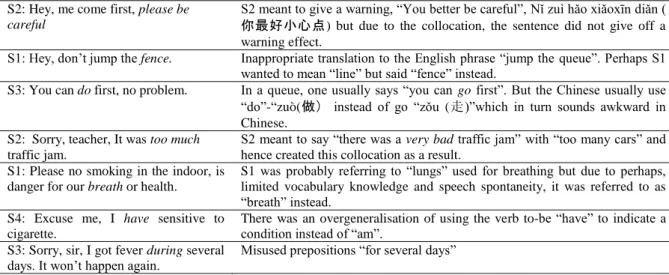
Additionally, due to the spontaneity that comes with speech, students tend to create inappropriate collocations because they thought they could also be used in the same way in the L2 (Shi 2015). Table 4 demonstrates some of these collocations.
TABLE 4. Examples of Interference in Word Choice
S2: Hey, me come first, please be careful
S2 meant to give a warning, “You better be careful”, Nǐ zuì hǎo xiǎoxīn diǎn ( 你最好小心点) but due to the collocation, the sentence did not give off a warning effect.
S1: Hey, don’t jump the fence. Inappropriate translation to the English phrase “jump the queue”. Perhaps S1
wanted to mean “line” but said “fence” instead.
S3: You can do first, no problem. In a queue, one usually says “you can go first”. But the Chinese usually use “do”-“zuò(做) instead of go “zǒu (走)”which in turn sounds awkward in Chinese.
S2: Sorry, teacher, It was too much
traffic jam.
S2 meant to say “there was a very bad traffic jam” with “too many cars” and hence created this collocation as a result.
S1: Please no smoking in the indoor, is danger for our breath or health.
S1 was probably referring to “lungs” used for breathing but due to perhaps, limited vocabulary knowledge and speech spontaneity, it was referred to as “breath” instead.
S4: Excuse me, I have sensitive to cigarette.
There was an overgeneralisation of using the verb to-be “have” to indicate a condition instead of “am”.
S3: Sorry, sir, I got fever during several days. It won’t happen again.
The errors in translating and selecting appropriate English words for proper use was probably due to inadequate exposure to Contrastive Analysis in the second language acquisition process. Without the knowledge and practice, students would be unable to compare and contrast the differences between the vocabulary aspects between the Chinese and English words. Therefore, students need to be given detailed insights into the comparative and contrastive aspects between the Chinese and English words to minimise these interference errors.
TENSES
There are no tenses in the Chinese language. This is because, in the construction of Chinese phrases, time adverbs are included in the sentences and they are used to represent the time of when the action takes place (Dipolog-Ubanan 2016). This means that the verbs in the Chinese language stay the same regardless of whether the action takes place in the past, present or future. Hence, this is another major syntactic interference that causes errors in English language usage. Table 5 demonstrates some of the errors in tenses made by the students in this study.
TABLE 5. Examples of Interference in Tenses
S1: Thanks, because I have learn English for 4 years. S5: Thanks, because I already stay here for 5 years. S5: I’m already full, I just eat the dinner.
S5: Sorry. I am late, my mother just call me.
In these examples, the students failed to change to the verbs to the present participle forms but retained the base verb forms in the sentences instead.
S4: I’m sick for several days, sorry.
S6: Sorry, teacher, I was sick before, It is very heavy, so I missed class.
S2: Sorry, it is too late.
S4 retained the present tense of the be verb “am” and “is” instead of using “I was”.
S6 managed to use the tense correctly in the first part of the sentence but the L1 tense structure interfered in the second part of the sentence.
The students’ inability to change the English verbs to its appropriate forms of tenses was due to failure in Contrastive Analysis during the second language acquisition process. Students were unable to grasp the rules related to verb tenses. Nevertheless, it is interesting to note that Interlanguage patterns (patterns transferred from the L1) could be seen when the students attempted to use English time markers in their sentences which were similar to Chinese such as already (“yǐjīng- 已经)and just (kānghào- 康浩). Here, the students were able to transfer them appropriately, just as how it should appear in an English sentence rather than choosing to omit them due to challenges in remembering the sentence patterns correctly.
OMISSION AND INSERTION
It was observed that quite a number of omissions and additions occurred in the L2 speech of a Chinese speaker as well. These omissions mainly affect articles, prepositions, verbs-to-be and even pronouns. Sometimes, unnecessary lexical insertions were also added into their sentences. For example, in the sentence, “Please no smoking in the indoor, ^ is danger for our breath or health”, S1 inserted the preposition “in” which was not necessary in this case because a preposition is only used when indicating a temporal, spatial or logical relationship and not to be used when the meaning is already clear without inserting them. “Indoor” had clearly indicated a location and hence, no extra preposition was needed. A definite article “the” was also inserted before “indoor” when a zero article was needed. Hence, students were unaware of rule restrictions when it comes to various conditions requiring the use of different articles or zero articles.
to the indefinite article “a” in English, these “Chinese articles” however are only used for singular, countable nouns unlike the English language which has certain rule for usage. The use of the indefinite English articles “a”, “an” and the definite article “the” depends on the number referred to in the noun, whether the noun’s first sound is a consonant or a vowel and also if the noun was referred to for the first time in a sentence or at a subsequent time. Additionally, certain uncountable nouns do not require articles. This confusion is displayed in Table 6.
TABLE 6. Examples of Article Omission and Insertion
S1: This is ^ accident, sorry.
S5: Sorry, because I was sick. I can give you ^ MC later.
These examples show that the article “an” was omitted, before “accident” and “MC”.
S6: Hi, can you guys ^ quiet please? This is ^ library.
The verb “be” and article “a” was omitted. The right sentence should be “Hi, can you guys be quiet please? This is a library.”
S5: Excuse me, this is ^ library, we need ^ quiet environment, you can discuss in the discussion room.
Again, the article “a” was omitted both before “library” and “quiet environment”. This was probably because the student may have assumed that they were already in the library so an article was unnecessary.
S5: Would you mind smoking at outside of ^ car? Because I am allergic to smoke.
The definite article “the” was omitted before “car”. Here, an unnecessary insertion of a preposition “at” was also added because in the Chinese language, “at” (cai) is usually inserted before a location to indicate where the verb is taking place.
Table 7 illustrates examples of omissions with prepositions. This was probably due to the absence of prepositions in the Chinese language.
TABLE 7. Examples of Preposition Omission
S2: No, No. Just so so, I learn English ^ ^ long time. Omission of preposition “for” and article “a”. S2: Sorry. I go ^ other date. Next time lo. Omission of preposition “with”..
S6: Can you go out ^ smoke?
S3: If possible, I would like you not ^ smoking.
Omission of preposition “to”.
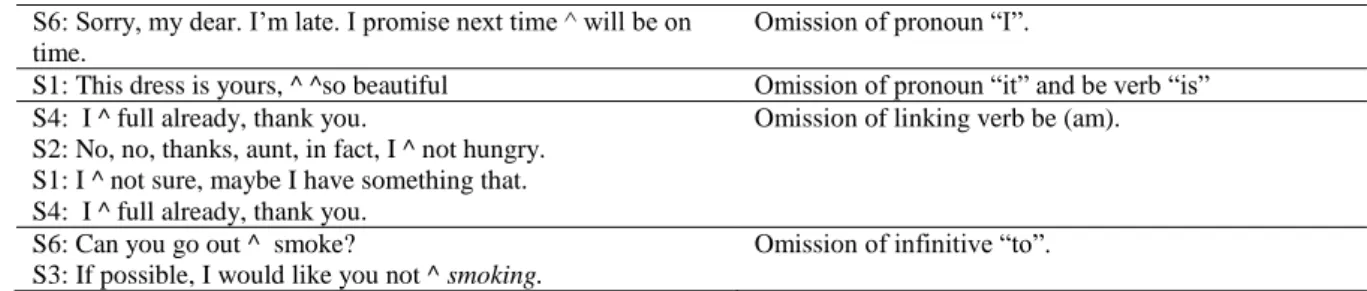
Apart from the above, other omissions such as pronouns are displayed in Table 8. Based on Error Analysis, this was probably due to overgeneralisation and simplification where the students probably thought that since the pronoun “I” had already been mentioned earlier in the sentence, it was appropriate to omit it in the subsequent phrases in case they were considered redundant. This case is similar with other pronouns.
TABLE 8. Examples of Other Types of Omission in Sentences
S6: Sorry, my dear. I’m late. I promise next time ^ will be on time.
Omission of pronoun “I”.
S1: This dress is yours, ^ ^so beautiful Omission of pronoun “it” and be verb “is” S4: I ^ full already, thank you.
S2: No, no, thanks, aunt, in fact, I ^ not hungry. S1: I ^ not sure, maybe I have something that. S4: I ^ full already, thank you.
Omission of linking verb be (am).
S6: Can you go out ^ smoke?
S3: If possible, I would like you not ^ smoking.
Omission of infinitive “to”.
SYNTACTIC AND STRUCTURAL ERRORS
Syntactic and structural errors were also found in the students’ speech. These mainly involve comma splice or run-on sentences. This basically means that students used commas to splice independent clauses instead of using conjunctions or string together a series of independent clauses using conjunctions which results in run-on sentences. Table 9 demonstrates some of these errors.
TABLE 9. Examples of Comma Splice
S6: Because I always communicate with my friend, then practice my English, so can faster improve my English. S6: Hi, Ms., you are so pretty today, and I like your dress, very beautiful.
S6: Sorry, before I had eaten something and so full, but it is so nice the food, can I eat later? S3: Please speak a little bit slow, I did not hear clearly.
Error analysis reveal that the errors were cause by different organisational structures between the Chinese and the English language. Most of the time, negative interference happens when students bring over structures from their L1 into their L2 speech. These kind of errors are even more pronounced in speech production because speakers tend to focus more on the meaning they want to get across rather than the presentation of the sentence. Here, S3 meant to say “Sorry, an emergency just happened.” but the interference resulted in “Sorry, just happen emergency.” which was similar to the Chinese sentence order “Gāng fāshēng jǐnjí qíngkuàng (刚发生紧急情况)”.
REASONS FOR PERSISTENT L1 INTERFERENCE IN SPEECH
The students revealed that even though they have resided in Malaysia for at least 3 years are studying their courses in the English language, they still lacked opportunities to communicate with other foreign students and lecturers during and outside of class time. Hence, they are limited in terms of practice as they do not often converse in the English language. Therefore, it was of no surprise when all the students in this study confessed that they were still unable to use the English language properly even though they had learnt English for more than 8 years and passed English language tests before commencing their post-graduate studies. Nevertheless, all students except S6 indicated that they could at least speak English three times a week when they had classes. Only one student noted that he found writing in English more difficult whereas the other five students found that speaking English was more difficult for them due to spontaneity. They pointed out that although they studied in Malaysia, the surrounding environment did not require them to use English often, so they spoke Chinese almost all of the time.
chat with native-speaker, their accent is too strong and they often use words which I do not know.”
The interviews confirmed that the students rarely had the opportunity to acquire English directly from concrete and social situations. So when they learnt some English expressions, they tended to apply those expressions mechanically.
CONCLUSION
In ICC, the use of the target language requires building a whole new linguistic system, including a new grammar which is different from that of the source language. In this study, findings based on certain aspects of Contrastive Analysis, Error Analysis, Interlanguage Analysis, and Contrastive Rhetoric have identified potential problems due to L1 interference and how cross-linguistic language interference influenced the students’ spoken English.
These L1 interferences may have resulted in misunderstanding and frustration for both the speaker and hearer because the direct translations and grammatical errors may convey messages that differ from what the students initially intended to say. Most students in the study had little awareness that their grammatically incorrect or directly translated speech may display an illocutionary force which differs from the speaker’s intention. They were unclear about the relationship between the linguistic forms and their communicative functions. For example, S6’s apology, “Sorry, teacher, I was sick before, it is very heavy, so I missed class.” may have caused misunderstanding due to lexical interference from the direct translation of the word “heavy”. What was “heavy” and how does it relate to sickness which happened “before”? A study by Lin and Lin (2019) found that Taiwanese learners of different proficiency levels were found to over-rely on basic meaning of words and lack collocation use. Hence it is proposed learners should be exposed to corpus resources of real world English throughout their EFL education in order to understand the relationship between the linguistic forms and their communicative functions.
Linguistic competency is therefore a very important aspect needed for successful communication. Fisher (1984:35) explained that “linguistic competence may be thought of as the learner’s knowledge of the structures and vocabulary of the language and it is his ability to produce and comprehend well-formed sentences in the language.” Here, linguistic competence is concerned with the knowledge of the structures of language, such as grammar, syntax, and vocabulary. Hence, Fisher (1984) described that in an L2 environment, the students’ behaviour is governed by rules, whereby they try to focus on applying rules to produce accurate grammatical forms. Therefore, without linguistic competence, L2 students would not be able to make even a single correct sentence to convey their intentions, and consequently, the hearer would not be able to understand them. Hence, linguistic competence is the basic condition for successful communication. If one cannot express oneself properly and understand the actual intentions of the other party, this means that communication has not been carried out successfully. In order to communicate smoothly, language learners need to improve their linguistic competence and communicative competence.
in developing effective methods which can improve the linguistic and communicative competence of these students. This may include encouraging thinking habits in English in order that the L2 patterns and organisation process may be internalised and hence avoiding interference altogether.
ACKNOWLEDGEMENT
The study is supported by Universiti Kebangsaan Malaysia research Funds.
REFERENCES
Al-Ghamdi, N. A., Almansoob, N. T. & Alrefaee, Y. (2019). Pragmatic Failure in the Realization of the Speech act of Responding to Compliments among Yemeni EFL Undergraduates. 3L: The Southeast Asian Journal of English Language Studies. 25(4), 1-14.
Bennui, P. (2008). A Study of L1 Interference in the Writing of Thai EFL Students. Malaysian Journal of ELT Research. 4, 72-102.
Chen, Y. & Li, X. (2016). Effects of L1 Transfer on English Writing of Chinese EFL Students. Cross-Cultural Communication. 12(4), 50-53.
Connor, U. (2002). New Directions in Contrastive Rhetoric. TESOL Quarterly. 36(4), 493-510. Corder, S. P. (1981). Error Analysis and Interlanguage. Oxford: Oxford University Press.
Darus, S. & Subramaniam, K. (2009). Error analysis of the written English essays of secondary school students in Malaysia: A case study. European Journal of Social Sciences. 8(3), 483-495.
Dipolog-Ubanan, G. F. (2016). L1 Influence on Writing in L2 among UCSI Chinese Students: A Case Study.
Pertanika Journal of Social Science & Humanities. 24(4), 1841-1853.
Ellis, R. & Barkhuizen, G. (2005). Analysing Learner Language. Oxford: Oxford University Press.
Farnia, M. & Wu, X. (2012). An Intercultural Communication Study of Chinese and Malaysian University Students’ Refusal to Invitation. International Journal of English Linguistics. 2(1), 162-176.
Feng Gai. (2009). The pragmatic failure in intercultural communication – a case study of the English majors in Yunan Normal University. China Academic Electronic Publishing House. Retrieved from http://www.doc88.com/p-9167315788672.html.
Fisher, R.A. (1984). Testing written communicative competence in French. Modern Language Journal, 8, 13-19. Hashim, A. (1999). Crosslinguistic Influence in the Written English of Malay Undergraduates. Journal of Modern
Languages. 12(1), 59-76.
Hermans, D., Bongaerts, T., De Bot, K. & Schreuder, R. (1998). Producing words in a foreign language: Can speakers prevent interference from their first language? Bilingualism: Language and Cognition.1(3), 213-229.
Hourani, T. M. Y. (2008). An Analysis of the Common Grammatical Errors in the English Writing made by 3 rd Secondary Male Students in the Eastern Coast of the UAE 1–80. Retrieved from https://bspace.buid.ac.ae/bitstream/1234/225/1/20050055.pdf
Ji, P. (2008). Pragmatics and pedagogy in College English Teaching. Shanghai: Shanghai Foreign Language Education Press.
Kaplan, R. B. (1966). Cultural thought patterns in inter-cultural education. Language Learning: A Journal of Applied Linguistics. 16, 1-20.
Kim, I.O. (2000). Relationship of onset age of ESL acquisition and extent of informal input to appropriateness and nativeness in performing four speech acts in English: a study of native Korean adult speakers of ESL. (Unpublished PhD thesis). New York University, New York City, U.S.
Krashen, S. 1977. Some Issues Relating to the Monitor Model. In H. Brown, C. Yorio, and R. Crymes (eds.). On
TESOL. 77, 144-158.
Li, R., Suleiman, R. R. R. & Sazalie, A. (2015). An investigation into Chinese EFL learners’ pragmatic competence. GEMA Online Journal of Language Studies. 15(2), 101-118.
Lin, C-H. & Lin, Y-L. (2019). Grammatical and Lexical Patterning of Make in Asian Learner Writing: A Corpus-Based Study of ICNALE. 3L The Southeast Asian Journal of English Language Studies. 25(3), 1-15. Manan, N. A. A. & Raslee, N. N. (2017). Describing the Use of Discourse Markers by ESL Learners in Writing.
International Journal of Advanced and Applied Sciences. 4(3), 101–106.
Richards, J. C. & Schmidt, R. (2002). Dictionary of language teaching and applied linguistics (3rd ed.). London: Longman.
Shi, W. (2015). Types of Chinese Negative Transfer to English Learning and the Countermeasures. Theory and Practice in Language Studies. 5(6), 1226-1232.
Siti Hamin Stapa & Mohd Mustafa Izahar. (2010). Analysis of errors in subject-verb agreement among Malaysian ESL learners. 3L The Southeast Asian Journal of English Language Studies. 16(1), 1-13.
Timina, S. (2013). The problem of Chinese language interference in written English. The European Conference on Language Learning Official Conference Proceedings 2013. Retrieved May 1, 2019 from
www.iafor.org
Ye, R. (2013). Discussion on interference from L1 culture to L2 writing and handling suggestions. International Conference on Education Technology and Management Science (ICETMS 2013). 36-38.
Zhao, C. & Mohd Nor, S. N. (2016). The Realization of The Speech Act Of Refusals Among Chinese EFL Speakers In Malaysia. Journal of Education and Social Sciences. 4(June), 244-251