1
Master Thesis Clinical Neuropsychology
Faculty of Behavioural and Social Sciences – Leiden University (August 2018)
Student number: s1754912
Daily Supervisor: Ineke van der Ham, Department of Health, Medical and Neuropsychology; Leiden University
CNP-co-evaluator: Esther Habers, Department of Health, Medical and Neuropsychology; Leiden University
Are spatial abilities that predict navigation
performance in a virtual environment perspective
dependent?
2
Abstract
In humans, there is a lot of individual variability in the quality of navigation in a new
environment. In earlier research, perspective taking ability, mental rotation ability and
visual-spatial working memory capacity were found to be predictive of learning a new
environment from visual media. The individual variability may be explained in part by
these three abilities. However, it is unknown is whether these abilities contribute
differently to navigation when the perspective from which an environment is learned,
is a first person’s perspective (egocentric) or an aerial perspective (allocentric). It was
expected that perspective taking ability would predict performance in navigation from
an egocentric perspective, mental rotation ability would predict performance in
navigation from an allocentric perspective and visual-spatial working memory capacity
would predict performance in navigation from both perspectives. Participants (N = 84)
were tested on six egocentric and six allocentric navigation tasks after watching a route
through a virtual environment from an egocentric and an allocentric perspective.
Perspective taking ability, mental rotation ability and visual-spatial working memory
capacity were the independent variables. Multiple regression analyses were conducted
for every navigation task and perspective separately. It was found that perspective
taking ability was more predictive for navigation performance when the perspective
was allocentric and visual-spatial working memory when the perspective was
egocentric. These results suggest that the influence of spatial abilities that predict
navigation performance is dependent on the perspective from which it is learned.
Keywords: spatial navigation, spatial abilities, perspective taking ability, mental
rotation ability, visual-spatial working memory, virtual environment, egocentric,
3
Introduction
Spatial navigation is an important cognitive skill we use in everyday life:
whether we go from home to work, from home to the supermarket, or by car on a
holiday to explore a whole new area. It is therefore an essential cognitive skill we all
use. There is, however, a lot of individual variability in the quality of spatial navigation
(Wolbers & Hegarty, 2010), which can already be demonstrated during development of
knowledge of a new environment (Ishikawa & Montello, 2006). Individual differences
in visual-spatial abilities can predict the type of environmental representations that
adults form after exposure to a new environment (Blajenkova, Motes, & Kozhevnikov,
2005). This individual variability is best described by a model of spatial navigation,
consisting of three domains: cognitive and perceptual factors, neural information
processing and brain structure (Wolbers & Hegarty, 2010). The focus of the current
study will be on the domain of cognitive factors that determine spatial navigation
ability, hereafter named visual-spatial abilities.
Early studies identified two important visual-spatial abilities that play a role in
spatial navigation: perspective taking, mental rotation (McGee, 1979; Carroll, 1993).
Perspective taking ability is the ability to imagine taking different perspectives in
relation to objects in a certain scene (McGee, 1979). Mental rotation is the ability to
mentally rotate objects as if seen from a different angle (Shepard & Metzler, 1971). In
their study on map sketching, Blajenkova et al. (2005) found that participants who drew
three-dimensional maps of a route through a novel environment had a better mental
rotation ability than participants who drew one-dimensional maps. Although
perspective taking ability and mental rotation ability show some overlap, they are also
partly dissociable (Kozhevnikov & Hegarty, 2001; Hegarty & Waller, 2004). Mental
rotation ability and perspective taking ability are small-scale spatial abilities (Hegarty,
Montello, Richardson, Ishikawa, & Lovelace, 2006; Wolbers & Hegarty, 2010), that
are more predictive of learning from visual media than of learning through direct
experience (Hegarty et al., 2006). Other small-scale spatial abilities are visual-spatial
working memory and encoding and recognizing spatial patterns1 (Hegarty et al., 2006). Visual-spatial working memory is the ability to temporally store and manipulate visual
1 Encoding and recognizing spatial patterns, was measured by the Embedded figures test in the study of
4
information mentally (McAfoose & Baune, 2009). Research on visual-spatial working
memory mostly consists of dual-task experiments, that use Baddeley and Hitch’s model
of working memory (Baddeley, 2003) and where interference of verbal or visual
information on the primary task is measured (Vandierendonck, Kemps, Fastame, &
Szmalec, 2004; Meilinger, Knauff, & Bulthoff, 2008). According to Baddeley (2003),
working memory consists of three subsystems called: the central executive, visuospatial
sketchpad and the phonological loop. The visuospatial sketchpad is the subsystem
where visual-spatial information is processed (Baddeley, 2003). Visual-spatial working
memory was demonstrated to be important in visual-spatial ability (Hegarty et al.,
2006). In the current study the small-scale spatial abilities perspective taking, mental
rotation and visual-spatial working memory, will be used as predictors to determine
their relative influence on navigation in a virtual environment.
In their study, Hegarty et al. (2006) found that the small-scale spatial abilities
(perspective taking, mental rotation and visual-spatial working memory), were more
predictive of navigation performance from visual media, than large-scale spatial
abilities (e.g. learning layout of new environments, navigation in known environments
and giving and interpreting navigation directions) (Hegarty et al., 2006). However, the
perspective that was used in the three different conditions (learning through direct
experience, watching a taped video route or from a virtual desktop environment), was
always from the first person (i.e. egocentric). Another study also found that perspective
taking ability predicted performance on navigation tasks that required updating of
egocentric (self-to-object) representations (Kozhevnikov, Motes, Rasch, & Blajenkova,
2006). But we do not know if there is a difference in predictive value of the small-scale
visual-spatial abilities (mental rotation, perspective taking and visual-spatial working
memory), between the performance on navigation tasks from an egocentric and an
allocentric perspective.
An egocentric perspective is about self-to-object relations, and an allocentric
perspective about object-to-object relations (Klatzky, 1998; Meilinger & Vosgerau,
2010). Both egocentric and allocentric perspectives can be used in navigation. They do
not exclude each other, but instead seem to interact in a hierarchical manner, when
people try to make sense of large-scale environments (Meilinger & Vosgerau, 2010).
There has been much debate about both the cognitive and neural basis of allocentric
representations and it has been difficult to invent navigation tasks that can separate
5
Iaria, 2014). In most situations, a navigation problem is solved using primarily
egocentric navigation ability or primarily allocentric navigation ability, but almost
never using only one of both (Ekstrom et al., 2014). Thus, the navigation tasks used in
the current study are not purely egocentric or purely allocentric, only the perspective is
completely different. In the current study, the allocentric perspective is translated as a
bird’s eye view, as if seen on a map from which the relations between different locations
in the environment can be learned. The egocentric perspective is translated as a
first-person’s view: everything is observed as if through your own eyes.
As mentioned before, small-scale spatial abilities associated with egocentric
navigation are perspective taking, mental rotation and visual-spatial working memory
(Hegarty et al., 2006). The literature is less clear on small-scale spatial abilities that are
associated with allocentric navigation. In neuroimaging studies, differences in
activation patterns were found between executing navigation tasks using an egocentric
strategy and using an allocentric strategy (Jordan, Schadow, Wuestenberg, Heinze HJ
FAU - Jancke, & Jancke, ; Gramann, Muller, Schonebeck, & Debus, 2006), suggesting
different underlying cognitive processes or spatial abilities. In later neuroimaging
studies, differences in activation patterns were also found using two conditions: route
learning from an egocentric perspective and map learning which can be seen as from
an allocentric perspective (Zhang, Copara, & Ekstrom, 2012; Zhang, Zherdeva, &
Ekstrom, 2014). Two pointing tasks were used to assess the participants’ knowledge of
the virtual environment: an egocentric SOP task and an allocentric JRD task (for more
on these pointing tasks; see Zhang, Copara and Ekstrom (2012) and Zhang, Zherdeva
and Ekstrom (2014)). The authors found that route learning led to faster improvements
on the egocentric pointing task and map learning to faster improvements on the
allocentric pointing task and that both spatial learning processes involved different
brain activation patterns (Zhang et al., 2012; Zhang et al., 2014). Do the different brain
activation patterns reflect different cognitive processes or do they reflect the same
cognitive process using different brain areas? These studies suggest that there is
evidence that different spatial abilities might be involved in allocentric spatial
navigation compared to egocentric spatial navigation, only these differences have not
been identified as far as the author knows.
In the current study, we attempted to identify differences in contribution of
spatial abilities to egocentric and allocentric spatial navigation. The predictive values
6
performance in computerized navigation tasks were investigated. Participants were
instructed to watch a videoclip of two different routes through a virtual environment:
one from an egocentric (i.e. first person’s perspective) and one from an allocentric
perspective (i.e. a bird’s eye view) (Török, Nguyen, Kolozsván, Buchanan, & Nadasdy,
2014). Two perspectives were used, because we do not know whether the small-scale
spatial abilities mentioned above contribute differently to learning a spatial layout from
an egocentric or from an allocentric perspective. Six navigation tasks were administered
with each an egocentric or an allocentric condition (depending on the perspective of the
route). In these tasks the route sequence, location-action linking, distance estimations
between scenes and landmarks, sense of direction with respect to start and end points
of the routes and map locations of scenes and landmarks were assessed. In general, it
was hypothesized there would be a difference between which spatial abilities would
predict navigation performance from an egocentric perspective and which spatial
abilities would predict navigation performance from an allocentric perspective. It was
hypothesized that perspective taking ability would be a stronger predictor in the
egocentric navigation tasks, as was found by Hegarty et al. (2006) and Kozhevnikov et
al. (2006), than mental rotation ability (Kozhevnikov et al., 2006). Mental rotation
ability was hypothesized to be a stronger predictor for the allocentric navigation tasks
than perspective taking ability, because as an object-based spatial ability it may be
predictive of object-based (i.e. allocentric) spatial navigation (Kozhevnikov et al.,
2006). Perspective taking ability was not hypothesized to be predictive of performance
on the allocentric navigation tasks, because perspectives did not necessarily need to be
changed for any of the allocentric tasks. Finally, it was hypothesized that visual-spatial
working memory would be a predictor for all the tasks of both the egocentric and
allocentric conditions, because all the navigation tasks used in this study required to
some extent visual-spatial working memory and in the study of Hegarty et al. (2006) it
has been found to be predictive of performance on navigation tasks.
Methods
Participants:
The participants were recruited at the faculty of social sciences at Leiden
University. Because of incomplete data on the variables gender, age, education,
7
excluded from this study. Data of 84 participants were left; male: n = 33 and female: n
= 51. Age ranged from 18 to 30 years old; M = 22.23 years; s = 0.31 years. All participants were students or young professionals. There was a small range in education
levels, but it was not expected to influence the outcome. Participants were rewarded
with credits or money. The Leiden University Psychology Ethical Committee approved
this study and informed consent was gathered from each participant.
Measures:
The following tests were administered: the Corsi Block Tapping Task (Corsi, 1972), to
measure visual-spatial working memory span; an adapted version of the Object
Perspective Taking Test inspired by Hegarty and Waller’s version of the Perspective
Taking Test (Hegarty & Waller, 2004), to measure the ability and accuracy of
imagining a different perspective and switching between perspectives; the Mental
Rotation Test (Shepard & Metzler, 1971), to measure the ability to mentally rotate and
manipulate visuospatial information and six navigation tasks (Route Sequence task;
Route Recognition task; Distance Estimation task; Point-to-start-task;
Point-to-end-task and Scene Recognition Point-to-end-task) with each an egocentric (first person perspective) and
allocentric (bird’s eye view) condition. The Mental Rotation Test and the navigation
tasks were programmed in E-Prime Version 3.0.
Corsi Block Tapping Task: The Corsi Block Tapping Task (Corsi, 1972) was used to assess visual-spatial working memory. Both the forward and backward conditions were
administered, but for the current study only the total score on the forward condition was
used. Sequences as described by Kessels et al (2000) were used (Kessels, van
Zandvoort, Postma, Kappelle, & de Haan, 2000). The sequences had to be reproduced
by the participant after the researcher showed them and were increasing in length from
two to a maximum of eight blocks that had to be remembered. The test was aborted if
the participant failed on two items from the same length. The span was the longest
completed sequence and the score the total score in a condition (forward or backward).
In the forward condition, the participant had to reproduce the sequence in the same
order as the researcher showed it and in the backward condition, the participant had to
mentally reverse the order that the researcher showed. The total score forward and was
used as an independent variable. The Corsi Block Tapping Task is used to measure
8
Perspective Taking Test: An adapted version, inspired by Hegarty and Waller’s version of the Perspective Taking Test (Hegarty & Waller, 2004), was used to assess the
capability to mentally translate perspectives from bird’s eye view to the first-person
perspective and to assess sense of orientation. Twelve different situations were shown
in which participants had to indicate the position of one object in relation to another.
They were asked to mentally place themselves next to a certain object looking at another
object, and then they had to indicate the position of a third object in relation to their
location using a pointer. An example of the instructions is: “Imagine yourself standing
at to the flower and looking at the tree. Now point in the direction of the car.” In this study, a paper-pencil version of the task was used. Participants were not allowed to turn
their heads or the paper. For each of the twelve trials, the researcher wrote down the
number of degrees the participant had indicated with the pointer. The answers were
compared with the actual direction in degrees and the anomaly in degrees was
calculated for each trial. The total score was the average amount of degrees that the
answers of the participants diverged from the actual answer. The higher the score the
less accurate the answers of the participants were.
Mental Rotation Test: A computerized version of the Mental Rotation Test (Shepard & Metzler, 1971) was used to assess visual-spatial working memory and the capacity to
mentally rotate objects. Participants were instructed to decide whether two figures of
blocks were the same or mirrored. They had to press the ‘1’ key if the figures were the
same and the ‘2’ key if the figures were mirrored. First, four practice trials were
presented, before the real test started. There were 48 trials, with 24 ‘same’ couples and
24 ‘mirrored’ couples. There were four different angles of rotation in the horizontal or
vertical plane: 45°, 90°, 135° and 180° degrees. Trials were randomized across
participants. The total score was the percentage correct. The higher the score the more
accurate the answers of the participants were. Participants were instructed to respond
as quickly as possible, but for the goal of the current study, reaction time was ignored,
because we were interested in the quality of mental rotation rather than reaction time.
Tübingen Navigation Tasks: First, a movie of a route through a virtual town called Tübingen (Meilinger et al., 2008; van der Ham et al., 2010), was shown from either an
egocentric (first person) or an allocentric (bird view) perspective. The simulations that
showed the routes in the virtual environment, were programmed using the game engine
9
for the routes. There were four different routes through the virtual Tübingen, all four
with an egocentric and allocentric condition. The duration of the egocentric routes
differed slightly between routes and was on average 5 minutes and 42 seconds. The
duration of the allocentric routes also differed slightly between routes and was on
average 4 minutes and 9 seconds. The egocentric routes were longer because on every
cross section was shown in detail by turning the ‘camera’ towards the right or left. This
was not necessary in the allocentric routes because of the overview that was already
presented through the bird’s eye perspective. Participants were instructed to pay
attention to as many details about the route as possible. Details like crossings (eight in
every route); distance between locations on the route; orientation with respect to start
and end locations of the route; and positioning of landmarks on the route, were tested
in six computerized subtasks. Every participant was shown one egocentric and one
allocentric route at both the pre- and post-measurement. The routes and conditions were
counterbalanced within and across participants. For these tasks and the movie, a HP
Elite Book 8770 w, with a Core i7-3840QM processor was used. The clocking speed of
the processor was 2.8 GHz and RAM was 16GB.
Route Sequence Task: During the Route Sequence Task participants were instructed to click on the correct arrow in a table (left, right and straight ahead) corresponding to the
eight crossings in the same order as encountered on the route. Thus, the sequence of
directions taken at eight crossings had to be remembered correctly. Only one table with
three rows and eight columns was shown, so there was only one trial. Since participants
had to remember only the correct order of turns taken at crossings, the arrow task is a
typical egocentric task. This task relies heavily on an internal representation of the
route. The score on this task was the percentage correct answers. The higher the score,
the higher the accuracy was on this task. It was expected that visual-spatial working
memory would be a significant predictor of performance on this task.
Route Recognition Task: During the Route Recognition Task, images taken at the eight different crossings were presented in a random order. When an egocentric route was
shown, pictures were from an egocentric perspective and when an allocentric route was
shown, pictures were from an allocentric perspective. Participants were instructed to
press the arrow keys (left, right and straight on) to indicate which direction they went
at every crossing. The task consists of eight trials (one for every crossing). The Route
10
the route and sense of orientation and is a measure of location-action linking. The score
on this task was the percentage correct answers. The higher the score, the higher the
accuracy was on this task. It was expected that visual-spatial working memory would
be a significant predictor in both the egocentric and allocentric condition, and mental
rotation and perspective taking ability in the allocentric condition, because the
participants were instructed to imagine themselves to be the arrow in the allocentric
conditions.
Distance Estimation Task: During the Distance Estimation Task three pictures were shown (one ‘main picture’ and two other pictures from the route). Participants had to
decide which of the locations on the pictures was closest to the ‘main picture’. Again,
there were eight trials, that were randomized across participants. Pictures were from an
egocentric perspective when an egocentric route was shown and from an allocentric
perspective when an allocentric route was shown. The distance estimation task relies
on both an internal representation of the route- and survey-based knowledge. The score
on this task was the percentage correct answers. The higher the score, the higher the
accuracy was on this task. It was expected that visual-spatial working memory would
be a significant predictor of the performance on this task.
Pointing Task: The Pointing Task was administered in two conditions. In the first condition participants had to point in the direction of the start location of the route using
a compass. In the second condition participants had to point in the direction of the end
location of the route. When the task was from the egocentric perspective, the compass
had to be put right in front of the participants on the desk, to imitate self-to-environment
relations. When the task was from the allocentric perspective, the compass had to be
held up straight and next to the screen by the examiner, so that the participant would
have the same view on the compass as on the map presented on the screen. In both
conditions, it was necessary for the researcher to sit next to the participant to write down
the degrees where the participant had put the pointer. Again, eight trials were presented,
and egocentric pictures were presented when the route was presented from an
egocentric perspective and allocentric pictures were presented when the route was
presented from an allocentric perspective. The pointing task relies on sense of direction
and orientation of one position with respect to another (in this case the start or end
location of a route). Trials were randomized across participants. The score on this task
11
accurate were the answers of the participants and the lower the score the better the
performance. Both visual-spatial working memory and mental rotation ability were
expected to be significant predictors of the performance on the pointing tasks.
Scene Recognition Task: During the Scene Recognition Task pictures of a scene (egocentric condition) or icons representing a certain building (allocentric condition),
were shown. Participants had to decide for each picture or icon where on the map of the
city the location was situated by clicking on a location on the city map. Eight trials were
presented in random order. Pictures from an egocentric perspective were presented
when an egocentric route was shown and icons from buildings encountered on the route
were presented when an allocentric route was shown. The egocentric condition of this
task relies on translating an egocentric perspective to an allocentric perspective. The
score on this task was the average anomaly of the correct location in pixels. The higher
the score, the less accurate were the answers of the participants. Perspective taking
ability and visual-spatial working memory are expected to be significant predictors of
performance on this task.
Procedure:
All participants were measured on two occasions. For the current study, only
the data of the first measurement will be used. At the start of the first measurement
occasion, participants were informed by the examiner about the goal of the study and
the content of the measurement. Informed consent forms were signed after which the
measurement began. The participants had to complete the questionnaires, watch the
route videos and complete the navigation tasks on a laptop behind a desk in one of the
faculties lab spaces, while the examiner stayed in the room behind another desk. First
personal data (such as age, gender, education level), were gathered in a short
questionnaire, followed by the video of the route after which, the six navigation tasks
were administered. Two routes out of four possible routes for the navigation tasks were
presented (both the allocentric and egocentric condition of different routes). In half of
the participants the egocentric movie followed by the egocentric subtasks was
administered first and the allocentric movie and subtasks second. In the other half, the
allocentric condition was administered first and the egocentric condition second. Before
the videos were started, the participants were instructed to pay as much attention as
possible to the route, the orientation during the route and the virtual environment. After
12
every navigation task, participants had to read the instructions and were asked if the
instructions were clear to make sure they understood the task. When the pointing tasks
started, the examiner had to sit next to the participants to register the degrees the
participants pointed at with the compass in front of them (egocentric pointing tasks), or
next to the screen (allocentric pointing tasks). In the latter case the examiner held the
compass straight up, next to the screen of the laptop to match the bird’s eye view of the
allocentric condition. After both conditions of the navigation tasks were administered,
participants were given a ten-minute break. After the break, the rest of the tests was
administered. First, the Corsi blocks test was taken, followed by the perspective taking
test. These were paper pencil versions of the tests, so the participants had to switch
desks and sit across from the examiner. Finally, the computerized version of the mental
rotation test was taken at the other desk behind the laptop again. When the Corsi task
was administered, participants were instructed to tap with their index finger the
sequences in the same order as the examiner did (the forward condition). After the
forward condition, the backward condition was administered. Participants were
instructed to tap with their index finger the sequences in the reversed order after the
examiner demonstrated them first. Next, the perspective taking task was administered.
Instructions for the task were like the following example: “Imagine yourself standing
at the flower and looking at the tree. Now point in the direction of the car.” One trial was used as an example to make sure the participants understood the task, followed by
the twelve experimental trials. Finally, the mental rotation task was administered using
the laptop again. This was a computerized version and the participants had to read the
instructions themselves. The examiner asked the participants after reading, if the
instructions were clear, to make sure they understood the test. First four practice trials
were administered, followed by the 48 experimental trials.
Design:
For this explorational study, a multiple regression model was designed with
three predictors, which were the scores on the Perspective Taking Test, Mental Rotation
Test and the total score on the forward condition of the Corsi Block Tapping Task. The
total score of the forward condition of the Corsi Block Tapping Task was used, because
it is a more reliable measure of performance than the span. The total score considers
performance on two trials of the same length, while to achieve a certain score on the
13
score on the reversed order condition of the Corsi Block Tapping Task was ignored
because literature suggests that the forward recall condition of the Corsi Task is a purer
measure of the capacity of the visuo-spatial sketchpad (in Baddeley’s model of working
memory (Baddeley, 2003)), and therefore of visual-spatial working memory capacity
(Vandierendonck et al., 2004).
The dependent variables were the scores on the navigation tasks. In sum, there
were 12 navigation tasks (12 dependent variables), of which six navigation tasks from
an egocentric perspective and six navigation tasks from an allocentric perspective; and
three predictors (three independent variables). A between-subjects design was used to
gain more insight in possible individual variability due to differences in perspective
taking ability, mental rotation and visual short-term memory span. The order in which
allocentric and egocentric navigation tasks were administered was counterbalanced to
control for a possible order effect: half of the participants started with the egocentric
navigation tasks and the other half started with the allocentric navigation tasks. This
study was part of a larger research on training methods to improve quality of spatial
navigation, only the measures relevant to the current questions will be discussed here.
Statistical analysis:
Twelve multiple regression analyses were performed (one for each egocentric
and allocentric navigation task separately), to investigate which factors had a significant
effect on performance on the navigation task. As mentioned before the dependent
variables were scores on the six egocentric navigation tasks and the six allocentric
navigation tasks and the independent variables were perspective taking ability, mental
rotation ability and visual spatial working memory capacity. It was hypothesized that
perspective taking ability would be predictive of performance on the egocentric
navigation tasks. The better the perspective taking ability, the better would be the
performance on the egocentric navigation tasks. Furthermore, it was hypothesized that
mental rotation ability would be predictive of performance on the allocentric navigation
tasks. The better the mental rotation ability, the better the would be the performance on
allocentric navigation tasks. Finally, a better visual-spatial working memory capacity
was expected to predict a better performance on all navigation tasks. SPSS 23.0 will be
14
Results
Before running the analyses, assumptions for multiple regression analysis were
checked. According to Green (1991), the sample size (N >= 50 + 8 (k))was just large enough to get a medium effect (R² = .07; β = .20), if we would only be interested in the multiple R² (Green, 1991). However, the goal is to identify cognitive factors that are significant predictors of performance on the navigation tasks. Therefore, the β-weights are important to look at. When β-weights are important, sample sizes should be at least
N >= 104 + k (Green, 1991). So, the sample size may not be considered large enough for a medium effect of the β-weights. Therefore, any significant results of the current study should be interpreted with caution. After checking for sample size, outliers were
accounted for. For the analyses of the egocentric conditions of the Point-to-start Task
and the Scene Recognition Task, one and two outliers were removed respectively. For
the analyses of the allocentric conditions of the Route Recognition Task and the
Point-to-start Task, one and three outliers were removed respectively. Outliers were removed
if they differed three or more standard deviations from the mean. After removing the
outliers, the egocentric dependent variables (Point-to-start Task and Scene Recognition
Task) were distributed normally in this sample. For these two variables, the R² statistic will be reported. The ten remaining dependent variables were not distributed normally
(Shapiro-Wilk was significant at α = 0.05). So, the normality assumption was not met for these ten variables. For these ten variables, the adjusted R² statistic will be reported. Furthermore, assumptions of homoscedasticity and linearity were met. And finally,
during performing of the analyses, multicollinearity was checked for. All the VIF values
were far below 10 and all the tolerance statistics were far above 0.2, so there is no
collinearity in this data (Field, 2013).
Multiple regression analyses were performed for each navigation task
individually, to assess which predictors had a significant regression weight in
performance on these tasks. Three predictors were taken into the regression model: the
score on the Perspective-taking Task (average number of degrees that were deviant
from the correct answer), the score on the Mental Rotation Test (percentage correct),
and the total score on the Corsi Blocks Forward recall. Forced entry was chosen as a
method of entry, so no decision was made about the order of entry of the predictors into
the model. This was done simultaneously instead of a stepwise approach to prevent the
15
are given below per task. Only significant predictors will be described. Descriptive
statistics of the independent and dependent variables are depicted in Table 1 and Table
2 respectively.
Table 1
Descriptive Statistics
M S.D. Range Skewness Kurtosis
Perspective Taking Test 25.22 17.54 7.17 – 96 2.14 5.22 Mental Rotation Test 76.51 11.53 47.92 – 97.92 -0.16 -0.72 Corsi Total Forward 64.42 19.30 20 – 12 0.29 -0.28
Note. Descriptive statistics of the independent variables used as predictors in the multiple regression
model.
Table 2
Descriptive Statistics
M S.D. Range Skewness Kurtosis
Ego Route Sequence 62.20 26.74 12.50 – 100 0.05 -1.13 Ego Route Recognition 69.05 18.96 25 – 100 0.05 -0.95 Ego Distance Estimation 64.88 21.39 12.50 – 100 -0.08 -0.77 Ego Point-to-startᵃ 46.67 16.62 12.72 – 85.13 0.18 -0.40 Ego Point-to-end 51.54 22.39 10.87 – 114.64 0.53 -0.29 Ego Scene Recognitionᵃ 138.23 60.55 12.50 – 276.63 0.23 -0.21
Allo Route Sequence 65.03 24.53 12.50 – 100 0.00 -0.99 Allo Route Recognitionᵃ 82.23 15.75 37,50 – 100 -0.72 -0.12 Allo Distance Estimation 65.03 17.76 25 – 100 -0.32 -0.22 Allo Point-to-startᵃ 20.11 11.00 4.93 – 52.22 0.98 0.35 Allo Point-to-end 107.86 39.05 32.32 – 167.90 -0.31 -1.43 Allo Scene Recognition 126.50 72.85 23.88 – 309.75 0.43 -0.72
16
Egocentric Navigation Tasks:
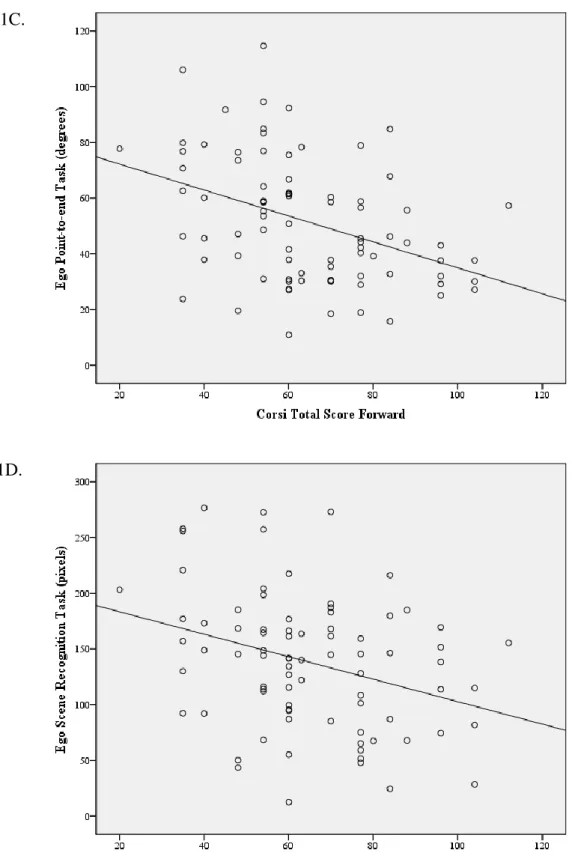
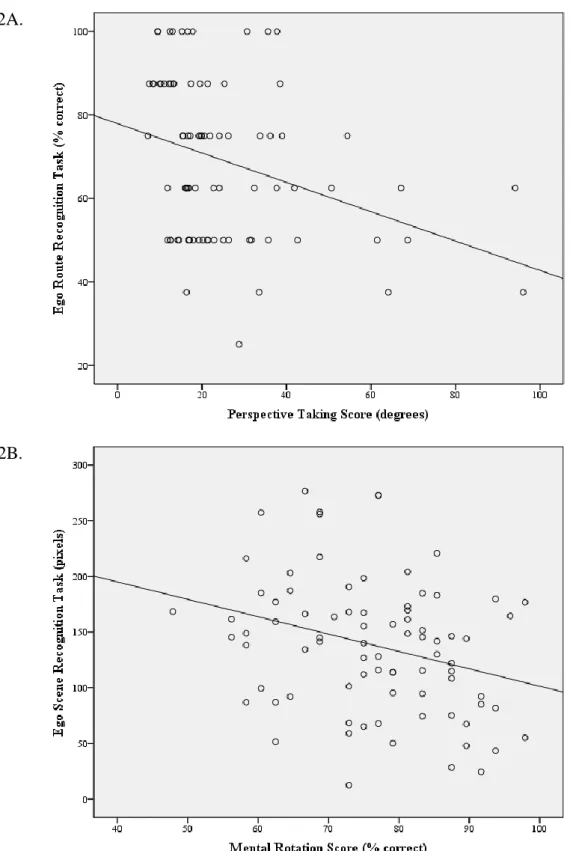
The results of the multiple regression analyses can be found in Table 3. In
Figures 1 and 2 (see the appendix), the regression lines of the significant β-weights, can be found for the egocentric navigation tasks.
Route Sequence Task: On the Route Sequence task, the F-test was not significant; F
(3,79) = 1.72, p = 0.169. The adjusted multiple squared correlation indicated that 2.5 percent of the variance was explained by the three predictors in this sample; adjusted
R² = 0.025. One of the three predictors had a significant regression weight: Corsi Total Score Forward (β = 0.25, p = 0.031). A larger Corsi Span forward is associated with a higher score on the Route Sequence task.
Route Recognition Task: On the Route Recognition task, the F-test was significant; F
(3,79) = 5.96, p = 0.001. The adjusted multiple squared correlation indicated that 15.2 percent of the variance was explained by the three predictors in this sample; adjusted
R² = 0.152. Two predictors had a significant regression weight: the Corsi Total Score Forward (β = 0.28, p = 0.009) and the Perspective Taking Score (β = -0.25, p = 0.025). A larger Corsi Total Score Forward was associated with a higher score on the Route
Recognition task. A lower score on the Perspective Taking test (i.e. a more accurate
performance) may be associated with a better performance on the Route Recognition
task.
Distance Estimation Task: On the Distance Estimation task, the F-test was not significant; F (3,79) = 1.37, p = 0.257. The adjusted multiple squared correlation indicated that 1.3 percent of the variance was explained by the three predictors in this
sample; adjusted R² = 0.013. None of the predictors had a significant regression weight.
Point-to-start Task: Before running the analysis, one outlier, that deviated more than three standard deviations from the mean, was removed. On the Point-to-start Task, the
F-test was not significant; F (3,78) = 2.41, p = 0.073. The multiple squared correlation indicated that 8.4 percent of the variance was explained by the three predictors in this
sample; R² = 0.084. None of the predictors had a significant regression weight.
Point-to-end Task: On the Point-to-end Task, the F-test was significant; F (3,79) = 7.41,
17 Table 3
Egocentric Navigation Tasks
F R² p β p
Route Sequence Task 1.72 0.025ᵃ 0.169
Corsi Total Forward 0.25 0.031*
Perspective Taking 0.04 0.748
Mental Rotation 0.02 0.882
Route Recognition Task 5.96 0.152ᵃ 0.001*
Corsi Total Forward 0.28 0.009*
Perspective Taking -0.25 0.025*
Mental Rotation 0.02 0.872
Distance Estimation Task 1.37 0.013ᵃ 0.257
Corsi Total Forward 0.13 0.256
Perspective Taking -0.08 0.495
Mental Rotation 0.10 0.372
Point-to-start Task 2.41 0.084 0.073
Corsi Total Forward -0.14 0.212
Perspective Taking 0.17 0.145
Mental Rotation -0.09 0.416
Point-to-end Task 7.41 0.188ᵃ 0.000*
Corsi Total Forward -0.33 0.002*
Perspective Taking 0.17 0.114
Mental Rotation -0.15 0.163
Scene Recognition Task 4.93 0.159 0.003*
Corsi Total Forward -0.28 0.011*
Perspective Taking -0.04 0.704
Mental Rotation -0.25 0.027*
Note. Results multiple regression analyses for the egocentric navigation tasks. F-tests, multiple squared
correlations and p are depicted. ᵃ = adjusted R² is used here since variables were not normally distributed; * = significant p-value at α = 0.05.
= -0.33, p = 0.002). A larger Corsi Total Score Forward was associated with a lower score (i.e. a more accurate performance) on the Point-to-end Task.
Scene Recognition Task: Before running the analysis, two outliers, that deviated more than three standard deviations from the mean, were removed. On the Scene Recognition
18
correlation indicated that 15.9 percent of the variance was explained by the three
predictors in this sample; R² = 0.159. Two of the predictors had a significant regression weight: the Corsi Total Score Forward (β = -0.28, p = 0.011) and the Mental Rotation Test (β = -0.25, p = 0.027). A larger Corsi Total Score Forward and a better performance on the Mental Rotation Test were associated with a smaller anomaly in pixels (i.e. more
accuracy) in the Scene Recognition Task.
Allocentric Navigation Tasks:
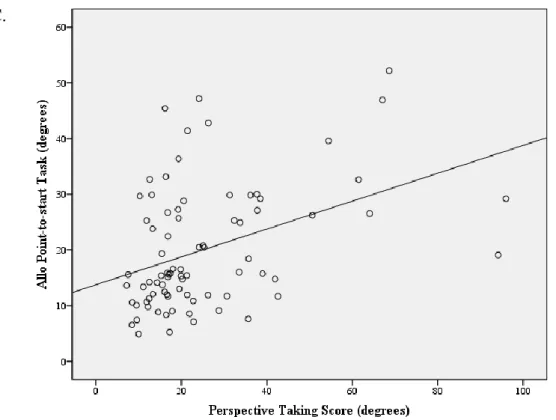
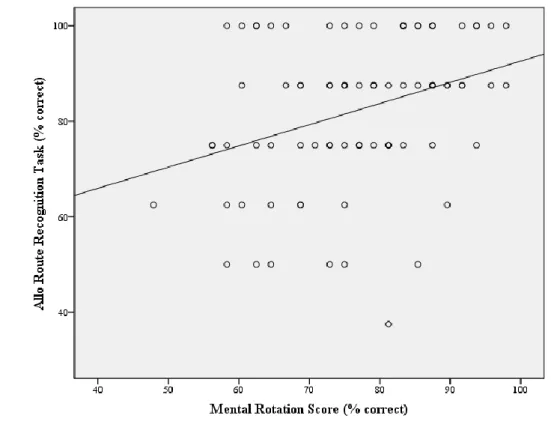
The results of the multiple regression analyses can be found in Table 4. In
Figures 3 and 4 (see the appendix), the regression lines of the significant β-weights can be found for the allocentric navigation tasks.
Route Sequence Task: On the Route Sequence Task, the F-test was not significant; F
(3,79) = 2.38, p = 0.076. The adjusted multiple squared correlation indicated that 4.7 percent of the variance was explained by the three predictors in this sample; adjusted
R² = 0.047. One of the predictors had a significant regression weight: The Perspective Taking Score (β = -0.23, p = 0.05). A lower score on the Perspective Taking Test (i.e. a more accurate performance) was associated with a better performance on the Route
Sequence Task.
Route Recognition Task: Before running the analysis, one outlier, that deviated more than three standard deviations from the mean, was removed. On the Route Recognition
Task, the F-test was significant; F (3,78) = 6.92, p < 0.001. The adjusted multiple squared correlation indicated that 17.8 percent of the variance was explained by the
three predictors in this sample; adjusted R² = 0.178. Two of the predictors had a
significant regression weight: The Mental Rotation Score (β = 0.23, p = 0.030) and the Perspective Taking Score (β = -0.30, p = 0.006). A higher score on the Mental Rotation Test was associated with a higher score on the Route Recognition Task. A more
accurate performance on the Perspective Taking Test was associated with a better
performance on the Route Recognition Task.
Distance Estimation Task: On the Distance Estimation Task, the F-test was not significant; F (3,79) = 0.32, p = 0.814. The adjusted multiple squared correlation indicated that 2.5 percent of the variance was explained by the three predictors in this
19 Table 4
Allocentric Navigation Tasks
F R² p β p
Route Sequence Task 2.38 0.047ᵃ 0.076
Corsi Total Forward 0.14 0.204
Perspective Taking -0.23 0.050*
Mental Rotation -0.10 0.375
Route Recognition Task 6.92 0.178ᵃ 0.000*
Corsi Total Forward 0.09 0.417
Perspective Taking -0.30 0.006*
Mental Rotation 0.23 0.030*
Distance Estimation Task 0.32 -0.025ᵃ 0.814
Corsi Total Forward 0.07 0.576
Perspective Taking -0.06 0.598
Mental Rotation 0.02 0.880
Point-to-start Task 5.58 0.147ᵃ 0.002*
Corsi Total Forward -0.12 0.257
Perspective Taking 0.38 0.001*
Mental Rotation 0.05 0.647
Point-to-end Task 1.20 0.007ᵃ 0.317
Corsi Total Forward 0.01 0.938
Perspective Taking -0.19 0.111
Mental Rotation 0.05 0.682
Scene Recognition Task 1.12 0.004ᵃ 0.345
Corsi Total Forward -0.07 0.531
Perspective Taking 0.13 0.271
Mental Rotation -0.08 0.496
Note. Results multiple regression analyses for the allocentric navigation tasks. F-tests, multiple squared
correlations and p are depicted. ᵃ = adjusted R² is used here since variables were not normally distributed; * = significant p-value at α = 0.05.
Point-to-start Task: Before running the analysis, three outliers, that deviated more than three standard deviations from the mean, were removed. On the Point-to-start Task, the
F-test was significant; F (3,76) = 5.58, p = 0.002. The adjusted multiple squared correlation indicated that 14.7 percent of the variance was explained by the four
20
regression weight: The Perspective Taking Score had a significant regression weight (β = 0.38, p = 0.001). A more accurate performance on the Perspective Taking Test was associated with a more accurate performance on the Point-to-start Task.
Point-to-end Task: On the Point-to-end-Task, the F-test was not significant; F (3,79) = 1.20, p = 0.317. The adjusted multiple squared correlation indicated that 0.7 percent of the variance was explained by the four predictors in this sample; adjusted R² = 0.007. None of the predictors had a significant effect on the Point-to-end Task.
Scene Recognition Task: On the Scene Recognition Task, the F-test was not significant;
F (3,79) = 1.12, p = 0.345. The adjusted multiple squared correlation indicated that 0.4 percent of the variance was explained by the three predictors in this sample; adjusted
R² = 0.004. None of the predictors had a significant regression weight.
Summary
Egocentric navigation tasks: In short, the most important results were, that significant
β-weights were found of the Corsi Total Score Forward for the egocentric conditions of
the Route Sequence Task, Route Recognition Task, Point-to-end Task and the Scene
Recognition Task. A higher Corsi Total Score Forward was associated with a better
performance on these tasks, thus visual-spatial working memory seems to be an
important predictor of performance. Another important predictor for performance on
the egocentric version of the Route Recognition Task is perspective taking ability. A
better performance on the Perspective Taking Test was associated with a better
performance on the Route Recognition Task. Finally, mental rotation ability was an
important predictor of performance on the Scene Recognition Task. A higher score on
the Mental Rotation Test was associated with a better performance on the Scene
Recognition Task.
Allocentric Navigation tasks: Significant β-weights were found of the Perspective Taking Score for the allocentric conditions of the Route Sequence Task, Route
Recognition Task and the Point-to-start Task. A better performance on the Perspective
Taking Test was associated with a better performance on these tasks. Mental rotation
ability was found to be an important predictor of performance on the Route Recognition
Task. A better performance on the Mental Rotation Test was associated with a better
performance on the Route Recognition Task.
Overall, the results indicated an important role of visual-spatial memory
21
navigation tasks. In the allocentric navigation tasks perspective taking ability was in
general an important predictor.
Table 5
Difference in Contribution of Predictors between Egocentric and Allocentric Navigation Tasks
Corsi Total Score Forward Perspective Taking Score Mental Rotation Score Egocentric Navigation Tasks
Route Sequence Task X
Route Recognition Task X X
Distance Estimation Task Point-to-start Task
Point-to-end Task X
Scene Recognition Task X X
Allocentric Navigation Tasks
Route Sequence Task X
Route Recognition Task X X
Distance Estimation Task
Point-to-start Task X
Point-to-end Task Scene Recognition Task
Note. Distribution of significant β-weights over the egocentric and allocentric navigation tasks. The X indicates that the β-weight was significant.
Discussion
The goal of the current study was to determine to what extent the small-scale
spatial abilities perspective taking ability, mental rotation ability and visual-spatial
working memory predict performance on navigation tasks from an egocentric and
allocentric perspective in a virtual environment. In general, it was hypothesized that
there was a difference in which spatial abilities would predict performance on
navigation tasks from an egocentric perspective and which spatial abilities would
predict performance on navigation tasks from an allocentric perspective. More
specifically, it was hypothesized that perspective taking ability would predominantly
be a predictor in the egocentric navigation tasks, and mental rotation ability
22
perspective taking ability was found to be a predictor for performance on three of the
six allocentric navigation tasks and for only one egocentric navigation task. The results
of the current study showed that perspective taking ability was a predictor in the
allocentric Route Sequence, Route Recognition and Point-to-start Task; and in the
egocentric Route Recognition Task. The second part of this general hypothesis was that
mental rotation ability would be a predictor for the allocentric navigation tasks. This
hypothesis was also rejected since the results showed that mental rotation ability was
only a predictor in the allocentric Route Recognition Task and in one egocentric
navigation task: The Scene Recognition Task. The final part of the general hypothesis
was that visual-spatial working memory would predict performance in all navigation
tasks from both egocentric and allocentric perspectives. This hypothesis was rejected
too, since the current study showed that visual-spatial working memory predicted
performance on four of the six egocentric navigation tasks and on none of the allocentric
navigation tasks. Visual-spatial working memory predicted performance on the
egocentric Route Sequence Task, Route Recognition Task, Point-to-end Task and
Scene Recognition Task. In short, there seemed to be a difference in the contribution of
the three spatial abilities to performance between navigation tasks from an egocentric
and an allocentric perspective. Visual-spatial working memory capacity was more
predictive of navigation from an egocentric perspective and perspective taking ability
was more predictive of navigation from an allocentric perspective, while mental
rotation ability had a more task specific effect. These results were clearly different from
what was expected.
In the study by Hegarty et al. (2006), it was demonstrated that small-scale spatial
abilities like perspective taking ability, mental rotation ability and visual-spatial
working memory were predictive factors for learning a route from visual media in
navigation tasks from an egocentric perspective (Hegarty et al., 2006). Based on these
findings, it was expected that perspective taking ability would also be predictive for
performance on egocentric navigation tasks in the current study, but this was only found
to be true for one of the egocentric tasks. Instead, perspective taking ability was found
to be predictive of performance on three allocentric navigation tasks, which was not
expected. The most logical explanation for this result could be that participants relied
on this spatial ability for imagining taking the perspective of the arrow in the allocentric
navigation tasks. In addition to that, the aerial perspective used in the Perspective
23
which means that the process of translating perspectives from aerial to egocentric in
both cases was similar. This translation of perspectives may have been necessary in
four of the six allocentric navigation tasks (not in the allocentric Distance Estimation
Task and the allocentric Scene Recognition Task). Of these four tasks the predictive
value was only not significant in the Point-to-end Task, although a trend was observed.
In the egocentric versions of these navigation tasks this translation of perspectives was
probably not necessary, so no similar results were found in the egocentric navigation
tasks, except for the egocentric Route Recognition Task. In this task participants
probably tried to imagine what the scene would look like if they would turn right, for
example, to see if they would recognize that part of the route. Therefore, perspectives
had to be imagined taking perspective of a point further down the street and looking in
another direction (left or right for example), similar to the instruction of the Perspective
Taking Test. It must be noted that the predictive effect of perspective taking ability
might have been significant in both egocentric pointing tasks if the sample size would
have been larger, because also here a trend could be observed and the mechanism of
imagining a different perspective could be the same as in the egocentric Route
Recognition Task. Nonetheless, it seems that perspective taking ability contributes
differently to performance on navigation tasks from an allocentric perspective than to
performance on navigation tasks from an egocentric perspective. This difference may
be explained by the difference in translating perspectives from aerial to egocentric,
which is necessary in the allocentric navigation tasks, but not in the egocentric
navigation tasks.
Kozhevnikov et al. (2006) stated that the Perspective Taking Test predicted
unique variance over the Mental Rotation Test in navigation tasks that required
updating of egocentric representations (Kozhevnikov et al., 2006), which means that
the predictive effect of perspective taking ability in these tasks, would probably be
larger than the predictive effect of mental rotation ability. In the current study both
egocentric and allocentric versions of the navigation tasks, where the effect of
perspective taking ability was found, required updating egocentric representations and
in all of them, the effect of perspective taking ability seemed to be larger than the effect
of mental rotation ability. Thus, the finding of Kozhevnikov et al. (2006) seemed to be
replicated in the current study. Though this was not part of the hypothesis, it would
explain why mental rotation ability was only found to be a predictor in the allocentric
24
hypothesized, predominantly in allocentric navigation tasks. In the allocentric Route
Recognition Task, mental rotation ability was probably involved in imagining taking
the perspective of the arrow and as seen before perspective taking ability was also a
significant predictor here. An explanation why mental rotation ability was not involved
in the allocentric pointing tasks could be that indicating the starting or end point of the
route did not require to mentally rotate the perspective as, for example in the Route
Recognition Task. It was also found that mental rotation ability was predictive of
performance on the egocentric Scene Recognition Task, but not on the allocentric Scene
Recognition Task. An explanation for this result could be that in the egocentric Scene
Recognition Task the perspective had to be translated from egocentric to allocentric,
which would require mental rotation ability. In the allocentric Scene Recognition task
no such translations were required to solve the task, but memory for landmarks and
landmark or object-based (allocentric) relations.
Finally, in the current study it was found that visual-spatial working memory
capacity predicted performance on four navigation tasks from an egocentric
perspective, but not for performance on any of the allocentric navigation tasks. No
trends were visible of visual-spatial working memory capacity for the allocentric
navigation tasks either. This unexpected finding might be explained by the fact that on
average, the duration in time of the allocentric routes was shorter than that of the
egocentric routes. Therefore, more demands could have been be made on visual-spatial
memory capacity in the egocentric tasks than in the allocentric tasks. A more likely
explanation could be that the route segments in the allocentric tasks were more
recognizable, because due to the perspective, they provided a more schematic overview
of the part of the route that was shown and contained less detailed information about
how buildings looked than the egocentric tasks, so lower demands were made on
visual-spatial working memory. The only exception would be the Route Sequence Task, which
relied on an internal schematic representation of the route. It could be that participants
were more inclined to actively rehears and store ‘left, right, straight on’ sequences in
the egocentric condition than in the allocentric condition, because of the lack of
overview in the egocentric condition compared to the allocentric condition. It could also
be that participants tried to visualize the route and that because of the less schematic
view in the egocentric Route Sequence Task, more demands were made on
visual-spatial working memory capacity than in the allocentric condition. For one navigation
25
found in either the egocentric or the allocentric condition. Performance on this task
clearly relies on other factors than the ones used in this study. One candidate could be
computing directions and distances (Wolbers & Hegarty, 2010). To the author’s
knowledge this is the first study that demonstrated a clear difference in contribution of
visual-spatial memory span between performance in navigation tasks from an
egocentric perspective and navigation tasks from an allocentric perspective in a virtual
desktop environment.
One important limitation of this study is the sample size. As mentioned before,
according to Green (1991) the sample size in a multiple regression model with four
predictors, should be at least 108 for a medium effect of the β-weights (Green, 1991). The sample size in this study was not large enough. This does not mean there is nothing
that can be concluded from this data, but the conclusions should be drawn with some
caution. Thus, future studies should have larger sample. Another limitation of this study
was the absence of a measure to test object location memory (Postma, Kessels, & van
Asselen, 2008). In future studies this might be a good predictor of performance on
navigation tasks like an allocentric task where locations of buildings have to be located
on a map. A final limitation was that virtual routes had to be watched and could
therefore not be experienced in an active way by the participants. Maybe that was also
part of the reason why distance estimation was not found to be predicted by any of the
independent variables. In real world navigation distance estimation is in part determined
by self-motion cues (Hegarty et al., 2006). Perhaps adding self-motion cues in a virtual desktop environment, so that participants can ‘virtually’ walk or determine the route
themselves, may prove to predict distance estimation better.
Future studies should have a larger sample size and include other predictors,
like object-location memory. Also, a condition should be added in which participants
can actively walk their own route in a virtual environment, instead of passively watch
a route. This study provides more insight in the spatial abilities that determine
navigation ability in a virtual environment, especially with respect to differences in
perspective. With that the current study also contributes to the development of
intervention methods that aim at improving real world navigation skills in neurological
patients who experience problems with spatial navigation. Nowadays, it is to an
increasing extent being acknowledged that neurological patients who suffered from a
stroke, experience problems with spatial navigation (van der Ham et al., 2010; van der
26
method to help these patients improve their navigation ability (Caglio et al., 2012;
Kober et al., 2013; Claessen, van der Ham, Jagersma, & Visser-Meily, 2015; Claessen,
Visser-Meily, de Rooij, Postma & van der Ham, 2016). But our understanding of
cognitive factors, that are needed for spatial navigation from visual media and virtual
reality needs to be further enhanced to develop more effective training methods. This
study is of clinical relevance because, it contributes to our understanding of cognition
in spatial navigation when using virtual environments.
Conclusion
In this study, it was found that visual-spatial working memory span is an
important predictor for spatial ability in a virtual environment from an egocentric
perspective, but not from an allocentric perspective. Also, perspective taking ability and
mental rotation ability were found to predict spatial ability in a virtual environment, but
not to the extent that was expected. These results suggest that the influence of spatial
abilities that predict navigation performance is dependent on the perspective from
which it is learned.The most important lessons that can be drawn from this study are
that in future studies new predictors should be added to the model to replace some others
that had no effect. Also adding a condition with more self-motion cues is advised, as is
a larger sample size. This study provides a better understanding of spatial abilities
underlying spatial navigation in a virtual environment and therefore contributes to the
development of intervention methods, that are being designed to improve real world
navigation in neurological patients, who experience problems with spatial navigation
in daily life.
Reference List
Baddeley, A. (2003). Working memory: looking back and looking forward.
Nat Rev Neurosci, 4, 829-839.
Blajenkova, O., Motes, M. A., & Kozhevnikov, M. (2005). Individual
differences in the representations of novel environments. Journal of Environmental
27
Caglio, M., Latini-Corazzini, L., D'Agata, F., Cauda, F., Sacco, K.,
Monteverdi, S. et al. (2012). Virtual navigation for memory rehabilitation in a
traumatic brain injured patient. Neurocase., 18, 123-131.
Carroll, J. B. (1993). Human Cognitive Abilities: A Survey of Factor-Analytic
Studies. Cambridge University Press.
Claessen, M. H., Visser-Meily, J. M., de Rooij, N. K., Postma, A., & van der
Ham, I. J. (2016). A Direct Comparison of Real-World and Virtual Navigation
Performance in Chronic Stroke Patients. Journal of the International
Neuropsychological Society, 22(4), 467-477.
Claessen, M. H., van der Ham, I. J., Jagersma, E., & Visser-Meily, J. M.
(2015). Navigation strategy training using virtual reality in six chronic stroke patients:
A novel and explorative approach to the rehabilitation of navigation impairment.
Neuropsychol.Rehabil., 1-25.
Corsi, P. M. (1972). Human Memory and the Medial Temporal Region of the
Brain. Unpublished doctoral dissertation, McGill University, Montreal, QB.
Ekstrom, A. D., Arnold, A. E., & Iaria, G. (2014). A critical review of the
allocentric spatial representation and its neural underpinnings: toward a
network-based perspective. Front Hum.Neurosci., 8, 803.
Field, A. (2013). Discovering Statistics Using IBM SPSS Statistics. SAGE
28
Gramann, K., Muller, H. J., Schonebeck, B., & Debus, G. (2006). The neural
basis of ego- and allocentric reference frames in spatial navigation: evidence from
spatio-temporal coupled current density reconstruction. Brain Res., 1118, 116-129.
Green, S. B. (1991). How Many Subjects Does It Take To Do A Regression
Analysis. Multivariate Behavioral Research, 26, 499-510.
Hegarty, M., Montello, D. R., Richardson, A. E., Ishikawa, T., & Lovelace, K.
(2006). Spatial abilities at different scales: Individual differences in aptitude-test
performance and spatial-layout learning. Intelligence, 34, 151-176.
Hegarty, M. & Waller, D. (2004). A dissociation between mental rotation and
perspective-taking spatial abilities. Intelligence, 32, 175-191.
Ishikawa, T. & Montello, D. R. (2006). Spatial knowledge acquisition from
direct experience in the environment: individual differences in the development of
metric knowledge and the integration of separately learned places. Cogn Psychol., 52,
93-129.
Jordan, K., Schadow, J., Wuestenberg, T., Heinze, H. J., & Jancke, L. (2004).
Different cortical activations for subjects using allocentric or egocentric strategies in a
virtual navigation task. Neuroreport, 15(1), 135-140.
Kessels, R. P., van Zandvoort, M. J., Postma, A., Kappelle, L. J., & de Haan,
E. H. (2000). The Corsi Block-Tapping Task: standardization and normative data.
29
Klatzky, R. L. (1998). Allocentric and egocentric spatial representations:
Definitions, distinctions, and interconnections. In Spatial cognition (pp. 1-17).
Springer, Berlin, Heidelberg.
Kober, S. E., Wood, G., Hofer, D., Kreuzig, W., Kiefer, M., & Neuper, C.
(2013). Virtual reality in neurologic rehabilitation of spatial disorientation.
J.Neuroeng.Rehabil., 10, 17.
Kozhevnikov, M. & Hegarty, M. (2001). A dissociation between object
manipulation spatial ability and spatial orientation ability. Memory & Cognition,
29(5), 745-756.
Kozhevnikov, M., Motes, M. A., Rasch, B., & Blajenkova, O. (2006).
Perspective-taking vs. mental rotation transformations and how they predict spatial
navigation performance. Applied Cognitive Psychology, 20, 397-417.
McAfoose, J. & Baune, B. T. (2009). Exploring Visual−Spatial Working
Memory: A Critical Review of Concepts and Models. Neuropsychology Review, 19,
130-142.
McGee, M. G. (1979). Human spatial abilities: Psychometric studies and
environmental, genetic, hormonal, and neurological influences. Psychological
Bulletin, 86, 889-918.
Meilinger, T., Knauff, M., & Bulthoff, H. H. (2008). Working memory in
30
Meilinger, T., & Vosgerau, G. (2010, August). Putting egocentric and
allocentric into perspective. In International Conference on Spatial Cognition (pp.
207-221). Springer, Berlin, Heidelberg.
Postma, A., Kessels, R. P. C., & van Asselen, M. (2008). How the brain
remembers and forgets where things are: The neurocognition of object−location
memory. Neuroscience & Biobehavioral Reviews, 32, 1339-1345.
Shepard, R. N. & Metzler, J. (1971). Mental rotation of three-dimensional
objects. Science, 171, 701-703.
Török, Á., Nguyen, T. P., Kolozsván, O., Buchanan, R. J., & Nadasdy, Z.
(2014). Reference frames in virtual spatial navigation are viewpoint dependent.
Frontiers in Human Neuroscience, 8, 646.
van der Ham, I. J., Kant, N., Postma, A., & Visser-Meily, J. M. (2013). Is
navigation ability a problem in mild stroke patients? Insights from self-reported
navigation measures. J.Rehabil.Med., 45, 429-433.
van der Ham, I. J., van Zandvoort, M. J., Meilinger, T., Bosch, S. E., Kant, N.,
& Postma, A. (2010). Spatial and temporal aspects of navigation in two neurological
patients. Neuroreport, 21, 685-689.
Vandierendonck, A., Kemps, E., Fastame, M. C., & Szmalec, A. (2004).
Working memory components of the Corsi blocks task. British Journal of Psychology,
95, 57-79.
Wolbers, T. & Hegarty, M. (2010). What determines our navigational
31
Zhang, H., Copara, M., & Ekstrom, A. D. (2012). Differential Recruitment of
Brain Networks following Route and Cartographic Map Learning of Spatial
Environments. PLoS One, 7, e44886.
Zhang, H., Zherdeva, K., & Ekstrom, A. D. (2014). Different “routes” to a
cognitive map: dissociable forms of spatial knowledge derived from route and