Effect of Loss of P2Y
2Receptor Gene Expression on Nucleotide
Regulation of Murine Epithelial Cl
2Transport*
(Received for publication, May 17, 1999)
Victoria L. Cressman, Eduardo Lazarowski, La´ szlo´ Homolya, Richard C. Boucher, Beverly H. Koller, and Barbara R. Grubb‡
From the Cystic Fibrosis/Pulmonary Research and Treatment Center, The University of North Carolina, Chapel Hill, North Carolina 27599
Extracellular nucleotides are believed to be important regulators of ion transport in epithelial tissues as a re-sult of their ability to activate cell surface receptors. Although numerous receptors that bind nucleotides have been identified, the complexity of this receptor family, combined with the lack of pharmacological agents specific for these receptors, has made the assign-ment of particular receptors and ligands to physiologi-cal responses difficult. Because ATP and UTP appear equipotent and equieffective in regulating ion transport in many epithelia, we tested the hypothesis that the P2Y2 receptor (P2Y2-R) subtype mediates these
re-sponses in mouse epithelia, with gene targeting tech-niques. Mice with theP2Y2-Rlocus targeted and
inacti-vated (P2Y2-R(2/2)) were generated, airways (trachea),
gallbladder, and intestines (jejunum) excised, and Cl2 secretory responses to luminal nucleotide additions
measured in Ussing chambers. Comparison of P2Y2
-R(1/1) with P2Y2-R(2/2) mice revealed that P2Y2-R
me-diated most (>85–95%) nucleotide-stimulated Cl2 secre-tion in trachea, about 50% of nucleotide responses in the gallbladder, and none of the responses in the jejunum. Dose-effect relationships for nucleotides in tissues from P2Y2-R(2/2) mice suggest that the P2Y6-R regulates ion
transport in gallbladder and to a lesser extent trachea, whereas P2Y4and/or unidentified receptor(s) regulate
ion transport in jejunum. We conclude that the P2Y2
receptor is the dominant P2Y purinoceptor that regu-lates airway epithelial ion transport, whereas other P2Y receptor subtypes are relatively more important in other nonrespiratory epithelia.
Metabotropic (G protein-coupled) P2Y receptors are ex-pressed in epithelia and regulate epithelial ion transport and, consequently, have become potential targets for drug therapy of diseases that reflect abnormal epithelial ion transport (1). Of particular interest in this context is cystic fibrosis (CF),1 a
disease that reflects widespread defects in epithelial ion trans-port due to mutations in the cystic fibrosis transmembrane conductance regulator (CFTR) (2). However, the spectrum of epithelia affected by this disease (e.g.airway, gallbladder, and intestine), the diversity of P2Y receptor subtypes (3), and the
absence of selective reagents to define which P2Y receptor subtypes regulate ion transport have made it difficult to ini-tiate therapeutic programs to target specific purinoceptors in these tissues.
The strongest evidence for a role for P2 receptors in the regulation of ion transport emanates from studies of airway epithelia. Recent reports indicate that extracellular triphos-phate nucleotides regulate many of the airway ion transport paths, including slowing Na1absorption (4) and stimulating Cl2 and K1 secretion (5, 6). Pharmacological studies in the human airway epithelial cell line CF/T43 have demonstrated that UTP and ATP are equipotent and cross-desensitize in promoting phospholipase C activity, leading to the hypothesis that the P2Y2receptor (P2Y2-R) is the dominant receptor
me-diating these responses (7, 8). However, it is difficult to distin-guish whether the actions of ATP and UTP on ion transport are mediated by a single purine/pyrimidine-sensitive receptor (e.g. P2Y2) and/or a combination of other recently cloned P2Y
recep-tors that are potently activated by ATP (e.g.P2Y1(9, 10), P2Y11
(11), or P2X (3, 12–14)), and UTP (e.g.P2Y4(15, 16)).
Studies of the P2Y receptor subtypes and regulation of ion transport in the gastrointestinal system are more limited. Data from the murine gallbladder suggest that both ATP and UTP are active in regulating Cl2 and HCO32 secretion (17, 18),
suggesting that the P2Y2-R may be the major P2Y-R subtype regulating ion transport in this tissue. Early studies of freshly excised rat jejunum reported regulation of ion transport by ATP but not UTP (19). More recent studies of triphosphate and diphosphate nucleotides in cell lines derived from the human intestine (e.g.CaCo2 cells) suggest that ATP, UTP, and UDP regulate enterocyte Cl2secretory rates (20).
We report here the use of a genetic approach (21) combined with traditional pharmacological methodologies to define the relative role of purinoceptors in the regulation of ion transport in epithelial tissues. Based on the reports of the actions of ATP and UTP in the epithelia described above, a first approach was to target a single receptor that could transduce responses to ATP and UTP equipotently. The P2Y2-R exhibits this
pharma-cology, and, consequently, mice were generated with inacti-vatedP2Y2-Rgenes using the homologous recombination
tech-nique (21). Because triphosphate nucleotide effects on Cl2and water secretion are projected as the major therapeutic actions of these agents in epithelial diseases such as CF (5, 22), char-acterization of these mice focused on the role of the P2Y2
receptor in mediating epithelial Cl2secretory responses. In a companion paper (23), the role of P2Y2 receptor in inositol
phosphate formation and intracellular Ca21 mobilization in tracheas and other tissues were characterized.
EXPERIMENTAL PROCEDURES
Mice Used for Phenotypic Characterization—Adult mice (wild type and P2Y2-R(2/2)) of both sexes were used in this investigation. All
* This study was supported by National Institutes of Health Grants HL34322 and DK51791 and Cystic Fibrosis Foundation Grant R026.
‡ To whom correspondence should be addressed: Cystic Fibrosis/Pul-monary Research and Treatment Center, University of North Carolina, Chapel Hill, NC 27599. Tel.: 919-966-5602; Fax: 919-966-7524.
1The abbreviations used are: CF, cystic fibrosis; CFTR, cystic fibrosis
transmembrane conductance regulator; Isc, short circuit current;
A3P5P, adenosine 39,59-diphosphate;a,b-meATP,a,b-methylene aden-osine 59-triphosphate; 2-MeSATP, 2-methylthioadenosine 59 -triphos-phate; 2-MeSADP, 2 methylthioadenosine 59-diphosphate, EC50, 50% of
maximal effective concentration.
© 1999 by The American Society for Biochemistry and Molecular Biology, Inc. Printed in U.S.A.
animals were bred and raised at the University of North Carolina. The mean body mass of the normal animals (32.461.8 g,n520) was not significantly different from the mean body mass of the littermate P2Y2
-R(2/2) mice (3461.9 g,n521). All mice were allowed food and water
ad libitumuntil euthanized.
Mice were euthanized with 100% CO2, and the tracheas, intestine,
and gallbladders were quickly excised. The trachea was dissected free of vessels and connective tissue, split longitudinally along the posterior surface, and mounted in Ussing chambers (24). The gallbladder was opened, irrigated to remove bile, and mounted as a flat sheet in an Ussing chamber. Because of the fragility of gallbladders, a cellulose mesh was placed over the aperture of the Ussing chamber (serosal side only) to prevent the tissue from falling through the aperture. Both tissues were mounted on Ussing chambers having an aperture surface area of 0.025 cm2. The techniques for mounting the intestinal tissue
(0.25-cm2aperture Ussing chamber) have been previously described
(25). Parafilm “O” rings were placed on both sides of the tissues to reduce edge damage.
Bioelectric Measurements—Electrical measurements of tissues were made under short circuit (Isc) conditions as previously reported (24, 26).
Tissues were bathed bilaterally in gassed (95% O2, 5% CO2) Krebs
bicarbonated Ringer solution having the following composition: 140 mM
Na1, 120 mMCl2, 5.2 mMK1, 1.2 mMMg21, 1.2 mMCa21, 2.4 mM HPO4
22, 0.4 mMH
2PO
42, 25 mMHCO
3
2, and 5 mMglucose. Amiloride (1024
M; Sigma) was added to the luminal side of all tracheas to block Na1absorption, which allows Cl2secretory responses to agonists to be studied (24). Since the gallbladder and jejunum were unresponsive to amiloride, this drug was omitted from the protocols involving these tissues. Tissues were allowed to stabilize for 30 min before the first measurements were made or drugs added. Short circuit (Isc) was
con-tinuously recorded and resistance calculated by Ohm’s law by meas-uring theIscchange in response to a 1-mV constant voltage pulse (26).
All additions were to the luminal bath.
Protocols—For the dose-response studies, each dose was added cu-mulatively to the luminal surface of the tissue. When the tissue re-sponded to the agonist, the response was immediate. After the response had peaked and/or stabilized (usually 2–3 min), the next dose was added. The response to the added agonist was determined as a change in theIscfrom the basal or previous dose level. For studies of the P2Y1
antagonist A3P5P in jejunum, tissues were pretreated with A3P5P (1024
M) in the luminal solution prior to nucleotide additions.
Materials—ATP and UTP were purchased from Amersham Pharma-cia Biotech (Uppsala, Sweden), A3P5P was from Sigma,a,b-methylene ATP (a,b-meATP), ATP (2-MeSATP), and 2-methylthio-ADP (2-MeS2-methylthio-ADP) from RBI (Natick, MA), and UDP and adenosine from Roche Molecular Biochemicals. Because UTP could potentially contam-inate commercial preparations of UDP, and to prevent formation of UTP from UDP via nucleoside diphosphokinase and endogenously re-leased ATP, hexokinase (10 units/ml) and glucose (25 mM) were present in all UDP stocks, and the purity of UDP was monitored by high pressure liquid chromatography (27).
Data Analysis/Statistics—For all tissues, data are expressed in terms ofIsc. ThisIscresponse is generated primarily by Cl2secretion
and to a lesser extent HCO32secretion.
2Therefore, here theDI scis often
referred to as Cl2secretion. Apparent EC50values represent the
con-centration of agonist that generated either 50% of the maximal re-sponse or, if saturation was not achieved, 50% of the rere-sponse to 1024
M. All data are expressed as mean6S.E. Statistical analyses were per-formed with nonpaired Student’sttests.
RESULTS Tracheal Epithelium
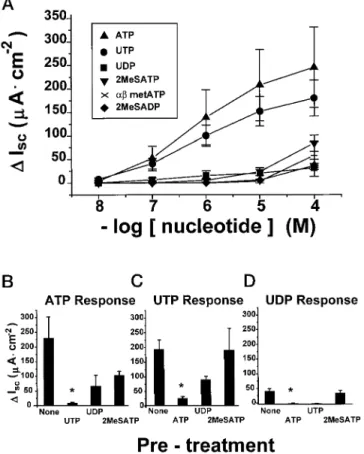
Characterization of Wild Type (1/1) Freshly Excised Murine Tracheal Responses to Nucleotides—The cumulative dose-effect relationships for six different nucleotides which are known to be agonists at different P2receptorsversustracheal Cl2
secre-tion rates (DIsc) are shown in Fig. 1A; ATP and UTP were
nearly equipotent and were the most effective agonists for the induction of Cl2secretion. Table I shows that in addition to ATP and UTP, only UDP elicited a saturable Cl2 secretory response within the micromolar concentration range (,1024M)
(27). The maximal effect of UDP was small (;20%) compared with ATP/UTP responses. The weak effect of 2-MeSADP or
2-MeSATP suggested that it was unlikely that ATP responses were primarily mediated by a P2Y1 receptor. Adenosine was also relatively ineffective (;15% of maximal ATP response;DIsc
536611mAzcm2at 1024
M,n55). These data suggest that
the P2Y2 receptor may be the dominant receptor in airway
epithelia of the murine trachea but that a receptor that is activated by UDP (e.g.P2Y6) is also expressed in this tissue.
As a second approach to identify individual P2 receptors in wild type mouse trachea, cross-desensitization studies were performed. The initial analysis of the interactions suggests that there is cross-desensitization between ATP and UTP; the ATP response was abolished by UTP pretreatment (Fig. 1B), and the UTP response was abolished by ATP pretreatment (Fig. 1C), consistent with interaction of both ligands at a single (P2Y2) receptor.
However, this interpretation was complicated by the obser-vation that both agonists produced large maximal responses (.200mAzcm22), suggesting that the failure to observe a second
response could reflect a ceiling effect and/or desensitization of other effectors in the Cl2secretory pathway. This possibility was supported by the observations that (i) UDP responses also were abolished by ATP or UTP pretreatment (Fig. 1D) and (ii) the actions of the muscarinic receptor agonist carbachol were reduced after exposure of the tissue to either ATP or UTP as
2 B. R. Grubb, unpublished observations.
FIG. 1. Mouse tracheas: wild type (P2Y2-R(1/1)). A, Isc dose
response to the indicated nucleotides. Data are means6S.E.,n56 at each dose.B, desensitization of tracheal ATP responses.Iscresponses to
1024
MATP were measured in tracheas that were pretreated with no other nucleotide (None,n57) or that were pretreated with 1024
MUTP (n54), UDP (n53), or 2-MeSATP (n53).C, desensitization to UTP responses.Iscresponses to 102
4
MUTP were measured in tracheas that
were pretreated with no other nucleotide (None,n57) or that were pretreated with 1024
MATP (n54), UDP (n53), or 2-MeSATP (n52). D, desensitization to UDP responses.Iscresponses to 102
4
MUDP were measured in tracheas that were pretreated with no other nucleotide (None,n56) or that were pretreated with 1024
MATP (n53), UTP (n53), or 2-MeSATP (n53).p#0.05. Data in all bar graphsare means6S.E.
pretreatment (Dcarbachol (1024M) naive56263.3mAzcm22;
Dcarbachol (1024
M) post-ATP (1024 M) 519 6 5mAzcm22).
Thus, it is not clear whether the reduced effects of UTP post-ATP indicate desensitization of a common receptor for these nucleotides (e.g.P2Y2) or whether activation of, for example, a
uridine-selective receptor (e.g.P2Y4or P2Y6) is masked by the ceiling effect of ATP acting on an ATP-selective receptor (e.g. P2Y11or P2X receptor). Moreover, since P2Y4, P2Y6, and P2Y11
receptors are not pharmacologically defined in the mouse, we cannot rule out the possibility that either of these receptors is activated by ATP, UTP, and UDP. The modest inhibition of the ATP response by 2-MeSATP pretreatment (Fig. 1B) without any effect on UTP or UDP responses (Fig. 2,CandD) raises the possibility of a low level of functional expression of a P2Y1 receptor in murine trachea.
In summary, it is difficult from the above data to distinguish whether a single receptor,e.g.P2Y2, or a mixture of receptors
accounted for all of the effects observed with the six agonists tested. In an attempt to resolve these issues, a comparable characterization of the nucleotide responses of P2Y2-R(2/2)
mouse tracheas was performed.
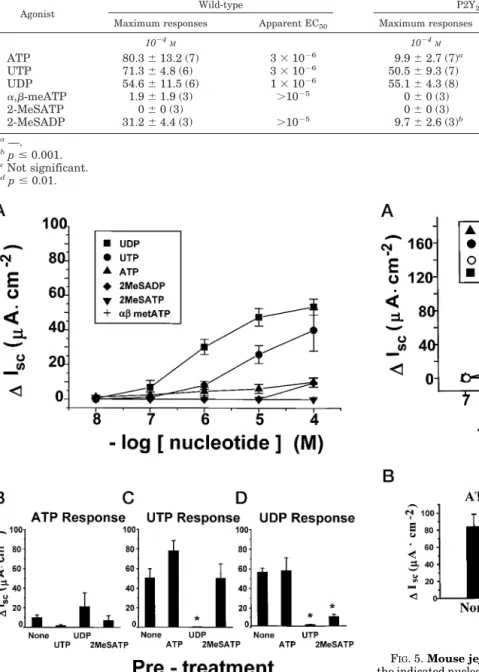
Characterization of P2Y2-R(2/2) Freshly Excised Tracheas— Fig. 2Ashows the cumulative dose-effect relationships for the six nucleotidesversusCl2secretion (DIsc) for the tracheas from
P2Y2-R(2/2) mice plotted on the same scale as for wild type
(1/1) mice. There were major (more than 85–95%) reductions in the Cl2secretory responses to UTP and ATP at all concen-trations tested. Further, there were major reductions in the magnitude of the responses to a,b-meATP, 2-MeSATP, and 2-MeSADP (Table I), indicating that these P2X and P2Y1 re-ceptor agonists (or contaminants), at high concentrations, also interact with the P2Y2receptor. No reduction in Cl2secretory
responses to UDP was observed relative to wild type, P2Y2
-R(1/1) mice (Table I).
To verify that theP2Y2-Rdisruption did not affect the Cl2 secretory capacity of the trachea, we compared responses to carbachol. Carbachol (1024 M) was equieffective in P2Y
2
-R(1/1) (62 6 3 mAzcm22) and P2Y
2-R(2/2) mice (63 6 2
mAzcm22), suggesting that the Cl2 secretory capacity of the trachea was not decreased by targeting theP2Y2locus (n54,
both groups).
The calculated EC50values, the magnitude of the maximal response, and the percentage reduction in the maximal re-sponses for the P2Y2-R(2/2) mice as compared with wild type
mice (Table I) clearly indicate that the P2Y2 receptor is the
dominant receptor in the murine trachea that transduces the administration of triphosphate nucleotides to the tracheal ep-ithelial surface into Cl2secretory responses.
A variety of protocols were employed in an attempt to iden-tify the residual receptors expressed in the P2Y2-R(2/2) mouse trachea. These protocols were in general difficult because of the small magnitude of the Cl2secretory responses mediated by
residual receptors and the failure of most agonists to reach saturating concentrations within the submillimolar range.
UDP responses in the tracheal preparations were not af-fected by the P2Y2 receptor disruption (Table I), suggesting that a functional P2Y6 receptor is expressed in this tissue.
Since P2Y6receptors are activated, although weakly, by ADP
(28), a portion of the small residual ATP effect could reflect extracellular conversion of ATP to ADP (29). However, al-though ATP inhibits UDP-evoked responses (Fig. 2D), UDP does not affect subsequent responses to ATP (Fig. 2B). This
FIG. 2.Mouse tracheas: P2Y2-R(2/2).A,Iscdose response to the
indicated nucleotides. Data are means6S.E.,n56 at each dose.B, desensitization to ATP responses.Iscresponses to 102
4
MATP were measured in tracheas that were pretreated with no other nucleotide (None,n510) or that were pretreated with 1024
MUTP (n54), UDP (n53), or 2-MeSATP (n53).C, desensitization to UTP responses.Isc
responses to 1024
MUTP were measured in tracheas that were pre-treated with no other nucleotide (None,n57) or that were pretreated with 1024
MATP (n5 3), UDP (n 5 3), or 2-MeSATP (n5 3).D, desensitization to UDP responses.Iscresponses to 102
4
MUDP were
measured in tracheas that were pretreated with no other nucleotide (None,n56) or that were pretreated with 1024
MATP (n53), UTP (n53), or 2-MeSATP (n53). Data in allbar graphsare means6S.E. TABLE I
Agonist responses in mouse tracheas nis shown in parentheses.
Agonist Wild-type P2Y2-R(2/2) maximum responseDecrease of
Maximum response Apparent EC50 Maximum response Apparent EC50
1024
M 1024
M %
ATP 229.5673 (7) 631027 12.763.1 (7) 231026 94.8a
UTP 191.5637 (7) 831027
3369.9 (7) 231027
83b
UDP 43.669.8 (6) 531026 39.4613.6 (6) 631027 10
a,b-meATP 58.1629 (3) .1025 5.265.2 (3) .1025 91
2-MeSATP 84.5617.1 (3) .1025 13.660.8 (3) 231026 84
2-MeSADP 37.163.9 (3) .1025
17.267.4 (3) 331026
54
a
p#0.01.
bp#0.001.
finding suggests that ATP could affect UDP responses by a different mechanism,e.g.ATP-dependent removal of UDP by ectonucleoside diphosphokinase (27).
A small residual effect of UTP was also observed in the P2Y2-R2/2tracheal epithelia (Fig. 2 and Table I), which was
mostly inhibited by pretreatment with UDP. This residual effect of UTP could reflect either extracellular conversion of UTP to UDP or direct activation of murine P2Y6receptors by UTP. The attenuation of UDP-promoted responses by UTP supports either of these possibilities.
Finally, the residual ATP effects were very small. The equi-potency and equieffectiveness of 2-MeSADP (and 2-MeSATP) with ATP (Table I) suggest that this small residual effect may reflect a P2Y1-R-like activity.
Gallbladder
Characterization of Nucleotide- stimulated Cl2Secretion in Wild Type (P2Y2-R(1/1)) Freshly Excised Gallbladders—We next tested for the effect of nucleotides on the freshly excised murine gallbladder (Fig. 3). These data differ from the freshly excised trachea in one striking respect,i.e.UDP was virtually equieffective and equipotent with ATP and UTP in initiating a secretory response (DIsc) in this tissue (Fig. 3A, Table II).
2-Me-SADP induced a small response (;40% of ATP response),
which was only attained at high micromolar concentrations. 2-MeSATP anda,b-meATP were entirely without effect in this tissue (Table II). Unlike the trachea, adenosine was completely ineffective (DIsc53.962.8mAzcm2at 1024M,n53).
Fig. 3, B–D, displays cross-desensitization protocols. UTP but not UDP partially blocked the subsequent response to ATP, and ATP largely attenuated the subsequent response to UTP but not to UDP, consistent with an interaction of ATP and UTP at a P2Y2receptor. UDP attenuated the subsequent response to
UTP but not to ATP (Fig. 3,B andC), and UTP blocked the subsequent response to UDP (Fig. 3D).
In summary, the data indicate the possible expression of a P2Y2and a P2Y6receptor in the murine gall bladder
epithe-lium. To test this hypothesis more rigorously, we characterized the effect of nucleotides on the gallbladder epithelial cells from the P2Y2-R(2/2) mouse.
Characterization of P2Y2-R(2/2) Freshly Excised Gallblad-der (Fig. 4)—Disruption of theP2Y2-Rgene in the gallbladder
revealed that the responses to ATP were virtually abolished in the P2Y2-R(2/2) gallbladders. In contrast, the effect of UTP
was only partially reduced (30%) in the P2Y2-R(2/2)
gallblad-der cells relative to the wild type cells, whereas the UDP responses were not affected by the P2Y2-R disruption (Table II).
Studies of interactions with the residual ATP responses were not informative because of the very small magnitude of these residual responses (Fig. 4). With respect to UTP, the relatively large (70% of wild type) residual UTP response was blocked by UDP but not ATP (or 2-MeSATP) pretreatment (Fig. 4C). Sim-ilarly, the persistent UDP response was inhibited by UTP but not adenine nucleotide pre-treatment (Fig. 4D). These data suggest that a common receptor transduces the P2Y2-R(2/2)
gallbladder UDP/UTP response. The P2Y6-R is a candidate for
this function.
Jejunum
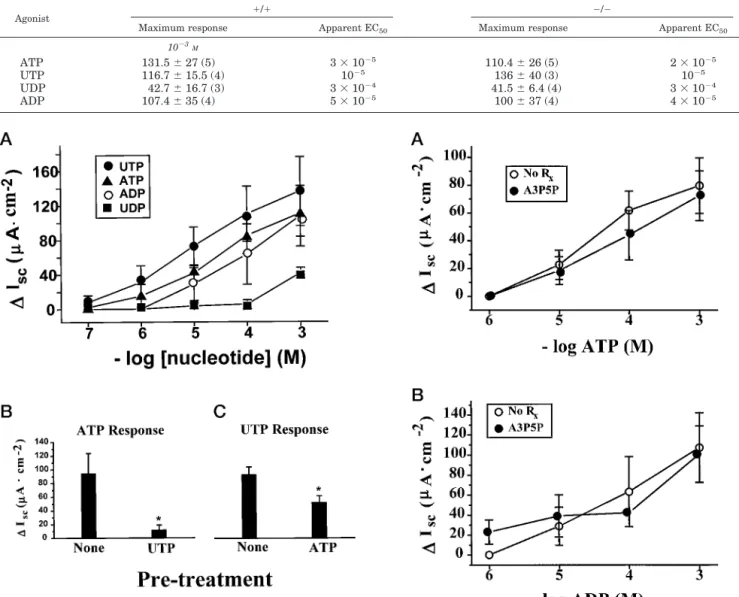
Effect of Nucleotides on Cl2Secretory Responses in Normal (P2Y2-R(1/1)) Jejuna—The luminal dose-response curve de-scribing the actions of ATP, UTP, ADP, and UDP on freshly excised normal mouse jejuna are shown in Fig. 5A. Several points deserve comment. First, unlike the tracheal and gall-bladder preparations, approximately 25–30% of the normal jejunal preparations failed to respond to any nucleotide. These preparations were viable, since they had a normal response to forskolin. The nonresponding preparations were omitted from the analysis. Second, the dose-effect relationships for all the effective agonists were somewhat shifted to the right (see Table III for EC50 values) as compared with the activities in the gallbladder and trachea. Third, as in the other tissues, ATP and UTP were approximately equieffective and equipotent ago-nists at the luminal jejunum surface. Fourth, uniquely in the jejunum, ADP was also nearly as effective and potent as ATP and UTP. In contrast to the gallbladder and trachea, UDP appeared to be weak and relatively ineffective. Adenosine (1024
M) was ineffective (DIsc59 65mAzcm2,n53) in jejunum.
Based simply on the agonist dose-effect curves, it seems rea-sonable to postulate that both P2Y2 (ATP/UTP)-like and
per-haps P2Y1-like (ADP) activities are expressed in jejuna.
Cross-desensitization experiments (Fig. 5B) suggested that UTP desensitized the subsequent ATP responses and that the converse was also true, consistent with the possibility that P2Y2 receptors transduce ATP/UTP responses. However, the
ceiling effect described earlier may be an equally likely alter-native explanation for these results.
Effect of Nucleotides on Cl2 Secretory Response in P2Y2 -R(2/2) Mouse Jejuna—In contrast to the data from the P2Y2
-FIG. 3.Mouse gallbladders: wild type (P2Y2-R(1/1)).A,Iscdose
response to the indicated nucleotides. Data are means6S.E.,n56 at each dose.B, desensitization to ATP responses.Iscresponses to 102
4
M
ATP were measured in gallbladders that were pretreated with no other nucleotide (None,n57) or that were pretreated with 1024
MUTP (n5
4), UDP (n5 3), or 2-MeSATP (n 5 3).C, desensitization to UTP responses.Iscresponses to 102
4
MUTP were measured in gallbladders that were pretreated with no other nucleotide (None,n56) or that were pretreated with 1024
MATP (n55), UDP (n53), or 2-MeSATP (n52). D, desensitization to UDP responses.Iscresponses to 102
4
MUDP were measured in gallbladders that were pretreated with no other nucleotide (None,n56) or that were pretreated with 1024
MATP (n53), UTP
(n53), or 2-MeSATP (n53). *,p#0.05 compared with result with no nucleotide pretreatment (None). Data in allbar graphsare means6 S.E.
R(2/2) trachea and gallbladder, the Cl2secretory responses to nucleotide additions in the P2Y2-R(2/2) jejuna were not dif-ferent from the wild type mice (Fig. 6A). Like the P2Y2-R(1/1)
jejuna, approximately 25–30% of the P2Y2-R(2/2) jejuna failed
to respond to any nucleotide and were omitted from the data analyses. For the responders, the potency of ATP and UTP and the magnitude of the Cl2secretory responses to these agonists in P2Y2-R(2/2) mice were virtually identical to those of the
wild type mice (see Table III).
Like the P2Y2-R(1/1) jejuna, smaller responses to the
sec-ond triphosphate nucleotide were observed in the P2Y2-R(2/2)
jejuna after the addition of a maximal dose of a first triphos-phate nucleotide (Fig. 6B). This “desensitization” may reflect homologous desensitization of a novel P2Y2-R-like receptor (see
below), a ceiling effect, or heterologous desensitization between an ATP and an UTP receptor. Since pretreatment with the P2Y1-R antagonist A3P5P (30) was without effect on ADP/ATP responses (Fig. 7), it is unlikely that the persistent ADP/ATP responses were mediated by P2Y1-R.
DISCUSSION
Numerous studies report that both purine and pyrimidine triphosphate nucleotides regulate epithelial ion transport. Be-cause the P2Y2receptor was the first receptor cloned that was
activated by both pyrimidine and purine nucleotides, many TABLE II
Agonist responses in mouse gallbladders nis shown in parentheses.
Agonist Wild-type P2Y2-R(2/2) maximum responseDecrease of
Maximum responses Apparent EC50 Maximum responses Apparent EC50
1024
M 1024
M %
ATP 80.3613.2 (7) 331026 9.962.7 (7)a 131026 88b
UTP 71.364.8 (6) 331026
50.569.3 (7) 231026
29 NSc
UDP 54.6611.5 (6) 131026 55.164.3 (8) 231026 0
a,b-meATP 1.961.9 (3) .1025 060 (3) 100
2-MeSATP 060 (3) 060 (3)
2-MeSADP 31.264.4 (3) .1025
9.762.6 (3)b .
1025
69d a
—.
bp#0.001. cNot significant.
dp#0.01.
FIG. 4.Mouse gallbladders: P2Y2-R(2/2).A,Iscdose response to
the indicated nucleotides. Data are means6S.E.,n56 at each dose.B, desensitization to ATP responses.Iscresponses to 102
4
MATP were measured in gallbladders that were pretreated with no other nucleotide (None,n57) or that were pretreated with 1024
MUTP (n55), UDP (n53), or 2-MeSATP (n53).C, desensitization to UTP responses.Isc
responses to 1024
M UTP were measured in gallbladders that were pretreated with no other nucleotide (None,n57) or that were pre-treated with 1024
MATP (n56), UDP (n53), or 2-MeSATP (n52).D, desensitization to UDP responses.Iscresponses to 102
4
MUDP were measured in gallbladders that were pretreated with no other nucleotide (None,n58) or that were pretreated with 1024
MATP (n53), UTP
(n53), or 2-MeSATP (n53). *,p#0.05 compared with pretreatment with no other nucleotide. Data in allbar graphsare means6S.E.
FIG. 5.Mouse jejuna: wild type P2Y2-R(1/1).A,Iscdose response to
the indicated nucleotides.n56 or more at each dose.B, desensitization study of response to ATP after treating tissue with 1024
MUTP (n55). Nonerefers to ATP response without pretreatment with another nucle-otide (n56).p#0.05.C, desensitization study of response to UTP after pretreating the tissue with ATP (1024
M).n58.None,n58. *,p#0.05.
studies have tentatively identified P2Y2-R as the receptor me-diating epithelial ion transport responses to triphosphate nu-cleotides. Based on comparisons of Cl2secretory responses in P2Y2-R(1/1) and P2Y2-R(2/2) mice, a surprisingly wide
spec-trum in the P2Y2-R contribution to ATP/UTP regulated ion transport was observed in the three different epithelia studied. The contribution ranged from P2Y2-R, being the dominant
ATP/UTP receptor in tracheal epithelia, to the gallbladder, where P2Y2-R appeared to transduce about 50% of the triphos-phate nucleotide responses, to the intestine, where P2Y2-R
appeared to transduce virtually none of the triphosphate nu-cleotide actions.
These observations led to studies designed to identify the P2Y receptors in addition to P2Y2-R that regulate ion transport
in mouse epithelia. The following are candidate P2Y receptors that may participate in this regulation, based on reports of studies of cloned human P2 receptors: P2Y1, which has a rank order potency of 2-MeSADP.ADP.2-MeSATP.ATP (10, 31, 32); P2Y4, which is activated by UTP but not by ATP (15,
16), P2Y6, which has a rank order of potency of UDP..ADP
.. UTP/ATP (28, 33), and P2Y11-R, which has a rank order
potency of ATP . 2-MeSATP and is not activated by ADP, UDP, or UTP (11). A problem, however, in assigning a response to these previously characterized P2 receptors is that homolo-gous murine P2 receptors have not been pharmacologically characterized in detail. For instance, it is not known whether UDP is an agonist at the cloned mouse P2Y2receptor (34) and
what is the rank order of potencies for ATP and ADP at the cloned mouse P2Y1 receptor (32). The importance of rodent
data is highlighted by the recent report that the rat P2Y4
receptor is activated equipotently by ATP and UTP (35, 36). Additional concerns in a pharmacological characterization of P2 receptor activity are data indicating that agonists may not be receptor-specific. For example,a,b-meATP, which was orig-inally thought be a specific and potent agonist for P2X recep-tors (37), is only a relatively weak agonist at the P2X1and P2X3 receptors (38 – 40), while 2-MeSATP, which was originally de-scribed as a selective P2Y (P2Y1) receptor agonist (37), is a
TABLE III
Agonist response in mouse jejunum nis shown in parentheses.
Agonist 1/1 2/2
Maximum response Apparent EC50 Maximum response Apparent EC50
1023 M
ATP 131.5627 (5) 331025 110.4626 (5) 231025
UTP 116.7615.5 (4) 1025
136640 (3) 1025
UDP 42.7616.7 (3) 331024 41.566.4 (4) 331024
ADP 107.4635 (4) 531025 100637 (4) 431025
FIG. 6.Mouse jejuna, P2Y2-R(2/2).A, Isc dose response to the
indicated nucleotides.n56 or more at each dose.B, desensitization study of response to ATP, after pretreating tissue with 1024
MUTP (n5
5). Nonerefers to ATP response without pretreatment with another nucleotide (n55).p#0.05.C, desensitization study of response to UTP after pretreating the tissue with ATP (1024
M).n58.None,n57. *,p#
0.05.
FIG. 7.Lack of effect of P2Y1-R antagonist (A3P5P) on jejunal
Cl2secretory responses to adenine nucleotides.A, ATP response of P2Y2-R(2/2) jejuna in the presence and absence of A3P5P.B, ADP
response of P2Y2-R(2/2) jejuna in the presence and absence of A3P5P.
All drugs were at a concentration of 1024
M(n55 for each point).
potent agonist at most P2X receptor subtypes (41). The avail-ability of mice with theP2Y2-Rgene inactivated greatly
sup-plemented our pharmacological approaches to identification of the roles of other P2Y receptors in nucleotide-mediated regu-lation of ion transport.
The concept of nucleotide-based pharmacotherapy for CF airways disease has emphasized the importance of defining the specific purinoceptor that mediates activation of Cl2secretion in this tissue (1). The data that describe the interactions be-tween these ligands and tracheal Cl2secretory rates in wild type mice (Fig. 1) demonstrate the difficulty in using strictly pharmacological approaches (e.g. a combination of agonist dose-response curves and desensitization protocols) to assign a specific P2Y receptor subtype to an ion transport regulatory function. However, the combination of the Cl2secretion (Figs. 1 and 2) and Ca21
idata from a companion paper (23) compar-ing the wild type with P2Y2-R(2/2) mice provide strong evi-dence for the first definitive assignment of P2Y2-R to a physi-ologic function. Thus, although costly and time-consuming, the gene targeting technique appears to be the unique approach for unambiguously defining P2Y2 receptor function in specific tissues.
There were small (;15% of P2Y2-R(1/1) responses) residual ATP and UTP Cl2 secretory responses in the P2Y2-R(2/2) trachea as well as a small, persistent UDP response. The de-tection of a relatively high potency UDP response (EC50 of
;1026
M, Table I) in the P2Y2-R(1/1) mouse trachea and its
persistence in the P2Y2-R(2/2) mouse suggest that a P2Y6
receptor mediated the UDP response. This observation is con-sistent with recent evidence of the expression of a UDP recep-tor in human airway epithelia (27). Data describing the equi-potency of 2-MeSATP and ATP (Table I), coupled with their cross-desensitization (Figs. 1 and 2), suggest that the P2Y1-R,
a P2X-R, or the P2Y11-R accounted for the very small residual
ATP responses in the P2Y2-R(2/2) trachea. The results of
intracellular Ca21 studies in the companion paper (23) favor P2Y1-R as the “other” P2 receptor.
Investigations of purinoceptor regulation of gallbladder Cl2 secretion have focused on triphosphate nucleotides (17, 18, 42). In the wild type murine gallbladder, both ATP and UTP were equipotent and effective agonists, consistent with a P2Y2
re-ceptor-mediated response (Fig. 3, Table II). The effectiveness and potency of UDP was consistent with regulation of Cl2 secretion in P2Y2-R(1/1) mouse gallbladder by a P2Y6
recep-tor. An apparent major difference between the gallbladder and the trachea is that 2-MeSATP or 2-MeSADP were ineffective in gallbladder (Fig. 3), indicating that the P2Y1 receptor (and
P2Y11-R) are not functionally expressed in this tissue.
The data from the P2Y2-R(2/2) gallbladder indicate that virtually all of the ATP regulation of Cl2transport is mediated via the P2Y2-R. These findings were further supported by the absence of effectiveness of P2Y1-R agonists and adenosine. In contrast, about 70% of the UTP response persisted. The cross-desensitization protocols with UDP and the potency order UDP.UTP suggested, but do not prove, that both the diphos-phate and triphosdiphos-phate pyrimidine nucleotide responses are mediated by the P2Y6-R and point to the need for cloning and characterizing the mouse P2Y6-R (as well as the mouse P2Y4 receptor). These data suggest a role for released pyrimidines as well as purines in the regulation of gallbladder ion transport rates.
In wild type mice, the equipotency of ATP and UTP, coupled with the partial cross-desensitization, suggested that the P2Y2-R transduced the Cl2secretory responses to both purine
and pyrimidine triphosphate nucleotides in jejunal epithelium (Fig. 5). We do not know why the potencies for all nucleotide
agonists were shifted to the right (Fig. 5 and 6), but we spec-ulate that this shift could reflect diffusion barriers,e.g.mucus, or high rates of cell surface nucleotide catabolism. These data contrast with previous studies in freshly excised rat and guinea pig intestines, which had suggested a regulatory role of ATP, but not UTP, in ion transport (19, 43). However, the data from the P2Y2-R(2/2) mouse unequivocally established that these
responses in mice were not transduced by the P2Y2 receptor
(Fig. 6; Table III). This observation requires an analysis of other P2Y receptors that transduce both purine and pyrimidine responses.
It appears unlikely that the UTP response is transduced by the P2Y6 receptor, because UDP appeared to be a relatively ineffective agonist in jejunal epithelium and the UTP responses were brisk (Figs. 5 and 6). It is possible that UTP responses were transduced by a P2Y4-like receptor. If the mouse P2Y4-R exhibits a pharmacology similar to the rat P2Y4receptor (i.e. UTP5ATP), the simplest hypothesis is that mouse jejunal ion transport is functionally regulated by ATP and UTP via P2Y4-R. Alternatively, if the mouse P2Y4-R behaves like the human P2Y4-R,i.e.UTP..ATP, ATP and UTP might act on different receptors, which cross-desensitize each other.
The effectiveness of ADP in stimulating jejunal Cl2secretion suggested the presence of a P2Y1receptor. However, it is un-likely that ADP (or ATP) was interacting with a luminal P2Y1-R because of the failure of A3P5P to block these responses
(44). Moreover, previous reports indicating a predominantly basolateral expression of P2Y1-R in other epithelia (e.g.
air-ways (45)) suggest that the P2Y1receptor was not involved in
the Cl2responses to luminal ADP and ATP.
There is little precedent for an ADP-stimulated response not mediated by the P2Y1receptor. The most notable action of ADP
on receptors other than the P2Y1receptor occurs in platelets.
ADP-promoted platelet shape change and aggregation involves three independent receptors: the P2Y1 receptor, a P2X
recep-tor, and a yet unidentified receptor that couples to inhibition of adenylyl cyclase (46). In rat C6 glioma cells, ADP also potently promotes inhibition of adenylyl cyclase by a mechanism that is independent from the P2Y1receptor (10). Besides these
obser-vations, there are no obvious additional candidates other than novel P2 receptors to mediate the jejunal response to ADP.
We conclude that the jejunal epithelium transduces Cl2 se-cretory responses to luminal nucleotides by a quite different set of receptors than are expressed on the tracheal or gallbladder epithelium. The effectiveness of luminal ADP in stimulating jejunal Cl2 secretion had not been reported in gut epithelia previously and was unique in the epithelia we surveyed. These observations may have important implications for potential therapies directed at this epithelium.
In summary, these studies of tissues excised from P2Y2 re-ceptor deficient mice have identified a functional role for the P2Y2nucleotide receptor subtype in the regulation of ion se-cretion. These studies have also demonstrated a diverse role for the P2Y2-R in this activity, the contribution being dominant in airways, intermediate in the gallbladder, and absent in the jejunum. Further, by eliminating the P2Y2-R from tissues, the studies have led to hypotheses that other P2Y receptor sub-types have ion transport regulatory activities in these epithe-lia. For example, we speculate that the P2Y6-R performs a
relatively large (gallbladder) and small (trachea) ion transport regulatory function in some epithelia, whereas the P2Y4-like
receptors are more important in others, e.g. jejunum. Since airways presently constitute the primary target for nucleotide therapy of CF (1) and targeting a specific P2Y receptor subtype linked to Cl2secretion would appear to be an optimal strategy, these data support the notion of the development of potent and
selective agonists for the P2Y2receptor as potential therapies
of CF lung disease and expand the spectrum of receptor targets for other epithelia.
REFERENCES
1. Donaldson, S. H., and Boucher, R. C. (1998) inThe P2 Nucleotide Receptors
(Turner, J. T., Weisman, G. A., and Fedan, J. S., eds) pp. 413– 424, Humana Press, Totowa, NJ
2. Davis, P. B., Drumm, M., and Konstan, M. W. (1996)Am. J. Respir. Crit. Care Med.154,1229 –1256
3. Fredholm, B. B., Abbracchio, M. P., Burnstock, G., Dubyak, G. R., Harden, T. K., Jacobson, K. A., Schwabe, U., and Williams, M. (1997)Trends Phar-macol. Sci.18,79 – 82
4. Devor, D. C., and Pilewski, J. M. (1999)Am. J. Physiol.276,C827–C837 5. Clarke, L. L., and Boucher, R. C. (1992)Am. J. Physiol.263,C348 –C356 6. Clarke, L. L., Chinet, T., and Boucher, R. C. (1997)Am. J. Physiol.272,
L1084 –L1091
7. Brown, H. A., Lazarowski, E. R., Boucher, R. C., and Harden, T. K. (1991)Mol. Pharmacol.40,648 – 655
8. Parr, C. E., Sullivan, D. M., Paradiso, A. M., Lazarowski, E. R., Burch, L. H., Olsen, J. C., Erb, L., Weisman, G. A., Boucher, R. C., and Turner, J. T. (1994)Proc. Natl. Acad. Sci. U. S. A.91,3275–3279
9. Janssens, R., Communi, D., Pirotton, S., Samson, M., Parmentier, M., and Boeynaems, J.-M. (1996)Biochem. Biophys. Res. Commun.221,588 –593 10. Schachter, J. B., Li, Q., Boyer, J. L., Nicholas, R. A., and Harden, T. K. (1996)
Br. J. Pharmacol.118,167–173
11. Communi, D., Govaerts, C., Parmentier, M., and Boeynaems, J. M. (1997)
J. Biol. Chem.272,31969 –31973
12. Soto, F., Garcia-Guzman, M., and Stuhmer, W. (1997)J. Membr. Biol.160,
91–100
13. Humphrey, P. P., Buell, G., Kennedy, I., Khakh, B. S., Michel, A. D., Surprenant, A., and Trezise, D. J. (1995)Naunyn Schmiedebergs Arch. Pharmacol.352,585–596
14. Surprenant, A. (1996)Ciba Found. Symp.198,208 –222
15. Communi, D., Pirotton, S., Parmentier, M., and Boeynaems, J.-M. (1995)
J. Biol. Chem.270,30849 –30852
16. Nguyen, T., Erb, L., Weisman, G. A., Marchese, A., Heng, H. H. Q., Garrad, R. C., George, S. R., Turner, J. T., and O’Dowd, B. F. (1995)J. Biol. Chem. 270,30845–30848
17. Harline, M. C., Price, E. M., Glover, G. G., Garrad, R. C., Weisman, G. A., Turner, J. T., and Clarke, L. L. (1996)Pediatr. Pulmonol., Suppl. 13, 284 –285 (abstr.)
18. Glover, G. G., Harline, M. C., Ortero, M., Camden, J. M., Turner, J. T., Weisman, G. A., and Clarke, L. L. (1996)Pediatr. Pulmonol., Suppl. 13, 285 (abstr.)
19. Kohn, P. G., Newey, H., and Smyth, D. H. (1970)J. Physiol.(Lond.)208,
203–220
20. Inoue, C. N., Woo, J. S., Schwiebert, E. M., Morita, T., Hanaoka, K., Guggino,
S. E., and Guggino, W. B. (1997)Am. J. Physiol.272,C1862–C1870 21. Koller, B. H., and Smithies, O. (1992)Annu. Rev. Immunol.10,705–730. 22. Mason, S. J., Paradiso, A. M., and Boucher, R. C. (1991)Br. J. Pharmacol.103,
1649 –1656
23. Homolya, L., Watt, W. C., Lazarowski, E. R., Koller, B. H., and Boucher, R. C. (1999)J. Biol. Chem.274,26454 –26460
24. Grubb, B. R., Paradiso, A. M., and Boucher, R. C. (1994)Am. J. Physiol.267,
C293–C300
25. Grubb, B. R. (1995)Am. J. Physiol.268,G505–G513
26. Grubb, B. R., Vick, R. N., and Boucher, R. C. (1994)Am. J. Physiol.266,
C1478 –C1483
27. Lazarowski, E. R., Paradiso, A. M., Watt, W. C., Harden, T. K., and Boucher, R. C. (1997)Proc. Natl. Acad. Sci. U. S. A.94,2599 –2603
28. Nicholas, R. A., Watt, W. C., Lazarowski, E. R., Li, Q., and Harden, T. K. (1996)
Mol. Pharmacol.50,224 –229
29. Chang, K., Hanaoka, K., Kumada, M., and Takuwa, Y. (1995)J. Biol. Chem. 270,26152–26158
30. Boyer, J. L., Romero-Avila, T., Schachter, J. B., and Harden, T. K. (1996)Mol. Pharmacol.50,1323–1329
31. Palmer, R. K., Boyer, J. L., Schachter, J. B., Nicholas, R. A., and Harden, T. K. (1998)Mol. Pharmacol.54,1118 –1123
32. Tokuyama, Y., Hara, M., Jones, E. M. C., Fan, Z., and Bell, G. I. (1995)
Biochem. Biophys. Res. Commun.211,211–218
33. Communi, D., Motte, S., Boeynaems, J. M., and Pirotton, S. (1996)Eur. J. Pharmacol.317,383–389
34. Lustig, K. D., Shiau, A. K., Brake, A. J., and Julius, D. (1993)Proc. Natl. Acad. Sci. U. S. A.90,5113–5117
35. Webb, T. E., Henderson, D. J., Roberts, J. A., and Barnard, E. A. (1998)
J. Neurochem.71,1348 –1357
36. Bogdanov, Y. D., Wildman, S. S., Clements, M. P., King, B. F., and Burnstock, G. (1998)Br. J. Pharmacol.124,428 – 430
37. Burnstock, G., and Kennedy, C. (1985)Gen. Pharmacol.16,433– 440 38. Valera, S., Hussy, N., Evans, R. J., Adami, N., North, R. A., Surprenant, A.,
and Buell, G. (1994)Nature371,516 –519
39. Chen, C. C., Akopian, A. N., Sivilotti, L., Colquhoun, D., Burnstock, G., and Wood, J. N. (1995)Nature377,428 – 431
40. Lewis, C., Neidhart, S., Holy, C., North, R. A., Buell, G., and Surprenant, A. (1995)Nature377,432– 435
41. Evans, R. J., Surprenant, A., and North, R. A. (1998) inThe P2 Nucleotide Receptors(Turner, J. T., Weisman, G. A., and Fedan, J. S., eds) pp. 43– 61, Humana Press, Totowa, NJ
42. Cotton, C. U., and Reuss, L. (1991)J. Gen. Physiol.97,949 –971
43. Korman, L. Y., Lemp, G. F., Jackson, M. J., and Gardner, J. D. (1982)Biochim. Biophys. Acta721,47–54
44. Boyer, J. L., Mohanram, A., Camaioni, E., Jacobson, K. A., and Harden, T. K. (1998)Br. J. Pharmacol.124,1–3
45. Homolya, L., Grubb, B. R., Lazarowski, E. R., Boucher, R. C., and Koller, B. H. (1997)Pediatr. Pulmonol., Suppl. 14, 234 (abstr.)
46. Jin, J., Daniel, J. L., and Kunapuli, S. P. (1998)J. Biol. Chem.273,2030 –2034