ISSN 1307-234X RESEARCH ARTICLE
© 2007 www.fisheriessciences.com ARAŞTIRMA MAKALESİ
RAPID QUANTIFICATION OF TOTAL BACTERIA ON
COD FILLETS BY USING REAL-TIME PCR
Jung-Lim Lee
1and Robert E. Levin
1∗1 Department of Food Science, Massachusetts Agricultural Experiment Station, University of Massachusetts, Amherst, Massachusetts, 01003, USA.
Abstract:
Real-time PCR assays, based on universal primers and SYBR® Green technology, were applied to the quantification of total bacteria derived from cod tissue. The detection range of the real time-PCR assay for 16S rDNA sequences from mixed bacterial cultures was linear for DNA derived from 1 x 101 to 1 x 10⁵ CFU/real-time PCR assay. Real-time-PCR allowed construction of a standard curve that facilitated quantification of total bacteria from fish fillets. Differential cen-trifugation and washing of tissue homogenate pellets was successful in eliminating PCR inhibi-tion by tissue components. There was no statistically significant difference (P >0.01) between plate counts from cod fillets and counts derived from real-time PCR. The minimum detection limit with cod tissue was target DNA derived from 10 CFU/real-time PCR equivalent to 1 x 10⁵ CFU/g. The real-time PCR assay proved to be a rapid and reliable assay for quantification of total bacteria on fish fillets.Keywords: Real-Time PCR, Quantification,Fish fillets, Total bacteria, Universal primers
∗
Correspondence to: Prof. Dr. Robert E. Levin, Department of Food Science University of Massachusetts, Amherst, 01003 E-mail address : [email protected] Phone no: 413-545-0181 Fax no: 413-545-1262
Introduction
Fishery products deteriorate rapidly post-mortem as a consequence of microbial growth and metabolism. Most products are rejected by sensory evaluation within one week of chilled storage (Beauchat 1995; Rodriguez et al., 2004; Skjerdal et al., 2004). There is a need for a rapid and reliable method for determining the total number of bacteria on seafood following refrigerated storage and before sale, in order to prevent the distribution to consumers of poor quality fish products with notably short refrigerated storage life, in addition to facili-tating the establishment of absolute criteria of quality. Many methods have been developed to enumerate bacteria in foods, such as plate counts, microscopic counts, estimation of metabolic activity, immuno assays, and PCR (Dalgaard 1995; Gonzalez et al., 1999). PCR is presently one of the more rapid techniques for quantification of bacteria in foods. Quantifica-tion of bacterial numbers of specific species by PCR has been determined with most probable number PCR (MPN-PCR), competitive PCR, and PCR-ELISA (Hielm et al., 1996; Lee et al., 1996; Gonzalez et al., 1999) techniques. However, these methods require multiple handling and time consuming procedures after PCR. Improved methodology therefore is still needed for more rapid quantification of total numbers of bacteria on seafood tissue. Re-cently, real-time PCR assays have been developed for detection and quantification of specific DNA sequence products by using TaqMan probes, molecular beacons or SYBR® Green (Levin 2004). Real-time PCR has several advantages including enhanced speed and the absence of post-PCR steps. The incor-poration of SYBR® Green into real-time PCR assays constitutes the simplest and least expen-sive reporter system. Unlike dual labeled fluo-rescent probes, the intensity of fluorescence of SYBR® Green increases when bound to the minor groove of double helical DNA (Levin 2004). The resulting increase in the intensity of fluorescence after each PCR cycle reflects the extent of amplification of the targeted DNA sequence. The use of SYBR® Green also has the advantage of allowing a DNA melting curve and Tm value of the amplicon to be ob-tained following real-time PCR, which allows distinction of the amplified product from primer dimers.
The purpose of this study was to develop methodology for the quantitative real-time PCR estimation of the total number of bacteria on refrigerated fish fillets. In our approach, universal primers based on conserved 16S rDNA bacterial sequences were used for real-time PCR.
Materials and Methods
Fish samples
The fish used in this study were cod fillets (Gadus morhua) purchased from local retail sources. The fillets were kept on ice and processed as soon as they arrived at the labo-ratory.
Development of mixed bacterial cultures from fish tissue for establishing a standard curve relating the Ct value to the log of the number of genomic targets
Preparation of fish tissue samples for quan-tification of bacterial numbers by plate counts and real-time PCR
All of the cod fillets were purchased from local retail sources. Each fillet sample (10g) was stomached with 90 ml of SMS in a filter containing stomacher bag, using a stomacher 400 (Tecmar Co., Cincinnati, Ohio, USA) at normal speed for 1 min. Portions of homoge-nized samples (3.0 ml) were centrifuged at 1.000 rpm (160g) for 3 min at 4°C to pellet tissue debri. Most of the supernatant (2.0 ml) was then divided into two 1.0 ml portions and transferred to microcentrifuge tubes. The first tube was subjected to direct plate count and real-time PCR assays. The second tube was centrifuged at 10.000 rpm (16.000g) for 10 min at 4°C to pellet bacterial cells, and the supernatant was discarded. The pellet was then resuspended in 1.0 ml of SMS. The resulting samples were used for plate count and real-time PCR assays. All samples were decimally diluted with TSB+ and total aerobic plate counts were determined as described above. Plate counts were expressed as log CFU/g of tissue. Real-time PCR was initiated by lysing the cells present in 100 ml of samples as de-scribed below.
Lysing of bacterial cells
Portions (100 µl) of the resulting cell sus-pensions from above were mixed with equal volumes of double strength (2X) TZ lysing solution (Abolmaaty et al. 2000) in 1.5 ml mi-crocentrifuge tubes. TZ lysing solution con-sisted of 2.0% Triton X-100 and 2.5 mg/ml sodium azide in 0.1 M Tris.HCl buffer at pH 8.0. The samples were lysed by heating the tubes in a boiling water bath for 10 min. and cooled to room temperature. They were then centrifuged at 10,000g for 5 min. to pellet cell debris. A portion (2.0 µl) of the crude super-natants were added directly to real-time PCR mixtures.
Real-time PCR
The real-time thermocycler used in this study was a DNA Engine Opticon® 2 system (MJ Research Corp., Waltham, MA, USA). The universal forward DG74: 5’-AGG-AGG-TGA-TCC-AAC-CGA-A-3’ and reverse RW01: 5’-ACC-TGG-AGG-AAG-AAG-GTG-GGG-AT-3’ primers (Greisen et al. 1994) used amplify a 370-bp sequence of the 16S rDNA
gene. The universal primers were synthesized by Sigma Genosys (The Woodlands, TX, USA). These primers are broadly homologous to conserved 16S rDNA bacterial genomic sequences not present in eukaryotes. 25 µl of the real-time PCR mixtures consisted of 12.5
µl of 2 x iQTM SYBR® Green Supermix (cat. no. 170-8882, Bio-Rad, Hercules, CA, USA), 1
µl of 0.4 µM forward primer and 1 µl of 0.4
µM reverse primer, 2 µl of DNA template and 8.5 µl of deionized water. Each set of samples included a negative control, in which deionized water was substituted for the DNA sample. The iQTM SYBR® Green Supermix consisted of 0.4 mM of each dNTP, 50 U/ml iTaq DNA polymerase, 6 mM MgCl2, SYBR Green I, and 20 nM fluorescein. Real-time PCR was per-formed with initial denaturation at 95°C for 3 min., followed by 40 cycles of denaturation at 95°C for 25 sec., primer annealing at 60°C for 25 sec and primer extension at 72°C for 1 min. The fluorescent product was detected after the extension step of each cycle. Following ampli-fication, melting temperature analysis of PCR products was performed to determine the specificity of the PCR. The melting curves were obtained by slow heating at 0.5°C/sec from 55 to 90°C, with collection of fluores-cence after each increase of 0.5°C.
Visualization of PCR products
Determination of real-time PCR amplifica-tion efficiency of target DNA from tissue
DNA from fillets with varying numbers of genomic targets (determined from plate counts) was incorporated into real-time PCR assays with and without the washing step ap-plied to tissue samples. Amplification effi-ciency was derived from Ct values obtained by first plotting URn (relative fluorescence) values against cycle numbers where URn= Rn+ - Rn- , Rn+ is the fluorescence in-tensity after each real-time PCR cycle, and Rn -is the fluorescence intensity of the base-line. From the mean Ct values, the number of target cells represented by the amount of DNA per real-time PCR assay was obtained from a stan-dard curve relating the log of the number of genomic targets (from CFU values) to Ct values. The equation E = Xn/Xo was then used, where Xn is the log number of target cells derived from the Ct value, Xo is the ini-tial known log of CFU, and E is the amplifica-tion efficiency of the real-time PCR assay. Thus, when the amplification efficiency is 100%, the E value becomes 1.0. Each mean value for E was derived from triplicate real-time PCR assays.
Data analysis
In real-time PCR a threshold level of emission above the base line is selected and the point at which the amplification plot crosses the threshold level is defined as the Ct value (Levin, 2004). The threshold is usually set at 10 times the standard deviation of the base line. Ct and Tm values were automatically determined by the Opticon Monitor 2 software. Resulting Ct values were plotted against the log of genomic targets (derived from plate counts) per real-time PCR. The equation de-scribing the linear curve is in the form: y = -ax + b, where y is the Ct value, a is the slope, x is the log of the number of genomic targets per real-time PCR, and b is the y intercept. The quantification of total bacteria from fish fillets utilizing Ct values was determined using the equation: Q = cd, where Q is the log of genomic targets/g of tissue, c is the log of the number of genomic targets/real-time PCR, and d is the multiplication factor of the sample.
Student’s T-test was used to determine the correlation between the counts derived from real-time PCR assays and plate counts. Data
from both methods were transformed into the log of CFU/g of tissue before undergoing statistical analysis. The SAS system for windows 6.12 software (SAS Institute Inc., Cary, NC.) was used to determine the statistical significance of results obtained. A confidence interval at the 99% level (p < 0.01) was assessed for each set of data.
Results and Discussion
The amplification patterns and sensitivity of the real-time PCR Assay
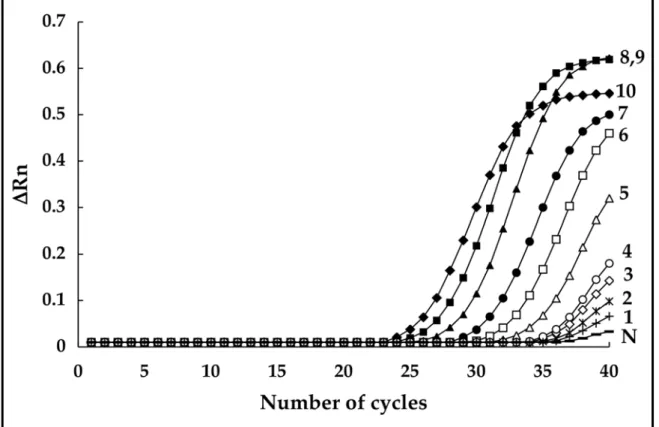
The real-time PCR amplified products from sequential dilutions of a mixed bacterial cul-ture revealed sigmoid-shaped curves (Fig. 1), typical of PCR assays (Fortin et al. 2001; Fitzmaurice et al. 2004). Ct values were found to be characteristically smaller for samples containing higher numbers of DNA targets than for those containing lower numbers of DNA targets (Fig. 1). Sensitivity tests were performed by generating plots as depicted in Figure 1, with resulting Ct values obtained by incorporating DNA derived from 3.2 x 100 to 1 x 10⁵ CFU/real-time PCR. The lowest level of real-time PCR detection was determined to be the DNA from approximately 3.2 target cells/PCR derived from a Ct value of 38.2 ±0.15. All of these amplification reactions were performed in duplicate involving three mixed cultures derived respectively from three different cod fillets.
Thermal denaturation profiles and reagent contamination issue with universal 16S rDNA primers
Fig. 1. Real-time PCR amplification plots for reactions with genomic DNA templates of mixed bacte-rial flora from broth culture (#1-10: DNA derived from varying numbers of CFU per real-time PCR: from 3.2 x 100, 1.0 x 101, 3.2 x 101, 1.0 x 10², 3.2 x 10², 1.0 x 10³, 3.2 x 10³, 1.0 x 10⁴, 3.2 x 10⁴, and 1.0 x 10⁵ labeled from 1 to 10 respectively. N: negative control. DNA templates were extracted from serially diluted mixed bacterial broth culture.
Interestingly, we consistently obtained amplicons from the negative controls where no DNA was added to real-time PCR reaction tubes. The Tm value of these amplicons was 86°C ±0.20 (data not shown), presumably derived from bacterial contamination of PCR reagents. The 16S rDNA gene is present in the genomes of all known bacteria that belong to the eubacterial kingdom (Greisen et al., 1994; Corless et al., 2000). It has been well documented that the amplification of 16S rDNA target sequences with universal primers by the PCR can be confounded by problems with bacterial contamination of reagents, such as Taq DNA polymerase (Corless et al., 2000). This is particularly true, at or near the limit of detection. DNA from 3.2 CFU per real-time PCR assay resulted in a mean Ct value of 38.2 ±0.15. The mean Ct value derived from nega-tive controls (no DNA added to real-time PCR tubes) was 38.9 ±0.89. This means that the practical limit of minimal detection of DNA targets per real-time PCR assay is greater than 3.2, namely 10. The mean Ct value obtained
with DNA from 10 CFU per real-time PCR assay was 37.4 ±0.30 which reproducibly fell below the mean and standard deviation of the mean Ct value of 38.9 ±0.89 for the negative controls.
Correlation between log number of genomic targets and corresponding Ct values derived from mixed cultures
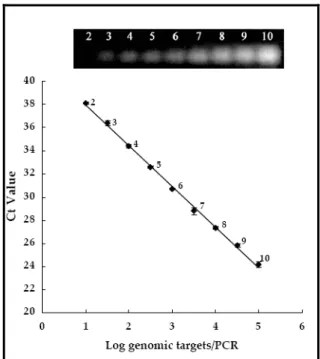
was confirmed from a DNA ladder (not shown). The correlation coefficient (R2 = 0.998) reflected a strong linear relationship (Fig. 2). The standard curve in Figure 2 was used for quantification of the total number of genomic targets on fish fillets.
Fig. 2. Relationship between the log number of genomic targets and relative cycle threshold (Ct) values from real-time-PCR amplification. Plotted values are the means and standard deviations de-rived from three independent assays. The straight line calculated by linear regression yielded a regression coeffi-cient (R2) of 0.998. Inset: image of RT-PCR amplified products of mixed bacterial broth culture from cod tissue. Lanes and corresponding plotted points designated 2-10: DNA from varying numbers of CFU per real-time PCR (#2-9: 1.0 x 101, 3.2 x 101, 1.0 x 10², 3.2 x 10², 1.0 x 10³, 3.2 x 10³, 1.0 x 10⁴, 3.2 x 10⁴, and 1.0 x 10⁵ respec-tively).
PCR amplification efficiency of mixed bac-terial flora from tissue
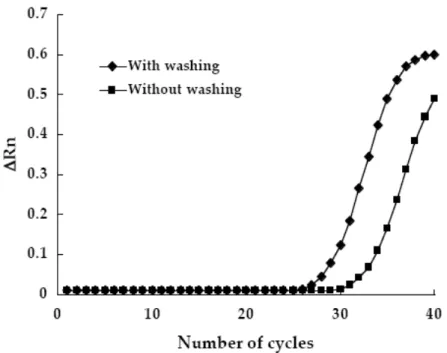
The Ct values from samples of fish tissue derived from stomaching, differential centrifu-gation, and washing were then compared to samples without washing as described in Mate-rials and Methods. The resulting Ct values derived from incorporating 1 x 10⁴ genomic targets per real-time PCR (Fig. 3) were then used to calculate the efficiency of
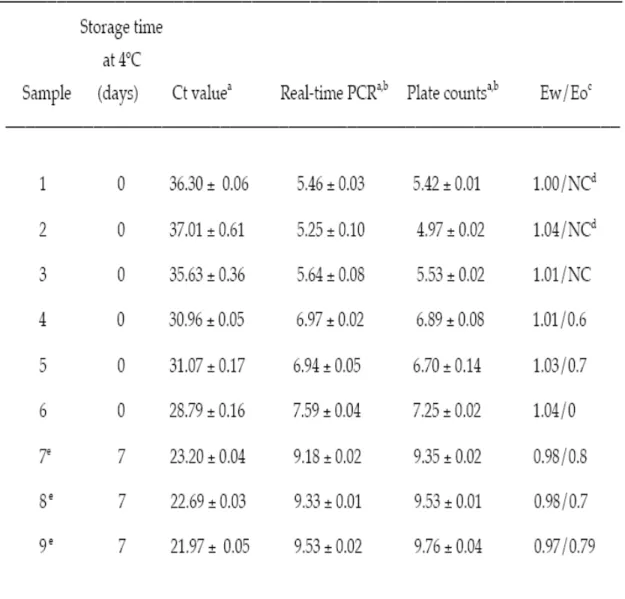
amplifica-tion. Washing the pellets derived from differential centrifugation of the homogenized tissue dramatically increased the efficiency of amplification (Rosen et al. 1992; Al-Soud et al.1998; Olsen 2000). This reduced the mean Ct value of 31.3 ±0.14 cycles without washing by 5.1 ±0.32 cycles to 26.1 ±0.18 and in-creased the ∆Rn value from 0.60 ±0.07 to 0.48 ±0.02 or 1.25-fold (Fig. 3). The Ct values al-lowed calculation of the mean amplification efficiency which was 0.99 with washing and 0.80 without washing. In addition, the log of the total number of genomic targets per gram of tissue obtained from interpolation of the standard curve in Figure 2 was compared to plate counts of the tissue. The log of the num-ber of genomic targets per gram of tissue with the washing step (8.36 ±0.05), estimated by real-time PCR was similar to the magnitude of the CFU obtained from plate counts (8.39 ±0.02). In contrast, the log of the number of genomic targets per gram of tissue without the washing step (6.87 ±0.05), estimated by real-time PCR was notably below the actual CFU derived from plate counts (8.39 ±0.02). Rela-tive amplification efficiencies involving tissue samples from cod fillets with log 5.3 to log 9.5 CFU/g are presented in Table 1. Complex biological samples such as foods have been reported to inhibit the PCR (Rosen et al., 1992; Powell et al., 1994). Many substances such as, proteins, chelating agents, and haeme com-pounds have been found to be PCR inhibitors (Rosen et al. 1992; Buffone et al., 1991; Akane et al., 1994; Powell et al., 1994). The washing step was therefore critically required to obtain reliable counts by real-time PCR.
Comparison of bacterial counts derived from the RT-PCR and plate counts from randomly procured fish fillets
their zero time CFU counts were at an inter-mediate level of 106 to 107/g. Fillets 7, 8, and 9 were derived from fillets 4, 5, and 6 after
being held at 4oC for 7 days so as to yield maximum or near maximum counts (>109 CFU/g).
Fig. 3. Effect of sample washing on amplification efficiency of RT-PCR assay. Bacterial DNA tem-plates derived from 1 x 10⁴ CFU were prepared from cod tissue and incorporated into real-time PCR assays with two different tissue sample preparation procedures (with and without washing). Plots are representative of three replicated studies.
Conclusion
Our results indicate that the real-time PCR assay was able to reliably determine the total number of bacterial genomic targets from 105 to >109/g. It should be noted, that the PCR will not normally discriminate between target DNA sequences derived from viable and dead bacterial cells. The reason we obtained such close correlations between plate counts and counts from real-time PCR is due to the fact that the vast majority of bacterial cells on the fillets were viable and capable of forming colonies. Studies are presently being com-pleted that allow real-time PCR discrimination of viable from dead bacterial cells derived from fish fillets using methodology previously described (Wang and Levin, 2006).
Acknowledgments
References
Abolmaaty, A., Vu, C., Oliver, J. and Levin, R. E. (2000). Development of a new lysis solution for releasing genomic DNA from bacterial cells for DNA amplification by polymerase chain reaction. Microbios. 101: 181-189.
Akane, A., Matsubara, K., Nakamura, H., Takahashi, S. and Kimura, K. (1994). Identification of the heme compound copu-rified with deoxyribonucleic acid (DNA) from blood strains, a major inhibitor of polymerase chain reaction (PCR) amplifi-cation. J. Forensic Science.39: 362-372. Al-Soud, W. A., Lantz, P., Bäckman, A.,
Olcen, P. and Rådström, P. (1998). A sample preparation method which facili-tates detection of bacteria in blood cultures by the polymerase chain reaction. J. Mi-crobiol. Mets.32: 217-224.
Beauchat, L. R. (1995). Pathogenic microor-ganism associated with fresh produce. J. Food Prot.59: 204-216.
Buffone, G. J., Demmler, G. J., Schimbor, C. M. and Greer, J. (1991). Improved amplifi-cation of cytomegalovirus DNA from urine after purification of DNA with glass beads.
Clin. Chem.37: 1945-1949.
Corless, C. E., Guiver, M., Borrow, R., Edwards-jones, V., Kaczmarski, E. B. and Fox, A. J. (2000). Contamination and sen-sitivity Issues with a Real-Time universal 16S rRNA PCR. J. Clin. Microbiol. 38: 1747-1752.
Dalgaard, P. (1995). Qualitative and quantita-tive characterization of spoilage bacteria from packaged fish. International J. Food Microbiol.26: 319-333.
Fitzmaurice, J., Glennon, M., Duffy, G., Sheridan, J. J., Carroll, C. and Maher, M. (2004). Application of real-time PCR and RT-PCR assays for the detection and quantitation of VT1 and VT2 toxin genes in E.coli O157:H7. Molec. Cell. Probes. 18: 123-132.
Fortin, N. Y., Mulchandani, A. Chen, W. (2001). Use of Real-Time Polymerase chain reaction and molecular beacons for the detection of Escherichia coli O157:H7.
Anal. Biochem.289: 281-288.
Gonzalez, I., Garcia, T., Fernandez, A., Sanz, B., Hernandez, P. E. and Martin, R. (1999). Rapid enumeration of Escherichia coli in oysters by a quantitative PCR-ELISA. J. Appl. Microbiol.86: 231-236. Greisen, K., Loeffelholz, M., Purohit, A. and
Leong, D. (1994). PCR Primers and probes for the 16S rRNA gene of most species of pathogenic bacteria, including bacteria found in cerebrospinal fluid. J. Clin. Microbiol. 32: 335-351.
Hielm, S., Hyytia, E., Ridell, J. and Korkeala, H. (1996). Detection of Clostridium botulinum in fish and environmental sam-pling using polymerase chain reaction. Int. J. Food Microbiol. 31: 357-365.
Lee, S.-Y., Bollinger, J., Bezdicek, D. and Ogram, A. (1996). Estimation of the abundance of an uncultured soil bacteria strain by a competitive PCR method. Appl. Environ. Microbiol. 62: 3787-3793.
Levin, R. E. (2004). The application of Real-Time PCR to food and agricultural sys-tems. a review. Food Biotechnol. 18: 97-133.
Ludwig, W. and Schleifer, K. H. (2000). How quantitative is quantitative PCR with re-spect to cell counts? Syst. Appl. Microbiol.
23: 556-562.
Olsen, J. E. (2000). DNA-based methods for detection of food-borne bacterial patho-gens. Food Res. Int.33: 257-266.
Powell, H. A., Gooding, C. M., Garrett, S. D., McKee, R. A. and Lund, B. M. (1994). Proteinase inhibition of the detection of
Listeria monocytogenes in milk using the polymerase chain reaction. Lett. Appl. Mi-crobiol.18: 59-61.
Rodriguez, O., Losada, V., Aubourg, P. S. and Barros-Velazquez, J. (2004). Enhanced shelf-life of chilled European hake ( Mer-luccius merMer-luccius) stored in slurry ice as determined by sensory analysis and as-sessment of microbiological activity. Food Res. Int. 37: 749-757.
Skjerdal, O. T., Lorentzen, G., Tryland, I. and Berg, J. D. (2004). New method for rapid and sensitive quantification of sulphide-producing bacteria in fish from arctic and temperature waters, Int. J. Food Microbiol.
93: 325-333.