Implementing Information Security Management System
in SMEs and ensuring Effectiveness in its Governance.
Vadim Gordas
Technical Report
RHUL–MA–2014– 6
01 September 2014
Information Security Group
Royal Holloway, University of London
Egham, Surrey TW20 0EX,
United Kingdom
1
Student Number: 100751438
Vadim Gordas
Title: Implementing Information Security Management
System in SMEs and ensuring Effectiveness in its
Governance.
Supervisor: Geraint Price
Submitted as part of the requirements for the award of the MSc in Information Security
at Royal Holloway, University of London.
I declare that this assignment is all my own work and that I have acknowledged all quotations from published or unpublished work of other people. I also declare that I have read the statements on plagiarism in Section 1 of the Regulations Governing Examination and Assessment Offences, and in accordance with these regulations I submit this project report as my own work.
Signature: Vadim Gordas
2 TABLE OF CONTENTS EXECUTIVE SUMMARY ... 4 INTRODUCTION ... 6 1. LITERATURE REVIEW ... 8 Statement of objectives ... 9 Dissertation structure ... 9
1.1 Information Security Challenges for SMEs ... 10
1.2 Information Security Management frameworks for SMEs ... 13
The ISO/IEC 27001 ... 13
The Standard of Good Practice for Information Security ... 15
Practical guide to IT security Ideal for the small business ... 16
ISSA-UK 5173 Information Security for Small and Medium Sized Enterprises ... 17
Review of Availability of Advice on Security for Small/Medium Sized Organisations ... 19
1.3 Information Security Governance for SMEs ... 21
1.4 Literature review conclusions ... 23
2. RISK ASSESSMENT FOR SMES ... 24
2.1 The threat horizon for SMEs: vulnerabilities, threats and countermeasures used by industry... 24
2.2 Risk Assessment in SMEs: methods used, challenges and specificity of implementation ... 28
ISO/IEC 27005:2011 ... 28
ENISA Simplified Risk Assessment and Risk Management Approach for SMEs ... 30
NIST SP 800-30 R1: Guide for Conducting Risk Assessment ... 33
2.3 A coherent framework for Risk Management in SMEs ... 36
2.3.1. Context establishment ... 37
2.3.2. Assess the risk ... 38
Threats Assessment ... 38
Vulnerabilities assessment ... 38
Overall Risk Likelihood... 39
Overall Information Risk Rating ... 39
2.3.3. Select the information security controls ... 40
2.3.4. Implement missing control measures ... 46
2.3.5. Monitor and evaluate effectiveness of information security risk ... 47
2.4 Conclusions for Chapter 2 Risk Assessment for SMEs ... 47
3. INFORMATION SECURITY MANAGEMENT SYSTEM FOR SMES .... 49
3
3.2 Information Security Management System frameworks, a comparative analysis ... 50
3.3 A proposed Information Security Management System implementation framework for SMEs with implementation priorities and maturity levels ... 53
3.4 Continuous improvement approach ... 63
3.5 Conclusions for Chapter 3 A proposed Information Security Management System implementation framework for SMEs with implementation priorities and maturity levels ... 63
4. IMPLEMENTING INFORMATION SECURITY GOVERNANCE IN SMES ... 65
4.1 Do SMEs have the right to implement Information Security Governance? ... 65
4.2 Information Security Governance Frameworks’ comparative analysis... 66
4.3 A proposal for a harmonized Information Security Governance model for SMEs ... 69
4.4 A Framework for Information Security Monitoring and Reporting ... 70
4.5 Conclusions for Chapter 4 Implementing Information Security Governance in SMEs ... 73
5. CONCLUSION ... 74
4
Executive Summary
Nowadays organizations of all sizes rely on information and its quality to take informed decisions regarding company strategy and objectives. To ensure good quality of information, organizations have to implement appropriate information security measures. Confidentiality, Integrity and Availability are three most relevant security requirements for quality of information. However ensuring them continues to be a challenge.
A special category of organizations which require protection of business information are Small and Medium enterprises (SMEs). They, due to resource restrictions and insufficient IT knowledge maturity, face significant difficulties in setting up an effective and efficient information security control environment. The problem is worsen by the fact that most of available security standards and guidance were not build with enough usability in mind, tailored to an SMEs level of expertise. The risks are even more significant because most of the SMEs ignore implementation of even basic information security controls due to a false perception of information threats targeting just big corporations.
In our research we provided evidence to demonstrate that risk profiles for SMEs and big enterprises do not differ a lot. Both organization types use technology extensively and both would face serious consequences in the case of a data breach.
In our literature review we have shown that SMEs represent a majority of companies in UK. We discussed fundamental flaws in information security approach for SMEs. There is no consensus in the industry on how good information security for SMEs should look. Most of the approaches proposed a set of information security controls which was not even developed after a comprehensive risk assessment of major threats targeting SMEs. We reviewed ICO A practical guide to IT security Ideal for the small business (2012), ISSA-UK 5173 Information Security for Small and Medium Sized Enterprises (2011), and ICO Review of Availability of Advice on Security for Small/Medium Sized Organisations (2010). We pointed out weaknesses of each publication as first doesn’t require review and monitoring, auditing, business continuity and disaster recovery measures at all; second introduce BCP and DR only from 2nd level and users’ training from level three; third is not a security framework and recommends introducing a common structure for SMEs information security guidelines, and provides a high level structure for these guidelines, however it does not require a management system support for operation of information security controls. Therefore their implementation as standalone with no support from information security management system processes is not able to ensure effective protection of information security.
Results of our research enable SMEs to overcome the weaknesses of existing information security implementation approaches as we proposed an integrated solution for organizations’ information security. First we developed a risk management framework tailored to SMEs requirements. Second we proposed a new approach for implementing an information security management system (ISMS) in SMEs with three levels of maturity, the highest being full scope ISO/IEC 27001 ISMS. Third we made a detailed review of existing information security governance (ISG) frameworks and proposed a simple ISG approach for
5
SMEs supported by a detailed framework for information security monitoring and reporting with a template for information security status report.
In detail we reviewed ISO/IEC 27005:2011, ENISA RM approach for SMEs and NIST SP 800-30 R1. ISO/IEC 27005 introduces a risk management process, however it just describes the key points without providing any particular methodology for risk assessment. ENISA and NIST approaches are too complex and do not provide an updated control matrix based on latest surveys and statistics of SMEs breaches. SMEs need an approach which is able to provide results in days rather than months as do most of the risk assessment methodologies developed for corporations. Our risk management framework provides an assessment methodology, and is aligned with PDCA model and ISO/IEC 27005. It includes Context establishment, Risk Assessment, Selection of the information security controls, Implementation of missing control measures and Monitoring and evaluation of effectiveness of information security risk.
After evaluating the overall risk profile organizations are provided with Information Security Controls Database with 31 control measures and three implementation priorities corresponding to low, medium and high profile of overall risk of organization. Then organizations are required to implement missing controls and ensure monitoring and reporting on risk analysis and risk treatment plan, enabling the risk management process to play a constructive role and show that information security is contributing to business success.
Our approach for implementing an ISMS in SMEs sets a three phases approach which represent an evolution of functional management systems with different levels of maturity. The phases are an ISMS with reduced maturity level, ISMS with intermediate maturity level, and ISO/IEC 27001 fully operational ISMS. Due to the compatibility with ISO/IEC 27001, embedded management processes for organization of all maturity levels, and clearly established objectives and characteristics of each implementation phase, SMEs can benefit from an optimized approach to ISMS implementation able to ensure adequate information security and contribute to business success.
To ensure information security alignment with business objectives we proposed an information security governance approach tailored to SMEs resources and expertise. ISG plays an essential role in aligning corporate functions with business goals. Key steps of our framework are Information security strategy alignment with business objectives, Setting strategic objectives and monitoring progress of their realization, Setting the Risk Appetite, Manage the Risks and Performance Reporting. To enable effective and efficient reporting regarding the state of security in enterprise we developed an Information Security Status report template, which provides a reliable view of information security function performance to organizations of any size.
The results of our research can be used by any SME to benchmark its internal information security control environment against good practices, assess the risks, develop an effective risk treatment plan, implement a management system tailored to its overall risk exposure and ensure a proactive governance approach. To enable ease of use we provided required templates and methodological guidelines for implementation. We believe that by following our recommendations SMEs will be able to improve their information security and form a more secure ecosystem of organizations.
6
Introduction
Frameworks, implementation guidelines and assessment standards for Information Security Management Systems began to be developed as a response to the growing concern about information security. Business began to be highly reliant on computers and electronic data from early 1990s. It is true that at that time not many systems were interconnected and primarily information security was a concern for big corporations. Due to the fact that there were no published internationally recognized frameworks for information security management, corporations had to put a lot of effort into implementing a set of security controls which would ensure a reasonable protection of their assets. Best practices were considered know-how and were protected, therefore a lot of heterogeneousness appeared even between organisations with similar risk profiles. Moreover the budgets spent on external consultants were significant (SCN, 2004) and could be hardly met by smaller organizations. Therefore Small and Medium Enterprises (SMEs) were placed in situations where they could not afford to be secure. Mainly it was because of budget constraints and lack of security models framed to their requirements, but we will see that a lot of factors actually had contributed to this.
Taking into account that SMEs represent the majority of the companies in economy of any state we have to remind that in the UK, according to Federation of Small Business, at the start of 2012 SMEs accounted for 99.9 per cent of all private sector businesses, 59.1 per cent of private sector employment and 48.8 per cent of private sector turnover (FSB, 2012). SMEs are classified as micro: 0-9 employees, small: 10-49 employees, and medium: 50-249 employees. In the UK there were estimated 4.8 million businesses which employed 23.9 million people, and had a combined turnover of £3,100 billion, from which SMEs employed 14.1 million people and had a combined turnover of £1,500 billion. So they have a major contribution to the national GDP, and therefore must be protected accordingly. More than that, the solution which has to be designed had to be flexible enough, in order to fit information security requirements of companies from different sectors. Financial and insurance sector companies will have different requirements, capacity and expertise from those in agriculture, forestry and fishing sectors. It was clear from the very beginning that the one size fits all approach will not work.
Development of IT control standards was accompanied by recognition of information security as a profession. In 1967 ISACA was founded (ISACA, 2013). At that time a group of individuals with controls auditing jobs in the computer systems, which were becoming increasingly critical to the operations of their organizations, recognized the need for a centralized source of information and guidance in the field. In the mid-1980s a need arose for a standardized and vendor-neutral certification program that provided structure and demonstrated competence. The (ISC)² was formed in mid-1989 as a non-profit organization with this goal.
The need for a comprehensive framework for internal control lead to the Development of COSO in 1985 (COSO, 2012) by Treadway Commission. COSO development was originally jointly sponsored and funded by five main professional accounting associations and institutes headquartered in the United States. It was a framework for stock exchange listed corporations which could not be applied for SMEs. The UK government concern on security threats to which organizations were faced, led to Department of Trade and Industry's (DTI) Commercial Computer Security Centre (CCSC) foundation in 1987. They realized that there is a gap for information security
7
guidance among the entire industry, organizations of different sizes had to be secured and therefore CCSC has taken a best practices approach for the development of the new guideline. The CCSC had two major tasks: to help vendors of IT security products by establishing a set of internationally recognized security evaluation criteria and an associated certification scheme which materialized in UK ITSEC, and to help users by producing a code of good security practice which resulted in a “Users Code of Practice” published in 1989. This code of practice was developed further by the National Computing Centre (NCC), and with help of BSI and British Industry was published as a British Standard’s guidance document PD 0003 - Code of practice for information security management, and following a period of further public review became the British Standard BS7799:1995 (Gamma Secure Systems, 2013). It is hard to underestimate the role of this standard which was the first standards on information security management available for everyone and defined recommended controls to help protect information within all types of organizations not only within the UK but all around the world.
Large enterprises benefit from economies of scale even from an information security perspective. It is much harder to achieve a reasonable level of information security in case of SMEs due to the budget restrictions, limited resources and limited information security expertise. Nevertheless, many small companies provide services which are considered to be critical by their clients, they provide internet connection for almost every employee and number of risks and vulnerabilities to which they are exposed is comparable to that of bigger organization. Moreover management awareness of information security is not on the list of top priorities even in some big enterprises, and in case of SMEs this attitude persists. Therefore the only one choice for SMEs survival is change of mentality, information security must become a top priority for their management and the costs associated with its assurance must be accepted. Small companies have the potential to catch up, they are more agile and can ensure mitigation of the risks to which they are faced, but in order to achieve that, their perception of information security must change.
8
1.
Literature Review
In the early days of information security, controls were implemented by a small number of computer managers with direct experience of specific risks (Lacey 2010). The complexity of technology forced these practitioners to take a better structured approach. Inconsistency of results posed another problem, the state of information security in the company could not be compared to the average level of the industry. Therefore benchmarking and evolution monitoring of IT security readiness was almost impossible to achieve. From the very beginning SMEs had fewer resources than big enterprises, however they have grown a dangerous habit of spending the minimum possible amount on information security (Lacey 2010). It means that we have to emphasize on the first line priorities which must be implemented and not swamp them with security frameworks which they will not be able to control.
On his IT Security Blog, Lacey (2010), discusses on the SMEs security problem which reflects a deeper fundamental flaw. For instance there is no consensus among the industry what should be the right approach. One approach could be to adapt existing security standards used by big enterprises, but even after cutting-of parts of ISO 27000 or COBIT, there could remain many irrelevant requirements. Another approach would be to take the attitude of security managers of big companies which think that SMEs must be compelled by the threat of losing their business if they will not ensure information security. For a big corporation doing business with insecure companies is a huge reputational risk, and they could end in a major security liability rather than cost saving. So if smaller companies want to do business with enterprises which care about their reputation, they will have to ensure compliance with their security requirements. This issue became known as supply chain security, and the idea is that you have to control information security through your entire supply chain in order to ensure a reasonable level of protection. Next method could be to develop some risk assessment methods which would permit appropriate information controls selection even by inexperienced practitioners, but it failed because risks have an annoying habit of changing, sometimes even faster than technology does.
We therefore need to go back to square one and design a more suitable portfolio of solutions, for a broader set of organisations and circumstances. Over the last three decades, the security problem space has grown progressively richer, more dynamic and complex, while the recommended solution space has largely stood still. It’s time for a rethink of the fundamentals of information security (Lacey 2010).
One of the things that SMEs are beginning to think about is outsourcing the security functions of the business to managed security service providers (MSSPs), says Adam Hils, a principal research analyst at Gartner who focuses on security(Moscaritolo, 2009). For SMEs, outsourcing security is a better choice now than it was two years ago. Hils says this is because there are more service options available than before, and they’re correctly priced (Moscaritolo, 2009). However even after outsourcing IT security function, risks will be owned by the organization and therefore ensuring appropriate monitoring and effective information security governance will remain managements’ responsibility. The wrong perception of outsourcing as a panacea for ensuring information security in case of SMEs will almost sure cause a data breach.
9
Statement of objectives
The objectives of our research were to:
- Review actual information security practices in SMEs.
- Review the threats and vulnerabilities horizon for SMEs and propose an effective framework to address those weaknesses.
- Review existing Risk Assessment and Risk Management methodologies and propose a suitable approach for implementation in SMEs.
- To develop an Information Security Management System implementation
framework tailored to information security requirements of Small and Medium Enterprises.
- To develop a simplified Information Security Governance framework which will
enable the direction and oversight of information security tasks across the enterprise.
- Review existing best practices and propose a methodology for monitoring and reporting on information security assurance, KPIs and performance benchmarking. We managed to achieve these objectives and even extended our research in order to support information security controls selection from a control database, to implement an ISMS aligned with overall organization’s risk exposure and required information security maturity level, and provided organization’s information security status report template.
Dissertation structure
Our dissertation is structured in five chapters:
1. Literature Review
1.1 Information Security Challenges for SMEs
1.2 Information Security Management frameworks for SMEs 1.3 Information Security Governance for SMEs
1.4 Literature review conclusions
2. Risk Assessment for SMEs
2.1 The threat horizon for SMEs: vulnerabilities, threats and countermeasures used by industry 2.2 Risk Assessment in SMEs: methods used, challenges and specificity of implementation 2.3 A coherent framework for Risk Management in SMEs
2.4 Conclusions for Chapter 2 Risk Assessment for SMEs
3. Information Security Management System for SMEs
3.1 Why implementing a set of security measures alone is not enough?
3.2 Information Security Management System frameworks, a comparative analysis
3.3 A proposed Information Security Management System implementation framework for SMEs with implementation priorities and maturity levels
3.4 Continuous improvement approach 3.5 Conclusions for Chapter
4. Implementing Information Security Governance in SMEs
4.1 Do SMEs have the right to implement Information Security Governance 4.2 Information Security Governance Frameworks’ comparative analysis
4.3 A proposal for a harmonized Information Security Governance model for SMEs 4.4 A Framework for Information Security Monitoring and Reporting
4.5 Conclusions for Chapter 4 Implementing Information Security Governance in SMEs
10
1.1Information Security Challenges for SMEs
Due to constraints which are characteristic to SMEs it is important to consider which factors have a greater impact on information security in this type of organizations. Scientific community provides just a small number of surveys which would allow us to draw conclusions. In their research Ebru et al., (2011) found that although all surveyed companies were working on internet and using e-mail accounts, just 50% were able to work via intranet and only a few of those utilize Ecommerce, Electronic Data Interchange and E-signatures. Eighty-five percents of organizations declared that the roles and responsibilities of information security have been determined within their organizations, 77% of the companies have issued information security policies and 70% of the employees were aware of those policies in the organizations. But only 48% of the employees participated in IS training and think that provided training was sufficient. It shows us that companies involved in this study began to develop information security awareness, but there is a lack of adequate and appropriate training for the staff. Moreover at least 25 % of the organizations were not confident that in case of disaster or equipment failure they will be able to retrieve their data without significant business interruption and 15% were not confident that their antimalware protection is up to date. So it is easy to observe a discrepancy between written information security policies and implementation of simple control measures, and we consider that it happens due to the lack of understanding of information security management system implementation.
A short study on information security practices in Thailand (Vorakulpipat et al., 2010) showed that business sectors seem to overlook information security and have lack of skills and knowledge. Although some companies may have positive results, there is still lack of awareness on some key issues (such as access control, outsourcing and information handling). Analysed SMEs had to improve employees’ skills on almost all information security topics of ISO 27001 and improve their training, business continuity, access control, anti-malware, data loss prevention, document management and security organization measures .
Much more reliable sources seem to be PwC and Ernst & Young data breach reports, which even if have a broader scope, provide us with valuable data on information security for SMEs. We will review them in order to outline the perception of information security factors among those organizations.
11
Figure 1: UK Information security breaches survey, number of organisations which faced breaches and their types
Source: PricewaterhouseCoopers UK Information security breaches survey Technical report (2012)
The research (PwC 2012) shows that three quarters of SMEs - 76% faced a security incident last year, and in more than a half of the cases this incident was serious. In regard to breaches 46% SMEs suffered from system failures or data corruption, 45 % from incidents caused by staff and 41 % from attacks by unauthorized outsiders. Therefore we can conclude that the overall information protection level in the UK companies is low, even if there is a slight decrease in incidents number. Moreover we can see that average data for SMEs does not differ a lot from statistics for large organizations, which confirms that threat landscape for small and large organizations is quite similar and both types of organizations have similar attractiveness for malicious intruders and other types of attacks.
Figure 2: UK Information security breaches survey, median number of breaches and types of staff-related incidents
12
Number of attacks by unauthorised outsiders remains very high – an average of 8 cases per year was reported, and the risk of data loss is multiplied by a high number of theft or fraud cases involving computers. Therefore SMEs have a high risk of data breaches and liability due to inadequate protection of business information.
Regarding staff related issues we noticed that 45 % of SMEs respondents reported incidents and 20% reported loss or leakage of confidential information. Consequently implementation of user awareness and training program must be a top priority for any organization, in order to ensure mitigation of misuse of company resources, unauthorised access, regulation breach and loss or leakage of confidential information risks.
Figure 3: UK Information security breaches survey, number of outsiders attack and the overall cost of organization’s worst incident
Source: PricewaterhouseCoopers UK Information security breaches survey Technical report (2012)
External attacks represent a high concern for SMEs, as many of them do not have capacity to react to timely to these incidents. Small organizations reported a very high number of attempts to break into organization’s network and high occurrence of some trivial attacks as denial of service and telecommunication traffic attack.
Overall costs for small organizations are high, an average of £15,000 -£30,000 was lost on worst incident. Business disruptions pose significant loses on SMEs as £7,000 loss per day was reported, organizations have to keep in mind this numbers when they decide on IT security budget because cost of control measures is much lower than the penalties suffered after an incident happens.
In conclusion, we noticed that being an SME doesn’t mean that you have a panacea from external attacks, as attackers frequently targeted small organizations due to their poor level of protection. Threat landscapes for small organizations become to be quite similar to that of large enterprises and therefore to withstand them a comprehensive set of security measures must be implemented.
13
1.2Information Security Management frameworks for SMEs
In this section we will review best standards and frameworks proposed for implementation of an information security system in organizations. Some of these standards were issued by international standardization bodies, other by associations of leading organizations, or even by government authorities. We will have an evaluation approach from SME information security implementers’ point of view. Namely, we will review following frameworks:
- ISO/IEC 27001;
- ISF Standard of Good Practice for Information Security;
- Information Commissioner’s Office 2012, A practical guide to IT security Ideal for the small business;
- Information Systems Security Association UK 2011, ISSA-UK 5173
Information Security for Small and Medium Sized Enterprises;
- Review of Availability of Advice on Security for Small/Medium Sized Organisations, Information Commissioner's Office.
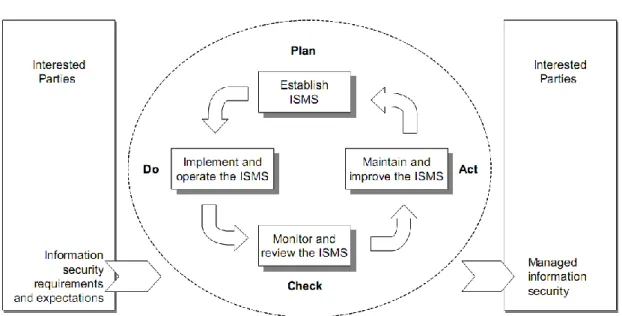
The ISO/IEC 27001 standard is the most popular standard for information security management. It represents evolution of British Standard BS 7799 and specifies the requirements for establishing, implementing, operating, monitoring, reviewing, maintaining and improving a documented ISMS within the context of the organization’s overall business risks (ISO, 2005).
Figure 4: Number of ISO/IEC 27001 certificates Worldwide
Source: The ISO Survey of Management System Standard Certifications – 2011
This standard introduced a mandatory risk based approach for information security requirements and controls definition, and framed them in a PDCA continual improvement framework.
SMEs specific needs should be identified in order to enable ISO 27001 implementation, a suitable tailored implementation approach should be identified.
14
Valdevit et al., (2009) proposed a set of objectives for an ISMS implementation guide. We will develop them and will add new ones which we consider to be critical for a functional management system. We added to the list of proposed objectives organization’s ability to ensure adequate information security, support of auditing and monitoring processes, continual improvement and ISMS Governance as they are essential parts of an effective ISMS framework.
1. Ensure organization’s ability to provide adequate level of information security that meets the security requirements determined by risk assessment and applicable regulatory requirements.
2. Downsize the requirements in order to reduce cost and complexity of ISMS. Existing level of skills, competence and IT maturity in SMEs are different from resources available to corporations, however information security still remain an issue with critical importance Valdevit et al., (2009).
3. Smooth the approach to users and do not impose implementation like constraints. New system benefits should be made clear to all employees, appropriate training and guidance should be provided Valdevit et al., (2009).
4. Propose recommendations and generic tasks which would ensure the proper operation of ISMS. All activities should be clearly defined and a process map based on PDCA cycle must be developed Valdevit et al., (2009).
5. Provide clear implementation guidance for each process of PDCA cycle Valdevit et al., (2009). Standards define the requirement which must be satisfied in order to be compliant, but usually they do not provide sufficient guidance from implementers’ perspective and list a set of best practices which do not take into account SMEs characteristics.
6. Ensure coherence and reliability of framework Valdevit et al., (2009). Methodology should ensure compatibility with certifiable standards and represent an integrated approach for information security protection.
7. Provide appropriate supporting tools and templates Valdevit et al., (2009). Usually implementation speed can be improved by using predefined policies templates, tools for gap assessment, business impact analysis, risks evaluation and controls selection. In most of cases they are considered know-how and are not freely available, however for a robust methodology they should be provided as mandatory deliverables.
8. Support auditing and monitoring. Companies must be able to claim conformity to international standards and monitor their level of IT security, therefore framework must specify auditable and clearly measurable criteria for evaluation.
9. Continual improvement must be ensured. Taking into consideration the variety of threats to which organizations are exposed, SMEs have to improve continually their security in order to withstand to new risks.
10.ISMS Governance should be ensured. Companies shall implement an effective accountability and control framework supported by continuous monitoring and reporting.
In order to adapt implementation of this standard for smaller companies, few academic researches were made. Lyubimov et al., (2011) proposed an application of information security methodologies integral engineering technique (ISIE) as design method for a SMEs ISMS, with three steps: organization inspection aimed to determine existing information security policies, controls, procedures and processes; model adjustment which involves conversion of ISMS requirements model
15
(requirements not yet satisfied) to organizational ISMS model; and ISMS implementation plan formalization involving development of a list of activities aimed to implement controls for unfulfilled requirements. It is clear that proposed workflow lacks concepts of risk assessment based on business impact analysis, controls evaluation, monitoring and continual improvement and represent just a segment of a management system which could not provide adequate security.
Figure 5: PDCA model applied to ISMS
Source: International Organization for Standardization 2005
Unfortunately, even if it is supported by the entire set of ISO 27000 series guidelines (e.g. ISO/IEC 27002, ISO/IEC 27005, etc.) ISMS implementation continue to represent a challenge for SMEs and it is confirmed by ISO 27001 implementation researches which state that several requirements are too complex for people not aware of security and ISMS, and for example questions related to different steps of risk management are not easy to understand for organizations’ employees (Valdevit and Mayer, 2010) . Other limits from SMEs point of view are excessive number of security controls which can be irrelevant even after dropping exclusions and lack of guidance on security controls implementation prioritization.
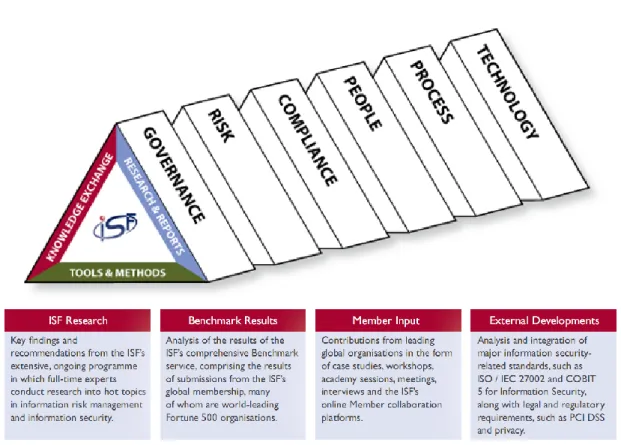
The Standard of Good Practice for Information Security, published by the Information Security Forum (ISF), is a business-focused, practical and comprehensive guide to identifying and managing information security risks in organizations and their supply chains. It is based on experience of forum members, many of which are featured on the Fortune 500 and Forbes 2000 lists (ISF, 2013). Standard is aligned with the ISO/IEC 27001 requirements, and provides a deeper coverage of ISO/IEC 27002 control topics, as well as some important topics which are not considered by ISO27001 as cloud computing, information leakage, consumer devices and security governance (ISF, 2013). The ISF model addresses the fundamental elements of an information security programme:
16
Figure 6: The ISF Security Model
Source: Information Security Forum 2013
By its conception ISF standard is not designed for SMEs, however it provides a set of distinct advantages from other frameworks as it is supported by Information Security Benchmarking tool which allows comparison of security level to similar organizations, a comprehensive Information Risk Analysis Methodology (IRAM) which provides tools for business impact assessment, threat and vulnerability assessment and controls selection, Third Party Security Assessment and Tool (TPSAT) and Return on Security Investment (ROSI) tool. The retention for access to ISF methodology is organization membership fee which in first year is £27,000.
Practical guide to IT security Ideal for the small business was released by Information Commissioner’s Office in 2012. The purpose of this guide is to support UK companies to comply with seventh data protection principle of data protection act which states that “appropriate technical and organizational measures shall be taken against unauthorized or unlawful processing of personal data and against accidental loss or destruction of, or damage to, personal data” (UK Parliament, 1998). Guide recommends a checklist for a layered approach to security:
- Physical security;
- Anti-virus and anti-malware; - Intrusion defence;
- Access controls;
- Employee awareness and training;
- Segmentation;
- Policies; and
17
It also provides useful guidelines for some topics with high relevance:
- Securing data on the move, which recommends use of encryption for data in transit;
- Keep you and your systems up to date, unfortunately this item points just on security software update, however operating systems, applications and database updates were not taken into account;
- Keep an eye out of problems, recommends security events monitoring in order to be able to detect incidents;
- Use your resources in a proper way, which points that some existing IT security resources usually are not used at the required extent;
- Minimise your data, recommends housekeeping and archiving of unused confidential data in order to minimise threats;
- Make sure your IT contractor is doing what they should be, recommends reviewing security assessment results of contractors and their IT security audit;
- Be informed, suggests to ask for advice and appropriate guidance from a professional.
ICO recommend a good set of controls, however it is not a comprehensive set which would be able to ensure organizational information security. It doesn’t take into account the need of information security evaluation and monitoring, auditing, business continuity and disaster recovery measures.
ISSA-UK 5173 Information Security for Small and Medium Sized Enterprises
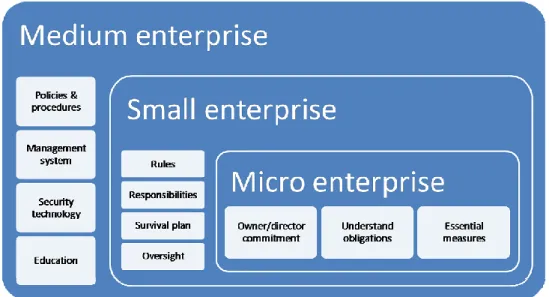
Information Systems Security Association developed a standard based on one year work of 30 ISSA members who looked at security best practice for companies with 250 or fewer employees. Standard was organised in three categories, micro, small, and medium, each of which is comprised of four principles of information security that are relevant for SMEs. Categories were developed to link with the size of SMEs, either in terms of staff size or revenue. The way that security has been pitched to the SMEs has been completely wrong in the past and fails to understand the difference both in the key drivers for, and the way a small business operates (Stewart P., 2010). The standard proposed by ISSA is not a set of prescriptive guidance and they recommend using it selectively to help to understand control points. Standard sets forth a hierarchy of three categories of control, each detailing the basic principles of information security a micro, small, or medium enterprise should pursue (ISSA, 2011):
1. Micro enterprise - Basic Security measures
1.1Owner/Director commitment, deals with establishing a formal security policy or statement.
1.2Understanding obligations, is described as understanding of relevant legal, regulatory and commercial requirement.
1.3Responding to security risks, establishes that management must understand and address information security risks and review them periodically.
18
1.4Essentials security countermeasures, are listed as physical security, procedural controls (passwords, backups, clean desk policy), technical measures (firewall, anti-virus, system updates, event logs and backups). 2. Small enterprise - Defined security regime
2.1Security rules, look like components of an acceptable usage policy.
2.2Security responsibilities, provision definition of security responsibilities for critical activities and activities like access rights management and backups.
2.3Disaster survival plan, states that backup copies must be kept at a remote location and a formal & simple BCP plan should be drawn.
2.4Security oversight, recommend to establish a list of checks to ensure fulfilment of employees’ responsibilities.
3. Medium enterprise - Managed Security system
3.1Policies & procedures, at these level formal policies and procedures stating responsibilities and control objectives have to be formalized.
3.2Management system, recommends to take a process approach and to encourage activities to be planned, implemented, checked and continuously improved on a proactive basis.
3.3Security technology recommends use of specific security technologies like strong remote access authentication, HDD encryption and IPS to safeguard critical data and business systems.
3.4Security education, states that employees must be updated on their responsibilities for reducing threats and an induction program for new comers must be established.
Figure 7: Illustration of how security advice can be tiered to reflect enterprise size
Source: Information Systems Security Association 2011
Large corporations have better resources at their disposal and are both aware of appropriate legislation they need to comply with. SMEs are unlikely to be aware of key legislation or have the necessary IT expertise to act on it. Stewart (2010) states that the irony of course is that compliance with key legislation is not optional, and that the Data Protection Act applies to all businesses, similarly all companies offering payments via credit cards must be PCI DSS compliant. So this model will not enable small companies to be fully compliant. Moreover disaster recovery and business
19
continuity planning is established only from the 2nd level which does not represent their level of importance. Even worse users’ training which is a key for maintaining information security in any company is postponed at the level of medium enterprise, putting the other two categories of organizations which will decide to comply with ISSA-UK 5173 standard at a high risk.
Review of Availability of Advice on Security for Small/Medium Sized Organisations (Information Commissioner’s Office).
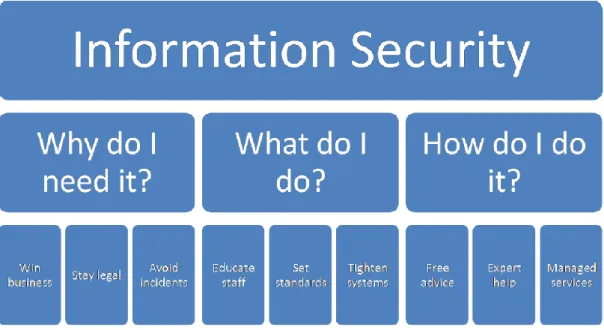
The Review of security advice availability is not a security framework, but it provides value analysing major security improvement issues to which are faced SMEs and outlines specific requirements characteristic to SMEs. The research recommends introducing a common structure for SMEs information security guidelines and provides a high level structure for these guidelines (Figure 8). Taking into account that analysis of the major information security advice sources for SME shows a large number of gaps and overlaps (Lacey & James 2010) we can conclude that prioritization and structuring of guidelines will be a driver to a more efficient communication and a better understanding among the enterprises.
Figure 8: An example of an efficient structure for SME security guidance
Source: Lacey, D. & James, B. (2010).
Few SMEs apply sufficient measures to safeguard their information security. Authors of this report propose three essential measures to remedy this problem (Lacey & James 2010):
- Firstly, SMEs must know where to go to find appropriate advice.
- Secondly, the advice provided must be compelling and relevant to their circumstances.
- Finally, they must see a clear route for taking further action.
They also formulate requirements for a guidance delivered to SMEs as (Lacey & James 2010):
- Appreciate the importance of security and privacy protection.
20
- Be motivated to instil a healthy security and privacy culture. - Place a value on personal information.
- Understand the root causes of data breaches.
- Identify and assess security risks to data and their impact. - Understand the range of protective measures available. - Appreciate the costs and benefits of privacy protection.
- Build security and privacy controls into new systems and processes. - Specify security and privacy in contracts with suppliers.
- Understand when and how to obtain specialist external support.
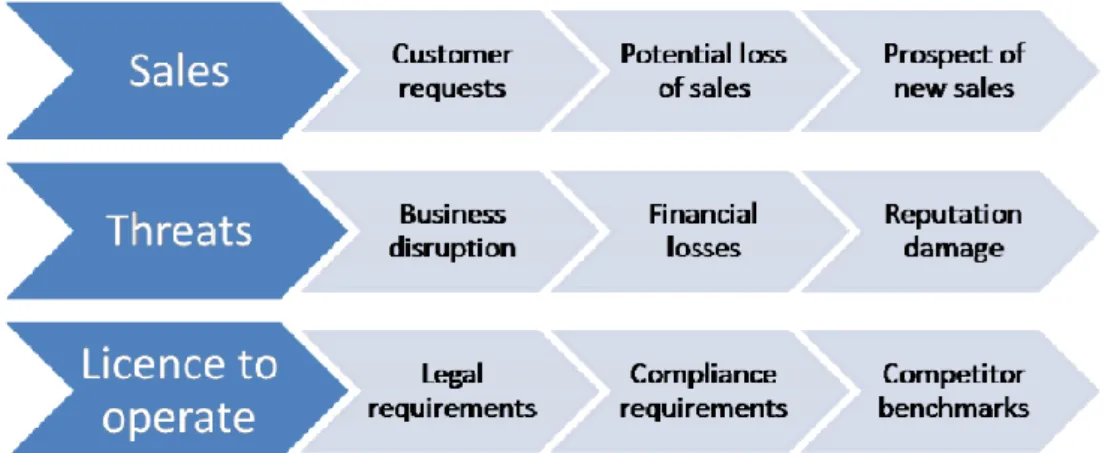
In conclusion, SMEs’ top management have to change its perception and attitude towards information security. Some of the drivers of this change can be regulations, external audits, potential loses, customer demands, recognition of information security importance and reputational and data breach risks (Figure 9). Information security must not be perceived as a cost or unnecessary overhead, but as the level of business protection against security threats and reputational gain.
Figure 9: Security drivers for small companies
21
1.3Information Security Governance for SMEs
Governance of information security is the main supporting tool for aligning objectives and strategies for information security with business objectives and strategies, and requires compliance with legislation, regulations and contracts (ISO, 2012). Alves et al. (2006) defined information security governance as act of directing and controlling an organization aligned with the strategy and business objectives, establishing and retaining a culture of information security, optimizing the related processes, and assigning activities to the most competent people to perform the necessary actions. Implementation of Information Security Governance programme has the potential to make IS function visible for business stakeholders and ensure long-term alignment with organization’s strategic goals.
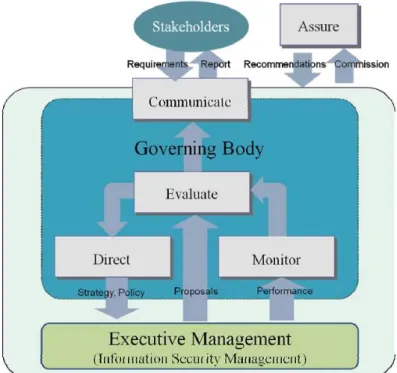
Information Security Governance (ISG) should be the responsibility of top management or members of the board, as they should have authority to direct, monitor and communicate strategic goals. The governing body is ultimately accountable for ensuring an effective information security strategy and support it through appropriate information security assurance framework. In respect to information security, the key focus of the governing body should be to ensure that the organisation’s approach to information security is efficient, effective, acceptable and in line with business objectives and strategies giving due regard to stakeholder expectations (ISO, 2012). A key step in ISG operation is to ensure proper measurement of overall effectiveness and efficiency of enterprise information security framework.
In scientific literature the need for a proper information security governance methodology led to development of proposals for new frameworks. Solms (2005) investigated co-existence of and complementary use of COBIT and ISO 17799 (now ISO/IEC 27002) as reference frameworks for ISG. Posthumus & Solms (2004) acknowledged that information security should be a priority of executive management, including the Board and CEO and should therefore commence as a corporate governance responsibility. They proposed a model addressing ISG from governance and management sides. Velga & Eloff (2007) proposed a four level ISG framework consisting of strategic, managerial/implementation and technical protection components.
Given the importance of ISG and potential benefits we agree with industry specialists (Poole V., 2006) that there is an urgent need for an information security governance guideline for SMEs, which will ensure appropriate level of accountability and control to address the rising number of security threats and demonstrate effective corporate control and e-security assurance. SMEs as any other organisations require a structured approach for monitoring success of information security arrangement, and the answer to the question How to achieve it?is information security governance.
22
Figure 10: Implementation of the governance model for information security
23
1.4Literature review conclusions
The conclusion of our review is that there is substantial scope for improvement in each of these areas, and a new framework for SMEs information security must be developed. The increasing number of data breaches suffered by SMEs proves that information security practices implemented by them are not effective. Existing guidelines for SMEs information security are deficient due to the fact that they represent extracts of information security controls instead of a functional ISMS. Most of existing risk assessment frameworks are too complex for SMEs and a new approach providing results in days rather than months is required. ISG framework were not developed with a tailored implementation approach for small organizations in mind, therefore a lightweight approach for ISG should be developed. The security framework for SMEs has to take into account the priorities of control measures and still be a part of a comprehensive management system. The framework must address the gaps identified by us in the reviewed methodologies.
The most important differentiator for the design of security guidelines for SMEs till now was the size of the enterprise. We believe that this approach is wrong because even small companies may be faced to a very high risk, due to the specific characteristics of their business. Consequently even for SMEs a risk based approach must be taken, and the need to develop a simplified risk management method should be addressed.
Complexity and efficiency of business operations varies accordingly to the size of an enterprise, and this has a major impact on priorities and operating methods. Security priorities and countermeasures change with enterprise size. Information security standards have similar control objectives but the urgency and affordability of countermeasures for SMEs will differ. Security advice, standards and recommended solutions need to be tiered to take account of this.
24
2.
Risk Assessment for SMEs
2.1The threat horizon for SMEs: vulnerabilities, threats and
countermeasures used by industry.
Understanding of threats and vulnerabilities is fundamental to enterprise risk management. Threat evaluation is consequently a key step for a successful risk management programme, and those threats should be evaluated in the context of organization, to determine the risk. Analyzing the PricewaterhouseCoopers, 2013 Information security breaches survey and Ernst & Young’s 2012 Global Information Security Survey, we observed that SMEs have significant challenges in implementing basic information security practices. Companies are struggling to keep up with both well-known and new security threats, and so they find hard to take the right actions. We noticed that the number of small businesses that formally assess security risks has dropped by 15%, being just around 60% in 2013 (PwC ISBS, 2013). This is worrying at a time when both cyber threats and business use of technology are rapidly growing, exposing organizations for new internal and external threat actors.
Existing threats
Top five security incident types show us an increasing number of breaches suffered by SMEs. Systems and data corruption incidents targeted 59% of organizations, which is by 13% more than in 2012. Attacks by unauthorized outsiders increased substantially to 60%, up from 41 % in previous year. This proves to us that SMEs are under attack, moreover they usually represent easy targets and hackers know that. There is an increase in staff related incidents, which for SMEs are at 57%, up from 45%. It shows us that existing approaches for staff awareness (if any) are not efficient and there is an urgent need for improvement. Viruses and malware infections are at 41% which is still a very high number for an area which has mature technologies. Theft and fraud involving computers began to be an issue for 16% of organisations, and there is no simple solutions to this one, as data loss prevention systems are not only expensive for SMEs but also require specific skills in administration which they usually do not have.
The future
The increasing complexity of technology and the fact that IT is beginning to be used in new ways poses new challenges for businesses. In this context there were few good
1 •Systemsfailure or data corruption 2 • Attacks by unauthorized outsiders 3 •Staff related incidents
4 •Infections by viruses or malware 5 •Theft or fraud involving computers
25
quality reports on the threat landscape trends, among which is Information Security forum Threat Horizon 2015 which provides us with valuable insights on what we should expect (ISF TH, 2013) :
- Cyber risk is challenging to understand and address. If senior executives don’t understand information security risks, they will either take on unknown it, which will not reflect the enterprise risk appetite, or will miss some opportunities. It is also hard to find the right people, as relevant experience of preventing and recovering from security incidents is built through practice. Outsourcing is not an answer, as organization can outsource operational IT activities but not Information Security Strategy and accountability. The last point is particularly relevant for SMEs as some of them wrongly perceive that their information security is made by their vendors (e.g. my web designer does my web security, my bank does my endpoint security, my ISP stops hackers).
SMEs as any other organisations have to meet organizational goals – profitability, protection of enterprise and regulatory compliance. This is enabled by information security: improved profitability (through enhancement of marketing and sales activities, and quantified and controlled information security risks and costs); protected enterprise (through proper measures for objectives realization, brand protection and adequate information security) and legal and compliance requirements (as are PCI DSS, ISO/IEC 27001, SOX and privacy regulations).
- Reputation is a new target for cyber attacks. Hacktivists create even more uncertainty and the impact may be very harming for both organization’s brand and operation. SMEs are more likely to suffer from insiders than before as the company boundaries are becoming blurred due to contractors, outsourcing and remote employees. More insiders will emerge as more people place their own ethics and perspectives above their employers (ISF TH, 2013).
- Criminals value your information. Attacks will become more sophisticated as criminals will try to involve disgruntled employees and will use leaked information to launch new range of attacks, much more sophisticated than before.
- The changing pace of technology doesn’t help. Bring your own device (BYOD), Bring your own network (BYON), and Bring your own Cloud (BYOC) initiatives bring their own risks. Considerable effort has to be put in place in order to manage these new vectors as unmanaged deployments of such technologies not only represent reach targets for attack but also can be worse than data breach when it will be not clear where the information is.
1 •Cyber risk is challenging to understand and address 2 •Reputation is a new target for cyber attacks 3 •Criminals value your information
4 •Technology is changing
26
- The role of government must not be misunderstood. Governments have a key
role in raising awareness and sharing threat information but they will not do information security for organizations. SMEs should be prepared to manage their risks and to prevent systems compromise.
Countermeasures
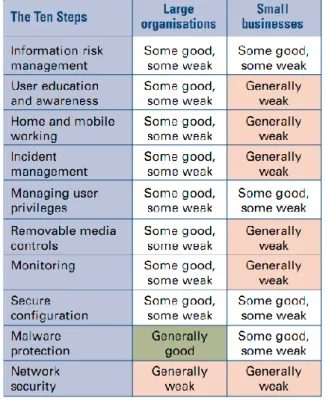
About 80 percent of known attacks can be defeated by embedding basic information security controls for people, processes and technology (GCHQ, 2012). The mitigation of cybersecurity threats and their control is a key challenge for SMEs. The decision to apply any information security safeguards must be made based on risk assessment, however with a high level of certitude a baseline set of controls which are applicable to most of organizations, can be defined. UK Government has issued a guidance to businesses on how to protect from information security threats “The Ten Steps”. It is
worrying that only 30% of large organisations had used this guidance. Moreover implementation of these suggested controls is particularly deficient in Small business.
Figure 11: Implementation of basic security practices
Source: PwC ISBS, 2013
GCHQ suggests that implementation of these ten measures represents a good foundation for effective information risk management (GCHQ, 2012). We consider that there are some particularities which should be considered for SMEs:
Information risk management- a clear and lightweight risk management framework must be formalized. We will define a high level risk assessment model later in this chapter. Top management must define enterprise information risk appetite, as they usually do for operational risk, and communicate it to relevant employees. Risk exposure must be reassessed periodically, as it is a continuous process.
27
User education and awareness- an employees’ training program must be established. It should cover both acceptable use practices and information risk awareness topics. Users must be briefed not only at employment during induction training, but also periodically updated with latest risks and defense practices. For SMEs it would be recommended to combine all employees’ trainings into an integrated training programme.
Home and mobile working- organizations should establish a policy defining parties which are allowed to connect remotely to enterprise systems, and establish proper technical means to ensure information security and way of use. SMEs should ensure separation between systems exposed to remote connection risks and other internal systems (e.g. using DMZ or VLANs).
Incident management- an incident management plan and incident response team should be established. This plan must be periodically tested in order to confirm its effectiveness.
Managing user privileges- an access rights management procedure outlining the entire lifecycle of user credentials from generation and usage to lock and removal must be formalized. For SMEs one of the most difficult tasks is to ensure that minimal requirements of segregation of duties and least privileges are met, and where not possible, adequate employee activity monitoring should be implemented as a compensatory control.
Removable media controls- management of removable media is a challenge even for mature organizations, as it requires efficient systems monitoring and data classification. Therefore for SMEs we would recommend to limit removable media usage as much as possible, to document usage authorizations and made users aware of them.
Monitoring- the key challenge in monitoring is to ensure that its requirements are aligned with enterprise GRC programme and IT department is monitoring KPIs that matters. For SMEs a minimal set of indicators should include Incidents, Malware protection, Patch Management and Key Risks associated with Critical Environment.
Secure configuration- organisations should establish priorities and timescales for systems and servers patching. SMEs can merge systems patching and vulnerability scanning processes on a monthly or bi-monthly basis. Microsoft provides a free vulnerability scanner (supporting Microsoft developed systems) MBSA, there are however professional tools like GFI and Nessus.
Malware protection- an organization-wide malware defense approach should be established. It should outline scanned targets, frequency of scanning and defense-in-depth layered scanning approach (e.g. first level scanning at the web-gateway and second level scanning at hosts).
Network security- this control is one of the most difficult to implement for both enterprises and SMEs. For small companies it is feasible to protect internal network through an automated IPS, to prohibit direct internet connections and to ensure continual monitoring of potential attacks (e.g. through automated alerts for exceeding accepted number of connections attempts).
28
2.2Risk Assessment in SMEs: methods used, challenges and specificity
of implementation
Risk assessment is the starting point for ensuring a comprehensive and efficient enterprise risk management. In information security Risk assessment objective is to determine the value of the information assets, identify the applicable threats and vulnerabilities (that exist or could exist), identify existing controls and their effect on risk, determine potential consequences and finally prioritize the risks and rank them against the risk evaluation criteria set in the context establishment phase to formalize an effective risk treatment plan which will ensure risk reduction to a level accepted by organization. Risk assessment provides a basis for establishing appropriate policies and selecting cost-effective methods to implement these policies (ISO, 2011).
Managing information risks is a big undertaking for large enterprises, which have dedicated budgets, access to risk management professionals and specialized consulting companies. This task is even more challenging for SMEs, as methodologies developed primarily for use in corporations don’t work well for SMEs. Some risk assessment methodologies can take 6 to 12 months, or even longer, to implement. According to Jim Herbeck (2012) “That simply doesn't work for SMEs. …SMEs need results - something that validates their expenditures for risk management and information security, not just paper reports that accomplish nothing tangible”. Nevertheless we have to review main risk assessment methods in order to understand how to accelerate this process for SMEs. In our research we will review following risk assessment methods:
- ISO/IEC 27005:2011 Information technology - Security techniques
Information security risk management
- ENISA Simplified Risk Assessment and Risk Management Approach for
SMEs
- NIST SP 800-30 R1: Guide for Conducting Risk Assessment
ISO/IEC 27005:2011
ISO/IEC 27005 provides guidelines for information security risk management in an organization, supporting in particular the requirements of an information security management (ISMS) in line with ISO/IEC 27001 (ISO, 2011). This standard supports the concepts specified in ISO/IEC 27001 and its scope is to support implementation of information security based on risk management approach (ISO, 2011). Standard has a general applicability as it is intended for all types of organisations.
According to the standard, Risk assessment process has 3 main parts: Risk identification, Risk analysis and Risk evaluation:
29
Figure 12: The risk management process
Source: ISO/IEC 27005:2011
Risk identification purpose – is to determine what factors can cause a potential loss, and where and why it might happen (ISO, 2011). First action would be to identify the
scope and boundaries for risk assessment and establish the assets and asset owners within this context. An asset can be anything having value for the organization, and therefore we should consider that hardware and software alone are not enough for a risk assessment. The goal for establishing an asset owner is to provide personal responsibility and accountability for it (ISO, 2011). Threats identification can be made based on history of previous incidents (if it exists), from asset owners, users and external threat catalogues. A threat has a potential to exploit vulnerability and harm assets such as information, processes and systems. Threats can be internal (insiders or user errors) or external (hackers, environmental factors, etc.). It is common to group threats by class and analyze them in context, as a control applied to mitigate one threat will very likely have impacts on other threats as well. Next step is
identification of existing controls which is made to avoid unnecessary work or cost, e.g. in the duplication of controls (ISO, 2011). These controls must be evaluated for their effectiveness, because an existing control might be ineffective, or not sufficient, or not justified, and new controls will have to be considered. Identification of vulnerabilities will show which of them can be exploited by threats and can cause harm to assets or organization. Identification of consequences will analyze the impact of loss of confidentiality, integrity and availability on assets (ISO, 2011).
Risk Analysis begins with a risk assessment methodology definition, followed by assessment of impacts, assessment of incident likelihood and risk level determination. Assets have to be classified according to their criticality to organization operation and objectives. Valuation can be determined as replacement value of an asset including the cost of recovery, or business consequences of loss or compromise of the asset such as the potential liabilities and loss of profit (ISO, 2011). The level of risk is determined at the Risk analysis stage, where values are assigned to the likelihood and the consequences of a risk, which can be quantitative or qualitative.
There are two approaches to Risk Assessment - qualitative or quantitative, following different methodologies. Qualitative RA is based on weightings of opinions