Cooperative Extension Service
College of Agriculture and
Home Economics N E W ME X IC O S T A E U N I VE R SI T Y T
Water for Dairy Cattle
Guide D-107
Michael L. Looper, Extension Dairy Specialist, New Mexico State University
Dan N. Waldner, Extension Dairy Specialist, Oklahoma State University
This publication is scheduled to be updated and reissued 2/07. INTRODUCTION
Water constitutes 60 to 70 percent of a livestock animal’s body. Water is necessary for maintaining body fluids and proper ion balance; digesting, absorb-ing, and metabolizing nutrients; eliminating waste material and excess heat from the body; providing a fluid environment for the fetus; and transporting nutri-ents to and from body tissues. Dairy cattle get the wa-ter they need by drinking and consuming feed that contains water, as well as from metabolic water pro-duced by the oxidation of organic nutrients. Water loss from the body occurs via urine, feces, and milk; through sweating; and by evaporation from body sur-faces and the respiratory tract. The amount of water lost from a cow’s body is influenced by the animal’s activity, air temperature, humidity, respiratory rate, water intake, feed consumption, milk production and other factors. This publication covers water intake guidelines and water quality issues for dairy cattle.
WATER INTAKE AND REQUIREMENTS
Lactating cows: Drinking water or free water in-take satisfies 80 to 90 percent of a dairy cow’s total water needs. The amount of water a cow drinks de-pends on her size and milk yield, quantity of dry
mat-ter consumed, temperature and relative humidity of the environment, temperature of the water, quality and availability of the water, and amount of moisture in her feed. Water is an especially important nutrient during periods of heat stress. The physical properties of water are important for the transfer of heat from the body to the environment. During periods of cold stress, the high heat capacity of body water acts as insulation– conserving body heat. Water intake (lbs/day) for lactat-ing cows can be predicted from the followlactat-ing equation:
Water intake, lbs/day =
35.25 + 1.58 x Dry matter intake (lbs/day) + 0.90 x Milk yield (lbs/day)
+ 0.11 x Sodium intake (grams/day)
+ 2.65 x Weekly mean minimum temperature (°F/1.8 – 17.778)
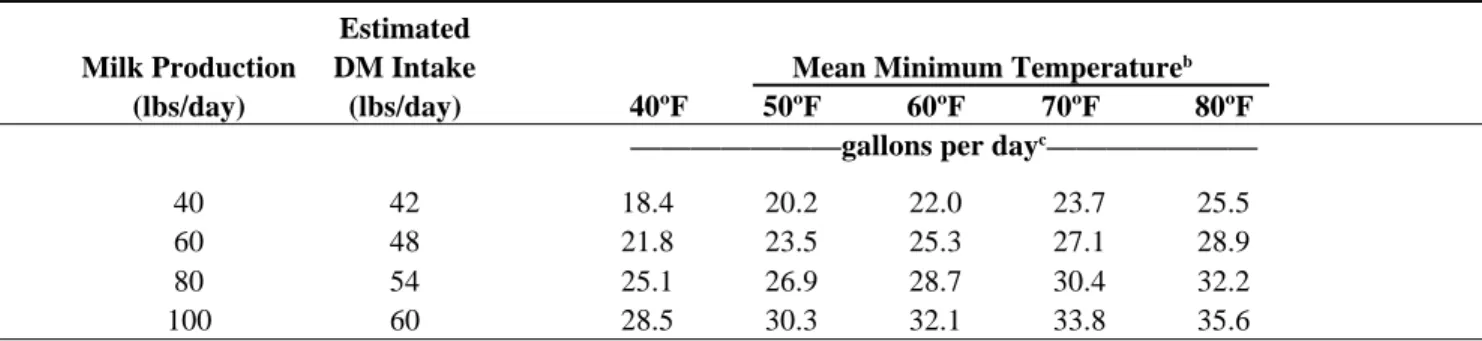
The equation predicts water consumption will change 1.58 pounds for each 1.0-pound change in dry matter consumed, 0.90 pounds for each 1.0-pound of milk produced, 0.11 pounds for each gram of sodium consumed, and 1.47 pounds for each degree Fahren-heit (F) change in weekly mean minimum tempera-ture. Weekly mean minimum temperature typically is 10 to 15 °F lower than mean daytime temperature. Table 1 lists the estimated daily water intake for lac-tating cows using the above equation.
Table 1. Estimated daily water consumption for a 1,500-pound lactating cow producing 40 to 100 pounds of milk dailya.
Estimated
Milk Production DM Intake Mean Minimum Temperatureb
(lbs/day) (lbs/day) 40ºF 50ºF 60ºF 70ºF 80ºF
———————gallons per dayc———————
40 42 18.4 20.2 22.0 23.7 25.5
60 48 21.8 23.5 25.3 27.1 28.9
80 54 25.1 26.9 28.7 30.4 32.2
100 60 28.5 30.3 32.1 33.8 35.6
aSodium intake = 0.18% of DM intake.
bMean minimum temperature typically is 10 to 15° F lower than the mean daytime temperature.
Dry cows: The major factors affecting free water intake of dry cows are concentration of dry matter in the diet, dry matter intake and amount of protein in the diet. Water intake of dry cows can be estimated by the following equation:
Water intake, lbs/day =
-22.80 + 0.5062 x Diet dry matter (%) +2.212 x Dry matter intake (lb/day)
+0.0869 x Diet crude protein (%)2
For example, a 1,500-pound nonlactating cow that eats 28 pounds of dry matter containing 12 percent moisture and 12 percent crude protein would consume 96 pounds (11.6 gallons) of water per day at air tem-peratures between 50ºF and 80ºF. Water intake may be 120 to 200 percent greater during periods of heat stress.
Calves and heifers: During the liquid feeding stage, calves receive most of their water as milk or milk replacer. However, studies show that calves of-fered water by free choice in addition to a liquid diet gain faster and consume dry feed earlier than calves provided water only in their liquid diet. Therefore, it is recommended to provide water by free choice to calves receiving liquid diets to enhance growth and dry matter intake.
Weaned dairy heifers consume approximately 1.0 to 1.5 gallons of water per 100 pounds of body weight (table 2). As with all livestock, water should be fresh, clean and always available. Care should be taken to ensure adequate water supplies during peri-ods of heat stress.
rates of water intake vary from 1 to 4 gallons per minute. On the basis of farm studies, the length of wa-ter troughs should be 2 inches per cow with an opti-mal height of 24-32 inches. Reducing the height 2 to 3 inches may be logical for Jerseys. Water depth should be a minimum of 3 inches to allow the animal to sub-merge its muzzle 1 to 2 inches. Provide at least one watering device for every 15 to 20 cows, or a mini-mum of 2 feet of tank space per 20 cows. At least two water locations are needed in the loafing area for each group of cows. For confinement operations, waterers should be allocated at milking parlor exit and within 50 feet of the feed bunk or at every crossover in freestall barns. Heifers should be provided at least one watering space per 20 animals with a minimum of two waterers per group.
The temperature of drinking water has only a slight effect on drinking behavior and animal performance. Under most circumstances, responses to chilling water would not warrant the additional cost. Given a choice, cows prefer to drink water with moderate tempera-tures (63-82°F) rather than very cold or hot water.
WATER QUALITY
Water quality is an important issue in dairy cattle production and health. The five properties most often considered in assessing water quality for both humans and livestock are organoleptic properties (odor and taste), physiochemical properties (pH, total dissolved solids, total dissolved oxygen and hardness), along with the presence of toxic compounds (heavy metals, toxic minerals, organophosphates and hydrocarbons), excess minerals or compounds (nitrates, sodium sul-fates and iron) and bacteria and algae. Research on water contaminants and their effects on cattle perfor-mance are sparse. The following discussion attempts to define some common water quality problems in re-lation to cattle performance.
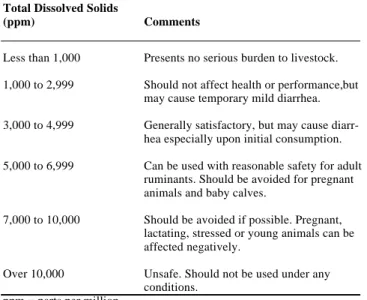
Salinity, total dissolved solids (TDS) and total soluble salts (TSS) are measures of constituents soluble in water. Sodium chloride is the first consider-ation in this category. Other components associated with salinity, TDS, or TSS are bicarbonate, sulfate, calcium, magnesium and silica. A secondary group of constituents, found in lower concentrations than the major constituents, includes iron, nitrate, strontium, potassium, carbonate, phosphorus, boron and fluoride. Guidelines for TDS in water for dairy cattle are pre-sented in table 3.
Research has shown feedlot cattle drinking saline water (TDS = 6,000 parts per million, ppm) had lower
Table 2. Estimated water intake for dairy heifers.
Weight Air Temperature
(lbs) 40ºF 60ºF 80ºF
————gallons per day————
200 2.0 2.4 3.3 400 3.8 4.6 6.1 600 5.4 6.5 8.7 800 6.8 8.2 11.0 1000 8.0 9.6 12.7 1200 9.0 10.8 14.5 DRINKING BEHAVIOR
Providing the opportunity for livestock to consume a relatively large amount of clean, fresh water is es-sential. Water is consumed several times per day and generally is associated with feeding or milking. Cows may consume 30 to 50 percent of their daily water
= 1,300 ppm), when the ration’s energy content was low and during heat stress. High-energy rations and cold environmental temperatures negated the detri-mental effects of high-saline water consumption. Likewise, milk production of dairy cows drinking sa-line water (TDS = 4,400 ppm) was not different from that of cows drinking normal water during periods of low environmental temperature. But it was signifi-cantly lower during summer months. Cows offered salty water drank more water per day (36 versus 32 gallons per cow) over a 12-month period than cows drinking normal water.
Table 3. Guidelines for use of saline waters for dairy cattle. Total Dissolved Solids
(ppm) Comments
Less than 1,000 Presents no serious burden to livestock. 1,000 to 2,999 Should not affect health or performance,but
may cause temporary mild diarrhea. 3,000 to 4,999 Generally satisfactory, but may cause
diarr-hea especially upon initial consumption. 5,000 to 6,999 Can be used with reasonable safety for adult
ruminants. Should be avoided for pregnant animals and baby calves.
7,000 to 10,000 Should be avoided if possible. Pregnant, lactating, stressed or young animals can be affected negatively.
Over 10,000 Unsafe. Should not be used under any
conditions. ppm = parts per million
Hardness is generally expressed as the sum of calcium and magnesium reported in equivalent amounts of calcium carbonate. Other cations in wa-ter, such as zinc, iron, strontium, aluminum and manganese, can contribute to hardness but usually are very low in concentration compared with cal-cium and magnesium. Hardness categories are listed in table 4. Water hardness has no effect on animal performance or water intake.
Table 4. Water hardness guidelines.
Category Hardness, milligrams/litera
Soft 0-60
Moderately hard 61-120
Hard 121-180
Very hard > 180
a1 grain/gal = 17.1 milligrams per liter
Nitrate can be used in the rumen as a source of ni-trogen for synthesis of bacterial protein, but reduction to nitrite also occurs. When absorbed into the body, nitrite reduces the oxygen-carrying capacity of blood and in severe cases results in asphyxiation. Symptoms of nitrate or nitrite poisoning are labored breathing, rapid pulse rate, frothing at the mouth, convulsion, blue muzzle and bluish tint around eyes, and choco-late brown blood. More moderate levels of nitrate poi-soning have been linked to poor growth, infertility problems, abortions, vitamin A deficiencies, reduced milk production and general unhealthiness.
The general safe concentration of nitrate in water is less than 44 ppm and less than 10 ppm of nitrate-ni-trogen (table 5). In evaluating potential nitrate prob-lems, feed also should be analyzed for nitrate in that the effects of feed and water are additive.
Sulfate guidelines for water are not well-defined, but general recommendations are less than 500 ppm for calves and less than 1,000 ppm for adult cattle. When sulfate exceeds 500 ppm, the specific salt form of sulfate or sulfur should be identified, since the form of sulfur is an important determinant of toxicity. Hydrogen sulfide is the most toxic form and concen-tration as low as 0.1 milligrams per liter can reduce water intake. Common forms of sulfate in water are calcium, iron, magnesium and sodium salts. All are laxative, but sodium sulfate is the most potent. Cattle consuming water high in sulfates (2,000–2,500 ppm) show diarrhea initially, but appear to become resistant to the laxative effect. Iron sulfate has been reported to be the most potent depressor of water intake com-pared with other sulfate forms. Water and feed with high sulfate contents have been linked to polioence-phalomalacia (thiamin deficiency) in beef calves.
Table 5. Concentration of nitrates (NO3) and nitrate-nitrogen (NO3-N) in drinking water and expected response.
NO3 NO3-N
(ppm) (ppm) Comments
0-44 10 No harmful effects.
45-132 11-20 Safe, if diet is low in nitrates and nutritionally balanced.
133-220 21-40 Could be harmful if consumed over a long period of time.
221-660 41-100 Dairy cattle at risk; possible death losses. 661-800 101-200 High probability of death losses; unsafe. Over 800 Over 200 Do not use; unsafe.
pH is a measure of acidity or alkalinity. A pH of 7 is neutral, less than 7 is acidic and more than 7 is al-kaline. Little is known about the specific pH’s effect on water intake, animal health and production, or the microbial environment in the rumen. The preferred pH of drinking water for dairy animals is 6.0 to 8.0. Waters with a pH outside of the preferred range may cause nonspecific effects related to digestive upset, diarrhea, poor feed conversion and reduced water and feed intake.
Microbiological analysis of water for coliform bacteria and other microorganisms is necessary to de-termine sanitary quality (fig. 2). Since some coliform bacteria are soil borne or nonfecal, a fecal coliform test may be used to determine if the source of total coliform is at least in part from feces. A fecal strepto-cocci test may be run on fresh samples to determine if the contamination is from animal or human sources. If fecal coliforms exceed fecal streptococci, human sources of pollution may be suspect. If fecal strepto-cocci exceed fecal coliform, animal sources of pollu-tion are indicated. For animal consumppollu-tion, especially young calves, total and fecal coliform counts should be less than 1 per 100 milliliters. For adult animals, total and fecal coliform counts should be under 15 and 10 per 100 milliliters, respectively. It is recommended that fecal streptococci counts not exceed 3 or 30 per 100 milliliters for calves and adult cattle, respectively.
Total bacteria count measures virtually all patho-genic as well as noninfectious bacteria that use or-ganic nutrients for growth. Total bacteria counts in
excess of 500 per 100 milliliters may indicate water-quality problems. Water sources with total bacteria counts in excess of 1 million per 100 milliliters should be avoided for all livestock classes. Most water sup-plies will have counts below 200 per 100 milliliters continuously.
Blue-green algae have been reported to cause ill-ness when cattle are allowed to consume water con-taining this organism. Although the causative agent has not been identified specifically, cattle should be prevented from drinking water with heavy algae growth. Symptoms in blue-green algae poisoning in-clude ataxia or incoordination of voluntary muscle movement, bloody diarrhea, convulsions and sudden death. This is an occasional problem in freestanding water, such as farm ponds. Shading water troughs and frequent sanitation will minimize algae growth.
Other potentially toxic compounds and organ-isms sometimes are found in water and can pose a health hazard to cattle. For safe consumption, water contaminants should not exceed the guidelines in table 6. However, many dietary, physiologic and envi-ronmental factors affect these guidelines and make it impossible to accurately determine the concentrations at which problems may occur.
Table 6. Generally considered safe concentrations of some potentially toxic nutrients and contaminants in water for cattle.
Upper-Limit Guideline Item (ppm) Aluminum 0.50 Arsenic 0.05 Barium 10.0 Boron 5.0 Cadmium 0.005 Chromium 0.10 Cobalt 1.0 Copper 1.0 Fluoride 2.0 Iron 2.0 Lead 0.015 Manganese 0.05 Mercury 0.01 Nickel 0.25 Selenium 0.05 Vanadium 0.10 Zinc 5.0
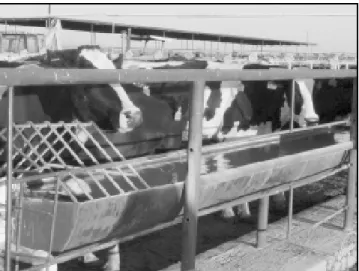
ppm = parts per million Figure 1. Cows may consume 30 to 50 percent of their daily
WATER SAMPLING AND TESTING
Typically, 1 or 2 quarts of water from the source in question should be adequate to complete any needed tests. Samples may be sent to any accredited commer-cial or state operated laboratory for analyses. Produc-ers should consult with their herd veterinarian or state Extension personnel for assistance in selecting a labo-ratory, as well as for assistance in selecting appropri-ate tests and interpreting results.
SUMMARY
Water availability and quality are extremely impor-tant for animal health and productivity. Limiting wa-ter availability to cattle will depress production rap-idly and severely.
The most common water quality problems affect-ing livestock production include high concentrations of minerals (excess salinity), high nitrogen content (nitrates and nitrites), bacterial contamination, heavy growth of blue-green algae and accidental contamina-tion by petroleum, pesticides or fertilizer products.
On the basis of the scientific literature, no wide-spread specific production problems have been caused by consumption of low quality water. Poor water quality might cause reduced production or nonspecific diseases and should be one aspect investigated when there are herd health and production problems.
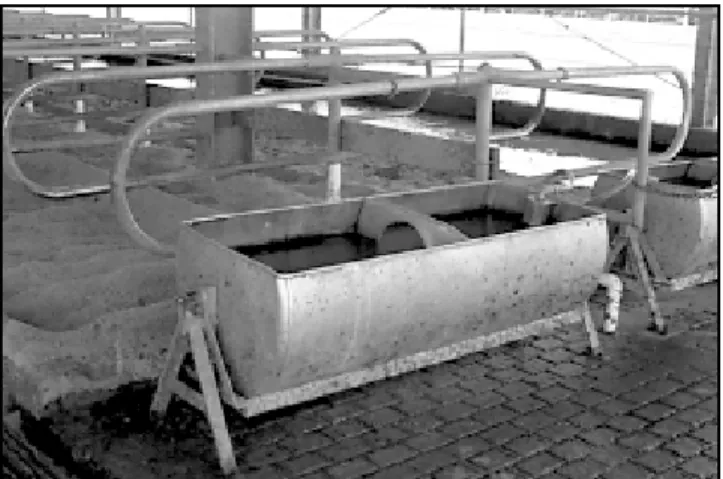
Figure 2. Microbiological analysis of water for coliform bacte-ria and other microorganisms is necessary to determine sani-tary quality.
REFERENCES
Beede, D.K. 1992. Water for Dairy Cattle. In: Large Dairy Herd Management. Ed. H.H. Van horn and C.J. Wilcox. Amer. Dairy Sci. Assoc. Champaign, Ill.
Dairy Practices Council. 1990. Guidelines for Po-table Water on Dairy Farms 3rd rev. ed. Barre, Vt. McFarland, D.F. 2000. Feed Area and Water Space
Design. In: Dairy Housing and Equipment Sys-tems. NRAES-129. Ithaca, NY.
Murphy, M.R., C.L. Davis and G.C. McCoy. 1983. Factors affecting water consumption by Holstein cows in early lactation. J. Dairy Sci. 66:35. National Research Council. 2001. Nutrient
Require-ments of Dairy Cattle 7th rev. ed. Washington, D.C.: National Academy Press.
New Mexico State University is an equal opportunity/affirmative action employer and educator. NMSU and the U.S. Department of Agriculture cooperating.