15
THERMODYNAMICS
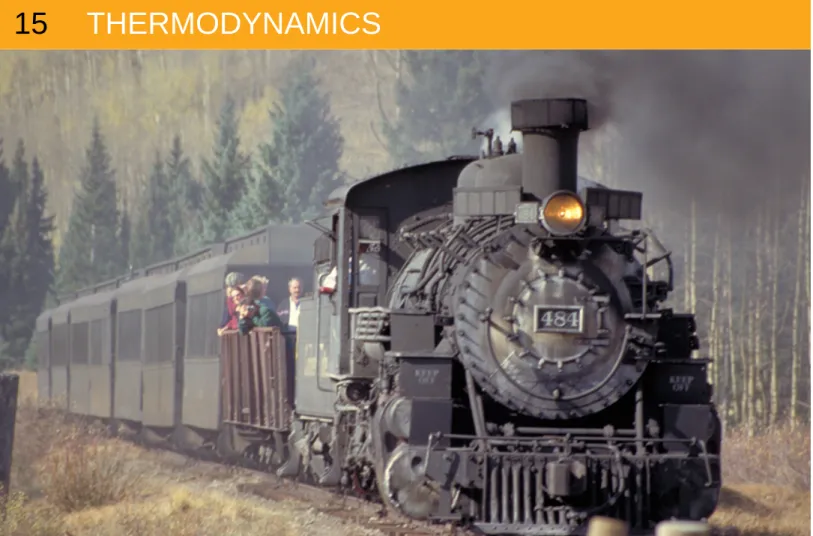
Figure 15.1A steam engine uses heat transfer to do work. Tourists regularly ride this narrow-gauge steam engine train near the San Juan Skyway in Durango, Colorado, part of the National Scenic Byways Program. (credit: Dennis Adams)
Learning Objectives
15.1. The First Law of Thermodynamics• Define the first law of thermodynamics.
• Describe how conservation of energy relates to the first law of thermodynamics.
• Identify instances of the first law of thermodynamics working in everyday situations, including biological metabolism. • Calculate changes in the internal energy of a system, after accounting for heat transfer and work done.
15.2. The First Law of Thermodynamics and Some Simple Processes
• Describe the processes of a simple heat engine.
• Explain the differences among the simple thermodynamic processes—isobaric, isochoric, isothermal, and adiabatic. • Calculate total work done in a cyclical thermodynamic process.
15.3. Introduction to the Second Law of Thermodynamics: Heat Engines and Their Efficiency
• State the expressions of the second law of thermodynamics.
• Calculate the efficiency and carbon dioxide emission of a coal-fired electricity plant, using second law characteristics. • Describe and define the Otto cycle.
15.4. Carnot’s Perfect Heat Engine: The Second Law of Thermodynamics Restated
• Identify a Carnot cycle.
• Calculate maximum theoretical efficiency of a nuclear reactor. • Explain how dissipative processes affect the ideal Carnot engine.
15.5. Applications of Thermodynamics: Heat Pumps and Refrigerators
• Describe the use of heat engines in heat pumps and refrigerators. • Demonstrate how a heat pump works to warm an interior space. • Explain the differences between heat pumps and refrigerators. • Calculate a heat pump’s coefficient of performance.
15.6. Entropy and the Second Law of Thermodynamics: Disorder and the Unavailability of Energy
• Define entropy.
• Calculate the increase of entropy in a system with reversible and irreversible processes. • Explain the expected fate of the universe in entropic terms.
• Calculate the increasing disorder of a system.
15.7. Statistical Interpretation of Entropy and the Second Law of Thermodynamics: The Underlying Explanation
• Identify probabilities in entropy.
Introduction to Thermodynamics
Heat transfer is energy in transit, and it can be used to do work. It can also be converted to any other form of energy. A car engine, for example, burns fuel for heat transfer into a gas. Work is done by the gas as it exerts a force through a distance, converting its energy into a variety of other forms—into the car’s kinetic or gravitational potential energy; into electrical energy to run the spark plugs, radio, and lights; and back into stored energy in the car’s battery. But most of the heat transfer produced from burning fuel in the engine does not do work on the gas. Rather, the energy is released into the environment, implying that the engine is quite inefficient.
It is often said that modern gasoline engines cannot be made to be significantly more efficient. We hear the same about heat transfer to electrical energy in large power stations, whether they are coal, oil, natural gas, or nuclear powered. Why is that the case? Is the inefficiency caused by design problems that could be solved with better engineering and superior materials? Is it part of some money-making conspiracy by those who sell energy? Actually, the truth is more interesting, and reveals much about the nature of heat transfer.
Basic physical laws govern how heat transfer for doing work takes place and place insurmountable limits onto its efficiency. This chapter will explore these laws as well as many applications and concepts associated with them. These topics are part ofthermodynamics—the study of heat transfer and its relationship to doing work.
15.1
The First Law of Thermodynamics
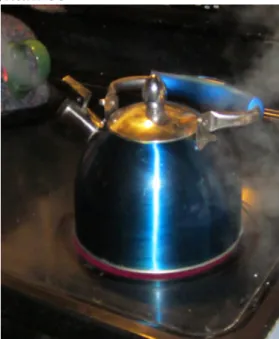
Figure 15.2This boiling tea kettle represents energy in motion. The water in the kettle is turning to water vapor because heat is being transferred from the stove to the kettle. As the entire system gets hotter, work is done—from the evaporation of the water to the whistling of the kettle. (credit: Gina Hamilton)
If we are interested in how heat transfer is converted into doing work, then the conservation of energy principle is important. The first law of thermodynamics applies the conservation of energy principle to systems where heat transfer and doing work are the methods of transferring energy into and out of the system. Thefirst law of thermodynamicsstates that the change in internal energy of a system equals the net heat transferinto the system minus the net work donebythe system. In equation form, the first law of thermodynamics is
(15.1)
ΔU = Q − W.
Here
ΔU
is thechange in internal energyU
of the system.Q
is thenet heat transferred into the system—that is,Q
is the sum of all heat transfer into and out of the system.W
is thenet work done by the system—that is,W
is the sum of all work done on or by the system. We use the following sign conventions: ifQ
is positive, then there is a net heat transfer into the system; ifW
is positive, then there is net work done by the system. So positiveQ
adds energy to the system and positiveW
takes energy from the system. ThusΔU = Q − W
. Note also that if more heat transfer into the system occurs than work done, the difference is stored as internal energy. Heat engines are a good example of this—heat transfer into them takes place so that they can do work. (SeeFigure 15.3.) We will now examineQ
,W
, andΔU
further.Figure 15.3The first law of thermodynamics is the conservation-of-energy principle stated for a system where heat and work are the methods of transferring energy for a system in thermal equilibrium.
Q
represents the net heat transfer—it is the sum of all heat transfers into and out of the system.Q
is positive for net heat transferintothe system.W
is the total work done on and by the system.W
is positive when more work is donebythe system than on it. The change in the internal energy of the system,ΔU
, is related to heat and work by the first law of thermodynamics,ΔU = Q − W
. Making Connections: Law of Thermodynamics and Law of Conservation of EnergyThe first law of thermodynamics is actually the law of conservation of energy stated in a form most useful in thermodynamics. The first law gives the relationship between heat transfer, work done, and the change in internal energy of a system.
Heat
Q
and Work
W
Heat transfer (
Q
) and doing work (W
) are the two everyday means of bringing energy into or taking energy out of a system. The processes are quite different. Heat transfer, a less organized process, is driven by temperature differences. Work, a quite organized process, involves amacroscopic force exerted through a distance. Nevertheless, heat and work can produce identical results.For example, both can cause a temperature increase. Heat transfer into a system, such as when the Sun warms the air in a bicycle tire, can increase its temperature, and so can work done on the system, as when the bicyclist pumps air into the tire. Once the temperature increase has occurred, it is impossible to tell whether it was caused by heat transfer or by doing work. This uncertainty is an important point. Heat transfer and work are both energy in transit—neither is stored as such in a system. However, both can change the internal energy
U
of a system. Internal energy is a form of energy completely different from either heat or work.Internal Energy
U
We can think about the internal energy of a system in two different but consistent ways. The first is the atomic and molecular view, which examines the system on the atomic and molecular scale. Theinternal energy
U
of a system is the sum of the kinetic and potential energies of its atoms and molecules. Recall that kinetic plus potential energy is called mechanical energy. Thus internal energy is the sum of atomic and molecular mechanical energy. Because it is impossible to keep track of all individual atoms and molecules, we must deal with averages and distributions. A second way to view the internal energy of a system is in terms of its macroscopic characteristics, which are very similar to atomic and molecular average values. Macroscopically, we define the change in internal energyΔU
to be that given by the first law of thermodynamics:(15.2)
ΔU = Q − W.
Many detailed experiments have verified that
ΔU = Q − W
, whereΔU
is the change in total kinetic and potential energy of all atoms and molecules in a system. It has also been determined experimentally that the internal energyU
of a system depends only on the state of the system andnot how it reached that state.More specifically,U
is found to be a function of a few macroscopic quantities (pressure, volume, and temperature, for example), independent of past history such as whether there has been heat transfer or work done. This independence means that if we know the state of a system, we can calculate changes in its internal energyU
from a few macroscopic variables.Making Connections: Macroscopic and Microscopic
In thermodynamics, we often use the macroscopic picture when making calculations of how a system behaves, while the atomic and molecular picture gives underlying explanations in terms of averages and distributions. We shall see this again in later sections of this chapter. For example, in the topic of entropy, calculations will be made using the atomic and molecular view.
To get a better idea of how to think about the internal energy of a system, let us examine a system going from State 1 to State 2. The system has internal energy
U
1 in State 1, and it has internal energyU
2 in State 2, no matter how it got to either state. So the change in internal energyΔU = U
2− U
1 is independent of what caused the change. In other words,ΔU
is independent of path. By path, we mean the method of getting from the starting point to the ending point. Why is this independence important? Note thatΔU = Q − W
. BothQ
andW
depend on path, butExample 15.1 Calculating Change in Internal Energy: The Same Change in
U
is Produced by Two Different
Processes
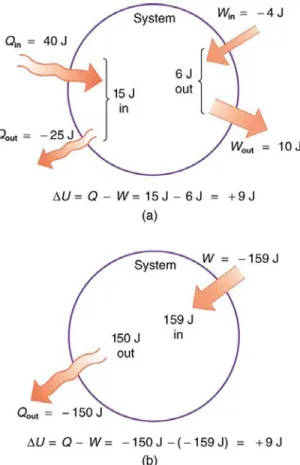
(a) Suppose there is heat transfer of 40.00 J to a system, while the system does 10.00 J of work. Later, there is heat transfer of 25.00 J out of the system while 4.00 J of work is done on the system. What is the net change in internal energy of the system?
(b) What is the change in internal energy of a system when a total of 150.00 J of heat transfer occurs out of (from) the system and 159.00 J of work is done on the system? (SeeFigure 15.4).
Strategy
In part (a), we must first find the net heat transfer and net work done from the given information. Then the first law of thermodynamics
⎛
⎝
ΔU = Q − W
⎞⎠ can be used to find the change in internal energy. In part (b), the net heat transfer and work done are given, so the equationcan be used directly.
Solution for (a)
The net heat transfer is the heat transfer into the system minus the heat transfer out of the system, or
(15.3)
Q = 40.00 J − 25.00 J = 15.00 J.
Similarly, the total work is the work done by the system minus the work done on the system, or
(15.4)
W = 10.00 J − 4.00 J = 6.00 J.
Thus the change in internal energy is given by the first law of thermodynamics:
(15.5)
ΔU = Q − W = 15.00 J − 6.00 J = 9.00 J.
We can also find the change in internal energy for each of the two steps. First, consider 40.00 J of heat transfer in and 10.00 J of work out, or (15.6)
ΔU
1= Q
1− W
1= 40.00 J − 10.00 J = 30.00 J.
Now consider 25.00 J of heat transfer out and 4.00 J of work in, or
(15.7)
ΔU
2= Q
2− W
2= - 25.00 J − ( − 4.00 J ) = –21.00 J.
The total change is the sum of these two steps, or
(15.8)
ΔU = ΔU
1+ ΔU
2= 30.00 J + (−21.00 J ) = 9.00 J.
Discussion on (a)No matter whether you look at the overall process or break it into steps, the change in internal energy is the same.
Solution for (b)
Here the net heat transfer and total work are given directly to be
Q = – 150.00 J
andW = – 159.00 J
, so that(15.9)
ΔU = Q – W = – 150.00 J – ( − 159.00 J) = 9.00 J.
Discussion on (b)A very different process in part (b) produces the same 9.00-J change in internal energy as in part (a). Note that the change in the system in both parts is related to
ΔU
and not to the individualQ
s orW
s involved. The system ends up in thesamestate in both (a) and (b). Parts (a) and (b) present two different paths for the system to follow between the same starting and ending points, and the change in internal energy for each is the same—it is independent of path.Figure 15.4Two different processes produce the same change in a system. (a) A total of 15.00 J of heat transfer occurs into the system, while work takes out a total of 6.00 J. The change in internal energy is
ΔU = Q − W = 9.00 J
. (b) Heat transfer removes 150.00 J from the system while work puts 159.00 J into it, producing an increase of 9.00 J in internal energy. If the system starts out in the same state in (a) and (b), it will end up in the same final state in either case—its final state is related to internal energy, not how that energy was acquired.Human Metabolism and the First Law of Thermodynamics
Human metabolismis the conversion of food into heat transfer, work, and stored fat. Metabolism is an interesting example of the first law of thermodynamics in action. We now take another look at these topics via the first law of thermodynamics. Considering the body as the system of interest, we can use the first law to examine heat transfer, doing work, and internal energy in activities ranging from sleep to heavy exercise. What are some of the major characteristics of heat transfer, doing work, and energy in the body? For one, body temperature is normally kept constant by heat transfer to the surroundings. This means
Q
is negative. Another fact is that the body usually does work on the outside world. This meansW
is positive. In such situations, then, the body loses internal energy, sinceΔU = Q − W
is negative.Now consider the effects of eating. Eating increases the internal energy of the body by adding chemical potential energy (this is an unromantic view of a good steak). The bodymetabolizesall the food we consume. Basically, metabolism is an oxidation process in which the chemical potential energy of food is released. This implies that food input is in the form of work. Food energy is reported in a special unit, known as the Calorie. This energy is measured by burning food in a calorimeter, which is how the units are determined.
In chemistry and biochemistry, one calorie (spelled with alowercasec) is defined as the energy (or heat transfer) required to raise the temperature of one gram of pure water by one degree Celsius. Nutritionists and weight-watchers tend to use thedietarycalorie, which is frequently called a Calorie (spelled with acapitalC). One food Calorie is the energy needed to raise the temperature of onekilogramof water by one degree Celsius. This means that one dietary Calorie is equal to one kilocalorie for the chemist, and one must be careful to avoid confusion between the two. Again, consider the internal energy the body has lost. There are three places this internal energy can go—to heat transfer, to doing work, and to stored fat (a tiny fraction also goes to cell repair and growth). Heat transfer and doing work take internal energy out of the body, and food puts it back. If you eat just the right amount of food, then your average internal energy remains constant. Whatever you lose to heat transfer and doing work is replaced by food, so that, in the long run,
ΔU = 0
. If you overeat repeatedly, thenΔU
is always positive, and your body stores this extra internal energy as fat. The reverse is true if you eat too little. IfΔU
is negative for a few days, then the body metabolizes its own fat to maintain body temperature and do work that takes energy from the body. This process is how dieting produces weight loss.Life is not always this simple, as any dieter knows. The body stores fat or metabolizes it only if energy intake changes for a period of several days. Once you have been on a major diet, the next one is less successful because your body alters the way it responds to low energy intake. Your basal metabolic rate (BMR) is the rate at which food is converted into heat transfer and work done while the body is at complete rest. The body adjusts its basal metabolic rate to partially compensate for over-eating or under-eating. The body will decrease the metabolic rate rather than eliminate its own fat to replace lost food intake. You will chill more easily and feel less energetic as a result of the lower metabolic rate, and you will not lose weight as fast as before. Exercise helps to lose weight, because it produces both heat transfer from your body and work, and raises your metabolic rate even when you are at rest. Weight loss is also aided by the quite low efficiency of the body in converting internal energy to work, so that the loss of internal energy resulting from doing work is much greater than the work done.It should be noted, however, that living systems are not in thermalequilibrium. The body provides us with an excellent indication that many thermodynamic processes areirreversible. An irreversible process can go in one direction but not the reverse, under a given set of conditions. For example, although body fat can be converted to do work and produce heat transfer,
work done on the body and heat transfer into it cannot be converted to body fat. Otherwise, we could skip lunch by sunning ourselves or by walking down stairs. Another example of an irreversible thermodynamic process is photosynthesis. This process is the intake of one form of
energy—light—by plants and its conversion to chemical potential energy. Both applications of the first law of thermodynamics are illustrated inFigure 15.5. One great advantage of conservation laws such as the first law of thermodynamics is that they accurately describe the beginning and ending points of complex processes, such as metabolism and photosynthesis, without regard to the complications in between.Table 15.1presents a summary of terms relevant to the first law of thermodynamics.
Figure 15.5(a) The first law of thermodynamics applied to metabolism. Heat transferred out of the body (
Q
) and work done by the body (W
) remove internal energy, while food intake replaces it. (Food intake may be considered as work done on the body.) (b) Plants convert part of the radiant heat transfer in sunlight to stored chemical energy, a process called photosynthesis.Table 15.1 Summary of Terms for the First Law of Thermodynamics,ΔU=Q−W
Term Definition
U
Internal energy—the sum of the kinetic and potential energies of a system’s atoms and molecules. Can be divided into manysubcategories, such as thermal and chemical energy. Depends only on the state of a system (such as itsP
,V
, andT
), not on how the energy entered the system. Change in internal energy is path independent.Q
Heat—energy transferred because of a temperature difference. Characterized by random molecular motion. Highly dependent on path.Q
entering a system is positive.W
Work—energy transferred by a force moving through a distance. An organized, orderly process. Path dependent.W
done by a system(either against an external force or to increase the volume of the system) is positive.
15.2
The First Law of Thermodynamics and Some Simple Processes
Figure 15.6Beginning with the Industrial Revolution, humans have harnessed power through the use of the first law of thermodynamics, before we even understood it completely. This photo, of a steam engine at the Turbinia Works, dates from 1911, a mere 61 years after the first explicit statement of the first law of thermodynamics by Rudolph Clausius. (credit: public domain; author unknown)
One of the most important things we can do with heat transfer is to use it to do work for us. Such a device is called aheat engine. Car engines and steam turbines that generate electricity are examples of heat engines.Figure 15.7shows schematically how the first law of thermodynamics applies to the typical heat engine.
Figure 15.7Schematic representation of a heat engine, governed, of course, by the first law of thermodynamics. It is impossible to devise a system where
Q
out= 0
, that is, in which no heat transfer occurs to the environment.Figure 15.8(a) Heat transfer to the gas in a cylinder increases the internal energy of the gas, creating higher pressure and temperature. (b) The force exerted on the movable cylinder does work as the gas expands. Gas pressure and temperature decrease when it expands, indicating that the gas’s internal energy has been decreased by doing work. (c) Heat transfer to the environment further reduces pressure in the gas so that the piston can be more easily returned to its starting position.
The illustrations above show one of the ways in which heat transfer does work. Fuel combustion produces heat transfer to a gas in a cylinder, increasing the pressure of the gas and thereby the force it exerts on a movable piston. The gas does work on the outside world, as this force moves the piston through some distance. Heat transfer to the gas cylinder results in work being done. To repeat this process, the piston needs to be returned to its starting point. Heat transfer now occurs from the gas to the surroundings so that its pressure decreases, and a force is exerted by the
surroundings to push the piston back through some distance. Variations of this process are employed daily in hundreds of millions of heat engines. We will examine heat engines in detail in the next section. In this section, we consider some of the simpler underlying processes on which heat engines are based.
PV
Diagrams and their Relationship to Work Done on or by a Gas
A process by which a gas does work on a piston at constant pressure is called anisobaric process. Since the pressure is constant, the force exerted is constant and the work done is given as
(15.10)
PΔV.
Figure 15.9An isobaric expansion of a gas requires heat transfer to keep the pressure constant. Since pressure is constant, the work done is
PΔV
.(15.11)
W = Fd
See the symbols as shown inFigure 15.9. Now
F = PA
, and so(15.12)
W = PAd.
Because the volume of a cylinder is its cross-sectional area
A
times its lengthd
, we see thatAd = ΔV
, the change in volume; thus,(15.13)
W = PΔV (isobaric process).
Note that if
ΔV
is positive, thenW
is positive, meaning that work is donebythe gas on the outside world.(Note that the pressure involved in this work that we’ve called
P
is the pressure of the gasinsidethe tank. If we call the pressure outside the tankP
ext, an expanding gas would be workingagainstthe external pressure; the work done would therefore beW = −P
extΔV
(isobaric process). Many texts use this definition of work, and not the definition based on internal pressure, as the basis of the First Law of Thermodynamics. This definition reverses the sign conventions for work, and results in a statement of the first law that becomesΔU = Q + W
.)It is not surprising that
W = PΔV
, since we have already noted in our treatment of fluids that pressure is a type of potential energy per unit volume and that pressure in fact has units of energy divided by volume. We also noted in our discussion of the ideal gas law thatPV
has units of energy. In this case, some of the energy associated with pressure becomes work.Figure 15.10shows a graph of pressure versus volume (that is, a
PV
diagram for an isobaric process. You can see in the figure that the work done is the area under the graph. This property ofPV
diagrams is very useful and broadly applicable:the work done on or by a system in going from one state to another equals the area under the curve on aPV
diagram.Figure 15.10A graph of pressure versus volume for a constant-pressure, or isobaric, process, such as the one shown inFigure 15.9. The area under the curve equals the work done by the gas, since
W = PΔV
.Figure 15.11(a) A
PV
diagram in which pressure varies as well as volume. The work done for each interval is its average pressure times the change in volume, or the area under the curve over that interval. Thus the total area under the curve equals the total work done. (b) Work must be done on the system to follow the reverse path. This is interpreted as a negative area under the curve.We can see where this leads by consideringFigure 15.11(a), which shows a more general process in which both pressure and volume change. The area under the curve is closely approximated by dividing it into strips, each having an average constant pressure
P
i(ave). The work done isW
i= P
i(ave)ΔV
i for each strip, and the total work done is the sum of theW
i. Thus the total work done is the total area under the curve. If the path is reversed, as inFigure 15.11(b), then work is done on the system. The area under the curve in that case is negative, becauseΔV
is negative.PV
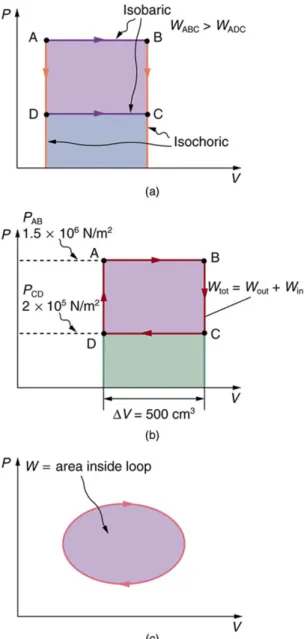
diagrams clearly illustrate thatthe work done depends on the path taken and not just the endpoints. This path dependence is seen inFigure 15.12(a), where more work is done in going from A to C by the path via point B than by the path via point D. The vertical paths, where volume is constant, are calledisochoricprocesses. Since volume is constant,ΔV = 0
, and no work is done in an isochoric process. Now, if the system follows the cyclical path ABCDA, as inFigure 15.12(b), then the total work done is the area inside the loop. The negative area below path CD subtracts, leaving only the area inside the rectangle. In fact, the work done in any cyclical process (one that returns to its starting point) is the area inside the loop it forms on aPV
diagram, asFigure 15.12(c) illustrates for a general cyclical process. Note that the loop must be traversed in the clockwise direction for work to be positive—that is, for there to be a net work output.Figure 15.12(a) The work done in going from A to C depends on path. The work is greater for the path ABC than for the path ADC, because the former is at higher pressure. In both cases, the work done is the area under the path. This area is greater for path ABC. (b) The total work done in the cyclical process ABCDA is the area inside the loop, since the negative area below CD subtracts out, leaving just the area inside the rectangle. (The values given for the pressures and the change in volume are intended for use in the example below.) (c) The area inside any closed loop is the work done in the cyclical process. If the loop is traversed in a clockwise direction,
W
is positive—it is work done on the outside environment. If the loop is traveled in a counter-clockwise direction,W
is negative—it is work that is done to the system.Example 15.2 Total Work Done in a Cyclical Process Equals the Area Inside the Closed Loop on a
PV
Diagram
Calculate the total work done in the cyclical process ABCDA shown inFigure 15.12(b) by the following two methods to verify that work equals the area inside the closed loop on the
PV
diagram. (Take the data in the figure to be precise to three significant figures.) (a) Calculate the work done along each segment of the path and add these values to get the total work. (b) Calculate the area inside the rectangle ABCDA.Strategy
To find the work along any path on a
PV
diagram, you use the fact that work is pressure times change in volume, orW = PΔV
. So in part (a), this value is calculated for each leg of the path around the closed loop.Solution for (a)
The work along path AB is
(15.14)
W
AB= P
ABΔV
AB= (1.50×10
6N/m
2)(5.00×10
–4m
3) = 750 J.
Since the path BC is isochoric,
ΔV
BC= 0
, and soW
BC= 0
. The work along path CD is negative, sinceΔV
CD is negative (the volume decreases). The work is(15.15)
W
CD= P
CDΔV
CD= (2.00×10
5N/m
2)(–5.00×10
–4m
3) = –100 J.
Again, since the path DA is isochoric,
ΔV
DA= 0
, and soW
DA= 0
. Now the total work is(15.16)
W = W
AB+ W
BC+ W
CD+ W
DA= 750 J+0 + ( − 100J) + 0 = 650 J.
Solution for (b)The area inside the rectangle is its height times its width, or
(15.17)
area = (P
AB− P
CD)ΔV
=
⎡⎣(1.50×10
6N/m
2) − (2.00×10
5N/m
2)
⎤⎦(5.00×10
−4m
3)
= 650 J.
Thus, (15.18)area = 650 J = W.
DiscussionThe result, as anticipated, is that the area inside the closed loop equals the work done. The area is often easier to calculate than is the work done along each path. It is also convenient to visualize the area inside different curves on
PV
diagrams in order to see which processes might produce the most work. Recall that work can be done to the system, or by the system, depending on the sign ofW
. A positiveW
is work that is done by the system on the outside environment; a negativeW
represents work done by the environment on the system.Figure 15.13(a) shows two other important processes on a
PV
diagram. For comparison, both are shown starting from the same point A. The upper curve ending at point B is anisothermalprocess—that is, one in which temperature is kept constant. If the gas behaves like an ideal gas, as is often the case, and if no phase change occurs, thenPV = nRT
. SinceT
is constant,PV
is a constant for an isothermal process. We ordinarily expect the temperature of a gas to decrease as it expands, and so we correctly suspect that heat transfer must occur from the surroundings to the gas to keep the temperature constant during an isothermal expansion. To show this more rigorously for the special case of a monatomic ideal gas, we note that the average kinetic energy of an atom in such a gas is given by(15.19)
1
2m v
¯
2= 32kT.
The kinetic energy of the atoms in a monatomic ideal gas is its only form of internal energy, and so its total internal energy
U
is(15.20)
U = N12m v
¯
2= 32NkT, (monatomic ideal gas),
where
N
is the number of atoms in the gas. This relationship means that the internal energy of an ideal monatomic gas is constant during an isothermal process—that is,ΔU = 0
. If the internal energy does not change, then the net heat transfer into the gas must equal the net work done by the gas. That is, becauseΔU = Q − W = 0
here,Q = W
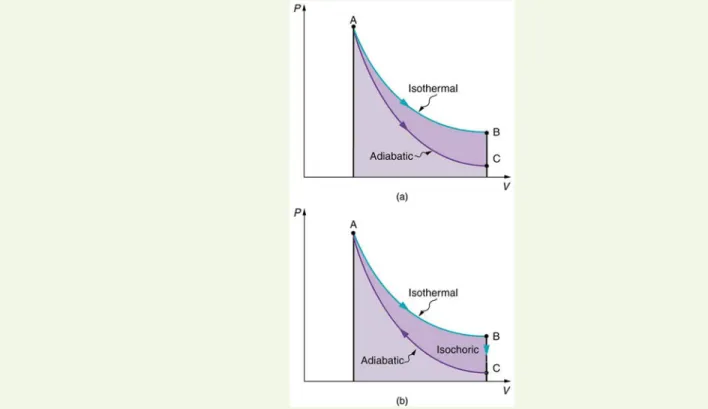
. We must have just enough heat transfer to replace the work done. An isothermal process is inherently slow, because heat transfer occurs continuously to keep the gas temperature constant at all times and must be allowed to spread through the gas so that there are no hot or cold regions.Also shown inFigure 15.13(a) is a curve AC for anadiabaticprocess, defined to be one in which there is no heat transfer—that is,
Q = 0
. Processes that are nearly adiabatic can be achieved either by using very effective insulation or by performing the process so fast that there is little time for heat transfer. Temperature must decrease during an adiabatic process, since work is done at the expense of internal energy:(15.21)
U = 32NkT.
(You might have noted that a gas released into atmospheric pressure from a pressurized cylinder is substantially colder than the gas in the cylinder.) In fact, because
Q = 0, ΔU = – W
for an adiabatic process. Lower temperature results in lower pressure along the way, so that curve AC is lower than curve AB, and less work is done. If the path ABCA could be followed by cooling the gas from B to C at constant volume (isochorically),Figure 15.13(b), there would be a net work output.Figure 15.13(a) The upper curve is an isothermal process (
ΔT = 0
), whereas the lower curve is an adiabatic process (Q = 0
). Both start from the same point A, but the isothermal process does more work than the adiabatic because heat transfer into the gas takes place to keep its temperature constant. This keeps the pressure higher all along the isothermal path than along the adiabatic path, producing more work. The adiabatic path thus ends up with a lower pressure and temperature at point C, even though the final volume is the same as for the isothermal process. (b) The cycle ABCA produces a net work output.Reversible Processes
Both isothermal and adiabatic processes such as shown inFigure 15.13are reversible in principle. Areversible processis one in which both the system and its environment can return to exactly the states they were in by following the reverse path. The reverse isothermal and adiabatic paths are BA and CA, respectively. Real macroscopic processes are never exactly reversible. In the previous examples, our system is a gas (like that in
Figure 15.9), and its environment is the piston, cylinder, and the rest of the universe. If there are any energy-dissipating mechanisms, such as friction or turbulence, then heat transfer to the environment occurs for either direction of the piston. So, for example, if the path BA is followed and there is friction, then the gas will be returned to its original state but the environment will not—it will have been heated in both directions. Reversibility requires the direction of heat transfer to reverse for the reverse path. Since dissipative mechanisms cannot be completely eliminated, real processes cannot be reversible.
There must be reasons that real macroscopic processes cannot be reversible. We can imagine them going in reverse. For example, heat transfer occurs spontaneously from hot to cold and never spontaneously the reverse. Yet it would not violate the first law of thermodynamics for this to happen. In fact, all spontaneous processes, such as bubbles bursting, never go in reverse. There is a second thermodynamic law that forbids them from going in reverse. When we study this law, we will learn something about nature and also find that such a law limits the efficiency of heat engines. We will find that heat engines with the greatest possible theoretical efficiency would have to use reversible processes, and even they cannot convert all heat transfer into doing work.Table 15.2summarizes the simpler thermodynamic processes and their definitions.
Table 15.2 Summary of Simple Thermodynamic Processes
Isobaric Constant pressure
W = PΔV
Isochoric Constant volumeW = 0
Isothermal Constant temperatureQ = W
Adiabatic No heat transferQ = 0
PhET Explorations: States of MatterWatch different types of molecules form a solid, liquid, or gas. Add or remove heat and watch the phase change. Change the temperature or volume of a container and see a pressure-temperature diagram respond in real time. Relate the interaction potential to the forces between molecules.
Figure 15.14 States of Matter (http://cnx.org/content/m42233/1.5/states-of-matter_en.jar)
15.3
Introduction to the Second Law of Thermodynamics: Heat Engines and Their Efficiency
Figure 15.15These ice floes melt during the Arctic summer. Some of them refreeze in the winter, but the second law of thermodynamics predicts that it would be extremely unlikely for the water molecules contained in these particular floes to reform the distinctive alligator-like shape they formed when the picture was taken in the summer of 2009. (credit: Patrick Kelley, U.S. Coast Guard, U.S. Geological Survey)
The second law of thermodynamics deals with the direction taken by spontaneous processes. Many processes occur spontaneously in one direction only—that is, they are irreversible, under a given set of conditions. Although irreversibility is seen in day-to-day life—a broken glass does not resume its original state, for instance—complete irreversibility is a statistical statement that cannot be seen during the lifetime of the universe. More precisely, anirreversible processis one that depends on path. If the process can go in only one direction, then the reverse path differs fundamentally and the process cannot be reversible. For example, as noted in the previous section, heat involves the transfer of energy from higher to lower temperature. A cold object in contact with a hot one never gets colder, transferring heat to the hot object and making it hotter. Furthermore, mechanical energy, such as kinetic energy, can be completely converted to thermal energy by friction, but the reverse is impossible. A hot stationary object never
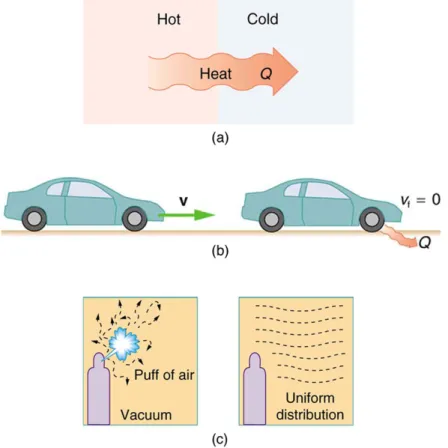
spontaneously cools off and starts moving. Yet another example is the expansion of a puff of gas introduced into one corner of a vacuum chamber. The gas expands to fill the chamber, but it never regroups in the corner. The random motion of the gas molecules could take them all back to the corner, but this is never observed to happen. (SeeFigure 15.16.)
Figure 15.16Examples of one-way processes in nature. (a) Heat transfer occurs spontaneously from hot to cold and not from cold to hot. (b) The brakes of this car convert its kinetic energy to heat transfer to the environment. The reverse process is impossible. (c) The burst of gas let into this vacuum chamber quickly expands to uniformly fill every part of the chamber. The random motions of the gas molecules will never return them to the corner.
The fact that certain processes never occur suggests that there is a law forbidding them to occur. The first law of thermodynamics would allow them to occur—none of those processes violate conservation of energy. The law that forbids these processes is called the second law of thermodynamics. We shall see that the second law can be stated in many ways that may seem different, but which in fact are equivalent. Like all natural laws, the second law of thermodynamics gives insights into nature, and its several statements imply that it is broadly applicable, fundamentally affecting many apparently disparate processes.
The already familiar direction of heat transfer from hot to cold is the basis of our first version of thesecond law of thermodynamics. The Second Law of Thermodynamics (first expression)
Heat transfer occurs spontaneously from higher- to lower-temperature bodies but never spontaneously in the reverse direction. Another way of stating this: It is impossible for any process to have as its sole result heat transfer from a cooler to a hotter object.
Heat Engines
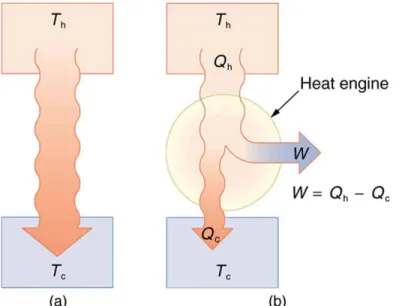
Now let us consider a device that uses heat transfer to do work. As noted in the previous section, such a device is called a heat engine, and one is shown schematically inFigure 15.17(b). Gasoline and diesel engines, jet engines, and steam turbines are all heat engines that do work by using part of the heat transfer from some source. Heat transfer from the hot object (or hot reservoir) is denoted as
Q
h, while heat transfer into the cold object (or cold reservoir) isQ
c, and the work done by the engine isW
. The temperatures of the hot and cold reservoirs areT
h andT
c, respectively.Figure 15.17(a) Heat transfer occurs spontaneously from a hot object to a cold one, consistent with the second law of thermodynamics. (b) A heat engine, represented here by a circle, uses part of the heat transfer to do work. The hot and cold objects are called the hot and cold reservoirs.
Q
h is the heat transfer out of the hot reservoir,W
is the work output, andQ
c is the heat transfer into the cold reservoir.Because the hot reservoir is heated externally, which is energy intensive, it is important that the work is done as efficiently as possible. In fact, we would like
W
to equalQ
h, and for there to be no heat transfer to the environment (Q
c= 0
). Unfortunately, this is impossible. Thesecond law of thermodynamicsalso states, with regard to using heat transfer to do work (the second expression of the second law):The Second Law of Thermodynamics (second expression)
It is impossible in any system for heat transfer from a reservoir to completely convert to work in a cyclical process in which the system returns to its initial state.
Acyclical processbrings a system, such as the gas in a cylinder, back to its original state at the end of every cycle. Most heat engines, such as reciprocating piston engines and rotating turbines, use cyclical processes. The second law, just stated in its second form, clearly states that such engines cannot have perfect conversion of heat transfer into work done. Before going into the underlying reasons for the limits on converting heat transfer into work, we need to explore the relationships among
W
,Q
h, andQ
c, and to define the efficiency of a cyclical heat engine. As noted, a cyclical process brings the system back to its original condition at the end of every cycle. Such a system’s internal energyU
is the same at the beginning and end of every cycle—that is,ΔU = 0
. The first law of thermodynamics states that(15.22)
ΔU = Q − W,
where
Q
is thenetheat transfer during the cycle (Q = Q
h− Qc
) andW
is the net work done by the system. SinceΔU = 0
for a complete cycle, we have (15.23)0 = Q − W,
so that (15.24)W = Q.
Thus the net work done by the system equals the net heat transfer into the system, or
(15.25)
W = Q
h− Q
c(cyclical process),
just as shown schematically inFigure 15.17(b). The problem is that in all processes, there is some heat transfer
Q
c to the environment—and usually a very significant amount at that.In the conversion of energy to work, we are always faced with the problem of getting less out than we put in. We defineconversion efficiency
Eff
to be the ratio of useful work output to the energy input (or, in other words, the ratio of what we get to what we spend). In that spirit, we define the efficiency of a heat engine to be its net work outputW
divided by heat transfer to the engineQ
h; that is,(15.26)
Eff = W
Q
h
.
Since
W = Q
h− Qc
in a cyclical process, we can also express this as(15.27)
Eff = Q
h− Q
cQ
h= 1 − Q
cmaking it clear that an efficiency of 1, or 100%, is possible only if there is no heat transfer to the environment (
Q
c= 0
). Note that allQ
s are positive. The direction of heat transfer is indicated by a plus or minus sign. For example,Q
c is out of the system and so is preceded by a minus sign.Example 15.3 Daily Work Done by a Coal-Fired Power Station, Its Efficiency and Carbon Dioxide Emissions
A coal-fired power station is a huge heat engine. It uses heat transfer from burning coal to do work to turn turbines, which are used to generate electricity. In a single day, a large coal power station has
2.50×10
14J
of heat transfer from coal and1.48×10
14J
of heat transfer into the environment. (a) What is the work done by the power station? (b) What is the efficiency of the power station? (c) In the combustion process, the following chemical reaction occurs:C + O
2→ CO
2. This implies that every 12 kg of coal puts 12 kg + 16 kg + 16 kg = 44 kg of carbon dioxide into the atmosphere. Assuming that 1 kg of coal can provide2.5×10
6J
of heat transfer upon combustion, how muchCO
2 is emitted per day by this power plant?Strategy for (a)
We can use
W = Q
h− Q
c to find the work outputW
, assuming a cyclical process is used in the power station. In this process, water is boiled under pressure to form high-temperature steam, which is used to run steam turbine-generators, and then condensed back to water to start the cycle again.Solution for (a)
Work output is given by:
(15.28)
W = Q
h− Qc.
Substituting the given values:
(15.29)
W = 2.50×10
14J – 1.48×10
14J
= 1.02×10
14J.
Strategy for (b)
The efficiency can be calculated with
Eff = W
Q
h sinceQ
h is given and workW
was found in the first part of this example. Solution for (b)Efficiency is given by:
Eff = W
Q
h. The workW
was just found to be1.02 × 10
14
J
, andQ
h is given, so the efficiency is
(15.30)
Eff = 1.02×10
14J
2.50×10
14J
= 0.408, or 40.8%
Strategy for (c)The daily consumption of coal is calculated using the information that each day there is
2.50×10
14J
of heat transfer from coal. In the combustion process, we haveC + O
2→ CO
2. So every 12 kg of coal puts 12 kg + 16 kg + 16 kg = 44 kg ofCO
2 into the atmosphere.Solution for (c)
The daily coal consumption is
(15.31)
2.50×10
14J
2.50×10
6J/kg
= 1.0×10
8kg.
Assuming that the coal is pure and that all the coal goes toward producing carbon dioxide, the carbon dioxide produced per day is
(15.32)
1.0×10
8kg coal×44 kg CO
212 kg coal = 3.7×10
8kg CO
2.
This is 370,000 metric tons of
CO
2 produced every day.Discussion
If all the work output is converted to electricity in a period of one day, the average power output is 1180 MW (this is left to you as an end-of-chapter problem). This value is about the size of a large-scale conventional power plant. The efficiency found is acceptably close to the value of 42% given for coal power stations. It means that fully 59.2% of the energy is heat transfer to the environment, which usually results in warming lakes, rivers, or the ocean near the power station, and is implicated in a warming planet generally. While the laws of thermodynamics limit the efficiency of such plants—including plants fired by nuclear fuel, oil, and natural gas—the heat transfer to the environment could be, and sometimes is, used for heating homes or for industrial processes. The generally low cost of energy has not made it economical to make better use of the waste heat transfer from most heat engines. Coal-fired power plants produce the greatest amount of
CO
2 per unit energy output (compared to natural gas or oil), making coal the least efficient fossil fuel.With the information given inExample 15.3, we can find characteristics such as the efficiency of a heat engine without any knowledge of how the heat engine operates, but looking further into the mechanism of the engine will give us greater insight.Figure 15.18illustrates the operation of the common four-stroke gasoline engine. The four steps shown complete this heat engine’s cycle, bringing the gasoline-air mixture back to its original condition.
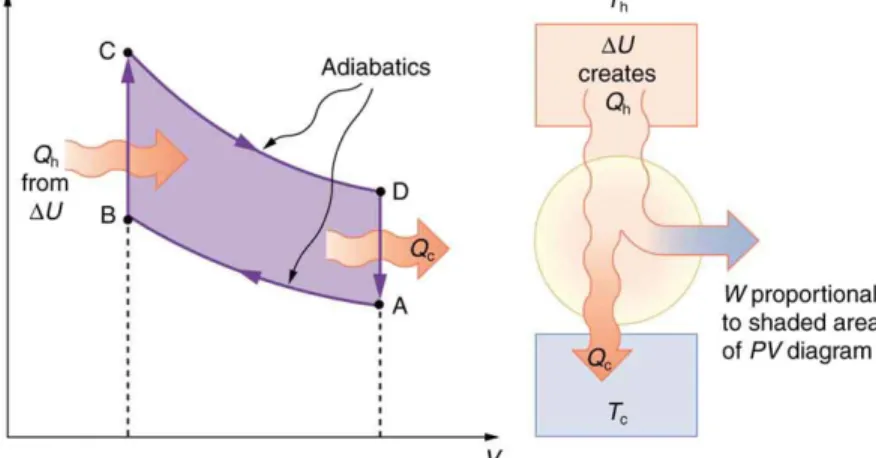
TheOtto cycleshown inFigure 15.19(a) is used in four-stroke internal combustion engines, although in fact the true Otto cycle paths do not correspond exactly to the strokes of the engine.
The adiabatic process AB corresponds to the nearly adiabatic compression stroke of the gasoline engine. In both cases, work is done on the system (the gas mixture in the cylinder), increasing its temperature and pressure. Along path BC of the Otto cycle, heat transfer
Q
h into the gas occurs at constant volume, causing a further increase in pressure and temperature. This process corresponds to burning fuel in an internal combustion engine, and takes place so rapidly that the volume is nearly constant. Path CD in the Otto cycle is an adiabatic expansion that does work on the outside world, just as the power stroke of an internal combustion engine does in its nearly adiabatic expansion. The work done by the system along path CD is greater than the work done on the system along path AB, because the pressure is greater, and so there is a net work output. Along path DA in the Otto cycle, heat transferQ
c from the gas at constant volume reduces its temperature and pressure, returning it to its original state. In an internal combustion engine, this process corresponds to the exhaust of hot gases and the intake of an air-gasoline mixture at a considerably lower temperature. In both cases, heat transfer into the environment occurs along this final path.The net work done by a cyclical process is the area inside the closed path on a
PV
diagram, such as that inside path ABCDA inFigure 15.19. Note that in every imaginable cyclical process, it is absolutely necessary for heat transfer from the system to occur in order to get a net work output. In the Otto cycle, heat transfer occurs along path DA. If no heat transfer occurs, then the return path is the same, and the net work output is zero. The lower the temperature on the path AB, the less work has to be done to compress the gas. The area inside the closed path is then greater, and so the engine does more work and is thus more efficient. Similarly, the higher the temperature along path CD, the more work output there is. (SeeFigure 15.20.) So efficiency is related to the temperatures of the hot and cold reservoirs. In the next section, we shall see what the absolute limit to the efficiency of a heat engine is, and how it is related to temperature.Figure 15.18In the four-stroke internal combustion gasoline engine, heat transfer into work takes place in the cyclical process shown here. The piston is connected to a rotating crankshaft, which both takes work out of and does work on the gas in the cylinder. (a) Air is mixed with fuel during the intake stroke. (b) During the compression stroke, the air-fuel mixture is rapidly compressed in a nearly adiabatic process, as the piston rises with the valves closed. Work is done on the gas. (c) The power stroke has two distinct parts. First, the air-fuel mixture is ignited, converting chemical potential energy into thermal energy almost instantaneously, which leads to a great increase in pressure. Then the piston descends, and the gas does work by exerting a force through a distance in a nearly adiabatic process. (d) The exhaust stroke expels the hot gas to prepare the engine for another cycle, starting again with the intake stroke.
Figure 15.19
PV
diagram for a simplified Otto cycle, analogous to that employed in an internal combustion engine. Point A corresponds to the start of the compression stroke of an internal combustion engine. Paths AB and CD are adiabatic and correspond to the compression and power strokes of an internal combustion engine, respectively. Paths BC and DA are isochoric and accomplish similar results to the ignition and exhaust-intake portions, respectively, of the internal combustion engine’s cycle. Work is done on the gas along path AB, but more work is done by the gas along path CD, so that there is a net work output.Figure 15.20This Otto cycle produces a greater work output than the one inFigure 15.19, because the starting temperature of path CD is higher and the starting temperature of path AB is lower. The area inside the loop is greater, corresponding to greater net work output.
15.4
Carnot’s Perfect Heat Engine: The Second Law of Thermodynamics Restated
Figure 15.21This novelty toy, known as the drinking bird, is an example of Carnot’s engine. It contains methylene chloride (mixed with a dye) in the abdomen, which boils at a very low temperature—about
100ºF
. To operate, one gets the bird’s head wet. As the water evaporates, fluid moves up into the head, causing the bird to become top-heavy and dip forward back into the water. This cools down the methylene chloride in the head, and it moves back into the abdomen, causing the bird to become bottom heavy and tip up. Except for a very small input of energy—the original head-wetting—the bird becomes a perpetual motion machine of sorts. (credit: Arabesk.nl, Wikimedia Commons)We know from the second law of thermodynamics that a heat engine cannot be 100% efficient, since there must always be some heat transfer
Q
c to the environment, which is often called waste heat. How efficient, then, can a heat engine be? This question was answered at a theoretical level in 1824 by a young French engineer, Sadi Carnot (1796–1832), in his study of the then-emerging heat engine technology crucial to the Industrial Revolution. He devised a theoretical cycle, now called theCarnot cycle, which is the most efficient cyclical process possible. The second law of thermodynamics can be restated in terms of the Carnot cycle, and so what Carnot actually discovered was this fundamental law. Any heat engine employing the Carnot cycle is called aCarnot engine.What is crucial to the Carnot cycle—and, in fact, defines it—is that only reversible processes are used. Irreversible processes involve dissipative factors, such as friction and turbulence. This increases heat transfer
Q
c to the environment and reduces the efficiency of the engine. Obviously, then, reversible processes are superior.Carnot Engine
Stated in terms of reversible processes, thesecond law of thermodynamicshas a third form:
A Carnot engine operating between two given temperatures has the greatest possible efficiency of any heat engine operating between these two temperatures. Furthermore, all engines employing only reversible processes have this same maximum efficiency when operating between the same given temperatures.
Figure 15.22shows the
PV
diagram for a Carnot cycle. The cycle comprises two isothermal and two adiabatic processes. Recall that both isothermal and adiabatic processes are, in principle, reversible.Carnot also determined the efficiency of a perfect heat engine—that is, a Carnot engine. It is always true that the efficiency of a cyclical heat engine is given by:
(15.33)
Eff = Q
h− Qc
Q
h= 1 − Q
cQ
h.
What Carnot found was that for a perfect heat engine, the ratio
Q
c/ Q
h equals the ratio of the absolute temperatures of the heat reservoirs. That is,Q
c/ Q
h= Tc
/ T
h for a Carnot engine, so that the maximum orCarnot efficiencyEff
C is given by(15.34)
Eff
C= 1 − T
T
ch,
where
T
h andT
c are in kelvins (or any other absolute temperature scale). No real heat engine can do as well as the Carnot efficiency—an actual efficiency of about 0.7 of this maximum is usually the best that can be accomplished. But the ideal Carnot engine, like the drinking bird above, while a fascinating novelty, has zero power. This makes it unrealistic for any applications.Carnot’s interesting result implies that 100% efficiency would be possible only if
T
c= 0 K
—that is, only if the cold reservoir were at absolute zero, a practical and theoretical impossibility. But the physical implication is this—the only way to have all heat transfer go into doing work is to removeall thermal energy, and this requires a cold reservoir at absolute zero.It is also apparent that the greatest efficiencies are obtained when the ratio
T
c/ T
h is as small as possible. Just as discussed for the Otto cycle in the previous section, this means that efficiency is greatest for the highest possible temperature of the hot reservoir and lowest possible temperature of the cold reservoir. (This setup increases the area inside the closed loop on thePV
diagram; also, it seems reasonable that the greater the temperature difference, the easier it is to divert the heat transfer to work.) The actual reservoir temperatures of a heat engine are usually related to the type of heat source and the temperature of the environment into which heat transfer occurs. Consider the following example.Figure 15.22
PV
diagram for a Carnot cycle, employing only reversible isothermal and adiabatic processes. Heat transferQ
h occurs into the working substance during the isothermal path AB, which takes place at constant temperatureT
h. Heat transferQ
c occurs out of the working substance during the isothermal path CD, which takes place at constant temperatureT
c. The net work outputW
equals the area inside the path ABCDA. Also shown is a schematic of a Carnot engine operating between hot and cold reservoirs at temperaturesT
h andT
c. Any heat engine using reversible processes and operating between these two temperatures will have the same maximum efficiency as the Carnot engine.Example 15.4 Maximum Theoretical Efficiency for a Nuclear Reactor
A nuclear power reactor has pressurized water at
300ºC
. (Higher temperatures are theoretically possible but practically not, due to limitations with materials used in the reactor.) Heat transfer from this water is a complex process (seeFigure 15.23). Steam, produced in the steam generator, is used to drive the turbine-generators. Eventually the steam is condensed to water at27ºC
and then heated again to start the cycle over. Calculate the maximum theoretical efficiency for a heat engine operating between these two temperatures.Figure 15.23Schematic diagram of a pressurized water nuclear reactor and the steam turbines that convert work into electrical energy. Heat exchange is used to generate steam, in part to avoid contamination of the generators with radioactivity. Two turbines are used because this is less expensive than operating a single generator that produces the same amount of electrical energy. The steam is condensed to liquid before being returned to the heat exchanger, to keep exit steam pressure low and aid the flow of steam through the turbines (equivalent to using a lower-temperature cold reservoir). The considerable energy associated with condensation must be dissipated into the local environment; in this example, a cooling tower is used so there is no direct heat transfer to an aquatic environment. (Note that the water going to the cooling tower does not come into contact with the steam flowing over the turbines.)
Strategy
Since temperatures are given for the hot and cold reservoirs of this heat engine,
Eff
C= 1 − T
T
hc can be used to calculate the Carnot (maximum theoretical) efficiency. Those temperatures must first be converted to kelvins.Solution
The hot and cold reservoir temperatures are given as
300ºC
and27.0ºC
, respectively. In kelvins, then,T
h= 573 K
andT
c= 300 K
, so that the maximum efficiency is(15.35)
Eff
C= 1 − T
T
ch.
Thus, (15.36)Eff
C= 1 − 300 K
573 K
= 0.476, or 47.6%.
DiscussionA typical nuclear power station’s actual efficiency is about 35%, a little better than 0.7 times the maximum possible value, a tribute to superior engineering. Electrical power stations fired by coal, oil, and natural gas have greater actual efficiencies (about 42%), because their boilers can reach higher temperatures and pressures. The cold reservoir temperature in any of these power stations is limited by the local environment.
Figure 15.24shows (a) the exterior of a nuclear power station and (b) the exterior of a coal-fired power station. Both have cooling towers into which water from the condenser enters the tower near the top and is sprayed downward, cooled by evaporation.
Figure 15.24(a) A nuclear power station (credit: BlatantWorld.com) and (b) a coal-fired power station. Both have cooling towers in which water evaporates into the environment, representing
Q
c. The nuclear reactor, which suppliesQ
h, is housed inside the dome-shaped containment buildings. (credit: Robert & Mihaela Vicol, publicphoto.org)Since all real processes are irreversible, the actual efficiency of a heat engine can never be as great as that of a Carnot engine, as illustrated in
Figure 15.25(a). Even with the best heat engine possible, there are always dissipative processes in peripheral equipment, such as electrical transformers or car transmissions. These further reduce the overall efficiency by converting some of the engine’s work output back into heat transfer, as shown inFigure 15.25(b).
Figure 15.25Real heat engines are less efficient than Carnot engines. (a) Real engines use irreversible processes, reducing the heat transfer to work. Solid lines represent the actual process; the dashed lines are what a Carnot engine would do between the same two reservoirs. (b) Friction and other dissipative processes in the output mechanisms of a heat engine convert some of its work output into heat transfer to the environment.
15.5
Applications of Thermodynamics: Heat Pumps and Refrigerators
Figure 15.26Almost every home contains a refrigerator. Most people don’t realize they are also sharing their homes with a heat pump. (credit: Id1337x, Wikimedia Commons)
Heat pumps, air conditioners, and refrigerators utilize heat transfer from cold to hot. They are heat engines run backward. We say backward, rather than reverse, because except for Carnot engines, all heat engines, though they can be run backward, cannot truly be reversed. Heat transfer occurs from a cold reservoir
Q
c and into a hot one. This requires work inputW
, which is also converted to heat transfer. Thus the heat transfer to the hot reservoir isQ
h= Qc
+ W
. (Note thatQ
h,Q
c, andW
are positive, with their directions indicated on schematics rather than by sign.) A heat pump’s mission is for heat transferQ
h to occur into a warm environment, such as a home in the winter. The mission of air conditioners and refrigerators is for heat transferQ
c to occur from a cool environment, such as chilling a room or keeping food at lower temperatures than the environment. (Actually, a heat pump can be used both to heat and cool a space. It is essentially an air conditioner and a heating unit all in one. In this section we will concentrate on its heating mode.)Figure 15.27Heat pumps, air conditioners, and refrigerators are heat engines operated backward. The one shown here is based on a Carnot (reversible) engine. (a) Schematic diagram showing heat transfer from a cold reservoir to a warm reservoir with a heat pump. The directions of
W
,Q
h, andQ
c are opposite what they would be in a heat engine. (b)PV
diagram for a Carnot cycle similar to that inFigure 15.28but reversed, following path ADCBA. The area inside the loop is negative, meaning there is a net work input. There is heat transferQ
c into the system from a cold reservoir along path DC, and heat transferQ
h out of the system into a hot reservoir along path BA.Heat Pumps
The great advantage of using a heat pump to keep your home warm, rather than just burning fuel, is that a heat pump supplies
Q
h= Qc
+ W
. Heat transfer is from the outside air, even at a temperature below freezing, to the indoor space. You only pay forW
, and you get an additional heat transfer ofQ
c from the outside at no cost; in many cases, at least twice as much energy is transferred to the heated space as is used to run the heat pump. When you burn fuel to keep warm, you pay for all of it. The disadvantage is that the work input (required by the second law ofthermodynamics) is sometimes more expensive than simply burning fuel, especially if the work is done by electrical energy.
The basic components of a heat pump in its heating mode are shown inFigure 15.28. A working fluid such as a non-CFC refrigerant is used. In the outdoor coils (the evaporator), heat transfer
Q
c occurs to the working fluid from the cold outdoor air, turning it into a gas.Figure 15.28A simple heat pump has four basic components: (1) condenser, (2) expansion valve, (3) evaporator, and (4) compressor. In the heating mode, heat transfer
Q
c occurs to the working fluid in the evaporator (3) from the colder outdoor air, turning it into a gas. The electrically driven compressor (4) increases the temperature and pressure of the gas and forces it into the condenser coils (1) inside the heated space. Because the temperature of the gas is higher than the temperature in the room, heat transfer from the gas to the room occurs as the gas condenses to a liquid. The working fluid is then cooled as it flows back through an expansion valve (2) to the outdoor evaporator coils.The electrically driven compressor (work input
W
) raises the temperature and pressure of the gas and forces it into the condenser coils that are inside the heated space. Because the temperature of the gas is higher than the temperature inside the room, heat transfer to the room occurs and the gas condenses to a liquid. The liquid then flows back through a pressure-reducing valve to the outdoor evaporator coils, being cooled through expansion. (In a cooling cycle, the evaporator and condenser coils exchange roles and the flow direction of the fluid is reversed.)The quality of a heat pump is judged by how much heat transfer
Q
h occurs into the warm space compared with how much work inputW
is required. In the spirit of taking the ratio of what you get to what you spend, we define aheat pump’s coefficient of performance(COP
hp) to be(15.37)
COP
hp= Q
W .
hSince the efficiency of a heat engine is
Eff = W / Q
h, we see thatCOP
hp= 1 / Eff
, an important and interesting fact. First, since the efficiency of any heat engine is less than 1, it means thatCOP
hp is always greater than 1—that is, a heat pump always has more heat transferQ
h than work put into it. Second, it means that heat pumps work best when temperature differences are small. The efficiency of a perfect, or Carnot, engine isEff
C= 1 −
⎛⎝T
c/ T
h⎞⎠; thus, the smaller the temperature difference, the smaller the efficiency and the greater theCOP
hp (becauseCOP
hp= 1 / Eff
). In other words, heat pumps do not work as well in very cold climates as they do in more moderate climates.Friction and other irreversible processes reduce heat engine efficiency, but they donotbenefit the operation of a heat pump—instead, they reduce the work input by converting part of it to heat transfer back into the cold reservoir before it gets into the heat pump.