Statistics
Denmark
Statistics
Finland
Statistics Norway
Statistics Netherlands
Statistics Sweden
International Sourcing
Moving Business Functions Abroad
Issued by: Statistics Denmark June 2008 Cirkulation: 1000 Printet by Fihl Jensen
Printed version: Price: 90,00 DKK. incl. 25 % VAT Can be obtained from www.dst.dk/boghandel
ISBN 978-87-501-1695-0
Pdf-version: Free access on:
www.dst.dk/publ/InterSourcing www.dst.dk/globalisering/InterSourcing ISBN 978-87-501-1696-7 Address: Statistics Denmark Sejrøgade 11 DK-2100 København Ø Tel. +45 39 17 39 17 Fax +45 39 17 39 99 E-mail: [email protected] www.dst.dk © Statistics Denmark 2008
All rights reserved. No part of this book may be reproduced or transmitted in any form
or by any means without permission in writing from the publisher according to the Danish Copyright Act. Excepted from this is the quotation-right, which gives the right to use quotations
with an indication of this publication as source in accordance with good custom and to the extent determined by the purpose.
Preface
The continuous globalisation of our economies confronts the national statistical offices with new challenges and user demands to measure new phenomena such as international sourcing. The increased frag-mentation of the value chain resulting from the sourcing of business functions internationally is an important feature of the globalisation process.
International sourcing – or off-shoring, which is the term the media commonly uses of the process – has attracted considerable policy and media attention particularly due to its perceived impacts on domestic employment. The debate has mainly been based on anecdotal evidence, as statistical evidence measuring the phenomena and its impact has not been available so far.
EUROSTAT, the Statistical Office of the European Communities, and the national statistical offices in the Member States have therefore launched an ad-hoc survey on international sourcing to establish the statistical evidence about the level, patterns and possible impacts of international sourcing for the European economies needed by policy-makers, researchers and other data users.
This joint publication by the national statistical offices of Denmark, Finland, the Netherlands, Norway and Sweden is also evidence of the importance and impact of globalisation. Comparing and analysing the results of the survey on international sourcing adds important value to the national results as it allows users to benchmark the performance of the domestic enterprises.
The co-ordination and main editorial tasks have been carried out by Statistics Denmark in close co-operation with the four other statistical offices. The publication has been compiled by an editorial group consis-ting of:
Peter Bøegh Nielsen (co-ordinator) Statistics Denmark (E-mail: [email protected]) Samuli Rikama
Statistics Finland (E-mail: [email protected]) Gusta van Gessel
Statistics Netherlands (E-mail: [email protected]) John Aage Haugen
Statistics Norway (E-mail: [email protected]) Kerstin Forssén
Statistics Sweden (E-mail: [email protected] )
Statistics Denmark, June 2008 Jan Plovsing
/
Explanation of symbols 0
0,0 } Less than 0.5 of the unit applied . Category not applicable
. . Data too uncertain or disclosed due to confidentiality . . . Data not available
Table of Contents
Summary. . . . 7
Introduction. . . . 10
1. Objectives and scope. . . 12
2. Survey Coverage and Target Population. . . 12
3. Business Functions. . . 13
4. The General Structure of the Questionnaire. . . 14
5. Survey Results. . . 15
1. Level and Pattern of International Sourcing. . . 17
1.1 Business Structure. . . 17
1.2 Level of International Sourcing. . . 18
1.3 Sectoral Comparison of International Sourcing. . . 20
2. Destinations and Types of Business Patterns for International Sourcing. . . 25
2.1 Destinations for International Sourcing. . . 25
2.2 Business Patterns for International Sourcing. . . 30
3. Plans for International Sourcing. . . . 34
3.1 Structure of Future International Sourcing. . . 34
3.2 Destinations for Future International Sourcing. . . 35
3.3 Destinations for Future International Sourcing by Business Function. . . . 36
4. Motivations and Barriers for International Sourcing. . . 41
4.1 Motivations for International Sourcing. . . 42
4.2 Motivations for Future International Sourcing. . . 45
4.3 Barriers to International Sourcing. . . 48
5. Impacts of International Sourcing. . . 56
5.1 Employment Impacts. . . 57
5.2 Other Impacts. . . 60
6. Special Feature: International Sourcing to Asia. . . 65
6.1 Introduction. . . 65
6.1 Sourcing to Asia. . . 66
Annex 1 Methodology . . . 71
Annex 2 EUROSTAT Questionnaire on International Sourcing. . . . 76
Summary
In the current debate the phenomenon of international sourcing is referred to with a variety of labels and terms such as off-shoring, near-shoring, delocalisation or outsourcing which are often used without explicit definitions. The somewhat generic heading of international sourcing has been chosen as a term to be used in this project.
The current discussions about the magnitude and impact of interna-tional sourcing are mainly based on anecdotal evidence as no harmo-nised and internationally comparable official statistics are currently available. Therefore EUROSTAT, the Statistical Office of the European Commission, and the national statistical offices in the Member States have launched an ad-hoc survey on international sourcing to establish statistical evidence needed by policy-makers, researchers and other users about the level, patterns and possible impacts of international sourcing for the European economies.
The national statistical offices in Denmark, Finland, the Netherlands, Norway and Sweden have decided to disseminate the national results of the survey on international sourcing in a joint publication. The publi-cation analyses differences across the countries to the extent they have integrated into the newest feature of economic globalisation, namely the increased fragmentation of the value chain allowing for moving business functions of the enterprises abroad totally or in parts in search of lower costs, other efficiency gains and/or access to skilled labour and new market opportunities.
An important feature of the survey is the splitting of the activities carried out by the enterprises into a number of business functions, i.e. into the core business functions of the enterprise, being a primary or secondary activity, and into a number of support business functions.
When comparing the national results one should be careful in analyzing the differences in exact values. The quality and harmonization of the survey across countries however generally allow for more general benchmarking which indicates possible similarities or differences in the reported levels.
The level of international sourcing is relatively similar across the five countries – with the exception of Sweden, partly due to a different survey set-up. The largest share of enterprises having sourced interna-tionally is found in Denmark (19 per cent of all enterprises with 50 or more employees), followed closely by Finland (16 per cent), Norway and the Netherlands (14 per cent).
The main business function sourced abroad is the core functions of the enterprises. This is the case especially for manufacturing enterprises as about 70 per cent of the manufacturing enterprises in Denmark, Finland and the Netherlands having sourced internationally have sourced their core functions abroad. Norwegian manufacturing enterprises showed
the lowest share (60 per cent) of enterprises sourcing their core activity abroad.
The most commonly sourced support function is ICT services which have been sourced by 25-30 per cent of the enterprises having sourced. A characteristic of the sourcing of ICT support functions is that mainly service enterprises source this function abroad.
More than one-half of all international sourcing activities from the five countries take place within the European Union. Denmark is the most active in sourcing to destinations outside the EU, although more than 50 per cent of its sourcing stays within the EU. Another important region for sourcing activities is Asia. One-fourth of all sourcing activities have Asia as destination.
The most frequent destinations for the sourcing of core functions, mainly manufacturing production, are the new EU Member States and Asia. Support functions are generally not moved to very distant locations. The old Member States are the most frequent destinations for enterprises sourcing their support functions abroad.
When carrying out international sourcing enterprises most often choose insourcing as the model, i.e. source business functions abroad within the same enterprise group. Outsourcing of business functions to external suppliers abroad is a less frequent type of international sour-cing. The only exception is Denmark where outsourcing and insourcing are almost equally important types of international sourcing.
Future sourcing expected for 2007-2009 is characterised by the growing importance of non-EU destinations. Core functions are expected to increase in importance in international sourcing as about 40 per cent or more of planned international sourcing from the five countries are core functions.
The new Member States together with China score the highest frequencies as expected destinations for future sourcing of core func-tions in 2007-2009. The most frequently expected sourcing destinafunc-tions of ICT functions are the old Member States.
In general, efficiency seeking factors such as cost reductions are the main drivers of international sourcing for enterprises in all countries. Reductions in labour costs are most often pursued when shifting functions abroad. Labour cost reductions are most important for enterprises in Denmark, Sweden and the Netherlands, where almost 60 per cent of the enterprises considered labour cost reductions very important.
Strategic decisions taken by the group head are also a key driver for international sourcing in all countries, with the exception of Denmark. Enterprises often also rate access to new markets as an important reason for international sourcing, particularly in Finland and the Netherlands.
Overall, enterprises perceive only rather limited barriers which hamper the international sourcing process. The main barrier for international sourcing reported by enterprises in all countries is that proximity to clients was needed. In addition, concerns of the sourcing operation exceeding benefits are generally considered as an important barrier. There were no major differences experienced across the countries.
Danish enterprises estimate gross job losses due to international sourcing to amount to 25,000 – 35,000 during 2001-2006 or approxi-mately 5,000 jobs lost annually – or less than 1 per cent of the workforce in enterprises with 50 or more employees. On the other hand, the enterprises report job creations constituting 7,000-10,000 jobs during the period 2001-2006 (or approx. 1,400 jobs annually) due to their sourcing of business functions abroad.
Plans to move high skill jobs abroad are much less frequently reported by enterprises when compared with plans to move other types of jobs abroad during the period 2007-2009. In addition, international sourcing is expected to generate more high skill job creation than high skill job losses during 2007-2009.
While international sourcing, on the one hand, causes the movement of high skill jobs abroad less often than other types of jobs, it also generates more often high skill job creation than creation of other types of jobs.
The overall perception of the impacts of international sourcing by enterprises is rather even across the Nordic countries and the Netherlands. Enterprises strongly consider international sourcing to have a major positive impact on their overall competitiveness.
Introduction
Industrial restructuring has been an important factor influencing the economic development within the EU in recent decades. It has especially affected the manufacturing sector, and has led to concerns amongst policy makers about a potential process of deindustrialisation in the EU. A more recent trend, increasing concerns about the future employment opportunities in Europe even further, is the apparent growth in international sourcing of services, especially to countries outside the EU. It has received a great deal of political and media attention, which has mainly been based on anecdotal evidence in the form of individual cases.
The international sourcing of services as a business strategy is being facilitated by technological developments, especially within ICT, allowing companies to codify and transfer information and knowledge globally. Another significant facilitator is the increased globalisation of services markets as a consequence of market deregulation and trade liberalisation.
While manufacturing activities are mainly independent of the location of production, the majority of service functions require a proximity to markets and clients. Therefore the services sourced internationally are mainly back-office functions, e.g. ICT services or finance/accounting services, enabled by the increased use of ICT and Internet connectivity of enterprises worldwide. However, there has also been a development towards moving various service functions that focus on customer contacts, especially call centres.
In the current debate the phenomenon of international sourcing has a variety of labels and terms such as off-shoring, near-shoring, delocali-sation or outsourcing, which are often used without explicit definitions. The somewhat generic heading of international sourcing has been chosen as a term to be used in this project.
The definition used for international sourcing is strict in terms of location, as it is limited to events replacing domestic production with foreign production. On the other hand, it is less restrictive with regard to control, as it includes all types of relocation of production of goods or services, irrespective of whether functions are sourced to an affiliated enterprise abroad or contracted out to an unaffiliated supplier abroad. The definition also includes all types of affiliated enterprises, and does not distinguish between greenfield establishments and existing affi-liates.
Definition of insourcing and outsourcing. CONTROL LOCATION External production outside the enterprise or enterprise group Domestic Sourcing (Outsourcing) Production outside the enterprise or group by non-affiliated enterprises but within the compiling country International Sourcing (Outsourcing) Production outside the enterprise or group and outside the compiling country by non-affiliated enterprises. This involves foreign subcontracting Internal production within
the enterprise group
Domestic Sourcing (Insourcing) Production within the enterprise group to which the enterprise belongs and within the compiling country
International Sourcing (Insourcing) Production within the group to which the enterprise belongs but abroad (by affiliated enterprises)
The survey focuses on the movement of domestic production to produ-cers located abroad (see below for the definition) as a result of a decision taken by a resident producer to reduce or close down pro-duction of goods or services domestically. This includes both core and support business functions of the enterprise. This publication focuses on international sourcing and does not address the issue of domestic sourcing.
It is important to emphasize that the expansion of the resident enterprises abroad are carried out in other forms than international sourcing, e.g. expanding existing foreign affiliates or acquisitions of foreign enterprises without moving currently performed business functions abroad. These types of activities are – by definition - not in-cluded in the analysis even if the borderlines between international sourcing and other types of expansion abroad must be described as blurred.
International sourcing is not a one-way street only moving business functions abroad. Enterprises in Denmark, Finland, the Netherlands, Norway and Sweden are also part of the global value chain receiving tasks due to sourcing from abroad. The impacts on the economies of these types of activities are not addressed in this publication.
1. Objectives and Scope
As stated above, the current discussions about the magnitude and im-pact of international sourcing are mainly based on anecdotal evidence as no harmonised and internationally comparable official statistics are currently available. Therefore EUROSTAT, the statistical office of the European Commission, and the national statistical offices in the Member States have launched an ad-hoc survey on international sourcing to establish statistical evidence needed by policy-makers, researchers and other users about the level, patterns and possible impacts of international sourcing for the European economies.
The overall objective of the international sourcing project is to provide decision-makers at the national and European levels with relevant statistical evidence and information about factors driving international sourcing, e.g. the impact on the competitiveness, motivations and perceived benefits and barriers together with possible employment consequences in the Member States.
In order to provide the statistical evidence needed, a survey tool and a methodology for monitoring the factors driving international sourcing have been developed by the national statistical offices, cf. Annexes 1 and 2. The project was launched in 2006 and the survey has been carried out between April and November 2007 in the 13 Member States and EEA countries participating.
2. Survey Coverage and Target Population
The survey on international sourcing is an economy-wide ad-hoc survey as it covers the so called non-financial business economy (NACE sec-tions C to I and K).
The focus of the survey is on large enterprises as the multinational groups of enterprises are considered to be the key players in inter-national sourcing. In terms of employment size class at the European level, a relatively high threshold is established: 100 or more employees. Several statistical offices decided to lower the threshold to enterprises with 50 or more employees as this size class is seen as more relevant for especially smaller economies such as the Nordic countries. The statis-tical unit is that used in the European Structural Business Statistics framework, i.e. the enterprise.
Definition of International Sourcing.
The total or partial movement of business functions (core or support business functions) currently performed in-house or domestically outsourced by the resident enterprise to either non-affiliated (external suppliers) or affiliated enterprises located abroad.
3. Business Functions
The remarkable development in the last decades especially within information and communication technologies has led to an increased fragmentation of the value chain. This relates both the production process and the location for carrying out the tasks involved. In order to understand the development it is necessary to identify a unit of analysis which is smaller than the enterprise – which is the main statistical unit in European structural business statistics. Consequently the concept of business function has been introduced and implemented in this survey on international sourcing, (see below).
Definition of Business Functions. Core business function:
Production of final goods or services intended for the market/for third parties carried out by the enterprise and yielding income. The core business function equals in most cases the primary activity of the enterprise. It may also include other (secondary) activities if the enterprise considers these to comprise part of their core functions.
Support business function:
Support business functions (ancillary activities) are carried out in order to permit or facilitate production of goods or services intended for the market/for third parties by the enterprise. The outputs of the support business functions are not themselves intended directly for the market/for third parties. The support business functions are in the survey divided into:
Distribution and logistics:
This support function consists of transportation activities, warehousing and order processing functions. In figures and tables “Distribution” is used as an abbreviation for this function.
Marketing, sales and after sales services including help desks and call centres:
This support function consists of market research, advertising, direct marketing services (telemarketing), exhibitions, fairs and other marketing or sales services. Also including call-centre services and after sales services such as help-desks and other customer supports services. In figures and tables “Marketing and sales” is used as an abbreviation for this function.
ICT services:
This support function includes IT-services and telecommunication. IT services consist of hardware and software consultancy, customised software data Box 2
processing and database services, maintenance and repair, web-hosting, other computer related and information services. Packaged software and hardware are excluded. In figures and tables “ICT services” is used as an abbreviation for this function.
Administrative and management functions:
This support function includes legal services, accounting, book-keeping and auditing, business management and consultancy, HR management (e.g. training and education, staff recruitment, provision of temporary personnel, payroll management, health and medical services), corporate financial and insurance services. Procurement functions are included as well. In figures and tables “Administration” is used as an abbreviation for this function.
Engineering and related technical services:
This support function includes engineering and related technical consultancy, technical testing, analysis and certification. Design services are included as well. In figures and tables” Engineering” is used as an abbreviation for this function.
Research & Development:
This support function includes intramuralresearch and experimental develop-ment. In figures and tables “R&D” is used as an abbreviation for this function.
4. The General Structure of the Questionnaire
The questionnaire on international sourcing is designed as a general survey tool applicable for all economic activities. In addition, the core of the questionnaire is based on a qualitative approach, which is considered to be the most useful basis to provide harmonised data allowing comparisons between the participating countries in this difficult and not well established area.
The survey consists of 6 modules collecting background information together with some general aspects of international sourcing. The focus of the survey is on the international sourcing activity of the enterprise i.e. on the module 3. Module 4 asks information about the international sourcing plans of the enterprises which have not yet sourced. Module 5 tries to estimate the expected impact on employment of the planned international sourcing. Finally, the question on barriers related to international sourcing activity in module 6 is aimed at all enterprises.
Structure of the Questionnaire.
Module 1: General information (for all enterprises)
Module 2: Sourcing activity of the enterprise (for all enterprises)
Module 3: Sourcing activity of the enterprise carried out internationally during 2001-2006 (for enterprises already carrying out international sour-cing in 2001-2006)
Module 4: Plans for international sourcing 2007-2009 (for enterprises with no prior international sourcing activity)
Module 5: Future impact on employment (for enterprises with international sourcing during 2001-2006 and/or plans for international sourcing during 2007-2009)
Module 6: Barriers on international sourcing (for all enterprises)
For more details about the questionnaire and the survey methodology used, see Annexes 1 and 2.
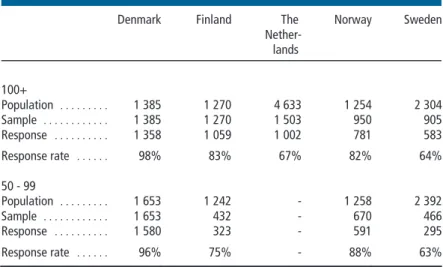
The questionnaire seems to have functioned well and the response rates are relatively high for an ad hoc survey which only in Denmark and Finland was carried out as mandatory surveys.
Survey Response Rates.
0 10 20 30 40 50 60 70 80 90 100
Denmark Norway Finland The Netherlands Sweden Per cent
Note: Enterprises with 50 or more employees – except for the Netherlands covering 100 or more employees.
5. Survey Results
The national statistical offices in Denmark, Finland, the Netherlands, Norway and Sweden have decided to disseminate the national results of the survey on international sourcing in a joint publication. In order to put the results into perspective, it has been considered valuable for the users to produce comparable results across the countries which are characterised by being small, open economies in the Northern part of Europe. Also the business structures are relatively similar, allowing for analysis of differences across the countries to the extent they have integrated into the newest feature of economic globalisation; the increased fragmentation of the value chain allowing for moving all or parts of the business functions of the enterprises abroad in the search of Figure 1
lower costs, other efficiency gains and/or access to skilled labour and new market opportunities.
When analyzing the results of the survey on international sourcing, it is important to understand that this is a pilot project introducing new concepts in a statistical framework. The issue is rather complex to mea-sure as movement of business functions is an on-going process for which it might be difficult to take stock at a given point in time. It is also im-possible to draw a strict line between international sourcing of functions currently performed in-house and other types of expansion abroad, e.g. establishing a plant on a totally new market such as China or South America.
The survey operates deliberately with a design mainly asking relatively simple questions which can be answered by tick marking an answer. Furthermore, as the survey was only mandatory in Denmark and Finland, the response rates in the other countries might influence the quality of the results and the possibilities for detailed breakdowns.
Due to differences in the survey methodology used, not all the infor-mation collected in the national surveys has been considered of a quality allowing for cross-country analysis. When comparing the nation-nal results one should be careful in anation-nalyzing the differences in exact values, but the quality and harmonization of the survey across countries usually allow for more general benchmarking indicating possible similarities or differences in the reported levels, see Annex 1 for applied national methodologies.
1.
Level and Pattern of International Sourcing
Main findings:• The level of international sourcing is relatively similar across the five countries – with the exception of Sweden. The largest share of enterprises having sourced internationally is found in Denmark (19 per cent of all enterprises with 50 or more employees), followed closely by Finland (16 per cent), Norway and the Netherlands (14 per cent). In Sweden the share stands at 4 per cent, see the Methodology annex for a different Swedish survey set-up and its possible impact on the level of international sourcing in Sweden. • The main business function sourced abroad is the core business of the
enterprises. This is the case especially for manufacturing enterprises as about 70 per cent of the manufacturing enterprises in Denmark, Finland and the Netherlands having sourced internationally have sourced their core functions abroad. Norwegian manufacturing enterprises showed the lowest share (60 per cent) of enterprises sourcing their core activity abroad.
• The most commonly sourced support function is ICT services which have been sourced by 25-30 per cent of the enterprises having sourced. A characteristic of the sourcing of ICT support functions is that mainly service enterprises source this function abroad.
1.1 Business Structure
The frequency of international sourcing in a country depends on a number of factors, e.g. the regulatory framework, openness of the economy, geographical location or the national business structure. The business structure is important in understanding the national levels of international sourcing as manufacturing enterprises – due to their limi-ted dependency on proximity to suppliers or clients – can move produc-tion across borders more easily. This partly explains why manufacturing enterprises have been sourcing their production internationally for decades; especially the textile industry has been an early mover in adopting international sourcing as a business model. The textile indu-stry began intensive international sourcing as early as in the 1970’s and 1980’s. This chapter compares the business structures of the five coun-tries in order to identify possible differences which can be explanatory factors for differences in the level of international sourcing across the countries.
In general, the five countries can be described as having rather similar business structures. It should, however, be noted that in Finland 42 per cent of all enterprises with 50 or more employees operate in the manu-facturing sector, cf. Annex Table 1.1. By contrast, the manumanu-facturing sector in Norway only makes up 30 per cent, and the share of high tech manufacturing enterprises is especially low.
Another sector which potentially could use international sourcing as a frequent business model is the knowledge intensive business services (KIBS) sector, which includes the ICT sector. Especially the rapid development of information and communication technologies has been a factor driving recent international sourcing of services. This applies especially to digital services which easily can be transported across huge distances. The KIBS sector is equally important across the five countries.
1.2 Level of International Sourcing
The level of international sourcing is relatively even across the exami-ned countries; varying from 19 to 14 per cent of all enterprises having sourced internationally – except for Sweden (only 4 per cent, see Annex 1 for explanation). Denmark has the largest share and the Netherlands the lowest, cf. Figure 1.2.1. It should be noted that the Dutch results only comprise enterprises with 100 or more employees. As larger enter-prises are more likely to source internationally than smaller ones; the Dutch level must be interpreted as relatively smaller. In Denmark, 25 per cent of all enterprises with 100 or more employees have sourced internationally, and the shares of this largest size class are 22 per cent in Finland, 17 per cent in Norway and 6 per cent in Sweden.
Level of international sourcing 2001-2006 and planned international sourcing 2007-2009. 0 2 4 6 8 10 12 14 16 18 20
Denmark Finland Norway The Netherlands Sweden Share of enterprises having sourced internationally 2001-2006
Share of enterprises having plans for international sourcing 2007-2009 Per cent
Note: Enterprises with 50 or more employees – except for the Netherlands covering 100 or more employees. Enterprises with plans 2007-2009 only include enterprises not having sourced internationally in the previous period 2001-2006, expect for Norway also including enterprises with sourcing activities 2001-2006.
Enterprises having sourced internationally - broken down by sector. 0 5 10 15 20 25 30 35
Denmark Norway Finland The Netherlands
Manufacturing Services
Per cent
Note: Enterprises with 50 or more employees – except for the Netherlands covering 100 or more employees.
The shares of enterprises in each of the five countries that have planned international sourcing for the period 2007 to 2009 vary between 5 and 11 per cent. Sweden shows the highest share of enterprises with planned sourcing and the Netherlands the lowest. See chapter 3 for a more detailed analysis of the plans for future international sourcing.
If the reported plans are all implemented as stated in the survey, this would indicate that- roughly estimated - at least 25 per cent of the Danish enterprises will have sourced internationally in 2009, followed by the Finnish enterprises (22 per cent), Dutch (19 per cent), Norwe-gian (18 per cent) and finally Swedish enterprises (15 per cent).
International sourcing in the four Nordic countries and the Netherlands shares to some extent the same patterns when broken down by business functions (see Annex Table 1.2). The core business functions are most frequently sourced in all the five countries. In Sweden (82 per cent), Finland (58 per cent), the Netherlands (55 per cent) and Denmark (52 per cent), the majority of enterprises with international sourcing have sourced their core business functions in parts or totally abroad. Only in Norway, the share of enterprises which have sourced their core business functions abroad is less than one-half. There are many possible reasons for this, but core business functions are vital for enterprises to stay competitive. The opportunity for manufacturing enterprises in parti-cular to lower their production costs by moving the production to e.g. one of the new Member States or China is an important driver for international sourcing (see also Chapter 4).
ICT support functions make up the most frequently sourced support function in the five countries. 28 per cent of the Norwegian enterprises have sourced their ICT support functions abroad in parts or totally, followed by Danish (27 per cent), Dutch (26 per cent), Finnish (25 per cent) and finally Swedish enterprises (22 per cent).
1.3 Sectoral Comparison of International Sourcing
This Chapter will present international sourcing in the five participating countries broken down into two main categories, Manufacturing (NACE D) and Services (here defined as the remaining non-financial business economy). As mentioned above, the preconditions for international sourcing are very different for manufacturing and services enterprises.
Core business functions are the most frequently sourced function by enterprises in the manufacturing industry (see Figure 1.3.1). The shares for the Dutch, Finnish and Danish manufacturing enterprises are relatively similar – around 70 per cent of all manufacturing enterprises having sourced internationally have sourced their core activities abroad in part or totally. Finally, the Norwegian manufacturing enterprises came out with only 60 per cent of the enterprises sourcing their core activities internationally.
Not surprisingly, services enterprises source their core functions internationally to a much lesser extent. This is valid for all five coun-tries, as around 40 per cent of the Swedish, Dutch and Finnish enter-prises which have sourced internationally in 2001-2006 have sourced their core functions abroad during this period. There is a large gap to Denmark (28 per cent) and Norway where only 16 per cent of services enterprises have sourced their core activity abroad.
International sourcing of core business functions broken down by sector. Share of enterprises carrying out international sourcing.
0 20 40 60 80 100 Sweden The Netherlands Finland Denmark Norway
Internationally sourced core function in Services
Internationally sourced core function in Manufacturing Per cent Note: Enterprises with 50 or more employees – except for the Netherlands covering 100 or more employees.
ICT support functions are the most frequently sourced support function in the five countries, cf. Annex Table 1.2. Especially the Dutch manufacturing enterprises (25 per cent of all manufacturing enterprises having sourced internationally) are frequent sourcers of ICT support functions, followed by the Finnish and Swedish manufacturing enter-Figure 1.3.1
prises (around 20 per cent). The Norwegian manufacturing enterprises show a considerable lower level with only 12 per cent, cf. Figure 1.3.2.
The international sourcing of ICT support functions is characterized by the fact that in all five countries the services enterprises source their ICT support functions abroad to a larger extent than manufacturing enterprises – only the Dutch services and manufacturing enterprises show a similar level for both sectors (see Figure 1.3.2).
International sourcing of ICT support functions broken down by sector. Share of enterprises carrying out international sourcing.
0 5 10 15 20 25 30 35 40 45 Norway Denmark Finland The Netherlands Sweden
Internationally sourced ICT services in Services
Internationally sourced ICT services in Manufacturing Per cent Note: Enterprises with 50 or more employees – except for the Netherlands covering 100 or more employees. The Swedish data for international sourcing in Services are too uncertain to be published.
Opposite to sourcing of core functions, manufacturing enterprises score clearly lower frequencies for international sourcing of support functions compared to services. Distribution and logistics functions are quite frequently sourced by manufacturing as well as the services enterprises making no major difference between the two sectors.
Particularly services enterprises have sourced administrative functions frequently ranging from 37 per cent of enterprises in Norway to 25 per cent in the Netherlands. In manufacturing this was less frequent as only around 15 per cent of enterprises sourced administrative functions, most often in Sweden (23 %) and the Netherlands (19 %).
In addition, marketing functions are sourced internationally especially by services enterprises. Almost 30 per cent of services enterprises in Finland and Norway have done so which exceeds clearly the levels of manufacturing sector.
Country profiles: Sourcing patterns. Denmark:
• International sourcing (2001-2006): 19 per cent of enterprises with 50 or more employees have sourced internationally. The most commonly sourced function is core business functions with a share of 52 per cent of all enterprises having sourced abroad. In Manufacturing the most commonly sourced function is the core business functions with a share of 70 per cent. In Services the most commonly sourced activity is ICT support functions with a share of 41 per cent.
• Planned international sourcing (2007-2009): share of enterprises which plan international sourcing is 6 per cent.
Finland:
• International sourcing (2001-2006): 16 per cent of enterprises with 50 or more employees have sourced internationally. The most commonly sourced function is core business functions with a share of 58 per cent of all enterprises having sourced abroad. In Manufacturing the most commonly sourced function is the core business functions with a share of 71 per cent. In Services as well the most commonly sourced function is the core business functions with a share of 39 per cent.
• Planned international sourcing (2007-2009): share of enterprises which plan international sourcing is 6 per cent.
The Netherlands:
• International sourcing (2001-2006): 14 per cent of enterprises with 100 or more employees have sourced internationally. The most commonly sourced function internationally is the core business functions with a share of 55 per cent of all enterprises having sourced abroad. In Manufacturing the most commonly sourced function is the core business functions with a share of 73 per cent. In Services as well the most commonly sourced function is the core business functions with a share of 42 per cent.
• Planned international sourcing (2007-2009): share of enterprises which plan international sourcing is 5 per cent.
Norway:
• International sourcing (2001-2006): 14 per cent of enterprises with 50 or more employees have sourced internationally. The most commonly sourced function internationally is the core business functions with a share of 40 per cent of all enterprises having sourced abroad. In Manufacturing the most commonly sourced function is the core business functions with a share of 60 per cent. In Services the most commonly sourced function is the ICT services with a share of 42 per cent.
• Planned international sourcing (2007-2009): share of enterprises which plan international sourcing is 8 per cent, cf. Annex 1 for methodology.
Sweden:
• International sourcing (2001-2006): 4 per cent of enterprises with 50 or more employees have sourced internationally (see also Methodology Annex). The most commonly sourced function internationally is the core business functions with a share of 82 per cent of all enterprises having sourced abroad. In Manufacturing the most commonly sourced function is the core business functions with a share of 94 per cent. In Services as well the most commonly sourced function is the core business functions with a share of 43 per cent.
• Planned international sourcing (2007-2009): share of enterprises which plan international sourcing is 11 per cent.
Annex Table 1.1. Business structure 2005.
Number of enterprises with 50 or more employees. Percentages.
Den- mark Fin- land The Nether-lands Nor- way Swe- den
Manufacturing high tech . . . 13 15 10 8 15
Manufacturing medium and low tech 24 28 20 22 23
Construction . . . 9 8 10 8 7 Wholesale trade . . . 14 7 13 9 9 Other trade . . . 9 10 10 14 10 Transport . . . 9 8 10 9 9 Knowledge intensive business services
(KIBS) . . . 11 12 10 10 12 Other sectors . . . 10 13 16 20 14 Total . . . 100 100 100 100 100 Annex Table 1.2
Business functions sourced internationally 2001-2006. Share of enterprises carrying out international sourcing.
Den- mark Fin- land The Nether-lands Nor- way Swe- den Core business functions . . . 52 58 55 40 82 Distribution . . . 23 19 23 10 26
Marketing and sales ………... 17 25 12 21 17
ICT services . . . 27 25 26 28 22 Administration . . . 18 20 23 24 26 Engineering . . . 20 10 6 14 .. R & D . . . 15 15 13 7 18 Other functions . . . 5 5 3 17 .. Note: Enterprises with 50 or more employees – except for the Netherlands covering 100 or more employees.
Annex Table 1.3
Business functions sourced internationally 2001-2006. Manufacturing. Share of enterprises carrying out international sourcing.
Den-mark Fin- land The Nether-lands Nor- way Swe- den Core business functions . . . 70 71 73 60 94 Distribution . . . 20 21 17 13 24 Marketing and sales . . . 12 23 15 13 .. ICT services . . . 17 21 25 12 19 Administration . . . 9 14 19 11 23 Engineering . . . 22 11 7 17 .. R & D . . . 14 10 15 7 22 Other functions . . . 5 2 2 20 .. Note: Enterprises with 50 or more employees – except for the Netherlands covering 100 or more employees.
Annex Table 1.4
Business Functions sourced internationally 2001-2006. Services. Share of enterprises carrying out international sourcing. Den-mark Fin-land The Nether-lands Nor- way Swe- den Core business functions . . . 28 39 42 16 43 Distribution . . . 28 18 27 7 .. Marketing and sales . . . 24 28 10 27 .. ICT services . . . 41 33 27 42 .. Administration . . . 30 30 25 37 .. Engineering . . . 17 9 4 11 - R & D . . . 17 21 11 7 .. Other functions . . . 6 10 3 12 .. Note: Enterprises with 50 or more employees – except for the Netherlands covering 100 or more employees.
2.
Destinations and Types of Business Patterns for
International Sourcing
Mainfindings:
• More than one-half of all international sourcing activities from the five countries take place within the European Union. Denmark is the most active in sourcing to destinations outside the EU, although more than 50 per cent of its sourcing stays within the EU.
• Another important region for sourcing activities is Asia. One-fourth of all sourcing activities have Asia as destination.
• The most frequent destinations for the sourcing of core functions are new EU Member States and Asia.
• Support functions are not transferred to very distant locations. The old Member States are the most frequent destinations.
• Insourcing, i.e. sourcing within an enterprise group, is the most preferred foreign entry mode, outsourcing, i.e. sourcing to external suppliers, is less preferred.
2.1 Destinations for International Sourcing
The choice of destination for international sourcing is a decision influenced by different factors such as the availability of cheap or specialised labour, the economic infrastructure in the region chosen, the possible network of affiliated enterprises or external suppliers or demand aspects. See Chapter 4 for analyses of the motivations for international sourcing.
In the period 2001-2006 the international sourcing from the five countries is characterised by the fact that the EU Member States make up the main destinations – ranging from 70 per cent in Sweden to just over 50 per cent in Denmark, cf. Figure 2.1.1. Obvious advantages of sourcing within the European Union are the short distance to producers as well as clients and the fact that the EU constitutes a free market for the movement of persons, goods and services with an institutionalised regulatory framework, which eliminates some of the traditional risks associated with sourcing abroad.
Destinations for international sourcing within the European Union. The survey operates with the following groupings of destinations for international sourcing within the EU:
Old Member States:
Belgium, Denmark, Germany, Greece, Spain, France, Ireland, Italy, Luxem-bourg, The Netherlands, Austria, Portugal, Finland, Sweden, United Kingdom Box 2.1
New Member States:
Czech Republic, Estonia, Cyprus, Latvia, Lithuania, Hungary, Malta, Poland, Slovenia, Slovak Republic, Bulgaria, Romania
A glance at the individual countries shows some interesting differences, (see Figure 2.1.1). Norway, The Netherlands and Finland have the old Member States as the most frequent destination for international sourcing, while Sweden have a preference for sourcing to the new Member States. The Danish enterprises distinguish themselves by having a non-European destination, namely Asia, as the most frequent single sourcing destination. On the other hand, Denmark shows the smallest share (23 per cent) of sourcing going to the new Member States, which constitute the destination for 37 per cent of the inter-national sourcing from Swedish enterprises.
Destinations for international sourcing. Core and/or support functions.
0 10 20 30 40 50 60 70 80 90 100
Norway The Netherlands Sweden Finland Denmark Old Member States New Member States Asian countries Other countries Per cent
The type of function sourced also influences the choice of destination, cf. Figure 2.1.2. In Sweden, Norway, the Netherlands and Finland the new EU Member States are the most frequent destinations for core functions, while the Asian countries are the most frequent destination for Danish enterprises.
Sourcing of core functions. Broken down by destinations. 0 10 20 30 40 50 60 70 80 90 100
Sweden Norway The Netherlands Finland Denmark Old Member States New Member States Asian countries Other destinations Per cent
Note: Enterprises with 50 or more employees – except for the Netherlands covering 100 or more employees.
Support functions are sourced within the EU more often than core functions, cf. Figure 2.1.3. Sweden takes the lead with 76 per cent. The old EU Member States are the most frequent destination for support functions for all countries. This pattern of the old Member States being the most frequent destination can be found for all the support functions reported in the survey.
Sourcing of support functions. Broken down by destinations.
0 10 20 30 40 50 60 70 80 90 100
Sweden Norway The Netherlands Finland Denmark Old Member States New Member States Asian countries Other destinations Per cent
Note: Enterprises with 50 or more employees – except for the Netherlands covering 100 or more employees.
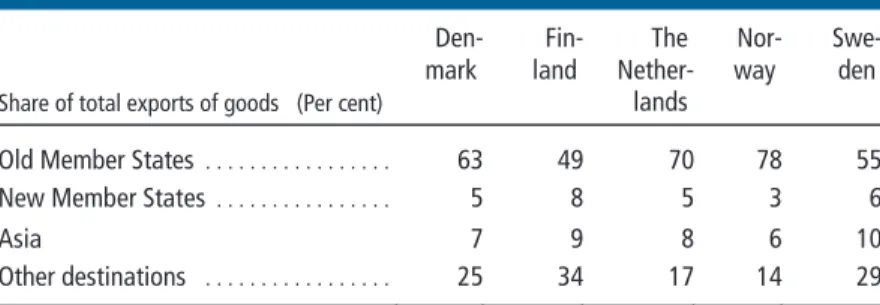
The second most popular destination for sourcing ICT functions from Denmark, Finland and the Netherlands is Asia. On the other hand, distribution and logistics support functions are rarely sourced to Asia; they stay in Europe which constitute the main exports market for the five countries.
Figure 2.1.2
Another way of looking at sourcing patterns is to take a sectoral approach i.e. are manufacturing enterprises preferring other countries for sourcing than services enterprises? Based on the data from Den-mark, Finland, the Netherlands and Norway this appears to be the case, see Table 2.1.1.
Geographical breakdown of core functions sourced internationally 2001-2006. Share of total number of functions sourced.
DK FI NL N S Manu- factu-ring Ser- vices Manu- factu-ring Ser- vices Manu- factu-ring Ser- vices Manu- factu-ring Ser- vices Manu- factu-ring Ser- vices
Old member states . . . 17 25 20 24 22 23 21 36 .. .. New member states . . 34 21 34 39 41 29 40 29 .. .. China . . . 24 16 21 8 11 15 23 .. .. .. India . . . 4 9 7 9 3 14 .. 17 .. .. Other countries . . . 21 29 19 21 22 19 15 18 .. .. Within EU . . . 51 46 53 63 63 52 61 64 .. .. Outside EU . . . 49 54 47 37 37 48 39 36 .. .. Note: Enterprises with 50 or more employees – except for the Netherlands covering 100 or more employees.
The core functions of manufacturing enterprises are most frequently sourced within the EU, particularly to new Member States ranging from a share of 34 per cent for Denmark and Finland up to 41 per cent for Dutch enterprises. China is the second most important destination for Finnish and Danish enterprises attracting over 20 per cent of the enterprises, while old Member States were somewhat less important. India accounts for only some 5 per cent of the total sourcing of manufacturing core functions, but a somewhat larger share of core functions sourced from services enterprises.
The core functions of services sector are most frequently sourced within EU with the exception of Denmark. The highest shares of sourcing of core functions in services sector within EU were in Norway (64 per cent) and Finland (63 per cent), while 46 per cent of sourcing of core functions in Danish enterprises had a destination within EU.
Country profiles: Destinations for international sourcing. Denmark:
• One-half of the international sourcing activities have destinations outside the EU. Asia is an important region for Denmark, because one-third of all sourced functions find their way to Asia.
• Asia is the most important destination for sourcing core functions. China is the most frequent destination within Asia.
• The old Member States are the most important destination for sourcing support functions.
Finland:
• The geographical distribution of all sourcing destinations is rather even. • Finland has the highest share of destinations other than the EU and Asia.
Finland source 11 per cent of functions to European countries outside the EU1, especially to Russia.
The Netherlands:
• More than 60 per cent of all international sourcing activities stay within the EU.
• Dutch enterprises source their core functions mainly to the new Member States and Asia.
• Only one-third of all support functions are sourced outside the EU by Dutch enterprises.
Norway:
• More than 60 per cent of all international sourcing from Norway is directed at the EU.
• The most important destinations for sourcing core functions are the new Member States (37 per cent) and Asia (31 per cent).
• Support functions mainly go to the old Member States having a share close to 60 per cent.
Sweden:
• Three-quarters of the sourcing from Sweden is going to the EU. The volume is equally divided between old and new Member States.
• Core functions are, in the first place, sourced to the new Member States (44 per cent), but the old Member States and Asia take one-fourth of the international sourcing activities each.
• Sweden is the lead country in sourcing support functions to the old Member States.
1 European countries outside the EU: Switzerland, Norway, Turkey, Russia, Belarus, Ukraine and
the Balkan states. Box 2.3
2.2 Business Patterns for International Sourcing
Generally two types of sourcing can be distinguished, (see also Introduction). The first is international insourcing. In this type of sourcing the business functions are moved abroad but kept within the existing enterprise group. This is a form of high-control and equity-based entry mode. Core or support business functions are moved to affiliated enterprises such as existing foreign enterprises of the same enterprise group or new foreign enterprises of the same group. The magnitude of ownership may vary. A foreign enterprise can be a totally owned subsidiary or a joint venture with 50% or more ownership. The mode of acquiring ownership can be a greenfield operation in which a foreign enterprise is newly created. It is also possible to acquire a foreign enterprise, e.g. an enterprise group purchases an existing pro-duction plant in China to move propro-duction from the Netherlands to China.
The second type is international outsourcing in which the functions move outside the enterprise or enterprise group to non-affiliated enter-prises. This involves foreign subcontracting and does not secure the same level of control for the sourcing enterprise as insourcing does, e.g. ICT services to a foreign external provider or subcontracting of research to a foreign laboratory.
The choice between keeping the production and functions within the existing firm boundaries or outsourcing them to a third party on a con-tractual basis is a strategic decision. It is assumed that a higher level of equity and greater ownership result in greater control. On the other hand, it can also be attractive to lay the risk in the hands of a third party. Subcontracting to a foreign enterprise also means utilising the expertise and knowledge of this enterprise, which might not be available within the sourcing enterprise or its affiliates.
Insourcing is the most preferred foreign entry mode (see Figure 2.2.1). It is also possible for an enterprise to switch between different entry modes and choose a combination of insourcing and outsourcing. An example could be: Sourcing a function to two different countries. The approach can differ by country of destination. It is possible that in the first country the sourcing is realised by insourcing and in the second country by outsourcing. That is the reason why the sum of insourcing and outsourcing is more than 100 per cent in Figure 2.2.1.
The preference for insourcing is greatest in Sweden. The enterprises in the Netherlands, Finland and Norway also most often choose insour-cing. In Denmark the pattern is somewhat different, as insourcing is as frequent as outsourcing.
International sourcing broken down by business partner. 0 20 40 60 80 100 Denmark Norway Finland The Netherlands Sweden
Within enterprise group (insourcing) Outside enterprise group (outsourcing) Per cent
Note: Enterprises with 50 or more employees – except for the Netherlands covering 100 or more employees.
This picture does not really change if we only look at the sourcing of core functions. Again, the Swedish enterprises mainly use insourcing as the mode of international sourcing and the Danish enterprises show a very different pattern with an even position between the two modes.
When considering the sourcing of support business functions in the Nordic countries and the Netherlands, it is obvious that insourcing is preferred for all functions. There are, however, some differences between the individual functions. Engineering and related technical services are functions which are not very often sourced, but if they are, the mode selected is relatively often outsourcing. This trend is the same in the individual countries. Marketing, sales and after sales services (including help desks and call centres) and also administrative and management functions are activities which are the least subcontracted to foreign firms.
International sourcing of ICT services broken down by business partner.
0 10 20 30 40 50 60 70 80 90 100
The Netherlands Finland Sweden Norway Denmark Within enterprise group (insourcing) Outside enterprise group (outsourcing) Per cent
Note: Enterprises with 50 or more employees – except for the Netherlands covering 100 or more employees.
Figure 2.2.1
ICT functions as well as R&D functions are often seen as strategic fac-tors enabling the enterprises to keep or improve their competitiveness. Therefore it is not surprising that the majority of sourcing is taking place within the enterprise group (insourcing) and not to an external supplier. In large multinational enterprises provision of these types of functions are often centralised in one or a few locations within the enterprise group in order to guarantee efficiency gains or protect intel-lectual property rights.
Almost 70 per cent of the enterprises in the Netherlands, Finland, Sweden and Norway are sourcing ICT functions within the enterprise group (see Figure 2.2.2). In these countries, 30 per cent or fewer enter-prises report sourcing ICT functions to an external services provider. However, Danish enterprises source more frequently to external providers (44 per cent) and less often within the group compared to the other countries. This pattern was observed also for sourcing of R&D functions.
Country profiles: Business patterns for international sourcing. Denmark:
• The only country where outsourcing occurs as often as insourcing.
• Sourcing of core functions and support functions such as engineering and related technical services, and research and development all take place both within and outside the enterprise group.
• Sourcing of the support functions marketing, sales and after sales services and administrative and management functions mainly stay within the enterprise group.
Finland:
• Insourcing is more frequent than outsourcing among Finnish enterprises. • The most frequently outsourced support function is engineering and related
technical services.
• The support functions marketing, sales and after sales services and administrative and management functions are mostly kept under control of the enterprise group.
The Netherlands:
• Insourcing is more frequent than outsourcing among Dutch enterprises. • Sourcing of the core functions stays within the enterprise group in three
quarters of the cases.
• Sourcing of all types of business support functions stays within the enterprise group even more often than core functions.
Norway:
• Insourcing is more frequent than outsourcing for core function and even more for business support functions.
Sweden:
• Nearly all functions which are moved abroad stay within the enterprise group. This applies to core functions as well as support business functions. • Sourcing of ICT services is the function most often subcontracted, but still
two thirds of the ICT functions sourced stay within the enterprise group. Box 2.4
3.
Plans for International Sourcing
Main findings:• Future sourcing is characterised by the growing importance of non-EU destinations.
• Core functions are expected to constitute the largest share of planned international sourcing in all five countries.
• The new Member States together with China score the highest frequencies as expected destinations for future sourcing of core functions in 2007-2009. • The most frequently expected sourcing destinations of ICT functions are the
old Member States.
The survey has been carried out to provide policy makers with evidence-based information about the increasingly important issue of interna-tional sourcing and its impacts on the domestic economies. To establish more informative and as up-to-date as possible material for future policy-shaping, the historical evidence of international sourcing in the period 2001-2006 is supplemented with indications of the future pat-tern of inpat-ternational sourcing for the period 2007-2009.
The enterprises were asked about their plans for future international sourcing in the period 2007-2009. It is important to underline that only the enterprises not having sourced in the period 2001-2006 are asked about their future plans, except for Norway which have also included the enterprises with sourcing activities in 2001-2006. Consequently, it is not possible to measure directly the development in the total interna-tional sourcing activities of the enterprises but only to benchmark the plans of the new sourcing enterprises against the pattern of the existing sourcing activities.
It could be expected that many of the enterprises already sourced parts of their core or support business functions abroad in the period 2001-2006 also would source internationally in the future. Consequently the results are underestimating the future level of international sourcing. This statement is supported by the Danish and Norwegian survey results The Danish survey results are showing a share of 16 per cent of enterprises having plans to source internationally if all enterprises are included and 6 per if only enterprises without previous international sourcing are included. The same figure for Norway is 8 per cent respect-tively 4 per cent.
3.1 Structure of Future International Sourcing
The future planned international sourcing is characterised by the fact that mainly core functions will be sourced internationally. This pattern can be found across all countries; around 40 per cent of the functions sourced are core functions, cf. Table 3.1.1. This pattern is also reflected Box 3.1
in the current structure of international sourcing, where core functions constitute the most frequently sourced business functions. For the planned sourcing activities, the share of core functions is expected to increase in all five countries.
Breakdown of the functions planned for international sourcing 2007-2009. Den- mark Fin- land The Nether- lands Nor- way Swe- den Core Function . . . 41 38 50 43 40 Distribution . . . 11 13 8 8 11
Marketing and sales 8 14 12 8 9
ICT services . . . 7 11 10 10 17 Administration . . . 8 7 13 9 10
Engineering . . . 18 9 2 16 7
R&D . . . 6 8 5 6 7 TOTAL . . . 100 100 100 100 100
Note: enterprises with 50 or more employees - except for the Netherlands covering 100 or more employees. Enterprises with plans 2007-2009 only include enterprises not having sourced internationally in the previous period 2001-2006, except for Norway also including enterprises with sourcing activities 2001-2006.
The other functions frequently planned to be sourced internationally in the period 2007-2009 are distribution and ICT support functions. Engineering functions are relatively important for Danish (18 per cent) and Norwegian (16 per cent) enterprises, while the Finnish ones intend to source marketing and sales functions more frequently than the others. This closely follows the pattern of the current sourcing structure, but both distribution and especially ICT services are expected to account for smaller shares in the future sourcing activities. Finally it can be mentioned that R&D functions constitute around 7 per cent of the planned functions to be sourced internationally in all countries.
3.2 Destinations for Future International Sourcing
A major trend in the planned future international sourcing is that sourcing outside of the EU is gaining more importance, cf. Figure 3.2.1. In the Netherlands, Sweden and Finland, the majority of the enterprises introducing international sourcing in the period 2007-2009 intend to source outside the EU.
For the Finnish enterprises particularly Russia is expected to be of major interest as a target country for future international sourcing. Around 20 per cent of the international sourcing of Finnish enterprises will aim at other European countries, while these attract only less than 10 per cent from the other Nordic countries and the Netherlands.
In Denmark and Norway the enterprises mainly intend to source within the EU. The future planned sourcing of Denmark is characterised by a large share of sourcing going to the new Member States – almost one-third of the total functions intended for international sourcing. The future importance of the new Member States is worth mentioning especially in the case of Denmark, as the Danish enterprises were clearly the ones having sourced least frequently to the new Member States in the period 2001-2006.
Destinations of planned international sourcing (core and/or support functions) 2007-2009.
0 10 20 30 40 50 60 70 80 90 100
Norway Sweden Denmark Finland The Netherlands Old Member States New Member States Asia Other Per cent
Note: enterprises with 50 or more employees - except for the Netherlands covering 100 or more employees. Enterprises with plans 2007-2009 only include enterprises not having sourced internationally in the previous period 2001-2006, except for Norway also including enterprises with sourcing activities 2001-2006.
3.3 Destinations for Future International Sourcing by Business Function
The sourcing decision is a strategic decision which takes a number of factors – e.g. cost reductions, location of customers, standardisation issues – into account, cf. also Chapter 4. These factors influence the choice of destination for the sourcing activity, and may differ between sourcing a manufacturing core function or a services support function. Therefore, this subchapter breaks down the geographical destination by type of function sourced.
The planned international sourcing of core functions for the period 2007-2009 is still characterised by the importance of the closest destinations, i.e. the EU Member States. This is especially the case in Denmark, where more than one-half of the Danish enterprises planning to source mention the other EU countries as a target destination. EU countries can expect to receive around 40 per cent of core functions sourced from the other Nordic countries and the Netherlands. However, when future expectations are compared with sourcing which has taken place 2001-2006, it is obvious that the old Member States are perceived Figure 3.2.1
as a clearly less attractive target area for future sourcing of core fun-ctions.
Sourcing of core functions is mainly carried out by manufacturing enterprises which source the total manufacturing production process or parts thereof. Therefore, it is not surprising that the new Member States together with China score the highest frequencies as expected destinations for future sourcing in 2007-2009, as especially the labour cost issue is seen as a driving factor for sourcing the core activities (see Table 3.3.1). In relative terms, the new Member States were most important for Danish enterprises and least important for the Norwegian ones.
Overall, around one-third of planned international sourcing cases will be assigned to the new Member States. China attracts around 20 per cent of sourcing of core functions with no major differences across the Nordic countries and the Netherlands. It is worth noticing that China is mentioned more frequently than the old EU Member States as a future destination by enterprises in all the five countries. India is mentioned less frequently as a destination country of sourcing core functions.
Breakdown of planned destinations for international sourcing of core functions 2007-2009. Den- mark Fin- land The Nether- lands Nor- way Swe- den
Old member states . . . 13 14 9 19 12
New member states . . 40 26 32 19 29
China . . . 17 19 19 22 27 India . . . 10 15 10 8 10 Other countries . . . 20 26 30 32 22 Total . . . . 100 100 100 100 100 Within EU . . . 53 40 41 38 41 Outside EU . . . 47 60 59 62 59
Note: enterprises with 50 or more employees - except for the Netherlands covering 100 or more employees. Enterprises with plans 2007-2009 only include enterprises not having sourced internationally in the previous period 2001-2006, except for Norway also including enterprises with sourcing activities 2001-2006.
The EU destinations, especially the old Member States, are the most frequent ones for the planned sourcing of ICT functions as well, except for Norway (see Table 3.3.2). One explanation might be that when European enterprise groups are streamlining their operations, they often prefer to centralise their ICT functions close to their head office. Overall, EU-countries attract two-thirds or more of the sourcing of ICT functions.