Managing Upstream Supply Chain Complexity based on Purchasing
Competencies - A Framework
Alhasan Y. Hakami
School of Aerospace, Mechanical & Manufacturing Engineering,
RMIT University, Melbourne, Victoria, Australia
Linda L. Zhang
Department of Management
IESEG School Management
3 rue de la Digue, Lille, France
Arun Kumar
School of Aerospace, Mechanical & Manufacturing Engineering,
RMIT University, Melbourne, Victoria, Australia
Abstract
While numerous articles have investigated the supply chain (SC) complexity, the empirical evidence of the ensuring benefits from managing SC and utilizing firm competencies is not reported. Nowadays, in the manufacturing sector, managing suppliers can account for up to 80% of the actual costs. Therefore, along with the increasing involvement of suppliers, the importance of the upstream side of supply chains has emerged. And it has attracted increasing attention from the practice. This paper aims to assist organizations in developing fundamental competencies in the purchasing function to minimize upstream supply chain complexity. It presents a novel purchasing competency model based on a process approach in order to exploit a firm's competencies in the most effective and efficient way.
Keywords
Purchasing competency, purchasing processes, upstream supply chain, supply complexity.
Introduction
The management of a firm’s entire supply chain (SC) has realized the strategic role of connecting and maintaining upstream and downstream business linkages. Therefore, one of the best practices in different industries is developing supply chain management strategies and utilizing the resources of other channel members. “It is no longer adequate for contemporary businesses to run these areas as loosely linked pockets of excellence” (Bozarth, Warsing et al. 2009). Thus, facilitating business activities in terms of reducing or avoiding supply chain complexity has attracted a great deal of attention from practitioners, academics, and researchers. Complexity has several negative effects on the supply chain, for instance, high operational costs, lack of cooperation and integration among the supply chain parties, significant time delays in delivery, inventory shortage or excess inventory, inefficient assets management, unreliable production line, and customer dissatisfaction. Supply chain complexity can be divided into three major areas of study, namely, upstream complexity, internal manufacturing complexity, and downstream complexity (Bozarth, Warsing et al. 2009). These complexities are closely correlated with the level of the efficiency of managing the supply chain. (Isik 2011) argues that “complexity can be reduced by an effective management that provides costs reduction within supply chains.” Along with increasing the efforts in solving SC complexity’s issues, SC competency development has emerged, reflecting the evidence in the literature in terms of facing the basis of competition in many industries in the future. Thus, SC competency can be conceived of as a combination of three management areas, as follows, purchasing competency, production competency, and logistics/marketing competency (Das and Narasimhan 2000). The theory of purchasing competency is based on contingency theory and expectancy theory (Poh and Forst 2011). These main theories justify why firms need to react the relevant factors of their surroundings (Burns and Stalker 1961, Woodward 1965). The role of the purchasing function has been developed from a rather clerical towards a more tactical and strategic function (Giunipero and Pearcy 2000). Moreover, purchasing decision making has become more competency and knowledge driven (Feisel, Hartmann et al.
Proceedings of the 2014 International Conference on Industrial Engineering and Operations Management Bali, Indonesia, January 7 – 9, 2014
2010). A review of recent research proves that PSM model shaped around the two practices of cross-functional integration and functional coordination (Foerstl, Hartmann et al. 2013). (Serdarasan 2013) declares that the complexity nature of SC adds to difficulty of managing the entire supply chain process, therefore, the common sense of SCM is about managing the complexity of SC. However, many authors have observed three generic approaches when dealing with complexity in supply chain, complexity management, complexity reduction and complexity prevention. One concept of complexity application areas in the field of organizational studies is to understand of the impacts of complexity on organizations, in order to help firms adapt to their environment and cope with their business processes. This concept leads the idea of this paper to be grounded in the observations of inside-out theory introduced by Hamel and Prahalad (1994) where companies need to fully understand their competencies and capabilities in order to successfully exploit their resources and develop the value of their business network. We identify two cornerstones of the model: (1) structure, how firms perceive the complexity of their business network, and (2) routines, how firms develop effective operational process and routines to utilize the value of network (Alinaghian 2012). This paper introduces a new approach for managing upstream SC complexity through developing and restructuring purchasing competencies. To clarify the relationship between upstream SC and purchasing competencies, we present some definitions to draw a clear and proper frame for this study. The upstream supply chain, or the supply-based network, is the portion of the supply chain network that is located between the buying company and its suppliers that is managed by the buying company through the purchasing function (Choi and Krause 2006). Purchasing plays a significant role in managing this area and linking it to the internal company processes as well as to the external processes. (Das and Narasimhan 2000) define purchasing competency as “the capability to structure, develop and manage the supply base in alignment with manufacturing and business priorities of the firm.” This paper focuses on the development of a purchasing competency framework. We develop a new insight based on a process approach and apply this concept in order to restructure the existing purchasing competencies in the literature.
The paper is organized as follows: in the next section, we review the relevant literature on purchasing competencies, and subsequently develop the conceptual model. This is followed by an elaboration of the model developed. The last section deals with the limitations and conclusions of this study, and ends with some suggested avenues for future research.
Literature Review
Firms recognize that the purchasing function is becoming a strategic choice in maintaining sustainability linkages with their input sources in the upstream side of SC. The effective management of the purchasing function provides firms with the strong position of competitive advantage (Narasimhan and Das 2001), while at the same time creating an efficient operation process. Das and Narasimhan (2000) argue that safeguarding competitive advantage through the development of firm competencies is not easily copied by competitors. Competency level reflects the firm’s ability to deploy its available resources (Javidan 1998). The emerging theory of purchasing competency has been introduced by Narasimhan (2001). However, despite its importance there have been very few studies that have clearly defined the group of purchasing competency. According to Narasimhan (2001), “there is a conspicuous absence of rigorous conceptualizations or examinations of this construct”. The evaluation of purchasing and supply management (PSM) from a tactical to a strategic function focuses on the several stages of development of a different set of purchasing competencies, taking into consideration the current practice in the particular industry. However, the significant contribution of this paper is trying to link and match the existing purchasing competencies with the actual operations environment. A recent study published in 2011 redefined the purchasing competencies by applying stakeholder theory and focusing on three primary groups. The stakeholder group supplier stands for external interface suppliers, the stakeholder group equals the internal interface elements, and the stakeholder group PSM staff indicates human resource elements (Narasimhan, Jayaram et al. 2001). Moreover, (Day and Lichtenstein 2006) separate the purchasing activities into two categories: externally facing purchasing practices and internal purchasing integration, which refers to an internally focused set of practices. Other investigators have developed and validated purchasing competency based on operation dimensions (empowerment, employee competency, interaction effectiveness, interaction effectiveness – tactical, new product development, and buyer and supplier relationship management) (Narasimhan, Jayaram et al. 2001) and IT competency (Done 2011). Monczka, Trent et al. (1993) argue that purchasing competency could encompass a portfolio of purchasing practices, leading to the consideration of four purchasing practices that might be encountered in many purchasing industries: supply base optimization, buyer-supplier relationship development practices, supplier capability audit, and purchasing integration. Zhang (2010) classifies purchasing competency into four major groups, including thirteen sets of purchasing competencies
management, project management, and product management. Furthermore, many studies have attempted to define purchasing competencies based on the opinions about “requirements” coming from recruiters, employees, managers, and leaders, creating a wide list of skills, personality features and attitudes, and mix of competencies, for instance, global purchasing skills, job environment knowledge, analytical skills, adaptability, and leadership (Bichon, Kamann et al. 2010). Lastly, one study tries to achieve define purchasing competency through the design of a purchasing performance measurement system, using five categories of roles that should be fulfilled in organizations: strategy management, measure performance, influence behaviour, learning and improvement, and communication (Poh and Forst 2011).
To summarize, the purchasing competences scatter in the available literature and are, in most cases, implicitly mentioned. This study is the first one that first identifies the common purchasing competences and subsequently develops a framework which systematically presents the competences and their relationships. Such a framework is very important because it contributes to an enhanced understanding of upstream supply chain complexity.
Framework Overview
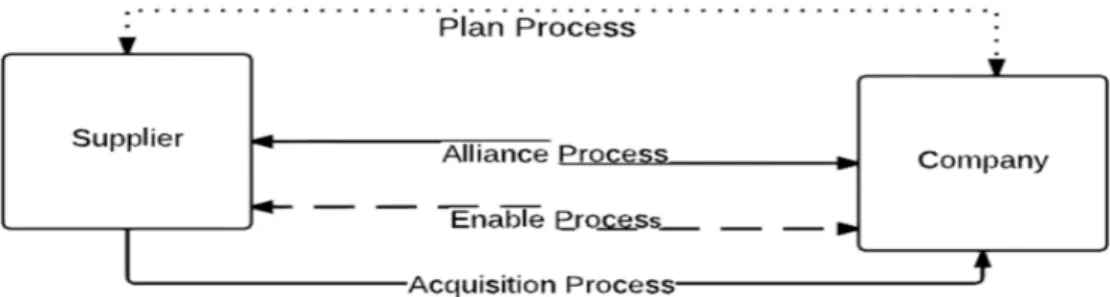
Essentially, our first attempt is to categorise the purchasing professionals into the purchasing activities introduced by (Barath and Hugstad 1977). Based on this literature, in this section, we introduce a new model using a suggested mapping approach to insure that all relevant purchasing processes are appropriately integrated into the purchasing function coherently, as well as directly involved in the day-to-day operations. We assume that any function in the organization can be drawn as a set of processes that are related to different activities. Each process is linked to internal activities, external activities, or both internal and external activities at the same time. Purchasing is a simple daily task, usually conducted in four main phases as follows (and illustrated in Figure 1):
1- Planning process: All tasks start with a sort of planning process in order to diagnose the actual needs, taking into consideration all of the expected requirements, events, and factors, such as, an initial market analysis, availability of resources and the ways or methods that will be used to fulfil the demands of the production line or the market. Therefore, some questions must be raised during this stage, such as: what market do we need to choose? What do we need to buy? Where will we buy it? How much should we spend? How are we going to buy it? What the advantages and disadvantages of or buying decision?..etc. at this stage, it is important to indicate that this planning process seen here as a continuous task that interfaces and interacts with all subsequent processes. We correlated Plan process with Research and development competence (R&D) as it’s obvious that there are overlaps in focus across this stream. Bremser and Barsky (2004) argues that “R&D programs are critical for many firms to achieve and sustain competitive advantage” However, R & D competence for achieving purchasing task is collocation of three major competence, (Market analysis, Product & technology development, Formulating policies & designing activities)
2- Alliance process: The alliance process finds suitable suppliers and matches the available materials in the market with the current budget and needs. From a business perspective, organizing the interactions between the suppliers and internal clients as well as maintaining the buyer-supplier relationship are major principles of the alliance process.
3- Enabling process: The enabling process achieves the purchasing task and carries out the relevant activities through the buying staff. The enabling process in this study involves the human resource elements.
4- Acquisition process: To complete this task, the firm needs to insure whether the purchased items require specific tools for transporting, handling, and storing. The firm also needs to verify that the purchased items match the firm’s quality and standards before the purchased items are ready for use.
Elaboration of Purchasing Competencies
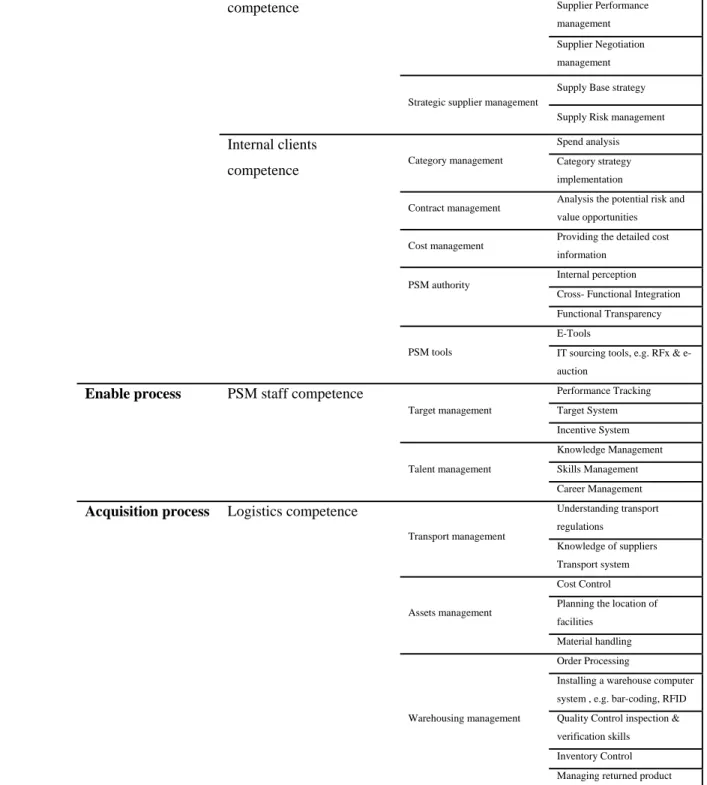
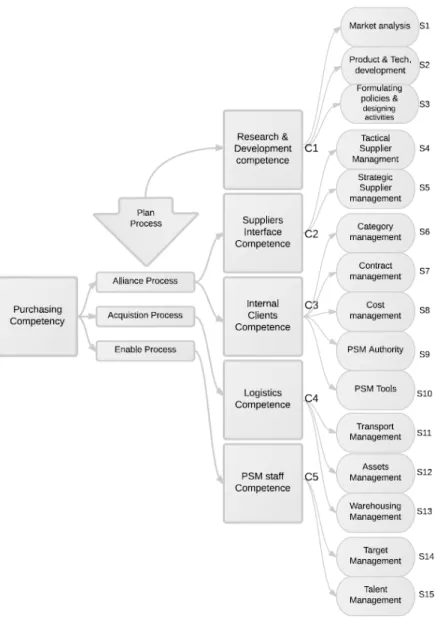
As explained earlier, the suggested purchasing competency model is based on three major processes, namely, the alliance process, enabling process, and the acquisition process, and one continuous process, the planning process. In this section, we will elaborate on the framework and expose the competencies that are related to each of these processes based on the existing literature. We will introduce a generalized model based on a process approach that involves all of the factors in the recent study that was conducted by (Kern, Moser et al. 2011), which was a purchasing model based on stakeholder theory. Our model is considered to be a restructuring of the stakeholder approach and an expanded to be more a comprehensive model that estimated to be an optimal organization’s internal tool for managing the supply complexity. Table.1 shows the purchasing competency model based on a process approach. In more detailed we will explain the components of each competency as follows:
First: The planning process is an advance process to address all resources, and drawing the road map in order to meet the requirements and demands. It is also an iterative process that represents the process of thinking about and organizing the activities that required in terms of achieving the organization’s goal and matching its strategies. Kraljic (1983) Stated that “purchasing must integrate its strategic plans with other functions within the overall corporate planning process”. In this study we identify three sets of skills and activities that associated with purchasing tasks and link them directly to R&D competence in order to addressing the role of the success factors. (1) Market analysis, It systematically reviews, the supply market, availability of resources and the company position within the business environment. Moreover, “the company needs to analyse its own needs and supply lines to gauge its ability to get the kind of supply terms it wants” (Kraljic 1983). There are two axes for fulfilling the requirements of market analysis in term of purchasing role, market segmentation and analysis tools and techniques, for instance, SWOT, PEST analysis. (2) Product & technology development, due to changing business environment, companies need to strive to maintain a strong position in an ever more competitive business arena. This searching for new products and technologies over the development process can impact the performance of the company to stay in the competitive position. By integrating marketing and R&D, companies can enhance the flow of market information (Ernst, Hoyer et al. 2010). In respect to purchasing competency we identify the following, tasks, Exploring existing suppliers capabilities, Development supplier program and Identifying alternative suppliers & Technologies to matching the firm capabilities to its suppliers as well minimising any potential risk my arise in the future. (3) Formulating policies & designing activities, complexity can be controlled by designing business functions activities as well-defined policies and services (Cherbakova, Galambos et al. 2005), usually, each different suppliers lead to different commitments and contracts. The duty of R& D to paint the picture of business processes throughout the following tasks, Formulating policies for supplier involvement, regulating the legal issues and contracts and Designing the activities & communications of internal customers.
Second: The alliance process links both the suppliers interface competency and the internal clients competency. Supplier management can be divided into a long-term strategically oriented perspective and a short-term tactically oriented perspective (Smeltzer and Siferd 1998). A strategic supplier perspective refers to issues that concern the long-term implications of developing a supply base strategy (Kern, Moser et al. 2011). This refers to both the establishment of the appropriate management to develop the supply risk concept and supply base strategy development (Monczka, Trent et al. 1993, Chen, Paulraj et al. 2004, Choi and Krause 2006). In contrast, a tactical perspective requires developing the buyer-supplier relationship, performance management system, and contract negotiation skills (Kern, Moser et al. 2011). The second group associated with the alliance process of the internal client’s competency, and it can be separated into purchasing and supply management authority and purchasing and supply tools. PSM authority towards the internal clients requires a position perception of PSM staff in the firm (Kern, Moser et al. 2011), and the integration of all of the company’s decision making. This process requires the functional transparency of all of the purchasing staff and the other staff in the organization (Carter, Monczka et al. 2005). In order to facilitate the functional coordination and integration, the company needs to implement an IT system to manage the day-to-day interactions (Kern, Moser et al. 2011). In the contemporary buying environment, and IT system has two dimensions for exchanging and sharing information that are well defined in the literature. First, an e-procurement system can exchange the required information with the suppliers, and second, an RFx (request for proposal, information, or quotation) and E-auction can unify the entire company’s management systems (Spekman, Kamauff et al. 1999, Hill and Scudder 2002). In addition, we identify three compensations of management areas that require a high level of practice and proper access, category management, contract management and cost management. These management areas have widely recognized in the contemporary literature, offer a set of tools and processes to deliver value of the purchasing competency.
Third: the enabling process refers to human resource management, which can be described in terms of a “transaction-relationship continuum” (Deadrick, Bruce et al. 1997). McAfee argues that “in order to support a relationship or partnering strategy with channel members, firms pursue an employee-for-life strategy that entails specific human resource methods for staffing, training, compensating, and evaluating personnel” (McAfee, Glassman et al. 2002). Thus, to achieve the buying task, the PSM staff group plays a dynamic role in linking all of the processes together. There are two major elements that increase the efficacy of managing the purchasing staff, namely, “target management” and “talent management” (Kern, Moser et al. 2011). Target management insures that the business activities match the firm’s strategy, and it can be achieved through a performance tracking system and an incentive system to increase the employees’ motivation and drive them toward a common goal (Alchian and Demsetz 1972, Huselid 1995). Another component of PSM staff competency is talent management. Kern (2011) argues that the talent management approach enhances knowledge sharing and provides the right skills through related training programs. For instance, in global companies, achieving the purchasing function requires possessing knowledge about international business regulations, and having awareness of some cultures aspects in order to deal with different organizational cultures. The nature of PSM talent involves skill training programs (Carr and Pearson 2002) and career management perspectives (Narasimhan, Jayaram et al. 2001, Zhu, Sarkis et al. 2008).
Fourth: the acquisition process refers to a logistics competency in connection with the purchasing task. (Thai, Cahoon et al. 2011) argue that logistics competency must be multi-talented across a wide list of management skills and logistics knowledge, which means that logistic competency can be possessed through both generalized and specialist skills (Gammelgaard and Larson 2001). To identify the necessary logistics skills that are related to the purchasing function, we will capture the physical acquisition processes that usually pass through well-known major phases in order to transport and utilize the purchased items, namely: transport management, assets management, and warehousing management. In this paper, we nominate the most related logistics competences from current profile skills and knowledge that are correlated to purchasing activities as following: (1) Transport management: this focuses on the legal aspects, especially when the company deals with international suppliers. For instance, the company needs to understand transport regulation and gain a fair amount of knowledge about the client’s transport system as well. (2) Assets management: the purchasing task usually requires increasing the reliability and efficiency of operations in order to minimize costs, as well as planning for the location of the facilities and facilitating the handling of the purchased materials. (3) Warehousing management: managing the warehouse requires a wide variety of skills. To insure that the relevant purchasing tasks run successfully, the firm should link the following skills to the purchasing competency framework to insure that all of the storage operations are on the right track: order processing, quality control and inspection, verification skills, inventory control, and managing returned products as well as, Installing a warehouse computer system, e.g. bar-coding, RFID to connect all processes together.
Process First order category Second order category Third order category
Pl
an proces
s
Plan process Research & development
competence Market analysis
Market segmentation
analysis tools and techniques, e.g. SWOT, PEST analysis
Product & technology development
Exploring existing suppliers capabilities
Development supplier program Identifying alternative suppliers & Tech.
Formulating policies & designing activities
Formulating policies for supplier involvement Regulating the legal issues and contracts
Designing the activities & communications of internal customers
Alliance process Suppliers interface Tactical supplier management Buyer-Supplier relationship management
competence Supplier Performance management Supplier Negotiation management
Strategic supplier management
Supply Base strategy Supply Risk management
Internal clients
competence Category management
Spend analysis Category strategy implementation
Contract management Analysis the potential risk and
value opportunities
Cost management Providing the detailed cost
information PSM authority
Internal perception Cross- Functional Integration Functional Transparency
PSM tools
E-Tools
IT sourcing tools, e.g. RFx & e-auction
Enable process PSM staff competence
Target management Performance Tracking Target System Incentive System Talent management Knowledge Management Skills Management Career Management
Acquisition process Logistics competence
Transport management Understanding transport regulations Knowledge of suppliers Transport system Assets management Cost Control Planning the location of facilities
Material handling
Warehousing management
Order Processing
Installing a warehouse computer system , e.g. bar-coding, RFID Quality Control inspection & verification skills
Inventory Control Managing returned product
Figure 2: Purchasing competency model based on a process approach
Conclusion
In this study, we applied a process approach to develop a framework for stakeholder-based purchasing competencies. Classifying the competencies in supply chain context based on a process approach is considered to be an initial step in demonstrating the complementary employment of firm purchasing competency in order to minimize the complexity of the upstream supply chain. The process approach offers useful insights into the relationship mechanism between the firm and its business network. Moreover, it introduces opportunities for future research that may be conducted in this area. First, an empirical research is needed for the purchasing framework described above. Second, identifying the relationships between these competencies and the corresponding upstream SC configuration elements in order to examine the optimal relationships is also necessary; and finally, examining the impact of the framework on the SC performance is equally important. Despite its contribution, we noticed the limitation of this study, which lies in the lack of framework validation. As a matter of fact, this is an ongoing research and an in-depth case study is being carried out to validate the developed framework.
Acknowledgements
References
Alchian, A. and H. Demsetz (1972). "Production, information costs, and economic organization." The American Economic Review 62(5): 777-795.
Alinaghian, L. (2012). Operationalising dynamic capabilities: A Supply network configuration approach. DRUID Academy 2012. Venue: University of Cambridge /The Moeller Centre.
Barath, R. and P. Hugstad (1977). "Professionalism and the behavior of procurement managers." Industrial Marketing Management 6: 297-306.
Bichon, A., et al. (2010). A Contingency approach of procurment competences and attitudes. IPSERA. France. Bozarth, C., et al. (2009). "The impact of supply chain complexity on manufacturing plant performance." Journal of
Operations Management(27): 78–93.
Bremser, W. and N. Barsky (2004). "Utilizing the balanced scorecard for R&D performance measurement." R&D Management 34( 3, 2004).
Burns, T. and G. M. Stalker (1961). The Management of Innovation. Tavistock. London.
Carr, A. and J. Pearson (2002). "The impact of purchasing and supplier involvement on strategic purchasing and its impact on firm's performance." International Journal of Operations & Production Management 22(9): 1032 - 1053.
Carter, P., et al. (2005). "Strategic performance meaurement for purchasing and supply." Center for Strategic Supply Research.
Chen, I., et al. (2004). "Strategic purchasing, supply management, and firm performance." Journal of Operations Management 22(2004): 505–523.
Cherbakova, L., et al. (2005). "Impact of service orientation at the business level." IBM Systems 44(4): 653.
Choi, T. and D. Krause (2006). "The supply base and its complexity: Implications for transaction costs, risks, responsiveness, and innovation." Journal of Operations Management 24: 637–652.
Das, A. and R. Narasimhan (2000). "Purchasing Competence and Its Relationship with Manufacturing Performance." The Journal of Supply Chain Management.
Day, M. and S. Lichtenstein (2006). "Strategic supply management: The relationship between supply management practices, strategic orientation and their impact on organisational performance." Journal of Purchasing & Supply Management 12: 313–321.
Deadrick, D., et al. (1997). "Customers for Life: Does it Fit Your Culture?" Business Horizons 40(4): 11-16.
Done, A. (2011). Develping Operational Competence in Purchasing. IESE Business School University of Navarra. Ernst, H., et al. (2010). "Sales,Marketing, and Research-and- Development Cooperation Across New Product
Development Stages: Implications for Success." Journal of Marketing 74(9, 2010): 80–92. Feisel, E., et al. (2010). Purchasing Skills - Developing the Purchasing Professional of the Future.
Foerstl, K., et al. (2013). "Cross-functional integration and functional coordination in purchasing and supply management." International Journal of Operations & Production Management 33(6): 689-721.
Gammelgaard, B. and P. Larson (2001). "Logistics skills and competencies for supply chain management." Journal of Business Logistics 22.
Giunipero, L. and D. Pearcy (2000). "World-Class Purchasing Skills: An Empirical Investigation." Journal of Supply Chain Management 36(4): 4-13.
Hamel, G. and C. K. Prahalad (1994). "Competing for the future." Harvard Business School Press.
Hill, C. and G. Scudder (2002). "The use of electronic data interchange for supply chain coordination in the food industry." Journal of Operations Management 20: 375–387.
Huselid, M. (1995). "The impact of human resource management practices on turnover, productivity, and corporate financial performance." Academy of Management Journal 38(3): 635-672.
Isik, F. (2011). Complexity in Supply Chains: A New Approach to Quantitative Measurement of the Supply-Chain-Complexity, InTech.
Javidan, M. (1998). "Core competence: What does it mean in practice?" Elsevier Science Ltd 31(1): 60–71.
Kern, D., et al. (2011). "Purchasing Competence: A Stakeholder-Based Framework for Chief Purchasing Officers."
Journal of Business Logistics 32(2): 122–138.
Kraljic, P. (1983). "Purchasing must become Supply management." Harvard Business Review.
McAfee, B., et al. (2002). "The effects of culture and human resourse management policies on supply chain management strategy." Journal of Business Logistics 23(1).
Narasimhan, R. and A. Das (2001). "The impact of purchasing integration and practices on manufacturing performance." Journal of Operations Management 19: 593–609.
Narasimhan, R., et al. (2001). "An Empirical Examination of The Underliying Dimension of Purchasing Competence." Production and Operations Management 10(1).
Poh, M. and K. Forst (2011). "Achieving purchasingcompetencethroughpurchasingperformance measurementsystemdesign-A multiple-casestudyanalysis." Journal ofPurchasing&SupplyManagement 17: 231– 245.
Serdarasan, S. (2013). "A review of supply chain complexity drivers." Computers & Industrial Engineering. Smeltzer, L. and S. Siferd (1998). "Proactive supply management: the management of risk." International Journal of
Purchasing and Materials Management.
Spekman, R., et al. (1999). "Towards more e!ective sourcing and supplier management." European Journal of Purchasing & Supply Management 5: 103-116.
Thai, V., et al. (2011). "Skill requirements for logistics professionals: findings and implications." Journal of Marketing and Logistics 23(4, 2011): 553-574.
Woodward, J. (1965). IndustrialOrganization:TheoryandPractice. London, Oxford University Press
Zhang, L., Identifying purchasing competences and organizational configuration for innovative product development, The 2011 IEEE International Conferences on Technology Management (ITMC), June 27 – 30, 2011, San Jose, CA, USA.
Zhu, Q., et al. (2008). "Confirmation of a measurement model for green supply chain management practices implementation." International Journal of Production Economics: 261–273.
Biography
Alhasan Y. Hakami is a Ph.D. candidate in Manufacturing System in Department of Aerospace, Mechanical & Manufacturing Engineering, RMIT University, Australia. His research focuses on Managing Upstream Manufacturing Complexity. Alhasan obtained his Master in 2010 from RMIT University, Australia in logistics management and bachelor degree in Sciences in the field of BUSS ADM (Marketing) from King AbdulAziz University, Saudi Arabia. He served as a director of business and industrial committees in Jeddah chamber of commerce & industry for 6 years.
Linda L. Zhang is a Full Professor of Operations Management in Department of Management at IESEG School of Management, Lille-Paris, France. She obtained her BEng and Ph.D. degrees in Industrial Engineering in 1998 and 2007 from Tianjin University, Tianjin, China and Nanyang Technological University, Singapore, respectively. Her research interests include warehouse design, production configuration, supply chain management, integrated product family development, and business process reengineering. On these areas, she has published a number of articles in international refereed journals, such as Decision Support Systems, IIE Transactions, IEEE Transactions on Engineering Management, Euroopean Journal of Operational Research, International Journal of Production Research, etc.
Arun Kumar is a Senior Lecturer at the Division of Manufacturing Engineering School of Aerospace, Mechanical & Manufacturing Eng, RMIT University. In 1988 and 1986 He received his Ph.D. in Industrial Engineering and Operations Research, and Ph.D. in Mining Engineering, from Virginia Polytechnic Institute and State University, Blacksburg, Virginia, USA. He obtained his M.S., in Mining Engineering, Southern Illinois University, Carbondale, Illinois, USA in 1981 and B.Tech. (Honors), in Mining Engineering, Indian School of Mines, Dhanbad, in 1980, India. His research interests in Applied and Probabilistic Operations Research, Operations Management, Logistics and Supply Chain Management, Reliability Engineering.