SEKA – Resultatredovisningsprojekt
The use and abuse
of the logical
The logical framework approach (LFA) has come to play a central role in the planning and management of development interventions over the last twenty years.
Although the logical framework has become universally known, it is far from universally liked. It has been the subject of much criticism over the years, concerning both the theoretical basis of the approach, and the way it is applied in practice.
In this review, we have attempted to take stock of the current views of international development NGOs on the LFA and the ways in which they use it.
Pontus Modeér
C
ONTENTS1 Introduction ... 1
1.1 Background ... 1
1.2 Methodology... 1
2 Pinning down the LFA... 2
2.1 Distinguishing the logical framework and the LFA ... 2
2.2 LFA as a formal procedure... 4
2.3 LFA as a way of thinking ... 5
2.4 LFA as a brand... 5
3 Current practice of using the LFA ... 5
3.1 Driving forces behind the LFA... 6
3.2 Planning ... 7
3.2.1 NGO as a facilitator... 8
3.2.2 NGO as a translator... 8
3.2.3 NGO as a buffer... 9
3.3 Performance management... 9
3.3.1 Development of indicators... 9
3.3.2 Monitoring and evaluation ... 10
3.3.3 Impact assessment ... 11
4 Debates on the LFA... 11
4.1 LFA as conceptual framework... 12
4.2 LFA as a system ... 14
5 Variations on the LFA theme ... 16
6 Conclusions ... 18
Annex 1: Terms of Reference ... 22
Annex 2: Questionnaire ... 24
Annex 3: Outline Questions for Review ... 25
Annex 4: Organisations Consulted ... 26
We are grateful to the many people from different agencies who gave up their time to answer our enquiries. We are also very grateful to our colleagues at INTRAC, especially Michael Richards and Anna Winterbottom, for their help in preparing this review. There were many organisations and people whom it was not possible to contact in the time available, and this report does not claim to present a complete picture. While acknowledging the help of all the respondents to our enquiries, this report expresses only our views. We remain responsible for any errors of fact or interpretation.
1 INTRODUCTION
1.1 B
ACKGROUNDThe logical framework approach (LFA) has come to play a central role in the planning and management of development interventions over the last twenty years. Its origins lie in a planning approach for the US military, which was then adapted for the US space agency NASA before being adopted by USAID for development projects over thirty years ago. It was picked up by European development organisations in the 1980s and by the end of the 1990s the LFA (or an adapted form of it) had become the standard approach required by many donors for grant applications (Hailey & Sorgenfrei 2004: 7).
Although the logical framework has become universally known, it is far from universally liked. It has been the subject of much criticism over the years, concerning both the theoretical basis of the approach, and the way it is applied in practice. While these have been widely acknowledged, the position of the LFA in development organisations has not been weakened – if anything it is stronger than ever. A simplistic characterisation of the prevailing attitudes to the LFA runs as follows: donors insist on it, while NGOs use it under sufferance. All recognise that it has many weaknesses, but there is a common view that despite these weaknesses, it is the best of a bad bunch of options available for planning and monitoring development work. Hence it carries on being widely used against all objections.
In this review, we have attempted to take stock of the current views of international development NGOs on the LFA and the ways in which they use it. We start in the next section by considering the different meanings and connotations of the term logical framework approach as it is used by different actors. In Section 3 we look at how LFAs are used by INGOs in both planning and project management. The next section reviews some of the debates and critiques around the LFA arising both from practice and the literature. In response to these challenges, different organisations have adapted the LFA and these variations on the LFA theme are outlined in Section 5. We conclude the paper by summarising the findings and reflecting on ways forward.
1.2 M
ETHODOLOGYThis review has been commissioned by Sida as part of a larger project which aims to establish new guidelines for measuring results and impact and reporting procedures for Swedish development NGOs receiving support from Sida. The full terms of reference can be found in Annex 1.
There were three major questions in the terms of reference: • What is the current practice of using the LFA?
• What are the perceived strengths and weaknesses of the tool? • What are the characteristics of different versions of the tool?
We have attempted to address these questions by asking for direct responses from various development actors and drawing on the literature.
Although we started with the intention of holding ten semi-structured telephone interviews with key informants, we realised that in order to identify and contact the appropriate people
within organisations in the time available we would have to draw heavily on existing contacts. We therefore decided to try and cast the net a bit wider by preparing a simple structured questionnaire which we disseminated widely from INTRAC and made available on the INTRAC website (see Annex 2). This brought forward responses from 18 different organisations, including donors, European NGOs, NGOs in developing countries and consultancy organisations. We were able to follow up some of these questionnaires with telephone interviews and also conducted telephone interviews with some other key respondents. These followed guidelines which expanded on the core questions raised above (see Annex 3).
The list of organisations consulted can be found in Annex 4. Recognising that the use of the LFA is controversial in many organisations, we conducted all interviews on conditions of anonymity. Since our major concern is about how logical frameworks are actually used, rather than the stated corporate position of how they should be used, we felt this would help to enable people to speak more freely. Of course, since we spoke with only one or two individuals in each organisation, this introduces the danger that we do not have responses which are representative of the range of views within the organisations. Given that we were speaking with key informants, who had knowledge and experience of using LFAs, we felt that for the most part these individuals had a good understanding of how their organisations used LFAs. In the text, we do not refer to individual organisations by name.
This view from practice was supplemented by a review of the literature, including published books and articles, websites and grey literature (drawing on INTRAC’s library and database of resources). A list of key references is in Annex 5. For the purposes of this review, we have deliberately limited our scope to the use of the LFA in development and have not attempted to go in depth into the broader management literature on related issues of results based management and performance management applied in the public and private sector (see Hailey & Sorgenfrei 2004 for further references).
2 PINNING DOWN THE LFA
Compared to many other development ideas, the LFA seems quite concrete, with its distinguishing feature being the use of the four by four matrix, from which it gets it name. It is easy to ask if an organisation uses the LFA, but their understanding of what it means varies greatly. It rapidly became clear from the responses to questionnaires and interviews that the term ‘the logical framework approach’ had different connotations for different people and organisations. These responses fall into three broad categories – the LFA as a formal system, the LFA as a way of thinking and the LFA as a ‘brand’ or ‘badge’ to keep donors happy. These are expanded on below. However, before that, it is important to establish some common definitions as a base for our further discussion.
2.1 D
ISTINGUISHING THE LOGICAL FRAMEWORK AND THELFA
It is useful to distinguish between the logical framework – the matrix which summarises the main elements of the programme of work and connects them to each other – and the logical framework approach – the overall process by which the elements which go into the matrix are formulated (Dale 2003: 58-59).
The logical framework as a matrix has a reasonably standard form. A typical example of the
format is given below (Box 1). There are variations in terminology (for example, some use
objectives instead of outcomes, or aim instead of goal) and structure (for example, some
adaptations are discussed in Section 5. However, we found that when people speak of the logical framework, they are referring to a matrix with both:
i) a vertical logic as a hierarchy of objectives – activities deliver outputs, which contribute to
outcomes, which help bring about the overall goal;
ii) a horizontal logic showing how progress against each objective can be assessed (indicators and means of verification) and the external factors (assumptions and risks) which might affect whether the reaching of the objectives will contribute to the next level.
Box 1: Typical logical framework format
Narrative summary Objectively verifiable indicators
Means of verification
Assumptions
Goal – the overall aim to which the project is expected to contribute
Measures (direct or indirect) to show the project’s contribution to the goal
Sources of information and methods used to show fulfillment of goal
Important events, conditions or decisions beyond the project’s control necessary for maintaining the progress towards the goal
Outcomes (or objectives) – the new situation which the projects is aiming to bring about
Measures (direct or indirect) to show what progress is being made towards reaching the objectives
Sources of information and methods used to show progress against objectives
Important events, conditions or decisions beyond the project’s control, which are necessary if achieving the objectives is going to contribute towards the overall goal
Outputs – the results which should be within the control of the project management
Measures (direct or indirect) to show if project outputs are being delivered
Sources of information and methods used to show delivery of outputs
Important events, conditions or decisions beyond the project’s control, which are necessary if producing the outputs is going to help achieve the objectives
Activities – the things which have to be done by the project to produce the outputs
Measures (direct or indirect) to show if project outputs are being delivered
Sources of information and methods used to show that activities have been completed
Important events, conditions or decisions beyond the project’s control, which are necessary if completing activities will produce the required outputs
Inputs Resources – type and level of resources needed for the project Finance – overall budget
Time – Planned start and end date
(Adapted from Mikkelsen 1995: 51)
In contrast a logical framework approach is concerned with the wider planning procedures of problem analysis, the development of objectives and indicators, and identification risks and assumption, which feed into the overall programme plan1. In the ideal world described in
much of the literature that sets out the logical framework approach, this process of programme planning is a participatory one, involving a wide range of stakeholders to reach a consensus on a programme of work; this may then be summarised in a logical framework. The GTZ process known as ZOPP (objective oriented project planning) is an example of the logical framework approach that arose from initial experiments with the logical framework.
1 These connotations of the LFA including analysis are consistent with an alternative expansion of the acronym
Many donors and NGOs now work with an LFA which incorporates stakeholder analysis and other participatory processes as integral parts.
We follow this common notion of the LFA being more than simply the matrix. However, this distinction means we must consider the possibility that various organisations may use the LFA and logical frameworks in different ways, or not at all:
• LFA producing a logical framework – the ideal type described in the various text books, manuals and guidelines;
• Logical framework without LFA – a matrix is produced at some stage during planning but without any participatory process;
• LFA without a logical framework – stakeholders agree on the programme of work, including different levels of objectives, indicators and assumptions, without ever trying to fit it within a formal logical framework matrix;
• No use of LFA or logical framework – different planning methods are used.
In this review, we found some NGOs that claimed to use the LFA but did not use the logical framework, while others claimed not to use the LFA but seemed to use much of the same thinking in their planning – working with a hierarchy of objectives, establishing indicators, risk analysis and so on. In such circumstances, the question of who is using the LFA stops being as simple as it first appears, as the respondents’ perceptions of what they mean by the LFA becomes important. We now turn to consider these perceptions in more detail.
2.2 LFA
AS A FORMAL PROCEDUREFor some, the LFA is a formal procedure for planning projects, and in some cases also providing the base for the monitoring and evaluation system. The LFA sets out a number of standard steps to be completed, which may include some form of participatory problem assessment and identification of aims and objectives, some form of risk assessment and so forth. The output of the LFA, the project or programme plan is usually required to be summarised in a logical framework.
Not surprisingly as a formal procedure, this outlook seemed to be most prevalent among those dealing with large numbers of projects, either as donors (government or grant giving NGOs), or as managers. It gives them a common basis to work from and enables them to make easier comparison between interventions – whether for grant approval or comparing progress between different initiatives.
For some the LFA fits within the broader approach of results based management in which the logical framework is widely used for planning (see Box 2). One donor respondent would only refer to the LFA in as far as it was part of the results based management system – it could not be isolated from the overall approach.
Box 2: Results based management
Key elements or phases of results based management include:
1. Identifying clear and measurable objectives (results), aided by logical frameworks. 2. Selecting indicators that will be used to measure progress towards each objective. 3. Setting explicit targets for each indicator, used to judge performance.
5. Reviewing, analysing and reporting actual results vis-à-vis the targets.
6. Integrating evaluations to provide complementary performance information not readily available from performance monitoring systems.
7. Using performance information for internal management accountability, learning and decision-making processes, and also for external performance reporting to stakeholders and partners. The first three phases generally relate to a results-oriented planning approach, sometimes referred to as strategic planning. The first five steps, together, are usually included in the concept of performance measurement. All seven phases combined are essential to an effective results based management system.
(Source: Binnendijk 2000: 4)
2.3 LFA
AS A WAY OF THINKINGFor other respondents, the LFA is understood more as a set of ideas and way of thinking. The value lies in working through a hierarchy of objectives, ensuring that you consider appropriate indicators and take account of the risks and assumptions. How you go about this process can be quite flexible and does not necessarily need to be captured in a matrix. A respondent in an NGO which has recently started to introduce the LFA reported that people are signing up for training in the approach because they like the thinking process – they see it as a ‘thinking tool’ but remain averse to the matrix. ‘The LFA should be used to challenge ourselves intellectually and help us think.’
Another respondent from an NGO that has used the LFA in the past but has now moved away from it, stated that the concept and many of the main elements of the approach are still in place. They remain concerned about hierarchies of objectives and struggle to identify clear indicators. While acknowledging that the LFA way of thinking is still prevalent within the NGO, this respondent objected that the way of thinking was unhelpful (see 4.1), in contrast to the new converts to the approach.
2.4 LFA
AS A BRANDA third sense in which the term LFA is used is as a way of branding ones planning approach to be acceptable to donors. As one NGO respondent stated after describing their approach to planning – ‘we only call it LFA because the donor requires us to use the LFA.’ Other NGOs make no claims to use the LFA as a matter of course, but will prepare logical frameworks and jump through various LFA hoops when it is necessary to satisfy donors. To some extent, the LFA in this sense can become superficial packaging which covers up the real way of doing business.
3 CURRENT PRACTICE OF USING THE LFA
Despite the widespread misgivings about logical framework approaches, they are explicitly used in one form or another by a wide range of development organisations across the world. In this section, we look at some of the ways they are used by different organisations at different stages of the programme management cycle.
3.1 D
RIVING FORCES BEHIND THELFA
Although some NGOs have internalised the use of the LFA, for most the original driving force came from donors, some of which have insisted that those receiving grants should adopt an LFA. One organisation which supports a range of local NGOs in preparing logical frameworks for donors, stated that these organisations only ever use it because it is a requirement, ‘it is never used voluntarily or because the client thinks it is a good idea’. Another INGO which does not use LFA internally, stated that ‘staff are free to use it if they find it useful, but most do not’. Again they only use it when donors insist on a logical framework.
However, this stereotyped view of the LFA being a donor imposition is by no means universal. Some have taken it on board and say they find it useful for their own work. For some NGOs, in particular those involved in a large number of partner agreements, the LFA provides a helpful way for them to appraise grant applications and manage their work. One grant making NGO, which only receives a minority of its funding from donors, already uses LFA internally for all projects and programmes.
It seems likely that the individual’s attitude to the LFA is likely to be closely related to how useful it is for their work rather than the nature of the organisation. Some remain unconvinced and are always trying to break out of it. Interviews for this research were only conducted at headquarters. The responses suggest that there is a hierarchy of attitudes – managers dealing with multiple projects like the logical framework as a useful summary to help simplify the complexity they face. However, those closer to the messy realities of development are less convinced. At times the manager in an NGO might like to receive logical frameworks from their partners (making life easier) at the same time as resenting the imposition of the LFA by their own donor.
A common experience was that introducing the LFA required a high level of investment in training and support to ensure that people can use it. Donors reported that this level of training was paying off in the case of larger NGOs, which were now able to deliver ‘good’ logical frameworks. They perceived the smaller NGOs to be struggling, but this came across as a reflection of those NGOs’ lack of capacity rather than a problem with LFA.
Another associated driving force behind the use of the LFA is the increasing concern about producing visible, sustainable impact as a result of development interventions. The LFA is seen as providing a clear set of expectations of what the work should achieve, which makes it easier for people to make the case for funding and also sets up a framework for reporting on progress. This is appealing to both donors and NGOs, who have to justify their decisions and spending in terms of delivery. For example, one NGO stated that the main reason for applying LFA principles in programming is:
the strongly felt need to be able to present, much more than before, results of the activities we support and implement, that is to demonstrate that our activities really make a difference to the goals and objectives we formulate. (NGO LFA documentation)
We leave the question of whether the LFA produces a realistic framework to achieve this to Section 4. The point here is that at the least, using the LFA provides easily digestible points to make the case for funding. This point came across most clearly with one of the NGO respondents, where the management is concerned about the accountability of their work and has introduced the LFA in order to challenge the staff to think more deeply about the impact of their work on people’s lives.
3.2 P
LANNINGAlthough using the LFA is theoretically a way of planning interventions and monitoring and evaluating their progress, in practice in most cases the LFA is only explicitly used at the planning stage. Given the different notions of what is meant by the LFA, inevitably each organisation has a different way of going about planning.
There was wide variation in the levels of participation brought into the planning process. Although the widely held view of the ideal LFA involved a participatory approach to planning, many NGOs found that it was very difficult to put into practice. For some the first challenge was to establish ownership of the planning process internally – especially where the LFA is seen as an external imposition.
The success of any framework tool is based on how you use it rather than the content. It needs to be seen as a legitimate thinking process in itself, and it needs to be seen as our planning process because we need it, not as a process or hoop we go through to get money. It should not been seen as an external requirement for funding but for ourselves and our colleagues. (Interview with NGO respondent)
NGOs also reported great difficulties in communicating the idea of the LFA to local partners in a way that they can easily use it. A number of respondents observed that they perceived a regional difference, with the ideas being much more readily absorbed in Latin America, while they find it much harder to engage African partners in preparing logical frameworks. This undermines any claim for the LFA to be an objective management tool, as it suggests that it is embedded within a particular set of culturally specific values and assumptions.
There has been some very painful experience for some NGOs as their attempt to use the LFA has resulted in overwhelming frameworks of objectives and indicators, which have proved totally unwieldy in practice. One NGO regional office produced a framework that tied in everything from field activities to the international headquarters, but unfortunately the links did not work.
Adopting a participatory approach to the LFA involves a major investment in time and resources. One NGO reported taking two years to put together a logical framework for a water project. An NGO respondent concluded:
The process of participatory logframe planning is too idealised for my liking. It may take us years to help diverse communities reach consensus about priority, higher risk issues. Only then would a participatory logframe planning approach become relevant. To pretend that rapid participatory planning can somehow replace this risks being superficial and promoting the inclusion of local elites rather than poor people. (Questionnaire response)
Some NGOs which had invested the time and effort in participatory planning reported finding that the resultant logical framework was such a valuable artefact, representing so many hours of negotiation to reach consensus, that it became very difficult to contemplate making further revisions as the project continued.
We identified three roles which NGOs tended to play as they used the LFA in the planning process, which varied according to the NGO’s commitment to the LFA, the capacity of partners to engage in the process and the particular project or programme under consideration.
3.2.1 NGO as a
facilitator
This is the role anticipated by the theoretical presentations of the LFA, where NGOs facilitate a participatory process for the development of the logical framework. This is most clearly evident among those NGOs which adopt the ZOPP process using participatory stakeholder workshops to analyse problems, reach consensus on potential solutions and negotiate plans of action which are summarised in the logical framework. As noted above, this can take huge amounts of time and result in a fragile framework, which nobody dares touch for fear of undermining the consensus.
While donors often seem to expect NGOs to play this role, it is not clear that they are aware of what it involves. Given that taking such facilitation seriously is a massive undertaking, we should ask why did NGOs take it on, especially when donors are the ones driving the introduction of the LFA? Where donors do get involved in the process they do so through individual employees who have very limited scope to change donor government policies. These employees are placed in the unhappy position of facilitating a process on behalf of the one major actor who will not change in response to the negotiations.
3.2.2 NGO as a
translator
In other cases, NGOs seem to play the role of translator of an existing planning process to fit with the LFA. This might involve using participatory process for programme design – resulting in a set of objectives, indicators and risk analysis – but without explicit mention of the LFA. The NGO staff then repackage this stakeholder process, drawing up a logical framework in a format acceptable to donors (and possibly managers). In as far as most donors have different requirements, it is inevitable that this translation goes on in many planning processes where NGOs have to tailor the logical framework to the various donors’ needs.
One small organisation described their use of the LFA as working with a small group of ‘experts’ to develop the logical framework and they then explain it to others. Some have come to take this translating role after difficult experience working in a more participatory way. One reported that although they initially involved staff, trainers, consultants and partner NGOs in problem analysis, they had struggled to write proposals in the LFA format. Now they involve the wider group of stakeholders only in the early stages and they prepare the logical framework in the office.
There were very different views among respondents on how much expertise is required to prepare a logical framework. Some suggested it was quite straightforward, while others said everyone found it hard. A couple of respondents raised the point that when NGOs adopted this translating role, it meant that donors’ understanding of the programme and organisations involved must be reduced. One NGO said they reduced the direct stakeholder involvement in order to avoid exposing too much internal detail to the donors. A Northern NGO respondent put it:
The process of logframe construction appears difficult for many international staff, even those with PhDs. Some prefer presenting their concepts as a written narrative, others visually, many prefer stories. While I might be able to convert these assessments into a successful proposition, is it in the donor's interests that I act as interlocutor and Northern NGO control agent? The donor has I'm afraid probably missed out on some more innovative work that cannot easily be presented either in its conceptualisation or by the individuals involved. (Questionnaire response)
3.2.3 NGO as a
buffer
There is also evidence that some NGOs take on the more extreme role of a buffer between the field stakeholders, whether staff, partners or communities, and the LFA. This will tend to be where NGOs see the LFA in a largely negative light and engage with it largely for fund- raising. In such cases NGO staff may make various efforts to subvert the LFA to ensure that it does not interfere with what they see to be the real work of development.
Some project managers claim to manage logical frameworks rather than accepting them as a management system. They will rework projects to fit the donors’ priorities – using the buzzwords such as ‘sustainable livelihoods’ or ‘gender mainstreaming’. Once these projects are funded they will then prepare reports in the office based on community-based monitoring processes (Bornstein 2003).
Bornstein’s work in South Africa highlighted the extent to which the logical framework can create barriers between donors and the primary stakeholders in developing countries:
In summary, the potential improvements in management to be derived from logframes and related rational planning tools were, according to many respondents, often offset by the irrationality of their use in monitoring and reporting. Resolution of the resulting contradictions entailed working within the system and manipulating it, or confining it to the office, or reallocating staff to its management or in a few cases, confronting it through innovative and more collaborative relations with selected donors. (Bornstein 2001)
3.3 P
ERFORMANCE MANAGEMENTGiven that the logical framework is strongly associated with results based management, we might have expected the use of the LFA to be carried forward more strongly into monitoring and evaluation. However, few follow the practice of DFID in adopting output to purpose reviews which routinely compare the progress as the programme continues against the plan as stated in the logical framework. For many, the LFA is put to rest once the project or programme begins.
3.3.1 Development of indicators
The first major sticking point for many organisations appears to be the identifying of appropriate indicators, which will reliably show changes related to programme interventions and be easy enough to collect. It seems to be relatively easy to come up with lists of indicators but much harder to restrict that list to a realistic and useful set. Most organisations can find indicators for outputs quite easily, but as there is more focus on demonstrating impact, they are struggling to find indicators at this higher level. One NGO involved in high levels of campaigning has the opposite problem of trying to work out what indicators they should use to identify change within individuals arising from campaigns delivered at the country level.
Part of the problem lies with the ongoing confusion about what indicators look like. Dale observes that while indicators are supposed to help assess the performance of the work being undertaken, in practice they are often a way of expanding on the general statements of outputs and objectives in the logical framework. This is demonstrated by the example offered in the LFA handbook produced by NORAD in 1996 to illustrate the relationship between objectives and indicators (Dale 2003: 65):
• Indicator: 500 male and female smallholders in Umbia district (cultivating 3 acres or less) increase their rice yield by 50% between October 1990 and October 1991, maintaining the quality of harvest as 1989 crops.
As a result the indicators become confused with the objectives and they effectively become
targets. In this paper we take an indicator to be:
an observable change or event which provides evidence that something has happened – whether an output delivered, immediate effect occurred or long-term change observed. They do not provide proof so much as reliable signs that the event or process being claimed has actually happened (or is happening). The evidence from a number of indicators will provide the convincing case for the claims being made. (Bakewell, Adams, & Pratt 2003)
With this definition, the more appropriate indicators for the NORAD illustration might be: a) the changes in rice yields for small holder farmers disaggregated by gender; b) crop quality. It is important that they are not confused with the objectives, to avoid the focus of the project shifting towards reaching the targets/indicators rather than the real objectives.
One NGO had gone through a long learning process to develop indicators demanded within the LFA. Having started with the common mistake of overburdening its regional programmes with very detailed indicators, it is now trying to establish a much lighter and manageable set of indicators for use within the organisation. As part of this process, it has noted the significant differences across its regional offices (see Box 3). In the end, NGOs have to be pragmatic and select indicators by working out what data it is realistically feasible to collect.
Box 3: Regional variations in methods for developing indicators
One NGO which uses LFA in all its work, recently asked its regional teams to identify 2–3 indicators for progress both towards the short-term objectives and the overall aim. It found that each region developed indicators in different ways:
West Africa has found it very difficult to come up with indicators at this level of objectives and aims, as their reporting has focused on activity indicators.
Asia set up very participatory processes with partners to establish indicators so all stakeholders are aware of them and have bought into them.
Latin America has put forward a very small set of indicators, but in order to avoid imposing them, they have not informed partners of them. However, the NGO staff know that partners already report in these areas and they will be able to extract the information from partners’ reports to give information on changes in indicators in the report to headquarters.
The approach in Latin America is only possible because they have already made a false start in developing indicators. Six years ago the regional team started working internally on indicators to fit with the LFA. This resulted in a complex set of indicators which were then sent to partners (presented in an Excel spreadsheet), who were expected to select those indicators to which they contributed. Overall, it was seen as an imposed structure and some partners simply hired consultants to fill in the forms, guessing (correctly) that it did not really matter, as the NGO would not be able to manage all the information. Therefore the NGO has gained a good understanding of the different indicators partners are using and also a strong concern not to impose a heavy indicator burden on the partners.
3.3.2 Monitoring and evaluation
Where the LFA is used for monitoring and evaluation, one NGO respondent commented that the focus is often the logical framework – to look at the expected achievements laid out in the matrix – rather than the work itself. As a result the emphasis of monitoring and evaluation systems based on the LFA is often upwards accountability to the donor, to show whether the intervention is delivering the outputs and impact as proposed.
A major problem is the requirement in the LFA to work out the programme logic including identifying indicators from the outset, and the tendency, in practice, for that logic to become fixed in the matrix. In theory, the logical framework can be revised through the programme cycle and changes made, at least to the output level. In practice, this rarely happens. One donor representative claimed that they encourage NGO partners to review their logical frameworks, but the same person thought that a well-designed framework would not need changing. The rhetoric of flexibility and learning which is suggested by the theoretical application of the LFA does not work out in practice.
One respondent pointed out that the project documents such as the logical framework only become important again when the headquarters or the donor wants to see it. What is on paper is less important at the local level until someone higher up the chain requires the paperwork. ‘Regional offices are more interested in those papers which specify what partners should deliver rather than papers which say what regional offices should deliver.’ Often it seems that donors, who present the LFA as a participatory approach, have had very limited involvement in the planning process and provide funding on the strength of the logical framework without really understanding the thinking processes underlying the plan. They then take the resultant logical framework to evaluate a project or programme and ask (usually external) evaluators to use the indicators as the benchmarks for assessing the work. As a result, the evaluators, who have not been involved in the planning process and therefore cannot understanding the thinking behind the project, have to measure the effectiveness of a project drawing on their own assumptions and those of the donor (which have usually been provided in discussions before meeting project personnel). The evaluation is therefore reinforced as a process to satisfy the donor requirements rather than a means of learning from the programme in a participatory way.
3.3.3 Impact assessment
Although the LFA does require statements of impact and the identification of indicators for it, this is an even weaker area in practice. The goal of the programme is not expected to lie within the scope of the programme, but it is anticipated that the programme will make some contribution to it. Therefore, it is particularly difficult to identify indicators of impact which will reliably link the work of the programme to progress toward the goal as many other factors may come into play.
Moreover, the LFA can only cope with the anticipated impacts and does not take into account unanticipated consequences. Given the common reluctance to make major changes to the logical framework, the scope for incorporating unintended consequences of the programme into the LFA is very limited.
One NGO reported that it is trying to encourage its regional staff to think of indicators which can be used for continuous monitoring of impact in their day to day to work – perhaps recorded in visit reports or diaries. They draw on these in periodic reviews of the logical framework, so new indicators can emerge and unexpected impacts might become visible. The challenge they face is ensuring that the system does not become unwieldy and create too much work.
4 DEBATES ON THE LFA
There have been formidable arguments raised against the use of the LFA, but despite these it remains the most common form of project planning. We summarise some of them here, but many have already been much rehearsed in the literature (Bell 2000; Biggs & Smith
2003; Dale 2003; Gasper 2000; Hailey & Sorgenfrei 2004; Hubbard 2001). Not surprisingly, given their prevalence, there has been a lot written about logical framework approaches over the last twenty years. However, in the last five years the flow has dropped off and it proved difficult to identify articles which had much new to say. Much of the literature is highly critical and there may be little else to add to the academic case against LFAs. However, it appears to have been ineffective as, far from derailing the LFA bandwagon, it has carried on and may have even gathered speed.
There is a common chorus from interviewees and the literature, that the problem with the LFA is not the framework itself, but the way it is used. For many the challenges are about the system, but there are also strident criticisms of the underlying logic. We start by looking at these more fundamental critiques of the LFA as a conceptual framework of thinking, before turning to how it is used as a system.
4.1 LFA
AS CONCEPTUAL FRAMEWORKFor many respondents, the advantage of the LFA is that it forces people carefully to think through what they are planning to do. It encourages a useful thought experiment where we can ask the ‘what if’ questions. People have to consider systematically how their proposed activities might contribute to the desired goal through delivering outputs and outcomes. As a result, many see the LFA as a useful way of encouraging clear thinking. One donor commented that it reduced people’s tendency to ‘waffle’ – to write long and unclear project documents. An NGO respondent said they found the LFA stopped ‘woolly thinking’.
These positive aspects are offset by the almost universal complaint that it rests on a very linear logic – if we do this, this will happen, and then this, and so on (given that our various assumptions hold). It is a mechanistic idea of cause and effect as if we can turn the key in the engine of development and the wheels start turning. Unfortunately (for the logical framework approach at least) we are not working with such a self-contained system and there are so many factors involved which lie beyond the scope of the planned initiative that will change the way things work. Although the LFA makes some attempt to capture these through the consideration of the risks and assumptions, these are limited by the imagination and experience of those involved. As a result the LFA tends to be one-dimensional and fails to reflect the messy realities facing development actors.
Logframes produce confusion rather than clarity and generate assessment processes unrelated to real project issues … Logframes can function to sideline the politics and messiness of development itself, reinforcing (and generating) mechanistic views of the development process in which inputs automatically lead to the specified outputs. (Bornstein 2003: 398)
While many respondents found that the structure the LFA provided for their thinking was actually quite helpful, they often found it difficult to communicate this way of thinking to others. Some donors claimed that the main problem was one of training. They reported that it was smaller NGOs, whose training resources were more limited, that struggled most with the LFA. In contrast, some NGO respondents suggested that it was difficult to translate the concepts behind the LFA into other languages and the way of thinking did not carry across in some cultures, making the inherent logic in the framework difficult to grasp. These problems were not confined to cross-cultural communication – others found similar problems in working with compatriot colleagues.
The world perhaps divides between those who see the LFA as a universal approach whose application is hindered by people’s lack of understanding; and those who see it as a more
positivist thinking, and alien to the rest of the world. Both universalists and particularists may find the LFA useful, but both groups have to face the fact that the some people ‘just don’t get it’. The former tend to see the problem lying with the people, while the latter locate the problem in the LFA.
Where the idea of the LFA is successfully passed on – usually ‘downwards’ from a donor to an NGO or from an international to a local NGO – and adopted, it can create a false belief that everyone is reading the resultant logical frameworks in the same way. It is easy for an expatriate development worker to feel they understand the work of a local NGO if it can follow the LFA and produce a clear logical framework. Unfortunately, the most successful local NGOs, who repeatedly get foreign funding, are those that have learned to play the game and can present their thinking in a logical framework in order to get funding. This creates a distortion of the relationship between so-called ‘partners’; the local NGO has to adapt to the alien way of thinking, while the foreign partner, whether NGO or donor, does not need to adapt to the local context.
A major advantage of the logical framework is that it provides a simple summary of the key elements of a development initiative in a consistent and coherent way. This enables rapid understanding of the broad outline of a project – what it is trying to do and how – and facilitates comparisons between different proposals. It is not surprising that managers in donor agencies find it very useful.
However, this introduces its own dangers when people forget, as they often do, that they are dealing with a summary. The logical framework is a simplification and ‘dangerous when not seen as such’ (Gasper 2000: 17). Most supporters of the LFA would agree that the matrix can only reflect a small part of the underlying process through which is was produced. Whether it was prepared through reaching consensus in participatory stakeholder workshops or simply consultants in the office, the logical framework necessarily leaves many things out – therein lies its usefulness. At the same time therein also lies its danger, as the things which do not appear in the summary that goes to decision makers tend to be forgotten. The LFA encourages planners to put on blinkers, so they see only what is important for getting a favourable decision.
This would be fine if everyone held to the view of the logical framework as a convenient summary. However, it is often effectively treated as a contract document, which specifies the work of the recipient of donor funds. Modifications cannot be made lightly, especially if it has been the product of a considerable level of negotiation between multiple stakeholders (see 3.2). Moreover, aspects of the project which do not easily fit within the framework become problematic.
For example, one NGO respondent provided a list of areas of work which the LFA does not handle well: ‘complex multi-factor processes’; ‘intransparent political decision-making processes’; and, ‘soft social changes’. As this respondent, and many others, observed, the requirement to fit within the framework encourages planners to focus on work which can show reasonably predictable outcomes in a relatively short time frame. As a result they tend to ‘lose sight of emerging opportunities and unintended positive and negative outcomes/impacts.’
This failure of the LFA to cope with unintended consequences is one of the most common criticisms of the whole approach, especially when it is applied to evaluation.
To adopt the logframe as a central tool in effects and impact evaluations assumes we have high powers of foresight, so that neither unforeseen routes or unintended effects are important. (Gasper 2000: 24)
It is these unexpected consequences which might be the most important consequences of all. Harley presents a case study of an education project where the most striking success was seen in areas not anticipated in the plan, making it very difficult to report with the logical framework:
If the logframe’s admirable clarity of focus leads in practice to an impoverishment of the phenomenon under scrutiny, it can equally lead to the exclusion of both unanticipated internal causes as well as beneficial consequences not within the purview of project purpose. Because they lie outside of the logframe, however, such developments, if they are indeed identified by an evaluator, are reduced in status to ‘unintended consequences’. In cases where funders and their agents have a distaste for reportage beyond the terse numbers neatly set out in the logframe’s rows and columns, insights of real value are highly vulnerable. (Harley 2005: 32)
An NGO respondent argued that the LFA forces development actors always to be guessing what the outcomes should be. This may be required by the logic, but as noted above, this linear logic rarely works as neatly as the presentation in a matrix suggests. In practice, most development initiatives are experiments, but the LFA sets them up to be judged by the criteria of what they set out to do. This squeezes out the possibility of supporting programmes which are explicitly experimental – looking to see what happens rather than predicting a narrow set of outcomes.
Gasper ( 2000: 25) observes another problem with making the stated objectives the basis for assessment. He points out that these are not necessarily the same as the ‘real objectives’ which may remain unstated. These real objectives may come to the foreground as the project is implemented and different stakeholders exert their interests, resulting in dramatically changed outcomes from those anticipated in the LFA. In this way the LFA can be depoliticising, as it tends to disguise political interests in its simple framework – it cannot penetrate the ‘zone of informal practices’ (Harley 2005: 37) which determine what actually happens. As a result a project which might be judged a failure within the LFA, may still fulfil the purposes of stakeholders and receive further support. This is reminiscent of the ‘anti-politics machine’, described by Ferguson (1990) in his famous study on donors’ and government’s repeated support for ‘failing’ projects in Lesotho.
Gasper highlights that while there is discussion about the unintended consequences of a project being both positive and negative, the focus on the expected, positive outcomes stated in the logical framework leaves no room for consideration of the expected, negative outcomes. Often some bad results can be anticipated. He also observes that thinking along these lines begs the question about these outcomes – whose intention or desire counts? (Gasper 2000: 23). Further reflection on these issues lies beyond the scope of this review, but they do highlight some of the fundamental concerns about the way of thinking embedded in the LFA.
4.2 LFA
AS A SYSTEMFor many respondents, their major problem with the LFA is how it is used in practice. While many accepted that the logic and systematic approach it encouraged was very important, actually putting it into practice in their management systems presented major challenges. Many of the comments focused on the logical framework matrix, which is widely seen as having acquired an overblown importance. Everyone knows it is a summary but it is often all that is seen of a project. The matrix has its supporters, as one NGO respondent said:
It is … good as a source of information – all the main thinking can be kept into one space, something quite crucial for a big organisation. Although based on Western 'logical' philosophy, I found that people from other cultures can get familiar with it pretty easily.
Others were more sceptical and found that the matrix has very limited value except to check for a certain degree of logic in thinking; the process by which the elements of the matrix were negotiated was much more important. For many the matrix structure is both a strength and a weakness. One NGO respondent said:
One of the major strengths of LFA is its matrix structure, which provides a simple and overall picture of the project. We developed the proposal in lesser pages, normally it consumes more for us. It’s participatory in nature and get to know the views of all the stakeholders. I would say, it enhanced my management skill. (Questionnaire response)
The same respondent also complained that:
It’s time consuming and difficult for the grassroot workers to understand the matrix. Most of our partner NGO workers do not know English, so we have to translate it and then retranslate it back to English to fit into the matrix. More of paper work for our team. Without sufficient training to the stakeholders, it does not yield the expected results. (Questionnaire response)
This sense that the LFA suggests promises of improved management which remain unfulfilled seemed to be to widespread among respondents. Many respondents were frustrated the LFA has achieved such a dominant role in development management.
Another problem with the LFA is if it is seen (which it often is) as THE key tool – instead of one part of a process that involves wide consultation, strong political and situational analysis, as well as strategic/change planning.
NGO staff often find that the demands of using the LFA tend to make them focus on the method rather than the broader development objectives. As one respondent put it, ‘people are focusing more on the logframe than reality!’ The challenges of identifying the elements to go in the framework can hinder NGOs from listening to the more imaginative solutions created by the community. While the LFA may be logical, it is too rigid in relation to the uncertain and fluid elements of programming. People and communities in most contexts operate with a much higher level of complexity than it is possible to include in LFA, so the neat logic does not work.
Even where NGOs make enormous investments in time and money to establish a participatory process as part of the LFA, some reported major difficulties. Going through a very thorough planning process with counterparts to create detailed plans can result in a logical framework that is more difficult to change. One NGO described how its partners became conditioned to feel ashamed of deviations from the plan even when the context changes (see Box 4 below). Ironically the more participatory the approach, the more effort invested in reaching a consensus to produce the framework, the more difficult it is to revise during implementation. The logical framework becomes a straitjacket – or a ‘lockframe’ as Gasper puts it ( 2000).
Box 4: Logical framework as a ‘lockframe’
In Central America, the LFA said the partner would construct a new building to expand a social business. When it became clear that the business was operating at a loss, the partner still felt committed to fulfil the plan as it was laid out in the logical framework. Thankfully, they eventually came to the NGO to beg for clearance to postpone construction.
The indicators are a particular element of the LFA, which people found consistently difficult as noted above (3.3.1). Nobody can deal with indicators easily. They are always problematic
and few can move beyond quantitative indicators. Harley argues from his case studies of education projects, that there is a fundamental problem with the selection of indicators within the LFA.
The difficulty here, and it is one that confounds logframe assumptions, stems ironically from one of the very strengths of the logframe. [Objectively Verifiable Indicators] must be specific and measurable. The real problem is that learning is not readily amenable to fragmentation into discrete identifiable elements. This is a point made originally by Stenhouse (1989) whose objection to behavioural objectives was that in practice, only the most trivial objectives were actually observable and measurable. To limit evaluation to selected measurable atoms is to strip education of its heart and soul. (Harley 2005: 31–2)
As Harley goes on to argue, the result is that indicators become ‘ghostly proxy measures’ for the process being monitored. As a result, evaluation is often circumscribed to consideration of the indicators set out, rather than asking broader questions about the assumptions underlying the project. (Harley 2005: 35)
Finally, one respondent argued that the management of risk and coping with the unexpected is critical for the success (or failure) of most development initiatives, and the risks and assumptions column is therefore the most important part of the logical framework matrix. However, it is usually the part taken the least seriously as it is the last column – more time is spent on outcomes and indicators. ‘Risks are almost always poorly analysed and just put in for completeness’ sake.’
There may be a perception that too detailed a risk analysis might be seen negatively by donors as it builds up a risky picture. It may also be impossible to undertake a sufficiently detailed risk analysis as part of the LFA as this may start to make the whole logic of the framework unravel. As discussed above, there are already many concerns about the robustness of the logic of the LFA as it requires too simplistic and narrow a view of the world. If we delve too deeply into the assumptions underlying this logic, it would not take much to derail any LFA, and with it the chance of funding.
5 VARIATIONS ON THE LFA THEME
While most respondents acknowledged many theoretical and practical objections to the LFA, many find themselves using it, either under pressure from donors, for want of any better alternative, or, more rarely, as enthusiasts. In response to these objections, different NGOs have adapted the LFA in various ways, which we discuss briefly here. It is worth noting that most respondents did not claim to have adapted the LFA:
We have not adapted the logical framework per se, but we have put it in its place!! This means that we see it as just the end product of a series of analyses as per the proper version of ZOPP and other participatory processes. (NGO respondent)
At the most basic level, many NGOs have adapted the terminology to fit better with their particular organisation – for example, a respondent from a human rights’ NGO said that they have changed terms to fit better with their campaigning activities. Most of the variation is around the terminology for the different levels of objectives – goal, super-goal, aim, overall objective, objectives, outcomes, outputs, effects, milestones, and so on. While each organisation may go through lengthy discussions to reach the terminology with which they are comfortable, we would suggest that such changes cannot address any of the more fundamental concerns around the use of the LFA.
Some organisations reported making some changes to the matrix. One respondent said that they encouraged people to use nested logical frameworks, which breaks down large programme frameworks into smaller parts. He argued that this enabled the LFA to show more clearly what is expected from whom in the programme plans.
The practice of scoping out long-term programmes with a broad programme logframe and then designing stages or component parts with contributory logframes is rare. The logframe therefore seems to be the 'be all and end all' instead of a project or programme being connected to other processes and government strategies etc. Especially in partnership arrangements, the clarity of roles and responsibilities of partners or local government is often missing from the single logframe approach and it is like flying on one wing! (Questionnaire respondent)
Others simply add additional rows to the matrix as a way of reducing the size of the steps between levels in the objective hierarchy – for example, having levels of objectives such as super-goal, goal, general objectives, outcomes, outputs. This helps to ensure that one logical framework does not try to establish over-stretched links between local programme activities and with global organisational goals. Again, while such adaptations might make it easier to map the reality of development programmes to the logical framework, it does little to tackle the more profound objections. It may also add a further layer of complexity in an approach that many already find bewildering.
Another, more radical adaptation of the LFA is to abandon the matrix altogether, while retaining the basic elements – the hierarchy of objectives, indicators and risks. This has the advantage of avoiding the ‘box’ but as the respondent pointed out, it means that it is much easier for partners to prepare a proposal where the links between different levels (e.g. outputs to outcomes) do not work.
As observed in Section 2, once NGOs move away from the matrix, the boundaries between those who claim to use the LFA and those who do not start to be blurred. Different NGOs use different elements of the LFA, in particular the linear thinking with a hierarchy of objectives. They do allow themselves more scope for flexibility but remain bound by the need to make neat predictions of potential outcomes in a very unpredictable environment. As one respondent put it:
We keep some elements, but found the LFA way of thinking is not helpful. It forces you to plan on the basis of anticipated results, rather than enabling you to put in effort and see what happens. More creative ways are much appreciated at field level. (Interview 23/8/05)
Although some of the NGOs contacted in this review reported that they do not use the LFA, they did not put forward any striking alternatives in planning and monitoring systems. Few organisations have managed to make any radical departure from results based management approaches as they are all under increasing pressure to demonstrate their effectiveness. One organisation which has made an attempt to break out of the standard approach is ActionAid. It designed its Accountability, Learning and Planning System (ALPS) which was adopted in 2000. ActionAid summarise the system as: a) a set of minimum requirements for planning and accountability which describe the reviews and reports required within the organisation; and b) a set of principles describing how these requirements should be met (see Box 5).
ALPS is an attempt to embed the idea of rights and justice in AA’s systems. The essential principles of ALPS are closely linked to ActionAid’s mission and strategy: promoting greater accountability to the people on whose behalf money is raised, gender equity, transparency and empowerment of the poor. The system was supposed to give citizens, particularly the most marginalised groups, opportunities to
influence and choose the direction of development that AA would take – and to hold AA accountable to their choices. (Guijt 2004: 5)
There is no space here to review this system in detail – it is fully documented on the ActionAid website (www.actionaid.org). It has been the subject of a detailed review (Guijt 2004) but it is still in its early days. One interesting concern raised by the review was the need to find the balance between the innovative system, largely based on qualitative data, and the more standard management information systems – ‘more efforts are needed to reach a good balance between the analytical use of quantitative and qualitative information.’ (Guijt 2004: 26)
Box 5: ActionAid ALPS
The minimum
ALPS as core set of requirements ALPS as principles The quality
• Strategies at each level (programmes, countries, functions, regions, ActionAid) every three to five years
• Increased accountability to poor people, partners and other key stakeholders
• Three year rolling plans – with annual
up-dates • Encouraged greater participation of poor people and partners in planning, budgeting, monitoring and assessing the value of interventions
• Annual participatory review and reflections
at all levels, functions, themes • Supported a better analysis of gender and power
• Annual reports for ActionAid globally,
regional programmes and divisions • Reduced burdensome reporting, and encouraged learning, critical reflection and innovation
• Promoted feedback loops and better management decision making processes
• Strategic/External (consultant led) reviews of work at each level after 3–5 years
• Improved our understanding of the cost of interventions and their impact
• Appraisals for new countries, markets • Fostered a culture of transparency
Source: (Guijt 2004: 5)
6 CONCLUSIONS
It is clear that there is both considerable disquiet among INGOs about the central place of the LFA in development programming and a similar disquiet about the prospect of abandoning it. Development organisations are torn between increasing levels of stakeholder participation and accountability and ever greater requirements to demonstrate that they have performed according to expectations and to provide evidence of impact. The LFA, while deeply flawed, seems to provide some middle ground, as it is both a component of results based management and also allows scope for intensive stakeholder participation, at least at the planning stage.
Both donors and NGO managers find the LFA helpful as it imposes a uniform way of thinking with a formal way of recording project or programme work and a common presentation that everyone who has been initiated into the LFA can read and understand. It makes their job easier. It forces development actors to think through the relationship between where they want to go (the impact) and what they are going to do (the inputs and activities), and the intermediate steps on the way. This is recognised as a major strength of the tool. It has always been presented as a strong counter-argument against practitioners who have attempted to highlight the very clear weaknesses of the LFA when they try to use it as a planning, monitoring and evaluation tool.
Managers at all levels described the logframe in terms similar to those of its advocates: as a useful way of encapsulating a project, checking on the coherence of project design, and
specifying objectives that could then be cross-checked against wider organizational aims and priorities. Logframes provide benchmarks and a structure for monitoring implementation and impacts. Criticisms of logframes related more to the style of management they promoted than to possible consequences for either programme content or participatory processes. Respondents noted, for instance, that the logframe is technicist, sterile and has no soul. (Bornstein 2001: 8).
Whatever attempts are made to make the LFA participatory and flexible, it seems unable to change as quickly as the environment within which it has been placed. Interestingly enough, we found that the more people that participate in developing the logic of the programme and completing the matrix (often through complex negotiations), the more difficult it is going to be to adapt the programme to a rapidly changing environment.
Despite such difficulties, the blame is often placed on those who use the LFA, rather than the approach itself. A support NGO described the LFA as ‘a tool that has potential but is constantly misused resulting in organisations filling in the boxes to receive funding’. Respondents described logframes as ‘a necessary evil’, ‘the best we have got’. As Gasper (2000: 18) observed, ‘logframes are inherently easy to misuse’. Often people are forewarned that it is easy to misuse and yet they still fall into the same traps. Using the LFA involves many compromises, and inevitably the most significant compromises seem to be made on the part of the less powerful actors. The LFA continues to serve the interests of donors and many INGOs, making their project management tasks easier, while failing to adapt to the troublesome and messy realities of development practice.
The question remains whether we should persevere with the LFA despite its flaws, for want of anything else. Tempting as this may be, we must remember that the LFA encapsulates a theory of change – a linear model of inputs causing a set of predictable outcomes. Some might go further and say that it is being used as a tool to impose a set of development ideas on communities in developing countries. As such it represents an ideology rather than being an objective, technical management tool. Perhaps the question that needs to be asked is whether we accept this underlying ideology. If not, are there any management systems available which carry less ideological baggage?
The depressing answer from this review is that the current options appear to be limited. The attempts to modify the LFA described in Section 5 are hardly radical departures from the overall approach. Only ActionAid’s ALPS breaks away from the basic ideas of results based management and it is not clear if this will be sustainable or replicable in other organisations. The blame for this cannot be laid wholly at the donors’ door. We found that while NGOs complain that the LFA is an imposition from donors, they are also reluctant to take the room to manoeuvre that they are offered by (some) donors and even more reluctant to pass that flexibility onto their partners in the South. This picture included Swedish NGOs, who while recognising the flexibility of Sida, still knew that they had to refer to LFA as part of Sida’s requirements. One Swedish NGO contacted outside this review conceded that while Sida’s LFA requirements were quite relaxed, the NGO still insisted their partners submitted logical frameworks to them as they saw it as the only way to manage their grants! This makes for a very unhealthy situation where everyone seems unhappy and nobody has a realistic alternative.
The ideal is to find a new approach which will build on the strengths of the LFA, while avoiding its weaknesses. This suggests we must look for an approach that enables some of the logic to remain (which builds the argument for support from donors), suggests ways of showing progress, but avoids becoming an unwieldy rigid instrument, which locks actors into inappropriate courses of action. We conclude this paper by very briefly outlining some ideas for moving forward. We offer these with the caution that this is the first outing for these ideas
and they need considerably more work before they can provide a viable alternative that might tempt donors and NGOs away from the LFA.
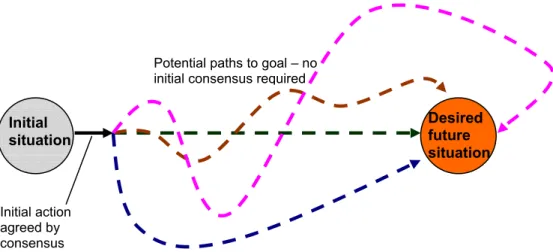
Some progress could be made by thinking through the design of development initiatives. A participatory process will require initial consensus from various stakeholders around two broad questions: a) what is the current situation? b) what is the desired future situation? This should then help produce agreement on the overall goal for the intervention. The next stage is to establish how that goal is to be reached. This is familiar ground and there are many participatory tools available for working through from goals to activities (such as problem/solution trees). This route to the goal rests on a theory of change.
The major strength of the LFA is that it does force people to think through their theory of change – a process which many people find difficult. In order to make a case for support, it is essential to explain how activities may produce certain outputs and contribute to a set of objectives and the overall goal. However, there may be many alternative paths to get from these activities to the goal. This logic is not the only path and there may be many unimagined routes. In other words, development actors must put forward their theory of change underlying their proposal, but it must also be recognised that it is only a theory. Moreover, it is likely to be one among competing theories.
The LFA requires us to reach consensus on the overall plan for the project – the goal, objectives, outputs and activities. This is where we are pushed into a linear mode of thinking. If we try to force everyone into agreeing one long logical path from activities to goals, not only do we expend a huge amount of effort, but we also have to work within one theory of change, which is captured in the logical framework. Inevitably, it is usually the theory that is most acceptable to donors which will dominate.
We need to ask if this is necessary. Rather than tying ourselves into one overall model of how the project will work, which relies on impossible predictions, we could start by focusing on achieving consensus around the initial activities. Thus we agree on the first step on the way. As action is carried out it must be reviewed and the next steps are determined, in discussion with primary stakeholders. Under such an approach, implementing a project is not concerned with following the predetermined path. Instead, it is like feeling your way through the marshes, stopping regularly to reassess your situation, changing direction, possibly even retreating as required, in order to work through towards the goal without stepping off a solid path and becoming impossibly lost in the mud (see Figure 1).
Figure 1: Feeling the way to the goal
Initial situation
Desired future situation
Initial action agreed by consensus
Potential paths to goal – no initial consensus required