Estudos e Documentos de Trabalho
Working Papers
8 | 2007
CHARACTERISTICS OF THE PORTUGUESE ECONOMIC GROWTH: WHAT HAS BEEN MISSING?
João Amador Carlos Coimbra
A p r i l 2 0 0 7
The analyses, opinions and findings of these papers represent the views of the authors, they are not necessarily those of the Banco de Portugal.
Please address correspondence to João Amador
Economics and Research Department
Banco de Portugal, Av. Almirante Reis no. 71, 1150-012 Lisboa, Portugal; Tel.: 351 21 313 0708, Email: [email protected]
BANCO DE PORTUGAL
Economics and Research Department
Av. Almirante Reis, 71-6thfloor 1150-012 Lisboa
www.bportugal.pt
Printed and distributed by
Administrative Services Department Av. Almirante Reis, 71-2ndfloor 1150-012 Lisboa
Number of copies printed
300 issues
Legal Deposit no. 3664/83 ISSN 0870-0117
Characteristics of the Portuguese Economic Growth:
What has been Missing?
∗Jo˜ao Amador† Carlos Coimbra‡
April 2007
Abstract
This paper analyzes the Portuguese economic growth since the 1960’s until present and com-pares its composition with that of Spain, Greece and Ireland. The average real GDP growth rate in each decade is decomposed as the contribution of input accumulation and total factor productivity. The contribution of labour and capital is separated using computed elasticities and the contribution of total factor productivity is disentangled into technological progress and effi-ciency. The methodology is based on Bayesian statistical methods and allows the computation of a world translog dynamic stochastic production frontier, which captures the technology that is available to all economies in each period of time. The results obtained are accurate in terms of the contribution of input accumulation and total factor productivity to GDP growth but there is lower precision when separating the contributions of technology growth and efficiency. The results obtained show that Portugal owes most of its economic growth to the accumulation of factors and not to total factor productivity. In particular the contribution of technology to economic growth is substantially lower than what is observed in the other economies considered. It is argued that this may be due to the existence of a low capital-labour ratio, which determines that Portugal is placed in a segment of the world production frontier that does not expand significantly as a result of technological progress. In addition, there is some evidence of modest developments in terms of efficiency which may be associated with the low quality of new inputs relatively to other economies. Another possible explanation for the disappointing performance of the Portuguese economy in the last decade lies in the existence of statistical inaccuracies in the measurement of GDP, especially in what concerns the contribution of some services.
Keywords: Growth Accounting, Portuguese Economy, Stochastic Frontiers, Bayesian Methods. JEL Classification: C11, O47, O5.
∗The opinions expressed in this paper are those of the authors and not necessarily those of Banco de Portugal or
the Eurosystem. Corresponding author: Jo˜ao Amador, Banco de Portugal, Economics and Research Department, R. Francisco Ribeiro 2, 1150-165 Lisboa - Portugal.
†Banco de Portugal and Universidade NOVA de Lisboa. E-mail: [email protected] ‡Banco de Portugal and ISCTE. E-mail: [email protected]
1
Introduction
The literature that focuses on the composition of economic growth is very large and the subject continues appealing to economists both in theoretical and empirical terms. From an individual country’s perspective, the disentanglement of the components of economic growth provides useful information in terms of past performance and on the relative importance of policies that promote faster factor accumulation and higher total factor productivity (TFP) growth. This analysis should be carried out taking a set of countries as a benchmark and the relevant production function must describe the existing world technology and not just the domestic technology. However, this is typically not done in empirical growth accounting exercises.
The seminal contributions to economic growth theory are that of Solow (1956) and, more recently, the works of Romer (1986, 1990) and Lucas (1988). The empirical liter-ature in this area divided into two different strands. One strand bases on the seminal work of Solow (1957), which decomposes economic growth in a given economy into factor accumulation and TFP. The other strand of literature bases on cross-country regressions to identify the characteristics of countries with good growth performance, profiting from the increasing availability of comparable international databases. Im-portant contributions in this area are those of Baumol (1986), Barro (1991) and Sala-Martin (1997).
In the last decade, the progress on computation methods lead to the increased uti-lization of Bayesian inference techniques in many areas of economic research, namely allowing for the computation of stochastic production frontiers, which can be used for growth accounting exercises.1 These methods seem particularly suitable when samples
are small. The initial contributions in this area are those of Koop, Osiewalski and Steel (1999, 2000), upon which we heavily rely in this paper.
The paper uses Bayesian statistical methods to compute stochastic production frontiers and describe the main characteristics of the Portuguese economic growth from 1960 until 2005, comparing it with three other benchmark economies - Spain, Greece and Ireland. These countries, usually designated as the EU15 cohesion countries, showed low and relatively similar levels of development in the 1960’s. Though, they recorded different growth paths, especially after the 1980’s, with Ireland showing a striking good performance. The growth accounting exercise was carried out taking eight separate pe-riods of 11 years (10 annual growth rates), comprising overlapping decades from 1960 onwards and assuming a dynamic translog stochastic production frontier. The
com-1Bayesian inference techniques have also been used to compute stochastic production frontiers at the micro level, see
putations are based on information for 21 OECD economies. The growth accounting exercise provides results for the contribution of inputs to GDP growth, which is fur-ther separated using the computed capital and labour elasticities. The contribution of total factor productivity is disentangled into technological progress and the degree of productive efficiency, i.e. the distance to the stochastic production function.
As previously remarked, the traditional growth accounting techniques do not refer to world technology and set rigid specifications for the production function - usually Cobb-Douglas with fixed coefficients and no dynamic considerations.2. Therefore, the
results obtained with this methodology should be taken with caution. Although using more advanced methods, this paper is still a pure growth accounting exercise. Thus it does not aim to reveal causation channels between the variables under observation or to identify any underlying fundamental causes for the economic growth. Such an exercise should be done preferably in the context of a general equilibrium model. The paper is organized as follows. In the next section we discuss some methodological issues and present the details of the model that is used for sampling. In addition, we describe the database that is used and point some shortcomings. In the third section we present the results obtained for the growth accounting exercises and discuss their robustness. Next we briefly contrast the composition of the Portuguese economic growth with that of the three benchmark economies. In section four we build on the results obtained to suggest explanations for the relatively poor performance of the Portuguese economy in the recent years. Finally, section five presents some concluding remarks.
2
The Stochastic Frontier Approach
Prior to the presentation of the details of the model used for sampling it is important to discuss some methodological issues. Firstly, contrary to what is done in the tradi-tional empirical growth accounting exercises, the GDP growth decomposition should be jointly and simultaneously computed for several economies. The underlying assump-tion is that there is an internaassump-tional producassump-tion frontier, which can be statistically identified because there are countries lying in its different segments. On conceptual grounds it means that all countries have equal access to the same technology, implying that if two countries have equal labour and capital endowments the one with higher GDP is more efficient, i.e. stands closer to the stochastic production frontier.
The speed of international dissemination of technological progress and its implications
2Some examples of growth accounting exercises for the Portuguese economy using the traditional growth accounting
in terms of growth theory are discussed by Basu and Weil (1998). These authors argue that the dissemination of technological progress in the actual production system occurs at a slower pace than the diffusion of knowledge. In the OECD countries, knowledge diffusion should occur at a very fast pace, meaning the existence of a common set of potentially available production technologies for all member countries. Therefore, the time that elapses until a country effectively adopts the technological innovations in the production systems becomes reflected in its relative production efficiency. In addition, if there is a technological progress potentially available for all, the interna-tional production frontier expands gradually in time in some way. We simply assume that the technological progress evolves according to a linear trend during each period considered.3 This implicitly assumes that there is an average speed for the adoption of
new technologies across countries and each country specific lags or leads are captured by the efficiency component.
The analysis focuses on eight 11 year periods (10 annual growth rates), for which stochastic production frontiers are computed. All results of the growth accounting exercise are presented in terms of 10 year average growth rates or contributions.4 The
length of the periods considered encompasses the average duration of the economic cycle, thus averaging out cyclical effects on the macroeconomic variables considered. The partition of the sample in sub-periods is also necessary because of the assumption on the dynamics of technological progress. In fact, it does not seem reasonable to assume that technology evolves linearly throughout several decades.
Regarding the specification of the production function, a translog formulation is used. This formulation comprehends, as a special case, the log transformation of the Cobb-Douglas production function, though it is much more flexible than the latter. In fact, a major limitation of the Cobb-Douglas production function is the absence of cross effects between labour and capital. Temple (2006) argues that the assumption of a Cobb-Douglas specification may lead to spurious results in economical and statistical terms. The problem is magnified because traditional growth accounting exercises treat TFP as unobservable (omitted variable), limiting specification testing. In fact, if the researcher had identified a good proxy for TFP and the data were actually generated by a translog, a suitably specified regression would accurately recover the parameters of that translog production function, and reject the Cobb-Douglas specification given sufficient variation in the data.
3Koop, Osiewalski and Steel (1999) tested other formulations for the dynamics of the production function, namely
a time specific model, where frontiers are totally independent in time, a quadratic trend model and a linear trend model imposing constant returns to scale. They concluded that the linear trend model is the best performer in terms of in-sample fit, ability to distinguish the components of TFP and number of parameters to compute. We deal with this issue in section 2.1.
Classical econometrics allows for the estimation of stochastic production functions, namely through maximum likelihood methods.5 However, the Bayesian methods
em-ployed here are suitable when samples are small, as it is the case, allowing inferences without relying on asymptotic approximations. Bayesian methods allow to rationally combine observed data with economically meaningful priors. In practical terms, for each variable, a posterior distribution function is obtained, combining observed data with initial assumptions (priors). We derive the posterior distribution functions of all parameters in the model, leading to the posterior distribution function of GDP growth components.
The prior for the efficiency parameter is an asymmetric positive distribution. The ra-tional behind this assumption is twofold. Firstly, this parameter measures the distance relatively to the production frontier so it should be positive. Secondly, there is a smaller probability of finding observations as we move further inner the production frontier. This assumption is common in stochastic frontier functions’ literature, remaining the concrete nature of the asymmetric distribution an open question. We opted for the use of a normal-gamma model (normal distribution of the residual component and gamma distribution for the efficiency component). Its relative advantages to the usual alter-natives, normal-half normal and normal-exponential models are discussed in Greene (2000) and Tsionas (2000).
2.1 The Model
The model considered for the decomposition of the GDP growth follows Koop et al. (1999), taking the form:
Yti =ft(Kti, Lti)τtiwti (1)
whereYti, Kti and Lti denote the real output, the capital stock and labour in period t
(t = 1, ..., T) in country i (i= 1, ..., N), respectively. Furthermore, τti (0< τti 61) is
the efficiency parameter andwti represents the measurement error in the identification
of the frontier or the stochastic nature of the frontier itself. As mentioned above, the basic model assumes a relatively flexible translog production function:
yti=x 0
tiβt+vti−uti (2)
5For references on non-bayesian estimation methods of stochastic production functions see for example Aigner, Lovell
where:
x0ti = ¡1, kti, lti, ktilti, kti2, l2ti
¢
(3)
βt = (βt1, ..., βt6)0 (4)
and lower case letters indicate natural logs of upper case letters. The logarithm of the measurement error vti is iid N(0, σt2) and the logarithm of the efficiency parameter is
one sided to ensure that τti = exp (−uti) lies between zero and one. The prior for uti
is taken to be a gamma function with a time specific mean λt.
The contribution of input endowment, technology change and efficiency change to GDP growth is defined in a fairly simple way. The GDP growth rate in countryi in period
t+ 1 can be written as:
yt+1,i−yt,i =
³
x0t+1,iβt+1−x
0 t,iβt
´
+ (ut,i−ut+1,i) (5)
where the first term includes technical progress and factor accumulation and the second term represents efficiency change. The first term can be further decomposed as:
1
2(xt+1,i+xti)
0(β
t+1−βt) + 1
2(βt+1+βt)
0(x
t+1,i−xti) (6)
The technical change for a given level of inputs results from the first term of the previous equation and is defined as:
T Ct+1,i = exp
·
1
2(xt+1,i+xti)
0(β
t+1−βt)
¸
(7) and the input change defined as the geometric average of two pure input change effects, relatively to the frontiers successive periods:
ICt+1,i = exp
·
1
2(βt+1+βt)
0(x
t+1,i−xti)
¸
(8) The efficiency change is defined as:
ECt+1,i= exp(uti−ut+1,i) =
τt+1,i
τt,i
(9) The average percentage changes in technology, input and efficiency result from geo-metric averages and can be defined respectively as:
AT Ci = 100∗
ÃT−1 Y
t=1
T Ct+1,i
! 1
T−1
−1
(10)
AICi = 100∗
ÃT−1 Y
t=1
ICt+1,i
! 1
T−1
−1
(11)
AECi = 100∗
Ã
TY−1
t=1
ECt+1,i
! 1
T−1
−1
(12)
= 100∗
h
[exp(u1,i−uT,i)]
1
T−1 −1 i
(13) Koop et al. (1999) suggest different models for the structure of technology change. It can be assumed that the parameters for the technology are different in each of the
T time periods (time specific model) or a more structured assumption where technol-ogy in a decade evolves in a linear (linear trend model) or a quadratic (quadratic trend model) way. Finally, the authors refer to a linear trend model constrained to a constant returns to scale technology.6 Each of these alternatives presents advantages and
po-tential limitations. The time specific model is very flexible but implies the sampling of numerous parameters, which is computationally heavy. The linear and quadratic trend models are less demanding in terms of parameters but force a more rigid dynamics for technical progress. The quadratic trend is obviously more flexible than the linear one, which makes it preferable if long periods are considered. The linear trend constrained to a constant returns technology probably imposes too much structure. These different alternatives were tested and the linear trend model offered the best results in terms of the in-sample fit and the ability to separate the components of TFP. Therefore we adopt such formulation:
βt =β∗+tβ∗∗ (14)
and
σ2
t =...=σT2 =σ2 (15)
Thus the model can be written as:
y =X∗β−u+v (16)
with
y=
³ y10...y0T
´ , u=
³ u01...u0T
´
, v = (v1...vT)0, β=
³ β∗0β∗∗0
´0
(17)
6Other more restrictive formulations consider technological progress to be exclusively captured by changes in the
first term ofβt. For instance Cornwell, Schmidt and Sickles (1990) consider a quadratic trend onβt and Perelman and
whereβ is a 12×1 vector and:
X∗ =
X1 X1
. .
Xt tXt
. .
XT T XT
(18)
whereXt is a 21 (countries)×6 vector.7 At this stage the full likelihood function of the
model can be written as:
fT N N
¡
y¯¯X∗β−u, σ2I
T N
¢
p¡σ−2¢p¡λ−1¢
T
Y
t=1
N
Y
i=1
fG
¡ uti
¯
¯1, λ−1¢ (19)
wherefT N
N stands for a multivariateT×N normal probability distribution function,fG
stands for a gamma probability distribution function and:
p¡λ−1¢ = f
G
¡
λ−1|1,−ln (τ∗)¢
p¡σ−2¢ = σ2exp−10−6
2σ2
Note that the prior forλ−1 assumes a gamma distribution with the first parameter equal
to 1, meaning a very flat prior and second parameter such that (−ln(τ∗))−1 is the prior
median efficiency. We assumeτ∗ = 0.03 so that the median of the efficiency distribution
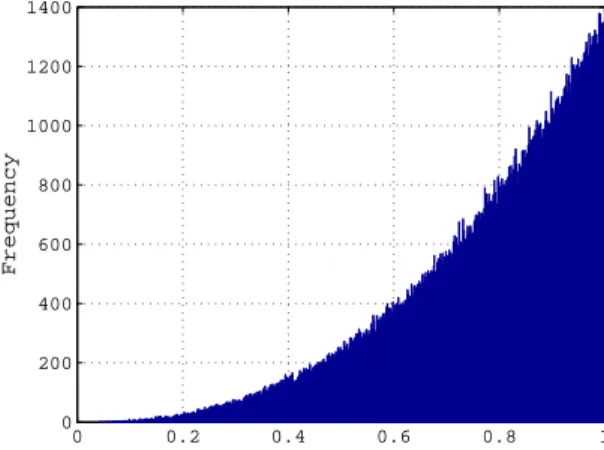
is 0.75. The robustness of results to this prior was confirmed taking different initial values forτ∗. In Figure 1 we simulate the prior distribution of the efficiency parameter.
As forσ−2 we assume the usual flat prior.
Given this prior structure the posterior marginal distributions that compose the Gibbs sampler are easily derived (see Appendix A). The conditional forβ is:
p¡β¯¯Data, u, σ−2, λ−1¢∝f2J N
³ β
¯ ¯
¯ bβ, σ2(X∗0X∗)−1´ (20)
where
b
β = (X∗0X∗)−1X∗0(y+u) (21)
The conditional forσ−2 to be used in the Gibbs sampler is:
p¡σ−2¯¯Data, β, u, λ−1¢∝f
G
µ σ−2
¯ ¯ ¯
¯n0+2T N,12 £
a0+ (y−X∗β+u)0(y−X∗β+u)
¤¶
(22)
7Given this matricial formulation, the generic element is: y
ti= (β∗1+tβ∗∗7 ) + (β∗2+tβ8∗∗)kti+ (β3∗+tβ9∗∗)lti+ (β∗4+
tβ∗∗
10)ktilti+ (β5∗+tβ∗∗11)k2ti+ (β∗6+tβ12∗∗)lti2. Therefore, the formulas for capital and labour elasticities are given by
EKti = (β2∗+tβ8∗∗) + (β∗4+tβ∗∗10)lti+ 2(β5∗+tβ11∗∗)kti and ELti = (β3∗+tβ9∗∗) + (β4∗+tβ10∗∗)kti+ 2(β∗∗6 +tβ∗∗12)lti,
Next, the conditional foru is:
p¡u¯¯Data, β, σ−2, λ−1¢∝fT N N
µ u
¯ ¯ ¯
¯X∗β−y− σ
2
λ i, σ
2I
N T
¶
(23) Finally the marginal posterior distribution for theλ−1 is:
p¡λ−1¯¯Data, β, u, σ−2¢=f
G
à λ−1
¯ ¯ ¯ ¯
¯1 +T N,−ln (τ
∗) +
T
X
t=1
N
X
i=1
uit
!
(24)
Figure 1: Prior distribution for the efficiency parameter Simulation with 420.000 iterations andτ∗= 0.03
0 0.2 0.4 0.6 0.8 1
0 200 400 600 800 1000 1200 1400
Frequency
The sequential Gibbs sampling algorithm defined by equations 20 to 24 was run with 420.000 iterations for each separate decade, with a burn-in of the first 20.000 iterations to eliminate possible start-up effects (see Casella and George (1992)). The compu-tational burden of running such a large number of iterations is high. Nevertheless, given the somewhat limited sample information content and the measurement prob-lems intrinsic to macroeconomic variables, such high number of iterations is necessary to obtain an adequate degree of convergence of the algorithm. For the period 1995-2005 we ran 620.000 iterations in order to test improvements in the accuracy of the results. The gains resulting from the increased iterations were marginal. The tradi-tional algorithm convergence criteria were computed and the posterior distributions were analyzed (see Geweke (1992)).
2.2 Database
The data used for employment and GDP from 1960 until 2005 for all 21 OECD countries considered8 except Portugal was obtained from the European Commission AMECO
8Countries considered were: Australia, Austria, Belgium, Canada, Denmark, Finland, France, Germany, Greece,
Ireland, Italy, Japan, the Netherlands, Norway, New Zealand, Portugal, Spain, Sweden, Switzerland, UK and US. The other OECD countries were not included due to lack of comparable data for the sample period. Nevertheless, the 21 countries considered constitute a representative sample as they are industrialized economies and stand for a large share of world GDP during the reference period.
database.9 The data for the total capital stock typically poses some problems. For
the first period in the sample, the stock of capital in each country as a percentage of GDP was taken from King and Levine (1994). These levels were updated taking the investment real growth rates existing in the AMECO database. On the one hand, we did not adopt the initial capital stock of AMECO because, as an assumption, it simply corresponds to 3 times the GDP at 1960, which is an obvious limitation. On the other hand, it is not possible to use only data from King and Levine (1994) because it ends in 1994. Other alternatives for the construction of the series of capital stock were tested but the results do not change qualitatively.
The other important point to mention is the origin of the data concerning employ-ment and GDP in Portugal. Although, in long sub-periods the AMECO data does not diverge significantly from the series we used, it shows some breaks, particularly in the employment series, that perturb the growth decomposition. Therefore, as an alternative, we use information from the the long series produced by Banco de Por-tugal, completed with the Labour Survey of the National Statistics Institute (NSI). As for the GDP, we use the annual real growth rates of the long series of Banco de Portugal to extend backwards the levels of GDP in 1995 estimated by the NSI. Finally, for 1995 onwards, we used NSI figures completed for the last two years with Banco de Portugal estimations. For the period 1995-2005, this data is practically equal to what is presented in the AMECO database.
It should be noted that, in spite of the international conventions governing national accounts compilation, there are important country specific practices that tend to blur international comparisons. For example, the separation of nominal variations in price and volume is not uniformly computed by the national statistical authorities (see Berndt and Triplett (1990)). The compilation of value added for some services, namely those associated to general government activities, also poses difficulties in international comparisons. These problems may affect the results obtained, though, we hope, not dramatically.
2.3 Results for the period 1960-2005
In this section we describe the Portuguese economic growth by main components, during the last forty five years against the set of benchmark countries. The fit obtained with the computation is very good, measured by the error relative to the observed GDP growth and the interquartile range. Nevertheless, there is less accuracy in the separation of the TFP components since the interquartile range increases.
In the sixties the Portuguese economy presented very high growth rates (see figure 2) in contrast with what happened in the seventies and in the beginning of the eighties. In the 5 to 6 years after the 1986 EU accession, economic activity accelerated again in Portugal. However, more recently, GDP grew at disappointingly low rates. As a matter of fact, in the last decade, for the first time, those rates fell below the OECD average. A decomposition of GDP growth is presented in Table 1. The detailed results for the benchmark countries are summarized in Annex B. 10
Figure 2: Average annual GDP growth in Portugal, Spain, Greece and Ireland
!"#$
%&'(
)* +
,"-"
./
01
23
01!
2 " *
+
,0
4
5
6
7
89
:
;
<
=
>
Capital accumulation is by far the main contributor to the Portuguese GDP growth in the period 1960-2005. This contrasts with the subdued role of employment. How-ever, in the periods 1960-1970, 1965-1975 TFP played an important role in explaining growth, basically through the effect of technical progress. One explanation for this result is the very fast decline of agriculture during the sixties and its replacement by services and industry. This trend was basically associated with the accession to the European Free Trade Association in 1960 and the export-lead industrialization that fol-lowed (see Lopes (1999) and Sousa (1995)). In the decade 1965-75 the results seem to capture another important fact of the Portuguese economy. In this period substantial investments in manufacturing took place, increasing the contribution of capital to GDP growth. Although the higher capital intensity may have contributed to take advantage of technological progress, some investments were not fully market oriented, limiting the contribution of efficiency. In contrast, the negative contribution of technical progress in the seventies may be related with sizeable external and internal supply shocks that hit the economy - the 1973 oil shock and the 1974 Portuguese revolution. The latter shock comprised several aspects, namely: high real wage updates, the nationalization process, the massive return of Portuguese citizens and the loss of export markets following the independence of the African colonies. This shock disrupted firms’ activities, leading to lower productivity growth, and contributed to sizeable public deficits. These factors
! "# "# $ % ! # &' &( $ $) $ $ $ % # * "# "' $ $ $ ) % $ + +( (* + !# + ' $ ) $ + # *# + !* + ( ) $ $ )$ + !" *! +
&* +
* ) ) ) % + *!
*& +
(! + & ) $ % % % ! ++ +
*" +
**
,
-.
/012
3
4/5
6 7 6. 2 36 855 . 27 9 : -; 6 7 .
/;<42;
.63
/;27=/5
> ?
Table 1: Portuguese Economic Growth
@ > A B A ? >
C@D
E >
C@D
F
concurred to a crisis in the current account in 1977. The effects of the subsequent adjustment measures on GDP were not severe, benefitting mainly from substantial ex-change rate depreciations and a favourable international economic situation. Another current account crisis occurred in 1983, following the 1979 second oil shock and a set of expansionary domestic macroeconomic policies. The response to this crisis required stronger expenditure-reducing policies and a GDP growth was negative in 1984. In the mid-eighties the Portuguese economy witnessed again some positive supply shocks, namely the accession to the European Economic Community and the implementation of some structural reforms in the financial sector and the (re)privatization of important sectors. Such events may have played a role in the stronger contribution of TFP in the period 1985-95. In addition, significant investment took place, associated with FDI inflows and infrastructures, partly financed by EU structural funds. In the most recent period, the GDP growth was disappointingly low, with strikingly low (negative or nil) contributions of technical progress and efficiency. We focus on possible explanations for this growth pattern in the next section.
One relevant aspect behind the Portuguese GDP growth pattern is the close path of TFP contribution and GDP growth. This pattern is not so clear in Spain, Greece and particularly in Ireland (see figure 3). In addition, the contribution of capital accumu-lation to GDP growth in Portugal is the highest, rising in the sixties and seventies and in the last decade.
Another way to analyze these developments is to compare them with those obtained for other benchmark economies. Spain and Greece have recorded average GDP growth
Figure 3: GDP growth and TFP contribution Spain ! ! " Portugal #$ % &$ #' % &' & $ % ($ ( ' % ) ' &' % (' ($ % )$ )$ % $$ )' % $' * * ! ! " Greece + , -.
/012
3
4567
! ! " Ireland 89 : ;9 ;< : =< 8< : ;< ;9 : =9 =< : >< =9 : >9 >< : << >9 : <9 * *
? @ A 9 8 ; =
BCD
EFGH
I J
KLM
! ! "
rates relatively similar to Portugal during most of the period considered, with the exception of the first and last two decades.
In the case of Spain the relative contributions of inputs and TFP are also similar to those of Portugal (see figure 4). The main difference lies in the larger contribution of employment to GDP growth in Spain and a smaller drop of the TFP contribution in the last periods. In the case of Greece, caution is required when analyzing the results because there is a large difference between the observed and the computed GDP growth rate in 1980-1990. Nevertheless, two results should be mentioned. Firstly, as in Portugal, employment tends to have a very small contribution for GDP growth. Secondly, on the contrary, TFP contribution in the last 10 years is much higher than in Portugal.
The other country considered presents quite a different story in terms of economic growth. Ireland registered average growth rates clearly higher than Portugal in the last 20 years and its composition is quite balanced. The truly remarkable acceleration of economic growth in Ireland reflects both production factors accumulation and TPF
Figure 4: Contributions to GDP growth (percentage points) ! " # $ % & ' ( )**+* , -, . . -/ 0 1 2 34 5 6 78 9 5 7 343
:;::7
< 7;
4<=
>;
?
;@
3AB
; 4 5 C 2 3 4 5 6 78 9 57 343 :5; < D 4 3 @ 3E 7 <F @ A6 3E 6 ; CC 2 34 5 6 7 8 9 57 343 :; BA @
3=B
; 4 5 2 34 5 6 78 9 5 7 343 :
<FA
7 5 F @ C 5 3< G H ? ;
6FE
;IJK
E63L
5 DM
<3BA9
5 ;> N O P Q , -, . . -/ 0 1 contributions.
In summary, Portugal is the country that presents the largest contribution of capital for economic growth and TFP performance has been poor. This means that growth was based not in qualitative factors but it was mainly driven by investment in physical capital that had little impact in productivity.11 More recently, the contribution of
employment to economic growth is very small, contrasting with positive contributions in all the countries considered.
11The short-term impact of investment on productivity tends to be smaller when it relies on imported capital goods.
3
What has Been Missing in the Portuguese GDP Growth?
It is important to discuss the underlying causes for the pattern of Portuguese growth. Firstly, the low capital-labour ratio in Portugal may have limited the ability to profit from technical progress. Indeed, new technologies are embodied in new capital and the performance of labour intensive sectors is limited. Secondly, more recently, the EMU accession changed the underlying macroeconomic conditions, notably through lower interest rates, leading to increased investment of firms and households. This expan-sionary monetary stance was accentuated by a pro-cyclical fiscal stance. Nevertheless, the increased contribution of capital accumulation in the economy might not have been directed to sectors where productivity was rising faster. In fact, in the recent period the technological progress is particularly strong in capital intensive sectors, mainly through the utilization of ICT (see Colecchia and Schreyer (2001) and Oulton and Srinivasan (2005)). However, the new macroeconomic environment implied a low level of inflation together with a significant positive gap between the growth rate of prices in the non-tradable and tradable sectors, thus favoring the former in terms of resources allocation. Given that productivity growth is stronger in the tradable sector, mainly industry, the sectoral composition of the Portuguese economy may not be favorable to productivity growth. Finally, the measurement of the output level and its growth rate in the non-tradable sector is acknowledged to be less accurate than in the tradable sec-tor. As a matter of fact, changes in quality and improvements in productivity are very difficult to assess through the standard procedures of National Accounts.12 Therefore,
it is possible that the Portuguese GDP growth in the last ten years might have been affected by measurement problems, influencing particularly the computed contribution of TFP. In the next two subsections we try to provide some evidence to support these arguments.
3.1 Low Contribution from Total Factor Productivity
One substantial difference between Portugal and the other economies considered is the very low level of capital stock per worker (figure 5).13 Even allowing for a substantial
measurement error in this variable, the difference remains high and it has not dimin-ished decisively since the 1960’s. Thus, the investment that was carried out in the last two decades has not been sufficient to overcome the structural lag.
One important consequence of this finding is the ability of the economy in taking
ad-12In many services sectors the gross value added is estimated on an input basis, therefore mechanically limiting
productivity gains. The most notable case is that of goods and services produced by the general government, for which there is no market valuation of output.
13This difference is consistently identified in different databases available, i.e. AMECO, Penn World Tables and King
Figure 5: Capital-Labour ratio
Portugal Ireland
Greece Spain
!
"
(a) Percentage of OECD-21 average
!
"
#$
%&
'
%&
'
"
#%
(
(b) OECD-21 average =100 (1995-2004)
vantage of the new production techniques that became internationally available. The shape (figure 6) and the dynamics (figure 7) of the stochastic production frontiers re-veal that technology favors higher capital-labour ratios, namely in recent decades, and technological progress is relatively stronger for higher capital per worker intensities notably in the sixties and nineties. In the recent periods the surface of the stochastic production function seems to have became more convex, meaning that the technological progress and potential TFP gains are centered in sectors with higher capital content. Such finding is consistent with the idea that technology and productivity are essen-tially associated with manufacturing and, more recently in ICT industries. Conversely, services and construction, with lower capital per worker, are not so benefited from technology. This would configure a poverty trap as low capital economies would be at a disadvantage in terms of economic growth and such outcome would limit their ability to invest. Nevertheless, the Portuguese case might not only be a story of investment shortage but probably also a story of low investment quality that is linked with the sectoral composition of economic activity.
The computed capital and labour elasticities, which are used to decompose factor’s contribution to growth, offer a complementary perspective (see table 3). Portugal shows high elasticities for capital, notably in the last decade, and labour elasticities have decreased consistently, becoming lower than in other countries. Finally, the sum of computed elasticities is relatively close to one in all countries and in all periods, meaning that technology is near the constant returns to scale paradigm.
The sectoral composition of Portuguese output reveals that the quick decrease in agri-culture’s relative weight was basically compensated by an increase in manufactures. This brought and increase in capital intensity and TFP contribution. During the pe-riod ranging from the mid-seventies to the mid-nineties the weight of manufactures
Figure 6: 3D stochastic production frontiers - Arrow points to Portuguese economy 3 4 5 6 7 8 7 8 9 10 11 0 1 2 3 4 5 6 7 8 ln(K) ln(L) ln(Y) (a) 1960 3 4 5 6 7 8 7 8 9 10 11 2 3 4 5 6 7 8 ln(K) ln(L) ln(Y) (b) 1965 3 4 5 6 7 8 7 8 9 10 11 2 3 4 5 6 7 8 ln(K) ln(L) ln(Y) (c) 1970 3 4 5 6 7 8 8 9 10 11 2 3 4 5 6 7 8 ln(K) ln(L) ln(Y) (d) 1975 4 5 6 7 8 8 9 10 11 2 3 4 5 6 7 8 ln(K) ln(L) ln(Y) (e) 1980 4 5 6 7 8 8 9 10 11 2 3 4 5 6 7 8 ln(K) ln(L) ln(Y) (f) 1985 4 5 6 7 8 9 8 9 10 11 2 3 4 5 6 7 8 9 ln(K) ln(L) ln(Y) (g) 1990 4 5 6 7 8 9 8 9 10 11 −4 −2 0 2 4 6 8 ln(K) ln(L) ln(Y) (h) 1995
Figure 7: Dynamic stochastic production frontiers (L level set for Portugal) 1960-70 K/L ! " #$ % % (a) 1960-70 1965-75 T=1 T=10 ! " #$%% (b) 1965-75 T=1 T=10 Reference value for L = 3900
(c) 1970-80 T=1 T=10 Reference value for L = 4000
(d) 1975-85 T=1 T=10 Reference value for L = 4200
(e) 1980-90 T=1 T=10 Reference value for L = 4300
(f) 1985-95 T=1 T=10 Reference value for L = 4600
(g) 1990-00 T=1 T=10 Reference value for L = 4800
(h) 1995-05
!" #
$%&'()
* # + # " , * -. -* -#, -/ 0 &1 * )2 " 3 ( -/ 4
1##.# /
+5
1#
" /
+"
&21
-*7
',
9
:;;<; =:;
> ?@ A B C? D @ E F: G
HI?
>
remained broadly stable and the slower decline in agriculture was compensated by a rise of services and construction. This somewhat limited the contribution of TFP to economic growth.14 Finally, during the nineties manufactures joined to the downward
trend of agriculture and, consequently, the weight of services and construction has risen faster. In fact the join weight of agriculture and manufacturing that represented almost half of gross value added fifty years ago, was reduced to around 20 per cent in 2005 (figure 8).
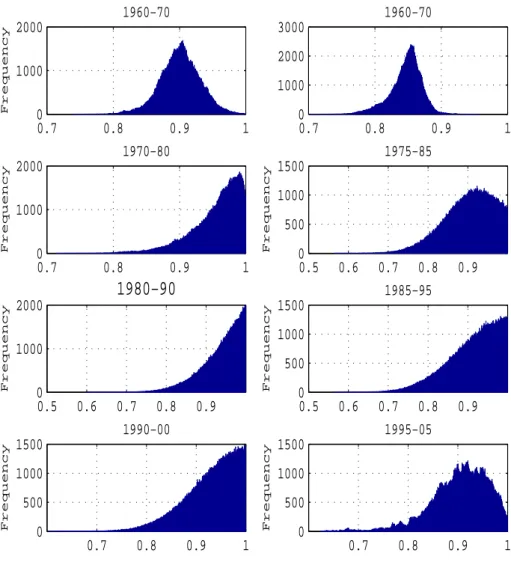
The discussion on the quality of the investment that was made in Portugal is not linked with factor intensity and its relation with technological progress but with the contri-bution of efficiency to TFP. The results reveal that, although Portugal presents a good level of efficiency in the utilization of resources comparatively to the other countries considered (see figure 9 and Appendix C), the contribution of efficiency developments was negative in the period 1965-75 and 1995-2005. Although there were significant investments in labour intensive manufacturing sectors, like textiles and clothing, fol-lowing the EFTA accession, in the period 1965-75 a substantial part of the investment was directed to large capital intensive industries. Unfortunately, the increasing of ca-pacity in these sectors almost coincided with negative developments in world markets. A similar result seems to be present in the 1995-2005 period. This time it is not a story
14It is acknowledged that the non-tradable nature of many services sectors lowers competition, contributing to lower
Figure 8: Sector shares in GVA
!
"
# $ %
& '(
&)
*
&+
,
)&
-. * /
(
$0)1&
' 2
$)
%
030&+&
#4
(-/
5,
-/1$
5 &
2
$)
%
03
-6
of investment in manufacturing capital intensive sectors, but probably investment in real assets with low return such as housing. The considerations on the quality of pro-duction factors are extendable to labour, as Portugal presents severe shortcomings in terms of average number of schooling years. Moreover, the institutional aspects of the Portuguese labour market may have been playing a role. There seems to be a lack of labour mobility, which is confined almost entirely to fixed-term contracts, making difficult efficient matches between workers’ skills and labour services needed by firms (see Blanchard and Portugal (2001)).
Nevertheless, considerations on the quality of production factors should be addressed specifically by including adjustment parameters in the production function like in Koop, Osiewalski and Steel (2000). In this case a bilinear production function is used to account for the effect of different characteristics of inputs. This is a research path to follow in future work.
3.2 GDP Measurement Problems
The measurement of economic activity in the non-tradables sector, where the produc-tion is often of an immaterial nature, faces difficulties that may limit its accuracy. Although the weight of this sector is clearly dominant and it has been continually increasing in the developed economies, the underlying statistical infrastructure of na-tional accounts has not improved proporna-tionally. In fact, there is lack of reliable and internationally comparable statistical indicators for some important services activities, notably, services provided by general government (figure 10).
These measurement problems associated to the non-tradables sector tend to affect all countries, but with different magnitudes. Therefore, when comparing growth
account-Figure 9: Posterior distribution of the efficiency parameter - Portugal
0.7 0.8 0.9 1
0 1000 2000
Frequency
1960−70
0.7 0.8 0.9 1
0 1000 2000 3000
1960−70
0.7 0.8 0.9 1
0 1000 2000
Frequency
1970−80
0.5 0.6 0.7 0.8 0.9 0
500 1000 1500
Frequency
1975−85
0.5 0.6 0.7 0.8 0.9 0
1000 2000
Frequency
1980−90
0.5 0.6 0.7 0.8 0.9 0
500 1000 1500
Frequency
1985−95
0.7 0.8 0.9 1
0 500 1000 1500
Frequency
1990−00
0.7 0.8 0.9 1
0 500 1000 1500
Frequency
1995−05
ing results across countries, the existence of such measurement problems should be considered. The idiosyncratic results obtained for Portugal in the last ten years might be partly related with important measurement problems. In fact, when looking deeper into Portuguese national accounts for the recent years, one striking aspect is that the poor labour productivity performance in the “other services”15, which accounts for
al-most 1/3 of total gross value added. In this sector, the output per person employed in Portugal declines persistently over the last ten years, possibly signalizing a significant underestimation of the sector’s output.
Admitting that there are some measuring problems of this type, probably largely due to
15This sector comprehends all services excluding, trading, transports, communications and financial services. It
includes mainly general government services and, to a lesser extent, some private services to firms and to individuals. The results for this sector are regularly published by national quarterly accounts. National annual accounts present this sector disaggregated into 12 subsectors but the last year available is 2003.
Figure 10: Weight of general government consumption on GDP
Portugal
Ireland Spain
Greece
!
"#
$%
&'
$%
&
$
(
the way general government real output is measured, we performed two simulations for the period 1995-2005 under the assumption that employment and capital levels are not significantly affected by this problem. In the first simulation, we artificially increased labour productivity annual rate of change of “other services” to match the average annual rate of change in the rest of the economy. In the second one, we set labour productivity annual rate of change of “other services” equal to zero. The average GDP annual growth rates where revised upwards by 0.9 and 0.3 percentage points, respectively. 16 As expected, the upward revision in GDP growth is reflected in a less
negative (in the second simulation) or even in a slightly positive contribution of total factor productivity (in the first simulation).17 However, it is worth noting that the
contribution of efficiency remains negative and almost unchanged in the two exercises while the contribution of technical progress, which was strongly negative, turns positive in the first simulation.
Although these exercises illustrate that measurement problems may have their share in explaining the poor performance of the Portuguese economy expressed in national accounts, the results obtained with simulations show that the increases in TFP con-tribution are not very strong, meaning that the other aspects must remain part of the explanation.
16The assumption of maintaining unchanged the employment and stock of capital levels is not unreasonable. The
stock of capital evolution reflects mainly the dynamic of GFCF which is recorded as the sum of expenditures of residents in equipment, transportation and construction goods. So if there is a problem of missing output in “other services” there are no strong reasons to believe that it would also significantly affect the measure of those two variables (employment and GFCF). Moreover, if an upward revision of the “other services” output takes place, in the expenditure side, it would be reflected mainly in more private and general government consumptions.
17As the estimation is made jointly for all the countries considered, the changes in Portugal affect not only its results
but also the results of the other countries. However, no noticeable changes were in fact detected in the results for the other countries.
4
Final Remarks
This paper develops a growth accounting exercise for the Portuguese economy in the last four decades, setting Spain, Greece and Ireland as a benchmark. The technical approach adopted here is superior to the typical growth accounting methodology. In this paper a dynamic translog world stochastic production frontier is computed, pro-viding a more accurate accounting of inputs and TFP contribution, allowing for the decomposition of the latter into technical progress and efficiency.
We conclude that Portugal derived much of its economic growth from capital accumu-lation, whereas labour input showed systematic low contributions. The contribution of TFP was lower than in the other benchmark countries, particularly in the last decade. Some explanations for the poor performance of TFP are proposed, basing on its decomposition. Firstly, the capital-labour ratio in Portugal is low in international terms, which does not allow to fully capture the benefits of technological progress. As a matter of fact, the expansion in the world production function is larger for higher capital intensities and its shape favours larger capital ratios. Secondly, the quality of the investment and other institutional factors seem to lead to a low contribution of efficiency improvements to GDP growth, thereby contributing to a poor overall TFP performance. Finally, the hypothesis of measurement problems in the Portuguese GDP, if confirmed, is reflected in the apparent poor performance of TFP. However, given its possible magnitude, it should not change the general picture.
There is clearly scope for further research in this area, namely adjusting capital and labour stocks by their quality to assess how changes in such characteristics affect GDP growth accounting.
References
Aigner, D., Lovell, C. and Schmidt, P. (1977), ‘Formulation and estimation of stochastic frontier production function models’, Journal of Econometrics (6), 21–37.
Almeida, V. and F´elix, R. (2006), ‘Computing potential output and the output gap for the portuguese economy’, Banco de Portugal Economic Bulletin .
Barro, R. (1991), ‘Economic growth in a cross section of countries’, Quarterly Journal of Economics 106, 407–433.
Basu, W. and Weil, D. (1998), ‘Appropriate technology and growth’,Quarterly Journal of Economics 113, 1025–1054.
Baumol, W. (1986), ‘Productivity growth, convergence, and welfare: What the long-run data show’, American Economic Review 76(5), 1072–85.
Berndt, E. and Triplett, J. (1990), Fifty Years of Economic Measurement, University of Chicago Press.
Blanchard, O. and Portugal, P. (2001), ‘What hides behind an unemployment rate: Comparing portuguese and u.s. labor markets’,American Economic Review1(91). Casella, G. and George, E. (1992), ‘Explaining the gibbs sampler’, The American
Statistician (46), 167–174.
Colecchia, A. and Schreyer, P. (2001), Ict investment and economic growth in the 1990’s: is the united states a unique case? a comparative study of nine oecd countries, Technical Report OECD DSTI/DOC 2001/7, October.
Cornwell, C., Schmidt, P. and Sickles, R. (1990), ‘Production frontiers with cross-sectional and time-series variation in efficiency levels’, Journal of Econometrics
46(1), 185–200.
Freitas, M. L. (2000), ‘Quantity versus quality: The growth accounting in ireland’,
Banco de Portugal Economic Bulletin .
Geweke, J. (1992), Evaluating the accuracy of sampling based approaches to the cal-culation of posterior moments, in J. M. B. et al., ed., ‘Bayesian Statistics 4: Pro-ceedings of the Fourth Valencia International Meeting’, Oxford Clarendon Press. Greene, W. (2000), ‘Simulated likelihood estimation of the normal-gamma stochastic
frontier function’, Quarterly Journal of Economics 113, 1025–1054.
Griffin, J. and Steel, M. (2004), ‘Semiparametric bayesian inference for stochastic fron-tier models’, Journal of Econometrics (123), 121–152.
King, R. and Levine, R. (1994), ‘Capital fundamentalism, economic development, and economic growth’,Carnegie-Rochester Conference Series on Public Policy40, 259– 292.
Koop, G., Osiewalski, J. and Steel, M. (1999), ‘The components of output growth: A stochastic frontier analysis’, Oxford Bulletin of Economics and Statistics
61(4), 455–487.
Koop, G., Osiewalski, J. and Steel, M. (2000), ‘Modelling the sources of output growth in a panel of countries’,Journal of Business & Economic Statistics18(3), 284–299. Kumbhakar, S. C. and Lovell, C. (2004),Stochastic Frontier Analysis, Cambridge
Uni-versity Press.
Lopes, S. (1999),A Economia Portuguesa desde 1960, Gradiva.
Lucas, R. (1988), ‘On the mechanics of economic development’, Journal of Monetary Economics 22, 3–42.
Meeusen, W. and der Broeck, V. (1977), ‘Efficiency estimation from cobb-douglas pro-duction functions with composed error’,International Economic Review(18), 435– 452.
Oulton, N. and Srinivasan, S. (2005), Productivity growth and the role of ict in the united kigdom: An industry view 1970-2000, Technical Report 681.
Perelman, S. and Pestieau, P. (1994), ‘A comparative performance study of postal services: A productive efficiency approach’, Annales de Economie et de Statistique
33, 187–202.
Romer, P. (1986), ‘Increasing returns and long-run growth’,Journal of Political Econ-omy 94(5), 1002–1037.
Romer, P. (1990), ‘Endogenous technological change’, Journal of Political Economy
98(5), 71–102.
Sala-Martin, X. (1997), ‘I just ran 2 million regressions’, American Economic Review
87(2), 178–183.
Solow, R. (1956), ‘A contribution to the theory of economic growth’,Quarterly Journal of Economics 70, 65–34.
Solow, R. (1957), ‘Technical change and the aggregate production function’,Review of Economics and Statistics 39, 312–320.
Temple, J. (2006), ‘Aggregate production functions and growth economics’, Interna-tional Review of Applied Economics 20(3), 301–317.
Tsionas, E. (2000), ‘Full likelihood inference in normal-gamma stochastic frontier mod-els’, Journal of Productivity Analysis13, 183–205.
Appendices
A
The Marginal Posterior Distributions
The model to estimate is of the form:
Y =X∗β+v−u
wherev is the error term and u is the efficiency parameter, which is function of para-meterλ (u=f(λ)).
The full posterior distribution of the model is:
P ¡β, u, λ, σ2|Y¢∝P ¡Y|β, u, λ, σ2¢P ¡β, u, λ, σ2¢
where the first term is the likelihood function. Therefore:
P ¡β, u, λ, σ2¢∝P (β)P ¡σ2¢
T
Y
t=1
N
Y
i=1
P ¡ui|λ−1
¢
P ¡λ−1¢
The prior distribution for the parameterλ is a gamma with parameters 1 and τ∗:
P (λ) = fG(λ|1,−ln (τ∗))
∝ −ln (τ∗)elnλ(−τ∗1)
The prior distribution for the parameterσ−2 is given by:
P ¡σ−2¢ = σ−2(n20−1) exp ³
− a0
2σ2
´ ∝ σ−2(n20−1)ao
2 e
−a0 2σ2
wherea0 = 10−6 is the usual non-informative prior.
The prior foru|λ−1 is an exponential function:
P ¡u|λ−1¢∝
T
Y
t=1
N
Y
i=1
1
λe
−1
λuit
The likelihood function is defined as a multivariate normal distribution:
P ¡Y|β, u, λ, σ2¢∝σ2(−N T2 )e{− 1 2σ2(Y−X
∗β+u)0(Y−X∗β+u)}
Therefore, the conditional posterior for the parameter β is: exp
½
− 1
2σ2 (Y −X
∗β+u)0(Y −X∗β+u)
which after decomposing and eliminating constants gives:
∝N12³β|β−(X∗0X∗)X∗(Y +u), σ−2(X∗0X∗)−1´
The conditional posterior forσ−2 is:
³ σ−2
³n
0
2 −1
´a
0
2e(
−a0 2σ2)
´
σ−2(N T2 )e− 1
2σ2(Y−X∗β+u)0(Y−X∗β+u)
σ−2(n0+N T
2 −1)e−
a0+(Y−X∗β+u)0(Y−X∗β+u)
2
σ−2
which gives raise to the gamma distribution:
∝G
µ
n0+NT
2 , 1 2
¡
a0+ (Y −X∗β+u)0(Y −X∗β+u)
¢¶
The λ parameter has the following conditional posterior:
−ln (τ∗)eln(τ∗)λYT t=1
N
Y
i=1
λe−λuit.λN Te−λ −ln(τ
∗)+PN
i T
P
t uit
!
which leads to a gamma distribution:
∝G
Ã
λ, NT + 1,−ln (τ∗) +
N
X
i T
X
t
uit
!
Finally, the conditional posterior distribution for u is:
T
Y
t=1
N
Y
i=1
λe−λuit.e−2σ12(u0u+2Y0u−2X∗βu)
meaning a multivariate normal distribution:
B
Growth Accounting in Spain, Greece and Ireland
! " ! ## ! " ! $" % ! & ! ## ! "' ! "' % ! ' ! $ # ! #( # ! ( % # ! #) ! $* ! (+ # ! "" % # ! +# ! # $ ! ( ) # ! +( % # ! +( ! ' ! (' # ! &" % # ! " ! # ! ($ # ! +$ % % ! " ! * ! $* ! $$ , -. /0 1 2 34/5
6 7 6. 2 36 855 . 27 9: -; 6 7 .
/;<42;
.63
/;27=/5
% ! " ! #) ! "& ! +# % % ! + ! #+ ! $# ! $" % ! ) ! # * ! + " ! + " % % # ! #* ! #$ !
&& #
! $* % # ! +* ! ) ! (+ # ! & % # ! ($ ! ) ! (( # ! )& % # ! +# ! ( ! (# # ! &( ! " ! & ! " ! $' , -. /0 1 2 3
4/5
6 7 6. 2 36 855 . 27 9 : -; 6 7 .
/;<42;
.63
/;27=/5
Spain > ? @ A
@B
? C >D E ? C >D F ? B Greece > ? @ A
@B
? C >D E ? C >D F ? B
! "" !# !$
% & &
' "" (! ()
% % & &
# "# ")) ")(
% %
"$* ( ") "+(
& % %
"** $' "$' "#
& & % % &
"!+ " "") "+"
%% %
"") "+ ## ""#
% % & % %
! "" *( *#
, -. /0 1 2 3
4/5
6 7 6. 2 36 855 . 27 9 : -; 6 7 .
/;<42;
.63
/;27=/5
Ireland > ? @ A @ B ? C >D E ? C >D F ? B
C
Posterior Distribution of the Efficiency Parameter
Figure 11: Posterior distribution of the efficiency parameter - Spain
0.7 0.75 0.8 0.85 0.9 0
1000 2000 3000
Frequency
1960−70
0.65 0.7 0.75 0.8 0.85 0
1000 2000 3000
Frequency
1965−75
0.7 0.8 0.9 1
0 1000 2000 3000
Frequency
1970−80
0.5 0.6 0.7 0.8 0.9 0
500 1000 1500
Frequency
1975−85
0.5 0.6 0.7 0.8 0.9 0
500 1000
Frequency
1980−90
0.5 0.6 0.7 0.8 0.9 0
500 1000
Frequency
1985−95
0.5 0.6 0.7 0.8 0.9 0
500 1000
Frequency
1990−00
0.65 0.7 0.75
0 1000 2000 3000
Frequency
Figure 12: Posterior distribution of the efficiency parameter - Greece
0.9 0.95 1
0 2000 4000
Frequency
1960−70
0.75 0.8 0.85 0.9 0.95 0
2000 4000
Frequency
1965−75
0.7 0.8 0.9 1
0 2000 4000
Frequency
1970−80
0.5 0.6 0.7 0.8 0.9 0
500 1000 1500
Frequency
1975−85
0.5 0.6 0.7 0.8 0.9 0
500 1000
Frequency
1980−90
0.4 0.6 0.8 1
0 500 1000 1500
Frequency
1985−95
0.4 0.6 0.8 1
0 500 1000 1500
Frequency
1990−00
0.55 0.6 0.65
0 1000 2000 3000
Frequency
Figure 13: Posterior distribution of the efficiency parameter - Ireland
0.8 0.9 1
0 2000 4000
Frequency
1960−70
0.75 0.8 0.85 0.9 0.95 0
1000 2000 3000
Frequency
1965−75
0.7 0.8 0.9 1
0 1000 2000 3000
Frequency
1970−80
0.5 0.6 0.7 0.8 0.9 0
500 1000 1500
Frequency
1975−85
0.5 0.6 0.7 0.8 0.9 0
500 1000 1500
Frequency
1980−90
0.5 0.6 0.7 0.8 0.9 0
500 1000 1500
Frequency
1985−95
0.7 0.8 0.9 1
0 500 1000 1500
Frequency
1990−00
0.75 0.8 0.85 0.9 0.95 0
1000 2000 3000
Frequency
WORKING PAPERS 2000
1/00 UNEMPLOYMENT DURATION: COMPETING AND DEFECTIVE RISKS
— John T. Addison, Pedro Portugal
2/00 THE ESTIMATION OF RISK PREMIUM IMPLICIT IN OIL PRICES
— Jorge Barros Luís
3/00 EVALUATING CORE INFLATION INDICATORS
— Carlos Robalo Marques, Pedro Duarte Neves, Luís Morais Sarmento 4/00 LABOR MARKETS AND KALEIDOSCOPIC COMPARATIVE ADVANTAGE
— Daniel A. Traça
5/00 WHY SHOULD CENTRAL BANKS AVOID THE USE OF THE UNDERLYING INFLATION INDICATOR?
— Carlos Robalo Marques, Pedro Duarte Neves, Afonso Gonçalves da Silva 6/00 USING THE ASYMMETRIC TRIMMED MEAN AS A CORE INFLATION INDICATOR
— Carlos Robalo Marques, João Machado Mota
2001
1/01 THE SURVIVAL OF NEW DOMESTIC AND FOREIGN OWNED FIRMS
— José Mata, Pedro Portugal 2/01 GAPS AND TRIANGLES
— Bernardino Adão, Isabel Correia, Pedro Teles
3/01 A NEW REPRESENTATION FOR THE FOREIGN CURRENCY RISK PREMIUM
— Bernardino Adão, Fátima Silva
4/01 ENTRY MISTAKES WITH STRATEGIC PRICING
— Bernardino Adão
5/01 FINANCING IN THE EUROSYSTEM: FIXED VERSUS VARIABLE RATE TENDERS
— Margarida Catalão-Lopes
6/01 AGGREGATION, PERSISTENCE AND VOLATILITY IN A MACROMODEL
— Karim Abadir, Gabriel Talmain
7/01 SOME FACTS ABOUT THE CYCLICAL CONVERGENCE IN THE EURO ZONE
— Frederico Belo
8/01 TENURE, BUSINESS CYCLE AND THE WAGE-SETTING PROCESS
— Leandro Arozamena, Mário Centeno
9/01 USING THE FIRST PRINCIPAL COMPONENT AS A CORE INFLATION INDICATOR
— José Ferreira Machado, Carlos Robalo Marques, Pedro Duarte Neves, Afonso Gonçalves da Silva 10/01 IDENTIFICATION WITH AVERAGED DATA AND IMPLICATIONS FOR HEDONIC REGRESSION STUDIES