Getting to Grips with
the Year of Care:
Page No.
Foreword
3
Introduction
5
What can the Year of Care offer me?
6
What is the Year of Care?
7
What the Year of Care is not
8
Why a Year of Care?
9
Year of Care: The Policy Context
10
Getting Started
11
Care Planning and Commissioning in Practice
15
o Care Planning in Practice
16
o Commissioning in Practice
26
Monitoring and Evaluation
35
References
36
Appendices
39
Appendix I The Year of Care and care planning
39
demonstration package
Appendix II NHS Yorkshire and the Humber IT templates
44
Since I began my role as National Clinical Director for Diabetes, I have been repeating a message to the diabetes community: Every person with diabetes deserves the highest standards of care, no matter where, when or by whom that care is delivered. Healthcare professionals delivering such care should be trained in diabetes, and recognise the boundaries of their knowledge. They should be given opportunities to extend those boundaries, and to update. Professionals and people with diabetes must have ready access to specialist advice.
Of course this message applies not just to people with diabetes, but with any health condition. The elements needed to ensure equal access to such care are beginning to extend in more and more NHS communities.
First of all, It is essential that the services provided are comprehensive and seamless, looking at the whole needs of the person and working across financial and organisational boundaries, e.g. across primary and secondary care. As an example, a working party comprising representatives of the Royal College of Physicians of London, the Royal College of General Practitioners and the Royal College of Paediatrics and Child Health, supported by the NHS Alliance, has recently published the excellent Teams without Walls, which brings with it the potential for seamless multidisciplinary care for people with long-term conditions.
But there is also another shift underway – in the relationship of people with long term conditions to the service itself. In this era of personalisation and choice, people with long-term conditions are more and more being recognised as experts in their specific care needs, with local services being required to support these needs in the most appropriate way. This was one of the key messages of Lord Darzi’s recent report “High Quality Care for All” and presents an exciting, yet challenging, framework in which care for long-term conditions must be developed.
Both these movements are good news for diabetes services and ultimately for all people with long term conditions. But turning these changes into improved outcomes will not be easy. Shifts in service planning need to be made before the
relationship between the person with diabetes and the service can change. It is this requirement that makes the Year of Care programme an ideal place to address these challenges, and is why the programme has captured the attention of so many people and groups.
When the pilot programme began, following a commitment in the 2004 White Paper Choosing
Health: Making healthy choices easier, three
healthcare communities in England were selected to pilot the Year of Care approach to both care and commissioning. Once implemented at a local level, the Year of Care rapidly grew from a discrete intervention into a complex programme of change, requiring services and organisational processes to be redesigned and starting a cultural shift amongst both healthcare professionals and people with diabetes.
The sheer scale of the programme is highlighted by the number of people who have become involved in it, both locally and nationally. Within the sites it has brought together Board members, consultants, GPs, diabetes specialist nurses, podiatrists, practice nurses, commissioners, Public Health, administrative and communications teams, Patient and Public Involvement leads and, of course, local people with diabetes.
Support for the national team has come from our partner organisations: Diabetes UK, The Health Foundation, the National Diabetes Support Team and also the Department of Health. The NHS Alliance and the NHS Confederation have been on
hand to offer advice, as has the National Association of Primary Care; we are indebted to the work of NHS Yorkshire and the Humber and have been fortunate enough to use Healthcare for London and the Care Planning Champions’ Network as sounding boards for ideas.
We hope that this publication will begin to pass on the knowledge gathered so far from the Year of Care. I hope you find it useful, whether it makes you stop and reflect about the care you provide, or inspires you to implement it locally. My only request is that you let us know of any work you undertake locally so that we can continue to share enthusiastic practice and celebrate local successes.
Dr Rowan Hillson
This guide to Getting to Grips with the Year of Care
is designed to help commissioners, clinicians and networks interested in setting up Year of Care programmes locally.
The Year of Care programme sets out to learn how routine care can be redesigned and commissioned to provide a personalised approach, including support for self management, for people with long term conditions, starting with diabetes.
It is a three year programme. The guide focuses on the preparatory phase only(i.e. the first year). It concentrates on what needs to be put in place and particularly the key role commissioning has to play. Each section provides guidance based on national literature and the experience of the three Year of Care pilots.
These pilots, in North of Tyne, Calderdale and Kirklees and Tower Hamlets, aim to:
• Establish care planning in routine practice.
• Identify sections of the local diabetes population by potential need for services and support for self care.
• Develop new and existing providers to support self care.
• Systematically link individuals’ needs and goals into population level commissioning.
• Explore the costs and benefits of providing these services and support.
The feasibility phase was successfully concluded in August 2008 and the evaluation of the implementation of the Year of Care was completed shortly after. The implementation phase will run through until 2010. An independent evaluation is assessing the impact of the approach.
Building on the experience of the pilots this guide:
• Outlines the thinking behind the Year of Care.
• Highlights the building blocks that need to be in place locally.
• Provides practical tips and advice on how to get started.
Key initial learning is that the services for people with long term conditions need to change fundamentally and this means that the Year of Care approach needs to be seen as a vast change project.
Since inception, the pilot sites have evolved with the Year of Care programme to become demonstration sites acting as laboratories for change. The good news is that as understanding of the scale of the task has got larger, motivation and commitment to local sustainability has become stronger. This has been largely based on the positive feedback from service users and clinicians, and the commitment to the patient at the heart of the endeavour.
Whilst we can offer resources, examples, a demonstration teaching programme and a core slide set that outlines exactly what the Year of Care is and its benefits, we cannot change local culture. That needs to be done by you. You will need considerable local understanding, enthusiasm and drive in order to put in place the changes required to deliver a Year of Care effectively. The Year of Care can be used as a catalyst for a programme of transformation. It therefore needs the commitment of an entire healthcare community.
We hope this guide is useful to organisations wishing to set up the Year of Care. The examples included are a small part of the material the pilots have produced, which is all available on the linked website. We have signposted these and other resources throughout the guide, and would always recommend that in the first instance you contact the Year of Care central team at [email protected].
Benefits to Chief Executives and Boards:
• It provides the framework for personalised care in long term conditions outlined in the Next Stage Review.
• It provides the infrastructure for the 2010 commitment for everyone with one or more long term condition to be offered a care plan.
• Greater value for money, as services are provided which meet local needs and deliver improved health outcomes.
• A stimulus to the whole healthcare community to redesign services for long term conditions, ensuring the right care is provided in the right place at the right time by people with the right skills, with the right funds in the right place.
• Potential to reduce avoidable admissions and A&E costs.
Benefits to people with long term conditions:
• More involvement in planning their care.
• A better understanding of their condition.
• Respect for and recognition of their everyday work to self manage.
• Tailored support for those who want to take on a greater role.
• Consistency and continuity of care.
• A central role in service planning, and agreeing what local care should look like.
• Information and signposting to local support services.
Benefits to clinicians:
• More satisfying consultations.
• A lever with commissioners to agree more time with patients.
• Commissioning influenced by genuine clinical data.
• Services commissioned that people with diabetes will use.
• Better outcomes for people with long term conditions.
• A new and interesting skill set.
• A lever to improve clinical IT and drive quality improvement.
Benefits to commissioners:
• Complete fit with World Class Commissioning.
• Provides the information needed to commission services that people want and clinicians value.
• Increases effective self management and addresses local need.
• Has a positive impact on other local and national drivers, such as reducing acute admissions and improving the patient experience.
• Provides a long term, sustainable approach to reducing the burden of chronic diseases on local resources.
What can the Year of Care offer me?
Year of Care is about improving care for people with long term conditions in the NHS. It describes the ongoing care a person with a long term condition should expect to receive in a year, including support for self management, which can be costed and commissioned.
The Year of Care approach puts people with long term conditions firmly in the driving seat of their care and supports them to self manage. It does this firstly by making routine consultations between clinicians and people with long term conditions truly collaborative through care planning, and then ensures that the local services people need to support this are identified and made available through commissioning.
Figure 1
To achieve the best outcomes, both effective care planning and commissioning have to be in place and working together.
Each individual will have different priorities and goals, often leading to actions they can take themselves. They may also choose how these will be supported from a wide range of differing service and support options (micro-level commissioning). Many commissioners are already providing a range of self care support services to build on. The challenge is to link each individual’s needs and goals, choices and service use into the commissioning decisions that take place at population level (macro-level commissioning). If this can be achieved, services can be planned based on the genuine needs of individuals.
What is the Year of Care?
Individual patient choices via the care planning process = micro-level commissioning
MENU OF OPTIONS
Examples
• Structured Education • Weight management • Screening for complications
• Buddying / walking groups
• Telephone review/ support • Smoking cessation advice
• Local authority exercise programme • Specific problem solving • EPP
Macro-level commissioning by the commissioner (PCT/practice) on behalf of the whole diabetes population
‘An end in itself’
‘A means to an end’
• Information
Year of Care
The Year of Care concept was originally linked to the idea of commissioning for periods of care in people with long term conditions using secondary care services, and was first referred to in this context by Professor Pieter Diegling. From the very start there have therefore been differing interpretations of what a Year of Care actually means. The three pilot sites interpreted the term in different ways, and our observation is that this will be the case in any healthcare community that begins to talk about it. Having different views within the team or in the healthcare community is an enormous barrier to delivery.
The Year of Care programme as it stands today, and the work of the pilot sites that is central to it, is about taking a new look at the relationshipbetween the NHS and people with long term conditions; the services they need to support them in living with their condition; adapting to and owning the changes it brings; and finally to becoming more effective in their self management of it. On the way the programme will collect a great deal of information about the services people use in a year from all parts of the healthcare community, and what this costs. The information and resources discussed in this Guide relate only to the definition of Year of Care given on the previous page.
One of the most important first steps for any community wishing to start thinking about Year of Care is to understand and agree what they mean by it.
Common areas of confusion
Many commissioners in England are currently looking intensively at how diabetes services are organised in their communities and coming up with new models of care, new roles for staff and new pathways for patients. It is natural for them to assume that this is what Year of Care refers to.
While work focussed on coordinating services is very important, the Year of Care programme and approach is focussed on rethinking the connectionbetween the person with the long term condition, healthcare professional and the service.
It follows that the Year of Care is not about describing new models or pathways of care. However, all three of the Year of Care pilot sites that started out in 2007 concentrating solely on core commissioning tasks for the Year of Care itself, have found that they cannot take full advantage of the benefits - nor sustain it in their communities - without addressing the underlying model of care as well. These aspects and how to get to grips with them are described in the section on commissioning.
Healthcare communities which plan to introduce the Year of Care will find it helpful to look at their model of care and wider commissioning strategies right from the start.
Finally, the Year of Care is not a single intervention that will either work or not work, and it is not being rolled out nationally. The Year of Care is a response to the huge challenges facing care of people with long term conditions, and provides a learning environment and community of practice which we are inviting people to join.
The involvement of people with long-term conditions in planning their own care and choosing how to manage their own condition is a critical step towards improving patient related outcomes and the focus of national policies to improve quality, such as the National Service Framework for diabetes (1). However, the evidence is that we still have a long way to go to achieve that aim. In 2007 the Picker
Institute reported that whilst NHS care has improved markedly in some respects (e.g. waiting times), and most patients are highly appreciative of the care they receive, the service as a whole is still far from patient centred (2). The most significant problem is that patients are not encouraged to share their views and feel they do not receive enough help to effectively self care.
Why a Year of Care?
In 2007, the Healthcare Commission published their review of almost 70,000 people with diabetes in England (3). They found that although 95% of people had diabetes checks at least once a year, less than half discussed their goals in managing their condition (Figure 2) , although having clearly articulated goals is the most important link with changing health behaviours.
Diabetes is also one of the most complex long term conditions. It already affects nearly 5% of the
population, uses nearly 10% of NHS resources and contributes to 10% of deaths. Prevalence is increasing fast. Diabetes can affect almost every area of the body and impinges on nearly every area of NHS activity.
So the need is great and the challenge considerable. If the Year of Care can provide personalised and tailored services for people with diabetes, the lessons learned and the new skills can be transferred more easily to other long term conditions.
Why a Year of Care for People with Diabetes?
had at least one check up in the last 12 months
Di
ab
etes
ca
re: The per
c
ent
a
ge of
a
dults who report th
a
t they…
From ‘Managing Diabetes’ Healthcare Commission: 2007 100%
90% 80% 70% 60% 50% 40% 30% 20% 10% 0%
Primary Care Trusts
discussed ideas about the best way to manage their diabetes
agreed a plan to manage their condition over the next 12 months
discussed their goals in caring for their diabetes and
“We have to keep up with the expectations of the public. This will mean allowing people to exercise choice and be partners in decisions about their own care, shaping and directing it with high quality information and support”.
“The fundamental solution to the rise of lifestyle diseases is to change our lifestyles. While the NHS can support and encourage change, ultimately, these are decisions that can only be made by us as individuals. Those with two or more long term conditions are more likely to be obese, eat less healthily and smoke than those with one or none (5). People need to know the risks and have the opportunity to take control of their own healthcare”.
“International best practice suggests that control by a patient is best achieved through the agreement of a personal care plan (6). Care planning creates packages of care that are personal to the patient. It involves working with professionals who really understand their needs, to agree goals, the services chosen, and how and where to access them. Personal care plans are agreed by the individual and a lead professional”.
“Over the next two years, every one of the 15 million people with one or more long term conditions should be offered a personalised care plan, developed, agreed and regularly reviewed with a named lead professional from among the team of staff who help manage their care”.
“Primary care trusts and local authorities have the responsibility to ensure that all this is achieved, as well as offering a choice of treatment setting and provider”.
Lord Darzi’s review and the clinician led SHA reports on which they were based were themselves drawing on a wealth of previous thinking and policy. Care planning was a central component of the Diabetes National Service Framework (1) and resulted in the report of a Working Group in which people with diabetes and clinicians defined what needed to be done. This was developed further for all people with long term conditions and tools for commissioners provided (7).
Year of Care: The Policy Context
People with long term conditions, healthcare professionals and commissioners need go no further than Lord Darzi’s 2008 report, ‘High Quality Care for All: NHS Next Stage Review Final Report’(4) to find a rationale for getting started with Year of Care:
The Year of Care is a change project which links across the health and social care communities. It is not a quick fix for personalised care, but requires sustained action and so ensuring that everything is in place from the outset is absolutely critical to its success. From phase one of the project we have learnt that there were three important initial issues. 1. Commitment from the top of each pilot
organisation with sustained involvement from a committed and enthusiastic Senior Responsible Officer, a formal steering group and employment of a full time project manager was critical to the huge amount of work and positive outcomes achieved in the first nine months. Pilots found
that one month from successful application to start up was not enough to secure this effectively but longer than three months would have reduced the focus.
2. The project needs to be an integral part of the organisation’s commissioning agenda, and synergies and tensions with other parts need to be managed.
3. Developing a clear local understanding of what the Year of care means should be an early priority. Not all the sections below will be relevant to everyone. Some organisations or services will find that they are further ahead than they thought.
Getting Started
Setting up the Year of Care will be easier if there is:
Figure 3
• High level clinical and managerial buy-in.
• Board level sponsorship.
• Local engagement and enthusiasm.
• Developed partnerships between voluntary, health, social care and private sectors.
• Strong local leadership in diabetes care.
• Commitment to people development and involvement.
• Robust management processes.
• Results oriented culture, with outcome measures in place.
Figure 4
Key messages from the pilots
1. Recruit a Project Manager.
2. Agree clear governance structures – who is accountable for what, who is leading each stream, who has overall responsibility.
3. Develop a project team after consideration of both functions and key individuals; take time to meet regularly, perhaps via away days and workshops.
4. Identify local ‘champions’ – ensure these are both clinical and managerial. Senior clinicians will need to devote considerable time which needs backfilling and this can take a few weeks to organise.
5. Agree clear reporting mechanisms. 6. Agree clear channels of communication.
7. Agree a communications strategy – how to promote the Year of Care internally and externally, and how to feed back results to people who have contributed. Linking with the work of the diabetes network will be important, to harness skills and avoid duplication
8. Complete a risk assessment and contingency actions. 9. Agree local support mechanisms.
10. Secure local commitment.
11. Identify resources needed – time, staff, expertise.
12. Set up programmes of work to deliver the required infrastructure for the care planning ‘house’ and commissioning ‘windmill’ models (see below).
13. Agree a workable timeline, with appropriate milestones. 14. Identify evaluation / monitoring methodology.
Stakeholders
The following is a compilation of stakeholders included in pilots. This should not be considered as a checklist as individual PCTs will identify their most relevant and important local stakeholders. Since a majority of the new work will take place in primary care where 85% of clinical contact in diabetes takes place, having senior and enthusiastic involvement from primary care is essential and this will need to be resourced. People with cross organisational roles were found to be particularly useful.
Figure 5
• Senior Responsible Officer
• Project manager
• Medical Director
• Clinical diabetes lead
• Commissioning lead
• Managerial diabetes lead
• Diabetes physician
• GP lead
• Clinical psychologist
• Public Health lead
• People with diabetes
• Dietician
• Podiatrist
• Social care commissioner
Project Team Stakeholders
• GP
• Practice nurses
• Practice managers
• Practice administrators
• Receptionists
• Healthcare Assistants
• Practice based commissioning chairs
• Primary care diabetes leads
• Community nurses
• District nurses
• Secondary care consultants
• Podiatrists
• Dieticians
• Ophthalmologists
• Pharmacists
• Director of nursing
• Community matrons
• Long term conditions board members
• Continuing Professional Development leads
• Public Health colleagues
• Information analysts
• Patient and Public Involvement Forums
• People with diabetes and service user groups
• Patient advice and liaison service coordinators
• The public
• Diabetes UK patients/supporters
• Voluntary sector services e.g. exercise groups
• Healthy Living Centres
• Public libraries
• Adult social care
• Education and training providers
Other Stakeholders
Pilots’ Experience
Each pilot site developed a primary care engagement strategy. This varied according to local culture and previous work. Care planning had already been piloted in North of Tyne and the benefits had spread by word of mouth between practices. In Calderdale and Kirklees the project manager had worked with practices previously and had already developed excellent working relationships. In Tower Hamlets a senior and highly regarded GP took on the role of champion and tried out many of the new features in her own practice first.
Other effective approaches included:
• Informal ‘meet and greets’ involving senior Trust staff and primary care.
• The sharing of all possible benefits with staff.
• Use of bite size slots at local meetings, such as GP and nurse meetings.
• Short articles included in local newsletters.
• Involving practice managers and administrative staff from the outset.
• Valuing the local knowledge and expertise of local practices to inform commissioning.
North of Tyne used a two staged approach to engage primary care.
1. The commissioning lead visited practice based commissioning groups to share project information and to get provisional sign up. 2. An information pack was then produced and
distributed to practices with an invitation for the diabetes lead GP and practice nurse to attend Year of Care training days.
This approach proved successful, with 29 practices out of 30 from across North Tyneside signing up.
Key guidance to support commissioners and their networks
• The National Diabetes Support Team has produced guidance for project leads and project team members to help develop project plans and to achieve project aims, Diabetes Service Planning: A Project Management Guide (8). The guide includes helpful tips and templates which can be adapted to meet local needs.
• A presentation outlining the Year of Care concept and its benefits can be obtained by emailing:
Key guidance to support stakeholder engagement
Examples of the information packs produced by the pilots are available on the Year of Care website:
One of the most useful things that the pilot sites developed was a clear vision of the whole of the Year of Care project, and then a series of images and models which broke this down into the many practical tasks.
The key images are the care planning houseand the
commissioning windmill and this guide is designed
round their constituent parts. Different stakeholders will be involved in different aspects of the project but the essential thing is that everyone can see the
‘bigger picture’ and where their contribution fits in, because the parts are all interconnected.
This ‘bigger picture’ is the care planning house model, which is built on the foundations of robust commissioning processes. It demonstrates that the crucial contributions of an engaged, informed patient and a healthcare professional committed to partnership working together also need an appropriate environment with sound organisational processes that facilitate their interaction.
The ‘house’ metaphor emphasises the importance and inter-dependence of each element - if one is weak or missing the structure (i.e. the diabetes service) is not fit for purpose.
Care Planning and Commissioning in Practice
E
n
ga
ge
d,
H
C
P
c
o
m
m
itte
d
to
Co mmissioning
- The f oundation
Organisational
processes
Engaged,
informed patient
partnership working
HCP committed to
Commissioning
- The foundation
The care
planning
consultation
Figure 7
Care planning can be seen as an end in itself. The value of engaging people with diabetes, or with any long term condition, in their healthcare and self care components is supported by a wealth of evidence. It is at the heart of partnership working. The National Diabetes Support Team’s publication, ‘Partners in Care: A guide to implementing a care planning approach to diabetes care’(9) describes it as:
“Looking with rather than at someone with diabetes”
The publication, from which many of the quotes in this Guide are taken, describes in detail the nuts and bolts of care planning as, “a gateway to more satisfying and effective consultations”.
In the context of Year of Care, care planning is also
a means to an end. The care planning consultation
will identify what each individual needs to support them to self care effectively. Across a health community these elements can then be collated and used by commissioners to ensure that the specific support and services required are being provided and available to use. Care planning will also be the essential portal to access many personal care opportunities such as individual budgets.
It’s a verb!
Perhaps the most important message for everyone involved in care planning is that while having a written care plan is important for many people, it is the process of collaborative care and joint working rather than the end product which is helpful. It is the action, ‘care planning’ which is important not the product, the ‘care plan’. It is the verb rather than the noun!
The National Diabetes Care Planning Working Group has developed a model for effective care planning (10) (Figure 8), based on the vision set out in the Diabetes NSF and the Modernisation Agency’s report on care planning (7).
Individu
a
l
’
s story
Profession
a
l
’
s
story
Sh
a
re
a
nd dis
c
uss inform
a
tion
Go
a
l Setting
n
o
i
t
c
A
n
o
i
t
c
A
A
c
tion
A
c
tion
Knowledge
a
nd he
a
lth
b
eliefs
Emotion
a
l
Beh
a
viour
a
l
So
c
i
a
l
C
lini
ca
l
Sh
a
re
a
nd dis
c
uss inform
a
tion
Go
a
l Setting
Sh
a
re
a
nd dis
c
uss inform
a
tion
Go
a
l Setting
Figure 8
This sequence of gathering, sharing and discussing information, deciding the issues, and developing a plan is not too distant from the traditional clinical consultation. However, in care planning the patient views and a much wider range of issues across all aspects of a person’s life with their condition is taken into account, and their personal goals are central to
the action plans developed. In diabetes it can replace the traditional annual review which has sometimes become a ‘tick box’ activity, with a
‘conversation’ that is more satisfactory and effective for everyone. The components are discussed in detail in Partners in Care (9).
The elements of the care planning consultation
Figure 9
1. Gather and share stories:The process begins with the equal sharing of both the professional’s and patient’s stories or perspectives. For the person with diabetes, this should start before the consultation with active encouragement to reflect on their life with diabetes, and questions or concerns they may have and would wish to raise in the consultation. In addition, this could include sharing of biomedical results prior to the consultation.
Systematic review of domains: Just as a traditional clinical ‘history’ has a structured approach to eliciting symptoms and signs, a care planning approach can review the ‘domains’ that are important to managing a long term condition like diabetes. The clinical domain is obvious but the domains of emotional health, social and behavioural issues and tapping into knowledge and health beliefs are equally important in supporting individuals to self care, but may often be overlooked.
2. Exploring and discussing information: This is central to a true partnership and a necessary prerequisite to deciding on the next stage, the individual priorities and more importantly their goals 3. Goal Setting: This critical component, in which the earlier stages feed into a focus and identification
of an explicitly stated individually determined goal, is the step which the literature tells us is most closely associated with subsequent effective self management.
4. Action planning: At this stage of the consultation, the person with diabetes and the healthcare professional should agree a set of action points, decide who will be responsible for achieving each of the actions and agree when the actions will be reviewed. For the person with diabetes, the actions are likely to relate to aspects of self care (9). For the healthcare professional, they might include referrals (especially to the self support services listed in the commissioner’s menu of options), investigations etc. Actions are more likely to be undertaken by either party if they are detailed, specific and set out within a given timescale.
The components of Care Planning
Figure 10
The pilot sites have found that there were a variety of ways to support the key components of the ‘house’, which can be broken down into the various ‘building blocks’ shown below. The text around the house shows examples of the key issues that need to be considered under each ‘block’.
The next sections look at what is required for strong ‘walls’ and a secure ‘roof.
En
g
a
ged,
in
fo
rm
ed
p
a
tie
n
t
H
C
P
c
ommitted
to
p
a
rt
ne
rsh
ip wo
rk
in
g
Org
a
nis
a
tion
a
l
pro
c
esses
C
ommissioning
- The found
a
tion
Individual’s story Professional’s
story
Share and discuss information
Goal Setting
n o i t c A n o i t c
A Action Action
Knowledge
and health
beliefs
Emotional Behavioural Social Clinical
Share and discuss information
Goal Setting
Share and discuss information
Goal Setting
The clinic
experience
Registration,
recall, review,
and follow up
Access &
communication
Named
contact
IT
templates
Awareness of
approach to
self-management
Consultation
skills /
competencies
Multi-disciplinary
team working
Knowledge of
local options
Clinical expertise
Structured
education/
Information
Awareness of
process & options
Pre-consultation
results
Access to own
records
Emotional &
psychological
Engaged, informed patient
To enable an individual to self-manage effectively and participate fully in any decision making processes, they will need a good understanding of their condition and how they can access any additional information they need. They also need to be familiar and comfortable with their potential role in partnership with the healthcare professional in the consultation and decision-making.
All sites see the benefit of commissioning structured patient education courses as a core part of routine care for people with diabetes to ensure that they are able to take part in care planning with more confidence and information. It is important to recognise that there are other mechanisms and sources of information, including ensuring that people are offered access to their records, or receive
copies of clinical correspondence written about them (11).
A first step
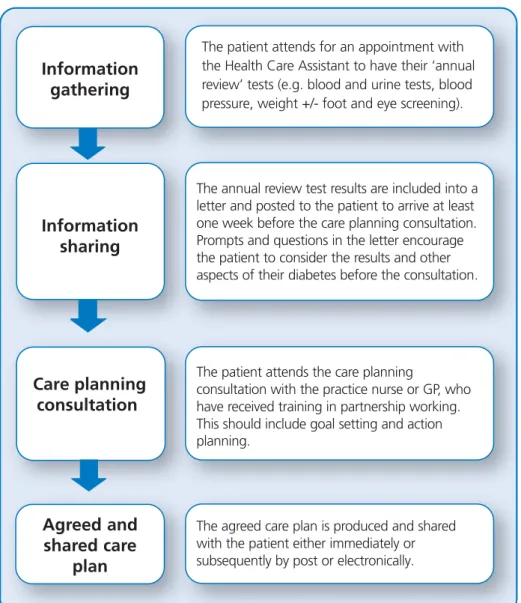
The sharing of results and other information prior to the consultation has been piloted and successfully implemented in a number of settings in both primary and specialist care in North Tyneside and Northumberland, and has been highly valued by both patients and health care professionals (9). The common components of the process are outlined in Figure 11. This process has been successfully reproduced by practices in each of the pilot sites with positive results and feedback.
This aspect can be started quite quickly by clinical teams and provides positive motivation to engage with other aspects.
Figure 11
Information
gathering
Information
s
haring
Care planning
c
on
s
ultation
Agree
d
an
d
s
hare
d
c
are
The patient attends for an appointment with
the Health Care Assistant to have their ‘annual review’ tests (e.g. blood and urine tests, blood
pressure, weight +/- foot and eye screening).
The annual review test results are included into a
letter and posted to the patient to arrive at least
one week before the care planning consultation.
Prompts and questions in the letter encourage
the patient to consider the results and other
aspects of their diabetes before the consultation.
The patient attends the care planning
consultation with the practice nurse or GP, who
have received training in partnership working. This should include goal setting and action planning.
The agreed care plan is produced and shared
Other aspects of communication with patients
People with diabetes need information about the care planning process itself, what to expect in this new way of working and how they can be involved.
It is essential to find ways of engaging and informing people with diabetes who have difficulty in reading and writing English, or whose first language is not English. For example:
• Narrative or picture based education programmes may need to be offered.
• Using telephone contact or recorded letters, rather than written, for reminders (both to provide information and for the care plan).
• Use well trained health workers from similar ethnic backgrounds to act as advocates where necessary.
• Multilingual interpreters have been shown to be very effective where employed and used appropriately. Where there are populations with low health literacy extra resources may be needed initially to ensure that people understand the material and how to use it. These issues were explored by Tower Hamlets and examples are available by contacting [email protected].
Healthcare professionals
committed to partnership
working
Engaging Local Staff
True partnership working will require a different approach to the consultation for many healthcare professionals. However, the following comments are frequently heard:
• Providers are not committed to this way of working.
• People with diabetes do not want this approach.
• You cannot measure this approach effectively.
• Working like this takes up too much time.
• People disagree with your care plan.
• Doing care planning means we will lose Quality and Outcomes Framework (QOF) points.
A suggested approach to all these issues and more is available in ‘Partners in Care’ (9).
Contrary to being sceptical, a further issue is that many clinicians will say, and believe, that they do this already. For those in primary care, a patient centred approach to consultation is at the heart of modern training. The evidence presented earlier is that for patients who want to be increasingly in control of their long term condition, this is not enough. It does however provide an excellent basis on which to move on and incorporate the new and additional skills many practitioners will need, to support self care and be comfortable with the patient being in the driving seat of their care.
The demonstration training programme (see Appendix I) is set up to enable these discussions to come to the fore, to provide situations in which to debate them and enable practitioners to reflect on their own practice. This programme is modelled on and mimics the new approach to care planning in which practitioners can set their own goals and action plans for improving their personal practice. Tools are available to help them assess their own practice. The use of consultation quality measures has been piloted, as well as team based assessments of the effectiveness of the clinic organisation in
Pilot sites have found that in addition to providing training there is no substitute for shoe leather. Seconding senior staff and using people who are already known and trusted in primary care have been essential to engaging and supporting practices in the tasks they need to do. Once started the positive feedback from patients and the increased satisfaction with more productive consultations help to generate further momentum.
Reviewing and Meeting Staff Training
Needs
The pilot sites all developed or commissioned training programmes for clinical teams. They pooled their experience and developed criteria for success. North of Tyne, which had the largest group of practices of the three sites, also had expert educators as part of their core project team. They were able to test, modify and repeat their training, and working with the other sites this has become the core of a demonstration programme (see Appendix). This complies with the national criteria that all education programmes should meet. Key learning points for Year of Care sites when thinking about training include:
• Training should be endorsed at the organisational level by senior leaders.
• Each organisation should assess staff learning needs and use this as the basis for the training programme.
• Training should be multidisciplinary, including practice managerial and administrative staff, and health and social care professionals working in the local community.
• Trained trainers and senior clinicians should deliver the programme.
• Methods for maximising primary and secondary care professionals’ attendance should be used. Practices should be supported to release staff. This includes providing cover for staff attending training, and delivering training at times that do not impinge on clinical commitments, e.g. lunch
• Do not underestimate the time and resources required for planning, coordinating and delivering the programme.
Content of training should include:
• What is Year of Care and key components.
• Philosophy of care planning and self care.
• Care planning consultation skills .
• Organisation and system aspects of care planning.
• Awareness of non-traditional services and support (menu of options).
• Use of local templates.
• Clear rationale for extra recording of patient information.
Embedding new skills
To embed and sustain the learning, training needs to be followed up with further support for practices. Mechanisms to deliver ongoing support include:
• Practice visits.
• Small network groups.
• Locality level meetings.
• Learning sets.
• Care planning away days.
• Refresher sessions.
Key Guidance to Support Commissioners and Clinicians
Organisational Processes
As the ‘house’ metaphor implies (p15), the effectiveness of the care planning consultation does not just depend on the quality of the interactions between the healthcare professional and the person with diabetes but also on the organisational processes that are involved.
On a simple level the usual registration, recall and review system will need to be adapted to allow the collection and sharing of the biomedical results prior to consultations. This will impact upon the wider practice team and their engagement and support is required. For example:
• Practice administrators will need to send out
oLetters inviting people to the first appointment and explaining the care planning process.
oLetters containing and explaining biomedical results and inviting people for the care planning appointments.
• A member of the clinical team, e.g. a Healthcare Assistant, needs to perform the biomedical tests prior to the annual review care planning visit. In addition, mechanisms need to be in place to ensure the practice staff are fully aware of the menu of options or services that are available and how to access these.
Pilots’ Experience
As well as the resources required to implement these processes there are very practical implications. For instance, Tower Hamlets has produced folders for patients to store test results and care plans. Each folder contains a simple colour coded chart that helps patients to interpret their biomedical results. Service users highly valued the coloured charts that helped them understand their results, but colour printing was not available in all practices so appropriate printers had to be provided.
Calderdale and Kirklees have produced a results sharing sheet, ‘Getting the most from your
appointment’, which encourages patients to set out
the agenda they would like to discuss during their consultation, and a care plan pro forma.
The pilots have worked in partnership with service users and healthcare professionals to review all resources, including leaflets, posters and patient letters to ensure they are in line with Year of Care principles.
Key guidance to support commissioners and clinicians
• National Diabetes Support Team (2008) Partners in Care: A guide to implementing a care planning approach to diabetes care (9).
• Joint Department of Health and Diabetes UK Care Planning Working Group (2006) Care Planning in Diabetes (10).
• NHS Modernisation Agency (2005) Good care planning for people with long term conditions: updated version (7).
• Examples of template letters, folders, information sheets, posters and care plans produced by the pilots are available on the Year of Care website:
IT Templates – Linking Clinical Care and
Commissioning
While IT cannot make people change their behaviour, it can support change and make it easier for people to do the right thing. Many GP practices are now ‘paperless’ and pilot sites quickly found that once they knew what they wanted to do, their current systems were not geared to support this. New templates are needed not just to send out the right letters and results in the new style, but to record the new information from patients and the important personal goals and action plans at the heart of support for self care.
Practices also need to have a system for capturing information from the care planning consultation, particularly goals and actions, to feed into macro-commissioning.
As an example, when considering the support or services provided for people who are overweight PCTs will currently know:
• The number of people who have a Body Mass Index (BMI) greater than 30.
• The services available to support people to lose weight.
• The capacity of each of these services.
• The number of people who use each service.
• The number of people who lose weight.
In addition, through the care planning process, Year of Care will help to:
• Identify the total number of people whowantto lose weight.
• Identify the number of people who wish to access existing support services. This will also identify over and under capacity of existing services.
• Identify the other actions and interventions, including self help, that people would like to use but are not available in the current menuof options.
• Provide feedback on the effectiveness of the different interventions and support services. The pilots have collaborated with an NHS Yorkshire and the Humber IT project, which has developed standardised templates that capture all these features. This is being tested initially in Yorkshire and will be used by the pilot sites in the near future. The template has been developed and is being tested using TPP SystmOne (see Appendix II). The templates and specification have been made available for incorporation or adaptation into other systems but this may not be a simple process.
Sites thinking about exploring the Year of Care need to give thought to this early on as the lead in to get the changes needed may become a rate limiting factor.
Pilots’ Experience
The pilots have shown that it is possible to implement simple templates and systems to allow the results sharing letters to be produced relatively easily. They have also attempted to make a start using manual systems for capturing and analysing the outputs of the care planning process for commissioning purposes.
Key Guidance to Support Commissioners and Clinicians
• Further information on the NHS Yorkshire and the Humber IT project can be obtained from: James Thomas
Year of Care Programme Manager Healthcare Policy Team
Diabetes UK Tel: 020 7424 1113
The pilot sites initially identified four specific commissioning tasks to support the Year of Care Programme:
1. Commissioning care planning.
2. Developing the menu of local options.
3. Linking micro-level to macro-level commissioning. 4. Service user involvement.
As work progressed they found that these specific elements linked to the wider work they were undertaking across their local organisations, within the framework of World Class Commissioning. Commissioning for the Year of Care thus became a highly complex endeavour with many component parts. As with care planning, pilots found it was more manageable if broken down into a set of linked tasks and work areas.
These can be described as the sails of a windmill, an image of sound delivery firmly based on the generic principles of World Class Commissioning. Each sail represents an area of relevant commissioning activity. The central part of each sail identifies one of the specific work areas of the Year of Care without which it will not be possible to deliver the benefits. The outer part of each sail is the linked activity the pilot sites found they were drawn into, both to enhance the benefits and to ensure sustainability and local spread.
Understanding these links and establishing Year of Care within a wider strategic commissioning strategy would be helpful for those embarking on this journey.
Commissioning in practice
Figure 12
Whole
System
Diab etes
Mod el
Care
Planning
Joint Strategi c Nee ds A ss ess ment Linking Mi cro- to M ac ro -Link s with other L T C s
Developing the Menu Patient an
d Pu b li c Involvement User Involvement WORLD CLASS
COMMISSIONING
People with Diabetes
World Class
C o m m i s s i o n i n g Competencies
1. Locally lead the NHS 2. Work with
community partners 3. Engage with public
and patients 4. Collaborate with
clinicians
5. Manage knowledge and assess needs 6. Prioritise investment 7. Stimulate the market 8. Promote
improvement 9. Secure procurement
skills
10. Manage the local health system 11. Make sound
financial investment
The Year of Care commissioning
‘sails’
1. The care planning sail
Year of Care specific task
Care planning itself needs to be commissioned together with other elements of the ‘house’. Some of the issues that will need to be considered are:
• How can this be embedded contractually? Does this need to be rewarded, perhaps via a Local Enhanced Service, or will it be included in General Medical Services?
• Potential increases in cost, and increases in time per consultation, at least to begin with. How will the expected savings from reductions in follow on appointments and reduced use of hospital resources be recorded?
• Ensuring healthcare professionals have the appropriate skills and that training is available and taken up. How will new skills be supported and maintained? How to commission high quality training that meets the objectives of their programme. How robust are existing peer review structures, and what can be done to ensure that this is undertaken routinely?
• How will delivery of a care planning approach be monitored?
• How can a consistent approach to consultations
be guaranteed to patients?
• Are local IT systems and Electronic Health Records capable of supporting care planning, and trapping appropriate commissioning data?
Pilots’ Experience
North Tyneside PCT is currently revising its local enhanced service to recognise the changes that are required to implement effective care planning. Kirklees PCT has developed a service level agreement to encourage practices to produce a plan for implementing care planning with their patients.
Tower Hamlets has had a local enhanced service specification for practice based patient centred diabetes services for some years. The Year of Care programme has identified a need for increasing the tariff paid to pilot practices to address the increase in resources required. Additional resource may be needed initially to support people with poor health literacy, who are keen to participate fully in the care planning process.
Resources
The central team has made available:
o A demonstration specification to commission care planning services.
o A demonstration training curriculum. A quality assurance tool to enable commissioners to assess training that they may be procuring will be available soon.
o IT templates to record the care planning consultation, patient use and service need and use.
o Tools for organisational audit and consultation evaluation (CQI-DM).
Whole
S
y
s
tem
Dia
b
ete
s
Mo
d
el
Care
The Wider Commissioning Tasks
Year of Care raises many issues for the whole local diabetes service. Among these are:
• How does care planning fit within the local model of care? Is there a systematic approach to where people with diabetes are seen?
• What is the role of the local specialist service?
• Is structured patient education incorporated into local pathways as routine, and does it specifically link to care planning itself?
• Are the resources in the right place to support the Year of Care Programme?
• How will funding be moved in line with any movements in care provision?
• What does this mean for local workforce development plans?
North of Tyne recognised the importance of this at an early stage and the potential for the Year of Care project to be a local lever for change. They have carried out an in depth piece of work across their whole commissioning area using programme budgeting and marginal analysis. This identified considerable variations in expenditure and outcomes and has enabled them to take a structured approach to redesigning services with care planning and a Year of Care approach across a much wider level. All the pilots are now undertaking some form of structured approach to commissioning a redesigned diabetes service.
Designing the Model of Care
There is considerable advice and experience available in developing or redesigning a whole community wide diabetes service. The ‘model of care’ defines all the components of the service, including the workforce, which should be commissioned to ensure that local people have a service that fits their specific needs. The ‘Diabetes Commissioning Toolkit’ (12) outlines the components of a diabetes health needs assessment, and of a generic specification based on national quality standards including National Service Frameworks and National Institute for Health and Clinical Excellence (NICE) guidance. ‘Developing a Diabetes Service: Using the diabetes commissioning
toolkit’ (13) provides practical suggestions and
guidance.
It is important to maximise all existing local knowledge and expertise. As part of World Class Commissioning, organisations will already be looking to work with local clinical teams and groups. Where diabetes networks exist these provide an excellent place from which to base this work. Many networks are equipped to not only offer advice to commissioners, but also to share previous projects and plans which would fit well with specific elements of the Year of Care commissioning agenda. There is practical advice on how to include users in local networks.
Key Guidance to Support Commissioners and their Networks
Needs Assessments and Service Models
o Diabetes Commissioning Toolkit (12) to help NHS commissioners to adopt a strategic approach to developing diabetes services.
o Developing a Diabetes Service: Using the diabetes commissioning toolkit (13)
Patient Education
• National Institute for Health and Clinical Excellence (2003) Guidance on the Use of Patient Education Models for Diabetes (TA60) (14)
• Department of Health and Diabetes UK (2005) Structured Patient Education in Diabetes: Report from the Patient Education Working Group (15).
• National Diabetes Support Team and Diabetes UK (2006) How to Assess Structured Diabetes Education: An improvement toolkit for commissioners and local diabetes communities (16).
National Reports
• Healthcare Commission (2007) Managing diabetes: Improving services for people with diabetes (3).
• Diabetes UK (2006) Diabetes: State of the Nations 2006: Progress made in delivering the national diabetes frameworks (17).
• Department of Health (2008) Five Years On: Delivering the Diabetes National Service Framework (18).
• Information Centre (2007) National Diabetes Audit: Reports on paediatric and adult diabetes services (19).
• Innove (2008) Delivering Performance Improvement: Findings from DiabetesE - Third National Report (20).
Online Resources
• The National Diabetes Support Team and the Yorkshire and Humber Public Health Observatory have been working together to develop an online Diabetes Data Directory which:
o Provides a brief description of the various tools/datasets.
o Links directly to relevant websites.
o Signposts to the various tools/datasets that will provide answers to key headline questions.
http://www.yhpho.org.uk/diabetesdatadirectory/introddd.asp
• A wealth of resources exists to support the process of mapping. Examples include: improvement leaders guides and process mapping, analysis and redesign guides. These can be found on the NHS Institute for Innovation and Improvement’s website:
http://www.institute.nhs.uk/index.php?option=com_joomcart&Itemid=194&main_page=docum ent_product_info&products_id=295
• Examples of booklets produced by the pilots containing a menu of options to support patients with self care are available on the Year of Care website:
2. The needs assessment sail
Assessing individual needs through the care planning process needs to be linked to wider approaches to local needs assessment including those within the framework of local Joint Strategic Needs Assessment.
Specific Year of Care Task
The pilots worked actively to identify the information they needed from routine clinical records (micro commissioning) to enable the link to be made with macro commissioning. This resulted in the development of Year of Care IT templates by NHS Yorkshire and the Humber.
Pilots’ Experience
The pilots recognised that other methods of needs assessment would be needed during the first year to inform the scope and scale of provider development.
North of Tyne piloted care planning and paper based recording in a number of practices.
Both Calderdale and Kirklees and Tower Hamlets used social marketing approaches leading to stratification of the population into categories with specific support needs.
Calderdale and Kirklees did a systematic review of diabetes records in one practice. This required significant human resource, and was to some extent hampered by the traditional biomedical content of the records. All sites held focus groups, learning from each other on how to run these and providing learning for others. The outcomes of Calderdale and Kirklees’ focus groups are shown in figure 13.
Wider Issues
There was considerable overlap with other needs of the populations, for example concerning obesity and Cardiovascular Disease (CVD) services. In addition, many patients had more than one condition (see the provider development sail, p32). Issues that pilots need to address included:
3. How to ensure your sample is representative of the local population.
4. How the data from the Year of Care fits with other short-, medium- and long-term local intelligence.
5. How IT templates can be developed to capture data routinely, and how this can be interpreted. 6. How patient confidentiality can be managed
within the Data Protection Act and local operating guidance.
Joint
S
trategi
c
Nee
ds
A
ss
e
ss
ment
Linking Micro- to Mac
ro-Figure 13
Theme
Service User Preferences
Emotional Support • Someone to talk to/a buddying system/peer support
• Support for families and carers
• 24 hour telephone helpline with trained staff
• Less busy staff with time to listen
• More recognition, help and support for depression
• Massage and meditation Access to Services • Closer to home
• One stop shop, e.g. pharmacists offering phlebotomy
• Do not want to attend hospital for blood tests
• Weekend/evening clinics with eye specialists
• Easier/more access to foot services
• Longer opening hours with drop in clinics
• Professionals to keep to appointment times
• Professionals to follow up on what they say they will do, e.g. telephone contact Information • Clearer communication of results with an explanation of what they mean
• Innovative use of technology, e.g. test results via email
• Information available in different languages
• Information for people with disabilities, e.g. deaf/blind
• High quality information throughout care, not just at the beginning
• More advice on food and weight management
• A plan of what to expect in the next 12 months
• More group education evenings Lifestyle/social aspects • Dosette boxes provided free or charge
• A greater range of activities to support a healthy lifestyle, e.g. t’ai chi, yoga
• Subsidised private gym membership
• Subsidised weight loss classes
• Training for staff in leisure centres
• More emphasis/guidance from doctors and nurses on non-medical lifestyle activities
• Single sex groups for some people
3 The provider development sail
The way in which service providers can be supported to develop an appropriate menu of services to support self management needs to be considered within the wider long term conditions agenda.
Some of the issues that need to be considered are:
• How social marketing techniques can be best
employed to stimulate innovative providers.
• How the relationships with service providers can be effectively managed through any subsequent change processes, including decommissioning.
• How your local market can be formally developed.
• How to ensure that healthcare professionals are aware of current and future services.
• How to engage with and feed into existing long term conditions’ alliances.
• How to develop currencies for individual services, packages of care and entire long term conditions.
• How to work in partnership with local authority and health and social care colleagues, to develop tailored services.
Further learning will emerge over the next phase as pilots begin to implement their programme.
This needs to extend beyond the diabetes services because of the considerable overlap with long term conditions. For example, many of the services for people with diabetes would also be useful for those with cardiovascular disease, obesity or arthritis. These services are likely to be spread across the public, voluntary and private sectors.
As a first step, the commissioner will need to review the current services that support self care. This needs to extend beyond the diabetes services because of the considerable overlap with long term conditions. These are likely to be spread across the public, voluntary and private sectors. These might include, for example, prescription for health at a local gym, alternative medicine care, community group programmes, counselling services, citizens' advice services, local patient and carer support groups, expert patient programmes and the PCT’s smoking cessation service. Pilots found that not all these services were known to local practices. Some could be extended to fill gaps in provision identified in the local needs assessment and added to the menu of diabetes support services. Pilots also set about systematically considering new providers and market development. Two pilots used social marketing techniques to segment the population into groups with specific needs so that these could be commissioned. This produced some debate within the project on the potential conflict of this approach with the care planning philosophy of building on individually identified goals and the potential for the service to ‘label’ individuals rather than groups. However, this approach provided new and imaginative ideas for support at population level and the potential to commission new services for the first year of the project delivery.
Using the Feedback from the Pilots
In Calderdale and Kirklees potential providers from across the health service, social services, local authority and the voluntary sector were invited to a workshop to map the current and planned Year of Care menu of options. Two groups reviewed existing levels of
Link
s
with
other LTC
s
Developing the Menu