TILA-RESPA
INTEGRATED
DISCLOSURE
Guide to the Loan Estimate
and Closing Disclosure forms
Version log
The Bureau updates this guide on a periodic basis to reflect finalized clarifications to the rule which impacts guide content, as well as administrative updates. Below is a version log noting the history of this document and its updates:
Date Version Rule changes
September 2014 1.1 § Updates to information on who to
contact with questions on the rule (Section 1.3)
§ Clarification of description of time periods less than whole years (Section 2.2.2. Loan Terms)
§ Clarification of requirement relating to provision of appraisals for certain loan types. (Section 3.6.2. Other Disclosures)
What’s inside
Version log ��������������������������������������������������������������������������������������������������������������������������2 1� Introduction ������������������������������������������������������������������������������������������������������������������6
1.1 What is the purpose of this guide? ... 7
1.2 Who should read this guide? ... 8
1.3 Where can i find additional resources that will help me understand the TILA-RESPA rule ... 9
2� Loan Estimate �������������������������������������������������������������������������������������������������������������10 2.1 General Requirements ... 10
2.1.1 Issuance and Delivery ... 10
2.1.2 Revised Loan Estimate ... 10
2.1.3 Use of Compliance Guide ... 11
2.1.4 Rounding ... 11
2.1.5 Consummation ... 11
2.2 Loan Estimate (page 1) ... 12
2.2.1 General Information ... 13
2.2.2 Loan Terms ... 18
2.2.3 Projected Payments ... 21
2.2.4 Costs at Closing ... 27
2.3 Loan Estimate (page 2) ...29
2.3.1 Loan Costs ... 31
2.3.3 Calculating Cash to Close ...42
2.3.4 Alternative Calculating Cash to Close table for transactions without a seller ...45
2.3.5 Adustable Payment (AP) Table ... 47
2.3.6 Adjustable Interest Rate (AIR) Table ...48
2.4 Loan Estimate (page 3) ... 51
2.4.1 Contact Information ...52
2.4.2 Comparisons ...52
2.4.3 Other Considerations ...53
2.4.4 Confirm Receipt ...55
3� Closing Disclosure �����������������������������������������������������������������������������������������������������56 3.1 General Requirements ...56
3.1.1 Issuance and Delivery ...56
3.1.2 Revised Closing Disclosure ...56
3.1.3 Use of Compliance Guide ...57
3.1.4 Rounding ...57
3.1.5 Consummation ...57
3.2 Closing Disclosure (page 1) ...58
3.2.1 General Information ... 59
3.2.2 Loan Terms ... 61
3.2.3 Projected Payments ...62
3.2.4 Costs at Closing ...62
3.3 Closing Disclosure (page 2) ...64
3.3.1 Loan Costs ...65
3.3.2 Other Costs ... 67
3.4 Closing Disclosure (page 3) ... 70
3.4.1 Calculating Cash to Close ...72
3.4.2 Alternative Calculating Cash to Close Table For Transaction Without a Seller ... 74
3.4.3 Summaries of Transactions ... 76
3.4.4 Borrower’s Transaction ...77
3.4.5 Seller’s Transactions ... 81
3.5 Closing Disclosure (page 4) ...85
3.5.1 Loan Disclosures ...86
3.5.2 Escrow Account ...88
3.5.3 Adjustable Payment (AP) Table ...89
3.5.4 Adjustable Interest Rate (AIR) Table ...90
3.6 Closing Disclosure (page 5) ...91
3.6.1 Loan Calculations ...92
3.6.2 Other Disclosures ...93
3.6.3 Contact Information ... 94
3.6.4 Confirm Receipt ...95
4. Where can I find a copy of the TILA-RESPA rule and get more information about it? ����������������������������������������������������������������������������������������������������������������������96
1�
Introduction
For more than 30 years, Federal law has required lenders to provide two different disclosure forms to consumers applying for a mortgage. The law also has generally required two different forms at or shortly before closing on the loan. Two different Federal agencies developed these forms separately, under two Federal statutes: the Truth in Lending Act (TILA) and the Real Estate Settlement Procedures Act of 1974 (RESPA). The information on these forms is overlapping and the language is inconsistent. Not surprisingly, consumers often find the forms confusing. It is also not surprising that lenders and settlement agents find the forms burdensome to provide and explain.
The Dodd-Frank Wall Street Reform and Consumer Protection Act (the Dodd-Frank Act) directs the Consumer Financial Protection Bureau (the Bureau) to integrate the mortgage loan disclosures under TILA and RESPA sections 4 and 5. Section 1032(f) of the Dodd-Frank Act mandated that the Bureau propose for public comment rules and model disclosures that integrate the TILA and RESPA disclosures by July 21, 2012. The Bureau satisfied this statutory mandate and issued proposed rules and forms on July 9, 2012. To accomplish this, the Bureau engaged in extensive consumer and industry research, analysis of public comment, and public outreach for more than a year. After issuing the proposal, the Bureau conducted a large-scale quantitative study of its integrated disclosures with approximately 850 consumers, which concluded that the Bureau’s integrated disclosures had on average statistically significant better performance than the current disclosures under TILA and RESPA. The Bureau has now finalized a rule with new, integrated disclosures (TILA-RESPA rule).1 The TILA-RESPA rule also provides a detailed
explanation of how the forms should be filled out and used.
1 Integrated Mortgage Disclosures Under the Real Estate Settlement Procedures Act (Regulation X) and the Truth In Lending Act (Regulation Z) (78 FR 79730, Dec. 31, 2013).
The first new form (the Loan Estimate) is designed to provide disclosures that will be helpful to consumers in understanding the key features, costs, and risks of the mortgage loan for which they are applying. The Loan Estimate must be provided to consumers no later than three business days after they submit a loan application. The second form (the Closing Disclosure) is designed to provide disclosures that will be helpful to consumers in understanding all of the costs of the transaction. The Closing Disclosure must be provided to consumers three business days before they close on the loan.
The forms use clear language and design to make it easier for consumers to locate key information, such as interest rate, monthly payments, and costs to close the loan. The forms also provide more information to help consumers decide whether they can afford the loan and to compare the cost of different loan offers, including the cost of the loans over time.
The Loan Estimate and Closing Disclosure must be used for most
closed-end consumer mortgages. Home equity lines of credit, reverse mortgages, or mortgages secured by a mobile home or by a dwelling that is not attached to real property (i.e., land) must continue to use current disclosure forms required by TILA and RESPA separately. The TILA-RESPA rule does not apply to loans made by persons who are not considered “creditors” because they make five or fewer mortgages as year.
Generally, the Loan Estimate and Closing Disclosure require the disclosure of
categories of information that will vary due to the type of loan, the payment schedule of the loan, the fees charged, the terms of the transaction, and State law provisions. The extent of these variations cannot be shown on a single, static example. This Guide includes most of the requirements concerning completing the Loan Estimate
and Closing Disclosure. However, this Guide may not illustrate all of the permutations of the information required or omitted from the Loan Estimate or Closing Disclosure
for any particular transaction. Only the TILA-RESPA rule and its official interpretations can provide complete and definitive information regarding its requirements.
See the TILA-RESPA Integrated Disclosure rule Small Entity Compliance Guide (Compliance Guide) for more information on the TILA-RESPA rule in general.
1�1
What is the purpose of this guide?
The focus of this Guide is to provide the instructions for completing the Loan
that may arise when completing the Loan Estimate and Closing Disclosure. This Guide - The Guide to Completing TILA-RESPA Integrated Disclosure Forms (Guide to Forms) is designed as a companion to the Compliance Guide which addresses questions about the TILA-RESPA rule in general. The Compliance Guide also discusses the good faith disclosure of settlement costs, limitations on changes to those amounts at consummation, and other information concerning the process requirements related to the Loan Estimate and the Closing Disclosure.
Changes related to the TILA-RESPA rule may take careful planning, time, or resources to implement. This Guide will help you identify and plan for any necessary changes.
This Guide summarizes the instructions for completing the Loan Estimate and
Closing Disclosure, but it is not a substitute for the TILA-RESPA rule. Only the rule and its Official Interpretations (also known as commentary) can provide complete and definitive information regarding its requirements. The discussions below provide citations to the sections of the TILA-RESPA rule on the subject being discussed. Keep in mind that the Official Interpretations, which provide detailed explanations of many of the rule’s requirements, are found after the text of the rule and its appendices. The interpretations are arranged by rule section and paragraph for ease of use. The complete rule and the Official Interpretations are available at
consumerfinance.gov/regulations/integrated-mortgage-disclosures-
under-the-real-estate-settlement-procedures-act-regulation-x-and-the-truth-in-lending-act-regulation-z/.
This Guide does not discuss the TILA-RESPA rule in general or other Federal or State laws that may apply to the origination of closed-end credit.
At the end of this Guide, there is more information about the TILA-RESPA rule and related implementation support from the Bureau.
1�2
Who should read this guide?
If your organization originates closed-end residential mortgage loans, you may find this Guide helpful. This Guide – together with the Compliance Guide - will help you determine your compliance obligations for the mortgage loans you originate. This Guide may also be helpful to settlement service providers, software providers, and other companies that serve as business partners to creditors.
1�3
Where can I find additional
resources that will help me
understand the TILA-RESPA rule?
Resources to help you understand and comply with the Dodd-Frank Act mortgage reforms and our regulations, including downloadable compliance guides, are available through the CFPB’s website at
www.consumerfinance.gov/regulatory-implementation. If after reviewing these materials you have a specific TILA-RESPA regulatory interpretation question, submit a detailed message, including your name, contact information, details about your regulatory question, and the specific title, section, or subject matter of the regulation you are inquiring about, to [email protected]. If you do not have access to the internet, you may leave this information in a voicemail at 202-435-7700. Please note that Bureau staff provide only an informal oral response to regulatory inquiries and that the response does not constitute an official interpretation or legal advice.
Generally we are not able to respond to specific inquiries the same business day. Actual response times will vary depending on the number of questions we are handling and the amount of research needed to respond to your question. Email comments about this Guide to CFPB_MortgageRulesImplementation@
cfpb.gov. Your feedback is crucial to making this Guide as helpful as possible. The Bureau welcomes your suggestions for improvements and your thoughts on its usefulness and readability.
The Bureau is particularly interested in feedback relating to:
§ How useful you found this Guide for understanding the TILA-RESPA rule.
§ How useful you found this Guide for implementing the rule at your business.
§ Suggestions you have for improving the Guide, such as additional implementation tips.
2�
Loan Estimate
2�1
General Requirements
2�1�1
Issuance and Delivery
You must provide a Loan Estimate to the consumer, either by delivering by hand or placing in the mail, no later than three business days of the receipt of an application. An application is considered received when the consumer provides the following information:
§ Consumer’s name,
§ Consumer’s income,
§ Consumer’s Social Security number to obtain a credit report,
§ Address of the property,
§ Estimate of the value of the property, and
§ The mortgage loan amount sought.
2�1�2
Revised Loan Estimate
When there is a changed circumstance after the Loan Estimate has been provided, the creditor can revise the Loan Estimate within three business days. A revised
Loan Estimate generally can be provided no later than seven business days before
2�1�3
Use of Compliance Guide
Please see Compliance Guide, sections 6, 7, 8, and 9, for additional information on details of these requirements. The information that follows discusses how to complete the Loan Estimate. Samples of completed Loan Estimates can be found at consumerfinance.gov/regulatory-implementation/tila-respa/.
2�1�4
Rounding
Dollar amounts must be rounded to the nearest whole dollar where noted in the regulation. (§ 1026. 37(o)(4)) If an amount is required to be rounded but is composed of other amounts that are not required or permitted to be rounded, use the unrounded amounts in calculating the total and then round the final sum. Conversely, if an amount is required to be rounded and is composed of rounded amounts, use the rounded amounts in calculating the total. (Comment 37(o)(4)-2) Percentage amounts may not be rounded and should be shown up to two or three decimals, as needed, except where noted in the regulation. (§ 1026.37(o)(4)(ii)) If a percentage amount is a whole number, show the whole number only with no decimals. (§ 1026.37(o)(4)(ii); Comment 37(o)(4)(ii)-1)
2�1�5
Consummation
Consummation is not the same thing as closing or settlement. Consummation occurs when the consumer becomes contractually obligated to the creditor on the loan, not, for example, when the consumer becomes contractually obligated to a seller on a real estate transaction.
(§ 1026.2(a)(13))
The point in time when a consumer becomes
contractually obligated to the creditor on the loan depends on applicable State law. (§ 1026.2(a)(13); Comment 2(a)(13)-1) Creditors and settlement agents should verify the applicable State laws to determine when consummation will occur, and make sure delivery of the Loan Estimate occurs within three business days of the receipt of an application.
This Guide uses references to the legal obligation, which includes the promissory note plus any other agreements between the creditor and consumer concerning the extension of credit.
2�2
Loan Estimate (page 1)
FIGURE 1: LOAN ESTIMATE (PAGE 1)
section 2.2.1
section 2.2.2
section 2.2.3
Page 1 of the Loan Estimate includes general information, a Loan Terms table with descriptions of applicable information about the loan, a Projected Payments table, a Costs at Closing table, and a link for consumers to obtain more information about loans secured by real property at a website maintained by the Bureau. Page 1 of the Loan Estimate includes the title “Loan Estimate” and a statement of “Save this Loan Estimate to compare with your Closing Disclosure.” (§ 1026.37(a)(1),(2))
The top of page 1 also includes the name and address of the creditor.
(§ 1026.37(a)(3)) A logo or slogan can be used along with the creditor’s name and address, so long as the logo or slogan does not exceed the space provided for that information. (§ 1026.37(o)(5)(iii))
If there are multiple creditors, use only the name of the creditor completing the
Loan Estimate. (Comment 37(a)(3)-1) If a mortgage broker is completing the Loan
Estimate, use the name and address of the creditor if known. If not yet known, leave this space blank. (Comment 37(a)(3)-2)
2�2�1
General Information
Date Issued
The date the Loan Estimate is mailed or delivered to the consumer. (§ 1026.37(a)(4))
Applicants
Applicants includes the name and mailing address of the consumer(s) applying
for the loan. Use each Applicant’s name and mailing address if there are multiple
Applicants. An additional page may be added to the Loan Estimate if the space
provided is insufficient to list all of the Applicants. (Comment 37(a)(5)-1) FIGURE 2: GENERAL INFORMATION OF THE LOAN ESTIMATE
Property
Property is the address of the property (which must include the zip code) that will secure the transaction. If the address of the Property is unavailable, use a description of the location of the property, for example a lot number. Always use a zip code. (Comment 37(a)(6)-1) Personal property such as furniture or appliances that also secures the credit transaction may be, but is not required to be included as Property. An additional page may not be appended to the Loan Estimate to disclose a description of personal property. (Comment 37(a)(6)-2)
Sale Price or Appraised Value or Estimated Value
If the loan is for a purchase money mortgage, use Sale Price. (§ 1026.37(a)(7)(i)) If personal property is included in the Sale Price of the Property, use that price without any reduction for the appraised or estimated value of the personal property. (Comment 37(a)(7)-2)
If the loan is for a transaction without a seller, use Appraised Value or Estimated Value. (Comment 37(a)(7)-1)
Loan Term
Loan Term is the term of the debt obligation. Describe the Loan Term as
“years” when the Loan Term is in whole years. For example “1 year” or “30 years.” (Comment 37(a)(8)-1.i, -1.ii) For a Loan Term that is more than 24 months but is not
whole years, describe using years and months with the abbreviations “yr.” and “mo.,” respectively. For example, a loan term of 185 months is disclosed as “15 yr., 5mo.” For a Loan Term that is less than 24 months and not whole years, use months only with the abbreviation “mo.” For example, “6 mo.” or “16 mo.” (Comment 37(a)(8)-2)
Purpose
Describe the consumer’s intended use for the loan. (§ 1026.37(a)(9)) Purpose is disclosed using one of four descriptions: Purchase, Refinance, Construction, or
Home Equity Loan.
§ Purchase is disclosed if the loan will be used to finance the Property’s
acquisition. (§ 1026.37(a)(9)(i))
§ Refinance is disclosed if the loan will be used for the refinance of an existing obligation that is secured by the Property (even if the creditor is not the holder or servicer of the original obligation). (§ 1026.37(a)(9)(ii))
§ Construction is disclosed if the loan will be used to finance the initial construction of a dwelling on the property disclosed on the Loan Estimate. (§ 1026.37(a)(9)(iii))
§ Home Equity Loan is disclosed if the loan will be used for any other purpose.
(§ 1026.37(a)(9)(iv))
Product
Provide a description of the loan. You are required to include two pieces of
information in this disclosure:
The first piece of information is any payment feature that may change the periodic payment, which includes Negative Amortization, Interest Only,
Step Payment, Balloon Payment, or Seasonal Payment. (§ 1026.37(a)(10)(ii)) Additionally, the duration of the relevant payment feature must be disclosed with a Negative Amortization, Interest Only, Step Payment, or Balloon Payment. (§ 1026.37(a)(10)(iv)) For example, a payment feature where there is a five-year period during which the payments cover only interest, and are not applied to the principal balance, would be disclosed as a 5 Year Interest Only for the payment feature.
§ Negative Amortization is when the principal balance of the loan may increase
due to the addition of accrued interest to the principal balance.
§ Interest Only is when one or more regular periodic payments may be applied
only to interest accrued and not to the principal of the loan.
§ Step Payment is when the scheduled variations in regular periodic payment
amounts occur that are not caused by changes to the interest rate during the loan term.
§ Balloon Payment is when the terms of the legal obligation include a payment
that is more than two times that of a regular periodic payment.
§ Seasonal Payment is when the terms of the legal obligation expressly provide
that regular periodic payments are not scheduled between specified unit-periods on a regular basis. For example, a “teacher” loan that does not require monthly payments during summer months has a Seasonal Payment.
§ If the loan can be described with more than one of these descriptions, only the first applicable feature is disclosed. (§ 1026.37(a)(10)(iii)) For example, a loan that would result in both Negative Amortization and a Balloon Payment would only disclose Negative Amortization as part of Product.
The second piece of information disclosed is whether the loan uses an Adjustable Rate, Step Rate, or Fixed Rate to determine the interest rate applied to the
principal balance. (§ 1026.37(a)(10)(i))
§ An interest rate is an Adjustable Rate if the interest rate may increase after consummation, but the rates that will apply or the periods for which they will apply are not known at consummation. (§ 1026.37(a)(10)(i)(A))
ú Each description must be preceded by the duration of any introductory rate or payment period, and the first adjustment period, as applicable. (§ 1026.37(a)(10)(iv)) For example, a product with an introductory rate that is fixed for the first five years and adjusts every three years starting in year 6 is a 5/3 Adjustable Rate.
ú When there is no introductory period for an Adjustable Rate, disclose “0.” (Comment 37(a)(10)-1.i.A) For example, a product with no introductory rate that adjusts every year after consummation is a 0/1 Adjustable Rate.
§ An interest rate is a Step Rate if the interest rate will change after consummation and the rates that will apply and the periods for which they apply are known at consummation. (§ 1026.37(a)(10)(i)(B))
ú Each description must be preceded by the duration of any introductory rate or payment period, and the first adjustment period, as applicable. (§ 1026.37(a)(10)(iv)) For example, a product with a step rate that lasts for ten years, adjusts every year for five years, and then adjusts every three years for the next 15 years is a 10/1 Step Rate. (Comment 37(a)(10)-1.ii)
ú When there is no introductory rate for a Step Rate, disclose “0” and then the applicable time period until the first adjustment.
(Comment 37(a)(10)-1.ii)
§ An interest rate is a Fixed Rate if the interest rate is not an Adjustable Rate or
Step Rate. (§ 1026.37(a)(10)(i)(C))
The following are examples of Product with both pieces of information included:
§ Year 7 Balloon Payment, 3/1 Step Rate: a step rate with an introductory interest
rate that lasts for three years and adjusts each year thereafter until a balloon payment is due in the seventh year of the loan term.
§ 2 Year Negative Amortization: a fixed rate product with a step-payment feature
for the first two years of the legal obligation that may negatively amortize. When the time periods disclosed in Product are not in whole years, for time
periods of 24 months or more, disclose the applicable fraction of a year by use of decimals rounded to two places. For time periods of 24 months or less, disclose the number of months with the abbreviation “mo.” (Comment 37(a)(10)-3) For example:
§ An Adjustable Rate Product with an
introductory interest rate for 31 months that adjusts every year thereafter is a 2�58/1 Adjustable Rate.
§ An Adjustable Rate Product with an
introductory interest rate for 18 months that
adjusts every 18 months thereafter is an 18 mo./18 mo. Adjustable Rate.
Loan Type
Loan Type is the type of the loan, such as Conventional or FHA.
For Loan Type, disclose:
§ Conventional if the loan is not guaranteed or insured by a Federal or State government agency,
§ FHA if the loan is insured by the Federal Housing Administration,
§ VA if the loan is guaranteed by the U.S. Department of Veterans Affairs, and
§ Other with a brief description if the loan is insured or guaranteed by another Federal or a State agency. (§ 1026.37(a)(11))
Loan ID#
Loan ID # is the creditor’s loan identification number that may be used by a
creditor, consumer, and other parties to identify the transaction. The Loan ID #may contain alpha-numeric characters and must be unique to the particular transaction. The same Loan ID # may not be used for different, but related, loan transactions
(such as different loans to the same borrower). When a revised Loan Estimate
is issued, the Loan ID # must be sufficient for the purpose of identifying the transaction associated with the initial Loan Estimate. (Comment 37(a)(12)-1)
For more Product examples, please see Comments 37(a)(10)-1, -2 and -3 in the Official Interpretations to Regulation Z.
Rate Lock
Indicate the rate is locked with Yes, indicate the rate is not locked with No. (§ 1026.37(a)(13))
When the interest rate is locked at the time of the Loan Estimate’s delivery, the date and time (including the applicable time zone) when the lock period ends must be disclosed. (§ 1026.37(a)(13)(i))
The date and time (including the applicable time zone) at which the estimated closing costs expire must be disclosed on every Loan Estimate. (§ 1026.37(a)(13)(ii))
2�2�2
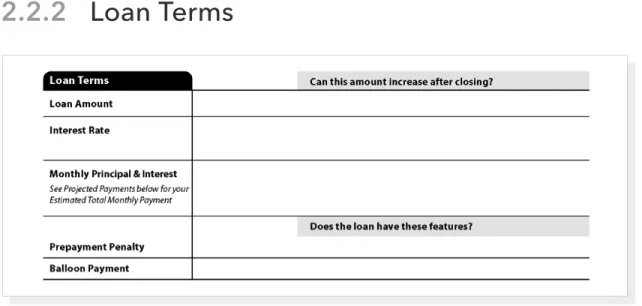
Loan Terms
Disclose in the Loan Termstable:
§ Loan Amount(if the amount is in whole dollars, do not disclose cents)
(§ 1026.37(o)(4)),
§ Initial Interest Rate,
§ Initial Monthly Principal & Interestamount,
§ Any adjustments to these amounts after consummation,
§ Whether the loan includes a Prepayment Penalty, and
§ Whether the loan includes a Balloon Payment. (§ 1026.37(b)) FIGURE 3: LOAN TERMS TABLE OF THE LOAN ESTIMATE
Interest Rate & Monthly Principal & Interest
If the initialInterest Rate is notknown at consummation, the fully-indexed rate is disclosed; a fully-indexed rate is the interest rate calculated using the index value and margin at the time of consummation. (§ 1026.37(b)(2))
The initial principal and interest payment amount also would be calculated using the same fully-indexed rate. (§ 1026.37(b)(3))
Adjustment to Loan Amount, Interest Rate, and Monthly
Principal & Interest after consummation
Under the subheading Can this amount increase after closing?, if the Loan Amount,
Interest Rate, or Monthly Principal & Interest
amounts can increase after consummation, disclose Yes where applicable with the information pertinent to the adjustment after consummation. (§ 1026. 37(b)(6))
§ For an adjustment in Loan Amount, the creditor must also disclose the maximum principal balance for the transaction and the due date (expressed as the year or month in which it occurs, rather than an exact date) of the last payment that may cause the principal balance to increase, together with a statement whether the maximum principal balance may or will occur under the terms of the legal obligation. (§ 1026.37(b)(6)(i)) The date disclosed is the year in which the event occurs, counting from the due date of the initial periodic payment. (§ 1026.37(b)(8)(ii))
§ For an adjustment in the Interest Rate, also disclose the frequency of interest rate adjustments, the date when the interest rate may first adjust, the maximum interest rate, and the first date when the interest rate can reach the maximum interest rate. (§ 1026.37(b)(6)(ii)) The date disclosed is the year in which the event occurs, counting from the date that interest for the first scheduled periodic payment begins to accrue after consummation. (§ 1026.37(b)(8)(i)) Also, disclose and
reference the Adjustable Interest Rate (AIR) Table on page 2 of the Loan Estimate. (§ 1026.37(b)(6)(ii))
§ For an adjustment to the Monthly Principal & Interest, the creditor would also disclose the scheduled frequency of adjustments, due date of the first adjustment, and the maximum possible amount (and the earliest date it can occur) of the Monthly Principal & Interest. In addition, if there is a period during which only interest is required to be paid, also disclose that fact and the
When describing time periods less than 24 months that are not whole years, see the instructions related to the Product in section 2.2.1 above
due date of the last periodic payment of such period. (§ 1026.37(b)(6)(iii)) The date disclosed is the year in which the event occurs, counting from the due date of the initial payment. (§ 1026.37(b)(8)(ii)) Also, disclose and reference the
Adjustable Payment (AP) Table on page 2. (§ 1026.37(b)(6)(iii))
When the Loan Amount, Interest Rate, or Monthly Principal & Interest payment cannot increase after consummation, disclose No where applicable. (§ 1026.37(b)(6))
Prepayment Penalty and Balloon Payment
A Prepayment Penalty is a charge imposed for paying all or part of a transaction’s principal before the date on which the principal is due. It does not include a waived third-party charge that the creditor imposes if the consumer prepays the loan’s entire principal sooner than 36 months after closing. (§ 1026.37(b)(4))
A Balloon Payment is a payment that is more than two times a regular periodic
payment. (§ 1026.37(b)(5))
Under the subheading Does the loan have these features?, when the loan has a
Prepayment Penalty or a Balloon Payment disclose Yes, as applicable. (§ 1026.37(b)(4) and (5)) When the answer is Yes to either, also disclose, as applicable:
§ The maximum amount of the Prepayment
Penalty and the date when the period
during which the penalty may be imposed terminates. For example, As high as $3,240 if you pay off the loan in the first two years. (§ 1026.37(b)(7)(i))
§ The maximum amount of the Balloon
Payment and the due date of such payment. For example, You will have to pay
$149,263 at the end of year 7. (§ 1026.37(b)(7)(ii))
When describing time periods less than 24 months that are not, see the instructions related to the Product in section 2.2.1 above.
2�2�3
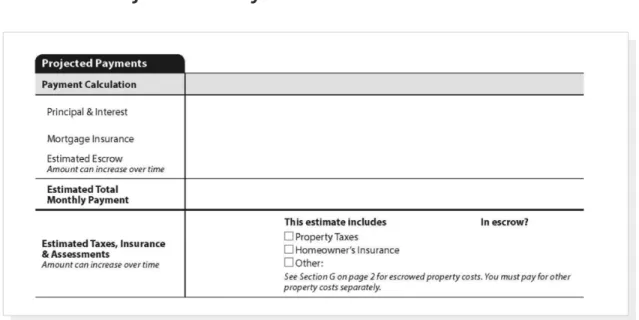
Projected Payments
The Projected Payments table shows estimates of the periodic payments that the
consumer will make over the life of the loan. Creditors must disclose estimates of the following periodic payment amounts in theProjected Paymentstable:
§ Principal & Interest;
§ Mortgage Insurance;
§ Estimated Escrow;
§ Estimated Total Monthly Payment; and
§ Estimated Taxes, Insurance, & Assessments, even if notpaid with escrow funds.
The Projected Paymentstable also describes whether taxes, insurance, and
other assessments will be paid with funds in the consumer’s escrow account. (§ 1026.37(c)(2))
General Instructions
Show in one column the initial Periodic Payment (or range of payments if required) for each of Principal & Interest, Mortgage Insurance, and Estimated Escrow. (§ 1026.37(c)(1)) Depending on the features of the loan, subsequent periodic payments also may be required to be disclosed. The Periodic Payment is the regularly scheduled payment of Principal & Interest, Mortgage Insurance, and
Estimated Escrow. (Comment 37(c)(1)(i)-1)
Initial Periodic Payment
To calculate the initial Periodic Payment, use the interest rate that will apply at closing, including any initial discounted or premium interest rate. If the interest rate at closing is not known, such as for an adjustable rate loan without an introductory fixed rate period, use the fully-indexed rate to determine the initial Periodic
Payment. (Comment 37(c)(1)(i)-2)
Subsequent Periodic Payments
If any of the triggering events listed below may occur during the life of the loan, add a column to show the amount of the periodic payments after the triggering event. (§ 1026.37(c)(1)(i)):
§ The Principal & Interest amount or range of such amount may change (for example if the loan has an adjustable rate). (§ 1026.37(c)(1)(i)(A))
ú Negative Amortization – for loans that have a Negative Amortization
feature, the Principal & Interest amount may change when the Negative
Amortization period ends under the terms of the legal obligation,
meaning the consumer must begin making payments that do not result in an increase of the principal balance. (Comment 37(c)(1)(i)(A)-2)
ú Interest Only – for Interest Only loans, the Principal & Interest amount may change when the Interest Only period ends, meaning the consumer must begin making payments that do not defer repayment of principal. (Comment 37(c)(1)(i)(A)-3)
ú Minor Periodic Payment variations resulting solely from the fact that months have different numbers of days are not triggering events. (Comment 37(c)(1)(i)(A)-1)
§ There is a scheduled Balloon Payment. (§ 1026.37(c)(1)(i)(B))
§ The lender must automatically terminate Mortgage Insurance or any functional equivalent. (§ 1026.37(c)(1)(i)(C))
ú Even if the borrower may cancel the insurance earlier, use the date on which the lender must automatically terminate Mortgage Insurance
coverage under applicable law. Only termination of Mortgage Insurance
is a triggering event, while a decline in Mortgage Insurance premiums is
not. (Comment 37(c)(1)(i)(C)-3)
show in the subsequent column the Periodic Payment amounts in the year following the one in which there were multiple changes. (§ 1026.37(c)(1)(i)(D)) A year for this table is the 12-month period following the due date of the initial
Periodic Payment. (§ 1026.37(c)(3)(ii))
Number of Columns
The maximum number of columns the Periodic Payments table may contain is four. If a loan has more than four triggering events, show a range of payments in the fourth column that reflects all remaining periodic payments not shown in the first three columns. (§ 1026.37(c)(1)(ii)) EXCEPT:
§ A Balloon Payment scheduled as a final payment always requires its own
column. (§ 1026.37(c)(1)(ii)(A))
§ If disclosing the final Balloon Payment means that other triggering events will
not fit within the four-column maximum, show the other triggering events as a range of payments in the third column. (§ 1026.37(c)(1)(ii)(A))
§ A Balloon Payment that is not a final payment is a triggering event that does not
necessarily require its own column. (Comment 37(c)(1)(ii)(A)-1)
§ The automatic termination of Mortgage Insurance generally requires the corresponding periodic payment to be shown in its own column, unless doing so would exceed the four-column maximum. (§ 1026.37(c)(1)(ii)(B))
ú Where the automatic termination of Mortgage Insurance need not be shown in its own column, the column showing the next periodic payment or range of payments should show the periodic payment amount without
Mortgage Insurance. (Comment 37(c)(1)(ii)(B)-1)
§ Show a range of payments rather than a single payment when:
ú There are more triggering events than can be shown in four columns and thus one column must be used to show two or more periodic payment amounts.
ú More than one of the triggering events occurs in a single year or one of the triggering events occurs in the same year as the initial periodic payment.
ú The Principal & Interest payment may adjust based on an interest rate index and the rates are not yet known (i.e., for an adjustable rate loan). (§ 1026.37(c)(1)(iii))
maximum payment using rounded dollar amounts. (§ 1026.37(c)(1)(iii), (o)(4)(ii)) For an Adjustable Rate loan, use the maximum and minimum interest rates that could apply such as through an interest rate cap. (Comment 37(c)(1)(iii)(C)-1)
§ Ranges of payments are required only for the Principal & Interest amount and
the Estimated Total Monthly Payment. Do not show a range of payments for
Mortgage Insurance or Estimated Escrow. (Comment 37(c)(1)(iii)-1)
2.2.3.A
Payment Calculation Column Headings
To the right of the Payment Calculation label, as column headings, use the years of the loan during which the payments or ranges of payments shown in that column will apply. (§ 1026.37(c)(3)(ii))
§ Use a sequence of whole years, counting from the due date of the initial
Periodic Payment.
ú For example, a two-column projected payments table might contain the headings “years 1-7” and “Years 8-30” if a triggering event occurs 85 months after the due date of the initial Periodic Payment. If a triggering event occurs in the middle of a year, use the next year in sequence as the heading for the subsequent column.
ú For example, assume a 30-year loan that requires Interest Only payments for the first 54 months from the due date of the initial Periodic Payment. The column heading for the initial Periodic Payment would be “Years 1-5”
and the column heading for the subsequent Periodic Payment would be “Years 6-30” because the triggering event occurs during the 5th year of
the loan. (Comment 37(c)(3)(ii)-1)
§ For Periodic Payments that may increase based on an adjustment of the
interest rate, use the maximum loan term possible under the terms of the legal obligation. To calculate the maximum loan term, assume that the interest rate rises as rapidly as is possible under the terms of the legal obligation, taking into account any applicable interest rate caps. (Comment 37(c)(3)(ii)-2)
§ For a Balloon Payment scheduled as a final payment, use Final Payment as the column heading. (§ 1026.37(c)(3)(iii))
2�2�3�B
Principal & Interest
Use the amount due for Principal & Interest for the period shown in the column heading. (§ 1026.37(c)(2)(i)) If the payment or range of payments includes any
payments of Interest Only, use the phrase Only Interest under the amount of the payment or range of payments.
Adjustable Rate Loans
Generally, calculate Principal & Interest using the maximum payments by
assuming that the interest rate will rise as rapidly as possible, taking into account the terms of the legal obligation, including any applicable caps on interest rate adjustments and lifetime interest rate cap. Other laws, such as a State usury law, can set the maximum rate if the legal obligation does not include a lifetime interest rate cap. Calculate the minimum payments by assuming that the interest rate will decrease as rapidly as possible, taking into account any introductory rates, caps on interest rate adjustments, and lifetime interest rate floor. For an Adjustable Rate
loan based on an index that has no lifetime interest rate floor, the minimum interest rate is equal to the margin. (Comment 37(c)(2)(i)-1)
For loans with a Negative Amortization feature, calculate Principal & Interest
using the maximum payment amounts after the end of the period during which the principal balance may increase by assuming the maximum principal amount permitted under the terms of the legal obligation at the end of the period. Calculate the minimum payment amount by assuming the interest rate is the minimum possible under the terms of the legal obligation. (Comment 37(c)(2)(i)-2) For loans with a Balloon Payment feature that may change depending on previous interest rate adjustments, calculate Principal & Interest using the assumptions for minimum and maximum interest rates described above and show as a range of payments. (Comment 37(c)(2)(i)-3)
2�2�3�C
Mortgage Insurance
Disclose the maximum amount payable as Mortgage Insurance that corresponds to the Principal & Interest payment shown in the same column. (§ 1026.37(c)(2)(ii)) Disclose as a rounded number. (§ 1026.37(o)(4)(ii))
Mortgage Insurance includes any mortgage guarantee that provides coverage
similar to mortgage insurance (such as a United States Department of
Veterans Affairs or United States Department of Agriculture guarantee), even if not technically considered insurance under State or other applicable law. (§ 1026.4(b)(5); Comment 37(c)(1)(i)(C)-1)
Calculate Mortgage Insurance premiums based on the principal balance that will exist after changes to the interest rate and payment amounts pursuant to the
legal obligation. The calculations should take into account any initial discounted or premium interest rate. For example, for an Adjustable Rate transaction that has a discounted interest rate during an initial five-year period, calculate Mortgage
Insurance premiums using a composite rate based on the rate in effect during
the initial five-year period and, thereafter, the fully-indexed rate, unless otherwise required by applicable law. (Comment 37(c)(1)(i)(C)-2)
If Mortgage Insurance is not required, disclose “0.” (Comments 37(c)(2)(ii)-1 and -2) Disclose the Mortgage Insurance amount that corresponds with the Principal &
Interest amount shown in the same column, even if Mortgage Insurance is paid on
a different schedule than Principal & Interest. (Comment 37(c)(2)(ii)-2)
2�2�3�D
Estimated Escrow
Disclose the amount the consumer will pay into an escrow account each month under the terms of the legal obligation. (§ 1026.37(c)(2)(iii)) Use a rounded number. (§ 1026.37(o)(4)(ii)) If an escrow account will not be established, disclose “0.”
Disclose “—” if there will be an escrow account, but the escrow account will be closed during the time-frame attributable to the applicable Periodic Payment. (Comment 37(c)(2)(iii)-1)
2�2�3�E
Estimated Total Monthly Payment
For each column, disclose the sum of the Principal & Interest, Mortgage
Insurance, and Estimated Escrow as Estimated Total Monthly Payment.
(§ 1026.37(c)(2)(iv)) The amount is rounded if any of the component amounts are rounded. (§ 1026.37(o)(4)(i)(C))
2�2�3�F
Estimated Taxes, Insurance & Assessments
As Estimated Taxes, Insurance & Assessments, disclose the total monthly
amount due for Property Taxes, Homeowner’s Insurance, charges imposed by a cooperative, condominium or homeowners association; ground rent; leasehold payments; and certain insurance premiums or charges if required by the lender. (§§ 1026.37(c)(4)(ii), 1026.43(b)(8)) Disclose Estimated Taxes, Insurance &
Assessments as a rounded number. (§ 1026.37(o)(4)(i))
Homeowner’s Insurance is any insurance against loss or damage, or against
liability arising out of the property. (§§ 1026.4(b)(8), 1026.37(c)(4)(ii)) The
insurance premiums included as Estimated Taxes, Insurance & Assessments are for credit life, accident, health, or loss-of-income insurance; insurance against
loss of or damage to property, or against liability arising out of the ownership or use of property; and debt cancellation or debt suspension coverage. (§§ 1026.4(b)(7), (8), (10), 1026.37(c)(4)(ii))
To calculate Property Taxes, Homeowner’s Insurance, and other insurance premiums, use the taxable assessed value of the real property securing the transaction after consummation, including the value of any improvements or construction, to the extent known, and the replacement costs of the property over the first year. (§ 1026.37(c)(5))
Include these amounts as Estimated Taxes, Insurance & Assessments even if an escrow account will not be established under the terms of the legal obligation. By the use of checkboxes, disclose if Property Taxes, Homeowner’s Insurance, or
Other required charges will be paid from an escrow account established under the
terms of the legal obligation under the heading “This estimate includes”. When applicable, describe briefly the type of charge to the right of the word “Other”. If there is more than one Other charge, disclose one type and the phrase and additional charges. (Comment 37(c)(4)(iv)-1)
Under a heading of In Escrow?: disclose Yes when an escrow account will be
established that will pay the item; or disclose No when an escrow account will not be established under the terms of the legal obligation for Property Taxes, Homeowner’s Insurance, and Other. If more than one item is disclosed as Other, disclose Yes, Some when one item is included and another is not. (Comment 37(c)(4)(iv)-2)
2�2�4
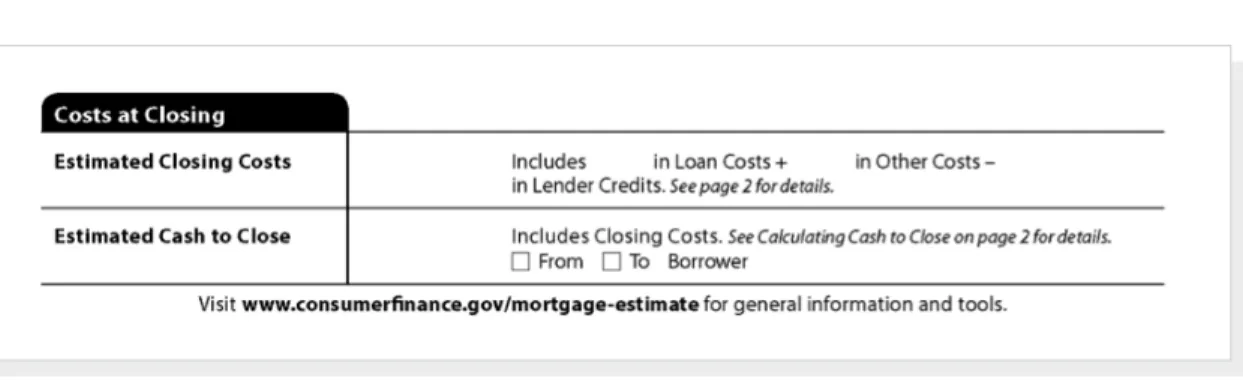
Costs at Closing
The Costs at Closing table shows:
Estimated Closing Costs are calculated in the same manner as the Total Closing
Costs disclosed on page 2 of the Loan Estimate. (See section 2.3.1 below) The
Total Closing Costs are also itemized to show from page 2 of the Loan Estimate:
§ The total of the Loan Costs table,
§ The total of the Other Costs table, and
§ Lender Credits in the Total Closing Costs subheading. (§ 1026.37(d)(1)(i))
§ The estimated amount of cash the consumer will be expected to pay at closing is also shown as Estimated Cash to Close. This amount is the same as the
Estimated Cash to Close, from the Calculating Cash to Close table on page 2 of
the Loan Estimate. (§ 1026. 37(d)(1)(ii))
Alternative Costs at Closing Table
For transactions without a seller, an Alternative Costs at Closing table together with an Alternative Calculating Cash to Close table on page 2 of the Loan
Estimate can be used in place of the Costs at Closing table shown above.
(§ 1026.37(d)(2)) The Alternative Costs at Closing table contains a variation that places checkboxes with Estimated Cash to Close in order to indicate whether the cash is due from or to the consumer. (Comment 37(d)(2)-2) If the Alternative Costs at Closing table is used, then the Alternative Calculating Cash to Close on page 2 of the Loan Estimate also must be used. (Comment 37(d)(2)-1)
2�3
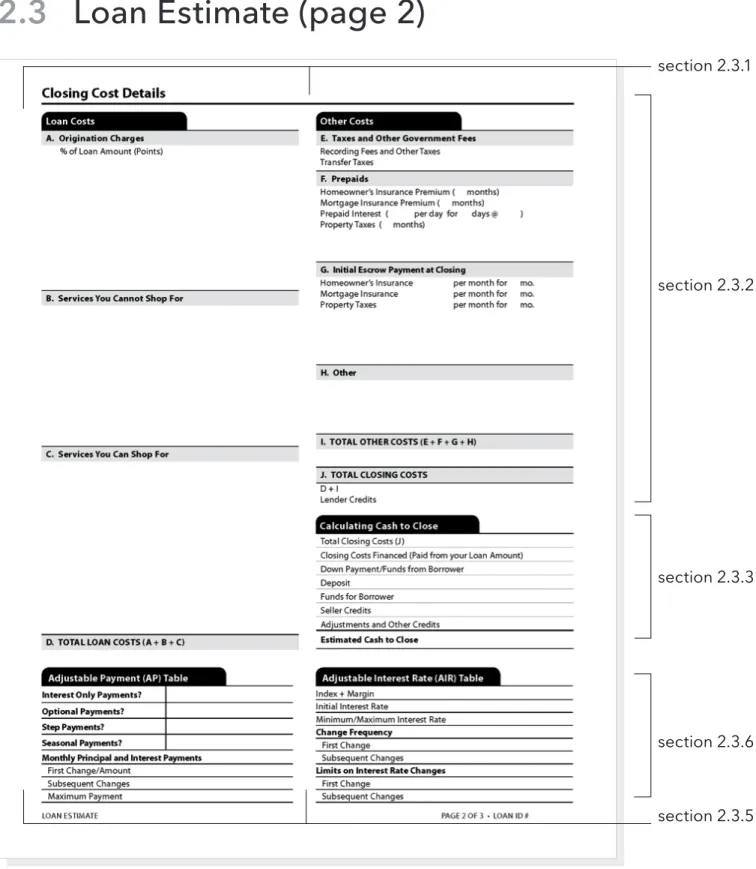
Loan Estimate (page 2)
FIGURE 7: LOAN ESTIMATE (PAGE 2)
section 2.3.1
section 2.3.2
section 2.3.3
section 2.3.6
Up to four main categories of costs are disclosed on page 2 of the Loan Estimate:
1� A good-faith itemization of the Loan Costs and Other Costs associated with the loan. (§ 1026.37(f) and (g))
2� A Calculating Cash to Close table that shows how the amount of cash needed
at closing is calculated. (§ 1026.37(h))
3� For transactions with adjustable monthly payments, an Adjustable Payments
(AP) Table with relevant information about how the monthly payments will
change. (§ 1026.37(i))
4� For transactions with adjustable interest rates, an Adjustable Interest Rate (AIR) Table with relevant information about how the interest rate will change. (§ 1026.37(j))
The items associated with the mortgage are broken down into two general types,
Loan Costs and Other Costs. Generally, Loan Costs are those costs paid by the consumer to the creditor and third-party providers of services the creditor requires to be obtained by the consumer during the origination of the loan. (§ 1026.37(f))
Other Costs include taxes, governmental recording fees, and certain other
payments involved in the real estate closing process. (§ 1026.37(g))
Items that are a component of title insurance or are for conducting the closing must include the introductory description of Title –. (§§ 1026.37(f)(2)(i), (g)(4)(i)) If State law requires additional disclosures, those additional disclosures are made on a document whose pages are separate from, and not presented as part of, the
Loan Estimate. (Comments 37(f)(6)-1, 37(g)(8)-1)
The amounts disclosed in the Loan Costs and Other Costs table are rounded to the nearest whole dollar. The daily amount of Prepaid Interest and the monthly amounts for the items in the Initial Escrow Payment at Closing in the labels are not
rounded, but the calculated amounts for those items are rounded to the nearest whole dollar. (§ 1026.37(o)(4))
The Loan Costs and Other Costs tables are further broken down in the next subsection.
2�3�1
Loan Costs
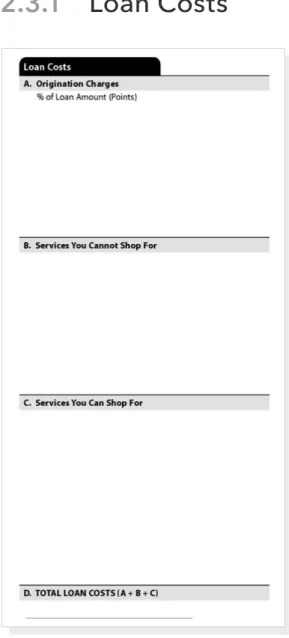
Loan Costs are disclosed in three subheadings, each of which is subtotaled:
§ Origination Charges,
§ Services You Cannot Shop For, and
§ Services You Can Shop For.
Disclose the sum of these three subtotals as Total Loan Costs. (§ 1026.37(f)) FIGURE 8: LOAN COSTS TABLE OF THE LOAN ESTIMATE
Origination Charges
Origination Charges are items the consumer will pay to each creditor and loan
originator for originating and extending credit. (§ 1026.37(f)(1))
First, include the amount paid, if any, by the consumer to the creditor to reduce the interest rate (sometimes referred to as “points”) as both a percentage of the loan amount and a dollar amount. (§ 1026.37(f)(1)(i)) If no points are charged, then leave blank both the percentage of points stated in the label and the dollar amount. (Comment 37(f)(1)-4)
Any other items that the consumer will pay to the creditor and loan originator may also be disclosed, up to 13 individual items. (§ 1026.37(f)(1)(ii)) If there are more than 13 Origination Charges, disclose the total amount of the items that exceed 12 as Additional Charges. (§ 1026.37(f)(6)(i)) Describe the items, other than for points paid, using terminology that clearly and conspicuously describes the service that is disclosed. (Comment 37(f)(1)-3)
The following items should be itemized separately in the Origination Charges
subheading:
§ Compensation paid directly by a consumer to a loan originator that is not also the creditor; or
§ Any charge imposed to pay for a loan level pricing adjustment assessed on the creditor that is passed on to the consumer as a cost at consummation and not as an adjustment to the interest rate. (Comment 37(f)(1)-5)
Only items paid directly by the consumer to compensate a loan originator are Origination Charges. Do not disclose compensation to a loan originator paid indirectly by a creditor through the interest rate on the Loan Estimate. (Comment 37(f)(1)-2)
Services You Cannot Shop For
Services You Cannot Shop For are items provided by persons other than the
creditor or mortgage broker that the consumer cannot shop for and will pay for at settlement. (§ 1026.37(f)(2)) Items listed as Services You Cannot Shop For must use terminology that describes each item, and disclose them in alphabetical order. (§ 1026.37(f)(5))
Services You Cannot Shop For might include:
§ Appraisal fee,
§ Appraisal management company fee,
§ Credit report fee,
§ Flood determination fee,
§ Government funding fee (such as a VA or USDA guarantee fee, or any other fee paid to a government entity as part of a governmental loan program),
§ Homeowner’s association certification fee,
§ Lender’s attorney fee,
§ Tax status search fee,
§ Third-party subordination fee,
§ Title – closing protection letter fee,
§ Title – lender’s title insurance policy, and
§ An upfront mortgage insurance fee (unless the fee is a prepayment of future premiums or a payment into an escrow account). (Comment 37(f)(2)-2)
Describe services related to the issuance of title insurance policies with the word
Title – at the beginning of the item. (Comment 37(f)(2)-3)
Items that are required for the issuance of title insurance policies may include: FIGURE 10: SERVICES YOU CANNOT SHOP FOR TABLE OF THE LOAN ESTIMATE
§ Examination and evaluation of title evidence to determine the insurability of the title being examined and what items to include or exclude in any title commitment and policy to be issued,
§ Preparation and issuance of the title commitment or other document that
discloses the status of title, identifies the conditions that must be met before the policy will be issued, and obligates the insurer to issue a policy of title insurance if such conditions are met,
§ Resolution of title underwriting issues and taking steps needed to satisfy any conditions for the issuance of title insurance policies,
§ Preparation and issuance of the title insurance policies, and
§ Payment of premiums for any lender’s title insurance coverage. (Comment 37(f)(2)-3)
The amount of the premium for the lender’s title insurance coverage must be disclosed without any adjustment to the premium that might be made for the simultaneous purchase of an owner’s title insurance policy. (Comment 37(f)(2)-4) Disclose no more than 13 Services You Cannot Shop For. (§ 1026.37(f)(2)(ii)) If there are more than 13 Services You Cannot Shop For, disclose the total amount of the items that exceed 12 with the label Additional Charges. An addendum to the Loan Estimate cannot be used to disclose the additional items. (§ 1026.37(f)(6)(i))
Services You Can Shop For
Services You Can Shop For are provided by persons other than the creditor or
mortgage broker and are services that the consumer can shop for and will pay for at settlement. (§ 1026.37(f)(3)) Items listed as Services You Can Shop For must use terminology that describes each item and disclose them in alphabetical order. (§ 1026.37(f)(5))
A creditor permits a consumer to shop for an item if the creditor permits the consumer to select the provider of that item, subject to reasonable requirements (such as appropriate licensing of the provider). (§ 1026.19(e)(1)(vi)(A); Comment 19(e)(1)(vi)-1) FIGURE 11: SERVICES YOU CAN SHOP FOR TABLE OF THE LOAN ESTIMATE
Services You Can Shop For might include:
§ Pest inspection fee,
§ Survey fee,
§ Title – closing agent fee, and
§ Title – closing protection letter fee. (Comment 37(f)(3)-2)
Describe services related to the issuance of title insurance policies with the word
Title – at the beginning of the item. (Comment 37(f)(2)-3)
Items that are required for the issuance of title insurance policies may include:
§ Examination and evaluation of title evidence to determine the insurability of the title being examined and what items to include or exclude in any title commitment and policy to be issued,
§ Preparation and issuance of the title commitment or other document that
discloses the status of title, identifies the conditions that must be met before the policy will be issued, and obligates the insurer to issue a policy of title insurance if such conditions are met,
§ Resolution of title underwriting issues and taking steps needed to satisfy any conditions for the issuance of title insurance policies,
§ Preparation and issuance of the title insurance policies, and
§ Payment of premiums for any lender’s title insurance coverage. (Comment 37(f)(3)-3)
The creditor must disclose the amount of the premium for the lender’s title
insurance coverage without any adjustment to the premium that might be made for the simultaneous purchase of an owner’s title insurance policy. (Comment 37(f)(3)-3) Disclose no more than 14 Services You Can Shop For. (§ 1026.37(f)(3)(ii)) If there are more than 14 Services You Can Shop For, disclose the total amount of the items that exceed 13 with the label Additional Charges. (§ 1026.37(f)(6)(ii)(B)) An addendum to the Loan Estimate can be used to disclose the additional items. (§ 1026.37(f)(6)(ii))
Total Loan Costs
Total Loan Costs is the sum of the subtotals of Origination Charges, Services You Cannot Shop For, and Services You Can Shop For. (§ 1026.37(f)(4))
2�3�2
Other Costs
Disclose Other Costs under four subheadings, each of which is subtotaled:
§ Taxes and Other Government Fees,
FIGURE 13: OTHER COSTS TABLE OF THE LOAN ESTIMATE
§ Prepaids,
§ Initial Escrow Payment at Closing, and
§ Other.
Total Other Costs is the sum of these four subtotals. (§ 1026.37(g)(5))
Other Costs are established by government action, determined by standard
calculations applied to ongoing fixed costs, or based on an obligation incurred by the consumer independently of any requirement imposed by the creditor. (Comment 37(g)-1) Other items that are required to be paid at or before closing pursuant to the contract for sale between the consumer and a seller are disclosed on the Loan Estimate to the extent the creditor has knowledge of those items when it issues the Loan Estimate. (Comment 37(g)-2)
Other Costs must be disclosed in the order listed in the regulation, with any additional items listed in alphabetical order in subsequent lines of the applicable subheading. (§ 1026.37(g)(7))
An addendum to the Loan Estimate cannot be used for additional items on the
Other Costs table. If all of the charges cannot be itemized in the number of lines provided in a subheading of the Other Costs table, the total of those items that exceed the number permitted are disclosed with the label “Additional Charges” on the last line of that subheading. (§ 1026.37(g)(8))
Taxes and Other Government Fees
Under Taxes and Other Government Fees, disclose Recording Fees and Other Taxes first and Transfer Taxes second. (§ 1026.37(g)(1))
Recording Fees and Other Taxes are fees assessed by a government authority to
record and index the loan and title documents as required under State or local law, together with any charges or fees imposed by a State or local government that are
not Transfer Taxes. (Comment 37(g)(1)-1 and -2) Recording Fees and Other Taxes do
not include fees that are based on the Sale Price of the Property or Loan Amount. For example, a fee for recording a subordination that is $20, plus $3 for each page FIGURE 14: TAXES AND OTHER GOVERNMENT FEES TABLE OF THE LOAN ESTIMATE
over three pages, is included as Recording Fees and Other Taxes; but a fee of $1,250 based on 0.5% of the Loan Amount is included as Transfer Taxes, and not
included as Recording Fees and Other Taxes. (Comment 37(g)(1)-1)
Transfer Taxes are State and local government fees on mortgages and home sales
that are based on the Loan Amount or Sale Price of the Property. The name that is used under State or local law to refer to these amounts is not determinative of whether or not they are disclosed as Transfer Taxes on the Loan Estimate. (Comment 37(g)(1)-3)
Disclose only Transfer Taxes paid by the consumer on the Loan Estimate. Whether the consumer pays the transfer tax is based on applicable State or local law. For example:
§ If a State law indicates a lien can attach to the consumer’s acquired property if the charge is not paid, the amount is included as part of Transfer Taxes;
§ If State or local law is unclear or does not specifically attribute the amount to the seller or consumer, disclose the amount apportioned to the consumer using common practice in the locality of the property. (Comment 38(g)(1)-4)
Transfer taxes to be paid by the seller are not disclosed on the Loan Estimate as
Transfer Taxes. (Comment 38(g)(1)-5)
The amount of Transfer Taxes disclosed could be modified to the extent the creditor has knowledge of the apportionment of transfer taxes in the contract for sale between the consumer and a seller when it issues the Loan Estimate. (Comment 37(g)-2) When a creditor does not have the contract of sale when it issues the Loan Estimate, the creditor must use the apportionment of transfer taxes provided for by State or local law, or common practice when State or local law is unclear. (Comment 37(g)(1)-4)
Disclose the sum of all transfer taxes paid by the consumer as Transfer Taxes. (§ 1026.37(g)(1)(ii)) No additional items may be listed or deleted in the Taxes and
Prepaids
Prepaids are items to be paid by the consumer in advance of the first scheduled
payment of the loan. (§ 1026.37(g)(2)) Prepaids are:
§ Homeowner’s Insurance Premium,
§ Mortgage Insurance Premium,
§ Prepaid Interest,
§ Property Taxes, and
§ A maximum of three additional items.
§ Each item must include the applicable time period covered by the amount to be paid by the consumer and the total amount to be paid. (§ 1026.37(g)(2)(i)-(iv))
Initial Escrow Payment at Closing
Initial Escrow Payment at Closing includes items that the consumer will be expected
to place into a reserve or escrow account at consummation to be applied to recurring periodic payments. (§ 1026.37(g)(3)) Initial Escrow Payment at Closing includes:
§ Homeowner’s Insurance,
§ Mortgage Insurance,
§ Property Taxes, and
FIGURE 15: PREPAIDS TABLE OF THE LOAN ESTIMATE
§ A maximum of five other items.
Also disclose the amount escrowed per month for each item, the number of months collected at consummation and the total amount paid. (§ 1026.37(g)(3)(i), (ii), (iii), (v))
Other
Other includes items in connection with the transaction that the consumer is likely to pay or has contracted with a person other than the creditor or loan originator to pay at closing and of which the creditor is aware at the time of issuing the Loan Estimate. (§ 1026.37(g)(4))
Separate insurance, warranty, guarantee or event-coverage products include, for example:
§ Owner’s title insurance,
§ Credit life insurance,
§ Debt suspension coverage,
§ Debt cancellation coverage,
§ Warranties of home appliances and systems, and
§ Similar products.
These items are disclosed when coverage is written in connection with a mortgage. These examples would not include additional coverage and endorsements on
insurance otherwise required by the creditor. (Comment 37(g)(4)-3)
Items that disclose any premiums paid for separate insurance, warranty, guarantee, or event-coverage products not required by the creditor must include the
parenthetical description (optional) at the end of the label. (§ 1026.37(g)(4)(ii)) A maximum of five items can be disclosed as Other. (§ 1026.37(g)(4)(iii))
Describe services related to the issuance of title insurance policies with the word
Title – at the beginning of the item. When the owner’s title insurance premium FIGURE 17: OTHER TABLE OF THE LOAN ESTIMATE
includes a simultaneous issuance premium, the premium is calculated by taking the full owner’s title insurance premium, adding the simultaneous issuance
premium for the lender’s coverage (if any), and then deducting the full premium for lender’s coverage. (Comment 37(g)(4)-2)
When the creditor is aware of those items, Other includes for example:
§ Commissions of real estate brokers or agents,
§ Additional payments to the seller to purchase personal property pursuant to the contract of sale,
§ Homeowner’s association and condominium charges associated with the transfer of ownership, and
§ Fees for inspections not required by the creditor but paid by the consumer pursuant to the contract of sale. (Comment 37(g)(4)-4)
Total Closing Costs
Total Closing Costs is the sum of Total Loan Costs (shown in Figure 8), Total Other Costs, and Lender Credits. (§ 1026.37(g)(6))
Lender Credits is the amount of any payments from the creditor to the consumer
that do not pay for a particular fee on the Loan Estimate and is disclosed as a negative number. (Comment 37(g)(6)(ii)-1)
For loans where all or a portion of closing costs are offset by a credit or rebate provided by the creditor (sometimes referred to as “no cost” loans), disclose such credit or rebate as Lender Credits. The creditor should ensure that Lender Credits
is sufficient to cover the estimated items the creditor represented to the consumer as not being paid by the consumer at consummation, regardless of whether such representations pertained to specific items. (Comment 37(g)(6)(ii)-2)
2�3�3
Calculating Cash to Close
Total Closing Costs
Total Closing Costs is the same amount disclosed as Total Closing Costs in the
Other Costs table (see section 2.3.2 above). The amount is disclosed as a positive number. (§ 1026.37(h)(1)(i))
Closing Costs Financed (Paid from Your Loan Amount)
Closing Costs Financed (Paid from Your Loan Amount) is calculated by
subtracting the estimated total amount of payments to third parties not otherwise disclosed in the Loan Costs (see section 2.3.1 above) and Other Costs (see section 2.3.2 above) tables from the Loan Amount disclosed on page 1 of the Loan
Estimate (see section 2.2.2 above).
§ If the result of the calculation is a positive number, Closing Costs Financed (Paid
from Your Loan Amount) is that amount, disclosed as a negative number, but
only to the extent that it does not exceed the amount of Lender Credits.
§ If the result of the calculation is zero or negative, then Closing Costs Financed
(paid from Your Loan Amount) is $0. (Comment 37(h)(1)(ii)-1)
Down Payment/Funds from Borrower
§ In a Purchase transaction, Down Payment/Funds from Borrower is the
difference between the purchase price of the property and the principal amount of the loan, disclosed as a positive number. (§ 1026.37(h)(1)(iii)(A)) However, when the loan amount exceeds the purchase price of the property, disclose $0
as Down Payment/Funds from Borrower. (Comment 37(h)(1)(iii)-1)