Introduction to PIDX XML Transaction Standards, version 1.0
Introduction to
PIDX
XML
Transaction
Standards
Introduction to PIDX XML Transaction Standards, version 1.0
Document Changes
Version Date Version Authors Change Description
23 JAN 2014 0.01 Larry Dyer, Gary Strickland Created outline and content description 6 FEB 2014 0.02 Larry Dyer, Gary Strickland 1st draft of section 1
20 FEB 1014 0.03 Larry Dyer, Gary Strickland • 1st draft of sections 2 • Added references
6 MAR 2014 0.04 Larry Dyer, Gary Strickland • Merged section 3 into section 2 • Completed 1st draft of section 2 • Completed 1st draft of section 3 • Started 1st draft of section 4 • Added references
• Added terms to be defined to glossary • Started index
15 MAY 2014 0.05 Gary Strickland • Completed 1st draft of section 4 • Started 1st draft of section 5 30 MAY 2014 0.06 Gary Strickland • Completed 1st draft of section 5
• Started 1st draft of section 6 • Updated index
12 JUN 2014 0.07 Gary Strickland • Completed first draft
• Edited document to define acronyms in each section
• Added illustrations 24 JUN 2014 0.11 Larry Dyer, Darren Ebanks,
Rick Conner, Gary Strickland
• Edited the participants’ handout for completeness, accuracy, and readability
26 JUN 2014 0.2 Gary Strickland • Reorganized major sections • Added PIP sections
1 JUL 2014 0.9 Rick Conner, Larry Dyer, Darren Ebanks, Gary Strickland
• Edited participants’ handout for
completeness, accuracy, and readability • Reviewed slide deck
7 JUL 2014 1.0 Paul O’Shaughnessy, Gary Strickland
• Completed Deployment Plan • Completed Lessons Learned • Reviewed deliverables
Introduction to PIDX XML Transaction Standards, version 1.0 Table of Contents
1 Introduction ... 8
1.1 Purpose of the Introductory Course ... 8
1.2 Intended Audience ... 8
1.3 What this course will cover ... 8
1.4 What this course will not cover ... 8
1.5 Why this course is important ... 9
2 Electronic Commerce Overview ... 9
2.1 The Need for Standards... 10
2.2 Business Process Alignment ... 10
2.3 EDI ... 11
2.4 XML ... 13
3 Overview of PIDX Business Process Alignment Standards ... 13
3.1 RosettaNet organization and standards ... 14
3.1.1 RosettaNet Strengths ... 15
3.2 PIDX XML Transaction Standards ... 16
4 Fundamentals of PIDX XML Transaction Standards ... 16
4.1 Action, Signal, and Process Control Messages ... 16
4.1.1 Action Messages ... 16
4.1.2 Signal Messages ... 17
4.1.3 Scope of Signal Messages ... 17
4.1.4 Process Control PIPs ... 18
4.2 The PIDX Message Components ... 19
4.2.1 Preamble ... 20
4.2.2 Delivery Header ... 20
4.2.3 Service Header ... 20
4.2.4 Payload ... 20
5 PIDX Partner Interface Processes ... 21
5.1 PIP Model ... 21
5.1.1 Business Operational View ... 21
5.1.2 Functional Service View ... 22
5.2 Defining a Partner Interface Process ... 23
5.2.1 PIP Specifications ... 23
Introduction to PIDX XML Transaction Standards, version 1.0
6 PIDX and RosettaNet Differences ... 24
6.1 XML Schemas vs. DTDs ... 24
6.2 PIDX Partner Interface Processes (PIPs) ... 24
6.3 Two-action PIPs ... 24
6.4 PIDX Dictionaries ... 25
6.5 Authorization ... 25
6.6 Authentication ... 25
6.7 Non-repudiation ... 26
6.7.1 Non-repudiation of Origin and Content ... 26
6.7.2 Non-repudiation of Receipt ... 26
7 Strengths of the PIDX XML Transaction Standards ... 26
7.1 Message Identification ... 27
7.2 Message Authentication ... 27
7.3 Message Authorization ... 27
7.4 Non-repudiation ... 28
7.5 Data Confidentiality ... 28
7.6 Data Integrity ... 28
7.7 Reliable Messaging ... 28
7.8 Exception Handling ... 28
7.9 Global Adoption and Support ... 29
8 Business Advantages ... 29
8.1 Lower Processing Costs ... 29
8.2 Lower Bad Debt Expenses ... 30
8.3 Improve Days Sales Outstanding (DSO) ... 30
8.4 Improved Visibility ... 31
8.5 Business Analysis ... 31
9 Barriers to Adoption and Implementation and Solutions ... 32
9.1 High Adoption and Implementation Costs ... 32
9.2 Competing standards and technologies ... 32
10 Next Steps ... 33
Appendix A: Message Examples ... 34
Appendix B: Error Codes ... 46
Appendix C: References ... 47
Introduction to PIDX XML Transaction Standards, version 1.0
Introduction to PIDX XML Transaction Standards, version 1.0
List of Tables
Table 1: PIDX X12 EDI Transaction Sets (PIDX, 1997) ... 12
Table 2: EDI startup costs ... 12
Table 3: Differences between RNIF 1.1 and RNIF 2.0 ... 14
Table 4: Business Signal Error Codes ... 46
List of Figures
Figure 1: B2B data exchange processes sequence diagram ... 9Figure 2: Interrelationships of RosettaNet Specifications (RNIF2 Core Specification, p. 2) ... 15
Figure 3: Content level validation activity diagram ... 18
Figure 4: PIDX action message MIME components ... 19
Figure 5: PIDX action message MIME components ... 20
Figure 6: Send Invoice PIP use case diagram... 21
Figure 7: Send Invoice PIP activity diagram ... 22
Introduction to PIDX XML Transaction Standards, version 1.0
1 Introduction
PIDX (Petroleum Industry Data Exchange) XML Transaction Standards are a set of documents describing standard methodologies to exchange business documents electronically in the oil and gas industry. The current PIDX XML Transaction Standards (PIDX) were developed by the oil and gas industry in 2002. PIDX includes:
• PIDX XML Transaction Standards, version 1.0 Standards Master (Core specification) • PIDX XML Transaction Standards, version 1.0 Implementation Guide (IG)
• Various versions of service content XML schemas
• Official interpretations of the standards by the PIDX Standards and Guidelines Committee The service content XML schemas have been updated periodically.
PIDX standards are based on RosettaNet standards. The PIDX transport, routing, and packaging (TRP) parts of the standard are mostly compliant with the RosettaNet Implementation Framework, Core Specification, version 2.0 (RNIF2).
1.1 Purpose of the Introductory Course
The oil and gas industry has over 10 years experience implementing the PIDX XML Transaction Standards, version 1.0. The collective experience of more than 200 operators, suppliers, and third party technology providers has demonstrated that some standards implementation projects have successfully been completed on time and on budget, while others have not. The course will discuss the PIDX XML Transaction standards, the challenges and barriers behind the inconsistent success of implementation projects, and how adopting companies can overcome those challenges and barriers.
1.2 Intended Audience
Business and technical personnel of companies currently implementing the standards, those companies who plan to implement them, and the third party technology providers who plan to facilitate
implementation projects will benefit from the presentations and discussions. 1.3 What this course will cover
The presentations and discussions will focus on the following: 1. An overview of the PIDX standards, including RNIF2 2. Successful implementations approaches
3. Issues that increase the cost, schedule, and the risk of project failure 4. Discussions on reducing costs, schedules and risk of failure
1.4 What this course will not cover
The presentation and discussions will not attempt to teach class participants the details of the PIDX standards or RosettaNet Implementation Framework, version 2.0. Participants do not need to have a
Introduction to PIDX XML Transaction Standards, version 1.0
detailed understanding of the standards. We will discuss the standards sufficiently to understand the how they work, what they do, and how to adopt and implemen
1.5 Why this course is important
Implementing PIDX XML Transaction Standards can help companies reduce costs outstanding (DSO), and provide better transaction visibility
the standards has shown that the standards can be adopted and implemented efficiently class will enable participants to take back to their companies
recurring challenges.
2 Electronic Commerce Overview
Electronic Commerce (EC) can be defined in many ways.
transformation of key business processes through the use of the internet. (IBM p. 1) Using this definition, EC includes unsolicited emails
online advertising in search engines,
internet technologies. The PIDX XML Transaction Standards
information. They describe the sequence of activities and data to realize the exchange of business information over the internet.
The information exchanged using the PIDX standards
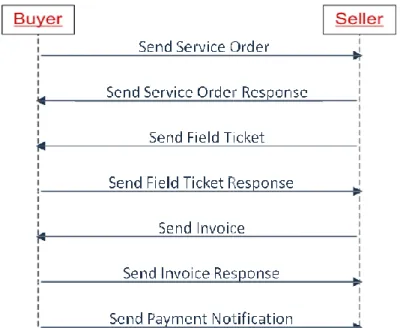
documents, such as purchase and service orders, field tickets, and invoices. The sequence diagram in figure 1 shows some of the business documents that can be exchanged using the PIDX standards sequence of their exchange.
Figure 1: B2B data exchange processes sequence diagram
Standards, version 1.0
detailed understanding of the standards. We will discuss the standards sufficiently to understand the how they work, what they do, and how to adopt and implement them to achieve company goals.
Why this course is important
Transaction Standards can help companies reduce costs, days sales
, and provide better transaction visibility. Over ten years of experience implementing shown that the standards can be adopted and implemented efficiently.
class will enable participants to take back to their companies the knowledge that will help them
Overview
can be defined in many ways. IBM defines electronic business as the transformation of key business processes through the use of the internet. (IBM p. 1) Using this
emails, business-to-consumer electronic store fronts like Amazon, online advertising in search engines, and the business processes used in the exchange of information
The PIDX XML Transaction Standards focus on the exchange of business describe the sequence of activities and data to realize the exchange of business
using the PIDX standards is usually in the form of common business nts, such as purchase and service orders, field tickets, and invoices. The sequence diagram in
shows some of the business documents that can be exchanged using the PIDX standards
: B2B data exchange processes sequence diagram
detailed understanding of the standards. We will discuss the standards sufficiently to understand they t them to achieve company goals.
days sales
experience implementing Attending the help them avoid
IBM defines electronic business as the transformation of key business processes through the use of the internet. (IBM p. 1) Using this
store fronts like Amazon, exchange of information using e exchange of business
describe the sequence of activities and data to realize the exchange of business
common business nts, such as purchase and service orders, field tickets, and invoices. The sequence diagram in
Introduction to PIDX XML Transaction Standards, version 1.0
The transformation of business processes began before the internet became popular. Banks and other businesses began authorizing the transfer of money and business data using proprietary file formats over telecommunications networks in the 1970s. In the 1980s organizations exchanged business data using telecommunications networks and electronic data interchange (EDI) standards. In 2002, the Petroleum Industry Data Exchange (PIDX) subcommittee of the American Petroleum Industry (API) published the PIDX XML Transaction Standards that were meant to replace EDI. While most oil and gas companies use the PIDX XML standards, some still use X12 EDI.
2.1 The Need for Standards
Before standards like automatic funds transfer (AFT) and EDI were developed to manage the exchange of business data, companies used telecommunications networks to exchange business data in proprietary formats. This process worked well for those companies that did a lot of business together, but it was not an efficient way to exchange data. Data exchange formats had to be changed when a company upgraded or changed its business systems, and new one-off formats had to be agreed to when adding new trading partners.
Businesses realized efficiencies exchanging data electronically, and they also realized that standards to guide the exchange would make the process more efficient. Accordingly, in 1982, the American National Standards Institute (ANSI) Accredited Standards Committee (ASC) released version 1 of the X12 EDI Standards. X12 EDI is used mainly in North America. Another EDI standard, Electronic Data Interchange for Administration, Commerce and Transport (EDIFACT), was developed by the United Nations, and is used in primarily countries outside North America.
EDI standards enabled companies to decouple their proprietary backend enterprise resource planning (ERP) systems from the business data formats they needed to exchange with their trading partners. This decoupling allowed companies to upgrade and change their backend systems without changing the data formats used to exchange business documents with trading partners. This solved the biggest problem prohibiting widespread electronic data exchange. It did not solve all the problems: Data exchange was still expensive, arcane, and complex, and only large companies could afford the systems and personnel required to run and maintain EDI middleware. When XML became a World Wide Web Consortium (W3C) recommendation in 1998, many businesses believed that XML could be used to eliminate the complexity, expense, and mystery associated with EDI, and finally enable global electronic data exchange.
2.2 Business Process Alignment
Exchanging business documents requires trading partners involved in a business transaction to align their business processes so documents can be processed successfully. Business process alignment applies to manual and electronic systems; the companies exchanging the data must understand how to process the data. For example, to execute a business process (BP) such as, “send invoice to customer,” both the supplier’s and the buyer’s processes need to be aligned to make sure the invoice sent and received is paid. In paper-based systems, the people responsible for sending an invoice must include information the customer needs to process the invoice, such as PO numbers, Authorization-for-expenditure (AFE) identification, field ticket data, and third party invoices. The invoice is then enveloped, and mailed.
Introduction to PIDX XML Transaction Standards, version 1.0
The customer receiving the paper invoice verifies that it conforms to their business rules, confirms that it contains all the information needed to process it, verifies that the expense was authorized, enters it into their accounts payable system, and finally, pays the invoice. The trading partners’ processes become even more complex when something goes wrong, such as missing information, or unexpected pricing.
The same business processes that buyers and sellers execute to send and pay a paper invoice need to be executed when trading partners process invoices using B2B technologies. However, electronic processing presents problems that don’t exist in the paper world. The data format required by a customer and
included in the suppliers’ invoices can vary by the supplier that sent the document. This formatting issue isn’t a problem when processing a paper invoice, because the person in accounts payable responsible for processing the invoice can look through it to find all of the information required for payment. This is a much more complex activity when executing the same process electronically. Additionally, the suppliers sending invoices must consider the disparate business rules and information requirements that vary by trading partner . While the alignment process is much easier now, it still presents challenges oil and gas companies need to overcome.
2.3 EDI
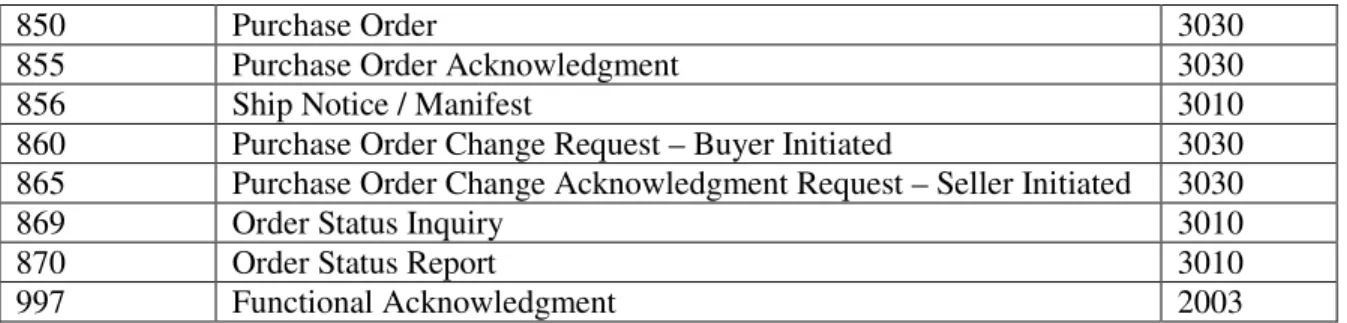
EDI has been used to align business processes since the 1980s. EDI is defined as the application-to-application transfer of data between organizations using a standard, structured, machine-readable format (Bort, 1998, p. A1-2-3). It was one of the first forms of electronic commerce extensively used in business, beginning in the 1970’s. Understanding EDI concepts is important to understanding current widely used B2B standards in the oil and gas industry because current standards are based on EDI concepts. EDI is the most common technology used in B2B transactions today, with the U.S. dollar amount of transactions equaling approximately that of all other B2B transaction technologies combined (Schneider, 2013, p. 217 – 218). While EDI is not used as extensively in the oil and gas industry as it was in the 1990s, it is still used in some oil and gas B2B transactions, and it is used more widely by oil and gas companies’ transactions with banks, transportation companies, and healthcare-related companies. There are several EDI standards used currently. The two most commonly used EDI standards are ASC X12, and UN/EDIFACT (United Nations/Electronic Data Interchange For Administration, Commerce and Transport). ASC X12 is used primarily in North America, and UN/EDIFACT is a global standard. The two standards define over 500 cross-industry transaction sets (business messages) between them. Each industry uses a subset of the transaction sets. The PIDX Implementation Guideline for EDI, 4th Edition describes a compliant subset of the 300 plus ASC X12 transaction sets. The PIDX X12 transaction sets are listed in table 1: PIDX X12 EDI Transaction Sets.
Transaction Set ID
Business Document Version
810 Invoice 3030
820 Payment order / Remittance Advice 3040
832 Price / Sales Catalog 3030
838 Trading Partner Profile 3030
840 Request for Quotation 2040
Introduction to PIDX XML Transaction Standards, version 1.0
850 Purchase Order 3030
855 Purchase Order Acknowledgment 3030
856 Ship Notice / Manifest 3010
860 Purchase Order Change Request – Buyer Initiated 3030
865 Purchase Order Change Acknowledgment Request – Seller Initiated 3030
869 Order Status Inquiry 3010
870 Order Status Report 3010
997 Functional Acknowledgment 2003
Table 1: PIDX X12 EDI Transaction Sets (PIDX, 1997)
EDI works well for those oil and gas companies implementing EDI standards. Companies reported reduced administrative handling costs, reduced delivery time for invoices, reduced float on payments, eliminated data entry, reduced errors, improved data consistencies, and efficiencies in cash application. As an example, in a 1999 survey, 3Com reported the costs to process a paper order to be $38, compared to $1.35 per order using EDI. The company estimated the annual savings processing orders and invoices using EDI to be $750,000, and total estimated savings when considering the reduction of data entry errors, the efficiencies due to better inventory management and reduced delays in processing to be $1.3 million (Falk, 1999). Other companies report significant cost savings using EDI. In 2008, average cost to process a paper order was $37.45 in North America, while the same order using EDI was $23.83
(Aberdeen Group, 2008).
While the EDI cost savings have been substantial for those companies implementing EDI solutions, not all companies implemented EDI solutions. In 2000, API-PIDX reported that 95% of Fortune 1000 companies were using EDI solutions, but that only 2% of non-Fortune 1000 companies were doing so. Those companies that do not use EDI solutions cite the cost and complexity of EDI systems as the main reasons for not implementing. Table 2 illustrates typical startup costs for processing EDI transactions in-house.
EDI System Component Cost
Hardware $20,000 - $100,000
EDI software, 1st year licenses and support agreements $50,000 - $200,000
Technical expertise, 1st year $70,000 - $500,000
Value Added Network (VAN) charges $24,000 - $100,000
Total 1st year costs $164,000 - $900,000
Table 2: EDI startup costs
Annual costs may omit the costs of hardware and software, but the licenses and support agreements continue. The personnel costs and VAN charges will also continue for in-house EDI processing, so the costs of in-house EDI processing are likely to be slightly less than the 1st year costs.
With the emergence of the internet and extensible markup language (XML), the oil and gas industry and other industries felt the B2B elements were in place to reduce the costs of using EDI to an acceptable level, and bring business process alignment to small and mid-sized companies as well as large companies.
Introduction to PIDX XML Transaction Standards, version 1.0
2.4 XML
XML is a relatively new technology created in 1996 under the auspices of the World Wide Web Consortium (W3C). The XML design goals included the following:
• XML should be easily usable over the internet • Programs processing XML should be easy to create • XML documents should be clear and human-legible • XML documents should be easy to create
• XML terseness is not an important consideration
The W3C issued XML 1.0 Recommendation in 1998 and XML 1.1 Recommendation in 2004. The business communities embraced XML as the way to bring business process integration to all companies, not just large global ones. The simplicity of XML, the WC3 mandate of ease of use, the availability of low-cost XML processors, and flexibility promised that all trading partners exchange business documents directly into the other’s ERP systems without programming. The only thing blocking universal business process integration was the lack of an industry-standard XML protocol. PIDX
chartered the Complex Products and Services Task Group (Com.Pro.Serv) in 2001 to develop oil and gas industry standards for exchanging business documents using XML. PIDX published PIDX XML
Transaction Standards, version 1.0 in February, 2002.
3 Overview of PIDX Business Process Alignment Standards
PIDX currently supports three messaging standards: 1. X12 EDI (Electronic Data Interchange)
2. PIDX XML Transaction Standards, version 1.0 3. Applicability Statement 2 (AS2)
X12 EDI has been a standard since the 1980s, and is still used by many oil and gas companies, mainly for exchanging business documents with organizations outside its industry. The PIDX XML Transaction Standards are the only one of the three standards promoted by PIDX. AS2 was offered as a low-cost alternative to the RNIF2 TRP. They were used by a few oil and gas companies for a few years. Currently they are not used.
According to the PIDX Standards Master, version 1.0 (PIDX1), the purpose of the standards is “…to promote standard processes for non-catalog, configurable products and services using eBusiness technology.” The standards defined public processes, a transaction, routing, and packaging (TRP) protocol based on the RosettaNet Implementation Framework Core Specification, version 2.0 (RNIF2), and an XML business vocabulary based on previously defined XML vocabularies including the Chemical Industry Data Exchange (CIDX), xCBL, and OFS-Portal.
To understand the PIDX XML Transaction Standards, one must understand RNIF2. RNIF2 describes the TRP protocol that enables participating supply chain members to implement RosettaNet partner interface processes (PIPs). PIDX did not adopt any of the other RosettaNet standards, including RosettaNet PIPs, or the RosettaNet Dictionary Framework.
Introduction to PIDX XML Transaction Standards, version 1.0
The PIDX exchange protocol relies on RNIF2, and it is mostly compliant with RNIF2. Oil and gas companies that use RNIF2-compliant messaging applications should not have problems adopting the PIDX standards.
3.1 RosettaNet organization and standards
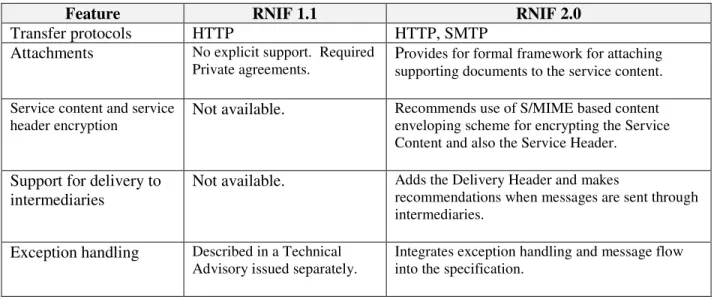
RosettaNet is a non-profit consortium of more than 500 technology, electronic components, and semiconductor manufacturing companies. RosettaNet was founded in the U.S. in 1998 to develop standards to automate inter-company supply chain business processes. In 2002 RosettaNet merged with The Uniform Code Council, which was renamed to GS1 US. GS1 US manages the RosettaNet standards. The RosettaNet standards include the core specification, a set of partner interface processes (PIPs) applicable mostly to the technology and electronics industries, and a dictionary framework defining information items in the standards. The core specification of the RosettaNet standards describes the TRP methodology. RosettaNet supports two versions of the core specification: RosettaNet Implementation Framework, version 1.1 (RNIF1), published in 1999, and RosettaNet Implementation Framework, version 2.0 (RNIF2), published in 2002. Both versions are still supported by RosettaNet, and both are free and open to the public. The major differences in the two core specification versions are summarized in table 3.
Feature RNIF 1.1 RNIF 2.0
Transfer protocols HTTP HTTP, SMTP
Attachments No explicit support. Required Private agreements.
Provides for formal framework for attaching supporting documents to the service content. Service content and service
header encryption
Not available. Recommends use of S/MIME based content enveloping scheme for encrypting the Service Content and also the Service Header.
Support for delivery to intermediaries
Not available. Adds the Delivery Header and makes
recommendations when messages are sent through intermediaries.
Exception handling Described in a Technical Advisory issued separately.
Integrates exception handling and message flow into the specification.
Table 3: Differences between RNIF 1.1 and RNIF 2.0
RosettaNet goals focus on improving supply chain interactions between trading partners by specifying standards to align trading partner business processes. The standards specify what should be exchanged and how the exchanges should be executed. The standards apply only to public processes; those processes that involve packing and unpacking a RosettaNet message, and interactions between trading partners. Private processes are out of scope of the RosettaNet standards. Private processes include processes exporting and importing data from and to an ERP system, and those translating data to and from service content.
Introduction to PIDX XML Transaction Standards, version 1.0
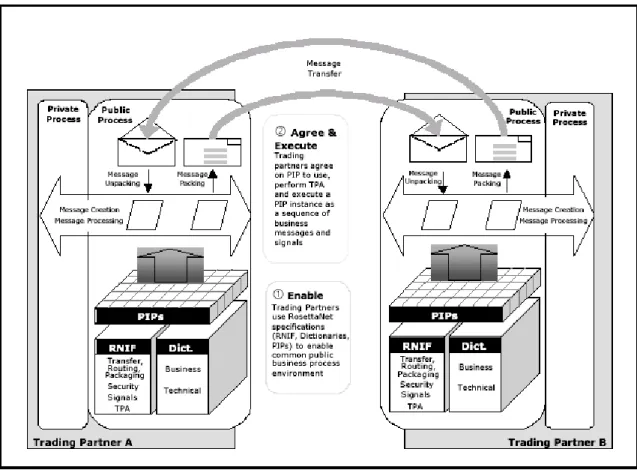
The RosettaNet standard documentation includes the core specification (RNIF2), a dictionary framework, and documentation describing PIPs. The relationships between the RosettaNet documentation are
illustrated in Figure 2.
Figure 2: Interrelationships of RosettaNet Specifications (RNIF2 Core Specification, p. 2)
The partner interface process (PIP) is the operational focus of the RosettaNet standards. The core specification, the business dictionary framework, service content DTDs, header DTDs, message guide lines, trading partner agreements, and associated private business processes support the execution of a PIP. Companies implementing RosettaNet-based standards must understand this: The successful execution of a PIP is the primary business and technical focus of the RosettaNet standards.
3.1.1 RosettaNet Strengths
Many companies have adopted and implemented the RosettaNet standards. The standards offer a robust and freely available way to securely integrate specific business processes of independent organizations using disparate systems. The standards do not describe just the data to be exchanged between trading partners; they define specific processes, as well:
• What to send • When to send • How to send
Introduction to PIDX XML Transaction Standards, version 1.0 • How to secure
• How to verify processing status
3.2 PIDX XML Transaction Standards
The PIDX XML Transaction Standards are modeled after the RosettaNet standards. The PIDX standards: 1. Use the RNIF2 standard for transport, routing, packaging (TRP), message reliability and security 2. Use the RosettaNet concept of the Partner Interface Process (PIP)
3. Rely on RosettaNet Message Guidelines to define the message header XML documents The RosettaNet standards were developed for the electronics and related industries. While the PIDX XML Transaction Standards, version 1.0 are based on the RosettaNet standards, there are a few, important differences. Some of the differences are necessary because of the needs of the oil and gas industry. Others restrict and change the RosettaNet core specification, RNIF2.
4 Fundamentals of PIDX XML Transaction Standards
A basic understanding of the RosettaNet Standards, how PIDX restricts those standards, and the processes and general data is necessary to successfully manage implementation projects. This section discusses the types of PIDX messages, their components, the processes used to create, deliver, receive, and process a PIDX message, and the PIDX XML Transaction Standards documentation.
4.1 Action, Signal, and Process Control Messages
There are two types of messages exchanged in a PIDX partner interface process (PIP): business action messages and business signal messages. Business action messages contain business documents such as invoices and purchase/service orders, and field tickets. Business action messages can also contain optional non-XML attachments.
PIDX business signals are positive and negative messages that acknowledge the receipt of a business action message, and return the validation status of the business action message. The trading partner that received the business action message MUST return a business signal when the receiving systems can determine that the action message was sent by a trading partner authorized to send it. RNIF2 contains one positive and one negative business signal. Only business action messages are acknowledged; business signals are never acknowledged.
RosettaNet defines a third message type called a process control message. A process control PIP is used to communicate process status outside of the context of the current process instance. PIDX XML
Transaction Standards do not mention process control PIPs. Process control is included in this section for completeness.
4.1.1 Action Messages
A PIDX action message contains a business payload. The payload MUST contain a business document formatted in accordance with a specific PIDX XML schema, such as an invoice, field ticket, or purchase order. The payload of an action message MAY contain other non-XML-formatted content, as agreed to by the trading partners implementing the PIDX PIP.
Introduction to PIDX XML Transaction Standards, version 1.0
4.1.2 Signal Messages
RosettaNet signals are messages used to communicate the status of processing events of an action message in a receiver’s system. Events that MUST be reported are base-level validation events:
1. The receipt and successful base-level validation of a message (Receipt Acknowledgment) 2. The receipt of an out of sequence message (Exception with a type of “General Exception”) 3. The receipt of a message that has invalid grammar; it did not pass base-level validation
(Exception with a type of “Receipt Acknowledgment Exception”)
Optionally, trading partners MAY agree to validate XML service content against the receiving trading partner’s business rules. This is called “content validation.” Section 4.1.3 Scope of Signal Messages, discusses base-level validation and content level validation.
The PIP specification determines if and when a signal is returned to the sender of an action message. Currently, all PIDX PIPs require the receiver of an action message to return a signal.
Receipt Acknowledgment Signal
A receipt acknowledgment (RA) is a positive business signal that acknowledges the receipt of a valid action message. Validity of the action message is determined by base-level validation and (optionally) by service content validation requirements negotiated between trading partners.
Exception Signals
An exception signal is a negative acknowledgment message indicating an error in the structure or the syntax of the associated action message. The following exception types indicate the types of exceptions thrown in the receiver’s system:
• Receipt-Acknowledgment Exception: a negative acknowledgment of receipt of a business action message sent when the action message is not structurally or syntactically valid
• General Exception: a negative acknowledgment signal sent to indicate an exception other than a structurally or syntactically invalid message
The trading partner receiving a business action message MUST acknowledge the receipt with one of the signals discussed. However, RosettaNet recommends that authentication or authorization failures should not be acknowledged to minimize security risks. Note that if an exception is thrown before the receiving trading partner’s system can identify the sending trading partner, RosettaNet standards prohibit sending a signal.
4.1.3 Scope of Signal Messages
A receipt acknowledgment or exception business signal is sent when a trading partner receives a PIDX action message. If the action message was base-level validated, the applicable syntax and structure rules are satisfied.
In addition to validating the action message’s structure and syntax, PIDX allows trading partners to optionally agree to validate the service content of the action
Introduction to PIDX XML Transaction Standards, version 1.0
message against the receiver’s business rules prior to sending the business signal.
If the trading partner receiving the action message validates the service content before sending the receipt acknowledgment/exception, then the trading partner MAY return an exception if the service content is not valid. The exception type is “General Exception” and the error code to use is PRF.DICT.VALERR. The activity diagram in figure 2 shows the process and message flow when the service content of an invoice is validated before creating a receipt acknowledgment or exception signal.
Base-level Validation Rules
The four XML parts of a PIDX message (preamble, delivery header, service header and service content) MUST be validated against a RosettaNet DTD (for the three header documents) or schema (for the service content). The following is the minimum level of validation that is required on each of the XML body parts. Validation against these rules is called “base-level” validation:
1. The XML document MUST be compliant with its corresponding DTD or schema
2. Where an element’s data type and/or length is specified in the corresponding schema (in the case of the service content) or Message Guideline (in the case of the header parts), the element MUST be validated against the schema or Message Guideline
3. In validating header documents, where the cardinality specification of an element in the Message Guideline is different from the corresponding specification in the DTD, the specification in the Message Guideline is more accurate and MUST be adhered to
4. In validating header documents, where the sequence or naming of an element in the Message Guideline is different from the corresponding specification in the DTD, the specification in the DTD is more accurate and MUST be adhered to
If a message does not follow one or more of the above rules, then it MUST be deemed invalid.
4.1.4 Process Control PIPs
RosettaNet defines process control PIPs to communicate process states outside of the context of the current process instance. For example, a new instance of the 0A1 “Notification of Failure” PIP is started when exceptions happen under a specific condition (namely, when the process is in “execution” state at one partner’s system and may have possibly reached a “completed” state in the other partner’s system) during the execution of any other process. For example, assume that a customer sends an invoice response action message in a single-action invoice PIP to a supplier. Assume further that the supplier validates the invoice response action message and returns a receipt acceptance to the supplier, completing the PIP for the supplier. If the customer subsequently discovers issues that prevent payment of the invoice, the 0A1 PIP should instantiate, sending a process control message to the supplier indicating the process was terminated in an exception state.
Current PIDX standards do not address process control PIPs. Figure 3: Content level validation activity diagram
Introduction to PIDX XML Transaction Standards, version 1.0 4.2 The PIDX Message Components
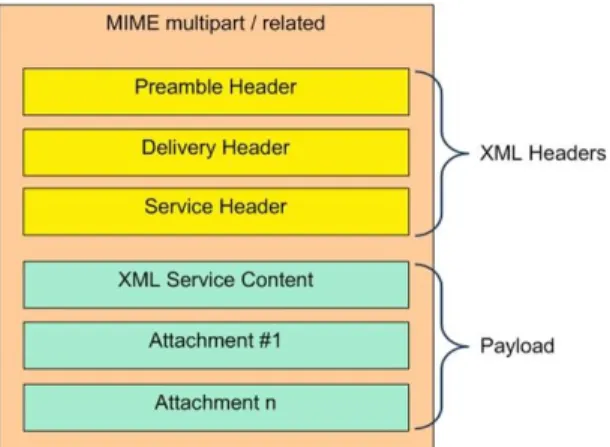
A PIDX message is a MIME multipart/related message consisting of three XML headers (preamble, delivery header, and service header), and a payload that includes mandatory service content, and optional attachments. The purpose of the headers is to enable the trading partner and any intermediaries to
• Identify the message as a PIDX-compliant message (preamble)
• Identify the sender for authentication and authorization (delivery header) • Identify the context of the message (service header)
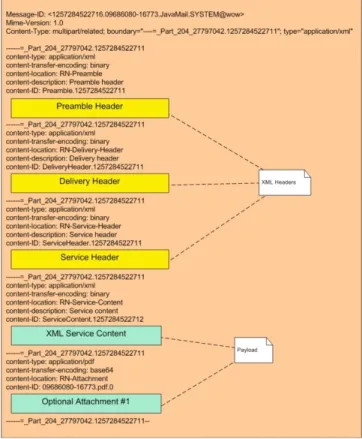
Figures 4 and 5 show the MIME components of a PIDX message. The payload includes the service content, and in the case of action messages, zero or more attachments. The payload of a signal message consists only of the service content. The service content is always a PIDX-compliant XML document. The headers and payload are packaged together using a MIME multipart/related construct. Trading partners may optionally agree to digitally sign the PIDX message.
The PIDX standards use XML schemas to define message service content. The standards use RosettaNet DTDs to define XML header parts.
Introduction to PIDX XML Transaction Standards, version 1.0 Figure 5: PIDX action message MIME components
4.2.1 Preamble
The preamble header identifies the standard and version with which a PIDX message must comply. PIDX standards require that PIDX XML messages comply with RosettaNet version 2.0.
4.2.2 Delivery Header
The delivery header identifies the sending and receiving trading partners, and the message instance information. This information is placed separately from the service header to allow access to the information by an intermediary when the service header is encrypted.
4.2.3 Service Header
The service header identifies the PIP, the PIP instance, the activity, and the action to which this message belongs. It provides the process context for a message.
4.2.4 Payload
The payload of a PIDX message includes the service content, and zero or more attachments. Only action messages can contain attachments.
Introduction to PIDX XML Transaction Standards, version 1.0
The payload is the content the service header describes and identifies. The Service Header format is fixed and independent of payload. The service content part of the payload depends on the PIP type and
instance in action messages, and the processing status in a signal message. Any action message attachments depend on data requirements agreed to by the trading partners.
5 PIDX Partner Interface Processes
A partner interface process (PIP) integrates the business processes of a buyer and a seller by exchanging messages containing common business documents. A PIP instance is a specific, unique PIP, such as sending a specific invoice for services. A PIP specification is a document describing the trading partner roles in the PIP, the activities each role performs, and the PIP message choreography. The PIP
specification also defines the time, security, authentication, and performance constraints of the process activities. The PIP specification identifies the XML schemas that control the structure and content of the business documents exchanged.
5.1 PIP Model
PIPs follow a specific choreography of action and signal message exchange. A PIP instance begins when a trading partner sends the first action message defined in a PIP specification and ends when all actions specified in the activity complete, or when one of the activities fails. RosettaNet describes the PIP model in three PIP views:
• The business operational view (BOV) • The functional service view (FSV)
• The implementation framework view (IFV)
The business operational view (BOV) and the functional service view (FSV) are based on ISO/IEC 14662:2004, the "Information Technologies Open-edi reference model." The RosettaNet specifications extended ISO/IEC 14662:2004 to include the implementation framework view (IFV), which describes TRP rules and constraints. The PIDX standards use the BOV and the FSV to describe PIPs, as defined in ISO/IEC 14662:2004. The information contained in RosettaNet’s implementation framework view is contained in the BOV, FSV, and the trading partner implementation guides.
5.1.1 Business Operational View
The business operational view (BOV) addresses the business processes and requirements trading partners use to execute a business transaction. These processes and requirements are specified in PIDX standards, trading partner implementation guides, government regulations (Sarbanes-Oxley, SEC regulations, etc.), and the business strategies, goals and policies of the trading partners implementing a PIP.
The BOV defines the roles the trading partners play in the business transaction, and the
activities each can perform. In the invoice PIP, the roles are "buyer" and "seller." Each role limits the activities trading partners can perform. The use case diagram in figure 6 illustrates the roles and the activities a buyer and a seller can execute when executing the Send Invoice PIP.
Introduction to PIDX XML Transaction Standards, version 1.0
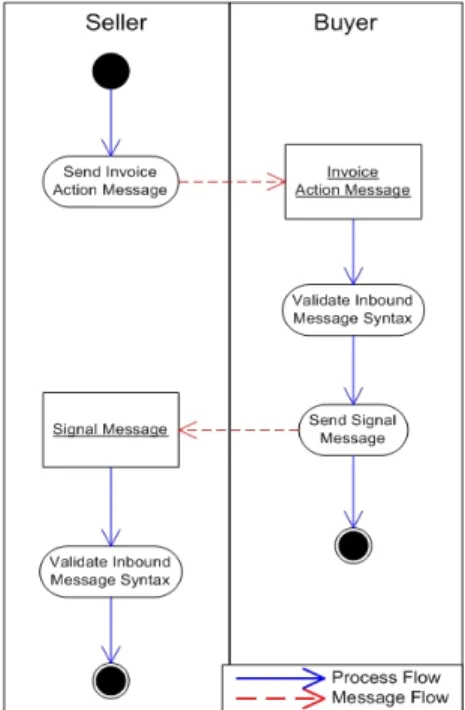
The use case shows that the seller role activities are limited to sending an invoice and validating the associated business signal sent by the buyer. The buyer role can validate the inbound action message and send a business signal acknowledging the seller’s invoice.
The use case in figure 6 describes what activities each role can execute in the PIP. The BOV also
describes how each role will execute the activities: the processes each role executes to satisfy the use case requirements. The activity diagram in figure 7 shows how each role executes the PIP activities
.
5.1.2 Functional Service View
The functional service view (FSV) is a technical view of the business transaction; it describes how business transactions defined in the business operational view (BOV) are executed by the trading partners’ information systems. The FSV describes the networks, endpoints, methods, and systems that will request and provide the business services described in the BOV. The FSV is governed by standards, specifications, and protocols including networking protocols (TCP/IP), communication protocols
(HTTP/S), encryption standards (SSL), and others.
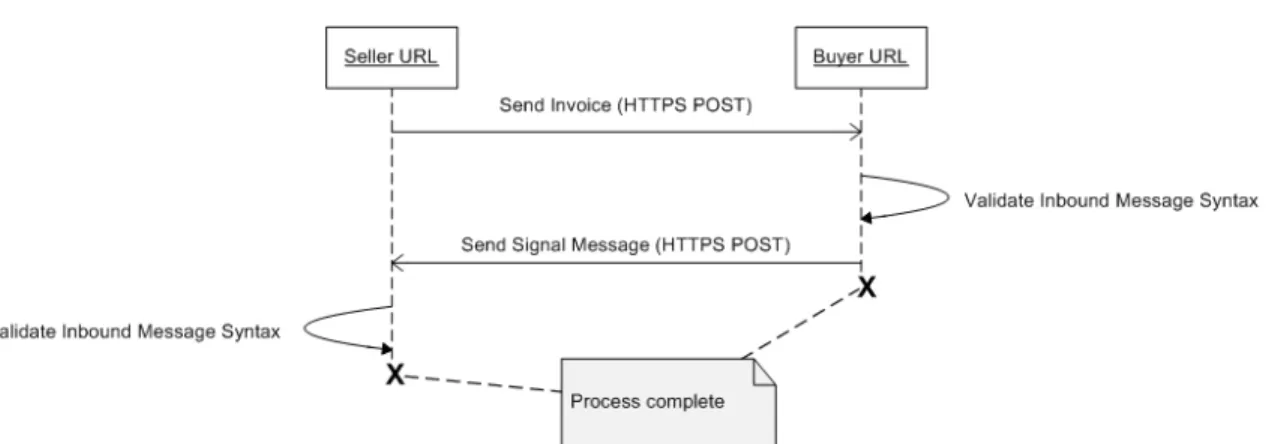
The FSV defines the public interfaces each trading partner exposes to accomplish the integration goals defined in the business operational view (BOV). The BOV and the FSV are interdependent; the BOV depends on the FSV to implement the specifications and standards described in the BOV. The sequence diagram in figure 8 shows the message choreography, communications protocol, encryption standard, and the trading partner interfaces (URL) exposed in processes to implement the requirements shown in the Send Invoice PIP in figure 6.
Figure 7: Send Invoice PIP activity diagram
Introduction to PIDX XML Transaction Standards, version 1.0
Figure 8: Send Invoice PIP functional service view sequence diagram
The FSV also defines the message exchange controls for each of the actions and signals involved in the dialog. For actions, this includes specifying the time within which an Acknowledgment of Receipt signal should be sent; the time within which a response to the action should be sent (if applicable); whether authorization is required to perform the action; and whether a secure transport should be used to transmit the action to the recipient. Refer to the PIP specification for complete details of the FSV part of that PIP specification.
5.2 Defining a Partner Interface Process
Before a buyer and a seller can execute a partner interface process (PIP) instance, they must describe the PIP sufficiently so that the two trading partners can configure applications to conform to each trading partner’s business rules. The description of the PIP to be executed is described in two primary documents:
1. A PIP specification
2. Trading partner implementation guidelines
5.2.1 PIP Specifications
A PIP specification describes a set of well-defined public processes trading partners use to execute a PIDX PIP instance. PIP specifications define the roles each trading partner plays in the process, the activities involved, and the type, content, and sequence of business messages exchanged by the trading partners while engaged in these activities. PIP specifications describe the business requirements and processes in the Business Operational View (BOV) section, and the technical processes and requirements necessary to implement the business processes and requirements in the Functional Service View (FSV) section.
The current version of the PIDX XML Transaction Standards do not contain PIP specifications. However, PIDX has developed PIP specifications for the next version of the standards. Those PIP specifications are backwards-compatible and could be used to describe the PIP implemented by the trading partners. PIP specifications can be found on the PIDX web site (www.pidx.org).
Introduction to PIDX XML Transaction Standards, version 1.0
5.2.2 Trading Partner Implementation Guidelines
Trading partner guidelines describe the payload data requirements necessary to process the sending trading partner’s message. Payload data requirements include the allowed values of information items in the XML document specified by the PIP specification, and any required attachments.
PIDX defines specific schemas that contain mostly optional information items that can be included in the service content of a business action message. There are multiple versions of each PIDX PIP schema. The trading partners executing the PIP must agree on the version, and which of the optional data are required. The PIP schema and version are usually specified by the trading partner receiving the business action message in that role’s implementation guide.
6 PIDX and RosettaNet Differences
There are some differences between the RosettaNet and PIDX standards. While the differences are small, some can cause compatibility issues with commercial off the shelf (COTS) software.
6.1 XML Schemas vs. DTDs
The RosettaNet standards use document type definitions (DTDs) to define and validate message headers and service content. The PIDX standard uses XML schemas to define and validate XML service content. 6.2 PIDX Partner Interface Processes (PIPs)
The needs of the oil and gas industry are sufficiently different from the electronics and related industries that RosettaNet PIPs could not be used to meet oil and gas company requirements. Accordingly, the Complex Products and Services Task Group (Com.Pro.Serv) developed PIDX PIPs specifically to meet the needs of the oil and gas industry.
The PIDX PIPs are documented in various schemas, the Standard Master, and in the Implementation Guidelines. Unlike the RosettaNet PIPs, the current transaction standards do not have separate PIP specifications for each PIP. Trading partners and third party technology providers facilitating implementations need to provide their own PIP guidelines for their internal needs.
6.3 Two-action PIPs
A trading partner may define a complete process that includes more than one business message. For example, a supplier may configure internal systems to send an invoice action message to a customer, and expect an invoice response action message from the customer. If the customer does not send an invoice response action message, the supplier’s system will throw an exception that could cause manual
intervention.
RosettaNet allows multiple PIPs to be combined into a single PIP, such as the invoice/invoice response. However, the PIDX standards explicitly allow only single-action PIPs. While a trading partner can still define a process as including two messages, i.e. invoice/invoice response, a customer whose system sends
Introduction to PIDX XML Transaction Standards, version 1.0
an invoice response to a supplier, and includes a reference to the original invoice in the invoice response service header, is not sending a PIDX-compliant message.
6.4 PIDX Dictionaries
The RosettaNet standards provide a dictionary framework to define the information items that can be used in a RosettaNet message. The framework includes technical and business data dictionaries, and message guidelines that provide necessary clarification and governance to the data defined in RosettaNet DTDs. The PIDX dictionary framework consists of the following:
o PIDX XML Petroleum Industry Data Dictionary (PIDD) o Preamble Message Guideline
o Delivery Header Message Guideline o Service Content Message Guideline
PIDX uses schemas to define the content of action message service content, so message guidelines are not necessary. The PIDX service content information items are defined in the PIDX implementation
guideline (IG) and their usage is constrained in individual message schemas, and the PIDX library schema.
6.5 Authorization
RosettaNet states the authorization requirement should be specified in the PIP specification, and that trading partners must agree to authorization requirements in advance of executing a PIP. If the PIP and trading partners require authorization, RosettaNet requires that each message exchanged must be digitally signed.
The PIDX standards state that trading partners must agree prior to initiating a messaging process that an initiating partner has the rights to send a specific business message and a receiving partner has the rights to act on that message. The standards do not require the sending trading partner to digitally sign the message.
6.6 Authentication
The RosettaNet PIP specifications specify the authentication requirement of the PIP messages. If a PIP specification requires the message to be authenticated, then the message is authenticated by requiring the sender of the message to digitally sign the message. In RNIF 2.0, a RosettaNet Business Message is digitally signed following the S/MIME IETF (RFC 2311) specification.
The PIDX standards require authentication, but the standards do not require the sender to digitally sign the message: “PIDX requires used of an independently managed or independently verifiable means of message authentication for the exchange of business transaction for complex products and services.” (PIDX XML Standards Master 2002-02-14 V.10, section 4.4.2 Authentication)
Introduction to PIDX XML Transaction Standards, version 1.0
The PIDX standards allow digitally signed messages to authenticate trading partners. However, the majority of the companies in the oil and gas industry use Secure Socket Layer (SSL) protocol and firewall rulesets to verify who is sending and receiving PIDX messages.
6.7 Non-repudiation
The RosettaNet Standards are straightforward on how and when to implement non-repudiation: The requirement is determined in each PIP specification. The PIDX standards are less clear, and different documents in the standard may conflict with others:
• The standards require “reliable messaging” and state that non-repudiation is a part of reliable messaging
• The standards require implementing systems to support non-repudiation methodologies such as digital signatures
• The standards recommend digital signatures, but they do not require them • The standards do not address the inclusion of digests in business signals
6.7.1 Non-repudiation of Origin and Content
If a PIP requires non-repudiation, RosettaNet requires the trading partners executing the PIP must provide non-repudiation of origin and content as follows:
1. The message sender digitally signs the message
2. The message receiver stores the received signed message for a time agreed to by both trading partners
PIDX requires message receivers to store messages for period agreed to by trading partners. PIDX recommends the use of digitally signatures, but does not require their use.
6.7.2 Non-repudiation of Receipt
If a PIP requires non-repudiation, RosettaNet requires trading partners to provide non-repudiation of receipt as follows:
1. The receiver of the action message digitally signs the associated business signal message 2. The business signal must include an MD5 or SHA-1 digest of the action message
3. The receiver must store the action message for an agreed-upon period
PIDX requires receivers to store messages for an agreed-upon period. The standards recommend the use of digital signatures, but they do not require their use. The PIDX Standards Master does not address the use of MD5 or SHA-1 digests in business signals, but the PIDX Implementation Guidelines includes, “Define use of the message digest" as a decision that needs to be made in implementing a PIP.
7 Strengths of the PIDX XML Transaction Standards
The PIDX Com.Pro.Serv (Complex Products and Services) Task Group chose to model the PIDX XML standards on the RosettaNet standards because the RosettaNet standards provide a robust and reliable messaging architecture for the exchange of XML documents. PIDX goals for the new XML standard include end-to-end security and integrity of both the messaging process and the transactional data. The Com.Pro.Serv. Task Group identified the following messaging requirements:
Introduction to PIDX XML Transaction Standards, version 1.0 • Message Identification
• Message Authentication • Message Authorization • Non-repudiation • Data Confidentiality • Data Integrity • Reliable Messaging • Exception Handling • Global adoption and support
7.1 Message Identification
Message identification requires sufficient information to allow the receiver to identify the transmission and packaging format to begin processing the message. Message identification is essential to a secure end-to-end transmission. This information includes details that tell the receiver the envelope format of the message. Once the receiving application begins to process the message, further descriptive details are needed. The business function that the message fulfills, as well as the routing information should be included in the message identification. Routing information must be detailed enough to permit proper transmission through one or multiple intermediate points such as third party technology provider hubs without the hub needing to open the message and without the routing data exposing confidential information regarding the destination, origin, or content of the message.
7.2 Message Authentication
Message authentication means verifying the sender of a message is who they claim to be. Trading partners need to have assurance that they are sharing information only with trading partners whose identities have been verified. Combined with authorization, authentication is a vital part of secure electronic message exchange. Authentication requires trading partners to agree to mutual validation of their electronic transmissions, usually by an independent third party.
7.3 Message Authorization
Authorization is the act of making sure that the sender of a message is permitted or authorized to send the subject message to the receiving partner.
Both RosettaNet and PIDX describe authorization as a two-step process:
1. Ensure that the sending partner (as identified in the Delivery and Service Headers) is authorized to send the subject message
2. Ensure that the sending partner’s organization, as identified by the digital signature on the message, is authorized to send the subject message
Introduction to PIDX XML Transaction Standards, version 1.0 7.4 Non-repudiation
Non-repudiation means that the trading partner sending a message cannot deny having sent the message (called “non-repudiation of origin and content”) and that a trading partner receiving a message cannot deny having received it (called “non-repudiation of receipt”).
7.5 Data Confidentiality
Confidentiality means protecting data from view or use by parties other than the trading partners or their agents involved in the transaction. While the PIDX standards provide for security at the application (message) layer, most trading partners rely on encryption provided by SSL technology during the message transport layer to provide data confidentiality.
PIDX considered several factors in assessing encryption standards to ensure that data remain confidential. First is the time sensitivity of the data. Data must be protected throughout the period of business validity. The second factor is the media the data use as a transmission conduit. Data transmitted using the Internet require encryption to achieve the same level of confidentiality as data transmitted via a private or virtual private connection. The final factor PIDX considered is the cost of each encryption level. Cost is measured in processing time and system resources and/or in dollar cost for encryption technology. 7.6 Data Integrity
Data integrity provides a message recipient the ability to verify that a message is complete and accurate. Accurate does not mean that data has the correct meaning for the business context of the data exchanged. It means only that the message received is equal to the message sent. Data integrity guards against changes made to the data either intentionally or unintentionally via corruption during transmission. 7.7 Reliable Messaging
PIDX requires reliable messaging. Reliable messaging is the ability of a receiver to receive a message once and only once. Reliable messaging is based on the public process defined by the specific PIDX partner interface process (PIP). The PIP defines the number of transmission retries for resending messages.
Reliable messaging also addresses the need for persistent storage complementing the application logic that maintains reliable messaging, and as a means of supporting non-repudiation. Knowledge of what messages have been both sent and received on both sides of communication is required for guaranteed reliable messages. Requirements for the medium of storage should not be prescriptive and can be determined at the time of implementation of the message exchange, but should support long term, persistent storage.
7.8 Exception Handling
Reliable messaging requires failed messages to be handled in accordance with the PIDX standards. How an exception is handled depends on which trading partner reports the exception, and on where the
message failed processing. The appropriate handling may be to resend the action message, send a receipt exception signal to the sender of an action message, or to do nothing. For example, if a message fails
Introduction to PIDX XML Transaction Standards, version 1.0
processing in a receiver’s system before the system can determine which trading partner sent the message, PIDX standards require the receiving system to stop processing the failed message.
7.9 Global Adoption and Support
The PIDX XML Transaction Standards are being used by over 200 organizations in the oil and gas industry. Representatives from these companies actively participate in PIDX projects to improve the standards, making them more accessible, flexible, and easier and less expensive to adopt and implement. Current and recent member-lead projects include:
• Creating version 2.0 of the PIDX XML Transaction standards • Creating implementation guidelines for implementing projects • Creating PIP guidelines for each PIDX business document • Creating training classes
• Updating XML schemas to meet the requirements of a diverse, global user community PIDX provides a global forum for delivering the process, information and technology standards that facilitate seamless, efficient electronic business within the oil and natural gas industry and its trading community. The organization emphasizes:
• A focus on business-oriented objectives
• A focus on continuous improvement of the standards
• Enlisting qualified people from member companies to lead and work on projects • Acting as a global standards body
• Broadly and frequently communicating with the oil and gas industry • Leveraging the work of others
• Recruiting and maintaining a diverse, global membership • Making standards available on an open and royalty free basis
8 Business Advantages
Using the PIDX standards to exchange business documents offers business advantages over exchanging paper documents:
• Lower processing costs • Lower bad debt expenses
• Lower Days Sales Outstanding (DSO) • Improved visibility
8.1 Lower Processing Costs
The cost to process a paper business document in North America is USD $37.45 versus $23.83 for electronic requisition (Aberdeen Group Study). Processing a paper invoice from a vendor, for example, requires the following activities:
• Receiving the envelope containing the invoice • Opening the envelope
• Determining that the contents is an invoice
• Determining that the invoice is from an approved vendor • Validating the line item pricing
Introduction to PIDX XML Transaction Standards, version 1.0
• Validating the work invoiced against the service company’s field ticket • Entering the invoice line items into an ERP system
• Manage exceptions in the invoice • Notifying the client of processing status The seller’s processes are complex, as well:
• Enter field work in field ticket system • Adjust field ticket to invoice
• Generate invoice • Envelope invoice • Send invoice to operator
• Wait for approval status or payment • Process exceptions
These activities can involve more than one person, and the entire process can take several days to complete. Each handoff in this workflow can result in errors that require rework.
The same activities must be executed in electronic invoice processing. However, in a fully automated invoice processing system, all of the activities are automated, and can be executed almost instantly. 8.2 Lower Bad Debt Expenses
Manually processing invoices to buyers is a complex process that can involve several people on both the seller’s side and the operator’s side. Each time there is a handoff in the workflow, delays and exceptions can occur:
• The invoice data can be lost in both the supplier’s and operator’s system • Multiple data entry can be erroneous
• Supplier exceptions discovered in operator’s systems are not reported timely, or not at all • Manual entry queues in operator’s system can be long
• Invoices containing errors must be reentered and the process restarted
Each of these events delay invoice payments. The delay can be more than 90 days past the invoice terms. The longer an invoice remains unpaid, the higher the probability that it will not be paid in full, or at all. The probability of unpaid invoices is reflected in financial statements as bad debt expense.
Automating the invoice process in the seller’s and buyer’s system reduces or eliminates the chance of errors or data loss, and reduces invoice processing time.
8.3 Improve Days Sales Outstanding (DSO)
Days Sales Outstanding is a financial ratio used to estimate how long it takes customers to pay their invoices. DSO measures the relationship between uncollected accounts receivable and credit sales during a period, typically a month. A high DSO ratio indicates that a company may have problems managing collection of credit sales. A very low DSO ratio may indicate that a company’s credit granting policies are too strict, and the company may be losing sales. Acceptable DSO ratios vary by company.
Introduction to PIDX XML Transaction Standards, version 1.0 DSO is calculated as:
Outstanding Accounts Receivable Balance / Average Sales per day
For example, assume a company has an outstanding accounts receivable balance on December 31 of $1,400,000, and that credit sales to its customers for the year is $10,000,000. The company’s DSO would be approximately 51 days:
1,400,000 / (10,000,000 / 365) = 51
If the company’s credit invoice payment terms are 30 days, then on average, its customers are paying their invoices 21 days late. This might indicate that the company is having problems converting accounts receivable into cash. It also indicates that the company might have a higher than acceptable bad debt expense.
Because of the inefficiencies of processing paper invoices that are eliminated in electronic invoicing systems, converting to electronic invoicing from paper invoicing can reduce DSO significantly. Oilfield service companies using the PIDX XML Transaction Standards report a decrease in DSO of 5 – 15 days after converting from manual invoicing systems. Using data from the previous example, this would represent a conversion of accounts receivable to cash of $140,000 to $414,000. Additionally, the
decrease in DSO would result in an increase in quality of the company’s accounts receivable which would result in lower bad debt expense estimations.
8.4 Improved Visibility
Manual purchase-to-pay processing systems can obscure data companies rely on to control their spending. Purchase orders contain information about what a supplier is authorized to do, how much the supplier can bill, and where the work will be done. Field tickets provide information on specific work done against a purchase or service order, and invoices detail the expense estimated in the field ticket and charged against the purchase or service order.
Collecting this information from a manual purchase-to-pay system can be difficult and labor intensive, and suffers from similar inefficiencies as those in generating and processing paper purchase orders, field tickets, invoices, and other business documents: Excessive time required to capture the information, errors in entering the information from the documents manually, lost documents due to the number of handoffs between personnel. As with processing business documents electronically, getting business data from the documents is more efficient.
8.5 Business Analysis
Because of better data visibility from implementing the PIDX standards, companies can more easily and better analyze what they are spending their money on: What they buy, from whom, and for how much enables buyers to better manage their supply chain strategies to get more value for the money they spend. This type of spend analysis enables companies to better manage supplier diversity, other supply chain risks, as well as identify more opportunities to reduce costs, and develop more effective sourcing strategies.
Introduction to PIDX XML Transaction Standards, version 1.0
9 Barriers to Adoption and Implementation and Solutions
The PIDX XML Transaction Standards are robust, stable, flexible, and well-supported by a global organization and an active user community. Hundreds of companies in oil and gas and other industries exchange millions of business documents globally every year. To get to this point, companies had to overcome issues with the standards:
• High adoption and implementation costs • Competing standards and technologies
9.1 High Adoption and Implementation Costs
One of the primary goals of PIDX is to make the standards affordable and available to small and medium-sized businesses. While the cost of adopting and implementing the standards has been reduced, they are still expensive to adopt and to implement. The costs to adopt include:
• The cost of PIDX-compliant middleware
• Technical expertise required to configure and implement the PIPs • Integrating the middleware with internal ERP systems
• Developing new PIPs
Adoption and implementation costs have decreased since the standards were published in 2002 to a level at which medium sized businesses can expect to realize the efficiencies and cost savings promised by the standards. However, more costs can still be driven out, making the standards practical for smaller companies to implement.
Currently, the PIDX standards are not completely compliant with the RosettaNet Standards configured in most commercial off the shelf (COTS) software. Accordingly, companies adopting the PIDX standards must make their RosettaNet-compliant applications PIDX-compliant. This may be as easy as
reconfiguring the RosettaNet-compliant application, or it may be that software must be modified or manual processes implemented to change the RosettaNet-compliant message to a PIDX-compliant message.
PIDX is currently working on a solution to this problem by removing all requirements from the standards that are not compliant with the RosettaNet standards.
Companies that cannot justify technical resources to maintain and operate PIDX-compliant systems can outsource outbound and inbound processing to 3rd party technology providers. Technology providers can provide cost-effective solutions to export data for outbound messages such as invoices, as well as
solutions to import message data received from a trading partner. 9.2 Competing standards and technologies
Companies have avoided adopting RosettaNet standards for reasons other than the high cost of adoption and implementation. There are other competing integration standards with their own strengths and advocates competing with the RosettaNet standards. EDI standards are still widely used. Other XML B2B integration standards are available including Business Message (BMS) standards from GS1.