Traceability System for Agricultural
Products Distribution Based on RFID
Technology
Koji Sugahara a, Kazunori Sato b, and Yoshinobu Kono c
a National Agricultural Reserch Center, Tsukuba, 305-8666 Japan, [email protected] b National Agricultural Reserch Center, Tsukuba, 305-8666 Japan, [email protected] c National Agricultural Reserch Center, Tsukuba, 305-8666 Japan, [email protected]
Abstract
Traceability System for Agricultural Products Distribution based on RFID (Radio Frequency Identification) technology was developed. A basic scheme of traceability systems is that a unique ID is assigned to each identification unit (lot) of the products and an ID label or tag is attached to it. On the premise of RFID application, a simple and versatile database to input and refer unified distribution process records was designed. The key concept is that a temporal identification unit is an “event” which is recorded at each point of the distribution process. Data of an event record consist of an event ID, a point ID, event time, and involved lot IDs. Basic types of events are “movements” of lots such as incoming or outgoing and “transforms” of lots such as combination, division, processing, or packaging. By cross-referring the event IDs and the lot IDs on the database, it is possible to trace forward and back the individual products on the distribution process. Based on this database, an on-site data recording system was developed by applying RFID tags which contain unique IDs, handy RFID readers which enable wireless LAN, and an Internet-accessible database server. On the events of the distribution process, the users read the RFID tags attached to the individual lots by using the RFID readers, and these records are sent to the database server via the Internet. The users can retrieve and refer the whole distribution process records in the database. In 2003 to 2005, field experiments were conducted to this system in the actual food chains of fruit and vegetable products in Yamagata, Shizuoka, Saitama, and Gunma Prefectures.
Key words: traceability system, distribution process, RFID, event, lot
1 Introduction
In these years, Japanese people have become increasingly concerned about food safety problems such as the issues on BSE (bovine spongiform encephalopathy), pesticide residue and misapplication. It is required to establish food traceability and to disclose information about food production and distribution processes, as a way to guarantee food safety and reliability. Therefore, the Japanese government, local governments, and JA (Japan Agricultural Cooperatives) have been promoting development and practical application of food traceability systems (FTS) as the national projects since 2001.
Several FTS based on information technology (IT) have been developed. On “Virtually Identified Produce System (VIPS)” (http://www.vips.gr.jp/) as the basic scheme of FTS, an identification number (ID) is assigned to an identification unit (lot) of food products and it is printed on the products’ labels or packages (Sugiyama, 2001). The farmers input the production data about their products and send this data to the Internet-accessible database server. The consumers who purchase these products can browse the products’ data by accessing the web site of VIPS and entering the products’ IDs. Based on VIPS, a practical information disclosure system for fruit and vegetable products, “SEICA” (http://seica.info/) was developed and open to the public in 2002 (Sugiyama, 2004).
Meanwhile, RFID (Radio Frequency Identification) as noncontact automatic identification technology has recently shown promise for more advanced and effective FTS. RFID is innovative technology to identify individual products on the distribution processes efficiently and quickly.
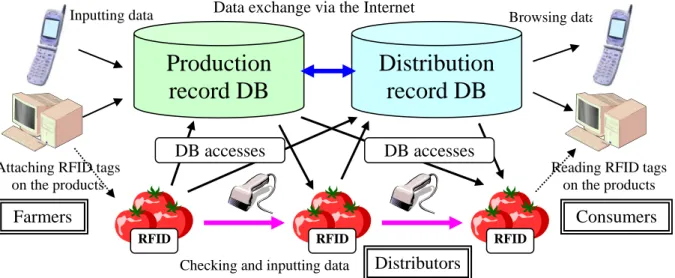
In the research project on FTS since 2003, we have been developing an integrated traceability system for agricultural products in the food chain such as production, distribution, sale, and consumption, based on network computing, mobile phones, and RFID (Fig. 1) (Sugahara, 2005). This system consists of three subsystems; a production record system using Internet-enabled mobile phones, a distribution record system using RFID, and an information disclosure system for consumers on WWW (World Wide Web).
We developed Traceability System for Agricultural Products Distribution based on RFID technology in this research project. And we conducted field experiments to test this system in actual food chains of fruit and vegetable products in 2003 to 2005.
2 System design
2.1 Database of distribution process records
For the purpose to develop a traceability system to apply RFID effectively, we designed a simple and versatile database to input and refer unified distribution process records. A method to identify and trace the distributed products is that an ID is assigned to each lot of products. Additionally, the key concept of this database is that a temporal identification unit is an “event” which is recorded at each point of the distribution process (food chain), such as incoming, outgoing, combination, and division. Data of an event record consist of an event ID assigned to each event, a point ID, event time, and involved lot IDs. The structure of the database is as shown in Fig. 2. It contains three main tables; Event Information Table, Lot Information Table, and Event/Lot Relation Table. Basic types of events are “movement” of lots such as incoming or outgoing, and “transforms” of lots such as combining, dividing, processing, or packaging. Especially when recording a transform event at which forms and IDs of the lots are changed, the involved lot IDs before and after (B/A) the event and B/A flags are inputted with the event ID to Event/Lot Relation Table of the database. By cross-referring the event IDs and the lot IDs on the database, it is possible to trace forward and back the individual products on the distribution process (Fig. 3), even if there are any number of events, especially transforms of any lots on the distribution process.
Fig. 1 Concept of the integrated traceability system for agricultural products to record and store data on the production and distribution processes, based on RFID and network technology
Production
record DB
Distribution
record DB
RFID RFID RFID
Farmers
Attaching RFID tagson the products Inputting data
Checking and inputting data
Browsing data
DB accesses
DB accesses
Consumers
Distributors
Data exchange via the Internet
Reading RFID tags on the products
2.2 Data recording system based on RFID
The basic scheme of food traceability system is that unique IDs are assigned to individual lots of the products and ID labels or tags attached to them. In order to identify the lots and record data of the “events” at each point of the distribution process efficiently and quickly, we developed an on-site data recording system based on RFID technology (Fig. 4, 5, 6). Specifically, RFID tags which contain unique IDs to
Fig. 2 Structure of the database of distribution process records
By cross-referring Event/Lot Relation Table, Event Information Table, and Lot Information Table, it is possible to trace forward and back the products on the distribution process.
Event Information Table Event Type Master Table
item name content item name content
event ID ID numbers of the events event type code
company code Refer to the company master event type name movement, transform, etc. event type code Refer to the event type master
event time record time of events
point ID Refer to the point master Point Master Table device ID ID of recording devices item name content
point ID ID numbers of record points company code Refer to the campany master Event/Lot Relation Table point name
item name content
event ID Refer to the event information Company Master Table lot ID Refer to the lot information item name content
B/A flag Before or After the event company code Unique numbers of companies company name
Lot Information Table
item name content Lot Form Master Table lot ID ID numbers of the lots item name content lot form code Refer to lot form master lot form code
creation time lot form name bag, box, container, palet, etc. deletion time
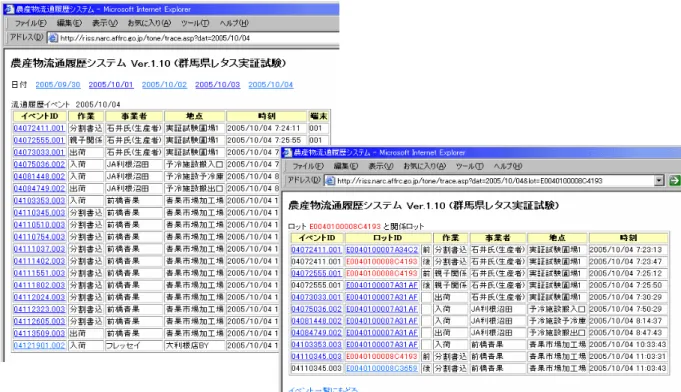
Fig. 3 Displays of a web application to refer the distribution process records in the database server
Left: A list of the events on the distribution process.
Right: A list of the events and the lots which are related to one of the lots. These data are recorded in the field experiment on lettuces in Gunma.
identify individual lots and handy RFID reading devices (readers) to input the lot IDs were applied. And an Internet-accessible database server was built. It stores the data which are sent from the RFID readers and it enables to retrieve and refer the distribution process records on WWW (Fig. 3).
The procedures to use this system are as follows:
1. When shipping the products at the first point of the distribution process, the users (mainly farmers) attach the RFID tags (lot tags) to the individual lots such as bags, boxes, containers, or pallets. They read the IDs of the lot tags by the RFID readers and record the data of the “outgoing” event. And they send these data form the RFID readers to the database server by FTP.
2. At each point of the distribution process such as a wholesale market, a delivery center, and a retail store, the users (mainly distributors and retailers) record the data of the “movement” or “transform” events by reading the lot tags.
3. When recording the transform events, the users record the lot IDs before and after the event such as combining or dividing, by reading both of the lot tags before and after the event.
4. The users can refer these whole distribution process records on the individual products via the Internet, by accessing the database server and retrieving the lot IDs on WWW.
2.3 Information disclosure system
It is required to disclose proper information about agricultural products to consumers. We developed an information disclosure system based on VIPS, and additionally applied “QR code” system (Denso Wave Inc.) which is a kind of two-dimensional (2D) barcode. In Japan, camera-equipped and internet-enabled mobile phones are recently very popular, and they have a barcode-reading function. Specifically, we built an application to create and print QR codes by reading RFID tags (lot tags) attached to the products. These QR codes contain the URLs to refer the lot IDs and to browse information on WWW by accessing the database server. And the labels which the QR codes are printed on are pasted the individual products for sale in the retail stores (Fig. 7). Therefore, the consumers who purchase these products with the QR codes can immediately browse and check the products’ information such as production and distribution data, by reading the QR codes using their own mobile phones.
3 Field experiments
We conducted field experiments of this traceability system on the distribution processes of fruit and vegetable products in 2003 to 2005. In these experiments, “mu-chip” (Hitachi, Ltd.), microwave-type RFID tags (2.45GHz), and “ACCUWAVE” (Dai Nippon Printing Co., Ltd.), electromagnetic-type RFID tags (13.56MHz) were applied. The two field experiments in 2005 are outlined below.
3.1 Satsuma oranges in Shizuoka
In February 2005, the field experiment using fruit products of satsuma oranges (unshu-mikan) was carried out, in cooperation with farmers, JA, a cooperative association (co-op) group, and Shizuoka prefectural government. In this experiment, we applied “ACCUWAVE” which contain unique IDs (Fig. 4) and handy-terminal-type RFID readers which enable wireless LAN (RCT-200-01: Welcat Inc.). The fruit products were delivered from the farms and the JA in Shizuoka Prefecture, to the delivery center and the co-op stores in Saitama Prefecture. The fruit products which the farmers had harvested in their orchards were shipped to the fruit sorting center of JA. They were packed in cardboard boxes and sticker-type RFID tags (box tags) were pasted on the individual boxes (Fig. 5). When shipping them form there, the outgoing event was recorded by reading these box tags using the RFID readers. When arriving at the delivery center, the incoming event was recorded. There, the boxes are opened and the products were divided into small plastic bags. These bags are put into container cases which RFID tags (case tags) were attached to, and then the transform event was recorded by reading both of the box tags and the case tags. When shipping them to the co-op stores, the outgoing events were recorded. When arriving at each of these stores, the incoming event was recorded.
3.2 Lettuces in Gunma
In October 2005, the field experiment for lettuce products was carried out, in cooperation with farmers, JA, a wholesale market, a supermarket, and Gunma prefectural government in Gunma Prefecture. In this experiment, we applied plastic-card-type RFID tags (ACCUWAVE) and the same RFID readers as in the experiment of satsuma oranges. The lettuce products which the farmers had harvested in their fields were put into container cases which RFID tags (case tags) were attached to. They were distributed from the fields to the vegetable cooling plant of JA, the wholesale market, and the supermarket. At these points, the movement events were recorded by reading the case tags (Fig. 6). In the wholesale market, each of the lettuce products was wrapped in a plastic film, and then the transform event was recorded. Additionally, the labels which QR codes printed on were pasted on the individual lettuce products (Fig. 7). These QR codes were created by coding the IDs of the case tags. Therefore, the consumers who purchased the products in the supermarket could the product information such as the production and distribution process records.
Fig. 4 RFID tag “ACCUWAVE” Electromagnetic type (13.56MHz). Provided by Dai Nippon Printing Co., Ltd.
Fig. 5 Reading the RFID tags pasted to the cardboard boxes by using a handy RFID reader.
In the field experiment on satsuma oranges in Shizuoka.
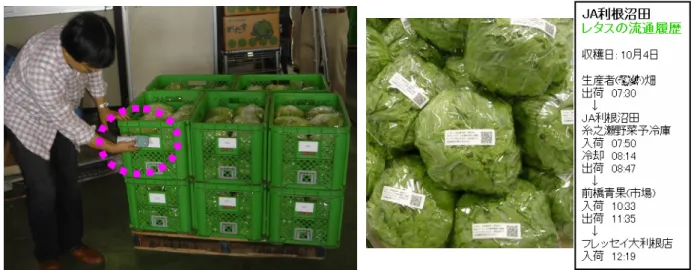
Fig. 6 Reading the RFID tags attached to the container cases by using a handy RFID reader. In the field experiment on lettuces in Gunma.
Fig. 7 Products for sale which are pasted the labels printed QR codes (left) and a display of the distribution records on a mobile phone (right). In the field experiment on lettuces in Gunma.
4 Discussion
About Traceability System for Agricultural Products Distribution, the major problems are cost to utilize RFID tags and devices, and workability of RFID handling such as tagging and reading. To solve these problems, it is required to research how to reuse RFID tags and how to automate RFID handling. However, RFID are expected to be lower in cost and more popular in the near future.
The field experiments of this system showed that it is easy and quickly to input the distribution process records by applying RFID. And cross-referring the event IDs and lot IDs in the database enables to trace forward and back the individual products on the distribution process. Therefore, it is possible to apply this system in any cases of product distribution.
In other hand, information systems to support agricultural production management based on IT such as AFAMA (Sugahara and Omatsu, 2004) and Nouyaku-navi (Nanseki et al., 2005) have already been utilized in many agricultural sites in Japan. If these systems assign lot IDs to individual products or planting fields and they provide these IDs via the Internet, the traceability system which we developed can easily collaborate with them.
We are developing an integrated traceability system, to trace the products on the both production and distribution processes and to provide accurate information on the products to consumers. And we are continuously planning to conduct field experiments of this system on various items of agricultural products, in cooperation with farmers, wholesale markets, distributors, retailers, and consumers around Japan. Based on results of these experiments, we will improve the system to reduce cost of RFID application and to improve workability of RFID handling.
5 References
Iketo, S., et al., 2003. Food traceability to establish security, Key for revitalization of food and agriculture, Science Forum Inc., Tokyo. (in Japanese)
Nanseki, T., et al., 2005. A navigation system for appropriate pesticide use: design and implementation, Agricultural Information Research, 14(3): 207-226. (in Japanese)
Sugahara, K., 2003. Disclosing information to consumers from organic and recycling farms. Japanese Journal of Farm Management, 40(4):13-20. (in Japanese)
Sugahara, K., 2005. Traceability system for agricultural products using RFID and mobile technology. Proceedings of International Seminar on Technology Development for Good Agricultural Practice in Asia and Oceania, pp. 204-212.
Sugahara, K. and S. Omatsu. 2004. Traceability system for agricultural products using RF-ID and mobile phones. Proceedings of AFITA/WCCA 2004, pp. 710-714.
Sugahara, K., et al., 2006. Effective distribution traceability system for agricultural products based on RFID technology. Proceedings of AFITA 2006, pp. 424-431.
Sugiyama, J., 2001. Virtually Identified Produce System (VIPS) using the Internet. Agriculture and Horticulture 76(8):845-854. (in Japanese)