B
ACKGROUND AND
T
ARGETS FOR
3G E
VOLUTION
Third-generation (3G) wireless systems, based on wideband code-division multiple access (WCDMA) radio access technology, are now being deployed on a broad scale all over the world. The first step in the evolution of WCDMA has also been taken by the Third Gen-eration Partnership Project (3GPP) through the introduction of high-speed downlink packet access (HSDPA) [1] and enhanced uplink [2]. These technologies provide 3GPP with a radio access technology that will be highly competitive in the mid-term future.
However, user and operator requirements and expectations are continuously evolving, and competing radio access technologies are emerg-ing. Thus, it is important for 3GPP to start con-sidering the next steps in 3G evolution, in order to ensure 3G competitiveness in a 10-year per-spective and beyond. As a consequence, 3GPP has launched the study item Evolved UTRA and UTRAN, the aim of which is to study means to achieve further substantial leaps in terms of ser-vice provisioning and cost reduction. The overall
target of this long-term evolution (LTE) of 3G, sometimes also referred to as Super-3G, is to arrive at an evolved radio access technology that can provide service performance on a par with or even exceeding that of current fixed line accesses, at substantially reduced cost compared to current radio access technologies. As it is gen-erally assumed that there will be a convergence toward the use of Internet Protocol (IP)-based protocols (i.e., all services in the future will be carried on top of IP), the focus of this evolution should be on enhancements for packet-based services. 3GPP aims to conclude on the evolved 3G radio access technology in 2007, with subse-quent initial deployment in the 2009–2010 time-frame. At this point, it is important to emphasize that this evolved radio access network (RAN) is an evolution of current 3G networks, building on already made investments.
Among others, the targets of long-term 3G evolution are [3]:
• The possibility to provide significantly high-er data rates than do the current steps of 3G evolution (HSDPA and enhanced uplink), with target peak data rates up to 100 Mb/s for the downlink and up to 50 Mb/s for the uplink.
• The capability to provide three to four times higher average throughput and two to three times higher cell-edge throughput (mea-sured at the 5th percentile) when compared to 3GPP Release 6 (Rel-6) systems (i.e., systems based on HSDPA and enhanced uplink).
• Improved spectrum efficiency, targeting an improvement on the order of a factor of 3 compared to current standards.
• Significantly reduced control and user plane latency, with a target of less than 10 ms user plane RAN round-trip time (RTT) and less than 100 ms channel setup delay • Reduced cost for operator and end user. • Spectrum flexibility, enabling deployment in
different spectrum allocations. This involves a smooth migration into other frequency bands, including those currently used for second-generation (2G) cellular technolo-gies such as GSM and IS-95.
T
OPICS IN
RADIO
COMMUNICATIONS
Hannes Ekström, Anders Furuskär, Jonas Karlsson, Michael Meyer, Stefan Parkvall,
Johan Torsner, and Mattias Wahlqvist, Ericsson
A
BSTRACT
Work has started in the 3GPP to define a long-term evolution for 3G, sometimes referred to as Super-3G, which will stretch the perfor-mance of 3G technology, thereby meeting user expectations in a 10-year perspective and beyond. The fundamental targets of this evolu-tion — to further reduce user and operator costs and to improve service provisioning — will be met through improved coverage and system capacity as well as increased data rates and reduced latency. This article presents promising technologies to fulfill these targets, including OFDM, multi-antenna solutions, evolved QoS and link layer concepts, and an evolved architec-ture. Furthermore, the results of a performance evaluation are presented, indicating that the requirements can indeed be reached using the proposed technologies.
Technical Solutions for the
3G Long-Term Evolution
EKSTRÖM LAYOUT 2/14/06 11:03 AM Page 38
One additional requirement is the possibility for smooth introduction of technical solutions that fulfill these targets. Thus, any new or evolved radio access technology must be able to coexist with current 3G radio access technologies and radio network architectures and vice versa.
To achieve the above-mentioned targets, 3GPP needs to consider new radio transmis-sion technologies as well as updates and mod-i f mod-i c a t mod-i o n s t o t h e e x mod-i s t mod-i n g r a d mod-i o n e t w o r k architecture. Many such technologies have been proposed in the context of new fourth-g e n e r a t i o n ( 4 G ) m o b i l e s y s t e m s r e s e a r c h [4–7]. However, in order to protect operator and vendor investments, the performance gain of any proposed update to or evolution of the 3G radio access or RAN must always be trad-e d o f f a g a i n s t i t s i m p a c t o n a l r trad-e a d y m a d trad-e investments.
In this article candidate building blocks of a p o s s i b l e l o n g - t e r m 3 G e v o l u t i o n a r e d e s c r i b e d . T h e s e b u i l d i n g b l o c k s a r e : a n evolved system architecture, evolved quality of service (QoS) and link layer concepts, the use of orthogonal frequency-division multiplexing (OFDM) as a new access technology enabling frequency domain adaptation, and finally, the possibility of employing multi-antenna solu-tions. It should be noted that the standardiza-tion of 3G long-term evolustandardiza-tion is currently ongoing. It is therefore uncertain to what extent these technical solutions will be includ-ed in the standard. An initial performance evaluation of some of these building blocks is also provided, and finally, conclusions are drawn and presented.
T
ECHNICAL
S
OLUTIONS
This section presents candidate technical solu-tions for the evolved radio access and RAN. A top-down approach is followed, beginning with architecture aspects and ending with physical layer issues.
A
RCHITECTUREE
VOLUTIONBased on the requirements of reduced latency and cost, it is natural to consider system archi-tectures that contain a reduced number of net-work nodes along the data path. This would reduce both the overall protocol-related process-ing as well as the number of interfaces, which in turn reduces the cost of interoperability testing. A reduction of the number of nodes also makes it possible to reduce call setup times, as fewer nodes will be involved in the call setup proce-dure. Such a reduction also gives greater possi-bilities to merge control plane protocols, thereby potentially further reducing call setup times.
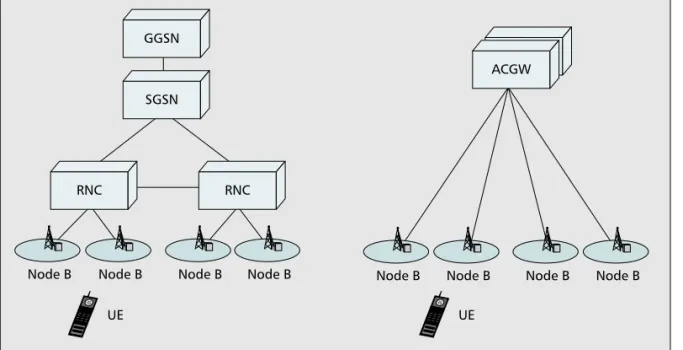
Figure 1 illustrates the current Rel-6 architec-ture and a possible path for an architecarchitec-ture evo-lution.
In Rel-6, the Node B handles the lower lay-ers of the wireless access, as this is the node with the antenna. The radio network con-troller (RNC) handles radio resource manage-ment, mobility management (locally), call control, and transport network optimization. It further acts as a termination point for the radio protocols. The gateway General Packet Radio Service (GPRS) support node (GGSN) acts as an anchor node in the home network. The serving GPRS support node (SGSN) acts as an anchor node in the visiting network and handles both mobility management and ses-sion management. Typically all traffic is rout-e d b a c k t o t h rout-e h o m rout-e n rout-e t w o r k s o t h a t a consistent service environment can be main-tained while also allowing the operator to fil-ter traffic and provide security to the end user (e.g., by means of firewalls).
In the proposed LTE architecture, the Rel-6 nodes GGSN, SGSN, and RNC are merged into a single central node, the access core gateway (ACGW) as shown in Fig. 1. The ACGW termi-nates the control and user planes for the user equipment (UE), and handles the core network functions provided by the GGSN and SGSN in Rel-6. The control plane protocol for the UE nnn
nFigure 1.The current 3GPP Release 6 architecture (left) and one possible evolved 3G architecture reduc-ing the number of nodes along the data path from 4 to 2 (right).
SGSN Node B UE GGSN SGSN ACGW RNC RNC
Node B Node B Node B Node B Node B Node B Node B
UE
Based on the requirements of reduced latency and
cost, it is natural to consider system architectures that contain a reduced number of network nodes along the data
path. This would reduce both the overall protocol-related processing as well as the number of interfaces, which in turn reduces the cost
of interoperability testing.
EKSTRÖM LAYOUT 2/14/06 11:03 AM Page 39
will be similar to radio resource control (RRC) in Rel-6, for example. handling control of mobil-ity and radio bearer configuration. In the user plane the ACGW will handle functions like header compression, ciphering, integrity protec-tion, and automatic repeat request (ARQ).
The proposed architecture has the following merits:
• User-plane latency is reduced, as there are fewer nodes, and less protocol packing/ unpacking.
• Call/bearer setup time is reduced, as there are fewer nodes involved in the setup pro-cedure.
• Complexity is reduced, as there are fewer interfaces to implement and test. The amount of interoperability testing required will therefore also be reduced.
• Placing an ARQ protocol in the ACGW will provide both robustness against lower-layer losses and a simple way to provide lossless mobility.
• Performing ciphering and integrity protec-tion of control and user plane data in the ACGW allows for a security solution at least as strong as in Rel-6.
• Support for macrodiversity can be provided with centralized radio control handling. This has been shown to give significant cov-erage and capacity gains.
• There is no need for a direct Node B–Node B interface for mobility. Such an interface would increase the operational burden for the operator (through additional configura-tion and planning) and also impose a new security threat to the network.
• A new function in the proposed architecture compared to Rel-6 is support for ACGW pooling. This allows for network redundan-cy solutions that increase the reliability of the network.
Q
UALITY OFS
ERVICEThe key driver behind the QoS concept described in this section is to provide operators with effective and simple means to provide ser-vice differentiation over networks that employ high-speed shared channels. Two components of the QoS concept are described: service differen-tiation and simplified bearer realizations. It should be noted that the concept presented
below should be seen as one possible evolution of the current 3GPP QoS concept.
Service differentiation is enabled by classifi-cation and marking of each packet at the net-work edge (i.e., ACGW for downlink traffic and UE for uplink traffic). The edge node classifies each incoming packet into different predefined service classes, such as Internet access and voice over IP (VoIP). This classification could, for example, be done on the basis of information contained in the protocol headers. Following classification, the packet is marked. An explicit form of packet marking is the use of IP layer dif-ferentiated services (DiffServ) code points, while an implicit form of packet marking is the map-ping of packets to “marked bearers,” such as a “marked” packet data protocol (PDP) context or radio access bearer. This marking is then used by each subsequent node to identify the service class to which the packet belongs. The edge node further performs rate policing and/or admission control to ensure that flows do not exceed a specified maximum bit rate. For some service classes (e.g., Internet access), this maxi-mum bit rate may be specified on a subscription basis, whereas for others (e.g., VoIP) it may be specified on a session basis during the session setup phase.
Once all incoming packets have been marked and policed, each node in the data path uses the markings to carry out appropriate queuing and policy-based scheduling. The queuing in the nodes may be service class dependent; that is, the size and dropping strategies of the queue may differ depending on the characteristics of the traffic belonging to the service class. Policy-based scheduling denotes the process of schedul-ing accordschedul-ing to predefined policies. Such policies can, for example, govern the distribution of bandwidth between different service classes. It is foreseen that such policies can be modified dynamically depending on the expected usage of particular services. It should be possible for the operator to push new policies to the relevant nodes through the network management system. For a more detailed discussion of service differ-entiation and scheduling, see [8].
Another key component of the QoS concept is the use of a reduced number of radio bearer realizations. For example, it is believed that due to the significant latency reduction in the evolved nnn
nFigure 2.Schematic data flow through the RLC and MAC layer for downlink traffic.
ACGW Node B UE MAC IP packet RLC payload RLC header RLC RLC payload RLC payload
FEC block FEC block
FEC fragment FEC fragment
TTI1 TTI2
FEC fragment
RLC payload RLC payload
FEC block FEC block
FEC fragment FEC fragment
TTI1 TTI2
FEC fragment
RLC payload
IP packet IP packet IP packet
EKSTRÖM LAYOUT 2/14/06 11:03 AM Page 40
RAN, even real-time services like VoIP could be supported over a reliable link layer (acknowl-edged mode). The bearers will, however, differ in the scheduling policies that are assigned to them. It is believed that this reduction in radio bearer realizations will help to reduce the time to market when introducing new services, since no service-specific bearer will need to be defined and tested prior to introduction of a new service.
L
INKL
AYERS
OLUTIONSWhile the Rel-6 link layer protocols support the peak data rates of HSDPA and enhanced uplink effectively, the requirements on the evolved RAN demand enhanced link layer concepts. A fixed radio link control (RLC) protocol data unit (PDU) size is regarded as too inflexible to oper-ate over a wide range of data roper-ates. Small PDUs lead to too large header overhead, while large PDUs would introduce too much padding over-head for small packets like VoIP frames or TCP acknowledgments. Therefore, another solution, called the packet-centric link layer, is outlined here.
The concept foresees two layer 2 ARQ proto-cols as in Rel-6. The RLC protocol, which con-tains ARQ functionality, operates between ACGW and UE, while the hybrid ARQ (HARQ) protocol is embedded in the medium access con-trol (MAC) layer, and operates between Node B and UE. The RLC protocol is needed to provide a reliable mobility and ciphering anchor point, and cope with congestion losses on the Iub inter-face, while radio interface transmission errors are typically not handled by the RLC, but by HARQ.
The key characteristic of the packet-centric link layer is to map packets (i.e., either IP pack-ets or RRC messages) one-to-one to RLC PDUs, thereby making the size of these PDUs variable, as depicted in Fig. 2. This concept deems seg-mentation and concatenation at the RLC layer obsolete, thereby eliminating padding overhead. An additional field, specifying the PDU size, is required in the protocol header. However, despite this added overhead, an overall gain in terms of overhead is typically achieved since padding is avoided.
In addition, the concept has the advantage that IP packets become implicitly visible in the Node B, because each RLC PDU corresponds to exactly one IP packet. This fact can be exploited by the scheduler in the MAC layer, which now sees complete IP packets as opposed to seg-ments thereof. This is expected to allow for more efficient scheduling decisions.
A potential problem of the packet-centric concept is that one RLC PDU may be too large to be transmitted in one frame (e.g., when the
receiver is experiencing bad signal quality). In this case, segmentation is required in the Node B. However, instead of segmenting an RLC PDU into multiple pieces,1it is proposed to first
encode the RLC PDU into forward error correc-tion (FEC) blocks and then use rate matching to form FEC fragments, which fit into the available radio resources. If the RLC PDU is large, this may result in a very high initial code rate, in some cases even higher than one, making it highly unlikely that such a transmission can be decoded correctly. Therefore, in combination with incremental redundancy HARQ, so-called autonomous retransmission is performed, where-by more data from this PDU is transmitted with-out waiting for a negative acknowledgment. This is repeated until the probability of successful reception has exceeded a certain threshold. Sub-sequently, conventional HARQ feedback is used to request further retransmissions if needed.
The RAN transport is expected to remain an expensive part of the network, and overdimen-sioning of these links cannot generally be assumed. Therefore, packet losses due to con-gestion in the transport network will occur despite deployment of enhanced flow control mechanisms. A further enhancement deals with this problem. In such scenarios the Node B can act as an RLC relay node and send negative acknowledgments back to the ACGW to request local retransmissions. This avoids time-consum-ing ARQ operations over the radio interface. Furthermore, since the sequence number is visi-ble in the Node B, head-of-line blocking for such retransmissions can be avoided by ordering the PDUs according to their sequence number in the Node B transmission queue.
P
HYSICALL
AYER ANDR
ADIOR
ESOURCEM
ANAGEMENT OFDM [9] is an attractive choice to meet requirements for high data rates, with corre-spondingly large transmission bandwidths, and flexible spectrum allocation. OFDM also allows for a smooth migration from earlier radio access technologies and is known for high performance in frequency-selective channels. It further enables frequency domain adaptation, provides benefits in broadcast scenarios, and is well suited for multiple-input multiple-output (MIMO) pro-cessing.The possibility to operate in vastly different spectrum allocations is essential. Different band-widths are realized by varying the number of subcarriers used for transmission, while the sub-carrier spacing remains unchanged. In this way operation in spectrum allocations of 1.25, 2.5, 5, 10, 15, and 20 MHz can be supported. Due to nnn
nFigure 3.Duplex schemes. Highest data rates for given bandwidth and peak power
Reduced UE complexity FDD only fDL fUL Combined FDD/TDD Unpaired spectrum TDD only fDL fDL/fUL fUL 1The segmentation of
RLC PDUs at the MAC layer is another viable alternative. Since it is the traditional approach, fur-ther discussion is omitted here.
The RAN transport is expected to remain an expensive part of
the network and over-dimensioning of
these links cannot generally be assumed. Therefore, packet losses due to congestion in the transport network will occur despite deployment of enhanced flow control mechanisms.
EKSTRÖM LAYOUT 2/14/06 11:03 AM Page 41
the fine frequency granularity offered by OFDM, a smooth migration of, for example, 2G spec-trum is possible. A 2G GSM operator can in principle migrate on a 200 kHz GSM carrier-by-carrier basis by using only a fraction of the avail-able OFDM subcarriers. Frequency-division duplex (FDD), time-division duplex (TDD), and combined FDD/TDD, as illustrated in Fig. 3, are supported to allow for operation in paired as well as unpaired spectrum.
Downlink: OFDM with Frequency Domain Adaptation— The basic time-frequency struc-ture of the OFDM downlink is illustrated on the left of Fig. 4. A subcarrier spacing of 15 kHz is adopted, allowing for simple implementation of dual mode Rel-6/LTE terminals as the same clock frequencies can be used. To minimize delays, the subframe duration is selected as short as 0.5 ms, corresponding to seven OFDM sym-bols. The cyclic prefix length of 4.7 µs is suffi-cient for handling the delay spread for most unicast scenarios, while only adding modest overhead. Very large cells, up to and exceeding 120 km cell radius, with large amounts of time dispersion are handled by reducing the number of OFDM symbols in a subframe by one in order to extend the cyclic prefix to 16.7 µs. Broadcast services are supported by transmitting the same information from multiple (synchronized) base stations. To the terminal, the received signal from all base stations will appear as multipath propagation and thus implicitly be exploited by the OFDM receiver.
Exploiting channel variations in the time domain through link adaptation and channel-dependent scheduling, as is done in current 3G systems such as WCDMA and HSDPA, has been shown to provide a substantial increase in spec-tral efficiency. With the evolved radio access, this is taken one step further by adapting the transmission parameters not only in the time domain, but also in the frequency domain. Fre-quency domain adaptation is made possible through the use of OFDM and can achieve large performance gains in cases where the channel varies significantly over the system bandwidth. Thus, frequency domain adaptation becomes increasingly important with an increasing system bandwidth. Information about the downlink channel quality, obtained through feedback from the terminals, is provided to the scheduler. The scheduler determines which downlink chunks to
allocate to which user and dynamically selects an appropriate data rate for each chunk by varying the output power level, the channel coding rate, and/or the modulation scheme. Quadrature phase shift keying (QPSK), 16-quadrature ampli-tude modulation (16-QAM), and 64-QAM mod-ulation schemes are supported in the downlink. Uplink: Single-Carrier FDMA with Dynamic Bandwidth— For uplink transmission, an important requirement is to allow for power-effi-cient user-terminal transmission to maximize coverage. Single-carrier frequency-domain multi-ple access (FDMA) with dynamic bandwidth, illustrated on the right of Fig. 4, is therefore pre-ferred. For each time interval, the base station scheduler assigns a unique time-frequency inter-val to a terminal for the transmission of user data, thereby ensuring intracell orthogonality. Primarily time domain scheduling is used to sep-arate users, but for terminals with limitations in either transmission power or the amount of data awaiting transmission, frequency domain scheduling is also used. Note that a terminal is only assigned chunks contiguous in the frequen-cy domain to maintain the single-carrier proper-ties and thereby ensure power-efficient transmission. Frequency domain adaptation is typically not used in the uplink due to lack of channel knowledge, as each terminal cannot con-tinuously transmit a pilot signal covering the whole frequency domain. Slow power control, compensating for path loss and shadow fading, is sufficient as no near-far problem is present due to the orthogonal uplink transmissions.
Multipath propagation is handled by frequen-cy domain equalization at the base station, aided by the insertion of a cyclic prefix in the transmit-ted signal. Transmission parameters, coding, and modulation are similar to the downlink transmis-sion.
M
ULTI-A
NTENNAS
OLUTIONSIn order to fulfill the requirements on coverage, capacity, and high data rates, various multi-antenna schemes need to be supported as part of the long-term 3G evolution. For example, beamforming can be used to increase coverage and/or capacity, and spatial multiplexing, some-times referred to as MIMO, can be used to increase data rates by transmitting multiple par-allel streams to a single user. However, conven-tional multi-antenna diversity techniques, at both nnn
nFigure 4.Time-frequency structure for downlink (left) and uplink (right).
Time Frequency Downlink User A User B User C User D 0.5 ms Time Frequency ≈200 kHz Uplink EKSTRÖM LAYOUT 2/14/06 11:03 AM Page 42
the receiver and transmitter, will also play an important role in fulfilling the requirements.
It is necessary to consider multi-antenna tech-nologies as a well-integrated part of the evolved radio access, and not as an extension added to the specification at a later stage. The potential of using the spatial domain is large, and the development of new and even more efficient multi-antenna algorithms is expected to continue for a long time into the future. Hence, to make the evolved radio access future-proof, it should be able to support new and improved multi-antenna algorithms in an efficient manner. In addition to an initial negotiation between the transmitter and receiver about the transmission scheme, this can be achieved by using the follow-ing key components:
• Multipurpose measurement signals
• Adjustable preprocessing rules for the mea-surements
• A few well-defined measurement result for-mats
It should be possible for the transmitter to send several multipurpose measurement signals.
These measurement signals should be orthogo-nal to each other, and the receiver needs no knowledge of the spatial properties of the signal (i.e., the antenna pattern or the beam pattern used for transmission). The receiver only needs to be informed of which signals to measure.
Different multi-antenna algorithms require measurements with different resolutions in the time, frequency, space, and stream domains. The Doppler spread of the radio channel and the velocity of the UE will also affect which resolu-tions are appropriate. By using a set of adjustable preprocessing rules for the receiver, it is possible to adapt the measurement resolution to the current conditions. For example, the aver-aging of measurements in time could be selectable between 0.5 ms and 100 ms, the aver-aging in frequency could be selectable between 300 kHz and 5 MHz, the averaging in space could be selectable between one antenna and all antennas, and the averaging in stream domain could be selectable between one stream and all streams.
For a large group of multi-antenna schemes, n
n n
nTable 1.Simulation models and assumptions (MMSE: minimum mean square error). Traffic models
User distribution Uniform, on average10 users/sector
Terminal speed 0 km/h
Data generation On-off with activity factor 20, 40, 60, 80, 100 percent Radio network models
Distance attenuation L= 27.5 + 37.1 * log(d), d= distance in meters
Shadow fading Log-normal, 8 dB standard deviation
Multipath fading 3GPP typical urban
Cell layout Hexagonal grid, 3-sector sites, 21 sectors in total Cell radius (intersite distance = 3 ×radius) 500–2250 m
System models
Spectrum allocation 20 MHz (4 x 5 MHz for WCDMA Rel-6)
Base station output power 40 W into antenna (10 W/5 MHz carrier for WCDMA)
Maximum antenna gain 18 dBi
Modulation and coding schemes QPSK and 16-QAM, turbo coding according to WCDMA Rel-6
OFDM parameters According to an earlier section
WCDMA receiver Two-branch antenna diversity with rake receiver, maximum ratio combining of all channel taps; 7 dB noise figure Evolved RAN MIMO scheme Two streams with per-antenna rate control (PARC) Evolved RAN receiver Two-branch MMSE, 7 dB noise figure
Scheduling Round-robin in time domain
Multipath propagation is
handled by frequency domain equalization at the base station, aided by the insertion of a
cyclic prefix in the transmitted signal. Transmission parameters, coding, and modulation are
similar to the downlink transmission.
EKSTRÖM LAYOUT 2/14/06 11:03 AM Page 43
such as various open-loop beamforming schemes, open-loop transmit diversity, and basic spatial multiplexing techniques, a requested data rate is a sufficient measurement result format. For other multi-antenna schemes, more feedback information about the radio channel is needed. By letting the transmitter specify how many bits should be used to represent the phase and ampli-tude, respectively, various multi-antenna schemes that require knowledge of the radio channel will be supported (e.g., closed loop transmit diversity and eigenvalue-based MIMO).
P
ERFORMANCE
E
VALUATION
In this section a simple radio network perfor-mance evaluation of a possible evolved RAN concept is presented. The intention is to indicate whether the performance requirements present-ed earlier can be met. To this end, assessments of downlink user quality, capacity, and coverage of a system employing a possible evolved RAN concept are made, and compared to a Rel-6 sys-tem based on WCDMA using the syssys-tem config-urations mandated in [3].
Simple models and assumptions are used. A summary grouped into traffic, radio net-work, and system models is provided in Table 1. The ambition is to achieve relative assess-ments of the gains associated with OFDM and MIMO. Frequency domain adaptation and o t h e r h i g h e r - l a y e r i m p r o v e m e n t s o f t h e evolved RAN are not included in the evalua-tion. It should also be noted that many con-trol plane and user plane protocol aspects above the physical layer are omitted, yielding optimistic absolute values.
A simple static simulation-based evaluation methodology is used. In each iteration of the simulation, terminals are randomly positioned in the system area, and the radio channel between each base station and terminal antenna pair is calculated according to the propagation and fad-ing models. To study different system load
lev-els, base stations are randomly selected to trans-mit with an activity factor franging from 20 to 100 percent. In cells with active base stations, a single receiving user is selected independent of channel quality. This models channel-indepen-dent time domain scheduling (e.g., round-robin). The total number of active users for activity fac-tor fis denoted U(f). Based on the channel real-izations and active interferers, a signal-to-interference-plus-noise ratio (SINR) is calculated for each terminal receive antenna. Using results from link-level simulations, includ-ing HARQ, the SINR values are then mapped to active radio link bitrates Rufor each active user u. In the case of MIMO, Ruis modeled as the sum of the rates achieved per MIMO stream. Note that Ruis the bit rate user ugets when scheduled. When the channel is shared between multiple users, a correspondingly lower bit rate than Ruis experienced above the MAC layer. Active base stations and users differ between iterations, and statistics are collected over a large number of iterations.
For each activity factor, the served traffic T(f) is calculated as the sum of the active radio link bit rates for the active users (i.e., T(f) = ΣUu=1(f)R
u), and the mean and 5th percentile of the active radio link bitrate are used as measures of aver-age and cell-edge user quality, respectively. Note that as the activity factor increases, individual active radio link bit rates decrease because of increased interference and thereby decreased SINR. The served traffic, however, increases as the number of active users increases.
Figure 5a shows the mean and 5th percentile (cell-edge) active radio link bit rate vs. served traffic for a cell radius of 500 m. The bit rates are normalized with the spectrum allocation to enable comparison between the evolved RAN and WCDMA Rel-6. It is seen that the evolved RAN concept yields significantly improved bit rates for both average and cell-edge users. Com-paring the bit rates at a served traffic of 0.75 b/s/Hz/sector, gains in cell-edge and mean active nnn
nFigure 5.Mean and 5th percentile normalized active radio link bit rate vs. traffic load for a cell radius of 500 m (left); normalized cell throughput vs. cell radius in fully loaded systems (right).
Normalized served traffic (b/s/Hz/sector)
1.8 2 0
0 0.5
Normalized active radio link bit rate (b/s/Hz)
1 1.5 2 2.5 3 3.5 1.6 1.4 1.2 1 0.8 0.6 0.4 0.2
Evolved RAN mean Evolved RAN 5th perc WCDMA R6 mean WCDMA R6 5th perc Cell radius (m) 2400 400 0 0.2
Max normalized system throughput (b/s/Hz/sector)
0.4 0.6 0.8 1 1.2 1.4 1.6 1.8 2 800 1000 1200 1400 1600 1800 2000 2200 600 Evolved RAN WCDMA R6 EKSTRÖM LAYOUT 2/14/06 11:03 AM Page 44
radio link bit rates of factors 3 and 4, respective-ly, are achieved. It is difficult to find overlapping regions of the active radio link bit rate for fair capacity comparisons. However, comparing the rightmost traffic levels, corresponding to the maximum system throughput in a fully loaded network (f= 100 percent), a gain of a factor 2.5 is achieved. Figure 5b shows how the maximum system throughput values depend on the cell radius. It is seen that the gain achieved by the evolved RAN is consistent for the full range of cell radii.
Although preliminary and excluding high-er-layer protocol improvements, the results indicate the high potential of the evolved RAN to improve user quality, capacity, and c o v e r a g e , t h e r e b y r e d u c i n g o v e r a l l i n f r a -structure cost in both coverage and capacity limited scenarios.
It should be noted that the major part of the performance benefits of the evolved RAN com-pared to WCDMA is due to the rather basic WCDMA Rel-6 configuration defined in [3], which excludes MIMO and uses a relatively sim-ple receiver structure. By applying MIMO and state-of-the-art receivers to WCDMA, similar performance is achieved as for the evolved RAN.
C
ONCLUSIONS
In order to meet user expectations in a 10-year perspective and beyond, an evolution of the cur-rent 3G standards is needed. In 3GPP this is called the 3G long-term evolution. The funda-mental targets of this evolution — to further reduce user and operator costs, and to improve service provisioning — will be met through improved coverage and system capacity as well as increased data rates and reduced latency. Promising technologies to fulfill these targets include an evolved system architecture yielding shorter delays, an evolved QoS concept giving operators effective means to provide service dif-ferentiation, an evolved link layer concept, and an OFDM-based physical layer supporting multi-antenna solutions, which together support high bit rates, capacity, and coverage. Perfor-mance results indicate that the proposed tech-nologies indeed are sufficient to meet the wireless communication needs of the decade to come.
R
EFERENCES[1] S. Parkvall et al., “The High Speed Packet Data Evolu-tion of WCDMA,” Proc. IEEE PIMRC 2001, vol. 2, Sept. 2001, pp. G27-31.
[2] S. Parkvall et al., “WCDMA Enhanced Uplink — Princi-ples and Basic Operation,” Proc. VTC Spring 2005, May 2005.
[3] 3GPP, “Requirements for Evolved UTRA (E-UTRA) and Evolved UTRAN (E-UTRAN),” Tech. rep. 25.913, http://www. 3gpp.org.
[4] D. Astely et al., “A Future-Radio-Access Framework,” to appear, IEEE JSAC, Special Issue on 4G Wireless Sys-tems, 2006.
[5] E. Mino Diaz et al., “The WINNER Project: Research for New Radio Interfaces for Better Mobile Services,” IEICE Trans., Japan, vol. E87-A, no. 10, Oct. 2004, pp. 2592–98. [6] X. Yu et al., “Toward Beyond 3G: The FuTURE Project in
China,” IEEE Commun. Mag., Jan. 2005, pp. 70–75.
[7] S. Abeta, H. Atarachi, and M. Sawahashi, “Broadband Packet Wireless Access Incorporating High-speed IP Packet Transmission,” Proc. IEEE VTC 2002 Fall, vol. 2, Sept. 2002, pp. 844–48.
[8] R. Ludwig et al., “Service Differentiation in Future Mobile Broadband Access,” Proc. WWRF13, Mar. 2005. [9] J. A. C. Bingham, “Multicarrier Modulation for Data
Transmission: An Idea Whose Time Has Come,” IEEE Commun. Mag., vol. 28, no. 5, May 1990, pp. 5–14.
B
IOGRAPHIESHANNESEKSTRÖM([email protected]) received his M.S. degree in electrical engineering from the Royal Institute of Technology, Stockholm, Sweden in 2000. He joined Ericsson Research, Aachen, Germany, in the same year and worked on the design and evaluation of 3G wire-less systems. He currently holds a position as senior research engineer at Ericsson Research, Stockholm, Swe-den, where he works with concept development for future wireless systems.
ANDERSFURUSKÄRreceived his M.S. degree in electrical engi-neering and Ph.D. degree in radio communications systems from the Royal Institute of Technology in 1996 and 2003, respectively. He joined Ericsson Research in 1997, working mainly with standardization of third-generation cellular sys-tems. He currently holds a position as senior research engi-neer, focusing on radio resource management in future wireless networks.
JONASKARLSSONreceived an M.S. degree from Linköping University, Sweden, in 1993 and a Ph.D. degree from the University of Tokyo, Japan, in 2003, both in electrical engi-neering. He joined Ericsson Research in 1993 and is cur-rently working with advanced antenna systems and signal processing for the long-term evolution of 3G. Between 1998 and 2003 he held a five-year assignment at Ericsson Research Japan, investigating interference cancellation for WCDMA system. In addition, he has worked with several advanced antenna trial systems.
MICHAELMEYERreceived his diploma and doctoral degree in electrical engineering from the University of Paderborn, Germany, in 1991 and 1996, respectively. In 1996 he joined Ericsson Research, Aachen, Germany. He holds the position of senior specialist and is leading a performance analysis team. Currently he is involved in the concept development for evolved 3G systems. His research interests include the design and analysis of link layer protocols for wireless systems.
STEFANPARKVALLjoined Ericsson Research, Stockholm, in 1999 and is currently a senior specialist in adaptive radio access, working in research on and standardization of future cellular technologies. He received M.S. and Ph.D. degrees in electrical engineering from the Royal Institute of Technology in 1991 and 1996, respectively. His previous positions include being an assistant professor in communication theory at the Royal Institute of Technology, 1996–2001, and a visiting researcher at the University of California, San Diego, 1997–1998. JOHANTORSNERjoined Ericsson in Sweden in 1998 and was responsible for radio network system design for HIPER-LAN/2 in Ericsson WLAN systems. In 2000 he moved to Ericsson in Finland to work on system management for WCDMA. In this role he has been active in 3GPP standard-ization and concept development for WCDMA with its evo-lutions. Since 2004 he works as a manager for Ericsson’s wireless access network research branch in Finland. He holds an M.S. in electrical engineering from the Royal insti-tute of Technology.
MATTIASWAHLQVISTreceived his M.S. in computer science (1995) and Lic.Eng. in signal processing (1998) from Luleå University of Technology, Sweden. He was deeply involved in the development and standardization of the 3G radio network architecture and radio resource management functions within the 3GPP standardization body. In the years since his focus has been on new RAN architectures, QoS and service performance, and cellular network perfor-mance. Currently, he holds a position as expert in stan-dardization of new radio networks. His interest is focused on network architectures for the evolution of 3G systems.
The fundamental targets of this evolution — to further reduce user and operator costs and to improve service provisioning —
will be met through improved coverage and system capacity as well as increased
data rates and reduced latency.
EKSTRÖM LAYOUT 2/14/06 11:03 AM Page 45