D
ELIVERINGV
ALUE ON THEP
ORT OFM
IAMIT
UNNELP
ROJECTL
OUISB
RAIS, PE
ANDJ
EFFREYP
LANT, MBA, P.E
NG., PMP, CVS
A
BSTRACTThe Port of Miami Tunnel [POMT] Project is an excellent example of the value-for-money that can be achieved through public-private-partnerships. Estimated to cost over $1.2 Billion to construct prior to the solicitation of bids in 2008, the successful concessionaire awarded a $652 million design-build contract to Bouygues Civil Works Florida, Inc. [BOUYGUES] in October of 2009. The project is proceeding on schedule and on-budget for a May 2014 opening.
Design-build bids are typically based upon an incomplete preliminary design and a contractor’s assessment of risk based upon years of experience. While many successful design-build contractors perform value
engineering during the bid stage to find innovative ways of satisfying the performance specifications at a lower cost and with a shorter construction duration, the real challenge occurs during the detailed design stage when the construction team must find ways to deliver the project on schedule and on budget.
BOUYGUES undertook a formal value engineering [VE] study shortly after receiving authorization to proceed. Facilitated by Jacobs Engineering, the lead design consultant, the workshop brought twenty-nine (29) members of the construction and design teams together in a problem-solving atmosphere to share creative ideas and kick-start the project. Fifty-six (56) of almost two hundred (200) ideas developed through brainstorming sessions were developed into VE recommendations.
BOUYGUES is implementing a significant percentage of the VE recommendations. In addition, a number of VE ideas led to further innovations in design or methods following the initial workshop. Most VE ideas were
consistent with the performance specifications and were implemented during the course of design development. Although there is no Value Engineering Change Proposal [VECP] clause in the design-build agreement,
BOUYGUES did agree to share savings with their client and the owner on one significant change.
The following paper outlines the VE process that was followed on the POMT project and highlights some of the significant VE recommendations that are being implemented.
I
NTRODUCTIONBouygues Civil Works Florida, Inc. [BOUYGUES] was awarded a $652 million design- build contract for the Port of Miami Tunnel [POMT] project by MAT Concessionaire, LLC [MAT] in October of 2009. MAT is a special purpose company controlled by Meridiam Infrastructure. Originally estimated at over $1.2 Billion to construct prior to the solicitation of bids in 2008, the POMT project represents an excellent example of the value-for-money that can be achieved through public-private-partnerships.
The Owner of the project is the Florida Department of Transportation [FDOT]. In addition to FDOT and the State of Florida, Miami-Dade County, the City of Miami and the Federal Highways Administration (FHWA) through the TIFIA program are sharing in the funding of the project. Over $300 million in private funding is also being provided by a consortium of ten (10) banks including BBVA, BNP Paribas, Calyon, Dexia, ING, RBS, Santander, Societe General, Uni-Credit and WestLB. The Miami-Dade Seaport Department is the primary beneficiary of the project and is actively involved.
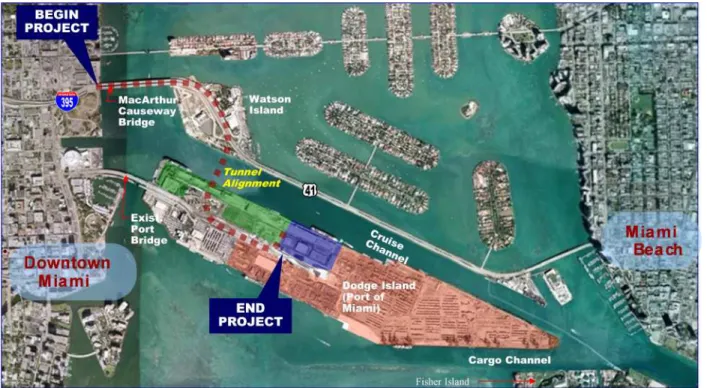
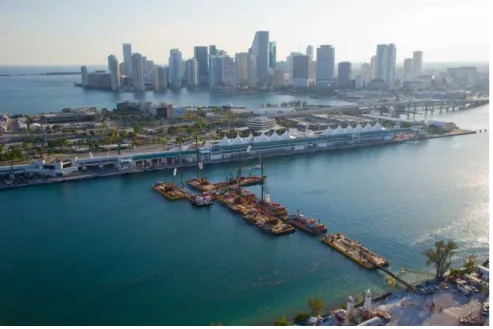
The POMT project will connect SR A1A/MacArthur Causeway to Dodge Island, providing direct access between the seaport and Highways I-395 and I-95. The POMT will create an alternative entry to the Port of Miami and keep the Port of Miami, the community’s second largest economic generator, competitive with other ports on the eastern seaboard anticipating an increase in freight traffic following the doubling of the Panama Canal capacity in 2014. In addition, the POMT will improve traffic flow in downtown Miami by reducing the number of cargo trucks and cruise ship related vehicles on congested downtown streets. It will also support ongoing and future development in and around downtown Miami.
Figure 1 – POMT Location
T
HEV
ALUEE
NGINEERINGC
HALLENGEBOUYGUES committed to deliver a fixed-price, date-certain tunnel project at the height of the financial uncertainties that gripped the US market, in some of the most technically challenging geotechnical conditions that have ever faced tunnelling contractors, and at half the cost of what the experienced owner’s engineers estimated the work should cost.
The tunnel project involves the construction of two 42’ diameter / 4,400’ long tunnels from the I-395 extension on Watson Island to the Port of Miami on Dodge Island. When completed, the tunnels will service the cruise ship terminals and the cargo operations of the Port of Miami. The Port is the largest cruise ship home port in the world and is among the top 11 container ports in the United States. For fiscal year 2011, the Port handled approximately 4.1 million passengers. During this same period, approximately 7.4 million tons of cargo and close to 0.9 million TEUs (twenty-foot equivalent units) were processed through the Seaport. The Port ranked first in the state in TEU volume for Fiscal Year 2011.i
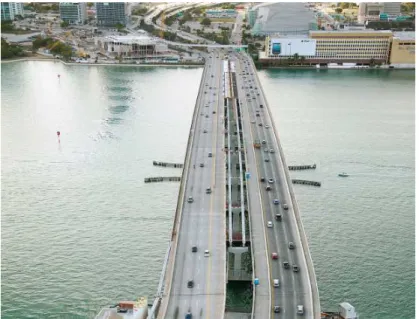
To add to the construction challenge, SR AIA/MacArthur Causeway is the main connection between the cities of Miami and Miami Beach carrying over 120,000 vehicles per day through the heart of the work site. Over one million eyes are on the project every day from high-rise office buildings and condominiums in downtown Miami and vicinity.
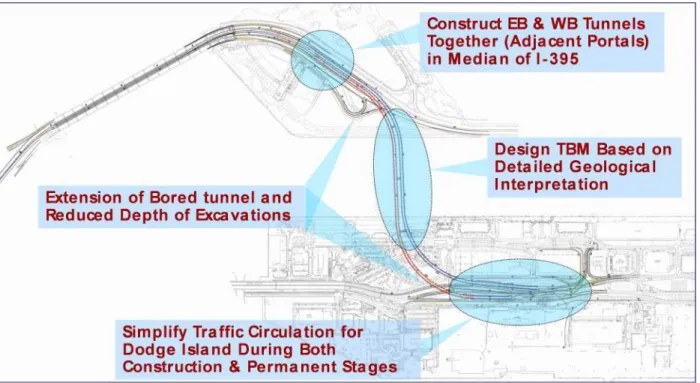
BOUYGUES was able to win the project through aggressive bidding based upon its extensive tunnelling experience from around the world. Its tunnelling accomplishments include the English Channel Tunnel, the Caluire Tunnel (France), the Sydney underground urban railway, the Cairo underground urban railway, the Rostock Tunnel (Germany), the Groene Hart tunnel (Netherlands) and the Tyne Tunnel (Newcastle, England). A number of modifications to the FDOT conceptual design were proposed by Bouygues and accepted by FDOT during the bid process. The most significant change proposed was the combining of tunnel portals on Watson Island into a single portal. This change significantly improved traffic flow by eliminating a dangerous weave condition between I-95 and the MacArthur Causeway, simplified construction and was expected to improve safety during construction. Other changes involved extending the bored tunnel sections to reduce traffic disruptions on Dodge Island related to cut & cover work and simplification of final traffic movements on Dodge Island.
Figure 2 – Bid Stage Value Enhancements
Despite its extensive experience, the POMT project presented special challenges to the BOUYGUES team. Innovative methods and technologies would still need to be found during the design stage to deliver on its firm commitments.
T
HEVE W
ORKSHOPRecognizing the potential for value engineering to kick-start the project and stimulate innovation, BOUYGUES included the following requirement in the contract with its primary design consultant, Jacobs Engineering Group Inc. [Jacobs]:
“Facilitation of a 5-day value-engineering workshop within the first month following Date of Commencement. The Value Engineering Facilitator is to be a Certified Value Specialist (CVS), a member in good standing of SAVE International (www.value-eng.org) and experienced in the facilitation of value engineering studies for complex transportation projects. The
value-engineering study is to be completed in accordance with the job plan as set out in the SAVE International Value Standard and Body of Knowledge (June 2007). The Designer is to provide technical subject matter experts in the fields of geotechnical engineering (support of excavation, tunneling, deep foundations, retaining walls, earthworks and pavement design), highway design, bridge design, hydrology (drainage, storm surges) and the permitting process. The Design-Builder will provide subject matter experts in estimating, constructability, scheduling and methods engineering. The technical subject matter experts should be independent of the preliminary design team.”
A five (5) day workshop was conducted from November 2 to 6, 2009 in Miami. Twelve (12) technical specialists and a facilitator were provided by Jacobs and sixteen (16) construction specialists were provided by
BOUYGUES. Jacobs hosted a welcoming reception for the VE Team in a venue overlooking Biscayne Bay on the evening of the first day of the workshop following a site tour that completed the information stage of the workshop. There was considerable excitement in the air, and some trepidation, as the VE Team digested the full extent of the challenge that faced them.
A cost model was presented that showed the cost of the bored tunnels accounted for almost 50% of the budget. The second highest costs were related to construction and support of the excavation required to launch and retrieve the tunnel boring machine.
The bid-stage 55 month schedule was reviewed. It was concluded that there was zero float in the schedule. It was noted that the schedule seemed to incorporate accelerated methods that would require innovations not identified in the bid submission. Potential penalties and damages for failing to complete on time were identified in the millions of dollars per month. It was concluded that failure to deliver on-time was not an option.
The functions of the overall project were identified as: Separate Traffic, Remove Downtown-traffic, Increase Safety, Increase Capacity, Improve Port, Stimulate Economy, Reduce Delays, Deliver Quality, Enable Redundant Access, Improve Levels of Service, Improve Environment, Reduce Public Investment, Improve Security, Reduce O & M Costs, Create Sustainability and Maintain Systems all within the context of making money and delivering on-time.
The individual components of the project were disaggregated into the following work packages and the functions of each work package identified: MacArthur Causeway Bridge Widening, Watson Island Surface Works, Dodge Island Surface Works, Tunnel & Tunnel Boring, Cross Passages, Buildings, Dodge Island “Y” Bridge, Portal U-walls and Support of Excavation [SOE].
The VE team divided into two for brainstorming purposes. One hundred and ninety-eight (198) ideas were generated then consolidated into a list of one hundred and sixty-two (162) for further evaluation. Of these, fifty-six (56) were developed into VE recommendations and twenty-fifty-six (26) listed as Design Suggestions. The VE recommendations and design suggestions were developed and written-up by seven (7) sub-teams of specialists in corresponding disciplines.
W
HAT WASI
MPLEMENTED?
The real test of value engineering lies not in the number of ideas generated or the number of ideas developed into recommendations, but in the number and quality of ideas actually implemented for the betterment of a project. The project team was well-acquainted with the challenges of making changes during the detailed design and construction stages of a design-build project.
The ideas that were carried forward tended to be those that could be implemented within the normal process of design development. They were ideas that could be presented to the client and owner as being within the scope of the Technical Specifications for the project.
One idea that the VE team felt would provide significant scheduling, site access, safety and management of traffic advantages was to combine the two separate portals on Dodge Island into a single portal. This idea required substantial changes to the bid-stage traffic patterns on Dodge Island. Although the Project Team believed that the changes represented better functionality by improving traffic flows to both the cruise ship and cargo areas of the Port, FDOT indicated that this change would require sharing of the expected contractor savings.
The POMT design-build and concession agreements do not contain Value Engineering Change Proposal (VECP) clauses. VECP clauses are standard in conventional design-bid-build contracts issued in accordance with the Federal Acquisition Regulations (FAR). FAR Part 48 defines value engineering as“the formal technique by which contractors may (1) voluntarily suggest methods for performing more economically and share in any resulting savings or (2) be required to establish a program to identify and submit to the Government methods for performing more economically. Value engineering attempts to eliminate, without impairing essential functions or characteristics, anything that increases acquisition, operation, or support costs.”
When VE change proposals are made voluntarily by a contractor it uses its own resources to develop and submit them. All development costs and schedule risks are absorbed by the contractor. On a project with zero float in the schedule and substantial penalties for failure to complete on-time there is no time available for protracted discussion between the contractor, the client and the owner on the benefits and cost savings associated with change proposals.
Fortunately MAT and FDOT recognized the potential benefits to all Parties of a single portal on Dodge Island. Independent estimates of savings were prepared by BOUYGUES and FDOT. Negotiations on cost savings concluded in a matter of weeks. BOUYGUES were given the green light to proceed with the single portal on Dodge Island. BOUYGUES was able to implement a number of related improvements to the Dodge Island construction staging, traffic management during construction and in the final traffic patterns.
The following is a summary of the major VE recommendations that were implemented:
Single Portal on Dodge Island
The original design was based upon twin portals on Dodge Island separated by the existing grade separation between cargo and cruise-bound traffic.
The final design is based upon a single portal and improved traffic circulation on Dodge Island.
Benefits: Savings in SOE and portal construction, replacement of “Y” bridge with simpler structure offset by increased roadway costs. Fewer temporary traffic stages during construction. Mobilization of larger work zone. Net savings shared with owner.
Figure 3 – Single Portal on Dodge Island
SOE Construction
The original SOE design was based upon the use of reinforced secant piles around the portal excavations combined with two types of tension piles (2’ diameter concrete caissons with embedded steel H-pile and 7” diameter reinforced micropiles) terminating in one of three excavation “boxes”. In addition, horizontal pipe struts would span the excavation near the top of the secant pile walls. Excavation would be performed “in-the-wet” to a depth of approximately 60 feet and a concrete base poured using tremie methods to engage the tension piles prior to dewatering.
The final SOE designs were based upon cutter soil mixing (CSM) techniques. Pipe struts were eliminated through the use of inclined soil anchor tie-backs. The maximum depth of excavation was reduced to 40 feet by extending the bored tunnel length and providing above-grade surcharge. All rock within the zone of excavation was pre-drilled and broken-up to facilitate excavation. Concrete was poured on an incline using tremie
methods.
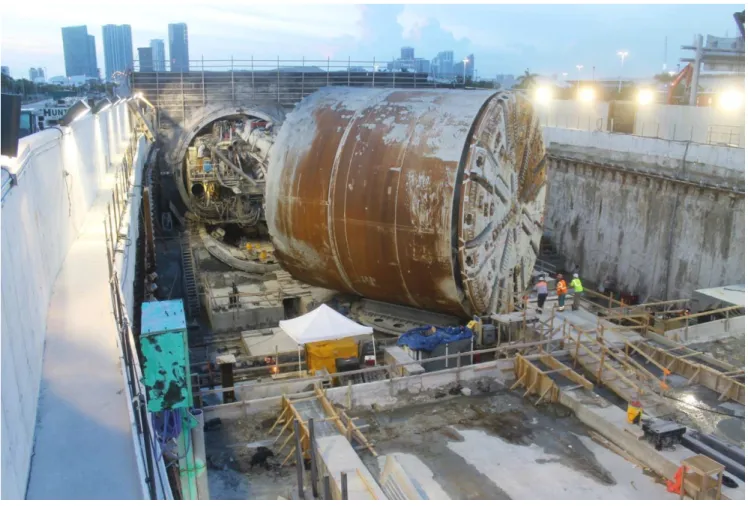
Benefits: The excavation on Watson Island was completed on-time and was ready for delivery of the tunnel boring machine [TBM]. The excavation for the single portal on Dodge Island was completed ahead of time and off the critical path.
Figure 4 – SOE and Excavation on Watson Island
Site Access
Access to the Watson Island site was initially expected to be from eastbound and westbound MacArthur Causeway.
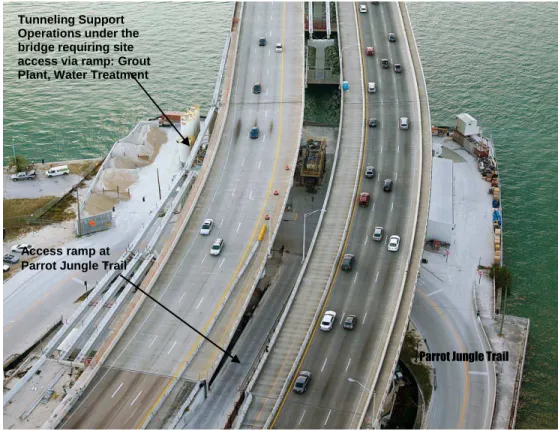
The VE team recommended accessing the work zone between the eastbound and westbound lanes of MacArthur Causeway by constructing a ramp from Parrot Jungle Trail where it passed beneath MacArthur Bridge. In addition, extension of the access road into the SOE box was recommended.
Benefits: This simple recommendation has removed the need for site access from the MacArthur Causeway greatly improving safety during construction. Site logistics have been significantly improved by enabling vehicular access into the tunnel. Smaller cranes are needed to lift tunnel liner segments onto the specialized trucks that feed the TBM. In addition, the access has allowed the area beneath the MacArthur Causeway Bridge to be used for the tunnel grout plant and the tunnel wastewater treatment plant.
Figure 5 – Watson Island Site Access
Watson Island Control Building
The proposed Watson Island Control Building was located directly above a portion of the proposed cut and cover tunnel section. Accordingly this building could not be constructed until after the cut and cover section of the tunnel was completed and engineered backfill installed. The building would be on the critical path and would force mechanical and electrical installations on to the critical path.
The building was relocated off the cut and cover section of the tunnel.
Benefits: Maintenance of Schedule. The Watson Island Control Building is no longer on the critical path
Figure 6 – Watson Island Control Building Access ramp at
Parrot Jungle Trail Tunneling Support Operations under the bridge requiring site access via ramp: Grout Plant, Water Treatment
U-turning the TBM
The original plan was to stage TBM operations from Watson Island, bore the eastbound tunnel, disassemble and remove the TBM on Dodge Island, truck it back to Watson Island, reassemble it and complete the westbound bore.
Once the Owner agreed to a single portal on Dodge Island, a decision was made to turn the TBM in the portal and to bore the westbound tunnel from Dodge Island. This permitted the batch plant, water treatment plant and mucking operations to be relocated to Dodge Island so that work could be advanced on the Watson U-walls and completion of the MacArthur Bridge widening.
Benefits: Maintenance of Schedule.
Figure 7 – U-turn the TBM
Grouting of Layer “7”
The stratigraphy of the soils through which the tunnels must pass are extremely complex. Eight (8) principal geological layers were identified. Layer “7”, identified as loose to medium sand, presented the greatest
challenge. Earth Pressure Balance TBMs depend upon the creation of pressure at the tunnel face to counteract the pressure exerted by the earth and groundwater and prevent any loss in stability. Layer 7 proved to include large fragments of extremely porous coral which when drilled would appear as lose to medium sand but in an undisturbed state were actually coral fragments with large voids.
Figure 8 – Geological Stratigraphy
BOUYGUES in association with the TBM supplier, Herrenknecht had devised a means of grouting Layer “7” in advance of the TBM should it become necessary. As the amount of grouting that would be required in advance of tunneling became known, it became clear that grouting from the TBM would substantially slow the rate of TBM progress. BOUYGUES undertook an extensive program of grouting Layer 7 using conventional surface and barge-mounted grouting methods. Additional environmental permits and precautions were required to work in the Government Cut channel. Work hours were severely restricted so as not to conflict with cruise ship traffic in the busy channel.
Benefits: Maintenance of schedule. Minimization of grouting costs. (Additional costs were shared with Owner.)
Figure 10 – Grouting Layer “7” in Government Cut
Optimization of Cross-Passages
The initial design included four (4) cross passages between tunnels and two (2) stairwells for emergency egress. All cross-passages were to be constructed by soil freezing. The stairwells would require complex shoring and de-watering to construct.
The two stairwells have been eliminated in favor of a fifth (5th) cross passage. Three of the cross passages will be pre-grouted from the surface and will not require soil freezing.
Benefits: Maintenance of Schedule. Simplified construction methods.
MacArthur Causeway Bridge Widening
The original design for the MacArthur Causeway Bridge included widening both sides of the bridge in the westbound direction at the merge of Miami-bound tunnel and Causeway traffic.
Geometric adjustments were made to the design to eliminate the need to widen the bridge on the north side at the merge.
Benefits: Simplified construction. Simplified traffic staging. Improved safety.
Figure 12 – MacArthur Causeway Bridge Widening
C
ONCLUSIONSThe formal VE process initiated by BOUYGUES on the POMT project and facilitated by Jacobs delivered substantial benefits to the project including:
1. The construction and design teams became acquainted right at the start of the project and built relationships that were essential to implementing many of the good ideas that came out of the VE workshop;
2. The workshop exposed differences in technical approaches and risk mitigation between a European contractor and an American design consultant that helped both sides to modify their approaches for the betterment of the project;
3. The introduction of function helped the design and construction teams to remember the client and owner perspectives when waxing enthusiastic about certain opportunities;
4. An understanding of function helped the team to differentiate between value opportunities that could be considered design development from those that would require a change in the Technical Specifications; 5. Virtually the entire construction team and many on the design team were looking at the project with
“fresh” eyes. The VE workshop brought the entire team up to speed very quickly and exposed areas of the bid-stage proposal that required additional attention;
6. The team approach to the development of VE recommendations served to jump-start the design process by fostering interaction between the designers and the builders;
7. Specific VE recommendations that were identified during the workshop were sufficiently understood and acted upon by the project team; and
8. Taken together the VE recommendations that were implemented will ensure that BOUYGUES will meet its schedule and cost commitments.
i
. Miami-Dade Seaport Department, A Department of Miami-Dade County, Florida; Comprehensive Annual Financial Report for the fiscal year ended September 30, 2011