Finding aids are one of many public faces of an archival repository. This paper presents the conclusions of a two-pronged study that investigated the perceptions of special collections archivists who create finding aids. This study addressed three questions: What are common perceptions of the purpose of finding aids among archivists? How does this perception differ from completed finding aids? What does this comparison reveal about the role of archivist as framer of the collection? Findings suggest that some archivists perceive that they strive toward and achieve objectivity in finding aids, but content analysis suggests that subjectivity by contextualization is present. Moreover, archivists are searching for ways to enhance or even replace finding aids in an attempt toward transparency in archival processing and to benefit users.
Headings: Archives
CONTEXT, SUBJETIVITY AND AGENCY: A STUDY OF FINDING AIDS BY TRIANGLE AREA NORTH CAROLINA ARCHIVISTS
By
Caroline Olivia Muglia
A Master’s paper submitted to the faculty of the School of Information and Library Science of the University of North Carolina at Chapel Hill
in partial fulfillment of the requirements for the degree of Master of Science in
Library Science. Chapel Hill, North Carolina
April 2012
Approved by
Table of Contents
Introduction ...3
Literature Review...6
Methodology ...13
Participants ...15
Interviews ...17
Content Analysis ...17
Findings...19
Interviews ...19
Content Analysis ...40
Opportunities for Further Research ...52
Conclusion ...54
Works Cited ...55
Appendices ...59
Email Correspondence ...59
Email Attachment ...60
“…The Archive, though the bundles may be mountainous, there isn’t in fact, very much there. The Archive is not potentially made up of everything, as is human memory; and it is not the fathomless and timeless place in which nothing goes away that is the
unconscious. The Archive is made from selected and consciously chosen documentation from the past and also from the mad fragmentations that no one intended to preserve and that just ended up there.”1
I. Introduction
In 1995, French critical theorist Jacques Derrida characterized a focus on archives as a fever (“mal d’archive”).2
For Derrida, tensions between public and private initiated his exploration into society’s strong desire to preserve intimate memories. Ultimately, Derrida announced that a preoccupation with the preservation of records and information in the form of an archive manifests as “sickness, a movement toward death.”3 The sickness felt for the archive reflects Derrida’s need to find the beginning, to locate the inception of things, a Freudian recovery of origins.4 Not an archivist by training,
Derrida’s theoretical impulses of origins can be evidenced in the method and tools of the profession.
Archivists dig. They dig toward a beginning for meaning and context. They dig into boxes, attics, albums, and hard drives; into financial records, intimate
correspondence, government documents, and home movies; into the lives of those esteemed, ordinary, scandalous, and sometimes unknown. Such simple acts of historical archaeology have far-reaching implications. Archivists are the vanguards of many materials that otherwise would be unknown to an eager public. They connect human
2 Jacques Derrida, “Archive Fever. A Freudian Impression,” Diacritics 25 (Summer 1995), 9-63. See also Scott Cline, “‘To the Limit of Our Integrity’: Reflections on Archival Being,” American Archivist 72 (Fall/Winter 2009): 331-343.
3 Ibid.
experiences to these materials “long before they became elements of historical analysis.”5 Archivists understand that what society knows and catalogs cannot be everything that exists in this world. Thus the archival profession is connected first to human experience and second to documenting that experience. If done correctly, then, the work of an archivist parallels human intellect, learning and being challenged every single day, most of the time in unexpected ways.
For trained archivists, the work is rarely romantic especially on a daily basis. Archival processing is the arrangement, description, and housing of archival materials for storage and use.6 And it is governed by rules. In 1898, Dutch thinkers Muller, Feith and Fruin developed guidelines that today are only partially relevant in an era of more paper than ever before along with (perhaps paradoxically) the centralizing role of electronic and digital medias, data and storage. However, in order to meet the needs of users, archival description must remain consistent and reliable even when materials are not.
Finding aids are one of the most explicit tools that the archival community utilizes to illustrate the product of their work to users, or perhaps, as Derrida claims, to identify the beginnings of a collection. This study borrows Richard Pearce-Moses’ definition of finding aids as “a tool that facilitates discovery of information within a collection of records”7 establishing physical, legal and intellectual control of a collection.8 Finding
5
Mary Jo Pugh, "The Illusion of Omniscience: Subject Access and the Reference Archivist," American Archivist 45 (Winter 1982): 42.
6 Richard Pearce-Moses, Society of American Archivist Glossary, “Archival processing”
http://www.archivists.org/glossary/term_details.asp?DefinitionKey=3060 (accessed February 2012).
7 Richard Pearce-Moses, Society of American Archivist, “Finding aid”
http://www.archivists.org/glossary/term_details.asp?DefinitionKey=66 (accessed February 2012).
aids are a tool of information about the contents of a collection, its availability and restrictions, and the specific context from which the collection was created. They are the representation of the collection. Finding aids are a map of the way a particular collection has been appraised, accessioned, processed and made accessible to users.
Mary Jo Pugh remarks, “[Creating finding aids] requires historical knowledge, imagination and the ability to write clear prose.”9 Certainly, some knowledge historical or otherwise is required to process a collection and create a worthy finding aid. And it is essential to communicate to diverse users the contents of the collection. But, Pugh’s remark also suggests that archivists, in the construction of a finding aid, introduce imagination and a particular writing style. Seemingly benign, these factors are disputed.
Finding aids are guides to a collection, but they may also be used to further understand the role of archivists who construct them. This study confronts three research questions: What are archivists’ common perceptions of the purposes of finding aids? How does this perception differ from completed finding aid? What does this comparison reveal about the role of the archivist as a framer of a collection? Archival science is a set of codified practices intended to increase impartiality. However, the role of objectivity in archival processing and in the creation of finding aids represents a departure from these practices and signals potential changes in the field.
drawn from this study contribute to a richer discussion of the depth of context, awareness of subjectivity and potential level of agency exhibited by both archivists and the official organ of their public work, the finding aid.
II. Literature Review
This study like archival work itself relies on myriad disciplines. Scholarship from archive and library practitioners—both theoretical and empirical—contributes to a
dynamic approach to understanding this study. Recently, some scholars of the library and information science field have grounded their scholarship in postmodern critical theory, a context within which this study also finds itself. Scholarship pertinent to this study falls into two categories: the first deals with the landscape of archival science from which finding aid construction and perceptions are impacted; while the second focuses on the theoretical and principled underpinnings, which transforms archives from sources to subjects engendered with agency.
In order to understand the role of finding aids, it is first necessary to consider the history of archival work. In 1898, three Dutch theorists made the first official attempt to standardize the “rules” of archival collection and maintenance.10
By the 1920s, English theorist Hilary Jenkinson narrowed the scope of the Dutch contribution to consider the institution of archives as a kind of storage facility and archivists the passive custodians of records, which remained in original order and kept for use by the records creator.11 While
10 Samuel Muller, J.A. Feith, and R. Fruin, Manual for the Arrangement and Description of Archives (1898), translation (1940) of the 2nd. ed by Arthur H. Leavitt (New York: H.W. Wilson, 1940).
some contemporary practitioners still yield to Jenkinson’s principles, many have adopted the American archival theorist, Theodore Schellenberg’s approach to archival
processing.12
By the 1950s, calling Jenkinson an “old fossil,” Schellenberg, staked his claim by rethinking the role of an archivist as far more powerful than had ever been considered before.13 In an age of increased paper use, archivists could now be viewed as engaged and active in processing and appraisal and archival materials could be used for reasons other than those for which they were created. Schellenberg argued that records could be assigned primary and secondary values that he defined as “primary values for the
originating agency itself and secondary values for other agencies and private users.”14
In
other words, primary values refer to the function of the records for the creator, while secondary values refer to the usefulness of the records to serve purposes other than their original function. Schellenberg also developed a records retention program solidifying the relationship between agencies producing records and agencies preserving records and making them accessible to a broad user base.15
Today, among the most contested aspects of archival science is the question of objectivity. Literature on this topic falls into two main categories: those who question
12
Luciana Duranti, “The Concept of Appraisal and Archival Theory.” American Archivist 57 (Spring 1994): 328-344.
13 Theodore R. Schellenberg, “The Appraisal of Modern Public Records,” A Modern Archives Reader:
Basic Readings on Archival Theory and Practice, Maygene F. Daniels and Timothy Walch, eds.
(Washington, DC: National Archives and Records Service, 1984): 57-70. Originally published as Bulletins of the National Archives, No. 8, 1956; 237-278; R. Tschan, “A Comparison of Jenkinson and Schellenberg on Appraisal” American Archivist 65 (Fall/Winter 2002): 176-95.
http://www.archives.gov/research/alic/reference/archives-resources/appraisal-of-records.html (accessed March 2012).
14
Theodore R. Schellenberg, “The Appraisal of Modern Public Records,” 1.
objectivity in the work of archives with or without calling for fuller disclosure; and those who call for fuller disclosure with or without questioning the role of objectivity. In 2006, Terry Cook declared, “the traditional notion of the impartial archivist is no longer
acceptable—if it ever was,”16 which is not surprising considering his evaluation decades earlier of archives as a reflection of culture with “momentous implications.”17
Objectivity, once upheld by the Dutch thinkers as well as Jenkinson as a primary goal for archivists, fell to a seemingly more realistic and empowering role for archivists as
“selectors” of history.18
Some archivists choose not to attempt objectivity while processing materials. Frank Boles questions the role of original order, the organization and sequence of records established by the creator, in processing modern archival
collections, a formidable tenet of archival arrangement.19 Francis X. Blouin, Jr. questions the role of objectivity in the archival profession, and Ian Keenan questions objectivity and its consequences to context in photographic collections.20
In addition, archival practitioners and theorists alike have attempted an alternative to challenges of objectivity—provide as much relevant information about the process as possible thus offering the user a full portrait of the materials. Rather than targeting objectivity specifically, these scholars consider ways in which the process can become
16
Terry Cook, “Remembering the Future: Appraisal of Records and the Role of Archives in Constructing Social Memory,” in Archives, Documentation and Institutions of Social Memory: Essays from the Sawyer Seminar, ed. Francis Xavier Blouin and William G. Rosenburg (Ann Arbor: University of Michigan Press, 2006), 173.
17 Terry Cook, “What Is Past Is Prologue: A History of Archival Ideas since 1898 and the Future Paradigm Shift,” Archivaria 43 (Spring 1997): 2.
18
Helen Willa Samuels, “Who Controls the Past?” American Archivist 49 (Spring 1986): 110.
more transparent. As an illustration, Verne Harris, archivist for former South African president and activist Nelson Mandela, wonders why archives seek to silence the process by which materials become accessible. 21 To this end, why not incorporate biographical sketches of archivists into finding aids?
This sentiment could be inspired by the 2002 article by Michelle Light and Tom Hyry wherein they contend that archivists should strive to construct more transparent finding aids that reveal “the impact of the processor’s work” and make a conscious move away from a goal of objectivity.22 Their proposal focuses on two additions to finding aids, which includes information about the archivist(s) who process the collection and the decisions made during the process including a rationale for weeded or modified materials. According to Light and Hyry, this information would serve as a much-needed context for the finding aid as a resource. In turn, this model could provide users with information on how to view the collection and insight into the way in which it was arranged and
described. In her 2010 work, Angela McClendon conducted a user study based on her analysis of Light and Hyry’s scholarship.23
The struggle with objectivity, as a contentious issue in the field, is evidenced in large part, in the content and display of institutional finding aids. Finding aids have been the focus of numerous scholarly efforts by theorists and practitioners. As instrumental as finding aids once were for the archival process, they have come under fire from archivists.
21 Verne Harris, Archives and Justice: A South African Perspective (Chicago: Society of American Archivists, 2007).
22 Michelle Light and Tom Hyry, “Colophons and Annotations: New Directions for the Finding Aid,”
American Archivist 65 (Fall/Winter2002): 216-230.
Richard Cox’s 2003 article challenges the insularity of finding aids among the archival community. He confronts archivists’ lopsided import of the function of records at the expense of their searchability for users. His article explores three ways that finding aids could be examined from outside the purview of archives: evaluation as artifacts “defining a particular view of the world,”24
analysis by design experts to understand the message finding aids express to society, and as tools of accountability.25
In considering the archivists’ contribution to scholarship through finding aids, Cox declares, “I believe one might be hard-pressed to sustain an argument that most findings are an intellectual accomplishment.”26 Perhaps most finding aids are not the most valuable contribution practitioners can make to the field, but this statement negates the significance of the archivists’ own perspectives on finding aids. A massive course correction, some archivists are engaged in transforming finding aids into tools worth using. Searching for and locating finding aids has also become a task under scrutiny with the combination of the proliferation of both web-based finding aids and search engines with the ability to retrieve just about anything from the Web.27
In her 1982 article, Mary Jo Pugh examines the relationship between the retrieval methods of reference archivists and subject access for users. Reading much like a manifesto for archivists to claim their expertise, Pugh writes,
Inventories...are too often merely lists of container and file headings. In the agency history or the biographical sketch, in the scope and content note, in the
24 Richard J. Cox, “Revisiting the Archival Finding Aid,” Journal of Archival Organization 5 (2008): 12. 25
Ibid.
26 Richard J. Cox, “Revisiting Archival Finding Aids,” 12.
27 Helen R. Tibbo and Lokman I. Meho, “Finding Finding Aids on the World Wide Web,” American
subgroup or series description, the archivist has the opportunity and the obligation to analyze in some detail the content and potential use of the
records...Preparing a sensitive, perceptive, provocative essay on the strengths and weaknesses of records for research use is difficult... (emphasis added)28
From this perspective, finding aids are upheld as unique works that blend training in the profession, expertise in the collection and a creativity that serves to enhance its contents. But, as this study’s content analysis finds, too much examination could result in a finding aid that interprets materials moving away from standards of objectivity.
Most recently, with the proliferation of born digital finding aids as well as the efforts of some universities to convert “legacy finding aids” to web-based versions, scholarly focus on finding aids has taken the form of usability studies.29 Archival practitioners have conducted an increasing number of usability studies of web-based finding aids that reveal a range of behaviors of both archivists and users, dealing with searches as well as the unintended audience of finding aids.30
In her 2002 usability study of web-based finding aids, Elizabeth Yakel remarks, “It is in finding aids that users’ representations of archives meet archivists’
representations of collections.”31
Certainly, this transmittance of vital information from archivist to myriad users is commonplace. Finding aids are created every day.
28
Mary Jo Pugh, “The Illusion of Omniscience: Subject Access and the Reference Archivist,” 42.
29 Of the 4 special collection archives used for my study, 3 of the 4 were actively engaged in transferring paper finding aids to electronic form, which included not only format changes, but also modifications to the content in order for them to include consistent metadata and headings as newer finding aids.
30 Joyce Chapman, Christopher Prom and Elizabeth Yakel have each conducted user-centered usability studies that question the content and searchability of existing web-based finding aids.
Yakel continues,
If these two cognitive representations intersect enough, the user is able to locate and utilize the archives and to identify primary sources that may hold the answers to his or her inquiry. If these representations diverge, the access tools are useless for the researcher.32
Yakel’s latter point of the failure of finding aids is echoed among practicing archivists in the Triangle area today.
Interviewees of this study have characterized finding aids as static, “good for now” and 4 of the 11 even took issue with the term finding aid, declaring it an “archivist’s term” that does not resonate and perhaps even confuses users.33 Wendy Duff and Penka
Stoyanova contend that archivists create finding aids in a manner in which they are most comfortable rather than privileging the potential user experience with the finding aid and collection.34
Outside of the archives community, important scholarship can be applied to the intellectual work of arrangement and description and the construction of finding aids. Postmodernism, appearing in nearly all the humanities and social sciences is a field of study that challenges Enlightenment rationalism and universalism by criticizing levels of power in relationships and in structural roles in society. In 1990, Judith Butler applied postmodernism to gender identity and construction.35 In her 2009 work, historian and
32 Ibid.
33 Interview conducted for study; March 2012.
34 Wendy M. Duff and Penka Stoyanova, “Transforming the Crazy Quilt: Archival Displays from a User’s Point of View,” Archivaria 45 (1998): 44-79.
anthropologist Ann-Laura Stoler suggested treating archives as subjects of study rather than simply serving as sources to support study of other subjects.36 To date, there is important work being published by library and information science professionals regarding finding aids as a transforming tool of contextualization. However, none place archivists who construct finding aids at the center to investigate
their perceptions of the components of finding aids as they relate to the final product. Francis X. Blouin, Jr. called archivists “mediators,” but as principle creators of these tools, archivists are much more than that.37 Learning about the construction of finding aids, such a complex and fundamental aspect of the archival enterprise, has implications for the ways in which practitioners understand arrangement and description, and even the role of their work itself.
III. Methodology
This study used semi-structured interviews for an exploratory and attitudinal study on the way in which archivists perceive objectivity in the creation of finding aids in comparison to what finding aids revealed through a content analysis from the same institution.38 This study focused on full-time archivists who create findings aids as part of their regular activities and work in academic repositories’ special collections
36
Ann-Laura Stoler, Along the Archival Grain: Epistemic Anxieties and Colonial Common Sense
(Princeton: Princeton University Press, 2009).
37 Francis X. Blouin, Jr., “Archivists, Mediation, and Constructs of Social Memory,” Archival Issues 24 (1999): 102-112.
38 This study relied heavily on qualitative research guides including Earl B. Babbie, The Practice of Social
departments in North Carolina’s Triangle region, which includes Durham, Orange and Wake counties. The focus of this study was originally narrowed to four universities including Duke University, North Carolina Central University, North Carolina State University and University of North Carolina, Chapel Hill. However, archivists working at North Carolina Central University did not participate in this study, so the institution is excluded from participant research and content analysis.
Self-reported statistical assessments from the universities focused on in this study are evidence of their commitment to special collections materials. According to Duke University Library System’s 2009/2010 statistics, the University holds 32,928,303 manuscripts of which 19,950,087 are housed in Special Collections and 6,123,948 in University Archives. This division works closely with special collections processing archivists and accounts for some of their daily work including the creation of finding aids.39 With a slightly varied metric, the Special Collections Research Center at North Carolina State University (NCSU) claims more than13,000 linear feet of original materials with 6,900 linear feet in manuscript form, a likely indication of special collections materials.40 NCSU’s collection consists mainly of engineering, technology, science and natural resources materials. Finally, in a 2010-2011 report, University of North Carolina, Chapel Hill claimed 24,915,707 manuscript materials in their University libraries system. While this total does not include maps (291,768) or government records (1,625,932), it does provide a basis for understanding the focus of their materials, most of
39 Duke University Libraries, “Library Statistics,” http://library.duke.edu/about/assessment/libstats/ (accessed February 2012).
40 North Carolina State University Special Collections Research Center, “Manuscripts Unit,”
which are housed at The Louis Round Wilson Special Collections Library.41 In a different section of the same report, the University claimed 6,247,786 volumes (excluding electronic books) nearly four times fewer than manuscript materials.42
Participants
Identified first on repository websites, email correspondence was sent to all employees working in Technical Services departments (Appendix A, B).43 Resulting in 38 potential participants, this study screened and excluded 4 participants because their work does not currently involve archival processing. In the end, this study included to 12 participants. So, of a total of 34 potential participants, this study reached 35% of the total (see Table 1). The only exception granted was allowing into the study Technical
Services archivists who created finding aids in a previous job, but do not currently create them. This included one digital curator whose job description recently changed and one archivist whose managerial role does not require the creation of finding aids.
For this study, the participant is the unit of analysis. 11 of 12 participants were female and all 12 ranged in age from mid-20s to 60s. Work experience by years and professional position at the archives varied from fewer than 2 years (one participant) as a
41 University of North Carolina, Chapel Hill, University Library System-Administration, Selected Library Statistics, “Size of Collection.” http://www.lib.unc.edu/aoffice/statistics/2011/size11.pdf (accessed February 2012).
42 University of North Carolina, Chapel Hill, University Library System-Administration, Selected Library Statistics, “Book Collection.” http://www.lib.unc.edu/aoffice/statistics/2011/volumes11.pdf (accessed February 2012).
processor to over 25 years of experience and achieving esteemed managerial positions (one participant).
Table 1: Participants
Repository Potential
Participants
Actual Participants
Excluded
(upon screening) Totals
Duke University (DU) 7 5 0 5
North Carolina Central
University (NCCU) 4 0 1 0
North Carolina State University
(NCSU) 10 5 0 5
University of North Carolina,
Chapel Hill (UNC-CH) 17 2 3 2
38 12 4 12 (35% of total)
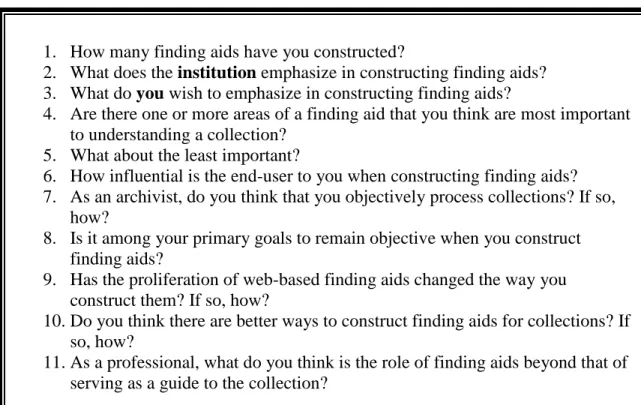
Because this study required answers to a complex series of interrelated questions, I conducted interviews rather than surveys. Interviews lasted from 40 minutes to one hour. The interview instrument included a series of 11 questions with two main categories: technical experience creating finding aids and role of objectivity in that creation.
population of archivists outside of the area. However, it does provide findings that can illuminate the current work as well as recommend promising opportunities for further and deeper research.
Interviews
The interviews, conducted in-person or over the phone, consisted of eleven questions--one quantitative question and 10 qualitative questions. Questions were designed to promote discussion and, with the exception of the first question, none could be answered fully with a single answer. Participants were not privy to the questions before the interview beyond being provided a basic overview of the topic drawn from the initial email correspondence sent to them (Appendix A).
Content Analysis
In tandem with conducting interviews with archivists from identified institutions, this study also investigated the findings aids of those institutions. Using web-based finding aids, this aspect of the study sought to compare the perceptions articulated by the archivists and the final product of the finding aids. Each of the institutions houses thousands of finding aids. This study used them as a lens through which to further investigate the perceptions of archivists in those institutions. To that end, this is not an exhaustive analysis of the content of finding aids. I reviewed 5 finding aids per
Content analyses are frequently used in the field of information and library science.44 As a qualitative content analysis, this study focused on the “subjective interpretation of the content of text data through the systematic classification process of coding and identifying themes or patterns.”45
Thus no metrics were designed to evaluate the finding aids.
Because qualitative content analysis can be difficult to conduct in a consistent manner across all data, this study closely followed Wildemuth’s eight steps of qualitative analysis of content including preparing data, identifying a unit of analysis (one web-based finding aid per institution), developing categories and coding scheme (placement of sections in finding aid, language used in sections written by archivists and additional information added by archivist that is unnecessary for a basic understanding of the contents of the collection), conducting a test of the scheme on a sample, applying the scheme to all the data, assessing the consistency of the scheme, drawing solid
conclusions, and finally reporting the methods and findings.46
44 Barbara Wildemuth, ed., Applications of Social Research Methods to Questions in Information and
Library Science, 308.
45 H.-F Hsieh and S.E. Shannon, “3 Approaches to Qualitative Content Analysis,” Qualitative Health
Research 15 (2008): 1278.
46 Barbara Wildemuth, ed., “Qualitative Analysis of Content,” in Applications of Social Research Methods
IV. Findings
Interviews
The interviews consisted of answering 11 questions (Figure 1).
Figure 1: Interview Guide
I. How many finding aids have you constructed?
This question was intended as a measurement of the different ways that newer and experienced archivists relate to finding aid creation. 6 archivists created fewer than 10 finding aids while 3 created fewer than 20 finding aids. One created approximately 200-300 finding aids and another created approximately 500. Finally, one participant estimated that she created well over 1,500 finding aids.
The participant pool tended toward newer archivists, archivists who have only recently begun creating finding aids as part of their daily work, or in one instance, a participant
1. How many finding aids have you constructed?
2. What does the institution emphasize in constructing finding aids? 3. What do you wish to emphasize in constructing finding aids?
4. Are there one or more areas of a finding aid that you think are most important to understanding a collection?
5. What about the least important?
6. How influential is the end-user to you when constructing finding aids? 7. As an archivist, do you think that you objectively process collections? If so,
how?
8. Is it among your primary goals to remain objective when you construct finding aids?
9. Has the proliferation of web-based finding aids changed the way you construct them? If so, how?
10. Do you think there are better ways to construct finding aids for collections? If so, how?
who is processing a large collection at an item level. In this case, her work on finding aids is extensive, but she is only producing a single one. These participants have worked in the field (in this role) for fewer than 6 years. The 2 more experienced creators of finding aids have been working in the field for longer than 10 years and have supervised colleagues and students in creating finding aids. In many cases, these archivists edit and contribute to finding aids created by others. Finally, one participant was responsible for reformatting paper legacy finding aids to standards compliant with today’s finding aids— machine-readable with all sections compliant with DACS.
II. What does the institution emphasize in constructing finding aids?
Answers to this question yielded a cluster of similar answers among all participants, but additional answers varied considerably.
All participants mentioned Scope and Content notes, Provenance, creator’s original order or organizational structure, Historical and Biographical notes and descriptive chronological histories as being the most important aspects of finding aids for institutions.
As 3 participants mentioned, with a revamped front-end presentation to web-based finding aids, there is a greater focus on the content of the collection.
One participant explained that the personal guidance she received from a mentor at the institution was stronger than the formalized institutional guidance in the form of handbooks she received.
significant role in subsequent questions including the personal deprioritization of certain fields).
One participant summarized description in all aspects of the finding aid as important.
One participant explained that she “documents decisions I’ve made as a processor so people understand how things ended up where they did.”47
3 participants also made sure to mention that finding aids needed to be DACS compliant and follow local and national style guide conventions.
III. What do you wish to emphasize in constructing finding aids?
Participant answers fell into 2 categories: content decisions and stylistic preferences when constructing a finding aid.
6 participants reported that they attempt to emphasize Scope and Content notes both at the collection and series levels. One participant explained that she “enjoyed doing the research” specific to Scope and Content notes. Related, one participant aimed to emphasize Subject Access “especially when the researcher would have no other reason to look at a particular collection based on an innocuous collection name.”48
On the other hand, one participant only offers “introductory information” elaborating, “Collections are so huge, and there is no room to chat. The
47
Interviewee #10, Interview by author, Chapel Hill, NC, March 2012.
expectation is that you are not detailed.”49
Similarly, one participant explained, “[I give a] general feel for what’s in collection, broadly defined [such as a] Scope and Content note… [I] put in notes where materials jump out.”50
One participant expressed, “I spend time determining intellectual arrangement. It’s the creative part that why I emphasize it” and then elaborated, “You impose it on a collection. You can’t read it.”51
3 participants chose to highlight access restrictions as important aspects of a finding aid.
One participant explained that thematic connections among areas within the finding aid and other related collections in the institution are essential to underscore in finding aids.
One participant suggested that a “balance of content and the structure of the content are most important”52—what the finding aid contains is equally important to the way in which it is displayed to users.
One participant noted that the institution is less concerned “with creating the perfect finding aid than…about simply getting it done and moving on to the next one.”53
Stylistically, one participant emphasized brevity, while 6 spoke of the importance of folder titles as valuable content for a user, which may also reveal the
49 Interviewee #10, Interview by author, Chapel Hill, NC, March 2012. 50 Interviewee #3, Interview by author, Durham, NC, March 2012. 51 Interviewee #12, Interview by author, Chapel Hill, NC, March 2012. 52
Interviewee #3, Interview by author, Durham, NC, March 2012.
organization schema of the creator. One participant explained the need for “succinct narrative about a collection to interpret at a glance.”54
IV. Are there one or more areas of a finding aid that you think are most important to
understanding a collection?
Answers to this question clustered around one focus, but varied on additional points.
Important to 9 of the participants were Scope and Content notes, which as one participant noted “explains the process—how you are organizing the materials.”55
One participant identified the Abstract and Collection Overview, which “tells you about research.”56
4 participants identified container listings including detailed folder titles and another participant explained that Collection Overviews “allow you to make the case for your collection.”57
Similarly, one participant said, “I come to my understanding of processing by folders.”58
Echoing one participant’s answer in a previous question, another participant pinpointed meaningful relationships between collections as the most important area of a finding aid even if her institution does not emphasize this area.
Related, one participant noted the structure of collections namely the series as important to “conceive of and articulate otherwise it’s a lost game from the
54 Interviewee #1, Interview by author, Durham, NC, February 2012. 55 Interviewee #7, Interview by author, Raleigh, NC, March 2012. 56 Interviewee #2, Interview by author, Durham, NC, March 2012. 57
Interviewee #5, Interview by author, Durham, NC, March 2012.
beginning.”59
Another participant explained that series are most important because “series is what archivist’s do.”60
V. What about the [areas a finding aid that are] least important [to understanding a
collection]?
Answers to this question highlighted particular areas that no longer seemed useful as well as external web-based and cataloging technologies that offer alternative information about the collection.
With the proliferation of web-based finding aids, 2 participants identified front matter to be of little importance noting that researchers want access to the information no matter the institution that houses it. Similarly, one participant pinpointed provenance and authenticity to be unnecessary.
One participant explained that the Biographical note was least important because “no one is looking to finding aids as a huge resource. It’s not an
encyclopedia…not exhaustive…it represents a collection.”61
Echoing this sentiment, one participant suggested, “Archivists are not historians.”62
Another participant explained that folder lists are not always helpful. This
participant characterized them as “vague, erroneous, imposed by archivist, so they are arbitrary…the granularity of folder lists is gratuitous.”63
59 Interviewee #3, Interview by author, Durham, NC, March 2012. 60
Interviewee #12, Interview by author, Chapel Hill, NC, March 2012.
Another emphasized that Controlled Terms are becoming less important especially for novice users who may not understand the phrase.
Yet 2 other participants identified administrative notes including general physical description and location as unimportant in a finding aid.
Still 3 others suggested that Subject Headings are irrelevant because of the MARC [catalog] record and Abstracts are repetitive especially with small collections where the Scope and Content note includes the same information.
One participant who explained that Subject Headings were unhelpful said, “Smart systems can uncover the words that are already in the finding aids.”64
VI. As an archivist, do you think that you objectively process collections? If so, how?
Answers to this question were straightforward, but not without reflection among the participants, which, in some cases, led to slightly different conversations from the original answer.
8 of twelve participants explained that they strive for objectivity when processing collections.
Of the 4 that did not, one explained that her work at a specialized repository involved materials donated specifically because of its “mission and ethos.”65 A second participant noted that her “historical subject knowledge and experiential knowledge come through”66 in her work, disallowing any notion of pure
64 Interviewee #3, Interview by author, Durham, NC, March 2012.
objectivity. A third participant explained, “There is no such thing as pure objectivity.”67
And the fourth explained, “[It is] not possible to be objective which is why finding aids should be minimal.”68
Of those participants who thought objectivity was possible in creating a finding aid (and processing a collection), several followed up with answers that spoke more to subjectivity.
One participant noted that when processing long-term collections, she tended to become protective over the contents, which led to subjectivity.
Another participant suggested that even with a goal of objectivity, every collection “sucks you in.”69
In describing folder titles for a collection, one participant elucidated, “You are less objective when you make decisions…what you choose to highlight because [it is interesting to you] in series is subjective.”70 Several answers to this question dealt with the issue of restrictions in the form of
controlling access or redacting portions of documents in an open collection. Maintaining objectivity for the archivists was connected to that of the users. If the archivists did not fight to allow open access, then users would not be privy to a full picture of his/her research focus.
67 Interviewee #3, Interview by author, Durham, NC, March 2012.
68 Interviewee #12, Interview by author, Chapel Hill, NC, March 2012. 69
Interviewee #2, Interview by author, Durham, NC, March 2012.
One participant explained that restrictions are a practical necessity that has “nothing to do with objectivity.”71
The same participant went on to remark, “Prejudices have no place because you can end up censoring.”72
So, while she understood the necessity of restrictions, prejudices could lead to a censorship all its own.
VII. Is it among your primary goals to remain objective when you construct finding
aids?
Answers to these questions fell into 2 categories: the intellectual process in striving toward objectivity and the physical manner in which it is displayed in the finding aid.
With regard to the intellectual process, one participant suggested that she only processed collections that interested her, which made striving for objectivity much more important even though she does not think she achieves it. By contrast, another participant noted that because she processed collections that were not aligned with her interests, she had no problems maintaining objectivity, even if she did not think about the impact of objectivity while processing.
4 participants emphasized the challenges of objectivity and donor relations. One explained working with a donor whose materials were subsequently restricted, which she felt challenged objectivity. Another 3 described the daily tedium of interacting with donors who provide input processing decisions and finding aids.
Specific to the construction of finding aids, 2 participants explained that historical subject knowledge and personal values influence the way in which aspects of a
collection were described. With examples such as race relations or a contentious public figure, they noted difficulties in remaining objective.
To combat subjectivity, one participant explained that she based the Scope and Content notes exclusively on facts rather than offering subjective statements, which “makes for a dry read.”73
The same participant declared, “I am a rule follower”74
and explained that she maintained her objectivity by sticking closely to original order and other processing guidelines.
One participant remarked, “More than objectivity, it’s transparency that is
important…documenting decisions that I make [when processing a collection].”75
Similarly, one participant explained his attempt at objectivity, but focuses on “impartiality through methods and practices.”76
VIII. Has the proliferation of web-based finding aids changed the way you construct
them? If so, how?
All but 2 participants have worked solely with web-based finding aids. Those
participants noted the simple interface and streamlined style sheets as contributing to the ease of use of finding aids.
One participant spoke directly to the availability of the Web. She noted, “Finding aids online are fantastic. It makes collections exist. But they directly replicate
73 Interviewee #4, Interview by author, Durham, NC, March 2012. 74 Ibid.
75
Interviewee #10, Interview by author, Chapel Hill, NC, March 2012.
finding aids we create on paper. We are not in touch with the way that makes websites useful.”77
One participant contended that web-based finding aids may challenge objectivity in that restricted access in an increasingly accessible environment may signal to users that the materials have value of some kind.
Another participant harkened back to the way she was taught to construct finding aids. Even though she has been processing for fewer than 3 years, she noticed that the ability for users to “drop into the middle of a finding aid” meant that she “forces distinction”78
in the various aspects of the finding aid. She has started tightening her language in the traditionally longer areas of a finding aid (Collection Overview, Scope and Content notes, Biographical and Historical notes) to keep relevant information available to users.
Echoing those sentiments, one participant took notice of keywords that she used to create finding aids that may be searchable. One participant felt assured by the CTRL + F search function in electronic finding aids. “Knowing that the [search function] exists changes the way I think about it. Series are less important. As long as information is labeled, decisions are not as important.”79 Similarly, one participant contended, “Because of the ubiquitous-ness of information, finding
77 Interviewee #11, Interview by author, Chapel Hill, NC, March 2012. 78 Interviewee #6, Interview by author, Raleigh, NC, March 2012. 79
aids are getting shorter… [There is] less compunction to add all the information knowing that if users want to know more they can research it.”80
One participant took a global approach to the question by stating that archivists should view collections as whole and in relationship to other archival institutions. “Finding aids have a constellation of users and objects. Before [finding aids were] ‘invisible facilitator[s].’ Now it’s a place where connections can be made. Finding aids give people ideas of representing collections that are not strict categories… [that are] more fluid now, which is a good and bad thing.”81
IX. How influential is the end-user to you when constructing finding aids?
10 of 12 participants explained that end users are important if not a primary influence when constructing finding aids. Of the 2 participants who did not, one explained that end users are “half of what’s on my mind,”82 while the other participant remarked that she “thinks about them a bit.”83
One participant stated, “I really believe that archival collections exist to be used.”84
More specifically, 5 participants explained that, during the creation of a finding aid for a collection, they were guided by envisioning research questions of potential users.
80 Interviewee #3, Interview by author, Durham, NC, March 2012. 81 Interviewee #12, Interview by author, Chapel Hill, NC, March 2012. 82 Interviewee #12, Interview by author, Chapel Hill, NC, March 2012. 83
Interviewee #10, Interview by author, Chapel Hill, NC, March 2012.
Another participant asserted that she is a “sort of teacher”85 to end-users as an expert of the collection.
One participant cautioned, however, that she does not get too involved in considering the end-user for fear of creating an overly descriptive finding aid, which can become too subjective in its focus. To that end, she avoids phrases such as “Of particular interest” that may steer certain users away from the collection.
The participant who contended that end users represent “half of what’s on my mind” explained that his goal is to make sure the collection has an “inherent structure made explicit by balancing between usability and fidelity to material.”86 He elaborated, “The goal is to get them researching not spending time with finding aid. Too much description can stifle research or give them the wrong impression of the collection.”87
Finally, he noted, “Finding aids only exist for researcher—structured, intellectual schematic so that they can enter collection in way that’s useful.”88
The participant who explained that she “thinks about [end users] a bit” said, “Some collections are so disorganized, it’s hard to find what they want quickly-that’s not the nature of historical research. I find solace in CTRL + F function.”89
85Interviewee #1, Interview by author, Durham, NC, February 2012.
86 Interviewee #12, Interview by author, Chapel Hill, NC, March 2012. 87 Ibid.
88 Ibid.
X. Do you think there are better ways to construct finding aids for collections? If so,
how?
Participant answers to this question yielded 2 main categories of answers: intellectual considerations that would enhance finding aids and physical modifications to existing finding aids that would function in dynamic ways. Searchability also emerged as a topic that several participants discussed, if briefly.
One participant noted, “Sections [of finding aids] cover the bases and I am okay with that. Not all are important to every researcher. “I’m okay with what we’ve got.”90
One participant noted that “intellectually describing the collection’s organization”91
could aid users. Another participant noted a similar point: “Intellectual process trumps physical location.”92
Another participant wanted finding aids to link to relevant and broader themes including history and culture providing a “comprehensive understanding for individuals”93
of available materials. To that end, the participant noted the importance of placing finding aids in a context and pondered the end-user: “Information seekers don’t stop seeking.”94
Still another participant noted that collections could relate topically or to a moment in history rather than an individual.
90 Interviewee #11, Interview by author, Chapel Hill, NC, March 2012. 91 Interviewee #5, Interview by author, Durham, NC, March 2012. 92 Interviewee #10, Interview by author, Chapel Hill, NC, March 2012. 93
Interviewee #1, Interview by author, Durham, NC, February 2012.
One participant explained in-depth the need to promote Encoded Archival Context as “a move in the right direction.”95 She stressed the importance of making institutional connections saying, “When researchers learn all the stuff that is out there, it will bode well for everyone.”96
In agreement, another participant remarked that finding aids “are like silos that do not talk to each other, but they need to.”97 Another said that finding aids must “connect the dots”98
but emphasized that archivists should not do research for users, but instead connect content so that users can see everything available to them. Finally, another participant explained the need for finding aids to offer “different views of the collection that are not static.”99
5 participants, in ruminating over this question, contemplated the “point of finding aids”100
asking aloud “What’s a finding aid, anyway?”101 “It is an outdated method of research.”102
“It is a static document.”103 “[Finding aids] are
95 Interviewee #4, Interview by author, Durham, NC, March 2012. 96 Ibid.
97 Interviewee #5, Interview by author, Durham, NC, March 2012. 98 Interviewee #2, Interview by author, Durham, NC, March 2012. 99 Interviewee #6, Interview by author, Raleigh, NC, March 2012. 100 Interviewee #5, Interview by author, Durham, NC, March 2012. 101 Interviewee #4, Interview by author, Durham, NC, March 2012. 102
Interviewee #1, Interview by author, Durham, NC, February 2012.
being used as a way to find a container and get it.”104
“[Finding aids] are electronic versions of the paper collection, and that’s it.”105
Yet another participant proclaimed, “Catalog records are becoming more dynamic, so finding aids are becoming less relevant.”106
In contrast, another participant noted, “Catalog records for collection are not helpful. Finding aids work much better.”107
3 participants focused on changes that could be made to enhance finding aids.
One participant described an approach to finding aids at her
institution--interactive guides may be the most useful way to handle the information already available in finding aids. This technique would allow users to view a “whole picture of what we have” and could “pull together all materials related” to topics that interested the user.108
One participant focused on the need to relate digital collections to other materials, while another considered adding thumbnails to finding aids, which she thought would be successful because “people are used to seeing images everywhere.”109
In contrast, one participant worried that adding too many images to a finding aid
104 Interviewee #2, Interview by author, Durham, NC, March 2012. 105 Interviewee #11, Interview by author, Chapel Hill, NC, March 2012. 106 Interviewee #5, Interview by author, Durham, NC, March 2012. 107 Interviewee #11, Interview by author, Chapel Hill, NC, March 2012. 108
Interviewee #6, Interview by author, Raleigh, NC, March 2012.
would restrict access to those with poor broadband services—“things would take too long to look through.”110
Another participant hoped to use finding aids that served as a “portal into big collections.”111
One participant expressed the need for a processor’s note in every finding aid.
XI. As a professional, what do you think is the role of finding aids beyond that of
serving as a guide to the collection?
Answers to this question revealed 2 roles for finding aids: internal to the repository or archival community; and external to a wider public.
One participant mused that finding aids “determine how archivists process collections and how that reflects the priorities and values of an institution.”112
Another suggested that they serve administrative functions.
One participant explained, “[Finding aids] are polymorphous, offering different ways to view collection… [They are] set up in a way to re-organize intellectual order for different purposes. There is an assumption on the part of archivist on who will be accessing the collection and finding aid. It is not tailored to work for general public.”113
110 Interviewee #11, Interview by author, Chapel Hill, NC, March 2012. 111 Interviewee #1, Interview by author, Durham, NC, February 2012. 112
Interviewee #3, Interview by author, Durham, NC, March 2012.
One participant explained succinctly that finding aids are most useful as a tool and emphasized that finding aids should not replace something else.
3 participants agreed that finding aids serve as outreach and public relations for an institution.
One participant said that finding aids are portals into and out of collection, linking up with other digital materials/collections, and cross-referencing to other
institutions.
2 participants mentioned the additional use of finding aids as “advertisements”114 and “discovering other collections.”115
One participant noted, “[Finding aids are] interesting documents themselves— how people are writing about history all relates to the finding aid.”116
Analysis
All of the archivists interviewed for this study reported that they reflect upon potential users of collections in archival processing and finding aid creation. This signals an intrinsic connection between the individual shaping the collection and the one
accessing its contents. This relationship is one that could be made more explicit to benefit end users. Certainly this disclosure would represent a shift in principles governing archival processing standard. But, perhaps they are already shifting. Once an archival
114 Interviewee #2, Interview by author, Durham, NC, March 2012. 115
Interviewee #1, Interview by author, Durham, NC, February 2012.
guideline, only one of the archivists interviewed for this study articulated her commitment to original order.
There exists a disparity between the way finding aids currently function and the imagined future use of finding aids. Participants tended to stay within the parameters of their institution’s guidelines emphasizing Scope and Content notes, Series notes and Container Listings. With web-based finding aids as the exclusive method of creation, collection overviews and abstracts are getting shorter and more concise. While archivists reported that they adhere to the standards set by their institutions, they all articulated visions of future finding aids. In particular, archivists identified subject access and thematic connections over controlled areas and physical location of materials. Archivists desired to make connections with finding aids that would move away from static tools to more dynamic and interactive networks of information that transcend institutions,
language and format to bring related materials to users located anywhere.
With regard to objectivity, most participants claimed a desire to strive towards objectivity with many asserting that they achieve objectivity in their work. However, the fuller answers to their questions challenge those claims. For example, when considering redacting portions of documents that may expose an individual’s or institution’s
participant justified her objectivity even after explaining that she highlights materials in a collection that she finds the most intriguing.
Indeed, objectivity is nearly impossible to achieve when digging through historically rich materials created by another entity. Archival processing is like getting paid to read people’s mail every single day, in high volumes. So, why did these
archivists, generally, grasp onto the notion of objectivity? Why not subscribe to Light and Hyry’s recommendation of adding a short biographical sketch of the archivist into the finding aid? This would allow archivists intellectual room to consider materials in various contextual arenas and offer users a deeper understanding of the materials.
If archivists are still striving toward objectivity, then it is possible that they are not processing collections in a manner that best suits users. As one participant explained, the only way to combat subjectivity (or leaving her fingerprint on finding aids) is to offer a dry introduction and description of the collection. Is that our only other option? To avoid revealing ourselves to users, we produce dry road maps to rich collections? Interviews revealed numerous points of tension both in conceptual frameworks that underpin finding aids as well as stylistic choices in constructing them. Still, the biggest point of tension is in the role and persistence of objectivity.
Context and transparency are intertwining concepts. In order to gain transparency, archivists must offer context—either of their process or that of the collection. Few
processing decisions could be viewed as inviting users to understand arrangement and description.
A related point of tension includes the level of description in finding aids. Offering detailed Biographical and/or Historical notes could disclose to users the framework within which the archivist understands the collection. The move away from verbose notes (attributed by participants to web-based findings aids, searchability within those documents, and readily accessible resources through the Web) could indicate a lack of transparency and thus context. However, as one participant explained, there is an assumption that users will conduct their own research—that the role of an archivist differs from that of an historian. This presupposition, though, may speak strongly to the need for contextualization—in this instance, the user will find information. But, this participant still remained aware of the research that will occur and continued to create finding aids with that knowledge. In other words, does the source of the context matter? As long as collections and finding aids are being contextualized, does that service the same goal? Couldn’t transparency, the end result of this contextualization, be achieved in this manner too?
The participants’ answers diverged from literature in two important ways—one based in contextualizing finding aids, and one in the placement of archivists at the nexus of this discussion. 3 participants stated the importance of viewing finding aids as
documents of history, culture or society—revealing the way in which we arranged and (especially) described collections and the priorities and values of the home institutions. Positioning finding aids as historical documents could serve as a persuasive argument for increased context and subjectivity. As Light and Hyry advocate, augmenting finding aids to include information on the processer and a list of modified and/or deaccessioned contents of the collection could contribute to their richness.117
Moreover, finding aids could achieve agency as historical artifacts beyond service to collections. A history of the archival profession may be found in the tools created for another purpose! Indeed, it is only by centralizing the attitudes and perceptions of archivists that these conclusions can be drawn. Thus a significant contribution to the literature is the voices of archivists as influential creators of this historical and topical documentation.
Content Analysis
No two finding aids are exactly the same. Collections contain materials and formats unique to the creator, which are accessioned with various restrictions and priorities; and processed by an archivist often with the help of a volunteer or student assistant over a period of time with certain budgetary and time constraints. Depending on the institution’s template for creating finding aids, some fields may be required at one institution and omitted from another. University of North Carolina at Chapel Hill’s
manual, How To Proceed contains a section entitled “The ‘Typical’ Finding Aid” which indicates, “In the messy world of manuscripts, nothing is typical. There are, however, finding aid formats that can be established, standards that can be set, and procedures that can be followed. The key, of course, is to apply the formats, standards, and procedures with flexibility.”118
Thus a comparison of finding aids within and across institutions is a challenge, to say the least.
However, because finding aids are the effective culmination of the archival process, it is necessary to understand what institutions require in their sections and what archivists choose to elaborate in those finding aids. Finding aids are, as one participant suggested, the first impression of a special collection to users, so it is even more
important to engage in an analysis of the products of the institution.119
A 2012 study of novice and advanced users of web-based finding aids found, Advanced participants disagreed with some structural decisions made by archivists concerning the order of sections in finding aids, but at the same time confirmed that increased navigational capabilities in the form of fixed tables of contents with hyperlinks to sections of the finding aid enhance usability by overcoming possible confusion that may be caused by the structure of the finding aid itself.120
Indeed, no matter the placement of sections in finding aids, some users will find it a helpful tool, while others will not. Furthermore, finding aids do not offer details of every aspect of the archival process, which may be important to users. As one participant in this study remarked, finding aids do not “accurately reflect what we have done up until that
118 University of North Carolina at Chapel Hill, “How To Proceed: Archival Processing at UNC”
http://www.lib.unc.edu/wikis/archproc/index.php/How_to_Proceed:_Describing (accessed March 2012).
119 Interviewee #8, Interview by author, Raleigh, NC, March 2012.
point. [We deal with] preservation, processing, time spent arranging, and understanding the [material]. [The finding aid] looks less impressive than if it showed the work we did.”121
Certainly, finding aids cannot expose every stage of archival processing. However, they could be used as a portal through which to examine the influence of archivists on finding aids even within the structured and standardized web-based environment within which they are conceived.
Notions of subjectivity are also illustrated in completed finding aids. Displays may be based on usability studies and comparative analyses of finding aids from other institutions. Ultimately, however, subjective decisions guide changes to the interface or style sheet. Thus the perceptions of archivists as well as completed finding aids are both shrouded in some level of subjectivity.
This study investigated 3 aspects of web-based finding aids found on institutional websites: first, the placement of sections in the finding aid; second, the language used in sections written by archivists; and third, additional information added by archivists that is unnecessary for a basic understanding of the contents of the collection. This analysis was intended to frame the attitudes of participants rather than serving as an in-depth study of all aspects of finding aids. Do finding aids uphold the priorities voiced by archivists?
Duke University
After a major overhaul, Duke University unveiled newly formatted web-based finding aids in early 2012. Very recently, in mid-March 2012, Technical Services posted a guide to their new findings aid on the library’s blog drawing attention to what they
referred to as a “facelift.”122
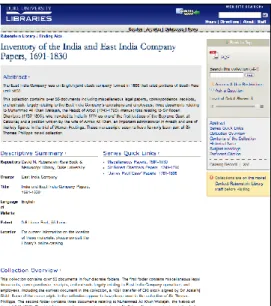
New finding aids are prepared with an expandable style sheet and clean interface with the institutional banner across the top and a sidebar menu featuring a PDF version of the finding aid, quick links to its sections, a slide bar that visually displays the level of detail on the screen, a search bar, link to ask further questions and catalog and XML display options.123
Figure 2: Duke University Finding Aids
At the top of the finding aid, the collection title including date ranges is displayed (see Figure 2). Directly underneath, the Collection Overview or Abstract marks the start of the finding aid. Below that, the Descriptive Summary offers collection metadata and institutional information; and Series Quick Links, which link to aspects of the contents of the collection. Some finding aids include either Collection Overviews or Abstracts below that, while others do not. Administrative Information informs users of Access
122 Duke University Libraries, The Devil’s Tale: Dispatches from the David M. Rubenstein Library, “Finding Aid Facelift!” http://blogs.library.duke.edu/rubenstein/2012/03/14/finding-aid-facelift/ (accessed March 2012).
Restrictions and Use Restrictions after which the Contents of the Collection, which is divided by Accessions or Container Lists. Toward the bottom of the interface include Historical Notes, Subject Headings, Related Material including other collections housed within the institution, Preferred Citation, Provenance of the materials, and Processing Information including names and dates of the archivists who processed the collection and encoded the finding aid (in EAD).
Even with the institution’s new format, there are still inconsistencies in the content of the finding aid. This can be attributed to the standard to which the finding aid adhered when it was created, or the personal input of the archivist creating it. As an illustration, participants from Duke University identified Scope and Content notes as being of particular importance when creating a finding aid. However, the top of the finding aids features a Collection Overview or Abstract, which ranges from a few sentences to multiple paragraphs.
Language used in finding aids serves as a guide for users to understand the contents of the collection. For some of Duke’s finding aids, the way that archivists describe aspects of the collection signals subjectivity by the archivist. For instance, in 2011, the final processing and encoding occurred for “Inventory of the Sidney Weintraub Papers, 1938-1984 and Undated.”124 The “preliminary” finding aid was drafted in 1985. The Collection Overview of this finding aid includes the statement: “Of particular interest here is the early work on the publication of Capitalism's Inflation and Unemployment
Crisis. Also of interest is the work that Weintraub did for the Canadian Institute for
124
Inventory of the Sidney Weintraub Papers, 1938-1984 and Undated. Rubenstein Library. Duke