The Integration of Mental and Physical Health Care
in Northeastern North Carolina
By Angela Wood
A Master’s Paper submitted to the faculty of the University of North Carolina at Chapel Hill
In partial fulfillment of the requirements for the degree of Master of Public Health in
the Public Health Leadership Program.
Chapel Hill 2012
The Merriam Webster Dictionary defines health as the condition of being sound in body, mind, or spirit. Health, as officially defined by the World Health Organization (WHO), is a state of complete physical, mental, and social well-being, not merely the absence of disease or
infirmity (World Health Organization, 1946). In order to attain good overall health, one must maintain physical fitness, mental stability, and social comfort and keep all three of these entities in a balance. Without good physical health, mental or emotional health will be compromised. Likewise, an imbalance of psychological or social health can cause a breakdown of a one’s physical state.
Mental health and mental illness represent different states of psychological well-being. As defined by the WHO, mental health is “a state of well-being in which the individual realizes his or her own abilities, can cope with the normal stresses of life, can work productively and fruitfully, and is able to make a contribution to his or her community.” According to The U.S. Department of Health and Human Services Mental Health: A Report of the Surgeon General, published in 1999, an estimated 17% of adults nationwide are considered to be in a state of optimal mental health. This means there is a balance between a person’s physical state and mental state. One way to improve mental health is to improve one’s physical health by eating well, exercising moderately and sleeping properly. Other ways to achieve favorable mental health are to have a fulfilling occupation or hobby and a rewarding relationship with another person. Additionally, the ability to become aware of one’s thoughts and feelings and to modify them when needed is essential to gaining optimal mental health (Penick, 2010).
combination thereof) associated with distress and/or impaired functioning.” In the United States, 46% of the people meet the criteria for a mental health illness at least once in their lifetime (Kessler RC B. P., 2005). Depression is one of the most common forms of mental illness and a major cause of morbidity worldwide (World Health Organization, 2001). Lifetime prevalence of unipolar depression is 17% in the United States (Andrade L, 2003). It has been estimated that by the year 2020, depression will be the second leading cause of disability throughout the world, following ischemic cardiac disease (Murray CJL, 1998).
Mental illness is a significant public health problem which can have a tremendous financial impact on the individual, their family and society. The economic burden of mental illness is high with an estimated cost of over fifty billion spent in 2006, according to the Agency for Healthcare Research and Quality (Soni, 2009). The financial burden of mental health care comes directly from mental health facilities, treatment programs and pharmaceuticals and indirectly from loss of work days or reduced work hours, related to emotional distress. Studies have showed that depression is associated with a higher rate of short-term disability compared to other chronic mental or physical illness (Kessler RC B. C., 1999).
limits under a group health plan.” In essence, it allowed mental illness treatment to be covered no different than treatment for a chronic physical condition such as diabetes or hypertension (Fact Sheet: The Mental Health Parity Act).
Many chronic physical health problems such as heart disease, diabetes, asthma, cancer, anxiety and eating disorders are associated with an increased incidence of mental illness. Depression is a comorbid disabling condition that affects approximately 15% to 25% of cancer patients (Derogatis LR, 1983). Researchers at Michigan State University found that 45 % of the 99 patients hospitalized for manic phase of bipolar illness were hypertensive, compared with the 30.5% rate of hypertension in the general population (D'Mello, 2010). The co-existence of mental health disease and physical health illness may result in a delay of diagnosis and a more complicated and less satisfying treatment outcome.
One explanation of the increased association of physical health diseases with mental illnesses is that the lifestyle of those people with serious mental illness may not be ideal. Many times those suffering from mental illness, especially schizophrenia, tend to have poor eating habits, obesity, and increase rates of smoking, drinking and usage of street drugs. Also, many antipsychotics medications used to treat mental illness are associated with weight gain, onset of diabetes and abnormal changes on electrocardiograms. The Mount Sinai Conference was organized in 2002 in New York City at the Mount Sinai School of Medicine to address this concern and to make recommendations to improve the physical health monitoring of patients with schizophrenia. Their recommendations were that early detection and intervention of physical health problems can improve the overall well being of those suffering from mental health illness (Marder, Essock, Miller, & al, 2004).
with systems-based enhanced depression care that provides accurate diagnosis, strong
collaborative relationships between primary care and mental health providers, and longitudinal case management, to assure appropriate treatment and follow-up” (Gjerdingen & Yawn, 2007).
In a study published in Pediatrics, researchers from the Departments of Pediatrics and Psychiatry at Wake Forest University Health Sciences, Winston-Salem, NC conducted a standard interview with 47 primary care pediatricians in the state and concluded that approximately 15% of the children in their practice had a behavioral health disorder such as attention deficit disorder, anxiety or depression (Williams & Klinepeter, 2004). In another survey of primary care
practices, most physicians reported that “they did not have enough knowledge and support to detect and manage mental health problems in young children and that they received minimal undergraduate training” (Cawthorpe, 2005).
Mental illness in children and adults can be successfully managed with good programs and integrated care with primary health systems. Healthy People is a program which establishes objectives and goals every ten years to improve the health of all Americans. Healthy People 2020 goal for mental illness is to “improve mental health through prevention and by ensuring access to appropriate, quality mental health services.” Two specific 2020 objectives for mental health care are to 1) increase the proportion of primary care physician office visits that screen adults aged 19 years and older for depression and to 2) increase the proportion of primary care physician office visits that screen youth aged 12 to 18 years for depression (US Department of Health and Human Services, 2012).
18, with serious emotional disturbances who receive treatment, 2) increase the proportion of adults with mental illnesses who receive treatment and 3) increase the proportion of adults over 65 with mental illness who receive treatment (Healthy Carolinians).
North Carolina’s 2020 Healthy Carolinian goals also recognize the importance of improving the mental health status of all individuals throughout the state. Better mental health often leads to better physical health and happier, more productive citizens of the state, who over their lifetime will use less health care services. Mental health objectives for 2020 were made to be more specific and are 1) to reduce the suicide rate from 12.4 per 100,000 population in 2008 to 8.4 per 100,000 population by the year 2020, 2) to decrease the average number of poor mental health days among adults in the past thirty days and 3) to reduce the rate of mental-health related visits to emergency rooms (Healthy Carolinians, 2011). It is recognized that patients with mental health crisis may need to be served in emergency departments but those with other mental health problems are best treated in centers which provide regular and comprehensive care (North Carolina Institute of Medicine, 2011).
primary practice in a rural area or in a county that has been persistently designated as a primary care health professional shortage area. The project also reported that in 2004, 15.6% of
psychiatrists reported a primary practice in a rural area compared to 21.6% of physicians with other specialties (Fraher & Swartz, 2006).
The shortage of mental health professionals in low income and rural areas necessitates that many primary care health providers are seeing patients with mental health illness in their offices. Severe or chronic cases of mental illness are usually serviced strictly by mental health professionals in mental health facilities. Patients who have minor or less severe forms of mental illness will seek help at the office of their primary care medical provider or the emergency room. Most primary care clinicians and emergency room doctors feel poorly equipped and trained in providing screening, diagnosing and treating acute mental illness. In a study looking at the care given to patients with mental health concerns, it was found that physicians and nurse
practitioners in primary care failed to identify very few of the specific mental health disorders most prevalent in primary medical care practice (Borus, J, & al, 1988). Likewise, mental health professionals who are managing the more complex individual with mental health illness, feel unequipped to provide care for the physical health needs of these individuals. An efficient and comfortable referral system between mental health providers and physical health providers is needed especially in areas with a shortage of mental health professionals.
Cottingham, 1984). As more became known of mental health disease, services and funding became available to treat the patient with mental health illness, but the services were separated from physical health services. A call to “reattach the head to the body” has been made to
overcome barriers and for health care providers to care for both the mental and physical health of the patient.
A logic model was developed by both mental health and public health professionals to address the coordination of care between mental health and physical health. The impetus for such a model came out of a meeting held in 2004 by the National Center for Chronic Disease
Prevention and Health Promotion called, “Mind the Body.” Staff participants included
researchers, educators and program and policy makers from the Centers for Disease Control and Prevention (CDC) who were interested in how to better integrate mental health into chronic illness prevention and health promotion. It was concluded from the meeting that a logic model should be developed to better address this important issue (Lando, 2006). A logic model is a model which visually conveys the association and connection between inputs, program activities and desired outcomes (short term, mid term and long-term).
Short-term outcomes for this model are the generation of community and professional awareness of the relationship of mental health and physical health and the understanding that good mental health is essential to maintaining good physical health. Mid-term outcomes are better treatment and referral patterns for those with mental health and physical health issues in the clinical settings of physician offices and health clinics. In addition, community support is a desired outcome along with improving the understanding of the individual between the
connection between good mental health and good physical health. Long-term outcomes look at improving the general health, both mental and physical, of the entire nation and aiming for a society where individuals are better able to adapt to life changes and quality of health is improved for all.
The National Council for Community Behavioral Healthcare (NCCBH) proposed a Four Quadrant Clinical Integration Model for the incorporation of physical health services and
behavioral health services for the individual with mental health and physical health needs (Parks & Pollack, 2005).
Low Physical Health Needs
High Physical Health Needs Low
Behavioral Health Needs
Q1 Q3
High Behavioral Health Needs
Q2 Q4
This model is based on a standard of care which is comprehensive and continuous,
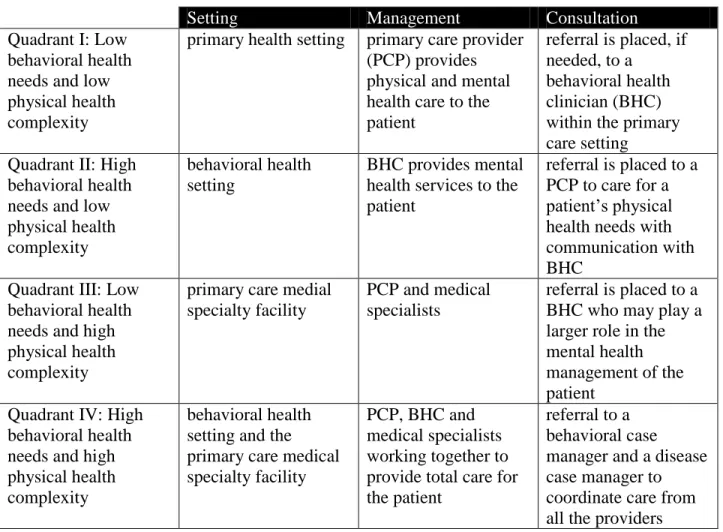
integrating the levels of mental health and substance abuse care with clinical competencies based on the severity of each disorder. The quadrants are described below in Table 2.
Setting Management Consultation
Quadrant I: Low behavioral health needs and low physical health complexity
primary health setting primary care provider (PCP) provides physical and mental health care to the patient
referral is placed, if needed, to a
behavioral health clinician (BHC) within the primary care setting
Quadrant II: High behavioral health needs and low physical health complexity
behavioral health setting
BHC provides mental health services to the patient
referral is placed to a PCP to care for a patient’s physical health needs with communication with BHC
Quadrant III: Low behavioral health needs and high physical health complexity
primary care medial specialty facility
PCP and medical specialists
referral is placed to a BHC who may play a larger role in the mental health management of the patient
Quadrant IV: High behavioral health needs and high physical health complexity
behavioral health setting and the primary care medical specialty facility
PCP, BHC and medical specialists working together to provide total care for the patient
referral to a behavioral case manager and a disease case manager to coordinate care from all the providers Table 2- Description of Four Quadrant Clinical Model
Quadrant I: Low behavioral health needs and low physical health complexity,
served in primary care.
risk, referral is made to a member of a behavioral health clinician (BHC), which is on site in the primary care setting. The BHC provides an assessment of the behavioral health condition and then consultation back to the PCP as well as behavioral health triage, brief treatment of the patient, referral to other community services and health education. The PCP may prescribe psychotropic medications, having access to psychiatric consultation regarding management of psychotropic medications and treatment algorithms. Quadrant I allows the patient consumer to receive both physical and mental health care in the setting of their primary care physician office.
Quadrant II: High behavioral health needs and low physical health complexity,
served in behavioral health setting with coordination with primary care.
The PCP takes on more of a consulting role and provides primary care services and collaborates with the BHC in a setting that is more focused on the behavioral health needs of the individual seeking services. Examples of behavioral health settings are not limited to but may include such entities as a crisis intervention hotline facility, homeless shelter outreach program and individual and/or family therapy group. In this instance, the BHC takes a more active role in the management of the patients, providing psychotropic medical treatment if needed.
Additionally the BHC provides case management to assure housing needs of the patient are met, along with other community supports. The BHC is responsible for creating a communication system with the primary care physician to assure coordination of mental and physical health care of the individual as needed. Management is usually handled by the BHC. Quadrant II is where most behavioral health consumers can be found.
Quadrant III: Low behavioral health needs and high physical health complexity,
The PCP provides primary medical services and works in conjunction with medical specialists to manage the complex medical health needs of the individual (like cardiac disease, diabetes or asthma). Like in quadrant I, the PCP uses standard screening tools and practice guidelines to assess the behavioral health needs of the patients. In addition, depression screening may be integrated into the assessment as many patients with cardiovascular disease, asthma and diabetes suffer from depression. The BHC provides an assessment of the behavioral health condition and then consults back to the PCP. In addition, the BHC provides behavioral health triage, brief treatment of the patient, and referral to other community services. Since these patients are suffering from complex and/or chronic medical conditions, health education regarding lifestyle changes are particularly important. The BHC many times serves as a physician extender, supporting the PCP by helping with problem solving with both acute and chronic patients in addition to helping with medication management and compliance.
Quadrant IV: High behavioral health needs and high physical health complexity, served in both the behavioral health setting and the primary care medical specialty facility.
practice policy is adopted which outlines the specific tasks to be done and how communication is to be accomplished.
The Washtenaw Community Health Organization (WCHO) in Michigan is an example of an organization which utilized the National Council for Community Behavioral Healthcare’s (NCCBH) Four Quadrant Clinical Integration Model to provide health care for their population (Reynolds, Chesney, & Capobianco, 2006). The WCHO was created by the University of Michigan Health System with cooperation and assistance from the local mental health center and private health clinics to provide services to those in the community suffering from severe mental illness. They found that integrating specialty mental health services into primary care practices improves the outcomes for patients with common mental health disorders such as depression. They also found that a barrier to the sustainability of this integrated health care was the financial challenge of reimbursement of the mental and physical health services rendered. This challenge could be successfully managed through additional training of clinical and administrative staff.
The social-ecological model (SEM) for health is a model which examines the relationship that an individual has with its social environment. An individual alone cannot be totally
INDIVIDUAL Seek help for mental health problems. Have available a home depression care management plan for seniors
INTERPERSONAL Respond sensitively to family and friends with mental health conditions. Know what community resources exist and help make contact with appropriate services
CLINICAL CARE Offer screening for depression in adults and adolescents. Offer developmental screening of young children. Deliver culturally competent care and develop crisis plans for persons with mental illness. Stay up to date on evidence based clinical guidelines COMMUNITY AND ENVIRONMENT SCHOOL AND CHILD CARE
Implement evidence-based mental health programs in schools. Train staff to recognize stress and signs of mental illness in children and resources available WORKPLACE Conduct assessment of office stress, health and job
satisfaction and use interventions to target office stressors INSURERS Provide coverage of mental health services in parity with
other health services. Provide coverage for
developmental screenings, psychological behavioral assessments, and depression screening and intervention in primary care settings with no cost sharing
COMMUNITY Facilitate easy entry to services and treatment. Publicize ways to access mental health crisis services outside emergency departments. Create partnership among emergency personnel, school, community hospitals, law enforcement, and behavioral health crisis service
providers
PUBLIC POLICIES Provide funding to support school-based health services. Develop comprehensive systems of care that include prevention, treatment, and recovery supports. Provide tax incentives to encourage comprehensive worksite wellness programs. Implement a surveillance system to promote developmental screenings. Provide funding for research on support and prevention strategies
Figure 1 – SEM and Strategies to Improve Mental Health Care
In North Carolina, the ICARE partnership was developed to help primary care health providers better manage and coordinate the mental health needs of their patients. ICARE stands for integrated, collaborative, assessable, respectful and evidence - based care. This project operated from 2006 to 2009 and developed around the Four Quadrant Model to provide
primary care facilities to provide mental health screening and by establishing effortless and effective referral patterns between the two disciplines (North Carolina Center for Excellence for Integrated Care, 2012).
The ICARE project was also instrumental in helping The University of North Carolina Medical School develop a curriculum which incorporates behavioral and emotional health into the medical training of their students in primary care. The ICARE partnership proved to be a success as health care providers reported improved communication between them and mental health service providers. Likewise, patients reported improved access to mental and physical care.
Another program in North Carolina which has proved successful in the primary care setting to help providers, especially pediatricians to adequately screen for mental health issues is The North Carolina Assuring Better Child Health and Development (ABCD) Project. This program helps pediatricians to implement developmental and behavioral screening and surveillance in their primary care practice. With effective screening, many children and adolescent with behavioral and mental health illnesses can be diagnosed by their primary care provider (Pelletier & Abrams, 2002). One of the 2010 mental health objectives for Healthy Carolinians was to increase the proportion of children and adolescents, birth to age 18, with serious emotional disturbances who receive treatment. Through more effective screening programs for mental disorders in the primary health care setting, more children and adolescents with mental health disease can receive treatment and referral at an earlier age.
substance abuse and that many times the care was “disconnected” because of the health care delivery required “numerous patient interactions with different providers, organizations, and government agencies.” To overcome this barrier, the committee recommended in its report that “individual treatment providers create clinically effective linkages among mental, substance-use, and general health care and other human service agencies caring for these patients.
Complementary actions are also needed from government agencies, purchasers, and accrediting bodies to promote the creation of these linkages” (National Research Council, 2006).
Not only does the health care field recognize the need for the coordination of mental health care and physical health, but consumer organizations such as The National Alliance on Mental Illness (NAMI) also support this initiative. NAMI is the nation’s largest grassroots mental health organization dedicated to improving the quality of lives of children and adults suffering from mental illness with over 210,000 members in 1,200 affiliates across the country. NAMI North Carolina is an active organization which advocates for changes in available programs, governmental policies, and public awareness of mental illness and its impact on society. NAMI advocates for the integration of mental health care and physical health care to improve the quality of total health care for an individual (About NAMI, 1996).
Community Care of North Carolina (CCNC) is a current program in North Carolina for Medicaid clients based on the idea of a medical home for the coordination of quality and cost-effective health care. CCNC is divided into 14 networks across the state. Health professionals enrolled in the CCNC program include both primary care medical providers and mental health
providers. These providers work with others involved in the health care field such as
pharmacists, social service workers, and community health educators to provide coordinated
approach, a primary care physician leads the team and coordinates services and referrals for their
patients. It is a cost efficient approach to health care as it eliminates many high cost health
services such as unnecessary referrals and avoidable emergency room visits. It also deters
duplication of services as patients cannot go to multiple providers without authorization from the
lead physician. Patients chose their medical home but can change their provider if at any time
they feel unsatisfied with their care (Community Care of North Carolina/Carolina ACCESS,
2012).
Partnering with the CCNC is the North Carolina Center of Excellence for Integrated Care which is built on the work of ICARE in assimilating behavioral and mental health treatment and physical health care to improve patient outcomes. The center takes an interdisciplinary team approach and is a resource for the health care professional to help them coordinate the health care of the individual. It provides training to health providers in the tools needed to do
assessments and provides technical assistance to help the providers to implement the services needed to coordinate and apply a standard of care to individuals with mental and physical health care needs (NC Health and Wellness Trust Fund, 2010).
Care Behavioral Health System (OCBHS), are dedicated to improving the mental and physical health of Northeastern North Carolina.
A Plus Results, headquartered in Washington County, North Carolina serves thirteen counties in eastern NC and provides services in child mental health and developmental
disabilities, adolescent behavioral health and substance abuse and adult mental health, substance abuse, disabilities and behavioral health. According to Justin Savoy, a qualified clinical
professional at A Plus Results, clients usually come self referred, but many are sent by their physicians, family members, employers, school officials or the legal system. After the initial input evaluation, clients receive a thorough clinical assessment by a licensed social worker. Information from the clinical assessment is used to develop a person centered plan which is individualized to the client’s mental health needs and includes both short term and long term treatment goals.
a primary health care provider. The agency strives to overcome any barriers by helping the client arrange for time off from work for their health visit, assisting them to set up babysitting for their children, and providing transportation or gas money to their appointments. A staff member of A Plus Results will even accompany the client to their primary medical care visit if the client wishes for this service. A Plus Results also will refer any client who does not have medical insurance or who is under insured to the proper agency to apply for any financial health assistance.
The staff at OCBHS knows the importance of the client receiving both optimal mental health care and physical health care. Deon Robinson, owner of OCBHS, has set a goal of 100% compliance by the end of 2012 for clients receiving mental health services at his agency to have a current primary care provider. The staff at OCBHS will assist any client to make an
appointment for a primary care health evaluation or will set one up for them with a medical provider of their choice or will refer to a medical provider. Several local family practitioners in Elizabeth City (Pasquotank County), where OCBHS has a branch office, collaborate frequently with the staff to provide feedback concerning the physical health of the client. OCBHS in Elizabeth City also has on site a board certified psychiatrist and licensed psychologists who provide counseling and medication management at the facility and provide an on-call service. Plans are currently underway for OCBHS to open an urgent medical care facility in Hertford (Perquimans County). Both the mental health providers and the physical health providers meet the health needs of the clients well at OCBHS.
Recommendations
Primary care physicians need to screen for mental health illness as part of their
preventative care visits.
make a repeat visit to thoroughly screen for any mental health disorder. Some patients may need an immediate referral to a mental health specialist.
The North Carolina Medical Society (NCMS) is the largest physician organization in the state of North Carolina. This society represents the interests of physicians and guides them to provide quality of care to the patient. Through support of the NCMS, the importance of mental health screening tests and tools to accomplish this task could be made available to all primary care physicians. Standard questionnaires can be made readily available to all physician practices at no cost. Local hospitals can invite mental health care specialists to come talk to primary care providers about the importance of screening and ways to develop effective screening tools.
Primary care physicians need to maintain an open form of communication with the mental health provider if a referral is made.
achieve optimal mental health. This sense of trust and confidence may increase a patient’s compliance and lead to a quicker recovery. The mental health provider should reciprocate with a telephone call or letter back to the primary care provider after seeing and evaluating the patient. This open form of communication between physical health providers and mental health providers allows direct coordination of care for the patient.
Open form of communication through direct telephone call or referral letter can be achieved if made a priority in a primary care practice. A patient who has been referred to a mental health specialist or agency should have the name of the referral provider documented in the patient’s medial chart and then notation as to whether or not communication was established with the mental health provider. Primary care practices can make this a standard of care practice for all patients who are referred for mental health services. Primary health care staff need to keep accurate records of patients referred to mental health providers and to arrange for follow up visits with the primary care provider after a referral is made so coordination of mental and physical health care can be done. If a patient is not compliant with their referral to the mental health provider, the primary care physician needs to be notified.
The number of mental health providers needs to increase in low income, rural areas
such as Northeastern North Carolina.
Areas like Northeastern North Carolina need more mental health providers as the demand is high and the quantity of providers is low. Local hospitals can recruit these
setting up mental health clinics in these underserved counties and having the clinics staffed by the medical school and the residents. This collaboration of services would be of value to both the client and the medical education program at East Carolina University. Also, mental health
providers in metropolis areas such as the Raleigh or Charlotte can provide assistance to the smaller counties who have a deficiency of mental health providers by consulting through video telecommunication services.
The North Carolina Psychiatric Association (NCPA) is in partnership with the North Carolina Medical Society and is a professional organization with 900 physician members. The mission of NCPA is to represent the psychiatric profession in North Carolina and to provide the highest quality of care for residents of the state with mental illness and substance abuse (NCPA, 2011). Mental health providers already practicing in northeastern North Carolina can become an active member of this association and use its influence to help hospitals and agencies recruit more psychiatrists to underserved areas of the state.
Patients in Northeastern North Carolina need the establishment of a medical home
to meet their health care needs
Ideally, the establishment of a medical home for a patient is the best way to coordinate physical and mental health care while providing services in an efficient and cost effective manner. This concept is supported by both physician groups and non physician organizations interested in improving the mental health care of the individual. Community Care of North Carolina (CCNC) is based on the idea of a medical home for coordination of health care but is currently only available for persons who are on Carolina Access Medicaid. The largest of the networks of CCNC is the Community Care Plan of Eastern North Carolina (CCPENC) which serves 27 counties, including most of Northeastern North Carolina. As of February 2011, this includes 214 private practices, 18 hospitals, 51 care managers and 133,542 total enrollees (CCPENC, 2011). One long range goal of CCNC is to expand services to persons who are covered under other payers such as Medicare, Blue Cross and Blue Shield of North Carolina, and North Carolina State Health Plan to meet the health care needs of all of North Carolina’s
citizens, not just those on Medicaid (CCNC, 2011). Support of health integrated programs such as CCNC by the local physician community, local and regional hospital boards, pharmacies, local public health departments, social service agencies, governmental officials and consumer organizations such as NAMI can lead to the establishment of more medical homes for health consumers in Northeastern North Carolina.
Conclusion
separate entities; viewed by both society and the medical field as distinct sciences. Through time, it was recognized that mental and physical health are interrelated and one cannot be treated without the other. Many mental health illnesses have a co-morbidity with physical health disease states. As mental health illness becomes more defined, providers of strictly mental health
services are finding that their patients have physical health needs which need to be addressed in order to better prevent and treat their mental health illness. Additionally, primary care health providers are feeling inadequately trained and skilled to manage their patients who have mental health illnesses in conjunction or separate from their physical health needs.
A Four Quadrant Clinical Integration Model defines how primary care providers and mental health providers can collaborate to care for patients with mental and physical health needs through a system of referrals and communication. In low income, rural Northeastern North Carolina, there is a paucity of mental health providers. In this area, primary care providers are seeing more patients with low complexity mental illness in their practice and need the tools and training to diagnosis and manage their illness. For high complex mental illness, care needs to be transferred to mental health professionals and communication established between the primary care provider and the mental health provider so complete care of the patient can be established. Recruitment of more mental health providers to Northeastern North Carolina through practice incentives will help meet the high demand for mental health services.
Glossary of Acronyms
ABCD - Assuring Better Child Health and Development BHC – Behavioral health clinician
CCNC - Community Care of North Carolina
CCPENC - Community Care Plan of Eastern North Carolina CDC - Centers for Disease Control and Prevention
ECBH - East Carolina Behavioral Health
ICARE -Integrated, collaborative, assessable, respectful and evidence - based care IOM – Institute of Medicine
NAMI - National Alliance on Mental Illness
NCCBH - National Council for Community Behavioral Healthcare NCMS - North Carolina Medical Society
NCPA - North Carolina Psychiatric Association OB/GYN – Obstetricians and Gynecologists OCBHS - One Care Behavioral Health System PCP - Primary care physician
PPD - Postpartum depression SEM - Social-ecological model
Works Cited About NAMI. (1996). Retrieved March 5, 2012, from NAMI:
http://www.nami.org/template.cfm?section=about_nami
Andrade L, C. (2003). The epidemiology of major depressive disorder: Results from the National Comorbidity Survey. Int J Methods Psychiatry Res. , 3-21.
Area Resource File 2004 (based on 2001 AMA data). Retrieved February 29, 2012, from http://www.shepscenter.unc.edu/hp/publications/Psychiatrist_Brief.pdf
Borus, J. F., J, H. M., & al, e. (1988). Primary health provider's recognition and diagnosis of mental disorders in their patients. General Hospital Psychiatry, 317-321.
Cawthorpe, D. (2005). Primary Care Physician Ability To Identify Pediatric Mental Health Issues. Canadian Academy of Child and Adolescent Psychiatry, 99 - 102.
CCNC. (2011). Retrieved March 6, 2012, from Community Care of North Carolina: http://www.communitycarenc.org/our-networks/#eastern
CCPENC. (2011). Retrieved March 6, 2012, from Community Care of North Carolina: http://www.communitycarenc.org/our-networks/#eastern
Community Care of North Carolina/Carolina ACCESS. (2012). Retrieved January 30, 2012, from North Carolina Department of Health and Human Services:
http://www.ncdhhs.gov/dma/ca/index.htm
County Health Rankings. (2011). Retrieved February 2, 2012, from County Health Rankings - Mobilizing Action through Community Health: http://www.countyhealthrankings.org/ Derogatis LR, M. G. (1983). The prevalence of psychiatric disorders among cancer patients.
JAMA , 751-7.
D'Mello, D. (2010). Acute Mania Associated With Increased Hypertension Risk. American Psychiatric Association 2010 Annual Meeting. New Orleans.
ECBH. (2012). Retrieved March 6, 2012, from East Carolina Behavioral Health: North Carolina Psychiatric Association
Fact Sheet: The Mental Health Parity Act. Retrieved March 5, 2012, from United States Department of Labor: http://www.dol.gov/ebsa/newsroom/fsmhparity.html
Fraher, E., & Swartz, M. (2006, January). Retrieved February 29, 2012, from The Supply and Distribution of Psychiatrists in North Carolina:
Gaynes BN, G. N.-B. (2005). Perinatal depression: prevalence, screening accuracy, and screening outcomes. Rockville.
Gjerdingen, D. K., & Yawn, B. P. (2007). Postpartum Depression Screening: Importance,
Methods, Barriers, and Recommendations for Practice. Journal of the American Board of Family Practice, 280 -288.
Healthy Carolinians. Retrieved January 30, 2012, from 2010 Mental Health Objectives: http://www.healthycarolinians.org/objectives/health/mental.aspx
Healthy Carolinians. (2011, February 3). Retrieved February 4, 2012, from Healthy NC 2020: http://www.healthycarolinians.org/objectives/userGuide/default.aspx
Kessler RC, B. (1999). Depression in the workplace: Effects on short-term disability. Health Affairs , 163-171.
Kessler RC, B. (2005). "Lifetime prevalence and age-of-onset distributions of DSM-IV
disorders in the National Comorbidity Survey Replication. Arch. Gen. Psychiatry , 593– 602.
Lando, J. (2006, March 15). A Logic Model for the Integration of Mental Health Into Chronic Disease Prevention and Health Promotion. Retrieved January 27, 2012, from Preventing Chronic Disease: http://www.ncbi.nlm.nih.gov/pmc/articles/PMC1563949/
Marder, S., Essock, S., Miller, A., & al, e. (2004). Physical Health Monitoring of Patients. Am J Psychiatry , 1334 -1349.
Mental Health Surveillance. Retrieved January 30, 2012, from Centers for Disease Control: http://www.cdc.gov/mentalhealthsurveillance/fact_sheet.html
Murray CJL, L. A. (1998). The Global Burden of Disease: A Comprehensive Assessment of Mortality and Disability from Diseases, Injuries and Risk Factors in 1990 and Projected to 2020. Geneva.
National Research Council. (2006). Improving the Quality of Health Care for Mental and Substance-Use Conditions: Quality Chasm Series. Washington, DC: The National Academies Press.
NC Health and Wellness Trust Fund. (2010). NC Health and Wellness Trust Fund establishes NC Center of Excellence for Integrated Care with DHHS Division of Medical Assistance. Raleigh.
North Carolina Center for Excellence for Integrated Care. (2012). Retrieved February 2, 2012, from iCARE Partnership:
http://www.icarenc.org/index.php?option=com_content&view=category&layout=blog&i d=105&Itemid=31
North Carolina Institute of Medicine. (2011). Healthy North Carolina 2020: A Better State of Health. Morrisville.
Parks, J., & Pollack, D. (2005). Integrating Behavioral Health and Primary Care Services. Alexandria: National Association of State Mental Health Program Directors.
Pelletier, H., & Abrams, M. (2002). The North Carolina ABCD Project: A New Approach for Providing Development Services in Primary Care Practice.
Penick, D. (2010, May 25). Definition of Optimal Mental Health. Retrieved February 29, 2012, from Livestrong.com: http://www.livestrong.com/article/131353-definition-optimal-mental-health/#ixzz1nmei2Z9Z
Reynolds, K. M., Chesney, B. K., & Capobianco, J. (2006). A collaborative model for integrated mental and physical health care for the individual who is seriously and persistently mentally ill: The Washtenaw Community Health Organization. . Families, Systems, & Health , 19 - 27.
Soni, A. (2009). The Five Most Costly Conditions, 1996 and 2006: Estimates for the U.S. Civilian Noninstitutionalized Population. Statistical Brief #248. Rockville.
Stoothoff, R., Murdoch, D., & Cottingham, J. (1984). Meditations on First Philosophy, in The Philosophical Writings of René Descartes (1641). Cambridge: Cambridge University Press.
US Department of Health and Human Services. (1999). Mental Health: A Report of the Surgeon General. Rockville,, Center for Mental Health Services, Nation.
US Department of Health and Human Services. (1993). Depression in Primary Care: Volume I. Rockville.
US Department of Health and Human Services. (2012, March 1). Healthy People Objectives 2020. Retrieved March 28, 2012, from Healthy People:
http://www.healthypeople.gov/2020/default.aspx
Williams, J., & Klinepeter, K. (2004). Diagnosis and Treatment of Behavioral Health Disorders in Pediatric Practice. Pediatrics, 601 - 606.
World Health Organization. Promoting Mental Health: Concepts, Emerging evidence, Practice: A report of the World Health Organization. Geneva.