~ 1 ~
DO OBESE INDIVIDUALS HAVE LESS CROSS-REACTIVE,
NON-NEUTRALIZING ANTIBODIES TO THE 2009 PANDEMIC H1N1
INFLUENZA VIRUS?
By:
-Mahreed Rahman Khan-
Honors Thesis
Department of Nutrition
University of North Carolina-Chapel Hill
2014
Approved:
_____________________
Advisor-Melinda A. Beck
~ 2 ~
ABSTRACT
Mahreed Rahman Khan
DO OBESE INDIVIDUALS HAVE LESS CROSS-REACTIVE, NON-NEUTRALIZING ANTIBODIES TO THE 2009 PANDEMIC H1N1 INFLUENZA VIRUS?
(Under the direction of Melinda A. Beck)
Background: Obesity has recently become a major global health concern as the worldwide population of those who are obese has increased to over 1 billion overweight adults. Recent studies suggest that obesity is a risk factor for severity of influenza virus, especially during the 2009 pandemic H1N1 outbreak. During the 2009 influenza pandemic, it was found that while overall severity to pH1N1 was mild, obese individuals had higher rates of hospitalization and severity than healthy weight individuals. The mechanism for impaired immunity in obese individuals will be explored.
Objective: To determine if naïve obese individuals have less pre-existing cross-reactive, non-neutralizing antibodies to pH1N1 proteins NP, M1 and HA than healthy weight individuals. Results: The average M1 antibody OD value in healthy weight patients was found to be 1.12 while average OD value in obese patients was found to be 1.01. The average NP antibody OD value in healthy weight patients was found to be 0.91 while the average antibody OD value in obese patients was found to be 0.97. The average HA antibody OD for healthy weight patients was 1.32 while the average antibody OD value for obese patients was 1.28. None of these differences were significant.
~ 3 ~
ACKNOLWEDGMENTS
I would like to thank my mentors Dr. Melinda Beck and Justin Milner for
guiding me throughout this project and helping me meet deadlines. I would like to
thank all of Beck lab for their support and assistance with this project. I would also
like to thank my parents for their unconditional support throughout all of my
schooling.
“If you learn from defeat, you have never truly lost”
~ 4 ~
TABLE OF CONTENTS
LIST OF TABLES………...5
LIST OF FIGURES………...6
CHAPTERS 1. STUDY AIMS AND HYPOTHESIS………....8
2. INTRODUCTION………...10
2.1 Obesity……….10
2.2 Obesity and immune response……….11
2.3 Influenza Virus and Infection………..12
2.4 Influenza Vaccination………..15
2.5 Pandemic H1N1 outbreak………16
2.6 Cross reactive immunity to Influenza Infection………...17
3. METHODS………19
3.1 Study Design and Participants……….19
3.2 Indirect ELISA……….…………19
3.3 Statistical Analysis………...……21
4. RESULTS………..……22
4.1 Demographics of the Study Population………...…22
4.2 Inf/Ped cross reactive antibody response……….…24
4.3 Healthy Weight and Obese antibody response………...….26
5. DISCUSSION………..………..30
5.1 Cross reactive antibodies to influenza………...……..30
5.2 Limitations……….……..31
5.3 Future studies……….……..32
~ 5 ~
LIST OF TABLES1. Weight classifications and respective BMI ranges... 10 2. Influenza extracellular and intracellular proteins with percentage conserved
~ 6 ~
LIST OF FIGURES1. Results of HAI for pre/post-vaccine in Healthy Weight and Obese patients…………. 24
2. M1 OD values for serial dilution series in infected and pediatric samples……… 25
3. NP OD values for serial dilution series in infected and pediatric samples………. 25
4. HA OD values for serial dilution series in infected and pediatric samples……… 26
5. M1 mean antibody OD value at a 1:3000 dilution factor……….……….. 27
6. NP mean antibody OD value at a 1:750 dilution factor………..…………... 28
~ 7 ~
LIST OF ABBREVIATIONS
pH1N1 Pandemic H1N1
CDC Center of Disease Control WHO World Health Organization BMI Body Mass Index
NP Nucleoprotein M1 Matrix Protein 1 HA Hemagglutinin
HRP Horse Radish Peroxidase HW Healthy Weight
OB Obese OD Absorbance
ELISA Enzyme-linked immunoabsorbent assay HAI Hemagglutinin inhibition test
~ 8 ~
CHAPTER 1STUDY AIMS AND HYPOTHESIS
Obesity has recently become a major global health concern as the worldwide population of those who are obese has increased to over 1 billion overweight adults, and nearly two-thirds of the US population has been reported as overweight or obese.1 Obesity is a topic of concern because of the associated risk factors, which include diabetes mellitus, dyslipidemia, hypertension, osteoarthritis, metabolic syndrome disease, and cardiovascular disease. In addition, obesity is considered an immune-compromising condition.1,7 The classification of obesity is determined by body mass index (BMI).2 The Center of Disease Control (CDC) calculates BMI via height (m) and weight (kg) measurements, the formula: weight (kg)/ [height (m)]2.2
The influenza virus is a contagious respiratory illness that is routinely spread among humans.3 The virus ranges in severity, from mild to severe illness which can result in hospitalization and even death. According to the World Health Organization (WHO), it is estimated that up to 5 million cases of severe illness occur along with 250,000 to 500,000 deaths worldwide.4 While most people recover within two weeks without serious medical treatment, those
who are immunocompromised (such as obese individuals) are more prone to severe complications.4 In the US, the CDC estimates that each year there are between 3,000 to 49,000
~ 9 ~
Recent studies suggest that obesity is a risk factor for severity of influenza virus, especially during the 2009 pandemic H1N1 outbreak.6 While obesity does induce a pro-inflammatory state
in the human body, the exactly immunological consequences of obesity on the immune response to influenza infection are not specifically identified.7 Using an animal model, studies in our lab have demonstrated that obese mice have less cross-reactive antibodies to pH1N1 compared with lean mice. Cross-reactivity is measured by the way in which the body’s immune system can combat antigens which appear similar.21 It is likely the increased severity seen in obese humans to pH1N1
was a result of decreased cross-reactive antibodies to the pandemic strain.36
Specific Aim: To determine if naïve obese individuals have less pre-existing cross-reactive, non-neutralizing antibodies to pH1N1 than healthy weight individuals.
~ 10 ~
CHAPTER 2INTRODUCTION
2.1 Obesity
The worldwide epidemic of obesity has more than doubled since 1980. It was reported in 2008 that there were 1.4 billion overweight adults over the age of 20 around the world. More than 35% of adults aged 20 and over are overweight, and 40 million children under the age of 5 were reported as overweight in 2011.1 Obesity is defined by a body mass index (BMI) of over 30. BMI
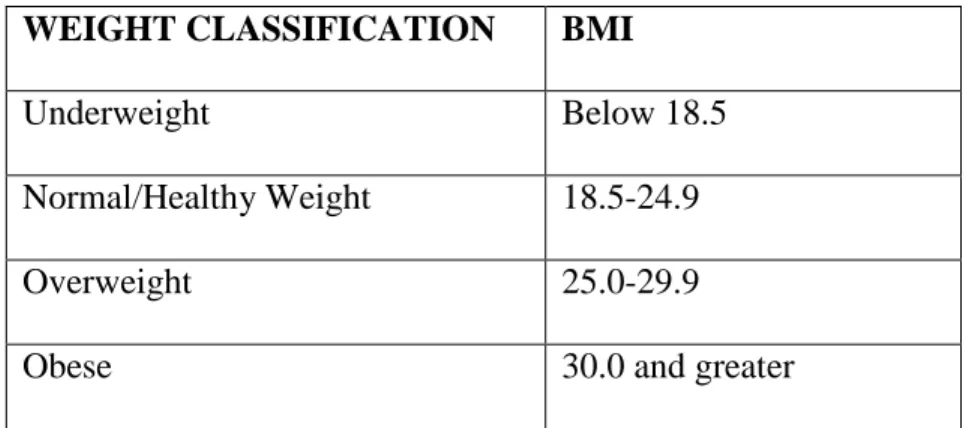
is calculated by correlating height and weight to determine relative fat accumulation that may impair health. The Center of Disease Control (CDC) calculates BMI via height (m) and weight (kg) measurements (formula: weight (kg)/ [height (m)]2).2 BMI is one of the best methods for assessment of obesity and overweightness. The CDC defines four distinct categories of BMI: a BMI of < 18.5 indicates Underweight health status, BMI of 18.5-24.9 indicates Healthy weight or Normal, BMI of 25.0-29.9 indicates Overweight while a BMI of 30.0 and over indicates Obese.2 Table 1 summarizes these classifications.
Table 1. Weight classifications and respective BMI ranges
WEIGHT CLASSIFICATION BMI
Underweight Below 18.5
Normal/Healthy Weight 18.5-24.9
Overweight 25.0-29.9
~ 11 ~
Being overweight and obese have been cited as the fifth leading cause of global deaths.1 In addition to mortality rates, obesity has been linked to risk factors for stroke, cardiovascular disease, type 2 diabetes, hypertension, cancer, osteoarthritis and dyslipidemia. Obesity is one of the most preventable diseases as exercise and proper dieting can help lower BMI to a healthy range.26 In addition medical care costs for those who are obese in the US alone exceeded 147 billion dollars.27
Fundamentally, BMI exceeding 25 is generally caused by an energy imbalance, where more calories are consumed than expended.2 An increasing global trend is the consumption of fast
foods or energy dense foods that are high in fat. In addition the rise in sedentary day jobs with limited physical activity and increasing sedentary modes of transportation has resulted in poor health among most populations. The combination of poor physical activity and increasing caloric consumption has resulted in the global obesity epidemic.1,2 Current trends suggest that by the year 2030 more than 51% of the world population will be obese, a 33% increase in prevalence. Additionally 549.5 billion more dollars will be used on medical costs resulting in more problems for healthcare cost containment.1
2.2 Obesity and Immune Response
~ 12 ~
furthermore obesity has recently been isolated as an independent risk factor for increased morbidity for pandemic H1N1 virus.32
It has been reported that obese individuals are more prone to infection than lean subjects. Obese individuals have been shown to be more susceptible to infections, bacteremia and poor wound healing.30 Obesity, which can be considered a state of malnutrition, has also been known to affect both cell-mediated immune response and leucocyte count. Associated production of leptin and reduction of adiponectin affects the stimulation and activation of innate and adaptive immune response. Specific cytokine-like signaling pathways appear to be hindered with altered leptin levels. Other pathways which are affected include altered number of T-lymphocyte and B-cell synthesis and circulation, decreased dendritic cell function and decreased response to antigen stimulation.29 Moreover, obesity results in a pro-inflammatory state associated with increased levels of circulating pro-inflammatory proteins, in both obese children and adults.29,31
2.3 Influenza Virus and Infection
Human influenza is a virus which has three separate strains, A, B and C. Influenza A and B are the only strains which are known to cause seasonal epidemics in humans. In addition Influenza A can be hosted in avian birds, humans and other mammals.8 Influenza is a respiratory
infection which is transmitted through unprotected coughing and sneezing. Crowded and enclosed spaces harbor the virus, as well as hand contamination and direct inoculation.10 The influenza virus attaches to sialic acid receptors on the apical surface of human tracheal epithelial cells.33 Upon infection the body generally takes 1-4 days to begin responding to the virus and then works to combat it; during this time humans are most contagious.10 Severity of the infection ranges from
~ 13 ~
fever and headache. More complicated cases include development of pneumonitis, bacterial pneumonia and others. Generally, recovery from the infection occurs within 1 or 2 weeks, but sometimes the virus takes a more fatal tone. It is estimated that worldwide 5-10% of adults are infected annually with influenza, while 20-30% of children are infected. In addition anywhere from 3,000 – 49,000 deaths worldwide are attributed to the influenza virus.10
Influenza generally results in an immune response in populations that doesn’t result in hospitalization unless the person is in some way immunocompromised. Generally speaking those who are most susceptible to influenza infection include children, the elderly, those with chronic disorders (CVD, asthma, hypertension, diabetes), pregnant women, and those who are obese.11 In addition influenza is more commonly seen in large, crowded population centers such as large cities as the virus can move quickly while airborne and person to person contact is increased.
~ 14 ~
Table 2. Influenza extracellular and intracellular proteins with percentage conserved between different influenza strains.
Upon exposure to the influenza virus, the virus binds to surface epithelial cells of the respiratory system. Glycoprotein HA has multiple sialic binding sites, making it a prime receptor for host cells (erythrocytes and surface epithelium). The virus is then endocytosed into the host cell and transcription of viral mRNA occurs.14 The body, upon detection of viral infection by RIG-1 (recognizes viral infections) will initiate innate and adaptive immune responses through production of pro-inflammatory cytokines IFN alpha and beta. Next, respiratory dendritic cells (RDC’s) capture the viral antigen, present it on MHC-II and migrate towards lymph nodes. In the lymph nodes, RDC’s interact with naïve T and B cells, stimulating white blood cells producing plasma and memory cells, helping the body fight infection.15 Antibodies are created for
Influenza Protein Percent Conserved between strains (%)
Hemagglutinin (HA) 12
Neuraminidase (NA) 17
Matrix Protein 1 (M1) 57
Nuceloprotein (NP) 56
Ion channel (M2) 13
PB1 74
~ 15 ~
glycoprotein HA on the surface of the flu virus, preventing binding of the virus to host cells in the body. Additional antibodies are produced to other proteins of the virus.
2.4 Influenza Vaccination
The severity of the flu virus has resulted in recommended protection from the infection through vaccination. The most effective way to prevent infection is to get vaccinated every year. The CDC recommends that everyone 6 months and older should receive a flu shot yearly.17 This is especially true for high risk patients such as the elderly, children, pregnant women and the immunocompromised.17 Due to the constantly changing nature of the influenza virus, antibodies from previous viruses are not as effective and may not result in proper protection against the current virus. The seasonal flu vaccine consists of two influenza type A strains and one influenza type B strain based on research and predictions of the circulating strain that season. In 2013 the very first quadravalent vaccine was distributed, consisting of two A viruses and two B viruses.
~ 16 ~
2.52009 Pandemic H1N1 OutbreakDuring the 2009-2010 flu season, the influenza strain H1N1 was identified in the US.16
This virus is often referred to as the “swine flu” because many of the genes seen in the virus were similar to influenza found regularly occurring in US swine (pigs). Further research suggested that two more genes of the H1N1 were from avian and swine genes of European and Asian descent, making the virus a “quadruple reassortant”. The nature of this quadruple re-assortment resulted in a new influenza virus which had not been seen in over 40 years.16 Scientists and physicians were
concerned because there would be no pre-existing immunity to a new strain such as H1N1, thus resulting in increased severity across all demographics.17 The novel strain of influenza A (pH1N1) is genetically distinct from any previous seasonal influenza virus, thereby rendering antibodies from previous seasons non-protective.19
During the subsequent flu season of the pandemic, the CDC reported the virus peaked from October to March and spread relatively quickly as compared to other flu seasons.18 However as the flu season continued, Dr. Jhung, of the CDC’s flu division told CNN that the spread and severity of the disease was typical of an influenza season.18 The CDC estimated that between 188,000 to 381,000 US citizens were hospitalized due to the pandemic, not stemming from the average of 250,000-500,000 annually. In addition the estimated death toll of the pandemic ranged from 8,520 to 17,620.20 Both the number of infected and the death toll did not spike as highly as was expected from a new strain of flu. The relatively mild effects overall could be attributed to increased rate of vaccination and possibility of cross-reactive immunity from previous influenza strains.
~ 17 ~
outcomes than healthy adults. It was found that elderly had greater protectively to pH1N1, which is uncommon for any flu strain. It is likely that older adults had been exposed to a flu strain similar to pH1N1 during the first half of the 20th century.26 This likely resulted in higher affinity antibodies in older adults which prevented severity from pH1N1. The increase in hospitalization and mortality were alarming and drew reason for concern in at risk populations, especially the obese and immunocompromised.
2.6 Cross Reactive Immunity
Cross-reactivity is measured by the way in which the body’s immune system can combat antigens which appear similar.21 Antibody binding sites, also known as epitopes, consist of about 15 amino acid sequences, 5 of them being responsible for binding of the antibody. The paratope, which is the part of the antibody molecule that binds to the epitope, consists of about 50 variable amino acids. A paratope can bind to unrelated epitopes, and an epitope can bind to unrelated paratopes.21 Similar structures such as shape and charge can aid in unrelated paratopes and epitopes binding together. This relationship is the basis for cross reactive antibody immunity.
cross-~ 18 cross-~
reacting antibodies that could protect them from pH1N1 infection as opposed to younger individuals, who did not have cross-reacting antibodies.25
~ 19 ~
CHAPTER 3METHODS
3.1 Study Design and Participants
Participants were recruited as part of a prospective observational study from the University of North Carolina Family Medicine Center in Chapel Hill, NC. The study is designed to understand the relationship between high BMI and immune response to the influenza TIV vaccine. For this study, participants were selected from adults who received the influenza vaccine during the 2010-2011 flu season, the vaccine did not contain pH1N1 as one of the vaccine strains.
During the enrollment visit, the study nurse obtained informed consent, medical records, weight, height, BMI and baseline blood samples. For this study, a sample of 91 participants were selected, 45 obese individuals (BMI ≥30) and 46 healthy weight individuals (BMI 18.5-25). Participants selected were HAI negative.
3.2 Indirect ELISA
~ 20 ~
the reaction is stopped with the addition of sulfuric acid. The color intensity is proportional to the amount of HRP activity, which in turn is related to the bound antibody. The color intensity was measured at 450nm using a spectrophotometer.24
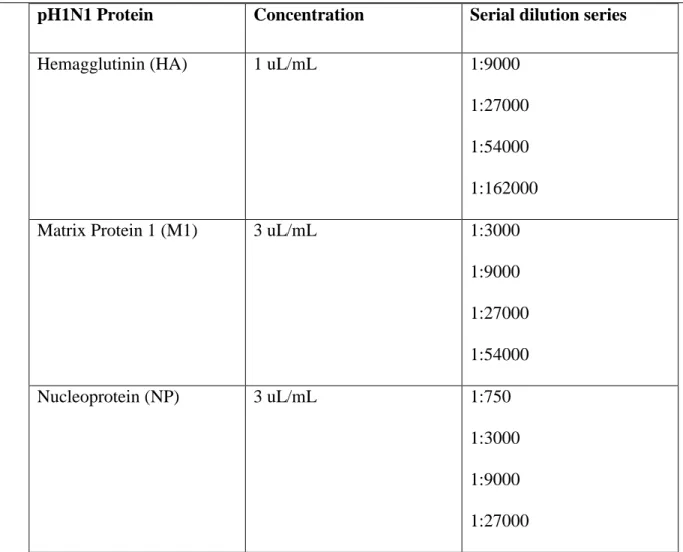
Following the indirect ELISA protocol, first Hemagluttanin (HA), Matrix Protein 1 (M1) and Nucleoprotein (NP) from the 2009 pH1N1 were isolated, diluted with coating buffer (250 mL 1x PBS solution with .397 NaCO3 and .935 HCO3) and 50 uL were platted to the 96 well plate.
~ 21 ~
pH1N1 Protein Concentration Serial dilution series
Hemagglutinin (HA) 1 uL/mL 1:9000 1:27000 1:54000 1:162000 Matrix Protein 1 (M1) 3 uL/mL 1:3000
1:9000 1:27000 1:54000 Nucleoprotein (NP) 3 uL/mL 1:750
1:3000 1:9000 1:27000
Table 3. Concentration of pH1N1 protein plated with respective serum dilution series
3.3 Statistical Analysis
~ 22 ~
CHAPTER 4RESULTS
4.1 Demographics of the Study Population
Participants were categorized into 2 BMI based groups: healthy weight (BMI 18.5-25) and obese (BMI ≥ 30). Forty-six healthy weight participants and forty-five obese participants were found in each group that were HAI negative (N=91). The complete demographics for the study population are presented in Table 4.
Healthy Weight Obese
Sample Size 46 45
BMI Mean ± SE
Range
23.3 ± 0.2 19.5 – 25.4^
35.4 ± 0.7 30 - 46.9
Age Mean ± SE
Range
45.2 ± 1.8 23 - 60
47.3 ± 1.6 20 - 60
Gender Male
Female
19 27
17 28
Race White
African-American Other 36 8 3 16 26 1
~ 23 ~
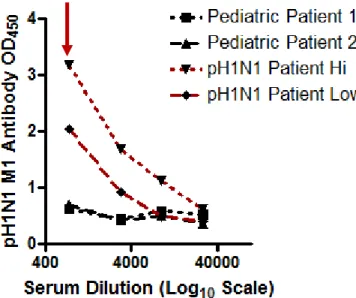
In addition to the 91 participants selected for this study, two infected patients and two pediatric patient serum were also tested for baseline values of antibody against NP, M1 and HA. Both pre-vaccination serum samples were from 2 year olds who were HAI negative for pH1N1 and H3N2, these samples were obtained from the Pediatric Continuity Care Clinic. Two convalescent serum samples from individuals who were positive for pH1N1 were obtained from BEI resources. One serum sample had a high antibody response, while the other had low antibody response; these infected samples were distinguished as Infected Hi and Infected Low. BMI was not known for pediatric or infected samples.
~ 24 ~
Figure 1. Results of HAI for pre/post-vaccine in healthy weight (HW) and obese patients.
4.2 Convalescent and Pediatric serum antibodies per influenza protein
~ 25 ~
Figure 2. M1 OD values for serial dilution series in infected and pediatric samples.
~ 26 ~
Figure 4. HA OD values for serial dilution series in infected and pediatric samples.
~ 27 ~
4.3 Healthy Weight and Obese antibody responseAs mentioned in the section above, the dilutions selected for the study samples were determined by the infected and pediatric OD separation. The average M1 antibody OD values at dilution factor 1:3000 was calculated for healthy weight and obese patients. Figure 5 below displays a graphical representation of this data.
Figure 5. M1 mean antibody OD value at a 1:3000 dilution factor.
The mean antibody OD value in healthy weight subjects was found to be 1.12 with standard error (SE) of 0.13. The mean antibody OD value in obese subjects was found to be 1.01 with SE of 0.11. Despite the fact that a greater antibody level was found in healthy weight subjects, the difference was not found to be significant between the two groups.
~ 28 ~
Figure 6. NP mean antibody OD value at a 1:750 dilution factor.
The mean antibody OD value in healthy weight subjects was found to be 0.91 with SE of 0.10. The mean antibody OD value in obese subjects was found to be 0.97 with SE of 0.09. The difference between the two groups was not found to be significant.
~ 29 ~
Figure 7. HA mean antibody OD value at a 1:27000 dilution factor.
The mean antibody OD for healthy weight subjects was 1.32 with SE of 0.10. The mean antibody OD value for obese patients was 1.28 with a SE of 0.10. The healthy weight subjects did have a higher average antibody level than the obese patients, however the difference found between antibody levels was not significant. Table 5 below summarizes the OD values for each protein conducted in this study.
Healthy Weight
Mean OD ± SE
Obese
Mean OD ± SE
Hemagglutinin (HA) 1.32 ± 0.10 1.28 ± 0.10
Matrix Protein 1 (M1) 1.12 ± 0.13 1.01 ± 0.11
Nucleoprotein (NP) 0.91 ± 0.10 0.97 ± 0.09
~ 30 ~
CHAPTER 5DISCUSSION
5.1 Cross Reactive Antibodies to Influenza
Obesity has recently become a major global health concern as the worldwide population of those who are obese has increased to over 1 billion overweight adults. This increase in the rate of obesity has resulted in heightened research interest in understanding how obesity contributes to wide range of diseases, including type 2 diabetes, cardiovascular disease and cancer.1,7 Of
particular interest for this thesis project, obesity was recognized as an independent risk factor for increased influenza morbidity and mortality during the 2009 influenza pandemic.14 In a typical flu season, anywhere from 5% to 20% of US citizens will contract the flu virus.8
~ 31 ~
Results from this study show that obese individuals do not have less pre-existing, non-neutralizing, cross-reactive antibodies than health weight individuals to pH1N1. Although no significant differences were found in cross-reacting antibody responses between healthy weight and obese subjects, there were some interesting trends identified. The M1 and HA antibody levels in healthy weight individuals was higher than that of obese individuals. It is possible with increased sample size, the data between the two groups would be significant.
5.2 Limitations
There were several limitations in this study. First, the relatively small sample size could address the lack of significance found for any of the pandemic protein antibody levels. The sample size should be increased with the possibility of finding significance in some of the findings. It is possible that with increased sample size the increased antibody levels seen in M1 and HA in healthy weight subjects would be significant. It would be ideal to increase the sample size to close to 100 in each group, effectively doubling the sample size of the initial study.
~ 32 ~
Finally, determining OD values based on specific dilution may not have been the correct method of approach to determine antibody response against influenza. Individual antibody response to an infection may not be determined by a specific OD value, but rather how many antibodies the specific individual requires for protection. For means of this study, the greatest difference between infected and pediatric serum dilutions was selected; however the OD value associated with the healthy weight and obese values may not be representative of their actual protection against influenza. Rather than averaging specific OD values for a dilution factor, the dilution series should be analyzed to determine when measurable antibody levels stay within 10% of the previous dilution factor to determine no longer measurable amounts of antibody.36
5.3 Future studies
As mentioned in the limitation section, a titer of the dilution series should be approached to determine antibody level to specific proteins of the influenza virus. This will give a more justified approach to understanding how obese and healthy weight individuals react to the influenza virus. Given the serial dilution series completed for this project, the data could be re-analyzed to determine if a higher associated titer is found with healthy weight individuals, suggesting that despite the initial antibody level is not as high, the antibodies do provide protection for the individual and will titer out further than obese subjects.
~ 33 ~
~ 34 ~
REFERENCES:
1. What Are the Health Risks of Overweight and Obesity? - NHLBI, NIH. (n.d.). Retrieved March 31, 2014, from http://www.nhlbi.nih.gov/health/health-topics/topics/obe/risks.html
2. Healthy Weight: Assessing Your Weight: BMI: About Adult BMI | DNPAO | CDC. (n.d.). Retrieved March 31, 2014, from
http://www.cdc.gov/healthyweight/assessing/bmi/adult_bmi/
3. CDC - Influenza (Flu) Viruses | Seasonal Influenza (Flu). (n.d.). Retrieved March 31, 2014, from http://www.cdc.gov/flu/about/viruses/
4. WHO | Influenza. (n.d.). Retrieved March 31, 2014, from
http://www.who.int/topics/influenza/en/
5. CDC - Estimating Seasonal Influenza-Associated Deaths in the United States: CDC Study Confirms Variability of Flu | Seasonal Influenza (Flu). (n.d.). Retrieved March 24,
2014, from http://www.cdc.gov/flu/about/disease/us_flu-related_deaths.htm
6. Van kerkhove MD, Vandemaele KA, Shinde V, et al. Risk factors for severe outcomes following 2009 influenza A (H1N1) infection: a global pooled analysis. PLoS Med. 2011;8(7):e1001053.
7. Oliveira AG, Araujo TG, Carvalho BM, et al. Acute exercise induces a phenotypic switch in adipose tissue macrophage polarization in diet-induced obese rats. Obesity (Silver Spring). 2013;21(12):2545-56.
~ 35 ~
9. Vaccines: Vac-Gen/How Vaccines Prevent Disease. (n.d.). Retrieved March 25, 2014, from http://www.cdc.gov/vaccines/vac-gen/howvpd.htm
10.WHO | Seasonal influenza and influenza A(H1N1). (n.d.). Retrieved March 26, 2014, from http://www.who.int/ith/diseases/si_iAh1n1/en/
11.Prevention and Control of Seasonal Influenza with Vaccines. (n.d.). Retrieved March 1, 2014,
http://www.cdc.gov/mmwr/preview/mmwrhtml/rr6207a1.htm?s_cid=rr6207a1_w#Person
sAtRiskMedicalComplicationsAttributableSevereInfluenza
12.Structure of influenza virus. (n.d.). Retrieved March 27, 2014, from
http://www.virology.ws/2009/04/30/structure-of-influenza-virus/
13.Greenbaum et al. PNAS. 2011.
14.Samji T. Influenza A: understanding the viral life cycle. Yale J Biol Med. 2009;82(4):153-9.
15.Notice to Clinicians: Early Reports of pH1N1-Associated Illnesses for the 2013-14 Influenza Season. (n.d.). HAN Archive. Retrieved April 1, 2014, from
http://emergency.cdc.gov/han/han00359.asp
16.2009 H1N1 Flu ("Swine Flu") and You. (n.d.). Centers for Disease Control and Prevention. Retrieved March 31, 2014, from http://www.cdc.gov/h1n1flu/qa.htm
17.Black S, Eskola J, Siegrist CA, et al. Importance of background rates of disease in assessment of vaccine safety during mass immunisation with pandemic H1N1 influenza vaccines. Lancet 2009;374(9707):2115–22.
~ 36 ~
http://www.redorbit.com/news/health/1113038974/h1n1-dominates-dangerous-flu-season-us-010514/514/
19.Pandemic H1N1 2009 Influenza, Janurary 2013. Available from
http://www.ncirs.edu.au/immunistation/fact-sheets/pH1N1-factsheet.pdf (Accessed March 2014)
20.CDC H1N1 Flu | In The News. (n.d.). Retrieved March 23, 2014, from
http://www.cdc.gov/h1n1flu/in_the_news/updated_cdc_estimates.htm
21.Haji-ghassemi O, Müller-loennies S, Saldova R, et al. Groove-type recognition of Chlamydiaceae-specific lipopolysaccharide antigen by a family of antibodies possessing an unusual variable heavy chain N-linked glycan. J Biol Chem. 2014;
22.Antibodies Cross-reactive to Influenza A (H3N2) Variant Virus and Impact of 2010-11 Seasonal influenza vaccine on cross-reactive antibodies – United States. (2012, April 13). Centers for Disease Control and Prevention. Retrieved April 1, 2014 from
http://www.cdc.gov/mmwr/preview/mmwrhtml/mm6114a1.htm 23.Indirect ELISA protocol. January 2013 Available from:
http://www.abcam.com/ps/pdf/protocols/indirect%20ELISA%20protocol.pdf (March 2014).
24.Indirect ELISA Protocol - Leinco Technologies. (n.d.). Retrieved March 25, 2014, from
http://www.leinco.com/indirect_elisa/
~ 37 ~
26.WHO | Obesity and overweight. (n.d.). Retrieved March 25, 2014, from
http://www.who.int/mediacentre/factsheets/fs311/en/
27.Obesity and Overweight for Professionals: Adult: Causes - DNPAO - CDC. (n.d.). Retrieved March 25, 2014, from http://www.cdc.gov/obesity/adult/causes/index.html 28.Finkelstein EA, Khavjou OA, Thompson H, et al. Obesity and severe obesity forecasts
through 2030. Am J Prev Med. 2012;42(6):563-70.
29.Milner, J. J., & Beck, M. A. (2012). The impact of obesity on the immune response to infection. Proceedings of the Nutrition Society, 71(02), 298-306.
30.De heredia FP, Gómez-martínez S, Marcos A. Obesity, inflammation and the immune system. Proc Nutr Soc. 2012;71(2):332-8.
31.Kanneganti, T. D., & Dixit, V. D. (2012). Immunological complications of obesity. Nature immunology, 13(8), 707-712.
32.Muñoz M, Mazure RA, Culebras JM. [Obesity and the immune system]. Nutr Hosp. 2004;19(6):319-24.
33. Mikhail N. Matrosovich,, Tatyana Y. Matrosovich, Thomas Gray, Human and avian influenza viruses target different cell types in cultures of human airway epithelium
PNAS 2004 101 (13) 4620-4624; published ahead of print March 15,
2004,doi:10.1073/pnas.0308001101
34.One Pound of Fat Versus One Pound of Muscle: Clearing up the Misconceptions @ Bamboo Core Fitness. (n.d.). Retrieved April 2, 2014, from
~ 38 ~
35.Perelman School of Medicine at the University of Pennsylvania. (2013, August 22). BMI
not accurate enough: Obesity/mortality paradox demonstrates urgent need for more
refined metabolic measures. ScienceDaily. Retrieved April 12, 2014
fromwww.sciencedaily.com/releases/2013/08/130822141948.htm
36.LaMere M., Moquin A, Lee E., et al. Regulation of Antinucleoprotein IgG by systemic vaccination and its effect on Influenza Virus Clearance. Journal of Virology May 2011 p.