Just
What
is
Sprawl,
Anyway?
Urban
sprawlisa hot-buttonissueintheU.S.Though
thetermiswidelyusedtodescribe thedistastefor contemporaryAmerican
suburbanand
urbandevelopment, aselectfew
group ofresearchers, academicsand
practitionershaveledtheresponsetothe
argument
against sprawl. Thispaperseekstocharacterizesprawlfrom
the perspectiveof landscapearchitecture whilefocusing onquantitativemeasurements
and
definitionsofsprawl.
At
itscoreitexaminestheissueofthe evolutionof urbanform
throughtime,and
offersoptionsfor addressing the debates over the negative orpositiveramificationsofsprawl.George
R.Hess, Salinda
S. Daley,Becky
K.
Dennison,
Robert
P.McGuinn,
Vanesa
Z.Morin,
Wade
G. Shelton,Sharon
R.Lubkin,
Kevin
M.
Potter,Rick
E.Savage,
Chris
M.
Snow
and Beth
M. Wrege
"In thenext threeor four yearsAmericanswillhavea
chancetodecidehowdecentaplacethiscoimtiywillbeto
livein.andforgenerationstocome. .Alreadyhugepatches
of once greencountrysidehavebeenturnedintovast, smog-filled deserts thatareneithercity,suburb,norcountiy.and
eachday
—
atarateofsome3.000acresaday—
morecountiysideisbeing bulldozedunder Youcan'tstop
progress, theysay.yetmuchmore ofthiskindofprogress
and weshallhavetheparadox ofprosperityloweringour
standard ofliving. ...Theproblemisthepatternofgrowth
—
OK ratherthelackofone."(Whyte 1958)
Introduction
Sprawl
isa hot topic inAmerica.
Articles about sprawlhave appeared
inmany
magazines
and
newspapers, including Time,US
News
and
World
Report,The
New
Yorker, Atlantic Monthly, Sierra.The
New
York Times,and
USA
ro<;/m'(Katzand Bradley 1999:Goldberger
2000;Moberg
2000:Thompson
2000;Tolson 2000: ElNasser
and
Overberg
2001; Firestone2001). Search for"urban sprawl"
on
theWorld
Wide
Web
and
you
willbe inundated withacombination
of
research,reports,reviews,and
rants. Inthe
academic
literatureindexedby
theInstitule
for
Scientific Information'sScience
Citation
Database,
thenumber
of
titlesincludingthe
word
"sprawl"had
increasedmore
than exponentially.
Indeed, sprawl has
become
theterm people usetodescribealmost anything theydo
notlikeabout
American
cities,from
trafficjams
on
endlesscommercial
stripstocookie cuttercommunities on
former farmland.Negative
effectsattributedtosprawl includeeconomic and
racial segregation,crime, poverty,loss
of
community,
increased infrastructurecosts,deterioratingairand waterquality, loss
of
farmlandand
open
space, increasedtrafficcongestion,
and
a generaldegradation inthe qualityofhuman
life.At
thesame
time, afew
voiceshave been
questioningtheconventionalwisdom
thatsprawlis
bad and "Smart
Growth"
policiesare the cure.Among
those voices are PeterGordon
and
Harry Richardson(1997a).professorsin
Universityof SouthernCalifornia's
School
of
Urban
Planningand Development,
who
contend
George
R.Hess
isan
Assistant Professor inNorth
CarolinaStale University's(NCSU)
Forestiy Department. Tlie co-authorswere
allparticipants in his course.Measuring
Suburban
Sprawl,which
was
taughtduringtheSpring200
J semester Thispaper
isa
productof
that course.Salinda
S.Daley
isa masters
student inNCSU's
Zoology
Department.Becky
K.Dennison, Robert
P.McGuinn,
Vanessa
Z.Morin,
and
Wade
G
Shelton
are masters students in theDuke
University NicholasSchool of
the Environment.Sharon
R.Lubkin
isan
Assistant Professorof Biomathematics
atNCSU.
Kevitt
M.
Potterand
Rick
E.Savage
are masters .students inNCSU's
Forestiy Department.Chris
M.
Snow
isa
continuing
education
student
inNCSU's
Department
of
Parks, Recreationand
TourismManagement.
Beth
M.
Wrege
isa
mastersstudentinNCSU's
Department
of
Parks,Recreation
and
Tourism
that
compact
development
isnot a curefortraffic congestion. Staley(1999) arguedthat
urban
growth
boundariesdo
not reducetrafficcongestion,that
farmland
isnotimperiledb\ urban growth,and
thatspraw1. itself, isnot bad.Yetdespite allthe purportedeffects
and
proposed
solutions,anumber
of
researchers noted thattheterm
"sprawl"was
rarely quantifieduntil recently(e.g.. Burchelletal.1998:
Downs
1998; Galsteretal. 2000:Myers
and
Kitsuse 1999:Malpezzi
1999).There
isalso apaucityof
correlativeanalysisbetween
measures of
sprawland measures of
social,economic, and
environmentalquality—
inpartbecause sprawl itselfhas not
been
welldefined(Downs
1998: Galsteretal 2000).One
of
thedifficulties inunderstandingsprawl isthatdifferentobservers
have
defineditbya
combination of
itscauses(e.g..zoning
and
poorplanning), characteristics(e.g.. low-density development),and
effects(e.g.. trafficcongestion
and
airpollution). Galsteret al.(2000) notedthat sprawl hasbeen defined asan aesthetic
judgement:
as the causeof
anexternality(e.g..high
automobile dependence,
job-housingspatialmismatch):astheconsequence of
some
independentvariable (e.g.. zoning): as adevelopment
pattern(e.g..low
density, leapfrogging):asa processof
development
throughtime:and
by example
(e.g..w
ith reference to aparticularcity such as Atlanta orLos
Angeles).Objectives
Ew
ing(1994).Malpezzi
(1999).and
Galsteretal.(2000)
argued
convincinglythatseparating the causes, characteristics,and
effects of spraw1isessential toreaching
consensus on what
sprawl is.We
agreeand
choseto focus ourefforts
on
the spatial characteristicsofsprawl.Our
primary objectivewas
to identify'and
quantifycharacteristicsof
sprawlon
the landscape.What
does
sprawl looklikeon
theground?
What
spatial characteristicsshouldone
lookfor todeclare acitysprawled or sprawling?in thispaper,
we
Characterize sprawl
from
a landscape perspective:• Presentquantitativeindices for
some
of
the characteristicsof
sprawlon
the landscape;•
Use
these indices tocompare
sprawlamong
the U.S.Census-defined
urbanized areasinthemid-Atlantic United States:and
•
Measure
the correlationamong
ourindices
and
afew
purported effectsof
sprawl.Landscape
Characteristicsof
Sprawl
The word
sprawl hasbeen usedtodescribetheurban
environment
since themid
20'*'centur\'(Table 1).
The
Oxford
English Diclionaiy (2001 )defines itas"the stragglingexpansionof an indeterminateurbanorindustrialenvironmentinto
an adjoiningcountryside: the area
of
thisad\ancement."
Spraw
1 hasbeen usedasanadjecti\e describingthe patternof acity"sgrowth,
averbdescribing theprocessofthatgrowth,
and
asa
noun
describinganurban landform.Although
thefirst usewe
found
was
by
Buttenheim
&
Comick
(1938), theterm
became
relati\elycommonplace
inthe 1940"sand
1950"s,coincident with
two
fundamental
lifechanges
in theUnited
States—
an increase in privateautomobile
useand
theexpansion of
theinterstate
highway
system.While
some
peoplewere
definingand
deridingsprawI duringtheearl> 1950"s.others
were
advocatingthe decentralizationof
American
cities as adefense againstthepossibilityof nuclearwar (Monson
and
Monson
1950. 195
1:Wigton
1953).However,
these advocatesof
citydecentralizationfavored well-planned,
concentrated
nodes
and were
verymuch
against thepoorlyplanned
sprawl ofcentralcities(Monson
and
Monson
1950).Early uses
of
theterm sprawl suggestthatitconsumes
excessivespace inan uncontrolled,disorderly
manner
leadingtolossand poor
distributionof
open
spaces,excessivedemand
fortransportation,and
social separation.The
"Thefollyofallowingfurlher unrestrictedexpansion
and
disorderlysprawling ofcitiesintoruralareas,turninggreenfields
and
forests into dreary-city streetsand making
the countryside inaccessibletothepoorer inhabitants ofthe interiordistricts, isgaining increasing recognition both inAmerica
and
Europe." (Bultenheimdi Cornick I93H)
"Among
thechiefproblemsfacing London, accordingtotheCountyPlan, werecorigestion. slums,inadequate
and
maldistributedopenspaces, indeterminatezoning, a/?J
sprawl, ijone includestheLondon
region. " (Rodwin 1945)"TheAssociationposesthe alternativeof'self-containedtowns'versus 'suburbansprawl.'
//accusesthe
latterof twobasicfaults:first, excessive
demand
fortransportationand
second, lackof open spaceforrecreation
and
also expansion." (Blumenfeld 1949) "... inthesuburbs that hcivebeen
growing
so rapidlyaroundthegreatcenters the buildingsexist,ideally, as free-standingstructures inaparklike landscape. Too often thetrees
and
gardens vanish underfurther pressure ofpopulation, yetthesprawling, openindividualistic structure, almostanti-socialin itsdispersed
and
itsrandom
pattern, remains."(Mumford
1953: 223)"
... theaimlesssprawlofsuburbiaisdestroying a preciousasset (openland). "(Haskell 1958)
"Greatsizehasanother featurethatisn'tquitesobeneficent. With veiy greatpopulationsizecomesveiy
great area(aswellashighdensity): and. withthe increasinguseoftheautomobile,
we
get 'sprawl,'allof whichleadsto intra-area spatialpatterns characterizedby veiyconsiderable socialseparation. "
(Thompson
1966)Table I.
Some
earlyusesoftheword
"sprawl"to describeurban growthpatterns.essential elementsofthese early definitions
have
remained
relativelyunchanged
throughtime. Inher report. Revisiting Sprawl:
Lessors
From
the Past,
Burgess
(1998:1)defined sprawl as".
..
expanding
physicaldevelopment,
atdecreasingdensities,inmetropolitanregions,
where
thespatialgrowth
exceeds
population growth."Lee and
Tian (1998) suggested thaturban sprawl leadsto inefficient land-use. leapfrogging,
and
low-densitydevelopment of
the urban fringe.The
SierraClub
(1998) defined sprawlas"iow-densitydevelopment
beyond
theedge of
serviceand
employment,
which
separates
where
people livefrom
where
they shop. work, recreate,and
educate—
thus requiring carstomove
between
zones."Brueckner
(2000) defined urban sprawlas excessivespatialgrowth of
cities.Aftera
comprehensive
literature review(Hess
2001).we
notedanumber
ofcommon
characteristics
among
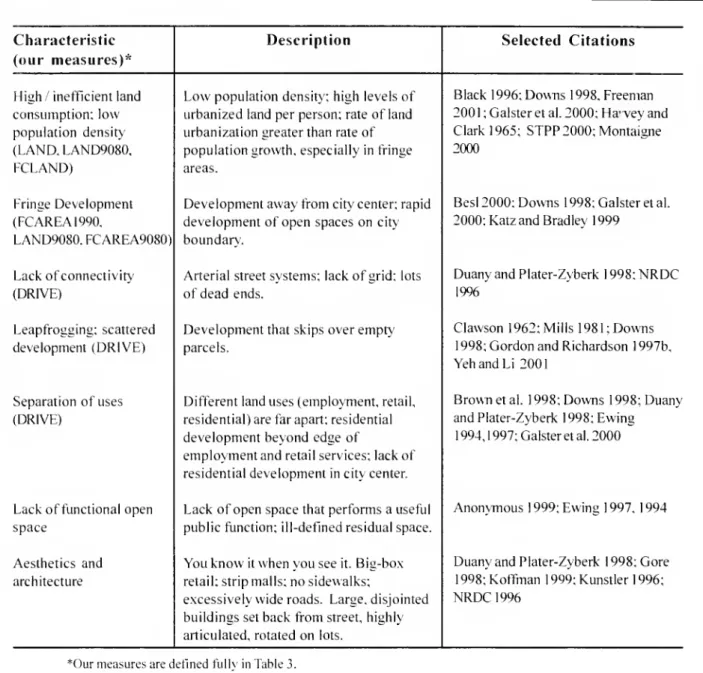
sprawl definitions(Table 2).Ewing(1994.
1997).Malpezzi
(1999).and
Galsteretal. (2000) provided valuable reviews
of
sprawl definitions.The
characteristicsassociated
most
frequentlywith sprawlwere
low-densitydevelopment,stripdevelopment, scattereddevelopment
away
from
the central city, leapfrogdevelopment,and
separationof
land uses. Density is by farthemost
common
measure, followed by
comparisons
between
therateat
which
land isurbanizedand
therateof
populationgrowth
(e.g.. landwas
urbanizedat three timestherateof population growth).Ewing
(1997)
arguedthatpoor
accessibility—
difficulty
moving
among
widely separatedlanduses
—
and
a lackoffunctional, publicopen
spacesare the primary hallmarksof
sprawl.There
seems
to be generalagreement
that sprawl isa matter of degree. Forexample,
it isdifficulttosayat
what
density acitybecomes
sprawled,butrelativelyeasy tosaythat
one
city is lessdense
than anotherand
thereforemore
sprawlingin thataspect.
Some
researchersconsider time to beacritical
component
inthemeasurement
of
sprawl(US
EPA
2000;Ewing
1994;Harvey
and Clark 1965).Harvey and
Clark (1965) notedthatCharacteristic
Description
Selected Citations
(our
measures)*
High/inefficientland
Low
populationdensit>: high levelsof Black1996;Downs
1998,Freemanconsumption; low urbanized landper person;rate ofland 2001;Galsteretal.2000:Ha-vey and population density urbanizationgreaterthanrateof Clark 1965;
STPP2000:
Montaigne(LAND.LAND9080,
populationgrowth,especiallyinfringe 2000FCLAND)
areas.FringeDevelopment Development
away
fi"om citycenter:rapid Besl2000:Downs
1998; Galsteretal.(FC
AREA!
990. development of open spaces oncit\ 2000;KatzandBradley 1999LAND9080, FCAREA9080)
boundary.Lack ofconnectivity Arterial streetsystems: lackofgrid; lots
Duany
andPlater-Zyberk 1998;NRDC
(DRIVE) ofdeadends.
19%
Leapfrogging: scattered Developmentthatskipsoverempty Clawson 1962:Mills 1981:
Downs
development
(DRIVE)
parcels. 1998;Gordon
andRichardson 1997b,o
YehandLi
2001CNJ tt:
1
Separationofuses Different landuses(employment,retail.
Brown
etal. 1998;Downs
1998;Duany
(DRIVE) residential)arefarapart:residential andPlater-Zyberk1998;Ewing
CO development beyond edge of
emplo\ment
andretailservices; lackof1994. 1997; Galsteretal.2000
i
residential developmentincity center.
Lack offunctionalopen Lack of openspacethatperformsauseful
Anonymous
1999;Ewing
1997, 1994a.
1
space publicfunction; ill-detlnedresidual space.
o
q:
s
Aesthetics and
You
know
itwhen
youseeit. Big-boxDuany
andPlater-Zyberk 1998;Gorearchitecture retail:stripmalls;nosidewalks; 1998;Koffman 1999; Kunstler1996:
excessivelywideroads. Large,disjointed
NRDC
1996buildingssetback from street,highly articulated,rotatedonlots.
*()urmeasuresaredefinedfully inTable3.
Table2. Spatial characteristics of sprmvl
found
inthe literature.moment
in time,because
sprawl isaform
of
quantitativeapproachestodefining sprawl, yetfew
growth.They
arguedthat it isthe trendin have developedcomprehensive
ways
tomeasure
populationdensity,ratherthancurrentpopulation sprawl.The
SierraClub
(1998) rankedU.S.density,thatdetermines
whether
a cityis Census-detlned urbanizedareasby considering sprawlingornot.A
citybecoming
lessdensely trendsinpopulationandland areagrowth,traffic populated through timeissaid tobe sprawling. congestionand open
spacelossindicators.They
even ifitiscurrently quitedensely populatedin alsoaccountedfor lossof important
w
ildlifehabitatcomparison
toothercities.and
historical sites. InUSA
Today,ElNasser
and
Overberg
(2001) rankedallof
theUS
Census-Approaches
toMeasuring
Sprawl
detlnedMetropolitanStatisticalAreasby
considering trendsinthe proportionofthe Several authorshavedecried the lack
of
populationintheMetropolitanStatisticalAreas
livinginurbanizedareas.
iviaipezzi(1
999) and
Galsteretai.(2000)
lia\e
done
tiiemost
cogent\vorl<todate, focusingprimarilyon
measuring
thespatialcharacteristics
of
urban landscapes.Malpezzi
(1999)
examined
severalmeasures
ofthe spatialdistributionof populationdensity'
among
censustractsofall U.S. Metropolitan StatisticalAreas.
He
compared
overall density:maximum
and
minimum
tractdensity:densityofthemedian,
tenth,
and
ninetiethpercentilepopulation-weighted
tracts: coefficientofvariationof
thetract densities:Theil's information
measure:
theGinicoefficient:parameters
of
the densities" tittoa spatialexponential or otherfunction:the
r-square statistics thereof:
and
the average distanceof each person tothe central business district.He
found
strong correlationsamong
the percentile measures,and
weaker
correlationsamong
the othermeasures.Malpezzi
alsoexamined
thecorrelationbetween
spatialmeasures and
commuting
measures,and found
(with strong correlation)thatdenserareashave shortercommutes, and
thatareaswithhighmedian
home
prices alsohaveshortercommutes.
Galsteret al. (2000)examined
sixdifferentmeasures
ofresidentialdevelopment:
1
)
Density, the average
number
of
residential unitspersquaremile: 2) Concentration,thedegreetowhich
development
islocatedwithin a relativelyfew
square milesof
the urbanized area:3)
Compactness,
thedegree towhich
development
hasbeen
clustered: 4) Centrality,the degreetowhich
development
is located close to thecentralbusinessdistrict:
5) Nuclearity, the extentto
which
an urbanized area ischaracterizedby
a singlecenterof development: and
6) Proximityof
land uses, thedegreetowhich
different land usesareclosetoone
another.They
applied thesemeasures
tothirteen large U.S. citiesand
rankedthem
from
least tomost
sprawled accordingto each oftheabove
six measures.
They
furthersummed
allof
the ranks foracityto provide anoverallmeasure
of sprawl foreach city. Galsteretal. (2000)alsoproposed
two
othermeasures
forfuturede\elopment:
com
innif}-, thedegreetowhich
landhasbeen
developed inanunbroken
fashion:and
diversilyof
luud nses. the degree towhich
differentland usesexistwithinportionsof
the urbanizedarea.Yeh
and
Li(1998,2001)
used a geographicalinformation system(GIS)analysis
of
remotely sensed data tomeasure
and monitor
the degreeof
urban sprawl for citiesand towns
inChina.They
characterized sprawl as scatterednew
development on
isolated tractsseparatedfrom
otherareasby
vacant land.To
quantify the degreeof
scatteringthey calculatedShannon's
entropy,a statisticalmeasurement
of
dispersion basedon
therelativenumbers
of an item (theamount
of
new
development, in thiscase) ineach
of
severalcompartments
(concentric ringsaround
a city, inthiscase). Citiesand
towns
with higher entropy valueswere
characterizedasmore
sprawled
because they exhibitedmore
dispersed
development
—
thenew
development
was
spread evenlyamong
thecompartments.
Yeh
and
Li also usedentropy tomeasure
dispersalof development
alongmajor
roadsand
highways.Although
Yeh
and
Lididnotdo
so.aseriesof entropy measures through time can be
usedtodeterminechangesinthedegreeto
which
acity's
development
isdispersed orcompact.Our
Measures
ofSprawl
We
defined sevenmeasures
that relatedirectlytoseveral spatial characteristics
of
sprawl (Table 3).We
restricted ourefforts tomeasures
thatcould becalculated using data readilyavailableinastandardized formatforcities nationwide.
We
focused oureffortson
U.S. Census-defined urbanized areas,
because
theyaredefinedconsistentlythroughoutthe United States.We
used1990
United StatesCensus and
related FederalHighway
Administration data,
because
theyare themost
recent dataavailable forurbanized areas in the United States.Most of
themeasures
reflectlandconsumption,differences
between
landconsumption
in the centerand
fringeof
the urbanizedarea,and
changes
in landconsumption
1
Measure
Description
/Rationale
(Data Source)
Formula
AREA
LAND
Land
Consumption
Area
of urban area(square miles) in 1990. Larger urban areasconsume more
land,and
areconsideredmore
sprawling.(US
Census Bureau)
Urbanized
land percapita in 1990. Sizeof
urban area/population(acresper 1.000people).
A
more
sprawlingcit\ usesmore
land per person.(US
Census Bureau)
UA*
Area
UA
Area(acres)UA
Population(1.000s)
i
CO
FCAREA
FCLAND
Population Concentration
Fringe-to-centerarearatioin 1990. Ratio
of
fringe areatoareaof
cit> center.Sprawled
citiesare said toha\emore
de\elopmentavva\
from
theircit} centers.(US
Census
Bureau) Fringe-to-center landpercapitaratioin 1990. Ratioof
landused percapitain the fringetoland used percapita inthe cir\ center.
Sprawled
cities areoften said toha\e
much
higher landconsumption
percapita inthe fringethaninthe center.(US
Census Bureau)
Areaof
UA
Friniie AreaofUA
CenterFringeArea/Fringe
Pop
Center.Area/Center
Pop
9
1
s!
i
o
2
DRIVE
Separation of
Land
Uses/AccessibilityDaiK
VehicleMileage
perCapitain 1993. Thismeasure
reflectstheaverage dailymileage per capita relativeto citiesof
thesame
population density.>
1means
more
dri\ingthan averageforcitiesof
same
density<1
means
lessdriving than averageforcitiesof
same
densityWe
usedthis indexasa surrogateformeasuringseveral spatialcharacteristicsofsprawl. Separation oflanduse. lackof
connectivit},
and
pooraccessibility are spatial characteristicsof spraw1thatresultinincreaseddri\ingand
higher\aluesofthisindex.
(US
FederalHighwav
Administration)Obser\ed
DaiK
Milease ExpectedDailyMileage (Seetextfordetails)FCAREA9080
LAND9080
Temporal
Development
PatternsRatiooffringe-to-centerarearatioin
1990
to1980
value. Cities aremore
sprawlingwhen
the sizeof
theirfringeareas increases fasterthan the sizeoftheir centers(i.e.,FCAREA9080
>
1).(US
Census Bureau)
Ratioof
urbanizedlandpercapitain1990
to1980
value. Cities are sprawlingwhen
their rateof
land use percapita isincreasing (i.e..
LAND9080
>
1).(US
Census Bureau)
FCAREA
(1990)FCAREA
11980)LAND
(1990)LAND
(1980)*L
A
=US
Census-defined urbanizedareaTable3. Ouantitarh-emeasuresofsprawlthat
we
caladated. Forallmeasures, higher valuesindicatemore
sprawl.The
U.S.Census Bureau
definesanurbanized areaas
one
ormore
central placesand
theadjacentdenselysettled urban tVinge thattogethercontaina
minimum
of50.000 persons(US-DC
1994).The
definition hasbeen
used since1950
topro\idea better separation of urbanandrural territory,population,and
housmg
inthe vicinity
of
placeswithrelativelylarge populations.The
definitionhaschanged
somewhat
throughtime,but hasbeen
relativelyconsistent since 1970.
The
urbanfringegenerallyconsistsof contiguousterritory
having
adensity ofleast 1.000 personspersquaremile.The
urbanfringe alsoincludesoutlyingterritory,ifitis
connected
tothecoreofthecontiguous areaby
roadand
iswithin 1.5 road milesofthatcore, orwithin fiveroad milesofthecorebut separated
by
waterorotherundevelopableterritory.
Other
territorywithapopulationdensity
of fewer
than 1.000people per squaremileisincluded intheurban fringeifiteliminates
an enclave or closesan indentation in the
boundary of
the urbanizedarea.Our
early analysesshowed
that the size (squaremiles)and
population(number of
people)of
urbanized areaswere
correlated atthe total(r=0.97). fringe (r=0.99).
and
center (r=0.70)scales.
Because
we
were
focusing on landscapecharacteristics,
we
chose towork
with areameasures
insteadof population measures. Similarly,we
usedmeasures
oflandconsumption
—
theamount
ofland used per person—
which
istheinverseof population density.One
canalsomeasure
land used perhousing
unit:however, housingunitdensityand
populationdensitywere
completelycorrelatedin our studyarea (r=1.0).Separation
of
landuses andaccessibilityare importantand
relateddimensions
of sprawlthataredifficult to ineasuredirectly.
The
term"accessibility"isusedin thesprawlliteratureto represent the ease of
movement
among
different land uses, especiallyhome,
work,and
services (e.g..Koenig
1980). Accessibilityisinfluencedby
thedegree towhich
these land usesare separatedon
the landscape. Personaltransportation surveys (e.g..
US-FHA
2001)
are the bestapproach
tomeasuring
accessibility,because
the\ provide information aboutwhat
peoplearedoing,
where
theyaregoing,and
how
they are gettingthere. Unfortunately, theyare costlyto
implement and
availableforonlya limitednumber
of
MetropolitanStatisticalAreas.We
used averagedaily vehiclemilestraveled per person as a surrogatemeasure
for degreeof
accessibilityand
separationof
land uses. Daily vehicle milestraveled perpersonare reportedby
Census-defined
urbanizedarea in theannual U.S.Department
of TransportationHighway
Statistics publication.
The
data arebasedon
astatisticalanalysis
of
trafficcounts usingtheHighway
Performance Monitoring
System
(Office
of
Highway
Policv Information 2000).We
used datafrom
the 1993Highway
Statistics(Officeof
Highway
InformationManagement
1994). becausethese
were
the firstdeveloped
using 1990
urbanized area boundaries.One
must
becarefulwhen
comparing
citiesof
differentdensities,because vehiclemiles traveleddecreases with increasingpopulation density(e.g..Ewing
1997). Therefore,we
developed
a"DRIVE"
index thataccounts for populationdensity.By
fittingacurvetodaily vehicle milestraveledperpersonasa functionof
populationdensitv',we
were
able to calculate the expecteddailyvehiclemilestraveled(DVMT)
based on thedensityof
acity.Our
indexwas
obtainedbycalculating
DRIVR Ob'.erved
DVMT
/persontixpetlcdDVMT/person. basedonurbanized area density
Because
theindex isnormalizedby
urbanized areadensity,it isonly
comparing
citiesoflikedensity.
We
arguethat higher valuesof
thisindexare relatedtorelativelyhigh
automobile
usethat resultsfrom
greater separationof
land usesand
pooreraccessibility.Applying
Our
Measures
ofSprawl
to theMid-Atlantic
Urbanized Areas
We
applied oursevenmeasures
(Table3)tothe forty-ninecitiesintheseven mid-Atlantic
states (Delaware.
Maryland.
New
Jersey.North
Carolina.Pennsylvania,Virginia,
West
Virginia) that (1)were
considered urbanized areas in bothHighway
Administration datawere
available.We
ranked the cities accordingtothe degree of sprawl foreach characteristic (Table 4).We
alsoevaluatedthe linear correlation
among
the seven measures,and found
thatnone of
themeasures were
highly correlated (Table 5).The
highestmagnitude
ofany
correlation (0.48)was
between
the fringe-to-centerareaand
landconsumption
ratios;most
correlationswere
much
weaker. Thislack
of
strongcorrelationimpliesthateach indexis
measuring
something
different.Agglomerative
Clusterand
PrincipalComponents
Analyses
An
agglomerati\e cluster analysiswas
usedto identify groups
of
citiesw
ithsimilarcharacteristics. Clustering isa
mathematical
techniquethat
groups
entitiesw
ithsimilarattributes
by measuring
thedistancebetween
them
in multidimensionalspace.At each
stepin anagglomerativecluster analysis,thetwo
entitiesorgroups
of
entitiesthataremost
similarto
one
anotheraregrouped
into a singlecluster.A
number
of approaches
can be taken tomeasure
the distancebetween
clusters.We
used
Ward's
Method, which measures
the variancebetween
clusters at each stepand
joins the clusterswith theminimum
variance.The
clusteranalyses
were performed
usingJMP
(SAS2001).
We
alsoperformed
aprincipalcomponents
analysis
on
our measures. Principalcomponents
anah
sis isanumericalmethod
usedto analvze multi\ariatedata(Legendre
and Legendre
1998).It isan ordinationtechniquethatis usedto
summarize
trendsand
patternsamong
samples
(urbanizedareas, inourcase). gi\enanumber
of
characteristics for each sample.The
output ofa principalcomponents
analysis isascorethatcombines
the characteristicsthatexplainmost of
thevarianceamong
samples.The
principalcomponents
analysiswas
performed
usingPC-ORD
(MjM
SoftwareDesign
2000).Both
clusterand
principalcomponent
analyses
were performed on Z-transformed
indices, orZ-scores.A
Z-score isthenumber
of
standardde\ iationsan observation isfrom
themean
of
the distribution.We
used Z-scoresinstead
of
theraw indexvalues,because
the index \alueswere of
ver}, differentmagnitudes. Clusterand
principalcomponent
analysis aresensitixetolargedifferencesin
magnitudes
andwillreturn spuriousresultsifdata are nottransformed.
We
usedclusterand
principalcomponents
analysesto
group
citieswithsimilarcharacteristics
of
landconsumption
(LAND),
fringe-to-center landconsumption
ratio(FCLAND).
and
daily vehiclemilestraveledper person.We
usedtheobserved
dailyvehicle milestraveledperperson ratherthan our density-adjustedDRIVE
index,because
densitywas
incorporated intotheanalyses(throughLAND)
and
bothmethods
therefore accountfordifferencesin densit\.
According
toourclusteranaK
sis.most
of the differencebetween
groups ofcitieswas
explained
by
overalllandconsumption
(LAND),
followed
by
the fringe-to-centerlandconsumption
ratios(FCLAND).
followedby
dailyvehiclemilestraveledper person. Principalcomponents
analysisof
thesame
variablesyieldedsimilarresults(Table4).
The
first principal axiscaptured 57 percentofthe variance inthedata,and
was
most
closeh associated with landconsumption
(LAND)
and
daily vehiclemilestraveledperperson.The
second
axiscaptured an additional24
percentof
the varianceand
was
most
closelyassociatedw
iththe fringe-to-centerlandconsumption
ratio(FCLAND).
The
larger,oldercitiesallhad
relatively low levelsof
landconsumption and
relativelylow
levelsof
dailydri\ingpercapita.Among
citieswithlow levelsoflandconsumption,daily driving
percapita
was
relatively low.regardlessof
theTable4 (right). Sprawlrankings of 49
urbanizedareasintliemid-Atlanticstates
from
most sprawled(I) toleastsprm^'led(49). Thefirst columnliststheurbanized areasfrom
mosttoleastsprawlingasranked bythefirstprincipalaxisof a principalcomponents analysis ofoverallland consumption (LAND),fringe-to-centerland consumptionratio
(FCLAND). and
observeddailyvehiclemilestrcn-eled. The remaining columns
show
therank of each urbanizedareaforeach ofour sevensprawlindices,
from
themostspra\\iedll)toLAND
FCAREA
City (principalaxisI)
AREA
LAND
FCAREA
FC
LAND
DRIVE
9080
9080
1. AshevilleNC 23 7 32 31 4 34 30
2.
HickonNC
32 5 24 42 5 23 453. Vineland-MillvilleNJ 15 1 48 49 44 48 35
4. Kingsport
VA
20 1 27 43 23 ~n 445. Lynchburg
VA
19->
39 29 20 24 6
6. Bristol
Tn7vA
38 4 44 24 22 377. HighPoint
NC
30 14 41 41 13 20 388.
BurhngtonNC
39 17 34 38 1 31 249.
GastoniaNC
27 13 30 37 11 27 36 c_C
10.Raleigh
NC
11 23 40 32 J-> 11 10 -111.Greensboro
NC
25 32 47 22 -) 25 41X
12.Winston-Salem
NC
16 20 42 26 10 41 31^
13.Danville
VA
42 8 49 19 24 49C/)
14.Wilmington
NC
29 6 31 27 32 44 39i
15.GoldsboroNC 40 11 35 15 38 46 46
16.Norfolk-VirginiaBeach
VA
9 43 13 37 "1 48>
z
17.
Durham
NC
18 30 46 44 16 26 4718.Charleston
WV
21 21 26 46 12 4 4$
o
19.AtlanticCity
NJ
17 16 13 40 14 8 2920.Charlotte
NC
21.Roanoke
VA
8
26
27
31
45
38
23
45
19 17
47 42
18
20
O
22.Petersburg
VA
19 29 47 36 19 1m
O
23.
Richmond
VA
7 29 19 34 7 40 9o
24.FayettvilleNC 14 24 25 48 39 43 32
m
7325.Hagerstown
MD
44 T) 21 14 28 36 19X
26.Huntington-Ashland
WV/KY
24 25 23 33 29 7 8m
w
(Si
27.Annapolis
MD
37 18 11 5 31 5 11m
—
t
28.Jacksonville
NC
31 12 16 30 48 49 40>
29.Parkersburg
WV
48 36 37 39 40 6 7jO.AIIentownPA
13 42 -n 28 30 35 1531.Charlottesville
VA
47 39 25 33 14 532.Altoona
PA
46 40 28 8 41 21 2533.Scranton-Wilkes-Barre
PA
9 28 14 20 42 30 T)34.Harrisburg
PA
12 26 T 16 8 28 3435.Sharon
PA
43 10 5 3 49 1 136.Erie
PA
M
41 36 35 45 9 2737.Johnstown
PA
45 yi 17 17 43 15 2638.Baltimore
MD
6 43 12 10 18 18 1739.Wilmington
DE
10 37 7 36 15 39 4340. Reading
PA
35 46 18 11 34 33 1341.StateCollege
PA
49 45 20 1 47 10-1
42.Trenton
NJ
~n 444 4 9 38 23
43.York
PA
36 38 8 9 21 32 1444.
Monessen
PA
41 15 1 21 46 13 1245.Washington
DC
4 47 9 18 6 45 3746.Pittsburgh
PA
5 J.5-1
12 35 12 28
47.Lancaster
PA
28 35 6 7 27 29 1648. Philadephia
PA
T 4810 6 25 17 21
PC
PC
LAND
PCAREA
AREA
LAND
LAND
AREA
9080
9080
DRIVE
AREA
1LAND
(0.31) 1FCLAND
0.38 (0.44) 1FCAREA
0.14 (0.32) 0.48 1LAND9080
0.03 0.07 0.31 0.13 1FCAREA9080
(0.2) (0.17) 0.27 0.22 0.43 1DRIVE
0.02 (0.04) (0.26) (0.12) (0.27) (0.27) 1PC
1 (0.30) 0.79 (0.60) (0.68) (0.11) (0.30) (0.41)Table5. Correlations
among
sprawlmeasures. Sprawl measuresare definedin Table3:PCI
isthescoreofthe firstprincipal components axis: negativenumbers areshown
inparentheses.fringe-to-center
consumption
ratio.No
citieshad
both high levelsof
landconsumption and
ahighratio
of
fringe-to-center landconsumption,
inessence, both the core
and
fringe ofcitieswith highratesof
landconsumption were developed
atsimilar densities. Citieswith high land
consuinption levels
were
further differentiatedby
the relative
amounts
of
drivingpercapita.Many
of
thecitieswith highlevelsof
dailydrivingper capitahave
recentlyexperienced periodsof
highgrowth and
economic
prosperity.Correlates
of
Sprawl:
Porest
Fragmentation
Background
Widespread concern
about environmental degradationasaresultof
regionaldevelopment
patternsemerged
in the 1960"sand
1970"s (Burgess 1998).Land
transformation has been cited as themajor
forcedrivinglosses in biological diversity(e.g..Vitouseketal. 1997). Habitatfragmentation, inparticular,hasbeendocumented
ashaving
negativeeffectson
biodiversity
by
increasing"edge
effects."and
isolatinganimal populationsatavariet}'of
spatialscales
(Lovejoy
et al. 1986.Laurance
etal.1997).
Though
rarelymentioned
directly,issues relatedtofragmentation, such as lossof and
limited accesstoopen
space, are often cited as negativeeffectsof "leapfrogging"development
(Downs
1998: Evving 1994. 1997).Sprawling
development
issaidtoresultinsmall, isolated patchesof
habitatsurrounded by
landinresidential,
commercial,
orindustrialuses. Inthemid-Atlanticregion,
concern
abouthabitat fragmentation isfocused
on
forestedhabitat,largely
because
forestis theclimax
vegetativecommunity
intheregion.Methods
We
tested the hvpothesisthatthe degreeofforest fragmentation in
and around
an urbanizedarea is directlv related tothe degree
of
sprawl.We
usedforestfragmentationmaps
developedby
Riitters.etal. (2000)from
Multi-ResolutionLand
Characteristics(MRLC)
land-covermaps
derived
from
1992 Landsat Thematic
Mapper
(TM)
data, at30 meter by 30 meter
resolution.Riittersetal. (2000) assigned
one
of
sixfragmentation categoriestoeach forest pixel based
on
the landcover
inthree fixed-areawindows
surroundingthe pixel (9x9.27x27.81x81).
Fragmentation
categoriesare: interior,perforated,undetennined.transitional,edge,and patch.
We
useddatafrom
thesmallest scale(highest resolution)vv
indow
(9x9)forouranalysis.We
considered allbut the forest interiorcategory to be
fragmented
and
calculated the proportionof
allforestpi.xelsthatwere
interiorforest in each urbanized area.
Because
sprawlis saidto affect habitatnear urbanized areas,
we
also calculated thepercent interior forest ina five-kilometerbufferaround
theurbanizedareas.Findings
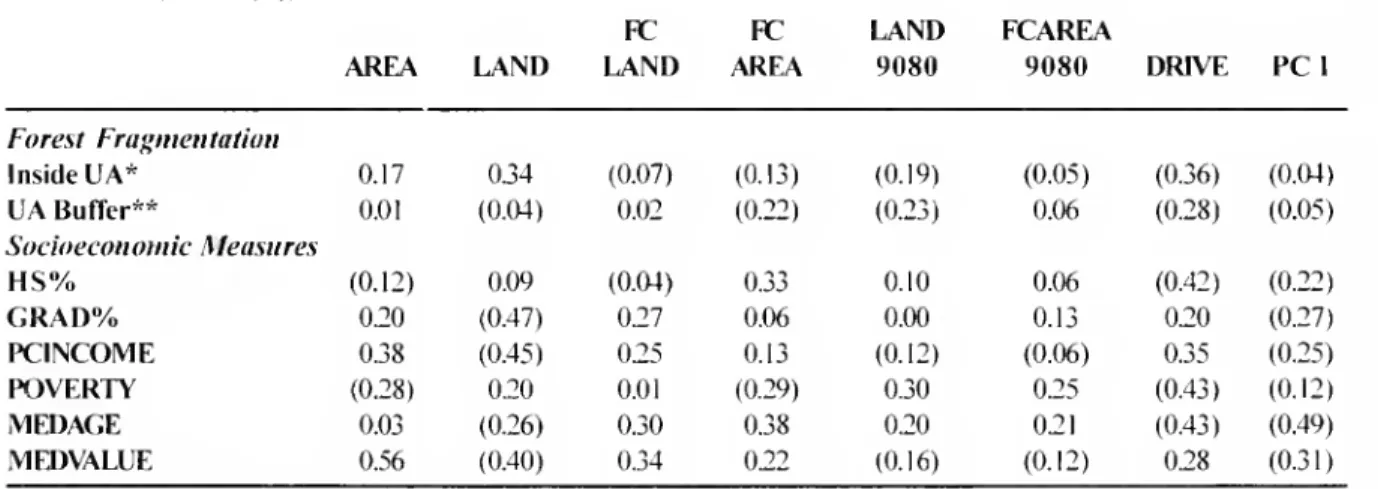
Neithertheproportionofinteriorforest
withintheurbanized areanortheproportion in
the fivekilometer region
around
theurbanized areawere
correlated stronglywithany
of ourmeasures
of sprawl (Table6).Socioeconomic
Measures
Background
Because
sprawl hasbeen
blamed
for a varietyof
social ills,we
setouttodetermineifany of
ourmeasures were
correlated with easilymeasured socioeconomic
indicators, hiSprawl
City: Race. Politics,
and
Planning
in Atlanta. Bullardetal. (2000) presentedarguments
thattypifythediscussion of
socioeconomic
issues relatedtosprawl. Bullardetal.(2000) theorizedthat
government
policy,includinghousing, education,and
transportationpolicies,have
subsidizedseparate butunequaleconomic
development,
segregated neighborhoods,and
affectedthespatial layoutof
central citiesand
suburbs.They
offeran environmentaljusticeframework
withwhich
to investigate the socialeffects
of
sprawlon
minorityand low-income
individuals.Environmental
justiceencompasses
environmental racism—
discriminationthattargetspeople
of
colorand
certainsocioeconomic
backgrounds and
excludesthem
from
planningdecisions—
and
environmentalinequity,
which
deniesethnicand
low-income
individualsaccessto
employment
centers.Methods
and
Findings
We
selected anumber
of
socioeconomic
attributesavailable
from 1990
US
Census
dataand
examined
theircorrelationwith ourmeasures
of sprawl (Table 7).None
oftheattributes
were
correlated stronglywith oursprawl
measures
(Table6).We
examined
scatterplotsof
themoderately
correlated(>0.4) pairsand found
thattheywere
dominated by one
ortwo
outlyingvalues,making
any
generalizations suspect.
Although
therelationship is
weak(r=0.43),
our indexofland useseparationand
accessibility(DRIVE)
does appear to increase as themedian
ageof housing
(MEDAGE)
decreases.The
implicationis thaturbanizedareaswith
new
housing
stockhave
a largerseparationof
land usesand
pooreraccessibility,resultingin
more
driving.Future
Work
Our
sample
sizewas
relativelysmall in terms ofperforming
clusterand
principalcomponents
analyses,
and
New
York
was
an outlier in several respects (e.g.,area,density).Applying
ourPC
PC
LAND
FCAREA
AREA
LAND
LAND
ARF^
9080
9080
DRIVE
PCI
Forest Fragmentation
Inside
UA*
0.17 0.34 (0.07) (0.13) (0.19) (0.05) (0.36) (0.04)UA
Buffer** 0.01 (O.W) 0.02 (0.22) (0.23) 0.06 (0.28) (0.05) SocioeconomicMeasures
HS%
(0.12) 0.09 (0.04) 0.33 0.10 0.06 (0.42) (0.22)GRAD%
020
(0.47)027
0.06 0.00 0.13020
(027)PCINCOME
0.38 (0.45) 025 0.13 (0.12) (0.06) 0.35 (0.25)POVERTY
(0.28)020
0.01 (0.29) 0.30025
(0.43) (0.12)MEDAGE
0,03 (0.26) 0.30 0.38020
021 (0.43) (0.49)MEDVALUE
0.56 (0.40) 0.34 022 (0.16) (0.12)028
(0.31)* IJ.A=
US
Census-defined urbanizedurea**Withina5-kilometerbulTeraroundtheurbanizedarea
Table6. Correlations henveen sprawl measiovs
and
measures ofpotentialenvironmentaland
socioeconomiccorrelates. Sprawl measures
and
definitionsareprovidedin Table3:PC
I isthescoreofthefirstprincipalcomporients axis:fragmentationvariables are describedinthetext: socioeconomicvariables
are describedin Table ''. Negativenumbers
Iariahle Description /Rationale
EdiicatioiKil Aiuiinineni
HS%
GRAD«c
Percent of people age25 >ears and olderfor
whom
high school orgraduate school is thehighestlevelofeducation. Higher levelsofeducation generallytranslateto higherincome and increased abilit) to satisfS preferencefor low-densit)'housing. Expecthigherlevelof educational attainment tobecorrelatedpositiveK withsprawl.(Bullardetal.2000)
Income
PCINCOME
POVERTY"
Percapitaincomeforpeople age5yearsandolder. Insurveys, upperincomeindividualsexpressed
a desire forlow-densityhousing andthe flexibility tobemobile. Expectsprawlingcities tohavea
higherper-capitaincome. (Bullardetal.2000)
Percentofindividualsage5 yearsandolder
who
fallbelowthe 1989povertyline. Sprawlleavesa decayinginnercity with highratesofpoverty. Expect sprawlingcitiestohave higher povert> levels.(Bullardetal.2000)
Huusing
MEDAGE
MEDVALUE
Median
age ofhousing stock in 1989. Duringthe 1950s-1970s.the influx oftractdevelopmentscreated affordable. lou-densit\ housing. Expect citieswith newer
homes
to bemore
sprawling. (Dear andElliot2001)Median
home
valuein 1989. Real estatemarketshavea directinfluenceoncostandavailabilityofhousinginurbanizedareas. IIiglicostsinthecitv centerdrivepeopleintothefringe. Expectcities with highermedianhousing\aluestobe
more
sprawling. (Dear andElliot2001)
Table 7. Description ofsocioeconomic vanuhlcs
ne
correlated againstourmeasures ofsprawl.measures
to allthe urbanizedareas in theUS.
increasingoursample
sizefrom 49
tonearl\ 400.might
re\ealadditional trends.Conceptually,
we
agree withEw
ing(1994)
that accessibility
and
lackof
functionalopen
space arekey
characteristicsof
sprawl.We
do
not agree with his assessmentofthe ease withwhich
these characteristics can bemeasured.
The
dail} vehiclemiles datawe
usedare animperfect
measure of
accessibility,because
the> are aggregated datathatpro\ideno
infomiation aboutwhat
individual drivers aredoing
orw
here theyaregoing. Personaltransportation surveys (e.g..US-FHA
2001) are a betterapproach
tomeasuring
accessibilitv'.becausethey provide information aboutwhere
peoplearegoing,and
how
they are gettingthere. Unfortunately, they are costly toimplement and
a\ailableforonlya limitednumber
of
MetropolitanStatisticalAreas. Further explorationof
accessibilitymeasures
thatcan becalculated easily forall urbanizedareas
would
be an importantcontribution to thesprawlliterature.
We
did notdevelop
an>measures
of
functional, publicopen
space.These
dataaredifficultto
develop
on
a nationalscale,because
no agency
collectsthem
consistently. Itis also unclearhow
privatelyowned, undeveloped
landswould
beaccounted
for in ameasure of
open
space.
While
itispossibletodelineate unde\elopedlandsusingaerialphotography
orsatelliteimagery,determiningifthey are
functioningasdesired(e.g..as wildlife habitat)is
a
more
difficult task.Data
on
public parksmight
beavailableinafairlyconsistentformnationally,
andmightprovideanadditional ineasureof spraw1.
Shannon's
entropymeasure of
spatialdispersionmeritsfurtherinvestigation(
Yeh
and
Li
200
1). Inasmallpilotstudy,we
analyzedcensus populationdataattheblocklevel usinga geographic informationsystemtocalculate the
degreeof entropyfor 14
North
Carolina urbanizedareas. Entropywas
calculated using fourconcentricrings of equal areaaround
an urbanizedarea's centerof
population mass.The
largestring
had
a radiusequaltothe longestspanfrom
the centerof populationtothe urbanized area boundary-.The
urbanized areaswere
differentiated byentropy,which
was
not well correlated withany of
our other sprawl measures.A
combination
of
entropyand
populationmoments
(e.g..Malpezzi
1999) might
allow
one
torefinethespatialresolutionof
our density measures.Conclusion
The
essential issue beingaddressed inthe sprawl debate istheevolutionof
urbanform
throughtime. Citiesgrow, with orwithout planning,and
develop landscapecharacteristicsthat persistthrough time
and
determinehow
theywillfunction.
The word
"sprawl"isbeing used todescribeacontemporary
urbangrowth
form. as well as the effectsof
that fonn. Galster etal.(2000) suggested that sprawl can
have
anumber
of
dimensions,and
thatcitiesmight
sprawl differentlyalong thesedimensions.Our
analyses supportthisnotion.We
calculatedsevenspraw
Imeasures
and
foundlittlecorrelationamong
them, indicatingthattheyeachmeasure
a differentdimension
of
sprawl. Further,few of
ourmeasures
correlatedwell with Galsteret al.'s (2000); nordidtheycorrelate withthemeasures
presented inUSA
Today
(ElNasser
and
Overberg2001).
With
somany
possiblemeasures
—
none
correlated strongly withthemeasures
of
environmentaland
socioeconomic
issueswe
examined
—
we
found ourselveswondering,
"Justwhat
issprawl,anyway?"
Clearly, sprawl ismulti-faceted.
How
sprawl isdefinedmay
indeed be in theeye ofthebeholder,
because
differentdimensions
of sprawlmay
be importantfordifferentenvironmental
and socioeconomic
issues.
Conceptual
models
relatingthecharacteristicsof sprawl to purported effects
of
sprawl areneeded
to select appropriatesprawl measures. Forexample, peopleconcerned
aboutlossofwildlife habitat
and
farmlandmay
bemost
interested in land
consumption and
therate atwhich
it is increasing(LAND
and
LAND9080).
Those concerned
withairpollutionmay
bemore
interested in the sheer sizeof an urbanized area
(AREA)
and
the separation ofland uses, asreflected
by
ourDRIVE
measure. If trafficcongestionisthe
major
concern,accessibilityand
separation ofland uses arelikelyto beof
paramount
concern(DRIVE).
In this case, densityisonly importantinsofar as itcontributesto separation
of
land uses. Peoplewho
agree withHarvey and
Clark(1965)that sprawl is bestmeasured by
trends indensitywill bemost
interestedinour temporal indices(LAND9080
and
FCAREA9080).
Ratherthan attemptingto
develop composite
indicesof
sprawl (e.g.. SierraClub
1998: ElNasser
and
Overberg
2001). itmay
bemore
usefulto
examine
urbandevelopment
patterns alonganumber
ofgradients. Forexample,
our clusterand
principalcomponents
analysesdemonstrated
thatcities can begrouped based
on
anumber
ofdifferent measures.These
analyses reflected theability
of
spatialconfigurationtodifferentiate
groups
of
cities,even
with the relativelycoarse datawe
used. Overall landconsumption
ratesand
the relative densities atwhich
the urbancenterand
fringe arepopulated explainedmuch
of
thedifferencesamong
groups
of
cities. Daily vehicle miles traveled per person differentiated patternsat finerscales.Although
we
found
no
strong correlationbetween
ourindividualmeasures of
sprawland
ourmeasures of
environmentaland
socioeconomic
condition, furtherexaminationof
these issues is warranted with respectto the clustersof
citieswe
identified.Acknowledgements
Thanks
tothe U.S.Environmental
ProtectionAgency
forfundingportionsof
thiswork
(toGRH):
toKurt Riitters forprovidingtheforestfragmentationdata:toFatih Rifki forhis insights:
to
Anthony
Sniderforearlyhelp withtheliteraturereview:
and
to thosewho
participatedin ourclass sprawI panel: RobertHealy.
Ben
Hitchings.
Mary
Kiesau.Ben
Taylor, ErikRoot,References
PrologueChapter48: Line 103-104.JnThe
Canterbury Tales.URL=hnp;
Anonymous.
1999.Sprawlreport card. www.canterburytales.org/canterbury_tales.html.URL=http://\v\v\v.1OOOfriends.org, visited2001
May
1.
spra\vi_report_card.htm. visited2001 Feb9.
Clawson.
M.
1962.UrbansprawlandspeculationinBaker, Warren. 1994.
Numbers
35:5.Page 465InThe
suburbanland.Land Economics38: 99-11 1.Complete
Word
StudyOld Testament - KingJamesVersion.
AMG
Publishers,Chattanooga Dear.M.
andM. Elliot. 2001.SprawlHits the Wall:TN. ConfrontingtheRealtiesofMetropolitanLos Angeles.
The
SouthernCaliforniaStudiesCenterBesl,J.2000.Suburbansprawl advances. Indiana andtheBrookings InstitutionCenteron Urban
BusinessJournal 75(2): 5-8. andMetropolitan Policy.
The
Brookings Institute. WashingtonDC.
URL=http: wwvv.brook.edu/es/ Black,J.Thomas. 1996.The
economicsofsprawl. urban/la/abstract.htm. visited2001May
I.Urban Land55(3):6.
Downs.A. 1998.
How
America'scitiesaregrowing: Brown.A.,C. Collins,T.Frank,K.Haddow.B. thebigpicture.BrookingsReview 16(4):8-12.T- Hitchings,S.Parry.G.Vanderpool.andL.
URL=www.brook.edu
pressREVIEW
fa98/§
Wormser. 1998.The
DarkSideoftheAmerican dovvns.pdf. visited2000June8.
1
Dream:
The
CostsandConsequences ofSuburbanSprawl.URL=http: Duany.A.,andE.Plater-Zyberk. 1998.
The
Traditionalwvvw.sierraclub.orgsprawl Teport98.visited200
1
Neighborhood and SuburbanSprawl:Attributes Co
Jan4. and Consequences.
URL=www.dpz.com/
Writings-Fileslnserted'B-02-P13-sprawI.htm,
C5
2
Brueckner.J.K..2000.Urbansprawl: Diagnosisand visited2001Jan 15.
2
remedies.International Regional ScienceReview
^
23(2): 160-171. ElNasser. H.andP
Overberg.2001.What
youdon't1
knowaboutsprawl.USA
Today19(112):1,2001Bullard.R.D.. G.S.Johnson,and A.O.Torres.2000. February22.
ce
SprawlCity- Race.Politics,andPlanningin
C
Atlanta. Island Press.Washington.
DC.
Ewing.Reid H. 1994.Characteristics.Causes,andElfectsof Sprawl:
A
LiteratureReview.Burchell.R.W..N.A.Shad. D.Listokin.H.Phillips.A. EnvironmentalandUrban Issues.Winter 1994:
1-Downs.
S.Seskin.J. Davis.T.Moore.D. Helton. 15.M.
Gall. 1998.The
CostsofSprawl—
RevisitedURL=http:/ www.nas.edu trbpublications/tcrp/ Ewing.R. 1997.IsLosAngeles-stylesprawldesirable?
tcrp rpt 39-a.pdfvisited2001 April 15. JournaloftheAmerican Planning Association 63(1): 107-126.
Burgess.P. 1998. Revisiting"Sprawl": Lessonsfi^om
thePast.
The
UrbanCenterPublications. Firestone. D.2001. Ninety'sSuburbs of West andClevelandStateUniversity.Cleveland.
OH.
South:DenserinOne. SprawlinginOther.The
URL=http: urbancenter.csuohio.edu/pubs/New
YorkTimes.2001April 17.burgess.html.visited2001
May
1.Freeman.L.2001.
The
effectsofsprawlonButtenheim,H.S..
&
RH.
Comick. 1938.Landreservesneighborhoodsocialties:
An
explanatory forAmericancities.The
JournalofLand and analysis.JournaloftheAmericanPlanningPublicUtilitv'Economics 14:254-265. Association67:69-77.
Blumenfeld.H. 1949.
On
thegrowth ofmetropolitan Galster.G.R.Hanson.H.Wolman,S.Coleman, andJ. areas. SocialForces28:59-64. Freihage.2000.Wrestingsprawltotheground:definingand measuringanelusiveconcept. Chaucer.G. circa 1390.
The
Canon'sYeoman's FannieMae
Foundation. WashingtonDC.
URL=www.fanniemaefoundation.org/research/
Galster.pdf.visited2001 Jan 15. 1997. Biomasscollapsein
Amazonian
forestfragments. Science278: 1117-1118. Goldberger.P.2000. Ittakesa village:theanti-sprawl
doctors
make
amanifesto.The
New
Yorker76(5): Lee.J.andL.Tian. 1998.Analyzinggrowth-128.
management
policieswith geographicalinformationsystems.Environment andPlanning Gordon,P.,andH. Richardson. 1997a.
Why
sprawlisB—
Planningand Design25(6):865-879.good.CascadePolicyInstitute. Portland.
OR.
URL=www.cascadepolicy.org/growth/ Legendre,P..andL.Legendre. 1998.Numerical gordon.htm,visited2001
May
1. Ecology(2ndEnglishedition).Elsevier.Amsterdam. TheNetherlands. Gordon,P.,andH.Richardson. 1997b.Arecompact
citiesadesirableplanning goal? Journalofthe Lovejoy.T.E..R.0.Bierregaard.A.B.Rylands.J.R.
C
AmericanPlanning Association63(1):95-106. Malcolm,C.E.Quintela.L.H.Harper,K.S. C/1 Brown.A.H. Powell,G. V.N.Powell,H.0.R.
Gore,Al. 1998.RemarksasDeliveredbyVicePresident Schubart.andM. B. Hays. 1986.
Edgeandother
5
AlGoreattheBrookingsInstitution.
The
effectsofisolationonAmazon
forestfragments. COBrookingsInstitution,Washington
DC.
Pages257-285InM. E.Soule(editor).URL=www.brook.edu/es/urban/gore.htm,visited Conservation Biology:
The
ScienceofScarcity1
r—
2001
May
1. andDiversity. Sinauer Associates,Sunderland.Massachusetts,
USA.
>
Hanson.S.and
M.
Schwab. 1987.Accessibilityand-<
intraurbantravel.Environment andPlanning
A
19: Malpezzi,S. 1999 Estimatesofthemeasurement and>
<
735-748. determinantsofUrban Sprawlin
US
MetropolitanAreas.CenterforUrban
Land
Economics.o
O
Harvey.R.O..and W.A.V.Clark. 1965.Thenatureand Universityof Wisconsin,Madison
Wl.URL1
=m
o
economics ofurbansprawl.
Land
Economics41 :http://wiscinfo.doit.wisc.edu/realestate/pdf/ 73
O
1-9. 9906a.pdf
URL2=
http://wiscinfo.doit.wisc.eduym
realestate/pdf'9906a.pdf, visited2001May
1.
I
Haskell.D.and
Whyte
W. 1958.The
city'sthreat tom
openland.Architectural
Forum
108:86-90. 166. Mills, DavidE. 1981.Growth,speculationandsprawlm
inamoncentriccity.JournalofUrban Economics. —
j
>
Hess,G.R.2001.Measuring suburbabsprawl: 10:201-226.
1
—
annotatedbibliography.
URL=
courses.ncsu.edu:8020/for610v/common/biblio, Monson,
D.,&
Monson,A. 1950.How
canwe
visited2001
May
25. disperseourlargest cities?Part1.The
AmericanCity 65(12):90-92.
Katz,B.andJ.Bradley. 1999. Divided
we
sprawl.TheAtlanticMonthly284(6): 26. Monson,
D.,&
Monson,A. (1951).How
canwe
disperseourlargest cities? Part11.
Koenig.J.G. 1980Indicatorsofurbanaccessibility :
The AmericanCity 66(1): 107.
Theory andapplication.Transportation9:
145-172.
Mumford.
L. 1953.The Highway
andtheCity.Harcourt.Brace
&
World.Inc.New
York. Kofinann.T. 1999.EveninMaine? Environment41(4):30.
MjM
SoftwareDesign.2000.PC-ORD
Version4.0:MultivariateAnalysisofEcologicalData.
Kunstler.J. 1996.
Home
fi-omnowhere.Atlantic GlenendenBeach.Oregon,USA.
Monthly278(3):22.
URL^www.thealantic.com/issues/96sep/kunstler/ Moberg,D.2000.Heal ourcities.Sierra 85(3):74.
kunstler.htm.2001 Jan3.
Montaigne, Fen.2000.There goestheneighborhood! Laurance,W.P.,S.G.Laurance,L. V,Ferreira.J.M.
Audubon
102(2): 60-70.M\ers.D.andA.Kitsuse. 1999.
The
debate over Thompson.D.2000. Asphaltjungle.Time
155(17):50-future densityofdevelopment: an interpretive 51.
review.Wori<ingPaper.LincolnInstituteofLand
Policy.URL=ww\v.linconinst.edu workpap
Thompson.
W.R. 1966.Economic
problemsand myers\veb.html.visited2000
June7. trends. Pages 17-20InUS
Chamber
ofCommerce
(editor).America'scities
-
CurrentProblems andNRDC
(NationalResourcesDefenseCouncil). 1996. trends. UnitedStatesChamber
ofCommerce.
EnvironmentalCharacteristicsofSmart Growth Washington
DC.
Neighborhoods:An
E\plorator\ CaseStudy.Natural ResourcesDefenseCouncil. Washington Tolson. J.2000. Putting thebrakeson suburban DC. URL=www.nrdc.orgcities/smartGrowth/char sprawl.
US
News
&
WorldReport128(11):64.charin.x.asp. visited2001 Jan 16.
US-DC
(Department ofCommerce). 1994.TheurbanOfficeof
Highway
InformationManagement. 1994. andruralclassifications.Chapter 12InHighwa\ Statistics. 1993.
US
Departmentof GeographicAreaReferenceManual.US
Transportation.FederalHighwa_\'Administration. Depaitiiientof
Commerce.
WashingtonDC.
URL-October 1994.ReportNo.
FHWA-PL-94-023.
http:,,wwvv.census.gov, geo/w\v"W'garm.html.Washington.
DC.
visited2001May
3.i
OfficeofHighway
Policy Information.2000.Highway
US-EPA.
2000.Green Communities:Where
AreWe
K
PerformanceMonitoringSvstemField Manual. Going? Socio-EconomicTools:Sprawl.US
1
US
Department ofTransportation. Federal Environmental ProtectionAgenc\. Region3.Highway
Administration.OMB
No.21250028. PhiladelphiaPA.URL=wwvv.epa.gov/region03/CO
Washington.
DC.
OxfordEnglishDictionan,.2001.
URL=hnp:
greenkil'2sprawl.htm,visited2001 Jan 15.
US-FHA(
FederalHighway
Administration).2001.1
www.oed,visited2001April 12. National HouseholdTravel Survey,2001.URL=
5; http://ww\s. bts.gov/nhts/. visited2001
May
3.1
Riiners.K..J.Wickman.R.O'Neill. B. Jones,andE.-J Smith. 2000. Global-scalepatternsofforest Vitousek.P. M.. H.A.
Mooney.
J. Lubchenco. andJ.fragmentation. Conservation Ecolog\ 4(2):3. M.Melillo. 1997.
Human
domination ofEarth's5
Rodwin.L. 1945.Gardencitiesandthemetropolis.
ecosystems. Science 277: 494-499.
The
Journalof LandandPublicUtilityEconomicsWhyte.W.H.
1958. Urbansprawl. Pages 133-156In 21:268-281.The
Editorsof Fortune(editors).The
Exploding Metropolis.Doubleday andCompany,
Inc.,New
SAS. 2001.JMP
Version4.0.4.SAS
Institute.Cary.NC.
York.SierraClub. 1998.
What
issprawl? Wigton,C. 1953. Is \ourcitya target??A
reportonU
RL=w\vA\.sierraclub.orgsprawl/report98/ industrialdispersion today.The American
Cit>' what.html,visited2001 Jan15. 68(2): 159,161.Staley. S. 1999.TheSprawlingofAmerica: InDefense Yeh,A.G.O.and X.Li. 1998."Sustainableland
ofthe
Dynamic
Cit\. ReasonPublic Policy developmentmodelforgrowthareasusingGIS. Institute.Los AngelesCA.
URL=www.rppi.org/ InternationalJournalof GeographicalInformation ps251.html.visited2001 Feb 19. Science12(2):169-189.STPP
(SurfaceTransportationPolic\ Project)2000. Yeh,Anthony Gar-On. and XiaLi2001.MeasurementDriventoSpend. Surface Transportation Policy and Monitoring of Urban SprawlinaRapidly
Project,Washington
DC.
Growing
RegionUsingEntropy. PhotogrammetricURL=www.
transact.org/Reports/driven/ Engineering&
Remote
Sensing 67(1):83-90.DriventoSpend.pdf.visited2001 Feb20.