Explaining Heterogeneity in Selection of Bangladeshi
Migrant Laborers
Bill Wang
Faculty Adviser: Luca Flabbi
April 2nd, 2018
Abstract
Contents
1 Introduction 3
1.1 Motivation . . . 3
1.2 Industry Background . . . 4
1.3 Literature Review . . . 5
1.4 Contributions . . . 6
2 Data Sources and Descriptive Statistics 7 2.1 SURF Dataset . . . 7
2.2 IOM&DFID Bangladeshi Migrant Household Survey . . . 7
2.2.1 Geographic Origin of Migrants . . . 7
2.3 Transient Workers Count Too Work History Survey . . . 9
3 Descriptive Statistics 9 4 Assumptions 13 5 Empirical Testing on Selection 14 5.1 Latent Variable Function Formulation . . . 14
5.2 Regression on Migration Fee and Wages . . . 18
5.3 Multinomial Tests . . . 18
5.3.1 Multinomial Logistic Regression Results . . . 19
5.4 Interpretation of Probit Regressions with Regard to Theoretical Model . 20 6 Empirically Testing Selection by Worker Characteristics 20 6.0.1 Results of Tests and Interpretation . . . 22
7 Distribution of Work Experience Comparisons 24 8 Evidence for Returns to Experience 25 9 Explaining Patterns of Migration into International Markets 25 10 Conclusion 27 10.1 Policy Implications . . . 28
10.1.1 Policy Implications within Sending Country . . . 28
10.1.2 International Cooperation . . . 28
10.1.3 Policy Implications within Destination Country . . . 29
Appendices 30
A Theoretical Setting 30
B Middleman Facilitated Selection 33
C Selection under Perfect Information 33
D Assessing Assumptions 36
1
Introduction
1.1
Motivation
Low-skilled migrant labor makes up significant proportions of the workforces of many wealthy, low-population states. Such practices are common in much of Asia and the Gulf States. The majority, close to 70 percent, of Singapore’s non-resident working population, numbering around 1.6 million workers, consists of low-skilled migrant labor (National Population and Talent Division, 2011). Qatar’s 1.2 million foreign workers make up 94 percent of its total labor force. The same patterns of employment exist in countries such as Saudi Arabia, the United Arab Emirates, Hong Kong, and many others, where workers from developing economies, including India, Bangladesh, the Philippines and Indonesia work as domestic workers, construction labor, or hold other, mostly low-skilled jobs.
Laborers are generally recruited from their home countries by a network of agencies and then matched with an employer. These workers are almost always temporary, remit much of their income, and live within modest means in their country of employment. In many cases, housing and food is provided by their employer. Additionally, many migrant workers have little to no grasp of the native language in their country of employment, which may create information asymmetry. In this paper, I will attempt to answer the question of what characteristics explain difference in selection of male migrant workers from agricultural regions Bangladesh into foreign labor markets to determine if selection of workers into labor markets is efficient or if it suffers from adverse selection.
Migrant worker recruitment has both development implications and implications on market productivity. Migrant remittances constituted over 6% of Bangladesh’s GDP in 2016, and over 30% for other some countries. Improving migrant income and welfare could significantly increase national GDPs and reduce poverty in many migrant-sending economies (World Bank, 2016). Investigating the efficiency of these migrant markets has potentially large implications on economic development of many low-income economies. Furthermore, investigating the network of recruitment also has human rights implications. Migrants into these labor markets are generally bound to an employer by law, as in the case through the ”Kafala” system in the Gulf States and similar labor laws in Singapore (Human Rights Watch). If migrant recruitment specifically targets less informed workers, they will be less knowledgeable about labor conditions in the destination country.
1.2
Industry Background
The recruitment process for migrant workers into the construction is different from conventional mechanisms of search and matching generally seen in labor markets. The following industry description is based on the specific regulations and terminology the hiring process of a worker into the Singaporean construction market. The recruitment process for countries in Gulf States and other Southeast Asian countries is similar, and identical with respect to middlemen recruitment in the migrant-sending country (Bangladesh). As the majority of the analysis in this paper will focus on recruitment in the migrant-sending country, minor labor law distinctions in the migrant-destination country are not of major significance. The important laws and institutions of interest that exist in all markets and destination are the presence of middleman networks and laws that bind the worker to a single firm.
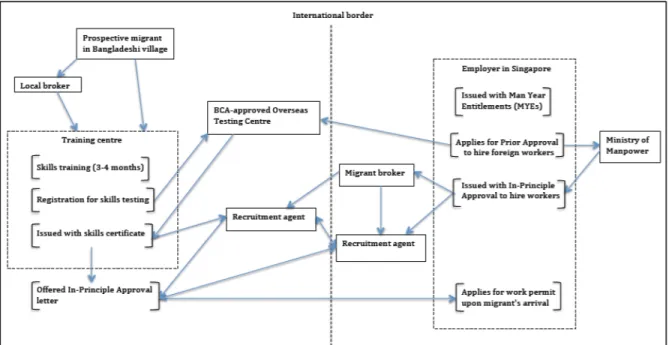
First, an employer with a certain number of vacancies (with a hard limit set by the Ministry of Manpower) sends a demand letter to an agent in Singapore for these to be filled. Next, the agent in the destination country will contact a counterpart in the migrant-origin country, who will then contact or send an agent to recruit from a village. The migrant will pay a fee to the final agent in the chain, who will then send the migrant’s information back through the chain. The migrant will be provided with a short period of training to learn basic construction skills before being matched with an employer and provided an In-principle Agreement (IPA), giving him his wage and length of contract. However, the wage given on the IPA is not often not the final wage; there is generally another wage negotiation that occurs in Singapore, resulting in a wage that is often lower than what is first given. If the migrant agrees to the initial agreement, he is then sent to Singapore and works under what is generally a one or two-year contract. After his contract the migrant generally returns to his country of origin and may reenter the process if he wants to find another job in a foreign country.
1.3
Literature Review
Analysis will be informed by prior research mostly in three categories: middleman lit-erature, development litlit-erature, and labor economics literature. Middleman literature provides a theoretical framework that is used in analyzing middle-directed migration networks, as does the previous literature on labor market dynamics. Development lit-erature, especially regarding migration and region-specific characteristics, also informs some of the assumptions that will be used in the following paper.
”Middlemen” provides a structure under which middlemen activity can be extrap-olated and modeled (Rubinstein, Wolinsky 1987). In addition, ”Asymmetric Informa-tion and IntermediaInforma-tion Chains” gives a general result that could be possible in this context, where there is trade under asymmetric information with long intermediation chains (Glode, Opp 2016). With middleman activity, the result can either be an im-provement of market efficiency or a decrease in market efficiency. Certain scenarios, such as when the middleman becomes an expert on the good he or she is purchasing, this activity can be conducive to efficient outcomes (Biglaiser, 1993). The presence of middlemen also depends on the inherent frictions in the market, which in the case of migration, are large search and information frictions (Spulber 1996). The hypotheses of middleman theory are tested in the analysis of the labor intermediation between rural Bangladesh and the Singaporean construction market, where selection by pro-ductivity would be the result of efficient intermediation. At a more basic level, another theoretical paper used in modeling selection of workers and contracts based on produc-tivity and information is “Games with Incomplete Information Played by ”Bayesian” Players” (Harsanyi 1967).
”Equilibrium Wage and Dismissal Processes” models selection into the labor mar-ket based on productivity and shows how overall marmar-ket productivity changes over time (Flinn 1997). Labor market dynamics depend on the heterogeneity of workers in selection, as does overall productivity.
The empirical procedures are very similar to methods commonly seen in labor eco-nomics. As is the case with labor market participation, migration suffers from selection bias. Migrants self-select into labor markets, and in this specific scenario, middlemen also select for migrants. Correcting for this selection bias, a Heckman selection model is used (Heckman 1976). The theoretical modeling of employment decision made use of previous literature in discrete choice models in labor economics and empirical tests (Keane et al. 2010). As is often the difficulty in labor economics The Roy model of income distribution and employment choice was also taken into consideration, as were as its corresponding empirical tests (Heckman, Sedlacek 1985). The variation of one productivity variable used in this paper, rather than the skill vector used in most Roy Model employment choice formulations, was due to the workers being of a very similar demographic: young men, similarly educated, from agricultural regions in Bangladesh. In many formulations of the Roy Model, demographic characteristics are used to proxy for variation in skill distribution. As in this scenario, demographic characteristics are fairly uniform, skill differentiation is vertical, along a single productivity vector.
where a randomized control trial found that providing workers with more information on wages and laws increased wages in the treatment group (Shrestha, Yang 2017). The theoretical assumption that under observable productivity, surplus is divided through a Nash Bargaining equilibrium was also motivated by the results of the randomized control trial done by Shrestha and Yang. They found that providing workers with more information on labor laws did not increase mobility rates, but did increase bar-gaining power as measured through worker wages. It is reasonable to assume that the same information asymmetry may also be present in the construction sector and other low-skill sectors, which shares similarities with recruitment of domestic workers. Also, although not a piece of economics literature, Bangladeshi Migration to Singapore, a sociological analysis, gives an immense amount of information on migration networks and institutions that inform my analysis (Mizanur Rahman 2017). Mizanur Rahman’s book details migration processes from Bangladesh into Singapore as well as into other migrant-receiving destinations, especially the Gulf States.
The model of migration choice and qualitative observations from ”Underinvestment in a Profitable Technology: The Case of Seasonal Migration in Bangladesh” were also used (Bryan et al. 2014). Bryan et al. found that individual-specific, experiential learning was vital in determining migration payoffs and utilities, which is also present in this paper’s analysis.
1.4
Contributions
Research in migration channels contributes to understandings of intermediation and provides either an example of efficiency loss or an demonstration of curtailing high search costs and middle-man mediated positive hierarchical sorting. If the analysis of selection does result in demonstrated deadweight-loss, this would be a demonstration of the results of ”Asymmetric Information and Intermediation Chains” (Glode, Opp 2016). If we see a result that demonstrates efficient selection, then it is a demonstration of middlemen benefiting market efficiency, and we can assume of the characteristics of the market as described in ”Middlemen as Experts” (Biglaiser 1993).
2
Data Sources and Descriptive Statistics
2.1
SURF Dataset
The smallest dataset, of 142, was collected at Singapore’s ”Little India” district at both a remittance bank and a free meals program for injured migrant workers in May through July of 2016. The dataset was for a project funded by a Summer Undergraduate Research Fellowship (SURF) by UNC-Chapel Hill. Preliminary analysis on this dataset served as pilot analysis for the analyses and trends in the larger datasets.
The dataset contains observables such as wages, middleman fees, age, years worked abroad, education, marital status, children, remittances, and savings information. This dataset is combined with the larger IOM/DFID migrant household survey for further analyses.
2.2
IOM&DFID Bangladeshi Migrant Household Survey
The first survey of its kind, the Migrating Out Of Poverty (MOOP) research consor-tium, sponsored by the International Organization for Migration (IOM) and the UK Department for International Development (DFID) conducted surveys of migrant and non-migrant households in Indonesia, Bangladesh, Ghana, Ethiopia, and Zimbabwe between 2013 and 2015. In each country, the researchers sampled approximately 900 migrant households and 300 non-migrant households. The Bangladesh specific survey was done in 2013.
The dataset contains information on wage, remittances, middleman fees, education, destination country, marital status, dependents, months worked abroad, pre-migration wage, assets, migrant connections at destination location, and household income. The sample of this survey includes both international and internal migrants, as well as non-migrants. The majority of the analyses done in this paper will be based off of this dataset.
2.2.1 Geographic Origin of Migrants
Figure 2: Geographic Origin of Sampled Migrants with Major Cities for Reference
Table 1: Migrant Origin by Upazila
Upazila Frequency Proportion Gumastapur 186 16.80%
Kalihati 180 16.26%
Kolaroa 160 14.45%
Shaghata 163 14.72%
Anwara 187 6.58%
Agaijhara 231 20.87%
2.3
Transient Workers Count Too Work History Survey
Data was collected by a Singaporean migrant worker advocacy nonprofit Transient Workers Count Too (TWC2) between November of 2015 through May of 2016. Surveys were taken at a total of ten locations of Singapore on Sundays, where migrant workers spend their weekly day off: Boon Lay, Chinese Garden, Jurong East, Botanic Gardens, Orchard Road, Esplanade, Little India, Farrer Park, Aljunied and Paya Lebar. In total, 1133 responses were collected, of which about 20% were discarded, leaving a sample of 910.
This dataset contains information on wage, age, nationality, years worked in the market, and wage history.
3
Descriptive Statistics
Table 2: International Migrants
Mean SD Min Max
Age 29.77 5.95 18.0 45
Education (years) 8.75 3.69 0.0 18
Children 0.76 1.03 0.0 4
Migration Fees* 320400.77 325110.17 0.0 3500000 Household Earnings* 36231.02 264980.72 790.9 5256123
Total Migrations 1.96 3.01 1.0 36
Months Worked 48.22 41.14 2.0 264
Pre-migration Wage* (N=218) 6025.90 8041.31 108.4 100000
N 536
Table 3: International Migrants (No Missing Data)
(1)
mean sd min max
Age 29.81 6.06 20.0 42
Education 7.98 3.85 0.0 18
children 0.81 1.09 0.0 4
Migration fees* 284990.26 341490.65 200.0 3500000
Household Earnings* 36231.02 264980.72 790.9 5256123
Total Migrations 1.96 3.01 1.0 36
Months worked 42.05 37.63 2 260
Pre-migration Wage (N=218) 6025.90 8041.31 108.4 100000
N 394
Table 1 details some observable characteristics of international migrants. All in this sample were male and from agricultural regions of Bangladesh. International migrants tend to be well-educated, with 8.75 years of education slightly under the equivalent of a high-school diploma in Bangladesh (10 years). Household income of migrants is significantly higher than the Bangladeshi average of 31,883 BDT (Bangladeshi Taka), as measured in 2016 (Note the survey was done in 2013), and approximately double the household earnings of the average rural household, at 18,349 BDT(Power and Participation Research Centre 2016).
The average amount paid in migration fees, mostly to the middleman, is roughly equivalent to USD$3850, and roughly equivalent to nine months of household earnings after migration.
Table 4: Internal Migrants
Mean SD Min Max
Age 27.93 6.10 20.0 42
Education 8.31 5.03 0.0 18
Children 0.72 0.95 0.0 4
Migration Fees* 31284.19 166819.69 40.0 3050000
Household Income* 23747.90 66032.26 632.7 1170488
Total Migrations 5.68 10.37 1.0 90
Months Worked 41.54 49.10 2.0 264
Pre-Migration Wage* (N=141) 3208.26 2284.47 114.0 12756
N 456
*All Monetary figures in Bangaldeshi Taka 2010 adjusted
Internal migrants tend to be slightly younger and similarly educated, as compared to international migrants. Household earnings are below that of international migrants, but still larger than those of most rural households. Pre-migration wage of internal migrants is observed to be approximately half of that international migrants. Internal migrants also tend to migrant more frequently, with the average internal migrant having already gone on 5.68 migrations, while the average international migrant only having made 1.96 migrations. However, the average recorded duration of work for both internal and international migrants differ by only six months.
Table 5: Descriptive Statistics: Non-migrants
Mean SD Min Max
Age 30.70 6.71 20.0 42
Education 5.85 5.03 0.0 25
Children 1.23 1.17 0.0 4
Household Earnings* 15672.69 32452.17 0.0 325048
N 257
*All Monetary figures in Bangaldeshi Taka 2010 adjusted
The non-migrant sample of households, comparing males in the migrant range, shows that non-migrants tend to be less educated than both internal and international migrants. Household income for non-migrant households is also slightly smaller than the average for rural Bangladesh.
Table 6: Marital Status of Migrants
Marital Status Unmarried Married Total
Non-Migrant 63 194 257
(24.5%) (75.5%) (100.0%)
Internal migrant 199 259 458
(43.4%) (56.6%) (100.0%) International migrant 253 294 547
(46.3%) (53.7%) (100.0%)
Total 515 747 1262
(40.8%) (59.2%) (100.0%)
The proportion of internal and international migrants that are married is fairly similar. The proportion of the married population among males between 20 and 42 is higher than that of both groups of migrants.
Table 7: Migrant Destination Countries
Destination Country Frequency Proportion
Singapore 169 30.90%
United Arab Emirates (UAE) 136 24.86%
Saudi Arabia (KSA) 84 15.36%
Malaysia 69 12.61%
Oman 36 6.58%
Kuwait 12 2.19%
Other 41 8.41%
Total 547 100%
either Southeast Asia or the Middle East. Note that the sample of destination countries are not representative of all low-skilled migrants from Bangladesh.
Table 8: Middleman Fee by Country (Bangladesh Taka, 2010 Adjusted)
Destination Country Mean Standard Deviation
Singapore 416396.32 197394.48
United Arab Emirates (UAE) 291761.97 354121.62 Saudi Arabia (KSA) 355709.56 369884.56
Malaysia 284916.34 376393.46
Oman 228568.88 62369.41
Kuwait 366645.99 420132.03
Other 238125.9 557007.1
From table 7, we can see that there is a large degree of variation for middleman fees both within country and between countries. For most of these countries, the standard deviation of middleman fees is greater than the mean. In all cases, middleman fees are equivalent to at least 6 months of the average household income after migration.
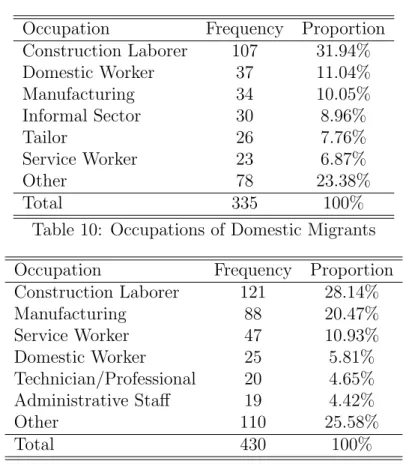
Table 9: Occupations of International Migrants
Occupation Frequency Proportion Construction Laborer 107 31.94%
Domestic Worker 37 11.04%
Manufacturing 34 10.05%
Informal Sector 30 8.96%
Tailor 26 7.76%
Service Worker 23 6.87%
Other 78 23.38%
Total 335 100%
Table 10: Occupations of Domestic Migrants
Occupation Frequency Proportion Construction Laborer 121 28.14%
Manufacturing 88 20.47%
Service Worker 47 10.93%
Domestic Worker 25 5.81%
Technician/Professional 20 4.65% Administrative Staff 19 4.42%
Other 110 25.58%
Total 430 100%
markets work in the construction sector, and manufacturing as well as domestic work is common in both markets. Note that ”service workers” in the domestic migration labor market perform tasks very similar to domestic workers, primarily focused on cleaning. This once again shows the similarities between both classes of migrants, as their job functions are very similar.
4
Assumptions
1. Middleman is a profit-maximizer
The middleman, as a firm, chooses the workers who are willing to pay the highest fees to migrate.
2. Migration as a household decision:
The decision to migrate is made in order to maximize household income, not only the income of the migrant. In a question given by the IOM & DFID household survey asking ”who was involved in making the decision to migrate?”, 94.8 % of the migrants listed other parties, almost all family members, with only the remaining 5.2 % listing themselves. This is consistent with previous patterns observed of migrant workers, where most of the money earned in the international market is sent home. The fact that migration is made as a joint family decision means that income will likely go to the family unit as a whole, rather than just the individual.
3. The international market is more productive than then internal market
The internal sector is in Bangladesh, while the international sector is in higher-paying developed countries. This is further evidenced by the remittances in each sector, as well as household income, as seen in tables 4 and 5. Furthermore, re-mittances of international migrants are over triple that of international migrants, indicating much higher wages in the international sector.
Table 11: Internal Migrants
N Mean SD
Remittances (Internal Migrants) 388 5843.34 9902.656 Remittances (International Migrants) 310 19814.13 36582.46
4. Identical characteristics are rewarded in both internal and international migration markets
From tables 9 and 10, the jobs worked by international migrants and international migrants are very similar. Therefore, the skills of both internal and international migrants are relatively similar, and that ability to work certain jobs are rewarded in both markets. If a worker can perform a task in the internal market, he will also be able to perform it in the international sector and be compensated more for his skills (seen from the previous table).
The international firms are not able to hire workers directly in Bangladesh. Hiring must take place through middleman. This also means that firms are not able to directly observe the workers who they are hiring.
6. International firms given an exogenous constraint, V of total workers
Usually by immigration restriction, the total number of workers allowed in a marketplace is limited by an external constraint.
5
Empirical Testing on Selection
Determining the presence of either selection by productivity or adverse selection in-volves discerning the impact and significance on various worker covariates on migra-tion likelihood and migramigra-tion fee. Given the list of worker observables, the direcmigra-tion of the coefficient as well as its significance would provide evidence for either surplus-maximizing selection by productivity or a form of adverse selection, leading to lower overall production levels. Then we formulate a latent variable function that translates into Probit and Heckman regressions after which we list the covariates and describe how the direction of its coefficient would be evidence for one form of selection of the other. From this we can provide evidence for either surplus-maximizing selection by productivity or adverse selection.
5.1
Latent Variable Function Formulation
First, we consider the utilities of workers, before incorporating middleman fee. The observable characteristics available on workers are Age (Ai), education (Ei), number
of children (Di), Marital Status(Mi), connections (Ci), pre-migration wage (WB,i),
number of total migrations (M T), and total months worked (T). In the structural equation, ci denotes consumption. Unobserved variables that impact utility of not
migrating are denoted it. For example, this may include risk preference. Unobserved
variables that impact wage offers in the domestic and international market areγit and ηit respectively; in the selection by productivity setting these can include endowments
of ability, for example. The interpretations of coefficients on the variables are as follows:
1. Age: We assume that reservation utility is increasing on age, and productivity is increasing (as the ages in our sample of workers is limited to men between 20-40). A positive coefficient would mean selection by workers with higher productivity, a negative coefficient would indicate selection of those with lower reservation utility.
2. Education: We assume that productivity is increasing on education. As more education workers are more productive, a positive coefficient for the education variable would indicate returns to education in the labor market and provide evidence for selection by productivity.
4. Total Migrations: A higher number of total migrations indicates more work ex-perience, a positive value on the coefficient for this variable would be evidence for selection by productivity, while a negative value would be evidence for adverse selection. Productivity is assumed to increase with work experience. A negative value indicates a possibility of the presence of recruitment on the basis of those with less information.
5. Pre-migration wage: Productivity and reservation utility are assumed to be in-creasing on re-migration wage. A positive coefficient on pre-migration wage could indicate selection by productivity, of those with higher reservation utilities, or selection of those who are less risk-averse (assuming decreasing relative risk aver-sion). A negative coefficient would indicate selection of those with lower reserva-tion utilities.
6. Number of Children/ Marital Status: Used primarily in the probit, children and marital status of migration impacts reservation utility in migration. The number of children a worker has and his marital status is assumed to have no relationship with his productivity, but as children and a spouse bring utility, it is assumed to increase reservation utility.
We assume that γit and ηit have a joint normal distribution, while epsilonit is
independent of the other two error terms and normally distributed. We then formulate the structural equations for worker utility as:
Uit=cit+αi(1−dext,it) where αit=βMMit+βDDit+it (1)
cit=wext,itdext,it+wint,i(1−dint,it) (2)
wint,it=βA,intAit+βE,intEit+βM T,intM Tit+βTi,intTit+γit (3)
wext,it=βA,extAit+βE,extEit+βM T,extM Tit+βT ,extTit+ηit (4)
The functionβA,intAit+βE,intEit+βM T,intMpit+βTi,intTit, which gives the return
to wages in the domestic sector by each of the observable variables, is to be denoted as
ϕ(Ωit), where Ωit⊂X~itis the individual-specific set of endowment characteristics that
are observed. Likewise, letψ(Ωit) denoteβA,extAi+βE,extEit+βM T,extM Tit+βT ,extTit,
the returns to wages in the international sector by each of the observable characteristics. Under unrestricted migration, a worker then chooses to migrate internally ifUint,it> Uext,it.
Uint,it> Uext,it:
ϕ(Ωit) +γit−(ψ(Ωit) +ηit)>0
or
Similarly, for the decision to migrate internationally, Uext,it ≥ Uint,it. For the
decision to migrate internationally over internally, this results in the value function of:
Viext(Ait, Eit, Mp,it, Tit, γit, ηit) =Uext,it−Uext,it= (βA,ext−βAint)Ait+ (βE,ext−βE,int)Eit+
(βM T,ext−βM T,int)M Tit+ (βT ,ext−βT,int)Tit+ηit−γit
Thus the worker will migrate internationally if:
ηit−it≥(wb,it+βMMit+βDDit−ψ(Ωit))
and
ηit−γit≥ϕ(Ωit)−ψ(Ωit)
However, incorporating restricted migration, we create a formulation for middleman fee. For each worker, the middleman sets a fee proportional to his wage gains from migration, that is
Fit=ρ(wext,it−wint,it)
where Fi is observed for all workers who migrate internationally (we assume the
next-best option for international migrants is to migrate internally). However, given the external constraint on worker vacancies the decision to migrate is the restricted to the worker’s with the highest gains from migration or willingness to pay. That is
Fit ≥F∗, whereF∗ is set by the middleman and observable. F∗ is the middleman fee
of the worker that pays the least amount of money to migrate. Then, a worker only migrates internationally if
ηit−γit≥U∗−(ϕ(Ωit+ψ(Ωit))
From this, we can construct the likelihood function of workers who migrate as well as estimate the coefficients on the variables which influence migration. The likelihood function for international migration, incorporating middleman fees, is then:
L(θ; Ωit) = S
Y
i=1
P r(dext,it= 1, Fit|Ωit)dext,itP r(dext,it = 0|Ωit)1−dext,it
=
S
Y
i=1
P r(ηit−γit≥U∗−(ϕ(Ωit) +ψ(Ωit)), ηit−γit=ϕ(Ωit) +ψ(Ωit)−Fit)dext,it
P r(ηit−γit< U∗−(ϕ(Ωit) +ψ(Ωit))1−dext,it
productivity and adverse selection. Testing for the presence of adverse selection in-volves interpretation of coefficients related and unrelated to productivity, comes with the addition of additional regresssors.
In this model, we assume that the next best option a worker who chooses to migrate internationally is always to migrate internally. We also assume the most productive workers are sorted into the international migration market. If one is not selected into the international market, then his productivity is high enough to receive positive utility from migrating internally. Therefore, the next best option of any worker who would choose to migrate internationally would be to migrate internally.
These formulations then allow us to satisfy the exclusion restriction for the Heck-man selection model, which will be used to answer the question of what explains the heterogeneity in selection of migrants into the international migration market.
5.2
Regression on Migration Fee and Wages
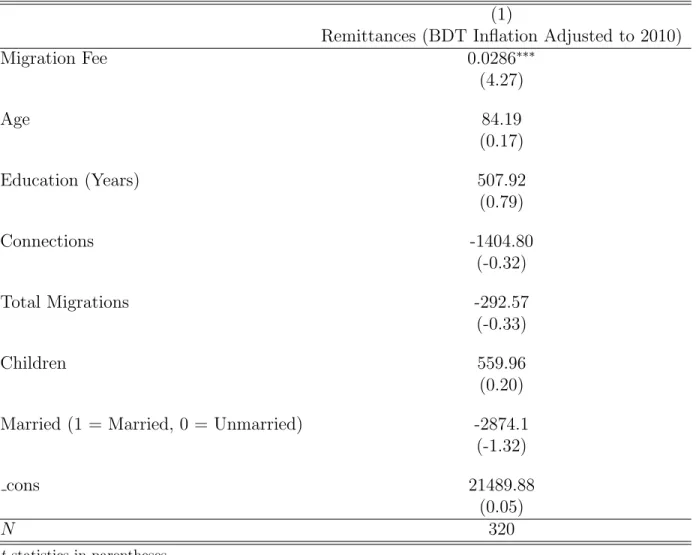
Table 12: Remittances vs. Migration Fee
(1)
Remittances (BDT Inflation Adjusted to 2010)
Migration Fee 0.0286∗∗∗
(4.27)
Age 84.19
(0.17)
Education (Years) 507.92
(0.79)
Connections -1404.80
(-0.32)
Total Migrations -292.57
(-0.33)
Children 559.96
(0.20)
Married (1 = Married, 0 = Unmarried) -2874.1 (-1.32)
cons 21489.88
(0.05)
N 320
t statistics in parentheses
∗ p <0.05,∗∗ p <0.01,∗∗∗ p <0.001
Firstly, running a ordinary least squares regression shows that migration fees of mi-grants is correlated with remittances. That is, workers that pay a higher fee to migrate do see a return in the form of higher remittances. This provides some evidence of selection on the basis of productivity, that more productive workers know they will garner higher wages abroad and be willing to pay higher fees.
5.3
Multinomial Tests
ln(P r(InternalM igrant)
P r(N on−M igrant) ) =β0+β1Ait+β2Eit+β3Mit+β4Dit+it (6)
ln(P r(InternationalM igrant)
P r(N on−M igrant) ) =β5+β6Ait+β7Eit+β8Mit+β9Dit+it (7)
5.3.1 Multinomial Logistic Regression Results
Table 13: Multinomial Logit on Migrants (Base case: non-migrants)
Migrant Status Internal Migrant
Age -0.0445∗∗
(-2.72)
Education 0.0983∗∗∗
(5.31)
Marital Status (1 = Married, 0 = Unmarried) -0.0441 (-0.57)
Children -0.151
(-1.57)
cons 1.405∗∗
(2.79) International Migrant
Age 0.0263
(1.68)
Education 0.108∗∗∗
(5.99)
Marital Status (1 = Married, 0 = Unmarried) -0.241∗∗ (-2.67)
Children -0.324∗∗∗
(-3.44)
cons -0.141
(-0.28)
N 1219
t statistics in parentheses
5.4
Interpretation of Probit Regressions with Regard to
Theoretical Model
The multinomial logit model, while showing selection by productivity, does not distin-guish between self-selection and selection by middlemen. It is already evident from the descriptive statistics that migrants as a whole are more educated and wealthy than the general population. The multinomial logit provides further evidence that international migrants are likely more productive and less risk-averse, as evidenced from education levels and family characteristics. Marriage and having children is assumed to make workers more risk-averse.
6
Empirically Testing Selection by Worker
Char-acteristics
International migration is selection based on two parties, both a middleman and a worker. While the probit regression shows selection on the basis of productivity in the case of both internal and international migrants, this does not imply that middle-man choose workers by productivity. As middlemiddle-man are profit maximizers, they will choose the set of workers for whom they can charge the highest middleman fees. The fee charged is a function of the wage differential, which is a function of worker-level characteristics. As workers in both markets work very similar jobs, I assume they are rewarded for the same characteristics, with returns to productivity being higher in the international sector, thus the equation for middleman fee can be formulated as such (see appendix D). We begin with the assumption that selection occurs based on pro-ductivity, testing for middleman selection involves a linear Heckman selection model, with the response equation, as:
ln(Fext,it) =β10M Text,it+β11Eex,it+β12Aext,it+βext,it~ ·Xex,it~ +ex,it (8)
Where the vector of controls includes country and year-level fixed effects. The second component, the selection equation, is as follows.
Exit=β13Aext,it+β14Eext,it+β15Dext,it+β16Cext,it+β17Mext,it+it (9)
The same interpretations of the coefficients as are used in the probit regression apply.
Testing the presence of selection by information asymmetry involves nesting the first response equation into an alternate specification including the connections (C) variable, another proxy for information. That specification is then as follows:
ln(Fext,it) =β10M Text,it+β11Eex,it+β12Aext,it+β13Cext,it+βext,it~ ·X~ex,i+ex,i
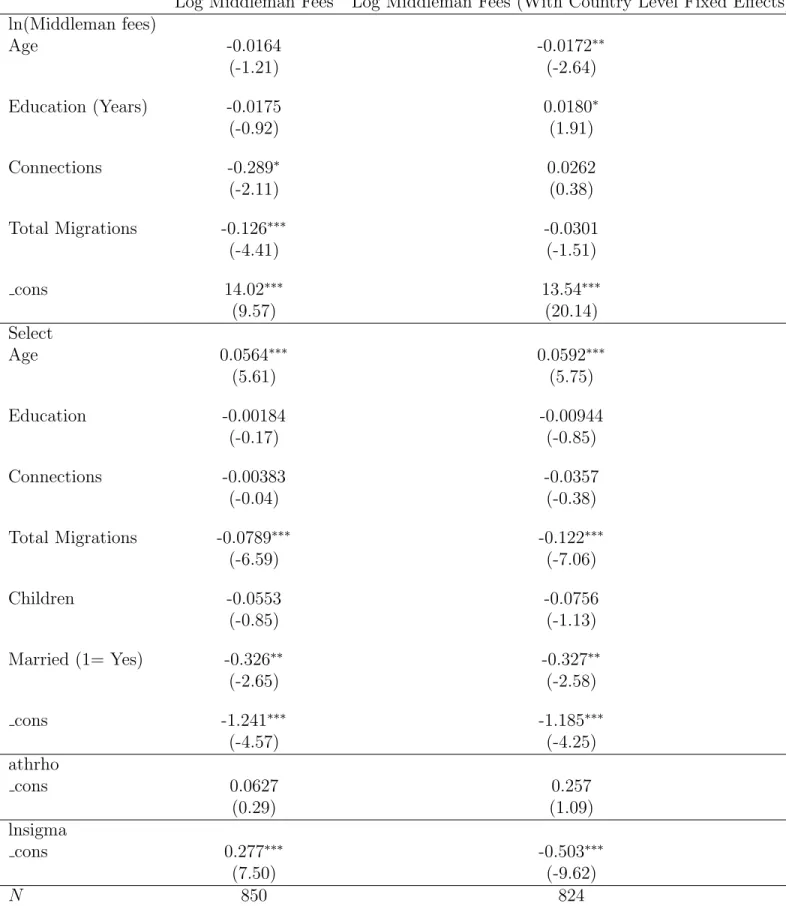
Table 14: Heckman Regression: Middleman Fees on Observed Variables
(1) (2)
Log Middleman Fees Log Middleman Fees (With Country Level Fixed Effects) ln(Middleman fees)
Age -0.0164 -0.0172∗∗
(-1.21) (-2.64)
Education (Years) -0.0175 0.0180∗
(-0.92) (1.91)
Connections -0.289∗ 0.0262
(-2.11) (0.38)
Total Migrations -0.126∗∗∗ -0.0301
(-4.41) (-1.51)
cons 14.02∗∗∗ 13.54∗∗∗
(9.57) (20.14)
Select
Age 0.0564∗∗∗ 0.0592∗∗∗
(5.61) (5.75)
Education -0.00184 -0.00944
(-0.17) (-0.85)
Connections -0.00383 -0.0357
(-0.04) (-0.38)
Total Migrations -0.0789∗∗∗ -0.122∗∗∗
(-6.59) (-7.06)
Children -0.0553 -0.0756
(-0.85) (-1.13)
Married (1= Yes) -0.326∗∗ -0.327∗∗
(-2.65) (-2.58)
cons -1.241∗∗∗ -1.185∗∗∗
(-4.57) (-4.25)
athrho
cons 0.0627 0.257
(0.29) (1.09)
lnsigma
cons 0.277∗∗∗ -0.503∗∗∗
(7.50) (-9.62)
N 850 824
6.0.1 Results of Tests and Interpretation
From table 12, the selection equations show the coefficients on age as positive and significant at the 1 percent alpha level. Older workers, who are assumed to be more productive, have a higher probability of migrating internationally. Number of total migrations is negative and significant at the 1 percent alpha level, which indicates loss of productivity as more experienced workers are less likely to migrate internationally. Married workers are also less likely to migrate internationally, which is consistent with marriage increasing an individual’s reservation utility.
The response equations also show similar trends. Total migrations is negative and significant at an alpha-level of 1 percent in the regression without country-level fixed effects, while connections to the destination market is negative and significant at an alpha-level of 5 percent. However, one country-level fixed effects are included, the regression gives mixed results. One one hand, the coefficient on education is positive and significant at an alpha-level of 5 percent, while the coefficient on age is negative and significant at the 1 percent alpha level. Note that while the coefficient on total migration is no longer significant, the t-statistic has a p-value of about 6 percent.
Note the inverse mills’ ratio (λ) on both regressions. In both cases, the inverse mills the regression is statistically significant at the 1 percent alpha level, showing the presence of selection bias. However, it is positive in the regression without country level fixed effects and negative in the regression with country level fixed effects. This implies that without country-level controls, the error term in the selection equation and the middleman fees equation is positively correlated when not controlling for des-tination country, while it is negatively correlated when desdes-tination country is factored in. When not including destination country, unobserved characteristics that increase the probability one migrates increases middleman fee, while the opposite is true when controlling for destination country.
There is a dramatic difference between the model including and excluding country level fixed effects. Exploring this further, I run a regression including interaction effects on the 6 countries most represented in the data: Saudi Arabia, the United Arab Emirates, Kuwait, Oman, Malaysia, and Singapore.
Once again, the inverse mills ratio is negative, indicating unobserved characteristics that increase the probability of migration decrease the migration fee. However, includ-ing interaction effects shows a great deal of variation between countries with regard to selection. The coefficient on education is positive and statisticall significant at the .1% alpha level, indicating that more educated workers in general pay more to go abroad. This is evidence that more productive workers know that they will receive more wages upon migrating and are willing to pay more for the premium.
However, there are very notable differences between countries. The coefficients on all of the countries’ interactions with education was negative and statistically significant at the 0.1% alpha level, with the exception of Kuwait (which have a p-value of 6%). For Malaysia, and Singapore, these negative coefficients were greater in magnitude than the overall positive coefficient on education. We can conclude that while there may be recruitment on the basis on workers with higher amounts of education overall, this is not the case in many of the major destination markets.
Table 15: Heckman Regression with Interaction Effects (1) lnmiddlemanfees lnmiddlemanfees Age -0.00911 (-1.37)
Education 0.169∗∗∗
(5.00)
EducationxKSA -0.144∗∗∗
(-3.76)
EducationxUAE -0.153∗∗∗
(-4.22)
EducationxKuwait -0.113
(-1.55)
EducationxOman -0.171∗∗∗
(-3.83)
EducationxMY -0.185∗∗∗
(-4.61)
EducationxSG -0.171∗∗
(-2.71)
Connections 0.0330
(0.50)
Total Migrations -0.0338
(-0.61)
Total MigrationsxKSA -0.178∗
(-1.70)
Total MigrationsxUAE -0.130∗
(-1.97)
Total MigrationsxKuwait 0.570∗ (2.37)
Total MigrationsxOman 0.0144
(0.10)
Total MigrationsxMY -0.0494
(-0.35)
Total MigrationsxSG 0.0203
(0.36)
cons 13.78∗∗∗
(20.85) select
Age 0.0601∗∗∗
(5.84)
Education -0.0100
(-0.90)
Connections -0.0362
(-0.39)
totalmigrations -0.121∗∗∗
(-7.05)
children -0.0812
(-1.22)
Married -0.332∗∗
(-2.64)
cons -1.202∗∗∗
(-4.31) athrho
cons 0.344
(1.35) lnsigma
cons -0.546∗∗∗
(-8.66)
N 824
tstatistics in parentheses
is negative and significant at the same alpha level. The coefficients on other countries is insignificant.
7
Distribution of Work Experience Comparisons
Figure 3: Total Migrations
8
Explaining Patterns of Migration into
Inter-national Markets
We can evaluate a number of explanations for selection of migrants into international labor markets using.
1. Productivity: Migration into international labor markets shows self-selection on the basis on productivity. Migrants who migrate internationally tend to be well-educated and have higher incomes than those who migrate internally and non-migrants. However, the difference in education, in comparison with internal mi-grants, is quite small.
There is evidence for middlemen selecting for productivity, as migration fee does correlate with remittances. However, note that there is a great deal of variation between countries with regard to selection on the basis of experience and edu-cation. Overall, more migrants who are more educated pay higher fees, but this varies greatly between countries. The same is true for work experience, markets certain countries seem to reward previous experience, while others do not.
2. Reservation utility: It is not the the case that the workers with lower reserva-tion utility migrate internareserva-tionally. Internareserva-tional migrants have higher incomes than domestic migrants. Although controlling for income, migrants tend to be unmarried, indicating lower reservation utility. Overall tough, migrants seem to wealthier than their non-migrant counterparts, indicating higher reservation utility.
3. Information: Middlemen have incentives to recruit first-time workers and those with less connections to the destination marketplace. There is evidence from this analysis that there is a significant amount of information asymmetry in the migration market, which explains a considerable degree of variation in migration fees. Both probability of migrating and migration fees are negatively impacted by factors that increase information about the destination market. This provides evidence that middlemen do recruit first-time workers, who have less information about the destination market. Also, note that the effect of knowing someone in the destination market on wages and labor expectations is much weaker than the effect of previously working in the market. As noted by Bryan et al., migration patterns seem to only change after experiential knowledge, not just passage of information.
4. Risk Preference: Risk preference explains self-selection to some degree. Migrants coming from higher-income households can be partially explained by decreasing relative risk aversion. As posited by Bryan et. al, a failed migration is not as costly to higher-income households as it is for lower-income households (2014). Marital status of migrants also provides evidence of self-selection on the basis of risk-preference, as married people are assumed to be more risk-averse than single people. Younger workers, who are assumed to be more risk-loving than older workers, are also willing to pay more.
migration. If selection were on the basis of risk-preference, decreasing the risk from migration should results in a greater propensity to migrate.
5. Migration as one-time income source: Contrary to our assumption of migrants as maximizing profit over a lifetime, which would mean migrants would migrate for multiple trips to increase income, it is possible that migration is used as a temporary source of income in response to certain income shocks. Tables 8 and 9 show household reports on remittance spending, much of which tends to be on events that could be possibly attributed to one-time shocks or needs for capital. By far the largest use of remittance spending, for both international and internal migrants, is on health and medical spending, followed by funding of homestead construction projects. It is possible that migration is in response to these needs, and after earning enough money to satisfy these requirements, migrants will remain home.
However, this does not explain the discrepancy between migration rates of in-ternational and domestic migrants. In both cases, remittance spending is fairly similar, but internal migrants tend to remigrate at much higher rates than do international migrants. Although responses to shocks and raising capital does factor into migration decision, it does not appear to explain heterogeneity be-tween migrant workers.
Table 16: Remittance Spending: International Migrants
Occupation Frequency Proportion
Health and medical 109 45.29%
Construction and development of homestead 34 12.32% Pay off migration-finance loans 29 10.51%
Pay off other loans 24 8.70%
Household Goods 16 5.80%
Other 64 23.18%
Total 276 100%
Table 17: Remittance Spending: Internal Migrants
Occupation Frequency Proportion
Health and Medical 161 48.79%
Construction and development of homestead 46 13.94%
Pay off other loans 30 9.09%
Household goods 27 8.18%
Education 13 3.94%
Farm agricultural material 13 3.94%
Other 86 26.06%
9
Conclusion
The migration patterns show some evidence for migrants paying migration fees accord-ingly to wage gains, with a high degree of variation between countries. Overall, rates of remigration are low, which results in productivity loss in the destination country and loss of remittance money for the migrant-sending country.
Further research should focus on the migration market to a specific country, as there is a noted difference between migration fees and returns to various worker char-acteristics between countries.
9.1
Policy Implications
Figure 4: Worker Attrition (Transient Workers Count Too)
Addressing the issue of inefficient middleman selection could address policy problems such as low productivity growth and worker retention in many labor markets. Figure 2 shows worker attrition, a concern of the Singaporean government and NGOs, which is partly attributable to middleman selection. This market failure provides a strong impetus for international cooperation on labor recruitment, as well as implementing laws in Bangladesh regarding middlemen that already exist in other countries.
9.1.1 Policy Implications within Sending Country
The difficulties in enforcement stem from Bangladesh being a predominantly rural country.
9.1.2 International Cooperation
Migration is an ideal issue for international cooperation, as a better organized system of migration can have results in gain for both the destination and the source country. Already, certain countries have cooperative agreements regarding migration regulation and migrant welfare. Regarding Bangladesh, in 2012 Bangladesh and Malaysia agreed to a Memorandum of Understanding (MoU) to better regulate migrant flows between countries and allow for migrant workers to file lawsuits against fraud by labor recruiters or businesses (Wickramasekara 2016). However, there has yet to be a case filed under this law.
Priorities of the migrant-sending and migrant-receiving countries often do not align, with the destination usually being more concerned about workforce productivity, while the sending country is generally more concerned about remittances and protection of its citizens. This can be seen through differences between policies in a migrant-sending country as compared to the migrant-receiving country. These MoU agreements can often create solutions that satisfy both priorities, for example, in the Bangladesh-Malaysia agreement, government industries often hire directly through the Bangladesh BMET (Bureau of Manpower Employment and Training), which oversees training workers for migration. This reduces middlemen fees and loan payments for migrants, and ensures a degree of quality by workers for the receiving country.
9.1.3 Policy Implications within Destination Country
Appendices
An earlier developed theoretical framework, this gives the assumptions under which each form of selection occurs as well as necessary conditions for first-best production outcomes under middleman-facilitated selection. The theoretical model more clearly outlines implications of selection on productivity in the receiving country.
A
Theoretical Setting
Agents
• SetM middlemen: aggregated as one firm, operating as a first-degree price dis-criminator
• SetS of potential migrants, of size S Set S is a finite
• SetIof domestic firms: aggregated into one firm
• SetE of international firms: aggregated into one firm
• Middleman: sets migration fee: Fi,∀si ∈S
• Worker: chooses to migrate internally, internationally, or to remain at home
• Domestic Firm: sets wagewint,i
• International firm: sets wagewext,i
Worker’s Problem
Explaining heterogeneity in migrant outcomes is a confluence of self-selection and mid-dleman selection. The population for midmid-dleman directed migration from Bangladesh is mostly young, low-skilled men who were previously subsistence farmers. Any poten-tial migrant has three choices:
• Remain in the home village, performing agricultural labor
• Migrate internally, performing mostly low-skilled household labor
• Migrate internationally, performing either construction or household labor
The decision to migrate depends on the endowment of characteristics on each in-dividual, denoted X~. Utility of not migrating is denoted as reservation utility Ui(X~). Utility of migration internally is a function of wage and cost of movement and working:
Uin,i(X~) =U(win,i(X~))−Ui(X~) (11)
Utility of international migration, similarly, is a function and wage and cost of move-ment. In addition to movement cost, international migration also includes middleman fees (Fin). Thus, the utility for each worker is given as:
Uex,i(X~) =U(wex,i(X~))−Fi(X~)−Ui(X~) (12)
The worker will choose to migrate internationally ifUex,i ≥Uin andUex,i≥Ui(X~).
Middleman’s Problem
The middleman is assumed to be a first-degree monopolist, and chooses the profit maximizing set of workers. For each individual worker, the middleman can set a price such that
Fi =U(Wex,i(X~))−Ui(X~) (13)
Given an external constraint of V by the firm, the firm chooses the set of workers such thatπM =Pni=1Fi is maximized, where Fi ≥0.
Firms’ Problem
The firm chooses a quantity of workers to maximize total profit, that is:
maximize
Q πi(Q) =P Q−W(Q) (14)
Where W(Q) is the entire sum of wages paid to all workers, and price P is exoge-nous.
First Best Outcome
The most efficient scenario, with optimal output, would be one in which both firms have perfect information on worker characteristics, and workers have perfect information on firm productivity and wages. In this idealized scenario, we assume that workers and firms can communicate. Such a scenario would have no need for a middleman, and selection into each market would result in first-best production levels in a standard. Productivity of migrants will be given as their cost of working: C(X~i) ∀si∈S In this
ideal iteration of the model, the assumptions are as follows:
Assumptions
1. Perfect Information
2. Uniform utility functions
3. The international market is more productive than then internal market
The international market is more productive and lucrative than the internal market: dπext
dq > dπint
dq and πext(q)πint(q) ∀q
4. Identical characteristics are rewarded in both internal and international migration markets
Cext(X~)) =Cint(X~))
5. Firm and workers can directly communicate
6. International firms given an exogenous constraint, V of total workers
Timing
A slight modification is made to the timing of the model, as there is no longer a place for middleman activity:
• t=0: Worker discovers endowments
• t=1: International firm given V vacancies (i.e. restriction on immigration), hire workers
• t=2: Firm produces good, receives total revenue
• t=3: Firms receive profit, worker receives wages
Outcome
In this idealized scenario, there is no need for a middleman, as firms are able to directly hire workers. For each worker, the firm has information on the worker characteristics and the ideal quantity the worker can produce to maximize firm profits and total surplus. Firm profits, for both firms, and worker wages are then determined by a Nash bargaining equilibrium in period 3. The total surplus is defined as
maximize
q πB(q)−CB( ~
X, q) =Ti where B=ext, int (15)
and
q∗ =argmax πBi(q)−CB(X, q~ )
To maximize total surplus, the optimal quantity produced will be until dpiB
dq = dCB(X~)
dq . Each worker has a corresponding total surplus associated with him. This
total surplus is then divided with a Nash bargaining equilibrium into firm profits and worker wages. The bargaining problem is as such:
maximize
wB,i
(u(wB,i))α(πB(wB,i))(1−α)
subject to u(wB,i)≥0
π(wB,i)≥0
u(wB,i) +πB(wi)≤Ti
(16)
Where
w∗B,i=argmaxu(wi)+πB(wi)=Ti u(wi)
α(π(w i))1−α
As the the constraint u(wi) +π(wi)≤Ti is binding.
We assume that bargaining power between all workers is constant; therefore, if total surplus produced by a worker is higher, than his wage will also be higher. Likewise, firm profits will also be higher for workers who produce higher total surplus. Provided a constraint on number of workers who can be hired, the firm chooses the V workers with the lowest cost of working. That is, V worker will work in the international firm, and
kSk−V workers will work either in the internal firm or choose not to migrate. The most productive workers choose to work abroad, aswext,i> wint,i from the assumption that
given a sufficiently lowly level of reservation utility, U. Also, note that the wages of the workers who do work in the international labor market are higher than the would-be wages of workers who did not migrate internationally, as only the workers who create the largest amount of total surplus migrate internationally.
Determining whether the workers choose to migrate internally is similar. The total surplus for the internal firm in determined, as a function of worker endowments. Then ifwint,i≥u, the worker will choose to migrate internally.
Given worker endowments, the worker will work in the international market if his productivity is above some certain threshold set by the firm. Cost of working is a function of worker endowments, X~i ∈Rn for all si ∈ S. We call the set of all worker
endowments Y ⊆ Rn. Then dC∗
dq∗ is the minimum of marginal productivity for all
workers, that is, the minimum of Cext(Y)
dq∗i for allX~i ∈Y. That is, dC∗
dq∗ is the marginal
cost of production at optimal production for the least productive worker in the set of workers designated by the international firm as sufficiently productive.
Then the decision to migrate for the worker as a function of his endowments is given as such:
dext(X~i) =
1 if dCext(X~i)
dq∗ ≤ dC ∗
dq∗
0 if dCext(X~i
dq∗ > dC ∗
dq∗
(17)
If the worker does not migrate internationally (Dext,i = 0), then the decision to
migrate internally is given as a function of worker endowments as
dext(X~i) =
(
1 if u(wint,i(X~))≥Ui
0 if u(wint,i(X~))<Ui
(18)
These outcomes will provide first-best production levels, maximizing levels of pro-duction and total surplus. The most productive workers are hired into the international sector, while less productive workers are filtered into the domestic, internal migration sector. The least productive workers remain as agricultural laborers. This scenario is the ideal scenario for a central planner, as it is Pareto optimal and maximizes total surplus in the economy.
B
Middleman Facilitated Selection
In reality, the firm cannot communicate directly with the workers when filling its vacan-cies. The firm contracts hiring through a middleman, another profit-maximizing firm. The middleman has no incentive to ensure the socially optimal outcome of maximum total surplus, though there are scenarios where this outcome occurs. In the following sections, I will outline the assumptions and scenario in which the first-best production outcome is achieved and scenario where production is sub-optimal.
C
Selection under Perfect Information
act as experts to filter the market of less efficient workers, similar to the scenario outlined by Biglaiser (1996). If we assume that workers have perfect information of the international migration market, workers would know their wage from migrating into each market. Middlemen will then maximize their profits by selecting the set of most productive workers. The assumptions, most of which are consistent from the model with communication between firm and worker, are as follows:
Assumptions
1. Perfect Information
2. Uniform utility functions
3. The international market is more productive than then internal market
The international market is more productive and lucrative than the internal market: dπext
dq > dπint
dq and πext(q)≥πint(q) ∀q
4. Identical characteristics are rewarded in both internal and international migration markets
Cext(X~) =Cint(X~)
5. International firms and workers cannot communicate
6. International firms given an exogenous constraint, V of total workers
7. Costless migration to internal sector
8. Uniform reservation utility
Ui(X~)) =Uj(X~)∀si, sj ∈S
Timing
• t=0: Worker discovers endowments
• t=1: Middleman given exogenous constraint V(vacancies), setsFi for V workers
• t=2: Workers pay fee, choose to migrate internally, or stay at home
• t=3: Firms produces goods, receives profit
• t=4: Worker receives wages
Outcomes
Once again, workers engage in a process of backwards induction to determine their wage from working in both international and internal markets. Wage is determined in both markets with a Nash bargaining equilibrium, where for all workers, wages are higher in the international migration market than the domestic market.
Then the utility of migrating internally is then given by
Ui(X~)int=U(wi,int(X~))−Ui (19)
And the utility of migrating externally is given by
From this, the additional utility from migrating internationally, in comparison with the next best option of migrating internally, is the difference in expected utility of the wages: U(wi,ext(X~))−U(wi,int(X~)). For each worker, si ∈S, the middleman is then
able to charge a fee,
Fi(X~)) =U(wext(X~i))−U(wint(X~i)) (21)
Proposition 1. Workers who are more productive are more profitable for the middle-man. That is: ∂ci(X~)
∂q∗i < ∂cj(X~)
∂q∗j ⇒Fi > Fj
Proof. Suppose there exist two workers: si and sj. Assume without loss of generality,
that worker i’s cost of working is at least as low as the threshold set by the firm,
∂ci(X~)
∂qi∗ ≤ ∂c∗(X~)
∂q and worker j has a higher cost of working than the threshold set by the
firm under the assumptions that led to the first-best production outcome: ∂cj(X~)
∂q∗
j >
∂c∗(X~)
∂q .
To prove that the migration fee (F) is higher for worker i, we must show that
U(wi,ext(X~)−U(wi,int(X~))> U(wj,ext(X~)−U(wj,int(X~))
or that
U(wi,ext(X~)−U(wj,ext(X~))> U(wi,int(X~)−U(wj,int(X~))
It is sufficient to show that the international sector has greater returns to produc-tivity than the internal sector, thatTi,ext−Tj,ext> Ti,int−Ti,int as we assume constant
bargaining power between workers in both markets.
The surplus maximizing quantity of production, results in first order conditions of
∂πB
qi =
∂Ci,B(X~)
qi and
∂πB
qj =
∂Cj,B(X~)
qj for both sectors B =internal, external.
At the first order conditions of each worker in the external market:
∂πext
∂q = ∂Ci
∂q for worker i and ∂πext
∂q = ∂Cj
∂q for worker j. Then at the first order
conditions of each worker in the internal market: ∂πint
∂q = ∂Ci
∂q for worker i and ∂πint
∂q = ∂Cj
∂q for worker j.
As from our assumptions, the international is more productive than the internal sector, and that same skills are rewarded in both sectors (assumptions 3 and 4). Then for the profit-maximizing quantity, determined from the first order conditions:
qB∗ =argmax πBi(q)−CB(X, q~ )
∆qext∗ =q∗i,ext−qj,int∗ >∆qint∗ =q∗i,ext−qj,int
Then ∂πext
∂q > ∂πint
∂q implies ∂πext
∂q (∆qext)> ∂πint
∂q (∆qint), then for worker i and worker
j,Ti,ext−Tj,ext > Ti,int−Ti,int, meaning that worker i will be willing to pay a higher
migration fee than worker j. ThereforeFi > Fj.
Although this does directly not prove that the middleman will choose the same set of workers as the firm operating under the assumptions that led to the optimal production levels, it does show that the workers more profitable for the middleman.
The middleman chooses the set of workers to maximize his profit given the con-straints on vacancies, that is:
maximize
si∈S
πM = V
X
i=1
As higher productivity workers are willing to pay higher fees to migrate into the international market, the middleman then chooses the workers with the lowest costs of working. Once again, the set of workers that migrate internationally are:
dext,i(X~) =
1 if dCext(X~i)
dq∗ ≤ dC ∗
dq∗
0 if dCext(X~i
dq∗ > dC ∗
dq∗
(23)
The workers that choose to migrate internally and remain in the agricultural sector remain the same as well. The set of workers who choose to migrate internationally, internally, and remain at home remain the same as the first-best outcome.
D
Assessing Assumptions
A certain number of these assumptions are quite unrealistic, while others can be as-sumed for computational ease or are testable.
1. Perfect information: this is an unrealistic assumption, as workers in rural Bangladesh have no few means of learning of the labor market in foreign markets. We can amend this assumption to perfect information between workers and the domestic labor market. It is reasonable to assume that rural workers will know wages in nearby cities for certain jobs.
2. Uniform utility functions: Not realistic, but made for computational ease. This does not allow us to factor risk preference in analysis, but does not significantly impact other parts of the analysis.
3. International market is more productive than the domestic market: realistic as-sumption, workers are migrating to high or middle-income countries, where pro-ductivity is higher than it is in Bangladesh
4. Identical characteristics are rewarded in both markets: This assumption is testable and observable. From tables 8 and 9, we can see that for both markets. As workers in both markets take on very similar jobs, we can assume that identical characteristics are rewarded in both markets.
5. Firms in the international sector and workers cannot communicate: Forms cannot hire workers without going through a middleman, this assumption holds.
6. International firms given an exogenous constraint of total workers: This assump-tion holds, as migraassump-tion is subject to government restricassump-tions.
7. Costless migration to internal sector: This assumption is not true, but migration in domestic markets is much smaller than it is in the international sector. As seen in table 3, the cost of migrating internally can be recuperated with one month of work. We will keep this assumption for computational ease and because cost of migration in the internal sector is sufficiently small that it is not dramatically impactful on decision-making.
E
Adverse Selection
We refer to this scenario as one of adverse selection between the middleman and the firm. the assumptions from above are amended to a more realistic set of assumptions. In this case, the worker lack perfect information on wages in the international market. The middleman has perfect information on worker characteristics. I will show that this scenario will generally lead to a loss of output for the international firm.
Assumptions
Most assumptions remain in place from the section on selection by productivity. How-ever, in this scenario, the worker does not have knowledge on his wages in the inter-national marketplace and reservation utility is a function of worker endowments. All other assumptions remain
1. Perfect information between worker and internal market
2. Uniform utility functions
3. The international market is more productive than then internal market
The international market is more productive and lucrative than the internal market: dπext
dq > dπint
dq and πext(q)≥πint(q) ∀q
4. Identical characteristics are rewarded in both internal and international migration markets
Cext(X~) =Cint(X~)
5. Firms and workers cannot communicate
6. International firms given an exogenous constraint, V of total workers
7. Costless migration to internal sector
Timing
• t=0: Worker discovers endowments
• t=1: Middleman given exogenous constraint V(vacancies), setsFi for V workers
• t=2: Workers pay fee, choose to migrate internally, or stay at home
• t=3: Firm produces good
• t=4: Firm and worker divide output
Outcomes
As is the case in previous cases, the worker’s of migrations ex ante are a function of his endowment vectors. However, there is a slight modification in the utility of a worker from migrating externally. In place of the previously used equation:
Ui(X~)int=U(Wex,i(X~))−Fi(X~)−Ui(X~) (24)
We replace the deterministic valueU(Wex,i(X~)) with the stochasticU(E[Wex,i(X~)].
E[Ui(X~)]ext=U(E[wex,i(X~)]−Fi(X~)−Ui(X~) (25)
The remaining equations for worker utility equations remain from the previous specifications. Then amount each worker is willing to pay for the middleman fee is given by
Fi =min[E[U(X~i)]ext−U(X~i), E[U(X~i)]ext−U(X~i)int] (26)
While in the previous section of selection by productivity, we assumed that the next best option for workers sufficiently productive to migrate abroad would be to migrate internally, this is no longer the case. The expected wage of a worker going abroad could be uncorrelated with his cost of working, while the utility of working domestically is determined by cost of working. In the assumptions of adverse selection, next best option for a worker who desires to work internationally could be either to remain at home or to migrate internally.
The middleman problem remains the same, the middleman will choose the set of workers who with the most willingness to pay up to the exogenous vacancy constraint (V) provided by the firm, once again given by equation (12).
First, we find the set of worker who would be willing to internationally under free migration. These are the workers for whom:
E[U(wi,ext)](X~)−Ui(X~)≥0 and
E[U(wi,ext)](X~)−U(wi,int)(X~)≥0
(27)
Then, following from equation (16), the middleman sets a fee Fi equivalent to the
utility of the worker minus his next best option. From the set of workers who are willing to migrate internationally, we can derive the set of middleman fees associated with what we will call S0⊂S, the set of willing migrants. This set of middleman fees is also a discrete set inR. This set is denoted as set Fand the middleman will choose
a minimum feeF∗ such that for all workers selectedF(X~i)∈[F∗, M ax(F)]. Denoting
the set of selected workersT,kTk=V.
The workers who migrate internationally will then pay a fee such that F(X~i) ∈
[F∗, M ax(F)].
Note that these conditions do not guarantee that the workers selected will be less productive than selection by productivity, but they can at best be equivalent. For the set of workers to be equally as productive, it would need to be the case that for the workers selected in the case of selection by productivity, that:
Conditions for first-best productivity levels under adverse selection
dC(X~i, q) dq∗i ≤
dC∗
dq∗ ⇔min[E[Ui(X~)
ext]−U
i(X~), E[U(X~i)ext]−U(X~i)int]≥F∗
and
dC(X~i, q) dq∗i >
dC∗
dq∗ ⇔min[E[U( ~
Xi)ext]−Ui(X~), E[U(X~i)ext]−Ui(X~)int]< F∗
References
[1] Agunias, Dovelyn Rannveig. Migration’s Middlemen: Regulating Recruitment Agencies in the Philippines-United Arab Emirates Corridor. Migrant Policy In-stitute. 2010
[2] Baey, Grace & Yeoh, Brenda S.A. Migration and Precarious Work: Negotiating Debt, Employment, and Livelihood Strategies Amongst Bangladeshi Migrant Men Working in Singapore’s Construction Industry. Working Paper, Migrating out of Poverty Consortium, February 2015.
[3] Biglaiser, Gary. Middlemen as Experts. The RAND Journal of Economics, 24(2):212-223, Summer 1993.
[4] Bryan, Gharad, Chowdhury, Shyamal & Mobarak, Ahmed Mushfiq. Underinvest-ment in a Profitable Technology: The Case of Seasonal Migration in Bangladesh. Econometrica, 82(5): 1671-1748, September 2014.
[5] Flinn, Christopher.Equilibrium Wage and Dismissal. Journal of Business & Eco-nomic Statistics, 15(2),1997.
[6] Flinn, Christopher & Heckmann, James. New Methods for Analyzing Structural Models of Labor Force Dynamics. Journal of Econometrics, 115(168),1982.
[7] Glode, Vincent & Opp, Christian. Asymmetric Information and Intermediation Chains. American Economic Review, 106(9), 2016.
[8] Harsanyi, John.Games with Incomplete Information Played by “Bayesian” Play-ers, I-III. Management Science, 14(3), 1967.
[9] Heckman, James. The Common Structure of Statistical Models of Truncation, Sample Selection and Limited Dependent Variables and a Simple Estimator for Such Models. Annals of Economic and Social Measurement, 5 (4): 475-492, 1976.
[10] Heckman, James & Sedlacek, Guilherme. Heterogeneity, Aggregation, and Mar-ket Wage Functions: An Empirical Model of Self-Selection in the Labor MarMar-ket. Journal of Political Economy, 93(61): 1077-1125, 1985.
[11] Human Rights Watch.w ’As If I am Not Human’ - Abuses against Asian Domestic Workers in Saudi Arabia. July 08, 2008.https://www.hrw.org/sites/default/ files/reports/saudiarabia0708_1.pdf
[12] Keane, Michael, Peta, Todd, & Wolpin, Kenneth. The Structural Estimation of Behavioral Models: Discrete Choice Dynamic Programming Methods and Appli-cations. Journal of Econometrics, 18: 115-168, 1982.
[13] Lim, EC & Alum, Jahidul.Construction productivity: Issues encountered by con-tractors in Singapore. International Journal of Project Management, 13(1): 51-58, Feb. 1995.
[14] Mizanur Rahman, Md. Bangladeshi Migration to Singapore: A Process-Oriented Approach. Singapore, Springer Nature, 2017.