Abstract
Objectives: To describe the development of the GooDMomS intervention and to summarize the findings of interviews assessing its use.
Methods: Individual qualitative interviews conducted among pregnant and postpartum women with current or recent diagnoses of gestational diabetes, respectively.
Results: Four key themes emerged among the participants involved in the interviews, including discussions about the ease of usability of the website; challenges associated with receiving a new diagnosis of gestational diabetes; desires for additional topics to be addressed in the program curriculum; and desires for additional tools and features to be incorporated to the website.
Introduction and background
Gestational diabetes mellitus (GDM), defined as glucose intolerance that begins or is first diagnosed during pregnancy, is part of a vicious cycle of diabetes and obesity in women and their offspring. (1,2) Of the 4 million women who become pregnant each year in the US, 7- 14% are diagnosed with GDM (3,4), depending on demographics and diagnostic thresholds. (5) GDM confers increased risks for the mother and fetus during pregnancy and places the woman and her offspring at risk for obesity and diabetes in the years after delivery. (6) About 30% of these women will develop GDM in the next pregnancy; up to 50% of women with GDM and high gestational weight gain (GWG) can develop diabetes within 5-10 years of delivery. (7)
Intrauterine exposure to GDM can result in accelerated growth, newborn adiposity, and a higher risk of diabetes and obesity in early childhood.(8)
With the increase in obesity and sedentary lifestyles, the prevalence of gestational diabetes is rising, both globally and in the United States. Prevalence rates are likely to further increase if the newly proposed International Agency of Diabetes and Pregnancy Study Groups (IADPSG) criteria are adopted. The proposed thresholds are based largely on the results of the
Hyperglycemia and Adverse Pregnancy Outcomes (HAPO) study (9), an international study in 14 centers which reported strong glucose-outcome associations among infants born to mothers with glycemic levels below current diagnostic thresholds. Applying the IADSP criteria would increase the prevalence of GDM in the US to 15-25%; a two to eight-fold increase in women diagnosed with GDM. (10) The well-documented upward trajectory of women with GDM coupled with the anticipated increase in cases with the IADPSG criteria will require innovative, effective approaches to assist clinicians with managing maternal metabolism and weight in gestational diabetics during pregnancy and the postpartum. Such interventions can promote glucose and weight gain control during pregnancy to improve birth outcomes and postpartum weight loss to reduce the risk of maternal obesity and type 2 diabetes.
Diabetes Prevention Program (DPP) (7) included women with histories of GDM, (8) but they were remote from diagnosis at the time of enrollment. Studies that test the effect of alternative modes (i.e. telephone, internet, and video) of delivering behavioral interventions are also limited. Internet-based and hybrid (i.e. internet and in-person) interventions have proven success in achieving behavioral change in in non-pregnant adults, but evidence of effectiveness is limited in the perinatal period. One pilot trial tested the effect of a telephone-based, DPP curriculum in gestational diabetics. The intervention began with the diagnosis of gestational diabetes and continued through the postpartum, showed promising results, but there were no statistically significant differences between groups.
To date, there is limited evidence on the effect of behavioral interventions in gestational diabetics during both pregnancy and the postpartum. There is essentially no evidence on the effect of internet-based or hybrid interventions on glucose and weight control in gestational diabetics. Our objective was to develop a multi-model behavioral intervention that begins in pregnancy with the diagnosis of gestational diabetes, and extends into the interconception period. The Gestational Diabetes Management System (aka “GooDMomS”) seeks to fill the gap in our current knowledge of the efficacy of pregnancy and postpartum behavioral interventions to improve outcomes of gestational diabetics and their offspring. GooDMoms emphasizes two aspects of social cognitive theory (SCT) (12) , to guide behavioral change: efficacy and self-regulation. In this paper, we outline the development of the components of GooDMomS and summarize the findings of a series of interviews on the acceptability and ease of use of the intervention components.
METHODS
We developed a novel Internet-based pregnancy and postpartum intervention and conducted 10 in-depth interviews to access women’s acceptability of the computer components. We describe the intervention components, identifying the novel components developed for gestational
diabetes during pregnancy. We summarize the adaptions to DPP for the postpartum period. We then summarize the recruitment and conduct of the in-depth interviews.
Adaptations for a pregnancy/postpartum behavioral intervention for GDM
that were successful in reducing the risk of developing type 2 diabetes, including among women with a history of GDM (7,8). These strategies have been modified to not only be used in the postpartum phase but also target behaviors during pregnancy. The original DPP was developed at the University of Pittsburgh and is described elsewhere. (7) Tate et al. (13,14) have adapted the DPP sessions into an online format, which we have further adapted to develop a pregnancy portion of the intervention that focuses on behavioral strategies to promote glucose control and appropriate gestational weight gain.
The DPP utilized a variety of tools and techniques to engage participants in the “Lifestyle Balance” program, the details of which are included in Table 1. GooDMomS also utilizes similar components, such as the presentation of a core curriculum focused on behavioral
self-management, a combination of group and individual approaches, and individualization of the intervention through tailored feedback and responses generated by the website based on participant’s input. Additionally, the GooDMomS curriculum contains more sessions (29 total, compared to 16) and is more varied in its methods of delivery, since it includes didactic Web lessons, instructional videos, in-person group sessions, and interactive webinars (Table 1).
We have also significantly enhanced the existing Web-based intervention to include content specific to the prenatal and postpartum periods and have therefore adapted the intervention for GDM specifically. Some of the key enhancements of the intervention include self-management through glucose monitoring and reporting, automated feedback that is generated based on participant input, and education on the maternal and fetal effects of hyperglycemia.
Study design
We conducted ten individual, in-person interviews to determine the usability and acceptability of a multi-component Internet intervention for women with gestational diabetes. This qualitative study investigates individual participants’ impressions of the content and structure of a novel Internet intervention for women with gestational diabetes. Participants were recruited from the University of North Carolina at Chapel Hill Obstetrics and Gynecology Clinics by convenience sampling. Eligible participants were diagnosed with gestational diabetes during a current or recent pregnancy, age 18 years or older, and English speaking. Recruitment continued until saturation of themes was reached. We obtained written and informed consent from all
in the study. The institutional review board at the University of North Carolina at Chapel Hill approved this study.
Conduct of interviews
The interviewer underwent a 60-minute training session with study investigators to review interviewer instructions and to clarify key questions to be included in the study.
After enrollment, participants were asked to log in to the GooDMomS website. The interviewer guided each participant through a thorough demonstration of the website and its various features. Women were encouraged to ask questions as they used the website and were given extra time to do additional browsing or testing at their leisure. After the demonstration was complete, each participant was interviewed and asked about their experience using the website and thoughts about certain features of the site (Table 2). The website demonstrations and interviews were conducted in a private clinic exam room or consultation room within the UNC hospital-based women’s clinic.
Data analysis and development of codebook
All interviews were audio recorded and transcribed verbatim by a professional transcriptionist. The transcriptions were reviewed and compared with the audio recording to ensure accuracy. The transcripts were then analyzed using Atlas.ti v6.2 qualitative data analysis software (Atlas.ti GmbH) to identify salient themes. The authors developed an initial codebook of concepts pertaining to the website use and its features, using the key topics from the interview guide. An individual coder then coded each transcript, adding additional codes for new and emerging concepts, based on a grounded theory approach. (15) Matrices of salient themes were then created to identify the frequency with which ideas were mentioned among the interview participants and to highlight suggestions that arose for potential website refinements.
RESULTS
Characteristics of the study sample
Hispanic. Similarly their insurance status reflected diversity, with a slight majority (40%) being recipients of Medicaid.
Key themes
We categorized participant responses into several key themes (table 4), which reflected specific participant comments about ease of use and usefulness of information and features for
addressing challenges of GDM management. Additionally, many women shared insights and opinions regarding means by which we could improve current features as well as suggestions for additional topics or features.
Ease of Using Website
In general, the women were able to navigate the website and utilize its features without difficulty. The majority of women commented explicitly on the website being user-friendly and easy to use. They specifically noted the simplicity; organization; ease of navigation, especially in using the labeled tabs at the top of each webpage; and appropriate conciseness of information delivered as pleasing features of the website.
I thought it was concise. I mean, on the Web, me personally, you don’t want to sit there reading pages and pages, so I think it was organized well. [It] had the bullet points broken out so you can get the gist of it pretty quickly.
(Pregnant participant 7)
I think it was simple and straightforward, which I think is key with engaging someone to use this regularly. I think if it became too top heavy or cumbersome, you know, there’s too many things to get into, distractions and what not, and I think the core purpose is to really focus on gestational diabetes, both the monitoring of it, both the education of it as well as helpful tips, so I think it was just enough, frankly.
(Pregnant participant 7)
Addressing Challenges of GDM Diagnosis and Filling In Knowledge Gaps
Several respondents expressed difficulty in having to remember to actually take blood glucose measurements or to remember to record them. Women seemed to prefer having a centralized, electronic record of this information rather than recording the information on paper or in a book.
I will probably be using that every day, . . . every day, because it’s, I guess it’s quicker for me to jump on the computer and put it in than it is to write it in the book, because I’ll forget it.
(Pregnant participant 3)
I think that’s my whole favorite part of the website, because it’s different from just writing it down and logging it [into] a book. . . . So you were already online, you get the information, keep track of your weight loss or gain or your blood glucose levels, all at the same time, so it’s very interesting and very helpful.
(Pregnant participant 1)
Another prominent theme that arose was focused on the challenges that the women faced in learning the new guidelines for a diabetic diet and adjusting their own meals and food intake accordingly. Over half of the women expressed frustrations or uncertainty in this area, along with excitement for potential ways that this website may be able to help them improve their understanding and guide them in behavioral change. Several women specifically cited the provision of recipes and specific food ideas as their favorite parts of the website.
The recipes are always good, because I know my biggest challenge was, the first thing I thought was, Well, what can I eat? You know, like, . . . Do I starve myself? I said, What exactly can I eat? So kind of teaching someone what, you know, they can prepare at home or what the meals need to look like, I think, is very helpful and seeing that from the homepage is great because a lot of times it’s that go-to thing. “Okay. I need something now. What can I eat?” So, that addresses that.
(Pregnant participant 7)
One of my big ones that I had problems with was knowing, like, you know, like, they gave me like a calorie plan thing, and I thought I was supposed to try and incorporate a calorie plan. They gave it to me as an example and it’s not about the calories. It was, Here is what you’re supposed to get, those carb levels. And I took those carb levels to be, Don’t go over and not necessarily meet them, so, like, that was something that was important that I never really quite grasped.
(Postpartum participant 1)
Online Peer Support
especially in terms of actual experience. Only one participant expressed that she had experience actively using an online discussion board.
I’ve actually joined two since I’ve been pregnant, so it’s interesting to see other moms going through the same thing that you’re going through and getting advice from them and sharing things that you’ve experienced, so it’s very useful, very helpful.
(Pregnant participant 1)
Several others stated that they had either never used one or that they only used them
passively—reading what other women posted but never actually posting themselves. Despite this variety in experience, most women expressed interest and a willingness to try using a message board, motivated by the potential for benefits of learning from other women in similar situations.
Using this program would probably . . . would be the first for me because I don’t do the message boards and things of that nature, but I’m willing to give it a try, just, you know, because somebody may know something more than I do, and it never hurts to ask.
(Pregnant participant 3)
Suggested Refinements
While all of the participants were generally pleased with most of the website features, they also shared their ideas regarding ways to further improve the website, either by making changes to features that currently exist or adding several completely new features. While the participants enjoyed the nutrition education and recipe tips provided on the website, many expressed a desire for more detailed, in-depth information specifically focused on diet and nutrition.
Participants expressed a strong desire for more dietary guidance, including more numerous and varied recipes, nutritional information, suggestions for foods to order when eating out, and tips for easy and quick snacks or on-the-go foods.
Other than diet, what’s good, what’s bad, and how to fix your meals on the diabetic standards, because, I don’t know[. . . .] I get burned out easily, and after a couple of months of the same things, you’re just really starting to get burned out.
(Pregnant participant 4)
I mean, just as much nutritional information as possible[. . . .] That was
something that was tough for me just trying to really figure out what I could and should eat . . . . Like, maybe some examples from a typical restaurant, things that might be good on a menu to order at a restaurant instead of just recipes,
because, I don’t know, I didn’t feel like cooking when I was pregnant.
And I really and truly like the on-the-go, fast ideas and suggestions [. . . .] because we’re all busy and we’re all working and it’s . . . . You can do Greek yogurt, you can do things like that, or good fruits and bad fruits and good veggies, and actually link[ing] it to food with carb counts would be another thing to have on there, as a page that actually says[, . . . ] so you know how much.
(Postpartum participant 1)
A few women also suggested that in addition to being able to utilize the Keep Track page to monitor weight, exercise, and blood glucose levels, it might also be useful if they were given the option to also record what they were eating. They felt that this would help them get a better idea of how certain foods were affecting the blood glucose levels that they were recording.
Another thing for me personally is I actually would write down what I ate every day as well, and so I could kind of see, Oh, when I eat this I get a much higher reading at dinner, or, you know, why my dinner readings were higher than my lunch readings, like what types of foods I was eating.
(Postpartum participant 2)
I eat pretty much, like, three different options a week for breakfast, and sometimes my results are higher or lower, even though I’m eating the exact same thing prepared the exact same way and the exact same measurements, so it’s really interesting because I do feel to a degree that maybe what you ate the night before does come into play even in the morning, so that’s something I would have people log in[. . . .] I would somewhere put what did you eat, in comparison to that number.
(Pregnant participant 8)
Several participants also felt that it would be helpful if there were a way that their providers could have access to the data that was being recorded on the Keep Track page. They mentioned the need to bring in their records to the clinic for their appointments so that their providers could review the trends and patterns of their blood glucose measurements over the course of the previous weeks. Some thought it would be nice to simply be able to print out the record directly from the website, and others suggested allowing providers to receive an email with the information or even to have direct access to that information from their patients’ records.
It would be great if the doctors could actually have access to it or, you know, whoever [is] checking it for you.
(Postpartum participant 1)
Something that you could mail to them, email to them, or something they could link up with would be great.
CONCLUSION
The women in this study were generally pleased and impressed with the features of the website and the tools and information that it had to offer. They found the site easy to navigate and appreciated the clarity and simplicity of both the information presentation and the overall content. The participants showed particular enthusiasm for several of the tools of the website, including the provision of recipe tips and the ability to track their weight and blood glucose measurements.
When discussing the use of an online message board, women expressed some mixed feelings and shared various experiences, including never having used them, passively using them only as a reader, and actively engaging in posting and reading. Despite this variation in experience, most participants felt that they would be willing to try the message board and predicted that perhaps they would be able to gain additional information and learn from other similar women. The potential perceived benefits of online communication is not unique to this population, since women with GDM have previously expressed a desire for the use of websites and message boards to connect with other women who have GDM. (16,17)
Several themes that emerged among our participants were similar to those among focus group participants from the DEBI trial. (16) First, the women from the focus groups expressed a desire for additional guidance on optimal carbohydrate requirements for their diets. (16) The women in our study also frequently commented on the challenges of understanding the nutritional
guidelines and requirements of a GDM diet and desiring further guidance on ways to ensure that they were achieving their nutritional goals. The focus group participants expressed a desire for the provision of recipes to help guide their food preparation, a wish that was also reflected in our participants’ comments. (16) Many women shared their concerns with attempting to identify foods that were appropriate to consume and ways to easily modify their diets to incorporate such foods.
experience. Patients who used the modem reported that it was convenient and timesaving. Providers were also pleased and felt that receiving the blood glucose information from their patients in this manner was more efficient.
There are several limitations of this study and its results. First, recruiting women by convenience sampling did not allow for an equal balance of pregnant and postpartum patients. Given the nature of the volume of patients regularly seen in our tertiary clinics, appointments for pregnant patients greatly outnumber those for postpartum women, so it is not surprising that this
distribution is reflected in the study sample. It is possible that a greater number of postpartum women would have had more insight into certain features of the site or more suggestions for information or tools that they wished they could have accessed during their pregnancy. However, analysis of the responses did not reveal any major differences in topics or content when comparing pregnant versus postpartum respondents. Second, while women were introduced to all features of the website and allowed ample time to browse and experiment, theirs was only a snapshot view of a longitudinal program that offers new features and information on a weekly basis. While women did not get to see the full scope of all that the website has to offer, their responses and suggestions for refinement generally highlighted novel ideas that are not currently part of the program.
The latest Pew Research Center data indicates that 74% of American adults use the Internet, and the third most commonly reported online activity is searching for health information. (19-21) Additionally, women are more likely than men to seek health information online, and 19% of Internet users report searching for pregnancy and childbirth information. (22) Therefore, delivering a health intervention via a Web-based program has the potential for significant reach and impact among pregnant and postpartum women.
Previous studies on Internet-based weight loss interventions have proven them to be successful among non-pregnant adults, and Internet use data would suggest that they have great potential to be the same among pregnant and postpartum women. (23-26) Many women are particularly focused on and concerned about the health of their developing baby during pregnancy, and this can provide a unique opportunity for igniting behavioral change. Research has shown that women may be more motivated and therefore more likely to engage in healthful lifestyle
set the stage for a powerful “teachable moment” for promoting healthy lifestyle practices during pregnancy. (28,29)
GooDMomS takes advantage of the “teachable moment” of pregnancy, along with the high prevalence of Internet use among women, and provides a novel approach to delivery of health information and provision of empowering tools to better enable women to care for themselves and manage their gestational diabetes. The positive reactions of the women who tested the website in this study are encouraging and further suggest that this intervention has great
potential for success. In this paper, we summarize the results of our interviews, which serve as
References
(1) Metzger BE, Coustan DR. Summary and recommendations of the Fourth International Workshop-Conference on Gestational Diabetes Mellitus. The Organizing Committee. Diabetes Care 1998 Aug;21 Suppl 2:B161-7.
(2) American Diabetes Association. Gestational diabetes mellitus. Diabetes Care 2003 Jan;26 Suppl 1:S103-5.
(3) Bellamy L, Casas JP, Hingorani AD, Williams D. Type 2 diabetes mellitus after gestational diabetes: a systematic review and meta-analysis. Lancet 2009 May 23;373(9677):1773-1779. (4) Damm P. Future risk of diabetes in mother and child after gestational diabetes mellitus. Int J Gynaecol Obstet 2009 Mar;104 Suppl 1:S25-6.
(5) Landon MB, Spong CY, Thom E, Carpenter MW, Ramin SM, Casey B, et al. A multicenter, randomized trial of treatment for mild gestational diabetes. N Engl J Med 2009 Oct
1;361(14):1339-1348.
(6) Kim C. Gestational diabetes: risks, management, and treatment options. Int J Womens Health 2010 Oct 7;2:339-351.
(7) Knowler WC, Barrett-Connor E, Fowler SE, Hamman RF, Lachin JM, Walker EA, et al. Reduction in the incidence of type 2 diabetes with lifestyle intervention or metformin. N Engl J Med 2002 Feb 7;346(6):393-403.
(8) Ratner RE, Christophi CA, Metzger BE, Dabelea D, Bennett PH, Pi-Sunyer X, et al.
Prevention of diabetes in women with a history of gestational diabetes: effects of metformin and lifestyle interventions. J Clin Endocrinol Metab 2008 Dec;93(12):4774-4779.
(9) Hyperglycemia and Adverse Pregnancy Outcomes. N Engl J Med 2008 05/08; 2012/06;358(19):1991-2002.
(10) ACOG Committee Obstetric Practice. ACOG Committee opinion. Number 267, January 2002: exercise during pregnancy and the postpartum period. Obstet Gynecol 2002
Jan;99(1):171-173.
(11) Kieffer EC, Sinco B, Kim C. Health behaviors among women of reproductive age with and without a history of gestational diabetes mellitus. Diabetes Care 2006 Aug;29(8):1788-1793. (12) Bandura A. Social foundations of thought and action: a social cognitive theory. Englewood Cliffs, N.J.: Prentice-Hall; 1986.
(13) Tate DF, Wing RR, Winett RA. Using Internet technology to deliver a behavioral weight loss program. JAMA 2001 Mar 7;285(9):1172-1177.
(15) Patton MQ. Qualitative research and evaluation methods. Thousand Oaks, Calif.: Sage Publications; 2002.
(16) Ferrara A, Hedderson MM, Albright CL, Ehrlich SF, Quesenberry CP,Jr, Peng T, et al. A pregnancy and postpartum lifestyle intervention in women with gestational diabetes mellitus reduces diabetes risk factors: a feasibility randomized control trial. Diabetes Care 2011 Jul;34(7):1519-1525.
(17) Nolan JA, McCrone S, Chertok IR. The maternal experience of having diabetes in pregnancy. J Am Acad Nurse Pract 2011 Nov;23(11):611-618.
(18) Kruger DF, White K, Galpern A, Mann K, Massirio A, McLellan M, et al. Effect of modem transmission of blood glucose data on telephone consultation time, clinic work flow, and patient satisfaction for patients with gestational diabetes mellitus. J Am Acad Nurse Pract 2003
Aug;15(8):371-375.
(19) Rainie L. Internet, broadband, and cell phone statistics. Pew Research Center’s Internet & American Life Project 2010.
(20) Lagan BM, Sinclair M, Kernohan WG. What is the impact of the Internet on decision-making in pregnancy? A global study. Birth 2011 Dec;38(4):336-345.
(21) Zickuhr K. Generations 2010. Pew Research Center’s Internet & American Life Project 2010.
(22) Fox S. Health Topics: 80% of internet users look for health information online. Pew Research Center’s Internet & American Life Project 2011.
(23) Appel LJ, Clark JM, Yeh HC, Wang NY, Coughlin JW, Daumit G, et al. Comparative effectiveness of weight-loss interventions in clinical practice. N Engl J Med 2011 Nov 24;365(21):1959-1968.
(24) Marcus BH, Lewis BA, Williams DM, Dunsiger S, Jakicic JM, Whiteley JA, et al. A comparison of Internet and print-based physical activity interventions. Arch Intern Med 2007 May 14;167(9):944-949.
(25) Polzien KM, Jakicic JM, Tate DF, Otto AD. The efficacy of a technology-based system in a short-term behavioral weight loss intervention. Obesity (Silver Spring) 2007 Apr;15(4):825-830. (26) Tate DF, Wing RR, Winett RA. Using Internet technology to deliver a behavioral weight loss program. JAMA 2001 Mar 7;285(9):1172-1177.
(27) Ockene J, Ma Y, Zapka J, Pbert L, Valentine Goins K, Stoddard A. Spontaneous cessation of smoking and alcohol use among low-income pregnant women. Am J Prev Med 2002
Oct;23(3):150-159.
(29) Phelan S. Pregnancy: a "teachable moment" for weight control and obesity prevention. Am J Obstet Gynecol 2010 Feb;202(2):135.e1-135.e8.
(30) Diabetes Prevention Program (DPP) Research Group. The Diabetes Prevention Program (DPP): description of lifestyle intervention. Diabetes Care 2002 Dec;25(12):2165-2171.
Table 1. Comparison of Components of DPP and GooDMomS Interventions Components of the Diabetic Prevention Program (30)
• Individual case managers or “lifestyle coaches” • Frequent contact with participants
• A structured core curriculum that taught behavioral self-management strategies for weight loss and physical activity
• Supervised physical activity session
• Combination of group and individual approaches, motivational campaigns, and “restarts” for maintenance intervention
• Individualization through a “toolbox” of adherence strategies • Tailoring of materials and strategies to address ethnic diversity • An extensive network of training, feedback, and clinical support
Total number of curriculum sessions = 16 Components of GooDMomS – Pregnancy
7 Lessons:
Lesson 1 – Gestational Diabetes: The Basics Lesson 2 – Treating Your Gestational Diabetes
Lesson 3 – The Benefits of Exercise for Women with Gestational Diabetes Lesson 4 – Medications to Treat Gestational Diabetes
Lesson 5 – The Benefits of Breastfeeding for You and Your Baby Lesson 6 – Postpartum Glucose Testing for the Gestational Diabetic
Lesson 7 – Gestational Diabetes, Long-term Implications for Type 2 Diabetes 2 Videos:
Video 1 – What Causes GDM?
Video 2 – Using Health Foods and Exercise to Manage Your Diabetes 1 In-Person Group Meeting:
Interactive focus group to discuss behavioral challenges and strategies for healthy eating and weight management, including a 30 minute exercise session
Total number of curriculum sessions = 11 Components of GooDMomS – Postpartum
24 Lessons:
Lesson 1 – Getting Started and Keeping Track Lesson 2 – Energy Balance
Lesson 3 – Daily Weighing
Lesson 4 – Becoming More Active
Lesson 5 – Incorporating Physical Activity into Your Everyday Lifestyle Lesson 6 – Be a Fat Detective
Lesson 7 – Fast Foods/Beverages/Eating Out Lesson 8 – Feeding Your Family
Lesson 9 – Social Support
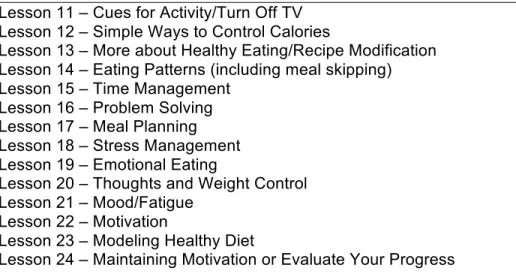
Lesson 11 – Cues for Activity/Turn Off TV Lesson 12 – Simple Ways to Control Calories
Lesson 13 – More about Healthy Eating/Recipe Modification Lesson 14 – Eating Patterns (including meal skipping) Lesson 15 – Time Management
Lesson 16 – Problem Solving Lesson 17 – Meal Planning Lesson 18 – Stress Management Lesson 19 – Emotional Eating
Lesson 20 – Thoughts and Weight Control Lesson 21 – Mood/Fatigue
Lesson 22 – Motivation
Lesson 23 – Modeling Healthy Diet
Lesson 24 – Maintaining Motivation or Evaluate Your Progress 2 Videos:
Video 1 – Getting Ready for Life After Delivery: Postpartum Glucose Testing Video 2 – Life after GDM
1 In-Person Group Meeting:
Interactive focus group to discuss healthy eating and weight management, with a special focus on the challenges of having a newborn, including a 30 minute exercise session
1 Webinar:
Managing exercise with new baby
Total number of curriculum sessions = 28
Table 2. Major Interview Question Topics 1
2 3 4 5 6 7 8
Lesson length/content General website layout Use of Keep Track page
Use of Personal Progress page Use of Message Board
Suggestions for additional topic(s) Favorite section(s)
Table 3. Demographic Characteristics of Participants
Characteristic Overall Mean (Range) or Frequency (Percent)
Age (n=10) 32.9 (23–44)
Race (n=10) African American Caucasian Hispanic
4 (40%) 4 (40%) 2 (20%)
Parity (n=10) 2.2 (1–5)
Insurance Status (n=10) Medicaid
Private Uninsured
4 (40%) 3 (30%) 3 (30%) Pregnancy Status (n=10)
Pregnant Postpartum
8 (80%) 2 (20%)
Gestational Age (n=8) 32 (15–38)
Table 4. Summary of Key Themes Identified and Proposed Refinements
Key Themes Examples
Ease of usability Concise, organized lessons Ease of tabbed browsing User-friendly layout Challenges of new GDM
diagnosis
Learning/understanding new diet guidelines and restrictions Identifying healthy, low-carbohydrate foods
Remembering to measure and record blood glucose values Desire for additional topics More detailed and varied diet/nutrition guidance
Desire for additional features Ability to track foods eaten along with daily blood glucose measurements