This study examines an asynchronous, form-based model of service for Readers' Advisory within a public library setting. Literature addresses some limitations of the traditional model of Readers’ Advisory service, including patron reluctance to approach librarians and time constraints for librarians handling multiple tasks and requests. One potential solution to overcoming these limitations is providing an asynchronous, form-based model of Reader’s Advisory service. This study introduces a form-form-based model as an experimental service in a pilot-study with the Chapel Hill (NC) Public Library. To assess the service model, data was collected through survey responses from study
participants and interview responses from participant-librarians. Results demonstrate that patrons and library professionals benefit from the provision of a form-based model of Readers’ Advisory service. Suggestions for further research considering the form-based service model, and the professional development of Readers’ Advisory skills for public librarians are included.
Headings:
Readers’ advisory services
by
Meghan M. Webb
A Master’s paper submitted to the faculty of the School of Information and Library Science of the University of North Carolina at Chapel Hill
in partial fulfillment of the requirements for the degree of Master of Science in
Library Science.
Chapel Hill, North Carolina November 2012
Approved by
Table of Contents
Introduction ... 2
Readers’ Advisory Service & the Readers' Advisory Transaction ... 2
Problem Statement ... 4
Purpose of Study ... 5
Literature Review... 6
Limitations of Readers’ Advisory in Practice ... 6
Current Trends in Library Service & Implications for Readers' Advisory ... 8
Methodology & Analytic Techniques ... 12
Research Site & Site Participation ... 13
Participants ... 14
Design of Reader's Request Form ... 15
Results and Discussion ... 19
Participant Surveys ... 19
Librarian Interviews ... 26
Limitations and Future Research ... 34
Limitations ... 34
Implications for Further Research... 35
Conclusion ... 36
References ... 40
Appendix A: Participant-Librarian Consent Letter... 42
Appendix B: Display Flyer ... 43
Appendix C: Participant Consent Letter ... 44
Appendix D: Reader's Request Form ... 45
Appendix E: Participant Survey Questions... 47
Introduction
In 2010, Online Computer Library Center (OCLC) conducted a nationwide survey to examine the resource use, perceptions, and impressions of the public library. The results, consistent across all age groups, demonstrated that Americans predominantly view the public library’s role as a place to get books; and when asked, “What is the first thing you think of when you think of the library?”, 75% of Americans provide “books” as their initial response (OCLC, 2010). Clearly, there is a strong connection between reading and the public library, demonstrating a connection that was forged from the institutional beginnings, and is still a leading impetus in the design, organization, and management of public library services. However, the strength of the association between public libraries and reading is less obvious in one of the most fundamental library
services developed to accommodate readers-- direct readers' advisory service.
Readers’ Advisory Service & the Readers' Advisory Transaction:
Direct readers advisory, as defined by Shearer (1996), one of the leaders in the study of Readers' Advisory, is "an exchange of information between two people with the purpose of one person's suggesting text for the other's later reading interest"; and
additionally, suggested materials are typically used for a "recreational, emotional, psychological, or educational need" (p. 3). While an important and essential service in public libraries, the traditional model of direct readers’ advisory, also referred to as the readers' advisory transaction, has not always proven to be the most effective and convenient model for either the library patron or the service professional.
to talk about a book they have read and enjoyed, and then proceed to listen for key appeal terms that may reflect a preference towards certain genres, authors, or styles of writing. In addition to descriptors that may suggest reading preferences, less appealing factors, or "peeves" may also provide clues as to what reading materials may be most suitable for the patron. The glaring difference between the readers' advisory transaction and the traditional reference interview is that the former offers many "possibilities" of meeting the patron's need, instead of the single correct answer or resource that fulfills a patron's informational need, as customarily seen in the reference interview.
Generally, the success of a readers' advisory transaction is measured through the affirmation that a patron receives in connecting their reading interests and practices with the services that are provided through their public library. Allowing a patron to connect readers' advisory service with their public library and the professional librarians that work there creates a bond between the user and the library institution. In her seminal work on readers' advisory, Readers' Advisory Service in the Public Library, Saricks (2005) offers commentary on the issue of measuring the success of a readers' advisory service, noting:
The exchange is a success when readers perceive, based on the service they receive, that the library is a place where they can talk about books and obtain suggestions and resources to meet their reading needs. As with any good conversation, a successful readers' advisory interview is not, nor should it be, a onetime encounter. The advisor encourages readers to return and give their reactions to books suggested, thus establishing an ongoing dialogue between readers and the readers' advisory staff. (p. 75)
Additionally, there are several other professional benefits associated with developing and practicing readers' advisory. Trott and Hollands (2011) outline several professional benefits to developing and practicing readers advisory. First, readers'
advisory can connect readers with “older books and midlist authors" within the collection, improving the circulation of older materials or materials that might not be as well-known, and creating unique entry points into a library’s collection (Trott & Hollands 2011, p. 119). Readers' advisory can also alert librarians to gaps within the collection, or areas for development within the reading selections. Through developed readers' advisory
anticipate reader demands and trends (p. 119). And finally, readers' advisory practice works to build essential library skills used to connect readers with their collection, and provide on-the-job continuing education opportunities. “Interacting regularly with readers, researching materials across genres and collections, keeping up with authors, and
learning to use all the tools necessary for good RA service provides challenging but rewarding work that reminds librarians and other library staff of their profession’s value and keeps a job fresh that could become stale if practiced passively” (p. 119-120).
Although there are several benefits for library patrons and for library
professionals to develop and practice readers' advisory, the literature on this model of service presents a different picture as to the effectiveness and utilization of this service in the field.
Problem Statement:
Recognized as a core service in public libraries, readers' advisory has the potential of both connecting readers and promoting the public library collection; and yet, research in the field indicates that most public libraries fail to deliver adequate readers' advisory service-- leading many to question the potential for improving the current models of readers' advisory service (Shearer 2001).
In responding to this call for change, some public libraries have begun to use alternative, asynchronous models of service for readers' advisory. Asynchronous readers' advisory is a model of service in which the readers’ advisory transaction takes place without direct, real-time contact between the library professional and the patron. One such example of asynchronous advisory is the use of “Readers' Interest Surveys”, a form-based readers' advisory service model that translates the face-to-face advisory
greater confidentiality and privacy for reluctant patrons, and offering readers' advisory that "fits the realities of daily practice" (Hollands, 2006, p. 205).
Purpose of Study:
Literature Review
The following Literature Review examines Readers’ Advisory practices in public libraries and the associated limitations of the traditional model of service. A review of the current trends in library service and service modeling reveals how the asynchronous, form-based model of service can improve Readers’ Advisory interactions.
Limitations of Readers’ Advisory in Practice:
Although few in-depth empirical studies have been conducted on the subject of the Readers’ Advisory interview, the nature of direct Readers' Advisory service and the limitations associated with this model of service have been examined in two formative research studies-- "The Nature of the Readers' Advisory Transaction in Adult Reading" by Kenneth Shearer (1996), and "An Investigation of Readers' Advisory Transactions in Nassau County (NY) Public Libraries" by Anne May, Elizabeth Olesh, Anne W.
Miltenberg, and Catherine P. Lackner (2000). Both studies were summarized and
reviewed in The Readers' Advisor's Companion, and presented similar findings about the nature of the readers' advisory transaction (May, 2001). The studies suggest that most direct readers' advisory services were perfunctory, and inadequate at providing readers with acceptable suggestions; some of the chief limitations outlined in both studies include failure to perform a thorough readers' advisory interview, staff discomfort with
handling readers' advisory requests, insufficient follow-up with patron interactions, and reluctance to utilize professional readers' advisory tools to offer suggested reading materials (May, 2001). May, Olesh, Miltenberg, and Lackner (2000) outline some of the shortcomings in the readers' advisory interactions that were observed from their study:
Both of these studies convey the need to examine current readers' advisory practices and offer models for improvement in readers' advisory transactions.
In "Readers Advisory Work" from Reference and Information Services in the 21st Century, Mary K. Chelton also addresses some of the common weaknesses in readers' advisory encounters. First of all, Chelton acknowledges "poor interpersonal
communication" as an impediment to successful readers' advisory interactions (Chelton, p. 298). In order to encourage library patrons to engage, librarians have to appear
approachable and provide an unbiased communicative presence; and because of this, face-to-face readers' advisory can become a very delicate and complex transaction (Chelton, 2011).
Once librarians are approached with a readers' advisory request, there are certain tendencies within the practice that restrict satisfactory readers' advisory service.
“Inappropriate OPAC Use” is one such tendency noted by Chelton; she argues that “many librarians immediately turn to Online Public Access Catalogs (OPACS) to identify other titles by the same author before asking the reader whether he or she has read other books by the author, or what the reader likes about the particular book” (p. 298). Chelton argues that while exploring other items by the same author gives the library professional an immediate task to accomplish, it is "rarely the correct initial action for an RA encounter" (p. 299). Chelton asserts that continuing with the readers' advisory interview, to make certain of the patron's reading preferences and desires, is the more appropriate action-- and responding to an initial read-alike suggestion can fail to provide a comprehensive evaluation of the reader's needs.
On a similar note, Chelton notes that many library professionals rely on unreliable resources to generate suggested reading material. The use of automatic recommendation lists from such agencies as Amazon.com and Barnes & Noble (bn.com), may offer useful “readalike” suggestions, but "they are generated through patterns of 'associative buying',
Yet another unsuitable response associated with readers' advisory transactions is "query avoidance and lack of follow-up". Chelton defines this tendency as a "flat-out refusal to answer an RA request", especially when faced with requests for information about a genre or writing style which the librarian is unfamiliar with (p. 299). This response implies that some library professionals experience discomfort with readers' advisory interactions, and unfamiliarity with readers' advisory tools, techniques, and skills that can be useful in navigating readers' advisory requests. Libraries may not be promoting or providing professional development opportunities for library professionals to continue developing readers' advisory skills.
In "Improving the Model for Interactive Readers' Advisory Service", Hollands (2006) also presents some of the limitations with traditional readers' advisory, and suggests how utilizing a form-based readers' advisory service can help to alleviate these restrictions. He outlines "faulty assumptions", or aspects of the readers' advisory service that presumably should occur, but in fact do not transpire appropriately. These
assumptions include: "readers will approach librarians with RA questions", "enough information is obtained in an interview to provide good RA service", "quality RA service is possible, given the time constraints of library encounters", and "resources needed by readers' advisors are easy to use in face-to-face discussion" (Hollands, 2006). These faulty assumptions speak to the challenges in everyday library practice-- such as the reluctance of patrons to approach librarians with their inquiries, and the time constraints that librarians feel when handling multiple requests at their service desk. Hollands encourages the use of form-based readers' advisory to provide a more efficient model of service; a "noninvasive way to use shared terminology" for more reluctant patrons, and an opportunity for "both parties in the readers' advisory transaction to interact in an efficient, low-pressure situation" (p. 211).
Current Trends in Library Service & Implications for Readers' Advisory:
meet the needs of the patrons.
O’Gorman and Trott (2009) share the concept of extending library services to reach patrons at access points beyond the traditional reference desk. In an effort to generate a more user-centered service, they suggest that using new technologies, such as instant messaging and chat, is "simply an extension of existing reference services, offering users a new service point at which to contact a librarian" (O’Gorman & Trott, p. 334). In the article, O’Gorman and Trott also suggest that libraries need to develop greater flexibility in providing services to users, as demands for both "speed of service" and more individual, personalized attention exist (p. 329).
The increasing trend towards more user-centered services is also noted in a study outlined in Theresa Arndt's article "Reference Service Without the Desk" (2010). Arndt and her colleagues at Library and Information Services at Dickinson College conducted an assessment of their current reference service model, and discovered two major areas of weakness. First, students seemed unsure about the role of the librarians at the reference desk; and second, the librarians felt strained for time to complete their multiple
responsibilities, and needed a better way to manage their time constraints (Arndt, 2010). In response to these issues, librarians sought to improve visibility an accessibility by offering alternative access points to their service through an "on-call" model and
scheduled consultations. This alternative model granted the library professionals efficient time management, and improved service access for students and faculty through the on-call and consultation opportunities-- demonstrating the value of an asynchronous service model that form-based readers' advisory also allows for.
In considering the provision of new service models for the future of library reference, Cassell and Hiremath (2011) outline current trends and new models for library service in Reference and Information Services in the 21st Century, noting that “Reference in the future will be less attached to a particular location no matter what type of library, but its focus will be user centered” (p. 426). They promote the implementation of multi-access points for professional library service, which will allow users to reach librarians for assistance through a variety of methods, and “give librarians more flexibility to do other projects rather than staffing a desk and gives the user more choices” (p. 426). Specifically, Cassell and Hiremath reflect on the future of readers' advisory services, asserting “librarians will develop their readers’ advisory skills to provide more personalized service to their users. . . Librarians will also spend time creating finding tools to guide their users in the ever-more-complex world of information resources.” (p. 424-425). The form-based model of service for readers' advisory offers a level of personalization and customization that is more difficult to replicate in traditional face-to-face methods, due to patron reluctance to provide a suitable amount of information, and the time constraints that librarians face when handling multiple patron requests.
Hollands and Moyer (2008), consider the form-based service model a creative approach to readers' advisory that can overcome some limitations of the traditional, face-to-face model. The use of reader profile forms "obtains more information that can be gained in an interview or conversation and is less obtrusive to the patron, but it allows the advisor to work asynchronously with full access to resources in developing a thoughtful list of suggestions" (Hollands & Moyer, p. 256). Hollands and Moyer go on to recognize that another important benefit of the form-based service model is the potential for
documenting the readers' advisory transaction, and the generating reader's finding tools for common reading preferences, such as alike lists for popular authors, or read-alikes for popular bestseller materials (Hollands & Moyer, 2008).
Hollands and Moyer also share the possibility of keeping reader profile forms on file, and suggest:
The use of readers profile forms that are then kept on file (with patron consent) is a good start toward solving the documentation problem. The profiles can be filled out by the patrons or used by the librarian when conducting an advisory
of the number of readers served when building a file (in either hard copy or digital form) that can be used to maintain an "institutional memory" of the reader. (p. 257)
Some of the limitations towards traditional readers' advisory service speak to altering the level of service convenience and reaching the reader through increased marketing and accessibility of readers' advisory service. The literature on service marketing and literature within the Library Science field focused on marketing issues help to connect how form-based readers' advisory can resolve some of the limitations of the traditional model.
In their research on service convenience, Berry, Seiders, and Grewal (2002) suggest the importance of "access convenience" in service models. Access convenience "involves consumers' perceived time and effort expenditures to initiate service delivery" and relates with the "consumers' required action to request service and, if necessary, be available to receive it" (p. 7). The introduction of a form-based readers' advisory service will allow library patrons a certain level of autonomy in their participation with the service transaction, allowing them to decide when and where (and how much information to include) to complete their readers' advisory form.
Berry, Seiders and Grewal present access convenience as the "primary reason for consumers to self-perform certain services", as it "reduces consumers' dependence on service providers whose accessibility may be inconvenient" (p. 7). For the purposes of this study, access convenience may prove to be a tremendous motivator for patrons to utilize the form-based readers' advisory service.
Methodology & Analytic Techniques
This study seeks to explore the use of a form-based Readers' Advisory service model in a public library setting. Designed as a "pilot", or limited study of an alternate service model, the form-based model was introduced as a trial service, as opposed to a full-implementation of the model within library services. The pilot study would test the service model within a small participant group of library patrons and library professionals, and gather feedback from both groups of participants to analyze the service model.
Surveys were used to examine participant responses to the form-based model of service, and interviews were used to measure the library professionals' responses to the service model. A mixed methods approach, utilizing both quantitative and qualitative data collection and analysis, was employed.
The study design incorporated two phases. The first phase of the study involved participant engagement with the form-based service model, and the second phase of the study involved the collection of participant feedback through survey and interview responses about their experiences with the service. I decided to organize my study into two phases so that participants would have an opportunity to experience the service model in an authentic context before being asked evaluative questions that might have biased their response.
The study began with the recruitment of participants at the study location; whereby participants completed a Reader's Request Form and submitted the form to the study coordinator(s). The completed Reader's Request Forms were then routed to the librarians to analyze, and use to generate a list of 5 titles from the library collection that they believed would appeal to the reader based on the information that they selected from their Request Form. Once the librarian had chosen 5 titles, they would route the
Each personalized reading list included the title and author of each recommended book, as well as a brief description of the book, and an illustration of the cover art. Participants were given the option of receiving their suggested reading list through email or picking-up a print copy of the list from the library service desk. After completing each participant's reading list, I would send the list to the participant and provide information on how to complete the participant survey. Again, participants had the option to
complete the survey in a print format or online.
After the librarians had responded to each participant's Request Form, and I had created and distributed the suggested reading lists, I conducted individual interviews with each of the participant-librarians about their experiences with the service model, and continued to encourage participants to complete and submit a survey.
Research Site & Site Participation:
The Chapel Hill Public Library (Chapel Hill, North Carolina) was selected as the study location. As one of the busiest library systems in North Carolina (with over 1,000,000 items circulated, over 352,000 patron visits, and over 99,000 reference
questions logged in 2011), the Chapel Hill Public Library was an ideal location to recruit participant-readers and collaborate with public librarians who provide traditional Readers’ Advisory services (Town of Chapel Hill, 2012).
At the time of the study, I was an employee with this library system, and my familiarity with the library and my rapport with the library professionals provided an advantage in developing and implementing the pilot study.
With the approval of the Academic Affairs Institutional Review Board at the University of North Carolina at Chapel Hill, I coordinated the study design with the Chapel Hill Public Library Head of Reference and Instructional Services, and three primary Reference staff members who, by designation of the Reference Supervisor, were considered confident Readers' Advisors. Participant-librarians were given a consent letter, which presented an overview of the study and outlined the voluntary and
confidential nature of the study (see Appendix A for the Participant-Librarian Consent Letter).
Participants:
Participants were recruited through both in-person appeals and a library display. The display included a flyer advertising the service, and Reader's Request Forms and attached consent letters that further explained the study and the confidential and
voluntary nature of the study (see Appendix B for the Display Flyer, Appendix C for the Participant Consent Letter, and Appendix D for the Reader's Request Form). The display was nearby the Reference and Information Services desk, and the self check-out
machines. The display location was coordinated with the Head of the Reference Department, and was chosen for its distance from the service desk, and its proximity towards other readers’ advisory materials, and library “events” information.
The in-person recruitment of participants occurred during the library operating hours from September 28th through 30th (2012). As library patrons and visitors entered and exited the library, I asked patrons if they were “looking for a good book?” or were interested in receiving reading suggestions. Patrons that engaged with my greeting were provided with an explanation of the study, and given the opportunity to participate.
In total, 17 participants were recruited for the study, with the majority of
Participants were given a Reader’s Request Form and a participant consent letter that outlined the study design, and included information about the voluntary and
confidential nature of participation, and contact information for the Principal Investigator and the Faculty Advisor. If recruited in-person, patrons were encouraged to provide "as much" or "as little" information on the Reader’s Request Form as they were comfortable with.
Design of Reader's Request Form:
In creating the Reader’s Request Form, the form-based model of service for this study, I referenced previous studies and form-based models of service to guide my design, and the selection of literary elements and appeals that would be included. Hollands
(2006) suggests that forms should be comprehensive and include many literary aspects and genres to choose from, should "allow readers to circle or cross out options, mark preference scales, or check boxes instead of writing open-ended responses", avoid library "jargon" that readers may not recognize, and "set a nonjudgmental tone" about reading preferences (Hollands 2006, p. 209). Hollands suggests that forms should include requests for patron’s contact information (and contact preferences, such as email of telephone), examples of past reading, genre and format preference, and “content limits” (content that the reader would prefer to avoid, such as violence or obscene language) (Hollands 2006, p. 209-210). These critical components of the form-based Readers’ Advisory service were included in the form-based model used for this research study.
Additionally, the form was modeled from current form-based models from other public library institutions, including the Wake County Public Library “Adult Customized Book List” (2012) and the Williamsburg Regional Library “Looking for a Good Book?” (2012) services.
and they were given the option to have available copies of suggested titles placed on hold for them.
Next, the form presented a “Reading History” section, and participants were asked to list 3 of their “favorite books/or authors and what you enjoyed about them”. This portion of the form allows for participants to share, in their own words, the type of reading materials that they have enjoyed and provides the library professionals with clues as to what read-alikes and additional titles would best match their “favorite” reading selections. Then, a section describing “Focus, Style & Tone” allowed participants to include preferences for “focus” (characters, action/events, issues & ideas, language & style, and setting); “style” preferences (such as happy/light, dark, funny, serious, relaxing, suspenseful/tense, straightforward language, lush/poetic, easy to read, and demanding); and a “peeves” section which allowed participants to include content they wished to avoid in their reading (explicit sexual content, rough/obscene language, violence, death, religion, politics, and ‘other’/to be specified by the participant).
The second side of the Reader’s Request Form presented more literary appeals and genres for the participant to select. A “Genres & Formats” section presented a list of major literary genres and formats, and further defined subgenres within each. The major genres, and subgenres, included:
Fiction (classics, historical fiction, literary fiction, bestsellers, gentle reads),
Fantasy (epic/quest, fairy tales, myths & legends, dark fantasy, magic & wizards),
Horror (ghosts/hauntings, psychological/sociopaths, monsters/zombies,
vampires),
Mystery (gentle/cozy, historical, police procedurals, women sleuths, British
detectives),
Science Fiction (aliens, alternate histories, dystopia/apocalyptic, military science
fiction),
Non-Fiction (biography/memoir, true crime, travel narratives, quirky non-fiction),
Religious/Inspirational (contemporary, inspirational romance, historical,
apocalyptic),
Romance (contemporary, historical, paranormal, cozy, multicultural, romantic
Suspense/Thrillers (legal, medical, espionage, techno-thrillers, action &
adventure),
Westerns (classic westerns, biographical, outlaws, home on the range).
Also, additional genres and formats were outlined in More Genres (women’s fiction, graphic novels, world literature, African American, and teen lit), and an Other selection allowed participants to specify a genre or format they were interested in, but was not presented on the form.
Next, the Reader’s Request Form suggested “Characters & Settings” preferences. Participants were instructed to select any “desired character or setting traits” and to “leave non-applicable selections un-checked”. The character traits included:
Age (under 12, teens, 20s-30s, middle aged, and over 65),
Gender (male, female),
Ethnicity (African-American, Latino-American, Asian-American,
Native-American, and recent immigrants), and
Relationships (family life, Gay/Lesbian, friendship, odd couples, singles,
divorce/widowhood). The setting traits included:
Where? (small towns, cities, rural, Southern U.S., New England, Europe, Asia,
and Africa), and
When? (ancient times, Middle Ages, Regency, Victorian, 1900s, contemporary,
and future).
And like the previous appeals sections, participants were given the option to specify other character or setting traits of interest that were not included on the form.
Eleven participants preferred to receive their suggested book lists electronically (through email), so in response, suggested reading lists were created and then attached to email as a digital document; and the other 6 participants preferred to pick-up the
Results and Discussion
Participant Surveys:
Surveys were used to collect participant feedback to the form-based service model (see Appendix E for the Participant Survey Questions). Upon receiving a personalized, suggested reading list, study participants were encouraged to complete the survey, which was available in both print and electronic formats. The survey was anonymous and neither survey format solicited any identifying information. Additionally, surveys were collected in an unidentifiable manner (paper surveys were sealed in unmarked, business envelopes before being returned, and electronic surveys were collected anonymously through an online form created by Google Docs).
Multiple efforts were made to contact study participants for both the distribution of personalized reading lists and the collection of participant feedback through the study surveys. Of the 17 original study participants, 10 surveys were successfully completed and submitted, yielding a response rate of 58.8%. More participants completed and submitted an online version of the study survey (7) than the print format (3). The following discussion outlines the survey results and observations.
The first question in the survey examined participant use (or disuse) of current readers' advisory tools. The question asked "How likely are you to use the following resources for recommended reading suggestions?", and presented a chart with 5 measures of "likeliness" ("N/A-- I don't use this resource", "Unlikely", "Somewhat likely", "Likely", and "Extremely Likely") and 9 optional resources for Readers' Advisory, including: "Family & Friends", "Library Catalog", "Librarian", "Bestseller Lists", "Library
"Family and Friends" earned the highest amount of "Extremely Likely" responses, and "Bestseller Lists" following with 3 "Extremely Likely" responses. "Published Book Reviews" and "Online Review Service" each earned 4 "Likely" responses, and
surprisingly, "Amazon.com" earned the highest number of "N/A-- I don't use this resource" responses (4).
Figure 1: Likeliness to use the following resources for recommended reading suggestions Family &
Friends
Bestseller Lists Published Book Reviews Online Review Service Amazon.com Extremely Likely (5) Extremely Likely (3)
Likely (4) Likely (4) N/A -- I don't use this resource (4) Likely (3) Somewhat
Likely (3)
Extremely Likely (2)
N/A -- I don't use this resource (3)
Likely (3)
Somewhat Likely (1)
N/A -- I don't use this resource (2)
Somewhat Likely (2)
Unlikely (2) Somewhat Likely (2) N/A -- I don't
use this resource (1)
Likely (1) Unlikely (1) Somewhat Likely (1)
Extremely Likely (1) Unlikely (0) Unlikely (1) N/A -- I don't
use this resource (1)
Extremely Likely (0)
Unlikely (0)
The responses for the "library resources" demonstrated a lesser degree of
Figure 2: Likeliness to use library resources for recommended reading suggestions Library Catalog Library Displays Librarian
Somewhat Likely (4) Somewhat Likely (4) Somewhat Likely (3) Extremely Likely (3) Extremely Likely (2) Unlikely (3)
Unlikely (2) Likely (2) Extremely Likely (2)
Likely (0) Unlikely (1) N/A (2)
N/A (0) N/A (0) Likely (0)
In general, the responses demonstrate that of all the reader advisory tools listed, library resources (such as the library catalog, library professionals, and library displays) are lesser-used and less familiar to patrons for readers' advisory needs.
The next section of the survey collected information about the frequency of visits to the library, and the participants' awareness of the provision of Readers' Advisory services by library professionals. Participants' visits to the library (within a month) varied from "once a month" (1), "twice a month" (4), "weekly" (4), and "more than once a week" (1); demonstrating that most of the participants were modest to frequent visitors of the public library.
The response to the awareness of Readers' Advisory service from public library professionals also demonstrates that there is uncertainty about this service from the user's perspective. As Figure 3 demonstrates, half of the respondents were unaware that
Figure 3: Awareness of Librarian provision of Readers' Advisory
Figure 4: Previous Readers' Advisory interaction with library professionals
When asked "Have you ever approached or asked a librarian for a reading
recommendation?", 70% of respondents answered "No", while only 30% answered "Yes" (Figure 4). An analysis of the results from participant awareness of readers' advisory service by library professionals demonstrate that the majority of respondents were not aware of this service, and had not previously approached a librarian for readers' advisory service. The data collected from this survey suggests there is a potential connection between these two measures, as two of the participants who reported they have approached librarians for reading suggestions, also reported that they were aware that librarians provided reading suggestions. The other participant who responded positively
Yes
No Unsure
"Were you aware that librarians
provide suggestions for leisure
reading?"
Yes
No
"Have you ever approached or
asked a librarian for a reading
for approaching a librarian for a reading suggestion reported that they were “Unsure” about whether librarians provided suggestions for leisure reading.
And finally, the survey examined participant satisfaction with the form-based service model. Participants were surveyed on design elements of the form and response aspects from the librarians, including: the design of the Reader's Request form, the amount of literary appeals and genres available on the Reader's Request form, the response time from librarians, the accuracy of the suggested reading list to your reading taste, and the selection of suggested reading titles.
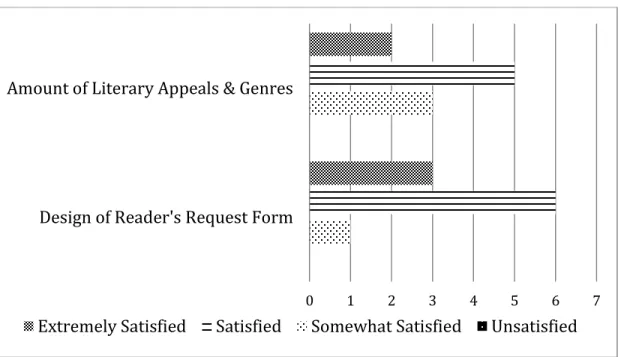
The survey responses demonstrated positive feedback for the design and inclusive elements (literary appeals and genres) of the Reader's Request Form. Figure 5 offers a representation of these survey results, illustrating that most participants were "satisfied" with both the amount of literary appeals and genres available on the form, and the overall design of the Reader's Request Form. In rating the satisfaction with the overall design of the Reader's Request Form, most participants reported they were "satisfied" (6) or
"extremely satisfied" (3) with the design; while the responses for the amount of literary appeals and genres available on the form were mostly "satisfied" (5) and "somewhat satisfied" (3). No respondents assigned "unsatisfied" for either category.
Figure 5: Satisfaction with Reader’s Request Form Design
0 1 2 3 4 5 6 7
Design of Reader's Request Form Amount of Literary Appeals & Genres
Another aspect of the form-based service model that was evaluated in the survey was the librarian-response to their Reader's Request Forms. The survey instructed participants to rate their satisfaction with the response time from librarians, the accuracy of the suggested reading list to your reading taste, and the selection of suggested reading titles, using the same satisfaction scale that was offered for the design elements
('unsatisfied', 'somewhat satisfied', 'satisfied', and 'extremely satisfied').
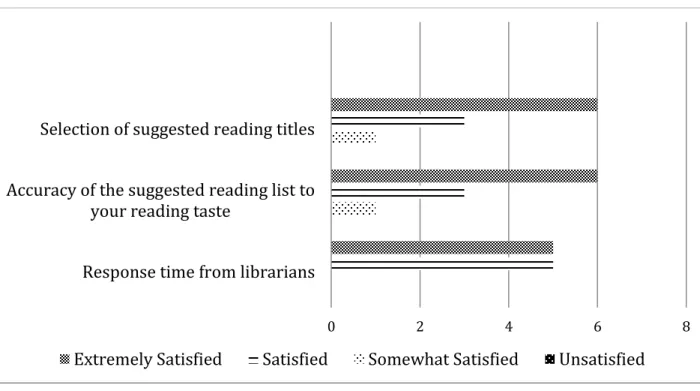
Figure 6 represents the response distribution for satisfaction with response time from librarians, accuracy of the suggested reading list to their reading taste, and selection of suggested reading titles. Both the accuracy and selection of suggested reading material received similar results, with most participants assigning a rating of "extremely satisfied" (6) and "satisfied" (3). Participants rated the response time from librarians with
"extremely satisfied" (5) and "satisfied" (5). In general, participants had a response time of 7 to 10 days (the timeframe when their Reader's Request Form was submitted to receiving a personalized reading list).
Figure 6: Satisfaction with response to Reader’s Request Form
And finally, participants were surveyed about their likeliness to use the service again. This measure attempts to highlight the overall success of this Readers' Advisory
0 2 4 6 8
Response time from librarians Accuracy of the suggested reading list to
your reading taste
Selection of suggested reading titles
model, as we established earlier that the success of a readers' advisory transaction is measured through the affirmation that a patron receives in connecting their reading interests and practices with the services that are provided through their public library.
Figure 7 illustrates the responses to the likeliness of participants to 1) use this service again, 2) recommend this service to a friend, and 3) access the service online. The majority of participants responded positively to their likeliness to use this service again, with 4 participants responding "extremely likely", 4 responding "likely", and 2 responding "somewhat likely". Responses to recommend the service to a friend were mostly "extremely likely" (4), but also presented "likely" (3), "somewhat likely" (2), and "unlikely" (1). The responses to use this service through online access were also varied, but were mostly positive with 6 "extremely likely" responses, 2 "likely", 1 "somewhat likely", and 1 "unlikely".
Figure 7: Likeliness to use service again
The participant surveys suggest that most of the participants were unaware that library professionals offered readers' advisory as a service, and most had never
approached a librarian for a reading suggestion.
0 1 2 3 4 5 6 7
Likeliness to use this service
again
Likeliness to recommend
service to a friend
Likeliness to access service
online
Unlikely
Somewhat Likely Likely
The overall satisfaction with the design of, and response to, the Reader's Request Forms suggest that a form-based model may provide a useful tool for reaching library patrons to provide readers' advisory service.
Additionally, the survey responses (and the fact that the majority of the surveys were completed online and the majority of participants received their suggested reading lists through email) suggest that online access to this service may generate a greater response rate.
Librarian Interviews:
After the conclusion of the study, I met with each of the 4 participant-librarians individually, to gather feedback of their professional experiences with the form-based model of service for Readers' Advisory (see Appendix F for the Participant-Librarian Interview Questions). As the literature has suggested, a form-based model of Readers’ Advisory provides service benefits for both library patrons and professional librarians, and my goal in conducting interviews with the participant-librarians was to examine their experience with this service model.
I asked each librarian the same 7 questions, and recorded their responses. Interview notes were categorized into meaningful units and consistent themes emerged and were examined together. The interview questions, and themed responses, included the following:
1. Please describe a typical Readers' Advisory transaction that you
experience.
noted that readers' advisory usually requires more "digging" to come up with enough information to make appropriate suggestions, and sometimes the efforts to try to get the patron to continually "narrow" their search doesn't always happen.
Only one librarian mentioned her efforts to encourage patrons to "come back" if they seek more suggestions or would like additional assistance. This may indicate the infrequency of face-to-face Readers’ Advisory requests that these librarians handle, or the pressure of handling multiple requests and tasks at a time, which is often part of the daily routine at many public library service desks.
In general, the librarian responses about typical readers' advisory transactions reflect the perfunctory nature of the face-to-face Readers’ Advisory transactions that occur within the public library field.
2. How does this form-based model differ from previous Readers' Advisory
transactions?
The librarians noted that the form based model “allowed for more time to consider choices, and to take into account different genres”. One added that using the forms to generate reading suggestions “led to the creation of a ‘cluster’ of suggested reading material”, rather than the recommendation of one author or title. This librarian also added that the form allowed for a more comprehensive definition of reader tastes and likes.
Another librarian noted that the form provided “more information” about the patron’s tastes/preferences; adding that “even though you try to elicit enough information in the Readers’ Advisory interview, you don't always get it”. She noted that having several literary appeals and genres presented in the form, gave the patron many choices to think about and target what they were looking for in books.
Another librarian observed that because the form was a written, tangible
whereas in traditional readers’ advisor, many times they don’t “follow up with appeal factors”, and this makes it harder to suggest more than 3-4 titles.
Yet another difference that was presented was the allowance of "specifics" that librarians might not be able (or have time) to approach patrons about. The form allowed patrons to select specific, and multiple literary aspects, and as one librarian suggested, included some literary aspects that librarians “may not be comfortable approaching them about” (for example, their preferences for ‘violence’ or ‘obscene language’). Also, the form gives patrons a prompted tool to consider what literary elements they enjoy, and allow the patron to further specify what they are looking for. The librarians noted that asking a patron to recall favorite books or genres at the service desk oftentimes “puts them on the spot”, and sometimes they have a hard time remembering what items they’ve read and enjoyed.
3. Did the forms provide enough information for you to make suggestions
with confidence?
All librarians were in agreement that the Reader’s Request Forms provided enough information for them to make suggestions with confidence. One librarian added that for most of the forms, she could have “easily recommended more than 5 titles”. Another librarian noted that participants freely shared information, subjects, and genres that interest them, and the information about favorite Books, authors, and then using the appeals gave a different breadth to the recommendations than would be achieved through traditional means.
One librarian noted that sometimes the information that a participant included on the form appeared to be somewhat contradictory.
4. On average, how long did it take you to compile a reading list from a
Reader's Request Form?
Two of the librarians offered the time range of 30 to 45 minutes. Another
suggested that it took her between 20 and 30 minutes, and another offered that the “easier ones” (where she was more familiar with author or genre) took her less than ½ an hour, and “longer” for the more “in-depth” ones (where she was not familiar with the authors or genres).
More than one librarian commented that it was difficult to gauge the amount of time spent analyzing the forms and assigning suggested reading materials, since they were often "multi-tasking" when working on responding to a form; they would frequently put it down and then come back to it, and confer with colleagues.
5. What were some benefits that you noticed with the form-based service?
Some of the benefits outlined from the librarian responses included the ability to obtain more information about the patron's reading preferences, the layout and design of the form being easy to understand and follow, and how the literary appeals on the form helped to "guide" the patron and present more reading options and considerations.
One librarian commented that the form-based service provided “an excellent start” for professional advisory work with patrons, especially when working with an unfamiliar author or genre. She also noted that the form-based service offered “good preparedness for ongoing Readers’ Advisory”, suggesting that the forms could be useful in assisting future Reader’s Advisory interactions.
The librarians also appreciated the layout of the form. Comments were made about the usefulness of including many “different factors and choices”, and the concise, easy-to-follow nature of the Reader’s Request Form. One librarian noted that offering both a section where the reader could include information about their favorite
books/authors (Reading History), and “pre-set” sections that outline Style, Tone, Genres, etc. allowed for readers to incorporate a sufficient amount of information about what type of reading materials they sought.
and she recognized that this participant would enjoy “food travelogues” in the nonfiction collection.
And, the librarians also commented on how the form-based model provided “specific” literary appeals, and “gave people more ideas to think about what they wanted, and what they were asking for”. One librarian noted that the form helped “guide the experience” for the reader, and may have even triggered a memory or an appeal that they may not have considered without using the form.
One librarian also commented on the time-management benefits of the
asynchronous design of this service model, noting “normally, you work under pressure at the desk, and this service allowed you to give more attention to the readers' advisory request”.
6. What were some challenges that you noticed with the form-based service?
Although librarians noted that the presentation of multiple literary appeals and genres allowed participants to narrow their search results, they also commented on some of the challenges associated with the inclusion of multiple options. Librarians mentioned the "contradictory" appearance of selected elements from the form. For example,
selecting a preference for both "relaxing" and "suspenseful/tense" in the "Focus, Style &Tone" section. For the librarians, these contradictions presented a level of uncertainty about precisely what the participant was looking for. Since the librarian felt that she would struggle to match a reader with a title that included both of these elements, she would offer titles that represented each of these appeals separately. Another librarian who also commented on the "contradictions", added that "mostly, the information provided was very clear, and any clarification would be minimal", adding that the information provided was well covered. She also mentioned that the participant contact information was available, and "I could've done a follow-up if needed to", although librarians had not been instructed to do follow-ups, and only one librarian commented that the patron contact information was available to them from the form.
Another librarian noticed that the ability to confer with the patron was not readily available. She commented that, "If I had a question, or needed to clarify some
know what people had read before, adding that "sometimes the titles I wanted to suggest seemed too obvious and I was unsure whether or not to include them because I was certain that this patron must have already read it". Conducting a face-to-face readers' advisory interview allows you to easily verify a person's reading history, and although form-based model requested participants to include a "reading history" of 3 titles, there is the possibility that librarians could include suggested reading material that has already been read by the patron. The librarian suggested that offering more titles for the suggested reading lists (10 instead of 5) would ease the potential problem of recommending too many titles that a patron may have already read.
And finally, some of the librarians mentioned their discomfort with responding to literary appeals or genres to which they were unfamiliar with. One librarian noted that "it was challenging to look into genres that I wasn't particularly knowledgeable about", but she added that working with unfamiliar genres or authors provided "good practice to help develop one's knowledge".
One of the librarians commented on the difficulty of using the preferences
provided in the "peeves" section of the Reader's Request Form to find appropriate reading suggestions. The "peeves" section allowed a participant to note elements they wanted to avoid in their reading, and included "explicit sexual content", "rough/obscene language", "violence", "death", "religion", and "politics". She mentioned that preferences in the "peeves" section were difficult to acknowledge and search for using the traditional review tools that guide their practice. Many reviews and readers' advisory tools do not include information about these less-desirable elements, and there is not any easy way to tell (without having read the book) whether or not these elements are included in a book, or to what degree these elements are included.
7. Is there anything else that you would like to add about your experiences
with this service model?
they have a love of books and sharing this enjoyment with others"; she also noted that "readers' advisory doesn't happen as much as it used to".
Three of the librarians suggested that while the service was valuable for patrons, they expressed concern about how adding this service would affect their staffing needs. One librarian commented that it would be "wonderful to add, if we had enough people [staff] to interact with the service", and another suggested that it is a great service, and would be beneficial for library patrons "if staffing allowed". And another commented that it is a service that she has noticed other libraries are doing, and it's a "good service to have", but the library would need to "figure out how to include" the service given the present staffing and resources allocation.
And finally, one of the librarians commented that "aside from the customer service aspect, it was a great exercise for the staff" and the service "provides good training and practice" for readers' advisory. She added that the service allowed her to keep thinking about books "you wouldn't jump to recommend". Her comments suggest the professional development benefits associated with promoting and developing readers' advisory service, and the additional focus such a service can provide for items in the collection that are not as visible or familiar to library patrons.
The responses from the participant-librarians have demonstrated that a form-based model of service for Readers' Advisory can offer some advantages to the traditional, face-to-face model for both library patrons and library professionals.
Librarians agreed that the Reader’s Request Forms allowed them to gather more detailed information about a patron’s preferred literary appeals and genres, which greatly aided in the provision of suggested reading material. Librarians suggested that the forms may also assist readers in specifying what types of books they are looking for, and help readers select specific requests through the use of appeal terms and prompts that are provided on the form. Responding to the request forms, and providing readers’ advisory was often a fun and engaging task that some noted is not a regular occurrence in current library practices.
Limitations and Future Research
Limitations:
1. Due to the multiple-phases of the study design, and limitations in time and funding, the sample size was restricted to a limited number of participants from one library system. The target number of study participants for this pilot program was 15-20, with 17 participants eventually being recruited. A larger sample size, including groups of participants from several different library systems, could improve the generalizability of the study and allow the results to more accurately reflect the larger population of library users.
2. Limitations regarding the scope of the study were also present. The investigator was limited to the feedback of one survey per participant, and the interview responses of librarians who completed an average of 4 Reader's Request Forms. Perhaps if a
longitudinal study were enacted, more data and feedback could be collected to allow for a more comprehensive overview of participant and librarian satisfaction with this service model could be produced.
3. The recruitment of participants also demonstrates a limitation with the study. Participants were recruited through both a library display and personal appeals at the Chapel Hill Public Library, with the large majority of participants being recruited through personal, face-to-face appeals. Given the specific nature of the study, participants were recruited to meet the criteria of the target sample audience -- library users who are looking for a reading recommendation, and therefore are target participants for a readers' advisory service.
had not previously been utilized at Chapel Hill Public Library. In addition, some of the librarians may have preferred face-to-face reader’s advisory interactions, or would have benefited from a scheduled follow-up with patrons.
5. The survey was presented as an anonymous survey to garner unbiased feedback about the participants' experience with the form-based model of service. However, due to the nature of subjective and opinion-based questions, there is potential for bias in response to questions regarding the "satisfaction" and "likeliness" measures of library services and professionals.
Implications for Further Research:
This pilot study examined the use of a form-based Readers' Advisory service in a public library setting. The results that were gathered from study participants and
participant-librarians encourage future researchers to examine potential improvements for readers' advisory service models.
Although this study utilized a print format of the form-based service, there was a noticeable trend to access the study materials through digital formats, and participants responded positively to their "likeliness to access the service online", with 60% of responses "extremely likely". The provision of form-based Readers' Advisory models through digital formats, such as online-forms and mobile apps, could offer additional considerations for service convenience and remote access of this service model.
Additionally, developing a longitudinal study of a form-based service model would allow researchers a more comprehensive survey of participant satisfaction. A longitudinal study would allow researchers to gauge participants' satisfaction with
recommended reading titles after they have a chance to read it, and to track the number of returning participants to the form-based service.
And finally, an examination of the current development and promotion of readers' advisory services within public libraries would add to the research in this area.
Conclusion
The observations and results of this study demonstrate that an asynchronous, form-based Readers' Advisory model can provide a valuable service for library patrons and professionals. In addition, the study results reveal considerations for further examinations of asynchronous service models, online access to library services, and professional development opportunities for Readers’ Advisory librarians.
The responses from the majority of participant surveys suggest that library resources are often unnoticed and underutilized. Specifically, 60% of respondents reported they were either “somewhat likely” or “unlikely” to use a librarian as a resource for recommended reading suggestions, and furthermore, the majority of respondents were unaware that librarians provide readers’ advisory service, and most had never approached a librarian for a recommended title. The form-based model of service offers a visible and tactile instrument for library patrons to recognize the provision of readers' advisory service by library professionals, and for reluctant patrons to approach library
professionals for readers’ advisory service in a "low-pressure" interaction. Serving as both a marketing tool and an access point to readers’ advisory, a form-based model of service can both collect detailed information about a patron’s reading preferences, notify the patron that this type of service exists, and can allow professionals to suggest reading material and direct patrons to desired leisure reading.
experiences with, the form-based service to evaluate the effectiveness of the form’s design and the literary terminology used included in the form.
Participant-librarian responses also exemplified satisfaction with the Reader’s Request Forms design. Their comments indicate a comfort with, and ease of using the forms to gather readers’ advisory information and make reading suggestions with confidence. Even though some of the librarians noticed the potential for participants to suggest contradictory appeal factors, overall, they were pleased with the amount of literary appeals and genres that were offered on the form. Perhaps future studies could encourage librarians to confer with participants (through the provided contact
information) to resolve discrepancies that may be present on the request form. Also, one of the librarians suggested that the form could serve as a beginning document for a readers’ advisory consultation, to help the patron further specify and determine what type of reading material they are seeking. The use of the form-based model can assist in narrowing down a patron’s request in a less-invasive process than repetitive verbal questioning (as used in traditional models), and it may be more efficient with regards to the timing of the transaction.
The participant feedback for the responses from librarians and the likeliness to use the service again emphasize library user appreciation of this service model. Overall, 90% of participants were either “extremely satisfied” or “satisfied” with both the accuracy of the suggested titles to their reading preferences, as well as the selection of suggested titles provided by the librarians. One hundred percent of participants that responded to the survey were either “extremely satisfied” or “satisfied” with the response time from librarians (suggesting that a 7 to 10 day window for response time is acceptable for most participants). This speaks to both the satisfaction of the participants and the effectiveness of the service for the library professional to offer appropriate, personalized reading suggestions in a timely manner.
studies on readers’ advisory transactions have demonstrated that personnel can spend between 5 and 15 minutes handling a traditional, face-to-face readers’ advisory request, and often these transactions result in 1 or 2 suggested titles (May, Olesh, Miltenberg, & Lackner, 2000). Considering that librarians could dictate their own timetable for completing the request, and could distribute the work throughout a few days, the time management efficiencies of the form-based model are superior to the pressures of
responding to a face-to-face readers’ advisory request within a shorter window of time. The participants’ tendency to access study documents electronically suggests that an online provision of this service may generate a greater response rate, and may
incorporate a faction of library users that do not frequent the physical library space, and/or are reluctant to approach library professionals. The results of the participant survey outline that 60% of respondents are “extremely likely” to use the form-based service through online access, and an additional 20% are “likely” to access the service online. The ability to complete and submit a Reader’s Request Form electronically would allow participants greater, remote access to the service. The electronic format may also provide an additional convenience for the library professional, allowing them to work on a request form in pairs or groups through a closed, library network.
Librarians agreed that the Reader’s Request Forms allowed them to gather more detailed information about a patron’s preferred literary appeals and genres, which greatly aided in the provision of suggested reading material. The participant-librarians reported no difficulties in using the information provided on the form to make reading suggestions with confidence. In addition, each of the participant-librarians described their
engagement with the form-based service as “fun”, and some noted that responding to readers’ advisory requests is not a regular occurrence. Their ease of use and enjoyment with the Reader's Request Forms may speak to the potential for using a form-based service as an ongoing professional development tool to keep librarians engaged with readers' advisory, and working to address a variety of literary requests.
demonstrates their approval of the service, but also the association they have made between the public library and a source for acquiring information to direct their leisure reading habits. As I have presented, Saricks (2005) defines a successful readers' advisory exchange as one when "readers perceive, based on the service they receive, that the library is a place where they can talk about books and obtain suggestions and resources to meet their reading needs" (p. 75). The results of our study reflect that a form-based service can provide successful readers' advisory exchanges, as defined by one of the foremost leaders within the field of Readers' Advisory.
In conclusion, this study has allowed us to examine an innovation in readers' advisory service, and although services & technologies change within the library field, the values of librarianship should remain. In the state of change and fluctuation within public libraries, one fact remains and should be emphasized-- recreational reading is still the most common motivation for public library visits, and the primary association people have with public libraries. Readers' advisory services should continue to be evaluated and improvements made in order to provide our patrons and community with the value that readers' advisory can provide, and to continue to advance and support America's public libraries. In closing, Hollands and Moyer (2008) offer these considerations for the future of readers’ advisory:
References
Arndt, Theresea. (2010). Reference service without the desk. Reference Services Review, 38(1), 71-80.
Berry, L., Seiders, K. & Grewal, D. (2002). Understanding service convenience.
Journal of Marketing, 66(3), 1-17.
Cassell, K. A. & Hiremath, U. (Eds.) (2011). Reference and Information Services in the 21st Century. New York: Neal-Schuman.
Chelton, M. K. (2011). Reader's advisory work. In Kay Ann Cassell & Uma Hiremath (Eds.), Reference and Information Services in the 21st Century, 293-305. New York: Neal-Schuman.
Hollands, Neil. (2006). Improving the model for interactive readers' advisory service.
Reference and User Quarterly, 45(3), 205-212.
Hollands, N. & Moyer, J. E. (2008). The future of readers' advisory. In Research-Based Readers' Advisory, 242-260. Chicago, IL: American Library Association.
May, A. K., Olesh, E., Miltenberg, A. W., & Lackner, C. P. (2000). A look at reader's advisory services. Library Journal 125(15), 40-43.
May, A. K. (2001). Readers' advisory services: Explorations of the transaction. In Kenneth Shearer & Robert Burgin (Eds.), The Readers' Advisor's Companion,
123-146. Englewood, CO: Libraries Unlimited.
O'Gorman, Jack & Barry Trott. (2009). What will become of reference in academic and public libraries? Journal of Library Administration, 49(4), 327-339.
OCLC. (2010). Perceptions of libraries, 2010: Context and community: A report to the OCLC membership. By Cathy De Rosa, et al.
Saricks, J. (2005). Readers' advisory service in the public library (3rd ed.). Chicago, IL: American Library Association.
Shearer, K. & Robert Burgin (Eds.). (2001). The readers' advisor's companion. Englewood, CO: Libraries Unlimited.
Town of Chapel Hill. (2011). Leisure. 2012-2013 Budget. Retrieved from
http://www.townofchapelhill.org/Modules/ShowDocument.aspx?documentid=157 68 (p. 166-170)
Trott, B. & Hollands, N. (2011). Contemporary and future roles for readers' advisory in public libraries. In Diane Zabel (Ed.), Reference Reborn: Breathing New Life into Public Services Librarianship, 117-131. Santa Barbara, CA: Libraries Unlimited. Wake County Public Library. (2012). Adult customized book list. Retrieved from:
http://www.wakegov.com/libraries/reading/custom/Pages/custombooklist_adult.as px