What Makes Adolescent-Targeted Anti-Tobacco
Advertisements Effective?
A Systematic Review and Qualitative Analysis
By
Robert G. Quattlebaum
A Master's Paper submitted to the faculty of
The University of North Carolina at Chapel Hill
In
partial fulfillment of the requirements for
The degree of Master of Public Health in
The Public Health Leadership Program.
Chapel Hill
Abstract
Table of Contents
Section 1: Introduction.
Conceptual Model.
Section 2: Methods
Systematic Review. Expert Interviews
Smoking-Related Cancer Survivor Photovoice Project.
Section 3: Results.
•3
79
9 12 1316
Source Documents. 16
Effective Advertisement Dimensions . 17
Explanations ofResearch Contradictions. 40
Smoking-Related Cancer Survivor Photovoice Project. 43
Application of Advertisement Dimension Research. . 44
Insights into an Adolescent-Targeted Smoking Prevention Campaign 47
Section 4: Discussion
Summary of Effective Advertisement Dimensions Application of Advertisement Dimension Research .. Putting Research into Action .
Project Limitations
Section 5: Conclusions
Section 6: References
Section 7: Appendices
Appendix A- Critical Appraisal of Selected Studies. Appendix B- Types of Theme
Appendix C- Types of Format
Appendix D- Types of Emotional Tone
Appendix E- Standardized Expert Interview Form Appendix F- SHOWeD Discussion Guide .
Appendix G- Long-Term Consequences of a Laryngectomy. Appendix H - Perceived Strengths and Barriers.
50
51 56 57 5862
65
Appendix I -Theoretical Framework for Advertisement Development
Section 1: Introduction
Background
North Carolina adolescents smoke at a rate slightly higher than the national average. In the CDC's 2003 YRBSS report, 25% of North Carolina adolescents smoked a cigarette in the last month, compared with the national average of 22%1. This increased rate highlights the desperate need for the state to provide an effective mass media campaign to reduce adolescent smoking.
To combat the threat of adolescent smoking, many state and national anti-tobacco campaigns use mass media to discourage youths from using anti-tobacco2 Evidence is growing that these campaigns reduce adolescent smoking, especially when used in combination with other programs2•3•4•5.
In mid-2003, the North Carolina Health and Wellness Trust Fund
(H& WTF), entrusted with resources from the Tobacco Master Settlement, set out to develop an adolescent-targeted tobacco prevention mass media campaign to compliment the previously existing school and community programs. As the frrst step of the 2004 campaign, they approached the Tobacco Prevention Evaluation Program (TPEP) to provide a systematic review of the literature to determine the most evidence-based means of reaching the North Carolina adolescent population through mass media. More specifically, they wanted to know:
What dimensions of an adolescent-targeted anti-tobacco advertisement are the most effective at reducing adolescent smoking?
In order to answer this question, this project was designed into three phases: a systematic review, expert interviews, and a smoking-related cancer
Systematic Review
In the first phase, a systematic review of the public health, marketing and business literature was tmdertaken. Its primary goal was to answer the research question stated above. While this review aimed to find the best current evidence on the topic, its ancillary goal was to determine gaps and contradictions within the literature.
This review revealed a great deal about what makes an adolescent-targeted anti-tobacco advertisement effective, but several gaps emerged. These gaps included the following questions:
I.) Using the current evidence, how can a mass media campaign be tailored to North Carolina adolescents?
2.) How can priority subgroups such as African Americans, Latinos, and American Indians be specifically targeted?
3.) Why are there multiple contradictions within this research area? 4.) What are the most effective ads, those that use cartoons, actors, or real
people?
Expert Interviews
The second phase of this project included detailed interviews with experts in the field of adolescent-targeted tobacco prevention mass media campaigns. This phase was necessary for four reasons. First, this phase would fill in the knowledge gaps that existed after the systematic review. It would determine how to tailor the campaign toward the North Carolina adolescent audience, how to effectively target priority subgroups, explain the contradicting areas of research, and determine what are the most effective actors - cartoons, actors or real people.
The expert interviews were not only organized to fill in the gaps of knowledge, but also determine if the expert opinions agreed with the experimental data collected in the systematic review. The interviews served as a way of double-checking the results of the review.
The third goal was to discuss the political feasibility of the campaign. Since North Carolina is a leading tobacco-producing state, the members of the
I
TPEP team were concerned that some campaign strategies that cast tobacco companies in a poor light would be politically unfeasible. The expert interviews served as a means of determining if these issues would be important for the North Carolina campaign, and develop strategies to avoid any potential problems.
Finally, this project would add qualitative research to the quantitative research of the systematic review. As discussed in T ashakkori and Teddlie, a mix
of qualitative and quantitative measures increase the breadth of any research and also ensures that a study is not missing any significant findings that may be overlooked if investigators use ouly one research style6.
Smoking-Related Cancer Survivor Photovoice
Project
The third phase of this project attempted to assemble smoking-related cancer survivors, and using a Participatory Action Research method called Photovoice, this phase aimed to answer the remaining questions. However, ouly one smoking-related cancer survivor was able to participate. Nevertheless, this phase of the project had three basic goals.
Goals of Project
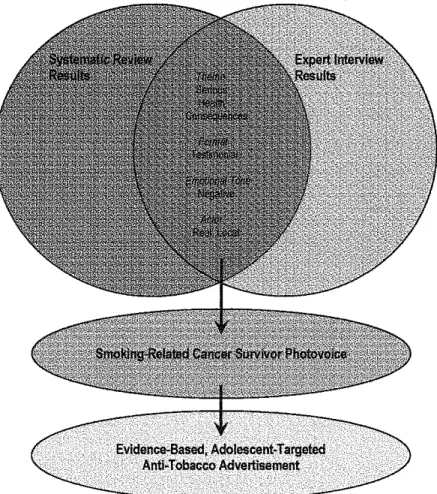
The results from the systematic reviews and expert interviews revealed that the serious health consequence of smoking theme was a very effective theme for anti-smoking messages. The third phase aimed to use this smoking-related cancer survivor to discover riveting serious health consequences of smoking. From the results of this project, the media vendor could develop an evidence-based, adolescent-targeted, anti-tobacco advertisement.
The expert interviews revealed that real people with real stories were the most effective at delivering the anti-tobacco message. Furthermore, it would target North Carolina youth especially if the campaign used a North Carolina figure. During this phase, project coordinators aimed to provide the campaign with such a figure.
This project is based on the tenets of Participatory Action Research. One of the most important functions of this research style is to encourage the study
I
population to take action7•8. This project aimed to encourage smoking-related cancer survivors to promote and advocate for adolescent smoking prevention.
PAR and Photovoice
George et a!. describes Participatory Action Research (PAR) as a "systematic investigation, with the collaboration of those effected by the issue being studied, for purposes of education and taking action or effecting social change. "7 This research is not a methodology, but rather an approach, which attempts to minimize the differences between researcher and participant. In
addition, it attempts to investigate questions, but also empower the population with the desired end result being action.
Photovoice is a methodology that uses a qualitative research approach. Wang et a!. describe Photovoice as "a PAR method by which people create and discuss photographs as a means of catalyzing personal and community change. "8 In this methodology, participants are asked develop photo-assigmnents that will help to answer the research question, take photographs that illustrate that
assigmnent, and discuss the photographs in order to come to a new understanding of the topic.
Other Components of the Smoking-Related Cancer Survivor Project
One of the tenets of the PAR approach is that there is no power differential between researchers (or project coordinators) and participants 7. While this leads to a broader, more ethical result ofthe research, the researcher also looses a great deal of control that would occur in other research designs. While the project coordinators aimed to fulfill the goals of the project, it was just as important to attend to the goals of the participant. As a result, the results presented in this report are simply a part of a broader project involving smoking-related cancer
survtvors.
Benefits of Photovoice in the Research Area
that one population- the older population that smoked and developed the serious health consequences of smoking- were not present in any research in this area. All research used adolescents as the study population. It was theorized that this older population would be critical to explore in any complete study of this area because they were the population that this campaign is hoping to target.
Second, this method is visual research. Since the potential application of the results is in visual media, the Photovoice method serves as an excellent means of stimulating the creative process in the participant population and the media vendors who will view the research results.
Third, like the expert interviews, this method is a qualitative research style. Most experts agree that the best studies include a mix of qualitative and quantitative methodologies in order to reach the appropriate research breadth6 By using the qualitative methods ofPhotovoice and expert interviews in
conjunction with the quantitative methods of the systematic review, investigators can obtain a complete picture of this research area.
Finally, as stated above, the desired end result of any PAR project is action. The systematic review indicated that adolescents respond to real people telling real stories about the serious health consequences of tobacco use. The last benefit of this method is the potential to encourage action in a group that has tremendous potential to make a difference in the adolescent smoking prevention campaign.
Project Conceptual Model
Section 2: Methods
Systematic Review
Types of Studies
Any study was included in the review if it evaluated the effectiveness of a dimension of a television advertisement in influencing the smoking behavior, intentions to change smoking behavior, attitudes about smoking, recall of advertisements, or perceived effectiveness of advertisements in youug
Table 1: Journal Databases
Medline ABI Informed Global
Business Source Elite
Expanded Academic Index CIOS
Academic Search MasterFILE Premier
people less than 18 years of age. Any type of methodology- from focus group data to randomized control trials - was included in the review. While any kind of methodology was accepted, the discovered studies only used one of three types of methodology: focus group studies, cross-sectional studies, and quasi-experimental studies. Each of the included studies was then
analyzed for methodological quality in order to judge the reliability ofresnlts (see below in
Analysis of Study Design Section). In the subgroup area, very few experimental studies existed, so opinion papers and editorials were included to determine if the authors discussed any consistent determinants.
For the purposes of this review, mass media was restricted to television
advertisements. The advertisements analyzed in the studies conld come from any
organization: state campaigns, national campaigns, tobacco companies or other anti-tobacco organization.
Studies were included regardless of
Table2: Search Term
publication date. However, this area of research is relatively new, and no published studies on this topic were available before 1985.
Outcome Measures
The primary outcome measure was self-reported smoking behavior. Intermediate outcome measures included intentions to change smoking behavior, attitudes toward smoking, knowledge about smoking behavior, and perceived effectiveness of the advertisements. Process measures included the recall (the proportion of adolescents the remembered the advertisement after a certain amount of time) of the advertisement.
Search Strategy
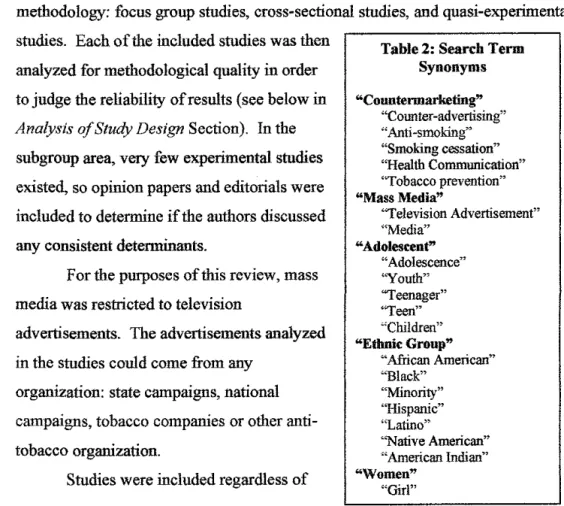
Research on tobacco counter-marketing spans a number of specialties, including medicine, marketing, business, and public health. For this reason, multiple search engines and search terms were necessary (see Tables I and 2).
The main search terms were "counter-marketing," "mass media," "adolescent,"
"ethnic group," and "women" (Synonyms used are listed in Table 2). Studies were selected based on the criteria stated above. Once studies were found using this method, individual online journal sites were searched for relevant articles that were possibly missed by the larger search engines. Articles, unpublished works, and grey literature were then discovered using expert interviews. Finally,
Analysis of Study Design
Advertisement effectiveness research is limited to three major study designs: focus groups, cross-sectional studies, and quasi-experimental
studies. While the quantity of research conducted on each variable is
important, it is critical to also consider the quality of the research. In general, quasi-experimental studies and cross-sectional studies were deemed the more methodologically sound and more likely to yield reliable results than focus group studies. For this reason, results from
quasi-experimental and cross-sectional studies were deemed stronger than data from focus group studies.
The results and discussion section for each study was examined
Table 3: Study Analysis
Type of Study
o Focus Group o Cross~sectional o Quasi-experimental
Methodology
Focus Group
o Rigorous Methodology o Diverse Population o - I 0 Participants/Group o < 15 Focus Groups
Quasi-experimental/Cross-sectional
o Large) diverse sample sizes
o Validated Commercials o High Response Rates
o Multiple Dimeosions Analyzed
Outcome Measure
o Recall of Advertisemeot o Perceived Effectiveoess of the
Advertisements
o Knowledge about Smoking Behavior o Attitudes toward Smoking
o Intentions to Change Smoking Behavior o Behavior Change
Direction and Strength of Effect
o Not Effective o Mildly Effective o Moderately Effective o Highly Effective
to determine the type of study (focus group, cross-sectional, or
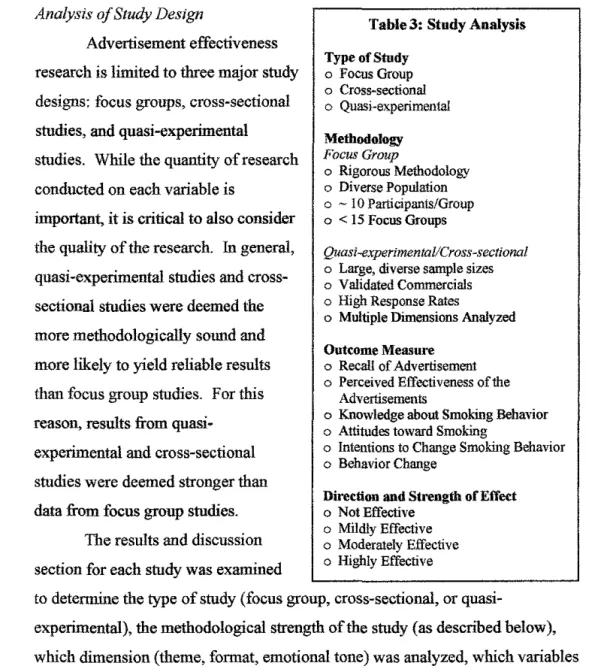
quasi-experimental), the methodological strength of the study (as described below), which dimension (theme, format, emotional tone) was analyzed, which variables within each dimension (for theme, serious health consequences, addiction, refusal skills and so on) were analyzed, and the strength and direction of the effect (Table 3). Within this field of study, there is no standardized outcome or standardized desired effect size. The results are largely based on author interpretation. Therefore, the strength of effect used was based on the authors own words: not effective, mildly effective, moderately effective, and highly effective.
rated mildly effective or ineffective. Contradictory evidence results when the
results of studies are contradictory.
Focus group studies were analyzed using the strategy outlined in Crabtree
and Millet'l. In general, rigorous qualitative studies utilized a staudardized
methodology for conducting and evaluating the focus groups; a diverse participant
population by gender, ethnic group, age, income level and smoking status;
approximately 10 participants per group; a maximum of 15 focus groups; and
reasonable compensation for participation. A critical appraisal of each focus
group can be found in Appendix A.
Quasi-experimental and cross-sectional studies were analyzed using
strategies outlined in Fletcher et al.10 Rigorous quasi-experimental and
cross-sectional studies employed large, diverse sample sizes; used validated
interventions (commercials); had high response rates, and tested multiple
dimensions (format, theme, tone). A critical appraisal of each cross-sectional
study can be found in Appendix A.
Expert Interviews
Development of Expert Interview Form
In the first phase, three dimensions (theme, format and emotional tone)
emerged as important in influencing advertisement effectiveness in preventing
smoking initiation. Investigators created a standardized questionnaire form that
included those dimensions, as well as contradictions within the literature and
means of targeting the campaign at North Carolinian adolescents. The
questionnaire used is found in Appendix E.
Selection of Interview Subjects
Researchers selected subjects in three ways. First, researchers who had
published several articles in the field of adolescent-targeted tobacco prevention
mass media campaigns were noted from the systematic review and asked to
participate. Second, at the conclusion of expert interviews, the participant was
interview. Finally, local experts familiar to the University ofNorth Carolina Tobacco Prevention Evaluation Program (UNC-1PEP) were asked for
recommendations on possible interview participants. In total, fifteen potential participants were identified through these three strategies, and of those, six were interviewed.
IRB Approval
The UNC School of Medicine Institutional Review Board approved the interview forms and study methods.
Recruitment of Interview Subjects and the Interview Process
A member ofUNC-TPEP contacted potential participants by email to explain the project and invite them to participate in the study. Respondents received a consent form and an abbreviated copy of the interview form so that they could follow along with the interview. All interviews were conducted by telephone and taped with the interviewees' signed consent. Interviews lasted an average of one hour.
Data Analysis
Interview tapes were transcribed, and for privacy reasons, their names were removed- only marked Expert A through F. The data was analyzed using the qualitative analysis software A TLAS-ti. The transcriptions were coded into numerous categories, and numerous themes, and theme families were discovered.
Smoking-Related Cancer Survivor Photovoice Project
Eligibility Criteria
Participants were eligible if they were diagnosed with a smoking-related cancer and they had a positive history of smoking. Both current smokers and non-smokers were eligible for the study. People younger than 18 years of age were not eligible for this study.
IRB Approval
This study was approved by the University ofNorth Carolina at Chapel Hill (UNC-CH) - School ofPublic Health Institutional Review Board on Research Involving Human Subjects.
Recruiting Participants
Project coordinators recrnited participants in six ways. First, project coordinators contacted facilitators oflocal cancer-related support groups and asked them to recruit eligible participants. Second, registered nurses with UNC Hospital's Oncology Department agreed to recruit possible participants. Third, physicians within UNC Department of Family Medicine and Thoracic Oncology were contacted to recruit for the project. Fourth, project coordinators recruited participants directly at the UNC Department of Thoracic Oncology Outpatient Clinic. Fifth, messages about the project were posted on websites of smoking-related cancer support organizations. Finally, leaders oflocal smoking and cancer-related activist groups were contacted and asked to recruit participants. All of these recruiters received a fact sheet that described the study and supplied the contact information of the project coordinators. Interested participants were instructed to contact the project coordinators. One participant volunteered to be a part of the study.
Photovoice Workshops
The film from the first photo-assignment was collected and developed. At the second meeting, the participant was shown all of the pictures from his photo-assignment From this set of pictures, he was asked to choose the three
photographs which were the most meaningful to him. These photographs were discussed using the SHOWeD format (Appendix F): What do you see here? What is happening in this photograph? How does this related to our lives? Why does this problem exist? What can we do about it? During these discussions, the coordinators and participant analyzed the content and context of the photographs. At the conclusion of the discussion, the participant and coordinators developed the next photo-assignment This agenda was repeated at the third and fourth meeting.
After the third meeting, the participant invited us to attend a support group meeting attended by other laryngectomy survivors. This opportunity gave the project coordinators to discuss the themes that had developed during the Photovoice project, and see if these themes were consistent with the rest of the population. Field notes were taken at this meeting, but no audiotape was used.
During the final meeting, the project coordinators and participant
discussed the future directions of the research, future community action, and the future applications of the uncovered themes.
Field Notes
In addition to the audio-tapes, field notes were taken by all of the project coordinators. These notes were transferred into a word-processing format and analyzed along with the transcriptions of the audio-tapes.
Data Analysis
The transcribed audio-tapes, field notes and photographs were analyzed using the qualitative analysis software ATLAS-ti. The documents and
Section 3: Results
Source Documents
Fourteen studies met the inclusion criteria for the systematic review of effective advertisement dimensions: seven focus group studies, four cross-sectional studies, and three quasi-experimental studies. The critical appraisal of all of these studies can be found in Appendix A. The strength and direction of findings can be found in Appendices B, C, and D. Six additional studies on targeting subgroups were analyzed: two opinion papers, two focus group studies, one cross-sectional study, and one quasi-experimental study.
divided into six fumilies (group of codes that have a very close connection to each other)(Table 4).
Effective Advertisement Dimensions
Multiple reviews indicate that mass media campaigns reduce adolescent smoking, especially when used in combination with other programs2,3·4•5. While many have examined these programs at the campaign level, few have explored what dimensions of individual adolescent-targeted anti-tobacco advertisements are the most effective at reducing adolescent smoking. Authors suggest a litany of factors, including ad content or theme, format, emotional tone, production quality, clarity and consistency10·ll,l2. Of these, only three (theme, format, and emotional
tone) have been studied. Two others were recommended in the expert interviews: production quality and actor characteristics.
Theme
For the purpose of this review, theme, often referred to as content, is defined as the main idea within any given advertisement. Experts use several typologies to categorize themes4•13•14 This review uses a combination of these approaches, yielding seven categories: serious health consequences, industry manipulation, secondhand smoke, short-term (also referred to as cosmetic) consequences, refusal skills, addiction. and negative social consequences/social norms.
Varying quantities of research exist for each of the seven categories. The evidence on each of the seven studied themes is described below, followed by a summary of the themes by effectiveness. A summary of the published evidence for the effectiveness of each theme can be found in Appendix B.
Serious Health Consequences
This theme focuses on the serious health consequences of smoking, including emphysema, lung cancer, other severe disease, and premature death1 1.
Supportive Evidence
Considerable reliable data show that the theme of serious health
consequences is moderately to highly effective. In two quasi-experimental cross-sectional stodies, Pechmann et al. and Wakefield et al. determined that
adolescents regarded this theme moderately and highly effective, respectively5•11. Similar results were found in two similar population-based survey stodies conducted by Biener and Biener et al10·1S In addition, results from a focus group
stody revealed that the serious health consequences theme was rated both highly effective and high in cognitive quality by youth participants14
Unsupportive Evidence
Other stodies suggest that the serious consequences theme is ineffective in anti-tobacco messages13'16•17 Pechmann and Goldberg performed a
quasi-experimental cross-sectional stody that found that adolescents rated this theme ineffective at changing intention to smoke16 Both a review of focus group data 13 and a small focus group stody17 found that long-term health consequences were rated ineffective by adolescents as well. A lack of description of the methodology of these stodies makes it difficult to understand why they reached different
conclusions than the more rigorous studies described above. One possible explanation could be if serious consequences were presented to youth as long-term outcomes, rather than problems that could develop in later in life.
Supportive Expert Opinion
Four expert interviewees agreed that the theme was an effective
dimension. In general, experts based these feelings on personal experience and research18•19.2°.21. "The Pam Laffin and Rick Stottard ads ... those are all very moving ads, very honest ads, truthful ads. They don't really pull punches. I think those are the type of ads that youth respond to."19
Only by paring this ad with another theme - such as industry manipulation- does it reach adolescents and become an effective dimension20 In addition, Expert E discussed how an ad that used this theme could be ineffective if it did not stimulate an emotional response21,
Industry Manipulation
This theme focuses on the deceitful marketing practices used by tobacco companies to sell their product13. Many authorities posit that this theme will be effective because it challenges and raises strong negative emotions about the tobacco industry among teens.15,22•23,24
Supportive Evidence
Considerable, reliable data demonstrate that industry manipulation is moderately to highly effective. A large, well-designed, population-based survey conducted by the Legacy Foundation found that the truth™ Campaign was very effective at improving teens' intention to change behavior. The campaign relies heavily on the industry manipulation theme. In a randomized, cross-sectional, population-based survey, Biener found that adolescents rated the Massachusetts ads with an industry manipulation theme as highly effective15.
Results from two focus group studies agree with the studies above. Large focus group data reported by Goldman and Glantz demonstrate this theme as effective in counter-advertising13. In a smaller focus group study, McKenna and Williams showed that youth thought ads using this theme were moderately effective17
Many researchers believe this theme is most effective when paired with other themes, especially the serious health consequences theme10,23'14. Since the truth™ Campaign uses multiple themes, the results found in its evaluation may indicate that the multi-theme approach makes this theme very effective23.
Unsupportive Evidence
Three studies of varying methodological strength caution against the use of the industry manipulation theme. A quasi-experimental cross-sectional study conducted by Pecbmann and Goldberg showed that industry manipulation alone is ineffective at improving intention to change behavior16• While the sample size is
large, the study methodology is not fully described. Two methodologically strong studies agree with Pecbmann and Goldberg's results. Pecbmann eta!. performed a cross-sectional study of1667 seventh and eighth graders to determine wbich type of ads influenced an adolescent's intention to change behavior11. These
results indicated that industry manipulation was ineffective at changing an adolescent's intentions. A focus group study conducted by McGloin and Burritt in North Carolina revealed that adolescents judged industry manipulation to be only mildly effective14 However, the authors did state that the industry theme could be successful if combined with other effective themes.
Supportive Expert Opinion
While the published research shows mixed results for this theme, the experts were more decisive; five participants indicated that the theme was an effective dimension. Experts based these opinions on research and on personal experience. When this theme was discussed, it was unanimously discussed with the truth™ campaign, wbich relies on this theme often18•19,2o,24,25
Advertisements that use this theme are effective for three reasons. First, it is controversial, and therefore attention grabbing19 Second, it can easily be used with other themes such as serious health consequences, wbich, when used together, can link tobacco companies with death and disease18•19 Finally, in addition to reducing the desire to smoke, these ads also stimulate an anti-tobacco activism, wbich helps change the social norm 18
got more sophisticated about reaching teens and so if the current industry
manipulation campaigns have been effective its not necessarily because of the
industry manipulation message- it could be because they're doing other things
right."20
Tobacco Producing States and Industrv Manipulation
As previously discussed, McGloin and Burritt found industry
manipulation relatively ineffective in North Carolina14. Authorities suggest that
this inconsistency results because adolescents within tobacco-producing states
have close contact with the tobacco industry. To refute this point, Thrasher et al
used the data from the Legacy foundation surveys to show that there is no
difference in rated effectiveness of industry-themed ads between tobacco
producing states and non-tobacco producing states in their large data set26.
Three expert interview participants discussed using industry manipulation
in North Carolina. Expert B and C indicated that the industry manipulation theme
would be as effective in North Carolina as it was in non-tobacco producing
states19,2°
Expert F discussed one possible issue- political feasibility. He indicated
that an ad is only effective ifit can ever be made, and that in North Carolina, it
conld be difficnlt to get these ads pro.dnced using state funds25
Secondhand Smoke
Pechmann and Reibling describe this theme as "advertisements that stress
the negative impact of secondhand smoke on family members and other people,
particnlarly infants and children. "4
Supporting Evidence
There are data to indicate that the theme of second hand smoke is
moderately to highly effective. Two quasi-experimental studies by Pechmann et
al. and Pechmann and Goldberg suggest that secondhand smoke is a highly
Glantz and one a single study by McGloin and Burritt- found that this theme was moderately to highly effective13•14
Supportive Expert Opinion
Five participants agreed that the second hand smoke theme was an effective dimension. The experts based these opinions on research and personal experience18•19,21,24,25 Several of these interviewees explained that they believed
that this theme was effective because it worked on two levels. First, it showed the negative health consequences on smokers' loved ones, which may dissuade teens from starting the habit24,25• Secondly, this theme also acts to change the social norms so that smoking is not tolemted. " ... If ads show kids or adults smoking around kids and basically carelessly endangering these kids and you see the kids suffering ... those really work because they evoke feelings of outrage and social disapproval. It's almost immomlity. 'How could these people be hurting their kids like that?' "21•
Expert C pointed out that this ad would not be effective if used alone in a smoking prevention campaign, because it is primarily targeted at smokers. However, it can be used with other themes, such as industry manipulation within a campaign and be effective20
Short-term (Cosmetic) Consequences
This theme highlights the negative cosmetic effects of tobacco, including stained teeth and bad breath. The short-term consequences theme is often found in advertisements in combination with the negative social consequences theme 4
Supportive Evidence
Unsupportive Evidence
A moderate amount of conflicting evidence exists on this theme. In a quasi-experimental cross-sectional study conducted by Pechmann and Goldberg, adolescents considered this theme ineffective16 In a review of focus group findings, the authors found that adolescents only rated this theme as mildly effective13
Unsupportive Expert Opinion
Four expert participants agreed that the theme is an ineffective dimension, based on the research and personal experience18,19,21,24 Many participants
indicated that these ads were ineffective because they were not "constructed" well18 "It just seems like a lot of the short-term consequences ads are hokey, hmnorous ads. They are exaggerated and just aren't realistic."19
Addiction
Advertisements using this theme demonstrate the addictive properties of cigarettes and the effect of this addiction 14 This theme is often found in the testimonial format along with the industry manipulation theme.
Supportive Evidence
The limited information on the addiction theme indicates it may be an effective counter-advertising theme. In a small focus group study conducted by McGloin and Burritt, the adolescents judged addiction moderately effective and high in cognitive quality (made the respondents "stop and think")14. In a review
of 186 focus groups, Goldman and Glantz also found this theme moderately effective, especially when used with industry manipulation or secondhand smoke13
Supportive Expert Opinion
Expert E, 2003; Expert F, 2003), while one stated that it was ineffective21,24,25•
Expert E indicated that these ads were effective because they reduced the feeling
of invincibility among adolescents21• On the other hand, Expert C discussed how
many kids that smoke do not think that they are addicted, and therefore this ad
would be ineffective20 Expert F indicated that it was helpful because it allowed
campaign organizers to discuss the banns of tobacco without targeting tobacco
producers25
Negative Social Consequences and Social Norms
The negative social consequences and social norms themes are closely
associated and often appear together in the same ad. The negative social
consequences theme focuses on the barriers smoking creates on the way to a
successful life. The social norms theme aims to reduce the belief that smoking is
acceptable behavior. Both of the themes intend to reverse the "cool, normal"
depiction of tobacco users ingrained in the American culture through decades of
b d . . 11
to acco a verttsmg .
Supportive Evidence
Two studies by the same primary investigator found that the negative
social consequences and social norms model is effective at influencing
adolescents' intention to smoke. In the first study, Peclunann and Goldberg found
these themes to be effective; however, the methodology of the study is not fully
described 16 In the second study using a controlled setting to show ads to youth
and get their feedback, Peclunann et al found the negative social consequences
theme was effective at reducing adolescents' declared intentions to smoke11
Unsupportive Evidence
The research on these themes is scant and conflicting. A review of focus
group data revealed that adolescents regarded the negative social consequences
ineffective among smokers, because youth who smoked found the messages personally offensive13
Unsupportive Expert Opinion
The majority of expert interviews found that the use of this theme was not recommended, except in very specific situations. Four participants indicated that the negative social consequences theme was ineffective18•19,2°,24, while one participant indicated that it was effective21. Several themes emerged when discussing this theme. The first was the importance of actor's characteristics with ads that used this theme. Two participants discussed how it was important to use actors that the target audience would see as role models, and avoid actors that
come off as "uncool. "19,2°
Expert E described that when this theme is used carefully, it can be effective. Ads that encourage disapproval toward smokers and the sense that smokers have made a wrong choice in their life are effective in adolesceuts2I.
While stating that in general this theme was ineffective, three of the participants agreed that with carefully selected actors and in specific instances such as those that Expert E describes, this approach could be effective19,2o,25
Refusal Skills
This theme demonstrates ways to avoid smoking. Often, role models tell why smoking is unattractive and then demonstrate avoidance techniques II. The
research on this theme in anti-tobacco advertising is scarce and contradictory.
Supportive Evidence
Unsuooortive Evidence
In a large, powerful quasi-experimental cross-sectional study performed by the Legacy Foundation, adolescents consistently rated the Phillip Morris campaign less effective than the truth™ campaign. The Phillip Morris campaign relies heavily on the refusal skills model. Interestingly, younger adolescents rated this theme more favorably, but not better than the Truth ™ campaign28.
Unsupportive Expert Opinion
The majority of expert interviews recommended against its use. Four participants indicated that the refusal skills theme was ineffective18,19,2°,24, while one participant indicated that it was effective21. Participants based these results on personal experience, because little research exists on this theme. In general, the refusal skills theme is seen as a special type of negative social consequences theme, instead of a theme to itself The arguments for and against its use were the same as those for the negative social consequences theme. In general, it could be effective if the production quality was high and the actors were well chosen19,2o
Format
For the purposes of this review, format is defined as the nature of the story or context utilized to convey the message. The typology used to categorize the different formats is a combination of schemes used elsewhere12,14• This model presents five categories. It is important to point out that format is closely tied to both theme and emotional tone, and a great deal of overlap exists. A summary of the published evidence presented below can be found in Appendix C.
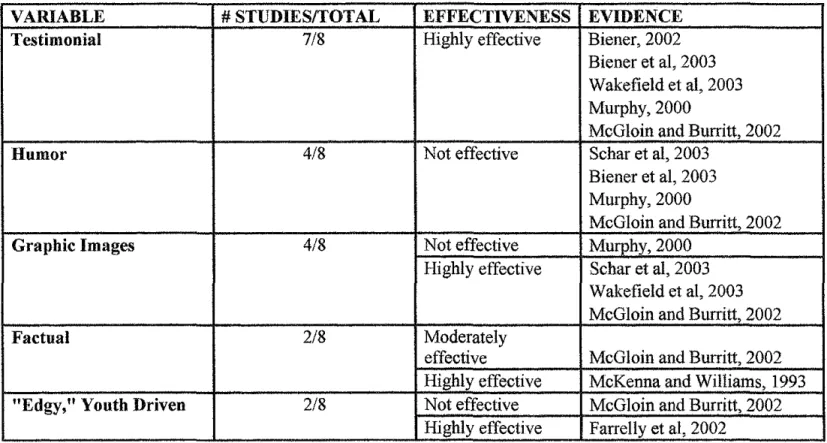
Testimonials
This format uses a story-telling approach to convey the message.
typically has a negative emotional tone. Most experts agree that this is the most effective format12,14•17
Supportive Evidence
Overwhelming support exists for the testimonial format. Three large, well-designed, quasi-experimental cross-sectional studies found that adolescents rated this format highly effective5•10•15 All of these studies had large, population-based samples and a strong study design. In addition to the quasi-experimental studies, two focus groups found this format to be most effective14.29
Supportive Expert Opinion
Four participants indicated that the testimonial format is effective18•19.20.2l,
while Expert D indicated that it was ouly effective in specific cases24 The experts based these opinions on both research and personal experience. Expert B explained that sad or personal testimonials worked when "they portray in an honest, truthful way the effects oftobacco."19 Expert C added that these ads needed to have an "edgy" component in order to work with adolescents20
All of the proponents of this format emphasize the importance of the actor. Expert A describes ads that worked because they tell the story oflife with after a laryngectomy, and it elicits a strong emotional response18 Expert B reiterated this idea when he stated, "ads that show real people experiencing the real effects of smoking are effective 19"
Celebritv Testimonials
Schar et al cautions against the use of celebrities in anti-tobacco advertisements12. The review of state campaigns revealed that celebrity testimonials about personal negative consequences of smoking were more effective than ads that portrayed celebrities as role models.
doesn't seem like, for kids that are at risk, that they care about Christy Turlington or the other CDC ads that use role models."20
Graphic Images
The graphic image format uses vivid images of real bodily destruction caused by tobacco14• The serious health consequences theme is often used in conjunction
with this format, and these ads typically have a negative emotional tone.
Supportive Evidence
A large, population-based study in Australia conducted by Wakefield eta! revealed that teenagers judged the graphic image format to be very effective5. Likewise, in a focus group study performed by McGloin and Burritt, teens found graphic images very effective14. Finally, in a review of state and national
anti-tobacco campaigns, Schar eta! found that graphic images were very effective12
Unsuwortive Evidence
Only one study wams against the use of the graphic image format. In a small focus group study, Murphy found that adolescents judged graphic images to be ineffective in anti-tobacco advertisements29 The study lacks a detailed
description of methodology, making it difficult to discern why its results differed from other studies.
Contradictorv Expert Opinion
Humor
This format uses humor and humorous situations to deliver an anti-tobacco message14• It is often found with the negative social consequences theme, the
refusal skills theme, and the short-term consequences theme. In addition, advertisements that use this format consistently have a positive emotional tone.
Unsupportive Evidence
While humor has a high recall, this format is consistently rated ineffective by all studies reviewed. In a large, quasi-experimental, cross sectional study performed by Biener teenagers often recalled humorous ads, but consistently regarded humor as an ineffective format10. Two focus group studies found similar results14,29
Supportive Expert Opinion
While humor was less effective than other formats, the three experts stated that humor had its place19,2°,24 Expert D stated, "Humor and satire work very well if it's done properly, but you don't want it to be stupid. You want it to be humorous and satirical. "24 Expert C agreed, indicating that ads that employ humor are "more difficult to pull off successfully. "20 Expert B described a specific instance when humor can be effective -when it is not the primary thrust of the ad19
In addition to using humor very carefully in individual ads, Expert C remarked that ads with the humor format could be effective in the midst of a larger campaign. "I think that most advertisers view humorous ads as a way to lighten up an overall campaign ... as a garnish on a dish ... I wouldn't serve it up as a dish, but I'd put it as a garnish. "20
Factual
and other formats, and advertisements with this format can have either a positive or negative emotional tone.
Supportive Evidence
Two focus group studies found the factual format was moderately to highly effective14'17• Additional research should be conducted to determine whether these results are consistent in larger studies.
Contradictory Expert Opinion
Only two participants discussed the factual format during the course of the interviews, and the results were mixed20,24 Expert C indicated that while he thought the use of statistics within ads would be ineffective, his research has shown that the statistics provide a means to capture adolescents' attention20. Expert D, however, indicated that ads that primarily use statistics would be ineffective24• Until more research is available, it seems this format should be avoided.
"Edgy" and Youth Driven
This format uses risk-taking youth to present the anti-tobacco message14• The industry manipulation theme (particularly within the truthTM campaign) often accompanies this formae8 While many state and national campaigns use this format, studies focusing on youth driven formats alone are limited.
Supportive Evidence
Unsupportive Evidence
A well-designed focus group study determined that ads using this furmat were generally rated ineffective by teenagers; however, when asked what they would like to see in future ads, teenagers selected this format quite often14
Supportive Expert Opinion
Three participants discussed the "edgy" format, and all three indicated that based on the research and personal experience, this format was very
effective19,2o,24 Most of these comments centered on the success of the truth™ campaign, which uses this format heavily. By using this format, the adolescents are more likely to pay attention to the advertisement. This finding also bolsters the importance of the actor within these ads, since the participants emphasized how what gave the ads this format was the use of edgy adolescents19,2°,24
Emotional Tone
Emotional tone is defined as an individual's affective response to an advertisement10'15. The theme and format of an advertisement partially dictate the emotional tone; therefore, certain themes and formats tend to be associated with a particular emotional tone. For the purposes of this study, emotional tone falls into two categories- positive and negative. A summary of the published evidence below can be found in Appendix D.
Negative Emotional Tone
Supportive Evidence
A total of eight studies determined that negative emotional tone was more
effective than positive tone. Four large, well-designed quasi-experimental
cross-sectional studies found that adolescents perceived advertisements with negative
tone to be more effective than advertisements with positive tone5•15,28•32 All of
these studies have large, diverse sample sizes and strong study designs. One
quasi-experimental cross-sectional study conducted by Montazeri and McEwen
showed similar results33.
Three focus group studies with varying degrees of methodological
strength found results similar to the studies above. Two well-designed focus
group studies found a negative emotional tone to be more effective than a positive
tone14•34 A focus group study conducted by Murphy also found that negative
emotional tone was more effective than positive tone29.
Supportive Expert Opinion
Five expert participants discussed emotional tone, and all indicated that
advertisements that elicited a negative emotion such as anger, sadness, or outrage
were more effective than those that elicited positive emotions such as happiness,
humor or hope18•19,20,2l,24. These results were based on research and on personal
experience. As Expert B stated, " ... ads that are more serious, more honest, more
truthfuL .. are going to be more effective. They have to be catchy, they have to
pull on the heart strings and they have to be emotionally powerful."19
Expert C did give one word of caution. "I think having pure ads that focus
[on negative emotional tone] are beneficial, but a whole campaign that focused
Positive Emotional Tone
When an advertisement elicits a positive affective response such as hnmor, hope, or inspiration, it conveys a positive emotional tone32•10• Hnmor is the most commonly used format that elicits such a response, and is the most frequently researched.
Unsuwortive Evidence
At best, positive emotional tone is mildly effective. Two studies - one a quasi-experimental cross-sectional study32 and one a well-designed focus group14 - found that adolescents believe positive emotional tone is less effective than negative emotional tone.
Three additional studies confirm these results. One quasi-experimental cross-sectional study conducted by Montazeri and McEwen showed that
adolescents rated positive emotional tone as ineffective33, as did two smaller focus group studies29•36.
Aspiration and Hope
Expert interview participants agreed that ads eliciting the positive feelings of aspiration and hope could be effective. However, there simply were very few ads and no research that indicated that this is trne18•19.2°.24•
Production Quality
For the purposes of this review, the production quality is the extent to which an advertisement looks professionally composed. Several authors have suggested that it plays an important role in determining advertisement
this way. "I think it's possible that I'm basing it [the ineffectiveness of social consequences theme] just on the low quality of ads that have been done with social consequences."19
Actor Characteristics
One dimension that was not covered in the systematic review that became very important in the interviews was actor characteristics. Over the course of the interviews, three different groups emerged: ads that portrayed cartoons, ads that use actors, and ads that used real people.
The results of the interviews indicate that using real people is the most effective. Expert A indicated that real people were more effective because "they are believable and hit on all of the dimensions if they are done well. If real people are telling a story, it evokes a feeling in the audience."18 Expert C, Expert D and Expert E agree on this issue as well for similar reasons20,21,24
The use of actors was an area of contention within the research. Expert A believed that when the ad seems overly contrived, it is obvious that the performer in the ad is an actor, and it is less effective18 However, Expert C and Expert E feel that in most cases, adolescents cannot distinguish an actor from a real person20.21.
Three participants discussed the use of cartoons, and all thought that they should be used with extreme caution19,2°,24 Expert C indicated that they can be used when targeting the young, "tween" age group, but they are ineffective with the older adolescents20 Expert B and Expert C discuss how cartoon ads often use the humor format, and have positive emotional tone. They admit that they can be effective, but they need to be used judiciously, and the production quality needs to be especially high19,2°.
Targeted Sub-groups
smoking status. They also wished to know how North Carolinians could
specifically be targeted with the mass media campaign.
Only a small body of research explores this area. Therefore, dnring the
expert interviews, the participants were asked to discuss how these groups could
be targeted. The synthesis of the literature review and expert interview results are
discussed below.
Ethnic Groups
In 2002, 23 percent ofhigh school students reported smoking cigarettes in
the past 30 days. These rates are not uniform; they vary by ethnic group and sex.
The prevalence of smoking would indicate that smoking is not a problem among
minority groups; 32 percent of white adolescents smoke, compared to 17 percent
of African Americans and 23 percent of Hispanics. However, the rate of decline
in smoking initiation is lower in the minority populations35. American Indians
have the highest prevalence of smoking among all ethnic groups - 39 percene7
Very little published research explores the possibility of targeting certain
ethnic populations. The expert interviews indicated that this was because little
differences exist between ethnic groups19,20,2l,24 Expert D stated" ... within ethnic
groups- especially with the ages you're talking about- they are all living in the
same culture. "24 Expert B reiterated this point by saying " ... a good ad- a catchy
ad- is going to be catchy across the board."19
Theme
Expert F (2003), Hannon (2000) and Ramirez et al. (2000) suggest that
themes emphasizing family and social norms would be the most influential among
minority teens25.38.39 Results from two focus group studies support this
statement. McGloin and Burritt showed that African American teens rated the
secondhand smoke advertisement very effective14• Ramirez et al. showed that
Latino teenagers found the refusal skills theme and the social norm theme
These themes are not the only effective themes for targeting Latino adolescents. Results from another focus group found that the addiction theme was effective among Latino adolescents, particularly in the younger age ranges34. In addition, Farrelly et al. found that the Truth™ campaign was equally effective among Latino and non-Latino youth, suggesting that themes used in the Truth campaign can also be used in this popnlation2
In a cross-sectional study performed with adolescents and adults, Marin et al. found that interventions relying on the short-term health consequences theme and secondhand smoke theme were effective at increasing the recall of the campaign41
Format
Only three formats were found to target minority adolescents. The interview with Expert A revealed that African Americans responded more favorably to humor than the other ethnic groups18 In the focus group study performed by McGloin and Burritt, African American youth rated the graphic image format ineffective14 Finally, the Stafford Institute determined that the testimonial format was especially effective among the Latino population34• No other studies exist that confirm the effectiveness of these formats in the adolescent minority population.
Actor Characteristics
Hannon and Expert B, Expert C and Expert F emphasized the importance of including actors of various ethnic groups in order to target those
groups19.2°.25•38 Results from the Legacy Foundation survey suggest this is an effective strategy, because ads that portrayed African American youth were rated highly by the African American participants23.
Skin tone was not the only means of targeting subgroups. Interviews with Expert B and Expert F as well as an opinion paper by Ramirez et a!. recommend that advertisements targeted at Latino teens shonld have Latino actors that speak a mix of English and Spanish19,25,39 While no studies confirm the effectiveness of
using Latino actors, Ramirez et a! confirmed that bilingual advertisements are effective within this popnlation40•
Gender
In 2002, 21 percent of adolescent girls smoked35 While for years women had much lower smoking rates than men, the rate is currently nearly identical between the two groups. The rate varies greatly between ethnic groups, with American Indian women at 35 percent, whites at 24 percent, African Americans at 24 percent, and Hispanics at 15 percent42
Theme
Very few studies examine the differences in anti-tobacco theme
preferences between boys and girls. Focus group findings mentioned by Flynn et a! suggest that adolescent girls rate the negative social consequences theme as effective43. In a successful anti-smoking campaign reported by Worden et al, an anti-tobacco intervention in girls resulted in a reduced incidence of smoking initiation44. While the authors performed no formal analysis on the theme of the campaign, most ads focused on the social norm and negative social consequences theme.
During the expert interviews, Expert B indicated that, in his experience, secondary smoke ads were more effective in girls than boys. No published studies were able to corroborate this claim19
Format
graphic images would be more effective in boys than in girls20. In a focus group study, McGloin and Burritt found the opposite- adolescent girls found the graphic images format to be very effective14
Smoking Status
Expert C indicates that this population may be much more difficult to reach than any of the other populations, because they consistently rate all ads worse than nonsmokers20 While there is very limited research on this area, a few studies do exist. In addition, the expert interviews yielded several interesting results.
Theme
Limited published information exists about the differences between smokers and non-smokers regarding thematic preferences or effectiveness. The small amount of published research and expert interviews reveal four themes may be effective at targeting smokers. In the large survey conducted by the Legacy Foundation, Farrelly et al. found that smokers found the truth™ ads to be much more effective than the Phillip Morris ads23• This suggests that the industry manipulation and serious health consequences theme may be effective among this group. Expert B and Expert D agree that the serious health consequences theme may be more effective at reaching smokers than nonsmokers. They add that the secondary smoke theme would also be effective19,24
However, results from a focus group performed by Peracchio and Luna dispute these assertions. The results show that smokers were more influenced by the short-term (cosmetic) consequences theme than the serious health
consequences theme. The authors suggest that adolescents are not concerned with the long-term risks associated with smoking27
smoking because of social conditions, and ads that use this theme go contrary to
their beliefs, alienating them from the campaign18,l9,2°
Format
Only Expert C commented on a difference with regard to format. He
suggested the humorous ads may be a means of appealing to this
population-drawing them in before delivering the message20•
Age
No published tobacco literature exists on the ability to target within the
adolescent population by age. In addition, the interviews fmmd very few means
of tailoring by age. Expert A found that younger adolescents (the tweens) rated
all ads more favorably. She indicated that this might be due to the desire for
social acceptance at this age18 Expert C warned that ads that used complex
messages, such as the industry manipulation theme, would be less effective at the
younger ages20
Recently, two studies call into question the cost-effectiveness of
adolescent-only-targeted mass media campaigns. Two population-based,
cross-sectional studies performed in Australia indicate that campaigns targeted to adults
are rated effective by adolescents5•45 In one of the studies, authors found that 85
percent of adolescents surveyed thought the adult-targeted campaign was aimed at
them. Additionally, 85 percent thought the ads were effective and 26 percent
thought about quitting because of the ads45 With increasing funding difficulties,
these two studies support the view that campaigns encouraging adults to quit will
cause the largest reduction in tobacco consumption, because the adult-focused ads
will help adults, and by example, adolescents 46.
Expert D also discussed the limited cost-effectiveness of targeting younger
age groups. He stated that the majority of smokers begin in their very late teens
or early twenties, and that this is the age when a media campaign could do the
most good. He indicated that most middle school-aged children have a negative
targeting ads at the population that is at the age where the majority of smoking initiation occurs, the campaign could be must more cost effective24.
North Carolina Audience
Fonr participants discussed how an adolescent-targeted mass media campaign could be tailored to North Carolina, and the results were astoundingly nnified. All fonr participants indicated that the results from other states would apply similarly here18•19,2o,25. Expert A, Expert B and Expert C all indicated that the serious health consequences theme, the testimonial format, and negative emotional tone ads would work in North Carolina as effectively as they do elsewhere18
•19,2°,25.
Experts A and B were quick to point out one specific means of reaching the population- use North Carolina stories. Both emphasized that North
Carolina's history with tobacco production would make North Carolinian stories much more effective18•19
Explanations of Research Contradictions/Limitations of Research
During the systematic review, several contradictions in the research emerged. Research on several of the themes, including short-term consequences, negative social consequences and industry manipulation, indicated that different authors showed opposite results. Dnring the expert interviews, investigators asked the participants whether they could identify the reasons for the
discrepancies. The responses to this question explained the contradictions, and also illmninated the major limitations to the research- avoidance of production quality, ads as multidimensional stimuli, exposure intensity, dimension
correlations, dimension limitations, methodology, outcome measure limitations, and study population limitations.
Multidimensional Stimuli
dimensions surely exist, but remain uustudied. For this reason, many of the themes and formats may be shown to be ineffective because the ads are
ineffective for other, uustudied reasons. For example, Expert C uses the example of the Phillip Morris "Boy on the Bus" advertisement, which uses the social norms theme and positive emotional tone. This ad was consistently rated poorly, and thus indicated that the social norms theme and positive emotional tone are less effective. However, these two dimensions may be effective, but another, more powerful, uustudied dimension, such as production quality, hampers the ad20 Expert D discusses how research in this area is often uses reductionism-only studying a few dimensions24
Expert D also indicates that within a given dimension, authors can often place advertisements into very strict categories, and ignoring interactions. It is also possible to limit the categories within a dimension. He uses the example of the industry manipulation theme, which is often ignored in some studies because of the political implicationl4
Avoidance of Production Quality
Expert B and Expert D agreed that one explanation for the discrepancies was the varying degrees of ad production quality19.24• Without controlling for the production quality, Expert B stated that it is difficnlt to compare ads 19 Expert D
reiterated this point, adding that the data from focus groups could be even more influenced by variations in production quality24
High Dimension Correlation
Exposure Intensity
Expert B states that exposure intensity may be important in the overall effectiveness of an ad. He states that in studies that rely on population surveys, the results will be affected by the intensity of the ads. If an ad is shown more often on television than a competing ad, it will be recalled more often, and seem to be more effective, assuming recall is the outcome measure of choice19• One other possibility was that some ads, such as industry manipulation are relatively sophisticated, and several exposures are needed to have the desired effect.
Methodology
Variations in Methodology
Four of the participants indicated that the methodology of studies is hampered by both the types of studies used to study the subject and the variations in methodology within study types18,20,2J.24 Much of the research in this area is based off of focus group data, which Expert C and Expert D indicate is
statistically vety suspecr0.24
Expert A, Expert C and Expert E indicate that within different study types, there is a variation in study design 18'20.21. Expert C gives the example of
laboratoty conditions. Some studies ask subjects to just watch the anti-tobacco ads, while others ask participants to watch the ads in the context of normal television. The results from these two slightly different studies have the potential to revealing vety different results20
Limitations in Advertisements
The study of anti-tobacco mass media campaigns is severely limited by the numbers of ads that are available to study. Expert C points out there are only a few ads that represent the different dimensions, and that one outstanding ad within any one categoty can potential swing the results toward those
Outcome Measure Quality
Both Expert B and Expert C brought up the fact that the outcome
measures used in the studies to date are inadequate19
,2°.
Expert C stated "the thing that is really lacking in the literature is studies with long-term outcomes that come from being exposed to ads multiple times. There are some studies out there, but they are few and far between. When you use short-term outcome measures, it is hard to account for all of the other things that are affecting youth smoking. "20By studying the short-term outcomes, Expert B points out a very interesting limitation. "The ads that kids remember the most may not necessarily be the ads that lead to changes in the knowledge, attitudes or behaviors related to
smoking."19 By using recall of ads and the perceived effectiveness, researchers may be drawing false conclusions about changing adolescent behavior.
Small Study Populations
Finally, Expert D focuses on the size of the majority of studies in this area. In terms of both population size and intervention size, Expert D points out that many studies will be unable to find a large enough effect with such small populations and interventions. Ouly a larger study with a large population and an intense intervention will be able to determine the small differences in effect that the various dimensions produce24
Smoking-related Cancer
Survivor Photovoice Project
In total, twenty-two primary
Table 5: Primary Documents
Text Documents
First Photo-discussion Session Second Photo-discussion Session
Third Photo-discussion Session Field Notes Photographs Ambulance Balloons Boat Candles Cat Daily Maintenance Dog Drive Thru Fire Engine Hottub lntoxilyzer 5000 Morning Ritual Old Work Pool Closed Pool Self-Portrait Shower
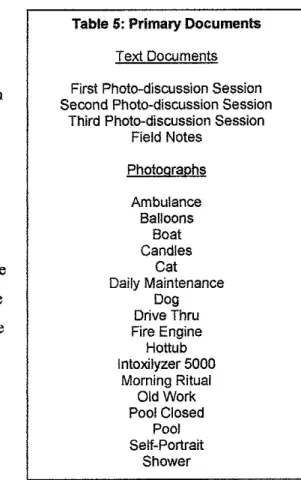
photo-discussions, the field notes, and seventeen photographs (Table 5). The text documents yielded over two hundred quotations, which were coded into seventy-one categories. Only thirty of these categories were pertinent to the topic of this project. The codes were divided into eleven families (group of codes that have a very close connection to each other); of those, three were pertinent to the project (Table 6). Finally, the codes were placed in networks to describe the linkages between the themes. There were a total of four networks, of which two were pertinent to the project (Appendix G and H).
!to be COOl
Bi Tobacco Unel!lical Prac!ices
Familvl
feeling
Per.;onal Cholce
Soda! I
Tobacco in l!le Med~
iflijlfovedl
TableS:
1Banier.;
~lmpor1ant
• nonnal
'and Codes'
Animal senslttvity.
lnabili!y !O BloW
~"'---1
No Alcohol
Hot
leed 'or I
'ool is Closed
ihavino
'"'""'
Telephone Difficullies
Water SoO!Is
Application of Effective Ad Dimension Research
As outlined by the conceptual model (Figure 1), the third phase of this research project aims to apply the knowledge acquired in the systematic review and expert interviews in order to develop ideas for an evidence-based, adolescent-targeted, anti-tobacco advertisement. The first two phases revealed that serious health consequences presented in the testimonial format would be effective at reducing teen smoking. This project succeeded in revealing some of these serious health consequences of smoking.
The participant, a laryngectomy survivor, presented many consequences of his smoking and his surgery. As presented in Appendix G, the primary
water, and loss of a sense of smell. Within some of these primary consequences are secondary consequences. In a visual context, the primary and secondary consequences were very powerful and evoked strong emotions. Many of these serious health consequences would make excellent anti-tobacco advertisements.
Concern of Water
Arguably the most striking serious consequence of smoking and the laryngectomy was the change in how the participant dealt with water. Multiple photographs were taken of water-related objects, and several secondary
consequences resulted from this concern of the water (Appendix G). Before the surgery, water was something that he did not fear, in fact he enjoyed. After the surgery, water became something to be extremely aware of, and any activity that involved water was performed with
much more care than ever before. This included showering, shaving and bathing. When asked how he felt about showering, he replied, "It is just a normal,
everyday task that has become ... not difficult, but has become a task that one has to pay more attention to. You have to be more conscious and more aware of what you are doing in the
shower than you used to be."