RESEARCH
Surveillance
for sulfadoxine-pyrimethamine resistant malaria
parasites in the Lake and Southern Zones,
Tanzania, using pooling and next-generation
sequencing
Jeremiah M. Ngondi
1*, Deus S. Ishengoma
2, Stephanie M. Doctor
3, Kyaw L. Thwai
3, Corinna Keeler
3,
Sigsbert Mkude
4, Oresto M. Munishi
1, Ritha A. Willilo
1, Shabbir Lalji
1, Naomi Kaspar
5, Chonge Kitojo
5,
Lynn A. Paxton
6, Nicholas J. Hathaway
7, Jeffrey A. Bailey
7, Jonathan J. Juliano
3, Steven R. Meshnick
3and Julie Gutman
8*Abstract
Background: Malaria in pregnancy (MiP) remains a major public health challenge in areas of high malaria transmis-sion. Intermittent preventive treatment in pregnancy (IPTp) with sulfadoxine-pyrimethamine (SP) is recommended to prevent the adverse consequences of MiP. The effectiveness of SP for IPTp may be reduced in areas where the
dhps581 mutation (a key marker of high level SP resistance) is found; this mutation was previously reported to be common in the Tanga Region of northern Tanzania, but there are limited data from other areas. The frequency of molecular markers of SP resistance was investigated in malaria parasites from febrile patients at health centres (HC) in seven regions comprising the Lake and Southern Zones of mainland Tanzania as part of the ongoing efforts to gener-ate national-wide data of SP resistance.
Methods: A cross-sectional survey was conducted in the outpatient departments of 14 HCs in seven regions from April to June, 2015. 1750 dried blood spot (DBS) samples were collected (117 to 160 per facility) from consenting patients with positive rapid diagnostic tests for malaria, and no recent (within past 2 months) exposure to SP or related drugs. DNA was extracted from the DBS, pooled by HC, and underwent pooled targeted amplicon deep sequencing to yield estimates of mutated parasite allele frequency at each locus of interest.
Results: The dhps540 mutation was common across all 14 sites, ranging from 55 to 98.4% of sequences obtained. Frequency of the dhps581 mutation ranged from 0 to 2.4%, except at Kayanga HC (Kagera Region, Lake Zone) where 24.9% of sequences obtained were mutated. The dhfr164 mutation was detected only at Kanyanga HC (0.06%). Conclusion: By pooling DNA extracts, the allele frequency of mutations in 14 sites could be directly determined on a single deep-sequencing run. The dhps540 mutant was very common at all locations. Surprisingly, the dhps581 was common at one health center, but rare in all the others, suggesting that there is geographic micro-heterogeneity in mutant distribution and that accurate surveillance requires inclusion of multiple sites. A better understanding of the effect of the dhps581 mutant on the efficacy of IPTp-SP is needed.
© The Author(s) 2017. This article is distributed under the terms of the Creative Commons Attribution 4.0 International License (http://creativecommons.org/licenses/by/4.0/), which permits unrestricted use, distribution, and reproduction in any medium, provided you give appropriate credit to the original author(s) and the source, provide a link to the Creative Commons license, and indicate if changes were made. The Creative Commons Public Domain Dedication waiver (http://creativecommons.org/ publicdomain/zero/1.0/) applies to the data made available in this article, unless otherwise stated.
Open Access
*Correspondence: [email protected]; [email protected] 1 RTI International, Dar es Salaam, Tanzania
8 Malaria Branch, Division of Parasitic Diseases and Malaria, US Centers for Disease Control and Prevention, Atlanta, GA, USA
Background
Malaria in pregnancy (MiP) remains a major public health challenge in areas of high malaria transmission. In pregnant women, malaria can cause mild to severe maternal anaemia, particularly in primigravid women, and placental infection can interfere with the maternal-fetal exchange of nutrients and oxygen, leading to pre-term delivery and low birth weight, and consequently increasing neonatal mortality [1, 2]. In order to prevent the adverse consequences of MiP, the World Health Organization (WHO) recommends the use of intermit-tent preventative treatment in pregnancy (IPTp) with sulfadoxine-pyrimethamine (SP)—a full treatment dose administered to pregnant women during routine ANC visits in the 2nd and 3rd trimesters. IPTp has a protective efficacy of nearly 25% against low birth weight and 21% against neonatal mortality [3].
Plasmodium falciparum resistance to SP results from an ordered accumulation of mutations in two genes, namely P. falciparum dihydrofolate reductase (Pfdhfr) and P. falciparum dihydropteroate synthase (Pfdhps) that code for enzymes targeted by sulfadoxine and pyrimeth-amine, respectively. Resistance increases with the num-ber of mutant alleles. The presence of five mutant alleles, the dhfr/dhps “quintuple mutant”, including the dhfr
substitutions N51I, C59R, and S108N and the dhps sub-stitutions A437G and K540E, are associated with a very high rate of failure when SP is used for the treatment of uncomplicated falciparum malaria [4]. However, SP remains effective for IPTp, even where the prevalence of the quintuple mutant is high, and thus its use continues to be recommended by the WHO [5, 6]. The efficacy of SP for IPTp appears to be compromised in the presence of a sixth mutation at dhps581 (sextuple mutant; A581G); infection with parasites harbouring the sextuple mutant has been associated with increased placental parasitae-mia and inflammation and failure of IPTp-SP to improve birth weight [7–9].
Previous studies have reported that the dhps 581 muta-tion is common in Tanga Region of Tanzania, with up to 57% of parasites harbouring the sextuple mutant [10]; however, there are limited data from other areas of Tan-zania. In light of the possibility that IPTp-SP may pro-vide no benefit to women in areas with a high prevalence of the sextuple mutant, it is critical to define the extent of this mutation. This study aimed to investigate the prevalence of the SP resistance mutations dhps K540E
(a surrogate marker for quintuple mutant [4]) and dhps
A581G [9] and dhfr I164L [1] (surrogate markers for
sextuple mutant parasites, with A581G being the more widely reported) in the parasite population in the Lake Zone (Mwanza, Geita, Mara, and Kagera Regions) and Southern Zone (Lindi, Mtwara, and Ruvuma Regions) of Tanzania.
Methods
Study area
From April to June, 2015, a cross-sectional survey was conducted in 14 health facilities (HFs) in seven regions of mainland Tanzania: all four regions in the Lake Zone (Mwanza, Geita, Mara, and Kagera) and all three regions in the Southern Zone (Lindi, Mtwara, and Ruvuma Regions) (Fig. 1). These regions were selected as they had high prevalence of malaria in the 2011/12 Tanzania HIV and Malaria Indicator Survey (THMIS) [11]. In each region, two health facilities were conveniently sampled from facilities with laboratory and where staff had been previously trained on collection of malaria rapid diagnos-tic tests (RDTs) for other projects to determine whether the dhpsA581G mutation was present in these regions.
Sample size
It was estimated that a sample size of 100 malaria positive patients from each facility would produce a two-sided 95% confidence interval of 1.6–11.3%, assuming the true proportion of patients infected with a given mutation was 5%. To account for false positive results that may arise by use of RDTs, the target sample size was inflated by 20% to approximately 120 samples per facility.
Study population
All patients age ≥6 months presenting to the outpatient department who were diagnosed with malaria by RDT (Malaria Ag Pf/Pan, SD Bioline®) or blood smear and no self-reported history of recent exposure to SP or trimeth-oprim-sulfamethoxazole (within the past 2 months if not pregnant, or during the pregnancy, if pregnant) were con-sented. In each health facility, consenting eligible patients were consecutively enrolled until the required number of DBS samples (120) were obtained.
Sample collection procedures
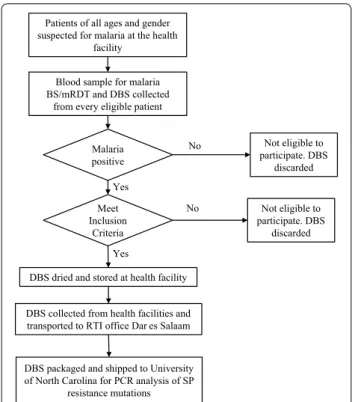
Two blood spots were collected on filter paper (Whatman no. 3, GE Healthcare Life Sciences) at the time the blood sample was collected for malaria testing; if the RDT was negative or the patient did not consent or otherwise did not meet inclusion criteria, the filter paper was destroyed (Fig. 2). Blood spots from consenting individuals were
air dried for 3–4 h on a flat, nonabsorbent surface, then sealed in plastic bags with a desiccant, and stored at room temperature at the study health facility. The sam-ples from all 14 health facilities were packaged in a water-proof container, and shipped to the reference laboratory at the University of North Carolina (UNC) for pooled deep sequencing analyses at three genetic loci associ-ated with sulfadoxine-pyrimethamine (SP) resistance,
dhfr164, dhps540, and dhps581 [8, 12–14].
Molecular methods Optimizing DNA extraction
120 Dried Blood Spots (DBS) from the Kharumwa health center were used in a preliminary experiment to deter-mine if DNA from batched DBS could be extracted reli-ably. Each subject’s DBS was punched 3 times. One of these punches was added to a single well of a 96-well plate. The other punches were pooled so that wells would contain either three or ten punches from individuals. The plate was extracted using the Chelex method using overnight incubation at 4 °C on a shaking platform at
700 RPM (TPM2 shaker, Sarstedt, Nümbrecht, Ger-many) [15]. After extraction, 3, 9 and 30 ml aliquots of supernatant were removed from the n = 1, n = 3, and
n = 10 extracts, respectively, and combined with aliquots
from similarly extracted samples: 1×: aliquots of all 120
individually extracted samples; 3×: aliquots of all 40 of
the 3-punch extracts; and 10× aliquots of all 12 of the
10-punch extracts.
Nested PCR amplification was done on each of the three DNA pools for dhps and dhfr using primers shown in Table 1 based on a previous report [16]. PCR condi-tions were 95 °C × 2 min, followed by 40 rounds of [95
°C × 30 s → 45 °C × 30 s → 72 °C × 1 min] and a final
round of 72 °C for 10 m. Individual indexed libraries for each gene were made for each DBS pooling condition using the NEB Next Ultra DNA Library Prep Kit (New England Biolabs, Ipswich, USA) and pooled in equimo-lar fashion. Pooled libraries were sequenced on an Illu-mina MiSeq using 2 × 300 bp reads at the UNC High
Throughput Sequencing Facility. Allele frequencies for single nucleotide polymorphisms (SNPs) within the
demultiplexed libraries were determined using methods previously described [17, 18].
Sequencing reads were aligned using bowtie2 with default settings to the P. falciparum 3D7 reference strain and the minor allele frequency (MAF) at all positions across the amplicon was determined using a revised ver-sion of our previously described Minor Allele Catcher (MAC) [18]. Bases and reads were excluded from analysis if they had a mapping quality less than or equal to 10, a read length less than or equal to 200 bp, a base quality of
less than or equal to 20, a base depth of less than or equal to 5000, if SNPs occurred in the first or last twenty-five bases of a read, or if 30% or fewer of the reads were on the forward or reverse strand.
Extraction and analysis of DBS from 13 other health centres
Based on the results of this pilot (Table 2), DNA from all of the remaining samples was extracted in batches of 10 by health centre. The DNA extracts from each of the health centres were then pooled yielding one amplicon pool for each site (13 pools). Library preps and analy-sis were performed as above. Data from the Kharumwa health centre, 10-punch extract, was re-run a second time to generate the 14-health center dataset.
Results
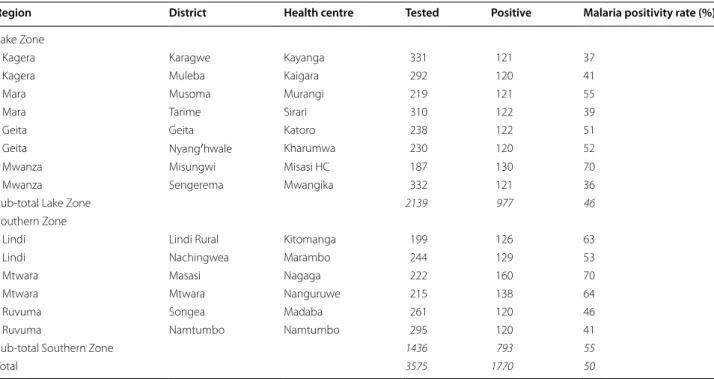
A total of 3575 febrile patients were screened, and 1770 were found to be positive for malaria, yielding an over-all positivity rate of 49.5% (Table 2). In this pilot work to determine the extraction efficiency of individual ver-sus pooled extraction using the 120 participants from Kharumwa health centre, the proportion of mutant alleles varied only slightly as a result of batching DBS prior to extraction, with 9.4–10.7% alleles mutated at
dhps540, 2.8–3.9% at dhps581, and none at dhfr164
(Table 3). As these differences in allele frequencies were considered negligible, DBS from all other health centers were extracted in pools of 10.
A total of 1750 dried blood spot (DBS) samples were collected (117–160 samples per facility) and used in the final study analysis. Deep sequencing resulted in an aver-age of 341,420 reads at dhfr (range 208,769–644,927) and 168,260 reads at dhps (range 49,419–313,645). The library from Kharumwa was re-sequenced during this project. Based upon this repeat sequencing (Table 4) and the 3 sequences in Table 3, the allele frequencies ± stand-ard deviations for dhps540 and dhps581 mutants were 90.0 ± 2.1% and 3.2 ± 0.7%, respectively. The dhps540 mutation was common across all 14 sites, with allele frequency ranging from 55 to 98.4%, with higher allele frequency at sites in Lake Zone compared to South-ern Zone (Table 4). Frequency of the dhps581 mutation ranged from 0 to 2.4%, with the exception of Kayanga health centre (Kagera Region, Lake Zone) where 24.9% of sequences were mutated (Fig. 1). The dhfr164 mutation was detected only at Kanyanga health centre (0.6%).
Discussion
In a survey of parasites from patients at 14 health facili-ties in the Lake and Southern Zones of Tanzania, the
dhpsK540E mutation was very common [in 10 facili-ties (71%) more than 85% of alleles at dhpsK540E were mutated, and nowhere were fewer than 55% mutated],
Blood sample for malaria BS/mRDT and DBS collected
from every eligible patient
Meet Inclusion
Criteria
Not eligible to participate. DBS
discarded
DBS dried and stored at health facility Malaria
positive
Not eligible to participate. DBS
discarded
DBS packaged and shipped to University of North Carolina for PCR analysis of SP
resistance mutations No Yes
No
Yes
DBS collected from health facilities and transported to RTI office Dar es Salaam
Patients of all ages and gender suspected for malaria at the health
facility
Fig. 2 Flowchart for recruiting participants and collecting samples.
BS blood smear, DBS dried blood spot, RDT malaria rapid diagnostic test
Table 1 Primers
Primer Sequence Descrpition
Pfdhfr-F1 TCCTTTTTATGATGGAACAAG dhfr outer forward Pfdhfr-R1 AGTATATACATCGCTAACAGA dhfr outer reverse Pfdhfr1-F TGAGGTTTTTAATAACTACACATTTAGA
GGTCT dhfr inner forward
Pfdhfr1-R TCGCTAACAGAAATAATTTGATACTCAT dhfr inner reverse Pfdhps-F1 AACCTAAACGTGCTGTTCAA dhps outer forward Pfdhps-R1 AATTGTGTGATTTGTCCACAA dhps outer reverse Pfdhps1-F TGAAATGATAAATGAAGGTGCTAGTGT dhps inner forward Pfdhps1-R GTTGTGTATTTATTACAACATTTTGATCA
while the dhpsA581G mutation remained rare and focal, with frequency greater than 2.4% in only one facility, Kay-anga Health Facility, where nearly 25% of alleles carried the dhpsA581G mutation. The quintuple mutation (rep-resented by the dhpsK540E) has been reported widely across Tanzania, with prevalence ranging from 64 to 98% in one recent report assessing seven regions [10] and 77 to 95% in another [19]. Previous reports from Tanga Region have found a high prevalence of parasites har-bouring the dhpsA581G mutation (44% in Korogwe [7], 51% in Muheza [19], and 57% in Bondo [10]). Although the Lake and Southern Zones of Tanzania are not imme-diately adjacent to Tanga Region, the absence of the
dhpsA581G mutation in the majority of sites highlights that there may be considerable geographic micro-heter-ogeneity. This is supported by data from Kavishe et al., who similarly found the dhpsA581G to be present at high
proportion in only Tanga and Kagera Regions, though the prevalence of mutants at their sites were higher than the allele frequencies reported here [10]. This is a reassuring finding, suggesting that IPTp-SP retains efficacy in the majority of Tanzania, but highlighting the need for moni-toring in multiple geographic sites.
The pooling and sequencing methodology presented here is a cost-effective alternative to individual allele-spe-cific PCR. Using this 2-step pooling methodology, it was possible to perform 90% fewer DNA extractions and 99% fewer sequencing runs than if samples from each par-ticipant had been sequenced individually, saving a sub-stantial amount of both time and money. The individual extraction and bi-directional Sanger sequencing of 1750 samples would cost on the order of $19,000. Here the same data has been compiled for under $4000.
Another advantage of the pooling method is that it allows direct calculation of the allele frequency, rather than prevalence. That is, it calculates the percentage of the parasite population bearing the mutation rather than the prevalence of individuals bearing parasites with mutated alleles. From an evolutionary point of view, the allele frequency of a mutation is more important than prevalence of the mutation because it approximates the likelihood that a mosquito will become infected with a mutant parasite after exposure to a given population.
Allele frequency and prevalence can be different when mixed infections are present and when individu-als have infections with varying levels of parasitaemia.
Table 2 Malaria testing and positivity rates at selected health centres
Region District Health centre Tested Positive Malaria positivity rate (%)
Lake Zone
Kagera Karagwe Kayanga 331 121 37
Kagera Muleba Kaigara 292 120 41
Mara Musoma Murangi 219 121 55
Mara Tarime Sirari 310 122 39
Geita Geita Katoro 238 122 51
Geita Nyang′hwale Kharumwa 230 120 52
Mwanza Misungwi Misasi HC 187 130 70
Mwanza Sengerema Mwangika 332 121 36
Sub-total Lake Zone 2139 977 46
Southern Zone
Lindi Lindi Rural Kitomanga 199 126 63
Lindi Nachingwea Marambo 244 129 53
Mtwara Masasi Nagaga 222 160 70
Mtwara Mtwara Nanguruwe 215 138 64
Ruvuma Songea Madaba 261 120 46
Ruvuma Namtumbo Namtumbo 295 120 41
Sub-total Southern Zone 1436 793 55
Total 3575 1770 50
Table 3 Distribution of mutants using pools from individ-ually extracted (1×), 3-punch extracted (3×) and 10-punch extracted (10×)
DNA pool Proportion of mutant alleles
Dhps540 Dhps581 Dhfr164
Traditionally, prevalence data have to be transformed by a complex equation to yield predicted allele frequencies [20]. However, in general, the allele frequency approxi-mates the prevalence of major strain in a human popula-tion, barring any biases [16, 21].
This study has a number of limitations. Samples were collected only from the Lake and Southern Zones, nei-ther of which are immediately adjacent to Tanga region, where the highest prevalence of the dhpsA581G have been reported, thus more studies in those areas are needed to better define the extent of the mutant. With regard to the pooling methodology employed here, while much more cost-effective and time-saving than tradi-tional PCR, it is not possible to trace a parasite strain back to a participant. Also, some haplotypes tend to be amplified better than others, leading to PCR amplifica-tion bias. However, newer barcoding methods, such as primer ID [22], compensate for amplification bias and could allow identification of individuals (although DNA would still have to be extracted from individual DBS).
While overall, these data are reassuring with respect to the efficacy of IPTp-SP, there are select areas with a high prevalence of the sextuple mutant, where IPTp-SP may no longer provide a useful benefit against malaria. Spread of this sextuple mutant will threaten the usefulness of SP for IPTp. Given the fact that the quintuple mutant is already found throughout Tanzania, and the sextuple mutant has been found in high prevalence in several sites, continued
surveillance in multiple sites, particularly in and around Tanga and Kagera, is warranted to monitor for the spread of the sextuple mutant. The pooling technique presented here provides a highly efficient and cost effective means to screen many samples from multiple sites.
Conclusion
Although the quintuple mutant was very common at all sampled facilities, dhpsA581G remains geographically restricted, suggesting that IPTp-SP remains effective in most of Tanzania. However, additional surveillance, particularly in and around Tanga and Kagera Region is warranted. This can be achieved efficiently through sequencing pooled samples as described here. Finally, a better understanding of the effect of the dhps581 mutant on the efficacy of IPTp-SP is needed.
Abbreviations
BS: blood slide; DBS: dried blood spot on filter paper; IPTp: intermittent pre-ventive treatment in pregnancy; IRS: indoor residual spray; MFP: malaria focal person; MiP: malaria in pregnancy; OPD: outpatient department; RDT: malaria rapid diagnostic test; SP: sulfadoxine-pyrimethamine; WHO: World Health Organization.
Authors’ contributions
JG, JMN, SM, OMM, DSI, RAW designed the study. DSI, SM, OMM, RAW, SL, NK, CK, and LAP oversaw the collection of the samples. SMD, KLT, NJH, JAB, JJJ, and SRM analysed the samples. JG, JMN, and SRM drafted the manuscript which all authors edited and approved. All authors read and approved the final manuscript.
Table 4 Summary of drug resistance allele frequencies
* Mean allele frequency for each zone was calculated by averaging the percentage of mutants from each health center
Region District Health centre Samples (N) Mutant, % (number of mutant/total sequences)
dhps540 dhps581 dhfr164
Lake Zone
Kagera Karagwe Kayanga 120 89% (154,320/173,457) 24.9% (46,056/185,117) 0.6% (3972/623,835) Kagera Muleba Kaigara 120 91.2% (270,373/296,323) 1% (31,77/313,669) 0% (123/286,155) Mara Musoma Murangi 117 86% (160,431/186,561) 0% (24/196,781) 0% (20/327,806) Mara Tarime Sirari 120 98.4% (262,461/266,632) 0% (71/285,418) 0% (17/249,213) Geita Geita Katoro 122 97.2% (254,986/262,202) 0.2% (547/280,267) 0% 19/310,706) Geita Nyang’hwale Kharumwa 120 92.9% (176,055/189,500) 2.4% (4860/201,156) 0% (23/322,015) Mwanza Misungwi Misasi 130 92.7% (168,879/182,105) 2% (3773/193,348) 0% (15/348,488) Mwanza Sengerema Mwangika 121 93.2% (177,559/190,591) 0.3% (692/202,087) 0% (24/386,750)
Mean allele frequency Lake Zone* 970 82.6% 3.9% 0.1%
Southern Zone
Lindi Lindi Rural Kitomanga 124 94.4% (162,087/171,760) 0% (47/177,058) 0% (11/225,710) Lindi Nachingwea Marambo 129 77.3% (35,351/45,753) 0.1% (57/50,926) 0% (41/231,375) Mtwara Masasi Nagaga 160 68.1% (107,370/157,670) 0% (17/164,456) 0% (46/247,292) Mtwara Mtwara Nanguruwe 129 73.2% (104,952/143,305) 0.8% (1180/154,626) 0% (17/385,082) Ruvuma Songea Madaba 120 92% (71,494/77,751) 0% (11/83,706) 0% (13/324,890) Ruvuma Namtumbo Namtumbo 118 55.7% (26,134/46,901) 0% (12/52,484) 0% (22/318,552)
Author details
1 RTI International, Dar es Salaam, Tanzania. 2 National Institute for Medical Research, Tanga, Tanzania. 3 UNC Gillings School of Global Public Health, Chapel Hill, NC, USA. 4 National Malaria Control Programme, Dar es Salaam, Tanzania. 5 US President’s Malaria Initiative/United States Agency for Inter-national Development, Dar es Salaam, Tanzania. 6 US President’s Malaria Initiative, Malaria Branch, Division of Parasitic Diseases and Malaria, US Centers for Disease Control and Prevention, Dar es Salaam, Tanzania. 7 Program in Bioinformatics and Integrative Biology, University of Massachusetts Medical School, Worcester, MA, USA. 8 Malaria Branch, Division of Parasitic Diseases and Malaria, US Centers for Disease Control and Prevention, Atlanta, GA, USA.
Acknowledgements
We are grateful to the staff of the HCs, NIMR Tanga team (Ezekiel Malecela and August Nyaki), and RTI staff who implemented the study and district malaria focal persons (DMFP) in Lake and Southern Zones for supervising the study.
Competing interests
The authors declare that they have no competing interests.
Availability of data and materials
The datasets generated during the current study are available from the cor-responding author on reasonable request.
Disclaimer
The findings and conclusions presented in this manuscript are those of the authors and do not necessarily reflect the official position of the US President’s Malaria Initiative, US Agency for International Development, or US Centers for Disease Control and Prevention.
Ethical approval and consent to participate
The study protocol was approved by the Medical Research Coordinating Com-mittee (MRCC) of the Tanzania National Health Institute for Medical Research (NIMR) [reference NIMR/HQ/R.8a/Vol.IX/1924]. The US Centers for Disease Control and Prevention (CDC) human research protection office reviewed the protocol and granted a non-engaged determination for CDC’s role in this project. Informed consent was obtained from all patients/parents or guardians of patients (for minors) participating in the study.
Funding
This study was made possible through support provided to the Tanzania Vec-tor Control Scale-up Project (Cooperative Agreement 621-A-00-10-00015-00) by the President’s Malaria Initiative (PMI) via the US Agency for International Development (USAID) and an inter-agency agreement with the US Centers for Disease Control and Prevention (CDC).
Publisher’s Note
Springer Nature remains neutral with regard to jurisdictional claims in pub-lished maps and institutional affiliations.
Received: 15 January 2017 Accepted: 30 May 2017
References
1. Rogerson SJ, Mwapasa V, Meshnick SR. Malaria in pregnancy: link-ing immunity and pathogenesis to prevention. Am J Trop Med Hyg. 2007;77:14–22.
2. Desai M, ter Kuile FO, Nosten F, McGready R, Asamoa K, Brabin B, et al. Epidemiology and burden of malaria in pregnancy. Lancet Infect Dis. 2007;7:93–104.
3. Eisele TP, Larsen DA, Anglewicz PA, Keating J, Yukich J, Bennett A, et al. Malaria prevention in pregnancy, birthweight, and neonatal mortality: a meta-analysis of 32 national cross-sectional datasets in Africa. Lancet Infect Dis. 2012;12:942–9.
4. Kublin JG, Dzinjalamala FK, Kamwendo DD, Malkin EM, Cortese JF, Mar-tino LM, et al. Molecular markers for failure of sulfadoxine-pyrimethamine and chlorproguanil-dapsone treatment of Plasmodium falciparum malaria. J Infect Dis. 2002;185:380–8.
5. Gutman J, Mwandama D, Wiegand RE, Ali D, Mathanga DP, Skarbinski J. Effectiveness of intermittent preventive treatment with sulfadoxine-pyrimethamine during pregnancy on maternal and birth outcomes in Machinga district, Malawi. J Infect Dis. 2013;208:907–16.
6. Kayentao K, Garner P, van Eijk AM, Naidoo I, Roper C, Mulokozi A, et al. Intermittent preventive therapy for malaria during pregnancy using 2 vs 3 or more doses of sulfadoxine-pyrimethamine and risk of low birth weight in Africa: systematic review and meta-analysis. JAMA. 2013;309:594–604. 7. Minja DTR, Schmiegelow C, Mmbando B, Boström S, Oesterholt M,
Mag-istrado P, et al. Plasmodium falciparum mutant haplotype infection during pregnancy associated with reduced birthweight, Tanzania. Emerg Infect Dis. 2013;19:1446–54.
8. Harrington WE, Mutabingwa TK, Muehlenbachs A, Sorensen B, Bolla MC, Fried M, et al. Competitive facilitation of drug-resistant Plasmodium falciparum malaria parasites in pregnant women who receive preventive treatment. Proc Natl Acad Sci USA. 2009;106:9027–32.
9. Gutman J, Kalilani L, Taylor S, Zhou Z, Wiegand RE, Thwai KL, et al. The A581G mutation in the gene encoding Plasmodium falciparum dihydrop-teroate synthetase reduces the effectiveness of sulfadoxine-pyrimeth-amine preventive therapy in Malawian pregnant women. J Infect Dis. 2015;211:1997–2005.
10. Kavishe RA, Kaaya RD, Nag S, Krogsgaard C, Notland JG, Kavishe AA, et al. Molecular monitoring of Plasmodium falciparum super-resistance to sulfadoxine–pyrimethamine in Tanzania. Malar J. 2016;15:335. 11. Tanzania Commission for AIDS (TACAIDS), Zanzibar AIDS Commission
(ZAC), National Bureau of, Statistics (NBS), Office of the Chief Government Statistician (OCGS), and ICF International. Tanzania HIV/AIDS and Malaria Indicator Survey 2011–12 [Internet]. Dar es Salaam, Tanzania: TACAIDS, ZAC, NBS, OCGS, and ICF International; 2013. http://www.nbs.go.tz/index. php?option=com_content&view=article&id= 353:2011-12-tanzania-hivaids-and-malaria-indicator-survey-thmis-report&catid=55:this&Ite mid=145.
12. Plowe CV, Kublin JG, Doumbo OK. P. falciparum dihydrofolate reductase and dihydropteroate synthase mutations: epidemiology and role in clini-cal resistance to antifolates. Drug Resist Updates. 1998;1:389–96. 13. Gesase S, Gosling RD, Hashim R, Ord R, Naidoo I, Madebe R, et al. High
resistance of Plasmodium falciparum to sulphadoxine/pyrimethamine in northern Tanzania and the emergence of dhps resistance mutation at Codon 581. PLoS ONE. 2009;4:e4569.
14. Naidoo I, Roper C. Mapping, “partially resistant”, “fully resistant”, and “super resistant” malaria. Trends Parasitol. 2013;29:505–15.
15. Taylor SM, Antonia AL, Harrington WE, Goheen MM, Mwapasa V, Chaluluka E, et al. Independent lineages of highly sulfadoxine-resistant Plasmodium falciparum haplotypes, eastern Africa. Emerg Infect Dis. 2014;20:1140–8.
16. Taylor SM, Parobek CM, Aragam N, Ngasala BE, Mårtensson A, Meshnick SR, et al. Pooled deep sequencing of Plasmodium falciparum isolates: an efficient and scalable tool to quantify prevailing malaria drug-resistance genotypes. J Infect Dis. 2013;208:1998–2006.
17. Taylor SM, Parobek CM, DeConti DK, Kayentao K, Coulibaly SO, Green-wood BM, et al. Absence of putative artemisinin resistance mutations among Plasmodium falciparum in sub-Saharan Africa: a molecular epide-miologic study. J Infect Dis. 2015;211:680–8.
18. Brazeau NF, Hathaway N, Parobek CM, Lin JT, Bailey JA, Lon C, et al. Longi-tudinal pooled deep sequencing of the Plasmodium vivax K12 Kelch gene in Cambodia reveals a lack of selection by artemisinin. Am J Trop Med Hyg. 2016;95:1409–12.
19. Baraka V, Ishengoma DS, Fransis F, Minja DTR, Madebe RA, Ngatunga D, et al. High-level Plasmodium falciparum sulfadoxine-pyrimethamine resistance with the concomitant occurrence of septuple haplotype in Tanzania. Malar J. 2015;14:439.
20. Hastings IM, Smith TA. MalHaploFreq: a computer programme for estimating malaria haplotype frequencies from blood samples. Malar J. 2008;7:130.
21. Aragam NR, Thayer KM, Nge N, Hoffman I, Martinson F, Kamwendo D, et al. Diversity of T cell epitopes in Plasmodium falciparum circum-sporozoite protein likely due to protein-protein interactions. PLoS ONE. 2013;8:e62427.