Trends of Skin and Soft Tissue Infections in the Department of Defense
By
Kermit Huebner
A Master’s Paper submitted to the faculty of the University of North Carolina at Chapel Hill
In partial fulfillment of the requirements for the degree of Master of Public Health in
the Public Health Leadership Program.
Chapel Hill
2010
___________________________ Advisor signature/printed name
________________________________ Second Reader Signature/printed name
Abstract
Background: Skin and soft tissue infections (SSTI) have risen sharply over the last decade as a
result of community-acquired methicillin-resistant Staphylococcus aureus (CA-MRSA).
Evaluations of national databases have shown an increase in healthcare visits due to CA-MRSA, but do not include federal healthcare facilities, including the military. This study evaluates the trends in SSTI likely related to CA-MRSA across the Department of Defense from 1999-2008. Methods: A dataset was constructed using the Defense Medical Epidemiology Database using
ICD-9 codes for carbuncle/furuncle during the time of interest. Data was then stratified to specific service components, Army personnel category, and Army military occupational
Background:
Skin and soft tissue infections (SSTI) traditionally have accounted for 1-2% of all
emergency department visits, but the incidence of SSTI’s has risen sharply over the last decade.1
An evaluation of the National Ambulatory Medical Care Survey and the National Hospital Ambulatory Medical Care Survey shows visits for SSTI increased by 59% in outpatient clinics and 31% in emergency departments from 1992-2003.2
The typical causative agents of SSTI included Streptococcusspecies and Staphylococcus aureus. While traditionally susceptible to most antibiotics, including penicillin, the increased incidence of SSTI has been correlated with an increased incidence of methicillin-resistant
Staphylococcus aureus (MRSA). MRSA was first discovered in 1960 and was found to be a
nosocomial pathogen.3 Patients at risk for hospital acquired MRSA (HA-MRSA) included those with previous antibiotic use, contact with a healthcare worker or nursing home resident,
residence in a long-term care facility, hospitalization, admission to an intensive care unit,
hemodialysis or peritoneal dialysis, mechanical ventilation, tracheostomy tube, nasogastric tube,
gastrostomy tube, or Foley catheter, total parenteral nutrition or enteral feeding, surgical
procedures, and previous isolation of MRSA.3,4 More recently MRSA has been implicated in SSTI in outpatients without any risk factors for HA-MRSA. These infections have been deemed community acquired MRSA infections (CA-MRSA).
more likely to produce exotoxins, such as the Panton-Valentine leukocidin (PVL) toxin which is a dermonecrotic toxin allowing for more aggressive skin penetration and abscess development.4 Pulsed Field Gel Electrophoresis evaluation can be used to differentiate between genetic clones. Common clones include USA 400 and USA 300. USA 400 is highly virulent and contains 16 unique superantigen genes in addition to PVL, but is a less frequent source of infection.5
USA 300 is much more common and reached epidemic and then endemic proportions in the U.S.6 Molecular typing has shown that in some institutions the USA 300 clone caused greater than 80% of CA-MRSA infections in the US mainland7, while the epidemiology of CA-MRSA in Alaska has not shown such USA 300 predominance.8
Methods:
A descriptive study of nested data in the Defense Medical Epidemiology Database (DMED) was undertaken to determine trends in SSTI in the Department of Defense from 1999 thru 2008. Goals of this project are to determine changes in the occurrence of SSTI in the Department of Defense and to evaluate differences between service components (Army, Navy, Air Force, and Marines). Secondary aims of this study are to evaluate differences between personnel status (officers and enlisted), differences between military occupational specialty categories, and differences in body location of SSTI in the Army sub-group as the prevalence of CA-MRSA has increased in the general population. This project was approved as an exempt protocol by the University of North Carolina-Chapel Hill Institutional Review Board.
Queries for this project were made using the International Classification of Disease, Ninth Revision Clinical Modification (ICD-9-CM) 3 digit code (680) for carbuncle/furuncle as the primary diagnosis in the ambulatory data set for years 1999-2008. While previous studies have used several subsets of SSTI, carbuncle/furuncle was used for this project as it has been noted in previous studies to correlate to infections with CA-MRSA.21
The ten year period from 1999-2008 was selected to capture time before and after the inflection point for increased CA-MRSA infections in the civilian population that occurred around 2000-2003.22 Information was set to include all genders, all ages, all races, all marital statuses, all occupations, and all
locations. The data set was then filtered to develop an Army specific dataset that was divided into personnel category (enlisted personnel vs officers). Each category was then filtered to sub-sets based on military occupational specialty categories. Enlisted categories consisted of the following:
1) Infantry, Gun Crews, and Seamanship Special 2) Electronic Equipment Repairers
3) Communications and Intelligence Specialist 4) Healthcare Specialists
6) Functional Support and Administration 7) Electrical/Mechanical Equipment Repairers 8) Crafts workers
Lastly, the Army dataset was filtered by ICD-9-CM to specific body location using the following codes:
3) 680.2 -Trunk
4) 680.3 – Upper arm and forearm 5) 680.4 - Hand
6) 680.5 - Buttock
7) 680.6 – Leg except foot 8) 680.7 – Foot
9) 680.8 - Other specified site 10) 680.9 - Unspecified site
Each data set was then imported into an Excel spreadsheet for development of graphs and bar charts. Trend analysis was then performed with least squares linear regression using Graphpad Prism 5 to compare the slope selected sub-set data.
Results:
Service Component
proportions of 18.7%, 19.6%, and 9.5% respectively. During this ten year period, infections in the Army had a 12-fold increase from 472 to 5,723. Increased counts also occurred in the Navy (4-fold), Air Force (4-fold), and Marines (4.5-fold) during this time, however, at lower amounts. Rates per 1,000 persons per year were similar for each branch of service in 1999, ranging from 1.01 in the Army to 1.34 in the Marines. In 2008, there were substantial differences between the rate in the Army and the other services with 10.79 infections per 1,000 persons in the Army and a range of 5.34 to 6.61 per 1,000 in the Navy, Air Force, and Marines. The lowest rate occurred in the Army in 1999 and the highest rate was in the Army in 2007 at 11.25 per 1,000 per year (Figure 1). Trend analysis revealed a significant difference between rates in the Army compared to rates in all other service components (p <0.0001).
Army Personnel Category
Raw data for the Army filtered by personnel category is included in Table 2 and graphed in Figure 2. Ninety-three percent of infections occurred in enlisted personnel. In 1999, 88% of infections occurred in enlisted members and in 2008 they accounted for 94%. Enlisted rates per 1,000 persons went from 1.05 to 11.99 during the study period and the rates for officers
increased from 0.72 to 4.06. The lowest rate occurred in officers in 1999 and the highest rate occurred in enlisted members in 2007. Changes in rates per 1,000 persons per year for the Army revealed a significant difference in the incidence of SSTI between officer and enlisted categories (p<0.01) (Figure 3).
Army Military Occupational Specialty Category
rates are shown in Figure 4. In 1999, the majority of infections occurred in the infantry (27.4%) and functional support and administration (25.6%). From 1999 to 2008, there was a 12.5-fold increase in infections among enlisted personnel. The percent occurring in the infantry decreased to 23.3% and functional support and administration decreased to 21.4%, while all other
categories increased in percentage of infection with the exception of healthcare workers. In 1999, rates per 1,000 persons ranged from 0.74 in electronic repair to 1.25 in healthcare. In 2008, rates varied from 8.56 per 1,000 in the infantry to 15.65 per 1,000 in craft workers. The lowest rate occurred in electronic repair in 1999 (0.74 per 1,000) and the highest rate occurred in electrical/mechanical repair in 2007 (17.1 per 1,000). There was a significant difference between groups (p = 0.007) with the largest increase in rates occurring with electronic/mechanical repair and craft workers. The lowest increases in rates per 1,000 persons occurred in the infantry and communications/intelligence.
Body Location
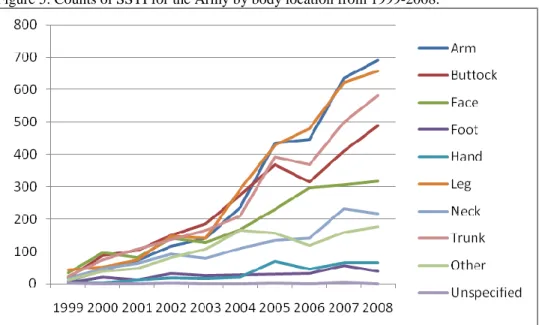
A graph of raw counts by body location for the Army is shown in Figure 5. In 1999, the majority of infections occurred on the leg (26.8%) and face (20.7%). In 2008, the majority of infections occurred on the arms (21.4%), legs (20.3%), trunk (18%) and buttocks (15.1%). The greatest percentage increase during the study time occurred in the arm, trunk, and buttock. Significant differences existed between body location over the study period (p<0.001). The highest rate of increase occurred in the arm, leg, trunk and buttocks. A chart comparing distribution of SSTI in 1999 and 2008 is shown in Figure 6.
Discussion:
when no isolates of MRSA was isolated from SSTI and the most common etiology was methicillin-sensitive Staphylococcus aureus.24 There was an increase in overall diagnosis of carbuncle/furuncle across the DoD from 1999-2008 with an inflection point occurring near 2003. The rates of infection in the DoD were comparable to that of cited civilian rates ranging from 17.3 to 32.5 visits per 1,000 population for the diagnosis of abscess/cellulitis.18
Within DoD, there was a substantially higher number infections and a higher rate of infection in the Army. This may be related to the type of training and living conditions
experienced by those in the Army, compared to the other components. Surprisingly, there was a significant difference between the Army and Marines which, intuitively, would be similar given the similar exposure to living in field conditions and training.
infection and having a locker near a teammate with an SSTI and sharing towels were associated with nasal carriage.25
The higher number of enlisted Army members with carbuncle/furuncles may be related to local outbreaks of CA-MRSA that occur within units or barracks. Outbreaks of CA-MRSA in military personnel in these living conditions have been reported.26
The greatest risk factor during an outbreak among military trainees in San Diego, CA included having a roommate with a prior skin infection (odds ratio 3.44).27 Given the number of infections in the Army and access to several free healthcare venues (unit medic, battalion aid stations, troop medical clinics, and the emergency department), it is possible for small outbreaks to occur without recognition by public health authorities.
Among enlisted members, the highest rates of infection occurred in craft workers and electrical/mechanical repair personnel. While environmental exposure to field conditions among combat arms personnel would be expected to result in increased infections, this finding may relate to the role of fomites in development of infections. Nasal colonization is an important aspect of the epidemiology of Methicillin-susceptible Staphylococcus aureus infection, but may not be as important in the transmission of CA-MRSA.28 Sharing of tools among craft workers and repair personnel could be responsible for the increased rate of infection among these
soldiers. Moreover, they may be more likely to develop skin abrasions or minor lacerations that could serve as a portal for infection.
military recruits.26 The change in body site location may be related to environmental exposure to fomites and a change in body site location colonization. Nasal colonization has been implicated as an important factor for methicillin susceptible S. aureus, and HA-MRSA, while colonization at non-nasal sites has been implicated for transmission and development of infection in patients with CA-MRSA.29
Colonization is likely to play a lessor role in the development of CA-MRSA SSTI dissemination as the percent of healthy populations with nasal colonization is
approximately 1%.30 While, Zafar, et al, found that household contacts of patients with CA-MRSA SSTI had higher nasal carriage rates than that of the general population, only half of household members carried the same strain as the patient, making direct transmission less likely.31
Ellis, et al, studied the natural history of CA-MRSA colonization and infection in a cohort of soldiers undergoing advanced individual training over a 10 week period. Of 812 soldiers that participated in the study, 24 were colonized with MRSA and 214 were colonized with methicillin-susceptible S. aureus. At the end of the 10 week period, only 8 of the CA-MRSA colonized soldiers remained colonized. None of the methicillin-susceptible S. aureus
carriers became colonized with MRSA. Of the 523 that were not colonized at all on initial screening, only 4 developed MRSA colonization in the 10 week period while 40 became colonized with methicillin-susceptible S. aureus. Of the initial 24 MRSA carriers, 9 developed soft tissue infections compared to 8 soft tissue infections in the group that was colonized with methicillin-susceptible S. aureus. This study revealed that carriage of MRSA is associated with a higher attack rate of SSTI compared to carriage of methicillin-susceptible S. aureus.32
However, additional sites of colonization, such as the groin and axilla, were not evaluated. Implications for interventions. Identification of personnel with higher rates of infection may
environmental contact. Such procedures have been used in outbreaks of CA-MRSA among sports participants. Recommendations for preventing staphylococcal skin infections among sports participants includes: 1) cover all wounds, 2) encourage good hygiene, including
showering and washing with soap after all practices and competitions, 3) ensure availability of adequate soap and water, 4) discourage sharing of towels and personal items, 5) establish routine cleaning schedules for shared equipment, 6) train athletes and coaches in recognition of wounds that are potentially infected, 7) encourage athletes to report skin lesions.11 Use of contact
precautions for persons with SSTI is supported by the changing epidemiology of these infections and is recommended by the Centers for Disease Control and Prevention.33 This would include identifying potential fomites and developing appropriate handling and cleaning procedures. Determining an intervention strategy to prevent the spread of CA-MRSA is also likely to have significant financial implications as infections with MRSA requiring hospitalization have been shown to be 2 -3 times as costly as those with MSSA infections.34 In outpatients, CA-MRSA is likely to require treatment with additional courses of antibiotics which also lead to increased economic impact.35
As increase in CA-MRSA SSTI has increased and treatment with B-lactam antibiotics has also decreased, a large percentage of patients are still treated with inactive antimicrobial therapy.36 This may lead to increased morbidity and expense for repeat treatment. Prevention of recurrence is also an issue. Study of CA-MRSA SSTI in an urban jail showed a 6 month recurrence rate of 14% compared to a recurrence rate of 8.8% for patients with MSSA SSTI.37
Decolonization for patients with recurrent infections may be of some benefit. A
that decolonization may be reasonable in 2 clinical situations: 1) for patients with multiple documented recurrences of MRSA infections and 2) for ongoing MRSA transmission in a closely associated and well-defined cohort of individuals (e.g. household). Outbreaks in military personnel may be candidates for decolonization therapy given their close association, specifically for those who live in close quarters, such as in the barracks.
Limitations:
This study is limited by the use of secondary data derived from a larger database of reported infections across the DoD. While reporting of diagnosis and diagnostic codes are required for each visit, it is possible for diagnoses to be coded in error. In some instances it is possible that no diagnostic code is reported, especially for personnel with unit level medics or aid stations that may treat soldiers without formal reporting. This may be more likely to occur in combat arms units and could explain why they have a lower rate of infection in the database.
Although this project shows that the incidence of SSTI has increased over the 10 year period, the exact incidence of CA-MRSA cannot be determined as culture information was not available in the database. To minimize this issue only infection that would have a high
correlation with CA-MRSA in previous studies were included in this evaluation by limiting the study to a diagnosis of carbuncle/furuncle. While this makes the study more specific to CA-MRSA, it has the potential to underestimate overall SSTIs.
operating base in Baghdad, with an overall calculated incidence rate of 880 per 100,000 persons per year for all SSTI and 600 per 100,000 per year for CA-MRSA infections.39
Future Research:
Additional studies to further determine target populations for intervention and risk factors for SSTIs in soldiers are needed. This would include focused questionnaires and environmental sampling in the personnel groups with the highest incidence of infection in this study. Use of cultures will be imperative as it has been shown through a prospective study assessing risk factors that clinical and epidemiological risk factors are not able to distinguish between MRSA and MSSA infections.40 Further evaluation of colonization and its effect on development of infection and transmission is needed, specifically evaluating sites other than nasal colonization to include the groin and axilla. A cohort study of soldiers to compare the impact of deployment on infection rates would also provide key information.
Conclusion:
Skin and soft tissue infections have risen dramatically across the United States, including the Department of Defense. Previous studies have evaluated the impact of CA-MRSA on the
Table 1. Counts for SSTI in each service component from 1999-2008.
1999 2000 2001 2002 2003 2004 2005 2006 2007 2008
Army 472 1044 1236 1614 1664 2666 4174 4598 5743 5723
Navy 493 663 646 895 1006 1245 1472 1936 2061 2049
Air Force 541 813 1006 839 959 1352 1534 1627 2161 2142
Marines 229 259 305 369 429 613 737 851 942 1036
Table 2. Counts of SSTI for the Army by personnel category from 1999-2008.
1999 2000 2001 2002 2003 2004 2005 2006 2007 2008
Enlisted 412 940 1121 1481 1529 2472 3849 4219 5268 5317
Officer 56 94 109 120 113 173 292 260 405 353
Figure 3. Rates per 1,000 persons per year of SSTI by Army personnel category from 1999-2008.
14
12
10
8
6
4
2
0
1999 2000 2001 2002 2003 2004 2005 2006 2007 2008
- Enlisted
Table 3. Counts of SSTI for enlisted soldiers by military occupational specialty category from 1999-2008.
1999 2000 2001 2002 2003 2004 2005 2006 2007 2008
Infantry 91 160 191 256 253 444 658 678 915 967
Craftworkers 12 34 19 27 17 37 110 113 154 166
Electronic Repair 26 50 63 120 160 190 335 267 344 275
Healthcare 39 99 99 123 137 196 284 407 376 467
Communications/Intelligence 32 77 118 123 166 221 306 368 595 523
Electrical/Mechanical Repair 47 119 186 238 235 472 795 936 1011 862
Functional Support and Administration 85 199 243 295 302 481 672 648 819 888
Figure 4. Rates per 1,000 persons per year of SSTI by military occupational specialty category from 1999-2008.
Figure 5. Counts of SSTI for the Army by body location from 1999-2008.
References:
1. Foldstad SG. CH 152: Skin and Soft Tissue Infections Emergency Medicine: A comprehensive study guide. In: Tintinalli JE, Kelen GD and Stapczynski JS, eds. Emergency Medicine: A Comprehensive Study Guide. 6th ed. New York, NY: McGraw-Hill; 2004:979.
2. McCaig LF, McDonald LC, Mandal S, et al. Staphylococcus aureus-associated skin and soft tissue infections in ambulatory care. Emerg Infect Dis. 2006;12:1715-1723.
3. Chambers HF. The changing epidemiology of staphylococcus aureus? Emerg Infect Dis. 2001;7:178-182.
4. Cohen PR. Community-acquired methicillin-resistant staphylococcus aureus skin infections: A review of epidemiology, clinical features, management, and prevention. Int J Dermatol. 2007;46:1-11.
5. Gordon RJ, Lowy FD. Pathogenesis of methicillin-resistant staphylococcus aureus infection. Clin Infect Dis.
2008;46 Suppl 5:S350-9.
6. Patel M, Waites KB, Hoesley CJ, et al. Emergence of USA300 MRSA in a tertiary medical centre: Implications for epidemiological studies. J Hosp Infect. 2008;68:208-213.
7. Johnson JK, Khoie T, Shurland S, et al. Skin and soft tissue infections caused by methicillin-resistant staphylococcus aureus USA300 clone. Emerg Infect Dis. 2007;13:1195-1200.
8. David MZ, Rudolph KM, Hennessy TW, et al. Molecular epidemiology of methicillin-resistant staphylococcus aureus, rural southwestern alaska. Emerg Infect Dis. 2008;14:1693-1699.
9. Archibald LK, Shapiro J, Pass A, et al. Methicillin-resistant staphylococcus aureus infection in a college football team: Risk factors outside the locker room and playing field. Infect Control Hosp Epidemiol. 2008;29:450-453.
11. Centers for Disease Control and Prevention (CDC). Methicillin-resistant staphylococcus aureus infections among competitive sports participants--colorado, indiana, pennsylvania, and los angeles county, 2000-2003. MMWR
Morb Mortal Wkly Rep. 2003;52:793-795.
12. Cohen PR. The skin in the gym: A comprehensive review of the cutaneous manifestations of community-acquired methicillin-resistant staphylococcus aureus infection in athletes. Clin Dermatol. 2008;26:16-26.
13. Wallin TR, Hern HG, Frazee BW. Community-associated methicillin-resistant staphylococcus aureus. Emerg Med Clin North Am. 2008;26:431-55, ix.
14. Hota B, Ellenbogen C, Hayden MK, et al. Community-associated methicillin-resistant staphylococcus aureus skin and soft tissue infections at a public hospital: Do public housing and incarceration amplify transmission? Arch
Intern Med. 2007;167:1026-1033.
15. Cohen AL, Shuler C, McAllister S, et al. Methamphetamine use and methicillin-resistant staphylococcus aureus skin infections. Emerg Infect Dis. 2007;13:1707-1713.
16. Stryjewski ME, Chambers HF. Skin and soft-tissue infections caused by community-acquired methicillin-resistant staphylococcus aureus. Clin Infect Dis. 2008;46 Suppl 5:S368-77.
17. Pallin DJ, Espinola JA, Leung DY, et al. Epidemiology of dermatitis and skin infections in united states physicians' offices, 1993-2005. Clin Infect Dis. 2009;49:901-907.
18. Hersh AL, Chambers HF, Maselli JH, et al. National trends in ambulatory visits and antibiotic prescribing for skin and soft-tissue infections. Arch Intern Med. 2008;168:1585-1591.
19. Pallin DJ, Egan DJ, Pelletier AJ, et al. Increased US emergency department visits for skin and soft tissue infections, and changes in antibiotic choices, during the emergence of community-associated methicillin-resistant staphylococcus aureus. Ann Emerg Med. 2008;51:291-298.
21. Zetola N, Francis JS, Nuermberger EL, et al. Community-acquired meticillin-resistant staphylococcus aureus: An emerging threat. Lancet Infect Dis. 2005;5:275-286.
22. Talan DA. MRSA: Deadly super bug or just another staph? Ann Emerg Med. 2008;51:299-302.
23. Moran GJ, Amii RN, Abrahamian FM, et al. Methicillin-resistant staphylococcus aureus in community-acquired skin infections. Emerg Infect Dis. 2005;11:928-930.
24. Summanen PH, Talan DA, Strong C, et al. Bacteriology of skin and soft-tissue infections: Comparison of infections in intravenous drug users and individuals with no history of intravenous drug use. Clin Infect Dis. 1995;20 Suppl 2:S279-82.
25. Nguyen DM, Mascola L, Brancoft E. Recurring methicillin-resistant staphylococcus aureus infections in a football team. Emerg Infect Dis. 2005;11:526-532.
26. Zinderman CE, Conner B, Malakooti MA, et al. Community-acquired methicillin-resistant staphylococcus aureus among military recruits. Emerg Infect Dis. 2004;10:941-944.
27. Campbell KM, Vaughn AF, Russell KL, et al. Risk factors for community-associated methicillin-resistant staphylococcus aureus infections in an outbreak of disease among military trainees in san diego, california, in 2002.
J Clin Microbiol. 2004;42:4050-4053.
28. Miller LG, Diep BA. Clinical practice: Colonization, fomites, and virulence: Rethinking the pathogenesis of community-associated methicillin-resistant staphylococcus aureus infection. Clin Infect Dis. 2008;46:752-760.
29. Yang ES, Tan J, Eells S, et al. Body site colonization in patients with community-associated methicillin-resistant staphylococcus aureus and other types of S. aureus skin infections. Clin Microbiol Infect. 2010;16:425-431.
31. Zafar U, Johnson LB, Hanna M, et al. Prevalence of nasal colonization among patients with community-associated methicillin-resistant staphylococcus aureus infection and their household contacts. Infect Control Hosp Epidemiol. 2007;28:966-969.
32. Ellis MW, Hospenthal DR, Dooley DP, et al. Natural history of community-acquired methicillin-resistant staphylococcus aureus colonization and infection in soldiers. Clin Infect Dis. 2004;39:971-979.
33. Talbot TR, Nania JJ, Wright PW, et al. Evaluation of the microbiology of soft-tissue abscesses in the era of community-associated strains of methicillin-resistant staphylococcus aureus: An argument for empirical contact precautions. Infect Control Hosp Epidemiol. 2007;28:730-732.
34. Shorr AF. Epidemiology and economic impact of meticillin-resistant staphylococcus aureus: Review and analysis of the literature. Pharmacoeconomics. 2007;25:751-768.
35. Davis SL, Perri MB, Donabedian SM, et al. Epidemiology and outcomes of community-associated methicillin-resistant staphylococcus aureus infection. J Clin Microbiol. 2007;45:1705-1711.
36. Gupta K, Macintyre A, Vanasse G, et al. Trends in prescribing beta-lactam antibiotics for treatment of
community-associated methicillin-resistant staphylococcus aureus infections. J Clin Microbiol. 2007;45:3930-3934.
37. David MZ, Mennella C, Mansour M, et al. Predominance of methicillin-resistant staphylococcus aureus among pathogens causing skin and soft tissue infections in a large urban jail: Risk factors and recurrence rates. J Clin Microbiol. 2008;46:3222-3227.
38. Wendt C, Schinke S, Wurttemberger M, et al. Value of whole-body washing with chlorhexidine for the eradication of methicillin-resistant staphylococcus aureus: A randomized, placebo-controlled, double-blind clinical trial. Infect Control Hosp Epidemiol. 2007;28:1036-1043.